UDC 575.21: 633.11 Original scientific paper
OBSERVED DURATION AND AVERAGE AND MAXIMUM GRAIN FILLING RATES IN WHEAT GENOTYPES OF DIFFERENT EARLINESS
Milka BRDAR1, Marija KRALJEVIĆ BALALIĆ2, and Borislav KOBILJSKI3
1
Schoolarship holder of the Ministry of Science and Environmental Protection, Stevana Divnina Babe 8, 21000 Novi Sad,
2
Faculty of Agriculture, University of Novi Sad, 21000 Novi Sad, Trg D. Obradovića 8
3
Institute of Field and Vegetable Crops, 21000 Novi Sad, Maksima Gorkog 30
Brdar M., M. Kraljević Balalić, and B. Kobiljski (2004): Ob-served duration and average and maximum grain filling rates in wheat genotypes of different earliness. – Genetika, Vol. 36, No. 3, 229-235.
Grain yields of wheat (Triticum aestivum L.) are influenced partly by final grain dry weight, which is largely determined by the rate and duration of the grain filling process. A study was undertaken to com-pare the observed final grain dry weight of five groups of wheat geno-types differing in earliness (extra early, medium early, medium late, late and a control group of high yielding NS cultivars) with the observed du-ration and average and maximum rates of grain filling in two different environments. Correlation coefficients were used to determine which grain filling parameter had more influence on final grain dry weight. In an environment common for our country (2002), final grain dry weight was strongly positively correlated with the average and maximum rates and strongly negatively correlated with the duration of grain filling. The me-dium late and control groups had the highest final grain dry weights. Cor-relations between final grain dry weight and the duration and average rate of grain filling were positive in an unfavorable environment (2001). The NS cultivars and extra early genotypes had the highest final grain dry weights. The rate and duration of grain filling are usually negatively cor-related. The influence of grain filling parameters on final grain dry weight _______________________________
is not the same in different environments, so the ability of the genotype to compensate for the low grain filling rate with grain fill prolongation in unfavorable environments might be more important. The observed aver-age grain filling rate is probably more important as a parameter for de-scribing these processes than the maximum one.
Key words: wheat, grain filling duration, grain filling rate
INTRODUCTION
Grain yield of wheat (Triticum aestivum L.) is a complex trait determined by number of grains per unit area and grain weight (CALDERINI and REYNOLDS, 2000). Potential number of grains is determined in early stages of plant develop-ment (SIDDIQUE et al., 1989) and the yield in after anthesis period depends on grain weight (WHAN et al., 1996), which is a result of grain filling process. Grain filling can be described by two parameters: duration and rate (MOU et al., 1994).
The most conspicuous environmental factor affecting grain weight is tem-perature (CALDERINI et al., 2001), as in the period preceding anthesis (KOBILJSKI and DENČIĆ, 1998), as during the grain filling (WARDLAW and MONCUR, 1995). The link between grain filling parameters (rate and duration) is generally accepted as inverse (HOUSLEY et al., 1982): faster accumulation of temperature units re-duces grain filling duration and increases grain filling rate (JOHNSON and KANEMASU, 1983). Above certain temperature threshold rapid dry matter accumu-lation cannot compensate for negative effects of reduced grain filling duration, which results in lighter grains at maturity (AL KHATIB and PAULSEN, 1984).
Genetic variability among wheat cultivars exists for both duration and rate of grain filling (DARROCH and BAKER, 1990). However, opinions about relative importance of grain filling parameters for grain weight are separated. Several au-thors (eg. BRUCKNER and FROHBERG, 1987) found significant correlation between grain weight and rate of grain filling. On the other hand, others (eg. SPIERTZ et al., 1971) reported positive associations between grain filling duration and grain weight. GEBEYEHOU et al. (1982) found positive connections between both grain filling parameters and grain yield. Different attitudes are probably connected with different environments in which the trials were conducted.
Quadratic (BRUCKNER and FROHBERG, 1987) and cubic (GEBEYEHOU et al., 1982) equation, linear regression (VAN SANFORD 1985) and multivariate analy-sis of nonlinear regression estimated parameters (DARROCH and BAKER, 1990) were more or less effective statistical methods used in efforts to describe grain filling. In attempt to get the most realistic picture about situation in field, we de-cided to use observed final grain dry weight and observed rate and duration of grain filling.
MATERIALS AND METHODS
The trial was conducted at the experimental field Rimski Šančevi, Insti-tute of Field and Vegetable Crops, Novi Sad, in 2001 and 2002. The plot areas were 5m2, sown in a four replications. The standard agrotechnic procedures were applied. Rimski Šančevi meteorological station data vere used. Analysed geno-types were selected in five groups: extra early (Vrn 7, Vrn 8, Vrn 9), medium early (Lerma Rojo, Inia 66, Argentina 80/5216), medium late (Bankut 1205, Phoenix, Odeska 51), late (F 54 70, Purdue 5392, Stepnjačka 30) and control group of high yielding NS cultivars (Pobeda, Renesansa, Evropa 90, Sonata).
Sampling was initiated 14 days after anthesis and continued at 7 days in-tervals in first 3 weeks, and approximately 2 days inin-tervals after, until maturity (13% moisture in grain). Random samples of 20 spikes per plot were harvested on each sampling date, selected in four replications. 10 grains from the middle of each of the 20 spikes were removed and oven dried at 80oC for 24h. The grains were weighed before and after drying.
Observed final grain dry weight (M), observed maximum grain filling rate (INmax), observed average grain filling rate (INsr) and observed duration of grain
filling (D) were analysed. Grain filling rate was calculated as ratio of final grain dry weight and grain filling duration and it is expressed in mg dry matter oC-1 grain-1. Instead of time units, accumulated growing degree days (gdd) from anthesis were used. Gdd were calculated as a summ of daily degree days (Tn), which was determined by: Tn = {(Tmax + Tmin)/2}Tb, where Tmax and Tmin are maximum and minimum daily temperatures, and Tb is the base temperature (0oC). Below the base temperature plants are unable to develop (DUGUID and BRÛLÉ BABEL, 1994).
The data were first analysed by ANOVA to establish if there are differ-ences between genotypes considering analysed traits. Correlation coefficients (HADŽIVUKOVIĆ, 1991) were used to determine which grain filling parameter had more influence on final grain dry weight.
RESULTS AND DISCUSSION
Analysis of variance conducted on individual trials showed significant group differences for all observed grain filling parameters in both environments. Combined ANOVA of two trials indicated significant differences between groups, environments and significant group/environment interactions for all parameters. The only exception was nonsignificant group/environment interaction for D.
Table 1. Sum of temperatures (°C), average daily temperature (°C) and sum of precipitation (mm) in May and June in 2001 and 2002 (Rimski Šančevi meteorological station)
Year 2001 2002
Sum of temperatures 1098.5 1245
Average daily temperature 18 20.4
The trials were conducted in two very different environments, which causes great deal of different connections between analysed traits: in 2001 grain filling process was interrupted by low temperatures and unusual high sum of pre-cipitation. We can mark this year as environment unfavorable for grain filling. The weather conditions in next year were common for our region (Table 1).
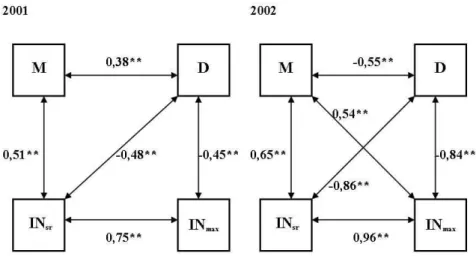
Correlation coefficients were used to determine which grain filling pa-rameter had more influence on final grain dry weight. In unfavorable environment correlations between final grain dry weight and the duration and average rate of grain filling were positive. Extra early genotypes and NS cultivars had the highest final grain dry weights, and the grains of late genotypes were the lightest. In an environment common for our region final grain dry weight was positively corre-lated with the average and maximum rates and negatively correcorre-lated with the dura-tion of grain filling. The highest final grain dry weights had the medium late and control group, and the lighest grains had extra early genotypes. Regardless of envi-ronments, rate and duration of grain filling are negatively correlated, similar to results obtained by several authors (eg. KOBILJSKI et al., 2000). Correlation coeffi-cients of maximum and average grain filling rate are positive (Figure 1).
Figure 1. Correlation coefficients between observed final grain dry weight (M), grain filling duration (D), maximum grain filling rate (INmax) and average grain filling rate (INsr) for all
analysed genotypes in 2001 and 2002 (** significant at 0,01 level of probability)
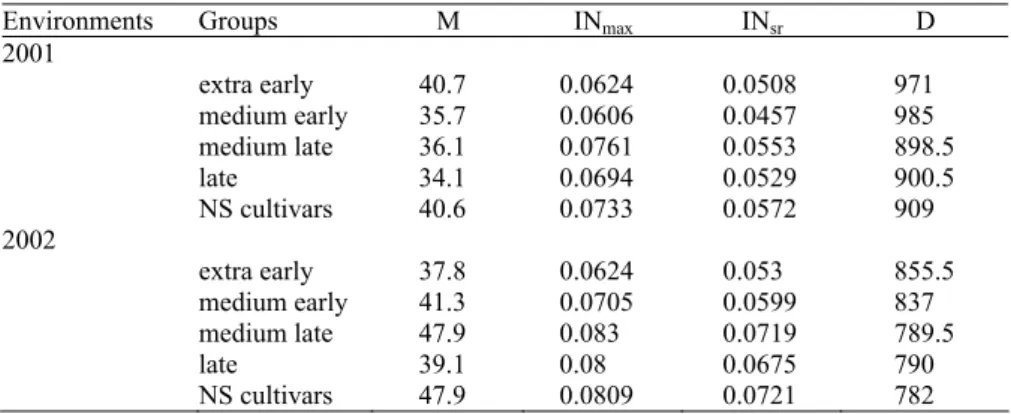
very high rates of grain filling. In our conditions extra earliness is not recom-mended: extra early genotypes are the only group whose grain filling rate was not increased in the next season by shorter grain filling caused by rapid accumulation of thermal units (Table 2).
Table 2. Observed final grain dry weight M (mg), maximum grain filling rate INmax (mg dm °C-1 grain-1), average grain filling rate INsr (mg dm °C-1 grain-1) and grain filling duration (gdd) in four groups of genotypes of different earliness and control group of high
yielding NS cultivars
Environments Groups M INmax INsr D
2001
extra early 40.7 0.0624 0.0508 971
medium early 35.7 0.0606 0.0457 985
medium late 36.1 0.0761 0.0553 898.5
late 34.1 0.0694 0.0529 900.5
NS cultivars 40.6 0.0733 0.0572 909
2002
extra early 37.8 0.0624 0.053 855.5
medium early 41.3 0.0705 0.0599 837
medium late 47.9 0.083 0.0719 789.5
late 39.1 0.08 0.0675 790
NS cultivars 47.9 0.0809 0.0721 782
It seems that the average grain filling rate is more important parameter for describing grain filling than the maximum one. Average grain filling rate was positively correlated with final grain dry weight in both environments. Also, the genotype Bankut 1205 had the highest maximum and the lowest average grain filling rate in group of medium late genotypes in both environments, contrary to usual positive link of those two parameters. It is probably connected with sudden leaf area loss and results in lightest grains in group. In addition, control group had the highest average grain filling rate in both environments and the lowest differ-ence between maximum and average grain filling rate in group of genotypes with short dry matter accumulation (medium late, late, NS cultivars) (Table 2). This indicated that, for high final grain dry weight, besides high grain filling rate, of great significance is the graduation of dry matter accumulation.
Because of importance of avoiding terminal dry and temperature stress, and need to provide enough time for grain filling, medium earliness is in our envi-ronment recommended for achievement of high grain dry weight. This indicates relatively short grain filling with high rate.
Received November 30th, 2004. Accepted December 27th, 2004.
REFERENCES
AL KHATIB K. and PAULSEN G. M. (1984): Mode of high temperature injury to wheat during grain development. Physiol. Plantarum, 61, 363-368.
BRUCKNER P.L. and FROHBERG R. C. (1987): Rate and duration of grain fill in spring wheat. Crop Sci., 27, 451-455.
CALDERINI D.F. and REYNOLDS M.P. (2000): Changes in grain weight as a consequence of de-graining treatments at pre and post anthesis in synthetic hexaploid lines of wheat (Ttiticum durum x T. tauschii). Aust. J. Plant Physiol., 27, 183-191.
CALDERINI D.F., R. SAVIN, L.G. ABELEDO, M.P. REYNOLDS, and G.A. SLAFER (2001): The importance of the period immediately preceding anthesis for grain weight determination in wheat. Euphytica, 119, 199-204.
DARROCH B.A. and R.J. BAKER (1990): Grain filling in three spring wheat genotypes: statistical analysis. Crop Sci., 30, 525-529.
DUGUID S.D. and A.L. BRÛLÉ BABEL (1994): Rate and duration of grain filling in five spring wheat (Triticum aestivum L.) genotypes. Can. J. Plant Sci., 74, 681-686.
GEBEYEHOU G., D.R. KNOTT, and R.J. BAKER (1982): Rate and duration of grain filling in durum wheat cultivars. Crop Sci., 22, 337-340.
HADŽIVUKOVIĆ S. (1991): Statistički metodi s primenom u poljoprivrednim i biološkim istraživan-jima. Drugo prošireno izdanje. Poljoprivredni fakultet, Institut za ekonomiku poljoprivrede i sociologiju sela, Novi Sad. AS IMPEX, Novi Sad, Šumadijska 10.
HOUSLEY T.L., A.W. KIRLEIS, H.W. OHM, and F.L. PATTERSON (1982): Dry matter accumula-tion in soft red winter wheat seeds. Crop Sci., 22, 290-294.
JOHNSON R.C. and E.T. KANEMASU (1983): Yield and development of winter wheat at elevated temperatures. Agron. J., 75, 561-656.
KOBILJSKI B. and S. DENČIĆ (1998): Relationship between agronomic traits in wheat under prean-thesis and postanprean-thesis drought and heat stress. Proceedings of 2nd Balkan Symposium on Field Crops, Vol. 1: Genetics & Breeding, 91-94.
KOBILJSKI B., S. DENČIĆ i M. IVEGEŠ (2000): Varijabilnost dužine i intenziteta nalivanja zrna i mogućnosti njenog korišćenja u oplemenjivanju pšenice. Selekcija i semenarstvo, 7 (3-4), 47-53.
MOU B., W.E. KRONSTAD, and N.N. SAULESCU (1994): Grain filling parameters and protein con-tent in selected winter wheat populations: II. Associations. Crop Sci., 34, 838-841.
SIDDIQUE K.H.M., E.J.M. KIRBY, and M.W. PERRY (1989): Ear : stem ratio in old and modern wheat varieties. Relationship with improvement in number of grains per ear and yield. Field Crops Res., 21, 59-78.
SPIERTZ J.H.J., B.A. TENNHAG, and L.J.P. KUPERS (1971): Relation between green area duration and grain yield in some varieties of spring wheat. Neth. J. Agric. Sci., 19, 211-222.
VAN SANFORD D.A. (1985): Variation in kernel growth characters among soft red winter wheats. Crop Sci., 25, 626-630.
WARDLAW I.F. and L. MONCUR (1995): The response of wheat to high temperature following an-thesis. I. The rate and duration of kernel filling. Aust. J. Plant Physiol., 22, 391-397. WHAN B.R., G.P. CARLTON, and W.K. ANDERSON (1996): Potential for increasing rate of grain
EKSPERIMENTALNO UTVRĐENA DUŽINA TRAJANJA, PROSEČNI I MAKSIMALNI INTENZITET NALIVANJA ZRNA GENOTIPOVA
PŠENICE RAZLIČITE RANOSTASNOSTI
Milka BRDAR1, Marija KRALJEVIĆ BALALIĆ2 i Borislav KOBILJSKI3
1
stipendista Ministarstva za nauku i zaštitu životne sredine, Divnina Babe 8, 21000 Novi Sad, Stevana
2
Poljoprivredni fakultet, Univerzitet u Novom Sadu, 21000 Novi Sad, Trg D. Obradovića 8
3
Naučni institut za ratarstvo i povrtarstvo, 21000 Novi Sad, Maksima Gorkog 30
I z v o d
Prinos zrna pšenice (Triticum aestivum L.) je delom uslovljen krajnjom masom suvog zrelog zrna, koja je u velikoj meri određena intenzitetom i dužinom trajanja procesa nalivanja zrna. Cilj istraživanja je poređenje eksperimentalno ut-vrđene krajnje mase suvog zrelog zrna 5 grupa genotipova pšenice različite ranostasnosti (ekstra rane, srednje rane, srednje kasne, kasne i kontrolna grupa naj-prinosnijih NS sorti) sa eksperimentalno utvrđenim prosečnim i maksimalnim intenzitetom, te dužinom trajanja nalivanja zrna u različim uslovima sredine. Ko-relacioni koeficijenti su upotrebljeni u pokušaju da se odredi koji parametar nali-vanja zrna ima veći uticaj na krajnju masu suvog zrelog zrna. U kod nas uobič a-jenim uslovima sredine (2002.) je krajnja masa suvog zrelog zrna bila u jakim pozitivnim vezama sa prosečnim i maksimalnim intenzitetom i u jakoj negativnoj vezi sa dužinom trajanja nalivanja zrna. Najveće krajnje mase suvih zrelih zrna postigli su srednje kasni i genotipovi kontrolne grupe. Korelacije između krajnje mase suvog zrelog zrna i dužine trajanja, te prosečnog intenziteta nalivanja zrna su bile značajno pozitivne u nepovoljnim uslovima sredine (2001.). Novosadske sorte i ekstra rani genotipovi su imali najveće mase suvih zrelih zrna. Intenzitet i dužina trajanja nalivanja zrna su obično u negativnoj korelaciji. Uticaj parametara nali-vanja zrna na krajnju masu suvog zrelog zrna nije jednak u različitim uslovima sredine, tako da bi mogla biti bitnija sposobnost genotipa da u nepovoljnim us-lovima sredine niske intenzitete nalivanja zrna nadomesti produženjem akumu-lacije suve materije. Za opisivanje ovih procesa bi prosečni intenzitet nalivanja zrna mogao biti važniji parametar od maksimalnog.