Depression, stress and guilt are linked to the risk of
suicide associated to ectopic pregnancy
Gláucia Rosana Guerra BenuteI,II, Debora Cristina Nozzella BordiniI,II, Thiago Robles JuhasI, Fabio Roberto CabarII,
Pedro Paulo PereiraII, Mara Cristina Souza de LuciaI, Rossana Pulcineli Vieira FranciscoII
DOI: 10.5935/MedicalExpress.2016.03.07
I Universidade de São Paulo, Faculdade de Medicina, Hospital das Clínicas, Divisão de Psychology, São Paulo, SP, Brazil II Universidade de São Paulo, Faculdade de Medicina, Departmento de Obstetrícia e Ginecologia, São Paulo, SP, Brazil
OBJECTIVE: To identify the risk for suicidal behavior in women who had a fetal loss resulting from ectopic pregnancy and verify the association of suicide risk with depression and psychosocial aspects.
METHODS: Thirty-one women diagnosed with an ectopic pregnancy were interviewed. Major depression was identiied using the Primary Care Evaluation of Mental Disorders questionnaire. The Prenatal Psychosocial Proile questionnaire was used to measure stress, social support and self-esteem.
RESULTS: We found that 16% (n = 5) reported suicide risk behavior. The correlation between suicide risk and symptoms of major depression, stress and guilt was statistically signiicant.
CONCLUSIONS: Depression and stress have been linked to the presence of suicide risk, further increasing the vulnerability of women with ectopic prgnancy, which generates intense emotional reactions as guilt.
KEYWORDS: Ectopic Pregnancy, Risk of suicide, Depression, Stress, Guilt.
Benute GRG, Bordini DCN, Juhas TR, Cabar FR, Pereira PP, Lucia MCS, Francisco RPV. Depression, stress and guilt are linked to the risk of suicide associated to ectopic pregnancy. MedicalExpress (São Paulo, online). 2016;3(3):M160307
Received for Publication on February 26, 2016; First review on March 16, 2016; Accepted for publication on April 22, 2016; Online on May 15, 2016
E-mail: [email protected]
■
INTRODUCTIONSuicide is understood as the human act of putting an end to one’s life1 and is recognized worldwide as a public health problem.2 Epidemiologic data show that one million people committed suicide in 2000, and WHO3 points to 900.000 suicides in 2003, that is, one death every 35 seconds. It is estimated that 1.53 million people will kill themselves in 2020.4
Although suicide ideation is an important factor in suffering, few studies have addressed the issue, especially in the reproductive context.5 It is estimated that a quarter of the pregnant population will attempt suicide and that 33% of the suicidal cases are associated with a depression diagnosis.6,7
An ectopic pregnancy (EP) is defined as the im -plantation and development of an egg outside the uterine cavity, most often in the fallopian tubes.8 The occurrence of EP rose 6% between the 1970s and the 1990s. In the
latter decade, the incidence of EP approximated 20:1000 pregnancies.9
Farhiet al10 carried out a prospective study designed to calculate suicide attempt and suicide mortality rates by analyzing the medical histories of 160 primiparas who underwent a surgical procedure for EP. They found that 6 women attempted suicide in the 12 months following surgery, and one of them actually killed herself. The authors discuss that an EP may produce changes in one’s self-image, persistent trauma, and uncertainty related to future pregnancies, all of which are factors that contribute directly to a suicide attempt or act.
Thus, suffering is necessarily a key dimension in suicidal behavior.11 Despite the relevance of the data, to the best of our knowledge, no subsequent studies have been reported.
family and/or friends. Using a six-point scale from 1 (very dissatisfied) to 6 (very satisfied), first they rate the support they receive from their partners and then from others. The overall score range is 11-66 for each of the support subscales.
A psychologist carried out a qualitative analysis of the responses to determine the basis for the women’s feelings about modes of birth, using a context analysis technique. This involves transforming a qualitative evaluation into a quantitative analysis. Content analysis of the semi-structured interviews provided a list of repeated themes, which were then used to organize the findings. The database was codified, and the answers from the interviews were translated by means of transversal analysis. It then became possible to categorize answers, and categories could be described quantitatively. No topic could fall into more than one category, and no woman could be coded twice for the same topic.18
Data were analyzed using the Statistica19 program for Windows (Release 4.3, Statsoft, Inc., 1993) and were reported as mean and standard deviation. Student’s t-test was used to compare the groups with or without risk of suicide. Categorical data were compared using the chi-squared test or the Fisher exact test where appropriate. The level of significance was set at p < 0.05 for all analyses.
■
RESULTSIn the current study, it was found that 16% (n = 5) of the participants reported thinking they would rather die or hurt themselves somehow. Such thoughts specifically point to a risk for suicide.
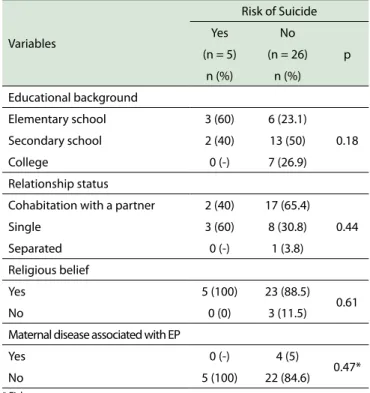
The results are displayed in the tables below and the data are divided into those from pregnant women at risk for suicide and those from pregnant women without such a risk. Table 1 shows that no statistical significance was found between the sociodemographic characteristics and the suicide risk.
Table 2 shows that the correlation between suicide risk and symptoms characteristic of major depression was statistically significant in terms of diminishing interest in daily activities (p ≤ 0.01), feelings of helplessness or guilt (p = 0.04), and diagnosis of major depression (p = 0.04).
As shown in Table 3, stress as measured by the Prenatal Psychosocial Profile was statistically significant (p = 0.05) when correlated with the groups of women at risk or not for suicide.
■
DISCUSSIONSuicidal behavior has a multifactorial etiology involving a series of complex phenomena with biological, genetic, social, psychological, cultural, and environmental elements related to the personal and/or collective life. It comprises ideation, attempt, and suicide itself.20
■
MATERIALS AND METHODSThis study has an exploratory descriptive design. The research was carried out at the largest public university hospital in Brazil, in the city of São Paulo (population: 10.9 million).
Thirty-one women with a diagnosis of Ectopic pregnancy were invited to participate in the study, which used a convenience design. The hospital research and ethics committee approved the study before enrollment (case #287/09). All participants were informed that their participation in the research was voluntary and that their names would remain confidential. They were assured their decision regarding whether or not to participate would have no effect on the quality of care they would receive. Written consent was obtained before conducting the interviews.
A questionnaire-based, semi-directed interview was conducted for data collection. The first part of the questionnaire included the collection of sociodemographic data [age (years), schooling (elementary and secondary education, complete/incomplete higher education), marital status (married or in a stable relationship, single, and separated)].
The interviewees averaged 28.9 ± 5.4 years of age: 48.4% had finished high school, 61.3% were in a stable relationship, 87.1% held a paid job and 96.8% had religious beliefs.
Table 1 - Association of sociodemographic characteristics with the presence or absence of suicide risk in women with ectopic pregnancy
Variables
Risk of Suicide
Yes No
p (n = 5) (n = 26)
n (%) n (%)
Educational background
Elementary school 3 (60) 6 (23.1)
0.18 Secondary school 2 (40) 13 (50)
College 0 (-) 7 (26.9)
Relationship status
Cohabitation with a partner 2 (40) 17 (65.4)
0.44 Single 3 (60) 8 (30.8)
Separated 0 (-) 1 (3.8)
Religious belief
Yes 5 (100) 23 (88.5)
0.61
No 0 (0) 3 (11.5)
Maternal disease associated with EP
Yes 0 (-) 4 (5)
0.47*
No 5 (100) 22 (84.6)
* Fisher
Table 2 - Depressive symptoms and diagnosis of major depression in association with presence or absence of suicide risk in women with ectopic pregnancy
Depressive Symptoms
Risk of Suicide
Yes No
p (n = 5) (n = 26)
n (%) n (%)
Insomnia or hypersomnia 3 (60) 14 (53.8) 0.59*
Fatigue or loss of energy 3 (60) 16 (61.5) 0.65*
Decreased or increased appetite 3 (60) 12 (46.2) 0.46*
Diminished interest in daily activities 5 (100) 5 (19.2) < 0.01*
Depressed mood 4 (80) 9 (36) 0.09*
Feelings of helplessness or guilt 2 (40) 7 (26.9) 0.04*
Diminished ability to think or concentrate 2 (40) 11 (42.3) 0.65*
Psychomotor agitation or retardation 4 (80) 11 (42.3) 0.14*
Diagnosis of major depression 4 (80) 7 (26.9) 0.04*
* Fisher
Some authors questions21,22 the available epidemio-logic data on suicide because of frequent underreporting; termination of life coded as the cause of death in death certi-ficates possibly occurs two to three times less than the actual number of suicides.23 In terms of suicide attempts, some go as far as stating that at least a tenfold increase in estimates would be more realistic.21-25
The percentage of women with self-destructive thoughts during pregnancy and the puerperium varies from 2.7% to 14%.26 Gentili25 emphasizes that suicide attempts by women without any complicating conditions are linked to (a) unplanned and unwanted pregnancy, (b) unfavorable socioeconomic conditions, (c) presence of symptoms of anxiety and/or depression, (d) not living with their partners. Fonseca-Machado et al27 associated suicidal ideation during pregnancy with depression. Silva et al.28 found that suicide risk factors in pregnant women with a diagnosis of depression include anxiety, the thought of abortion and partner absence. Studies dealing with suicide ideation in high-risk pregnant women are scarce.
A study conducted with 268 pregnant women with complicating conditions and/or obstetric disorders, including high blood pressure (preeclampsia and/or chronic high blood pressure), cardiopathy, diabetes mellitus, collagenosis, and risk for preterm labor, found that 5% of the study population reported suicide ideation and that 71.4% of the suicidal group had a diagnosis of depression.29
This study found a high rate (16%) of ideations that it would be better to die or somehow hurt oneself, which is indicative of a specific risk for suicide. A study conducted using the PRIME-MD to interview pregnant women with complicating conditions at the same health center as the one in this study found that 5% of the study population was at risk for suicide.5
Reported global rates for suicide ideation and attempt during a pregnancy without complicating conditions are in the 2.7%-9,2% range. And in the 14% range in the pos-tpartum.26-29 Therefore, the suicide risk found in the current study of 16% for women who were given a diagnosis of ectopic pregnancy must be considered as high. These data indicate the need for the performance of precise evaluations focused on the mental health of pregnant women diagnosed with the condition.
A qualitative study26 carried out in 1996 with 7 women to describe the experience of fetal loss resulting from EP found that the medical diagnosis was followed by intense mental suffering, triggering feelings of guilt and anguish, which lasted upwards of 2 years. The women had great difficulty mourning their loss, for there are no parting rituals in such cases, which hinders perception of one’s body image and maternal role.
Scores from Prenatal Psychosocial Proile Mean (SD) (n= 31) n (%)
Risk of Suicide
Yes (n= 5) No (n= 26) p
Score of Stress 22.5 (3.2)
0.05*
Yes 18 (58.1) 5 (100%) 13 (50%)
Partner’s support 51.9 (11.9)
0.08* Dissatisfaction with partner’s support 13 (41.9) 4 (80%) 9 (34.6%)
Support from other people 52.4 (13.8)
0.65* Dissatisfaction with support from other people 13 (41.9) 2 (40%) 11 (42.3%)
Self-esteem 24.8 (2.5)
0.14* Low levels of self-esteem 15 (48.4) 4 (80%) 11 (42.3%)
Table 3 - Association of Prenatal Psychosocial Proile scores of stress, support from partner, support from others, and self-esteem with the presence or absence of suicide risk in women with ectopic pregnancy.
* Fisher
In the analysis of depressive symptomatology, the current study showed that the symptoms of lessening of interest in daily activities and feelings of helplessness or guilt were linked to suicide risk. Guilt is a feeling which is present in fetal loss, regardless of the kind of abortion that takes place.32 It is felt as a result of the deviation from established behavior patterns. It stems from one’s feeling of unacceptability.33
Fetal loss may be understood as a deviation from established social behavior patterns. Despite cultural changes and the shifting position of women in the labor market, society still perceives maternity as inherent to women. Thus, depression and the risk for suicide may derive from the departure from such inner needs, which generates intense emotional reactions.34
As with depression, stress has been linked to the presence of suicide risk, further increasing the vulnerability of women with EP. A longitudinal study which evaluated women 16 years after they had EP observed a long-term emotional impact resulting from the losses they experienced. Even though 16 years had elapsed, two women still mourned the loss. It was also found that EP had been a traumatic experience which strained affective relationships and triggered faith crises.35
Further studies concerning pregnancy losses will be able to provide additional evidence of the recurrent nature of such a phenomenon and enable women’s health to be understood as involving mental suffering, thus allowing for the development of new public health policies.
The high rates found in this study, whether of suicide risk or major depression, suggest the importance of detection, evaluation, and early diagnosis of depression and suicide risk in women with an ectopic pregnancy.
■
AUTHOR PARTICIPATIONBenute GRG planned the project, performed the research, participated in writing the article and approved
approved the final text; Pereira PP performed gynecological evaluation of patients, participated in the writing of the manuscript and approved final text; de Lucia MC was responsible for the execution of the psychological testing of patients and approved final manuscript; Francisco RPV
participated in the planning of the project, supervised gynecological care of the patients, participated in the writing of the manuscript and gave approval to the final text.
■
CONFLICT OF INTERESTAuthors declare no conflict of interest associated to this project.
DEPRESSÃO, ESTRESSE E CULPA LIGAM-SE AO RISCO DE SUICÍDIO ASSOCIADO À GESTAÇÃO ECTÓPICA
OBJETIVO: identificar o risco de comporta
-mento suicida em mulheres que apresentaram perda
fetal resultante de gestação ectópica e verificar a as -sociação entre risco suicida com depressão e aspectos psicológicos.
MÉTODO: Trinta e uma mulheres diagnosticadas
com gestação ectópica foram entrevistadas. Diagnóstico
de Depressão maior foi identificado através do questio -nário Primary Care Evaluation of Mental Disorders. O
questionário Prenatal Psychosocial Profile foi utilizado
para avaliação de estresse, suporte social e auto-estima.
RESULTADOS: Foi encontrado índice de16%
(n = 5) de mulheres que reportaram risco de com-portamento suicida. A correlação entre risco suicida e sintomas de depressão maior, estresse e culpa foi
estatisticamente significante.
CONCLUSÃO: Depressão e estresse estiveram
aumen-17. Curry MA, Campbell RA, Christian M. Validity and reliability testing of
the Prenatal Psychosocial Profile. Res Nurs Health. 1994;17(2):127-35.
http://dx.doi.org/10.1002/nur.4770170208
18. Elo S, Kyngäs H. The qualitative content analysis process. J Adv Nurs. 2008;62(1):107-15. http://dx.doi.org/10.1111/j.1365-2648.2007.04569.x.
19. Statistica. Release 4.3 ed. StatSolft, Inc. 1993.
20. Mark L, Samm A, Tooding LM, Sisask M, Aasvee K, Zaborskis A, et al. Suicidal ideation, risk factors, and communication with parents. Crisis. 2013;34(1):3-12. http://dx.doi.org/10.1027/0227-5910/a000153 21. Marín-León L, Barros MBA. Suicide mortality: gender and socioeconomic
differences. Rev Saúde Pública. 2003;37(3):357-63. http://dx.doi. org/10.1590/S0034-89102003000300015.
22. Meneghel SN, Victora CG, Faria NMX, Carvalho LA, Falk JW. Carac-terísticas epidemiológicas do suicídio no Rio Grande do Sul. Rev Saúde Pública. 2004;38(6):804-10. http://dx.doi.org/10.1590/S0034-89102004000600008.
23. Holinger PC. Violent deaths in the United States: an epidemiologic study of suicide, homicide, and accidents. New York: Guilford Press; 1987.
24. Botega NJ, Marín-León L, Oliveira HB, Barros MB, Silva VF, Dalgalarrondo P. Prevalence of suicidal ideation, suicide plans, and attempted suicide: a population-based survey in Campinas, São Paulo State, Brazil. Cad Saude Publica. 2009;25(12):2632-8. http://dx.doi. org/10.1590/S0102-311X2009001200010.
25. Gentile S. Suicidal mothers. J InjViolence Res. 2011;3(2):90-7. http:// dx.doi.org/10.5249/jivr.v3i2.98.
26. Gausia K, Fisher C, Ali M, Oosthuizen J. Antenatal depression and suicidal ideation among rural Bangladeshi women: a community-based study. Arch Womens Ment Health. 2009;12(5):351-8. http://dx.doi. org/10.1007/s00737-009-0080-7
27. Fonseca-Machado MO, Alves LC, Haas VJ, Monteiro JCS, Gomes-Sponholz F. Sob a sombra da maternidade: gravidez, ideação suicida e violência por parceiro íntimo. Rev Panam Salud Publica. 2015; 37(4/5):258-64.
28. Silva RA, Ores LC, Jansen K, Moraes IGS, Souza LDM, Magalhães P, et al. Suicidality and associated factors in pregnant women in Brazil. Community Ment. Health J. 2012;48:392-395. http://dx.doi. org/10.1007/s10597-012-9495-0
29. Benute GR, Nomura RM, Reis JS, Fraguas Junior R, Lucia MC, Zugaib M. Depression during pregnancy in women with a medical disorder: risk factors and perinatal outcomes. Clinics (Sao Paulo). 2010;65(11):1127-31. http://dx.doi.org/10.1590/S1807-59322010001100013. 30. Pinheiro RT, da Silva RA, Magalhães PV, Horta BL, Pinheiro KA.
Two studies on suicidality in the postpartum. Acta Psychiat Scand. 2008;118(2):160-3. http://dx.doi.org/10.1111/j.1600-0447.2008.01184.x
31. Schetter CD, Tanner L. Anxiety, depression and stress in pregnancy: implications for mothers, children, research, and practice. CurrOpinPsychiatry. 2012;25(2):141-8. http://dx.doi.org/10.1097/ YCO.0b013e3283503680
32. Gurpegui M, Jurado D. Psychiatric complications of abortion. Cuad Bioet. 2009;20(70):381-92.
33. Broen AN, Moum T, Bødtker AS, Ekeberg O. The course of mental health
after miscarriage and induced abortion: a longitudinal, five-year
follow-up study. BMC Med. 2005;3:18. http://dx.doi.org/10.1186/1741-7015-3-18
34. Blom EA, Jansen PW, Verhulst FC, Hofman A, Raat H, Jaddoe VW, et al. Perinatal complications increase the risk of postpartum depression. The Generation R Study. BJOG. 2010;117(11):1390-8. http://dx.doi. org/10.1111/j.1471-0528.2010.02660.x
35. Schaper AM, Hellwig MS, Murphy P, Gensch BK. Ectopic pregnancy loss during fertility management. West J Nurs Res. 1996;18(5):503-17. http://dx.doi.org/10.1177/019394599601800503
ectópica, o que gera reações emocionais intensas como a culpa.
PALAVRAS-CHAVE: Gestação Ectópica, Risco de
suicídio, Depressão, estresse, Culpa.
■
REFERENCES1. Prieto D, Tavares M. Risk factors for suicide and suicide attempt: incidence, stressful events and mental disorders J Bras Psiquiatr. 2005;54(2):146-54.
2. World Health Organization. Multisite Intervention Study on Suicidal Behaviours SUPRE-MISS: Protocol of SUPRE-MISS. Geneva. 2002. 3. World Health Organization. Suicide prevention: facing the challenges,
building solutions. WHO European Ministerial Conference on Mental Health. 2002.
4. Souza VS, Alves MS, Silva LA, Lino DCSF, Nery AA, Casotti CA. Suicide attempts and suicide mortality in a countryside Bahia city J. bras. psiquiatr. 2011;60(4):294-300. http://dx.doi.org/10.1590/S0047-20852011000400010.
5. Benute GR, Nomura RM, Jorge VM, Nonnenmacher D, Fráguas Junior R, Lucia MC, et al. Risk of suicide in high risk pregnancy: an exploratory study. Rev Assoc Med Bras. 2011;57(5):583-7. http:// dx.doi.org/10.1590/S0104-42302011000500019.
6. Newport DJ, Levey LC, Pennell PB, Ragan K, Stowe ZN. Suicidal ideation in pregnancy: assessment and clinical implications. Arch Womens Ment Health. 2007;10(5):181-7. http://dx.doi.org/10.1007/s00737-007-0192-x 7. Barraclough B, Bunch J, Nelson B, Sainsbury P. A hundred cases of
suicide: clinical aspects. Br J Psychiatry 1974;125:355-73. http:// dx.doi.org/10.1192/bjp.125.4.355
8. Cabar FR, Pereira PP, Zugaib M. Intrauterine pregnancy after salpingectomy for tubal pregnancy due to emergency contraception: a case report. Clinics (Sao Paulo). 2007;62(5):641-2. http://dx.doi. org/10.1590/S1807-59322007000500018
9. Barnhart KT. Ectopic pregnancy. N Engl J Med. 2009;361:379-387. http://dx.doi.org/10.1056/NEJMcp0810384
10. Farhi J, Ben-Rafael Z, Dicker D. Suicide after ectopic pregnancy. N Engl J Med. 1994;330(10):714. http://dx.doi.org/10.1056/ NEJM199403103301013
11. Conte M, Meneghel SN, Trindade AG, Ceccon RF, Hesler LZ, Cruz CW, et al. Suicide Prevention Program: case study in a municipality in the south of Brazil. Cien Saude Colet. 2012;17(8):2017-26. http://dx.doi. org/10.1590/S1413-81232012000800013.
12. Fraguas R Jr, Henriques SG Jr, De Lucia MS, Iosifescu DV, Schwartz FH, Menezes PR, et al. The detection of depression in medical setting: a study with PRIME-MD. J Affect Disord. 2006;91(1):11-7. http://dx.doi. org/10.1016/j.jad.2005.12.003
13. Spitzer RL, Williams JB, Kroenke K, Hornyak R, McMurray J. Validity and utility of the PRIME-MD patient health questionnaire in assessment of 3000 obstetric-gynecologic patients: the PRIME-MD Patient Health Questionnaire Obstetrics-Gynecology Study. Am J Obstet Gynecol. 2000;183(3):759-69. http://dx.doi.org/10.1067/mob.2000.106580 14. Andersson L, Sundström-Poromaa I, Wulff M, Aström M, Bixo M.
Neonatal outcome following maternal antenatal depression and anxiety: a population-based study. Am. J. Epidemiol. 2004;159(9):872-81. http://dx.doi.org/10.1093/aje/kwh122
15. Andersson L, Sundström-Poromaa I, Bixo M, Wulff M, Bondestam K, Ström M. Point prevalence of psychiatric disorders during the second trimester of pregnancy: a population-based study. Am J Obstet Gynecol. 2003;189(1):148-154. http://dx.doi.org/10.1067/mob.2003.336 16. Lima E, Silva J, Ferreira EF, Medeiros M, Araújo ML, Silva AG, et al.