Polymorphism in the lymphotoxin-alpha gene,
position +252 (rs909253), is not associated with
preeclampsia development in Brazilian women
Polimorfismo no gene da linfotoxina alfa, posição +252
(rs909253), não está associado com o desenvolvimento
de pré-eclâmpsia em mulheres brasileiras
Cristina Wide Pissetti1
thiago Mantello BianCo2
sarah Cristina sato Vaz tanaka2
sueli riulda silVa3
Marly aPareCida sPadotto Balarin4
Abstract
PURPOSE: To investigate the frequencies of polymorphic allele and genotypes for the LT-α gene, position +252 (rs909253), in Brazilian women with preeclampsia. METHODS: This is a case-control study, in which 30 women with preeclampsia, classiied according to the criteria of the National High Blood Pressure Education Program, and 115 women in the control group, with at least two healthy pregnancies, were selected. Peripheral blood was collected, and DNA was extracted, followed by genotyping, using speciic primers and restriction analysis. The genotypes obtained were AA, AG and GG. Statistical analysis was performed using the χ2 association test. The Hardy-Weinberg
Equilibrium was tested using the Haploview Program. RESULTS: The results showed no association between genotypes and preeclampsia development (χ2=2.0; p=0.4). When the AG and GG genotypes were grouped according to allele
G presence or absence (genotype AA), the data showed that the presence of allele G was not signiicantly different between cases (women with preeclampsia) and controls (χ2=0.0; p=1.0). The LT-α gene polymorphism, position +252
(rs909253), seems not to be an important candidate for the development of preeclampsia. Other inlammatory genes should be researched, and studies involving gene-environment interactions should be performed, in order to reach a better understanding of the etiology of the preeclampsia.
Resumo
OBJETIVO: Investigar as frequências do alelo polimórico e genótipos para o gene da LT-α, posição +252 (rs909253), em mulheres brasileiras com pré-eclâmpsia. MÉTODOS: Trata-se de um estudo caso-controle, em que 30 mulheres com pré-eclâmpsia, classiicadas de acordo com os critérios do National High Blood Pressure Education Program, e 115 mulheres do grupo controle, com pelo menos duas gestações saudáveis, foram selecionadas. Amostra de sangue periférico foi colhida, e o DNA foi extraído, seguido pela genotipagem, usando iniciadores especíicos e análise de restrição. Os genótipos obtidos foram AA, AG e GG. A análise estatística foi realizada utilizando-se o teste de associação χ2. O Equilíbrio de Hardy-Weinberg foi testado com o auxílio do programa Haploview. RESULTADOS:
Os resultados não mostraram associação entre os genótipos e o desenvolvimento de pré-eclâmpsia (χ2=2,0; p=0,4).
Quando os genótipos AG e GG foram agrupados de acordo com a presença do alelo G ou ausência (genótipo AA), os dados mostraram que a presença do alelo G não foi signiicativamente diferente entre casos (mulheres com pré-eclâmpsia) e controles (χ2=0,0; p=1,0). O polimorismo no gene LT-α, posição +252 (rs909253), parece
não ser um importante candidato para o desenvolvimento de pré-eclâmpsia. Outros genes inlamatórios devem ser pesquisados, e estudos envolvendo interações gene-ambiente devem ser realizados para que se possa alcançar um melhor entendimento da etiologia da pré-eclâmpsia.
Discipline of Genetic, Instituto de Ciências Biológicas e Naturais, Universidade Federal do Triângulo Mineiro – UFTM – Uberaba (MG), Brazil.
1Health Attention Post-graduation Program, Universidade Federal do Triângulo Mineiro – UFTM – Uberaba (MG), Brazil. 2Health Sciences Post-graduation, Universidade Federal do Triângulo Mineiro – UFTM – Uberaba (MG), Brazil.
3Discipline of Gynecological and Obstetric Nursing, Universidade Federal do Triângulo Mineiro – UFTM – Uberaba (MG), Brazil. 4Discipline of Genetic, Universidade Federal do Triângulo Mineiro – UFTM – Uberaba (MG), Brazil.
Conlict of interests: none.
Keywords
Hypertension, pregnancy-induced Lymphotoxin-alpha Polymorphism, genetic Women’s healthy
Palavras-chave
Hipertensão induzida pela gravidez Linfotoxina-alfa Polimorismo genético Saúde da mulher
Correspondence Cristina Wide Pissetti Av. Gentúlio Guaritá, 107 Zip code: 38025-440 Uberaba (MG), Brazil
Received 07/17/2015
Accepted with modiications 08/18/2015
DOI: 10.1590/SO100-720320150005454
517 Polymorphism in the lymphotoxin-alpha gene, position +252 (rs909253), is not associated with preeclampsia development in Brazilian women
Rev Bras Ginecol Obstet. 2015; 37(11):516-9
Introduction
Preeclampsia (PE) is a pregnancy-speciic syndrome characterized by new-onset hypertension and proteinuria after 20th gestational week1. It is a major obstetric problem, leading to substantial maternal and perinatal morbidity and mortality worldwide, especially in developing countries2. The clinical spectrum of PE ranges from mild to severe3. The established risk factors include primiparity, previous preeclampsia, maternal pre-pregnancy high body mass index, multiple gestations, extremes of maternal age, and familial aggregation3,4. Family history of PE suggests a genetic predisposition5,6. It is widely accepted that PE does not follow a Mendelian inheritance, except in a few families6. Instead, PE is the result of complex interactions between the maternal and fetal genotypes and environment factors7. Although the disease has been recognized ever since antiquity to this date, the understanding of its causes is still limited, and PE is known as “the disease of theories”3. These theories are often ascribed to two opposing schools of thought: on one side, the ischemia-reperfusion leads to oxida-tive stress and vascular disease, and, on the other, PE is seen
as a maternal-paternal immune maladaptation8. A normal
pregnancy is accompanied by an inlammatory response, which is exaggerated in the case of PE, and it has been postulated that endothelial dysfunction can be part of this exacerbated
phenomenon9. The exaggerated inlammatory response to
pregnancy could be a condition occurring in genetically pre-disposed women10. Studies on PE have focused predominantly on genes of the renin-angiotensin, coagulation, and angiogenic pathways6. Genetic variants associated with maladaptation of the maternal immune response mediated by cytokines and components of the innate immune system have been targeted in recent investigations of genetic markers for detection of PE risk and severity involving primarily Caucasian populations11. Considering all these aspects, we could hypothesize that a variation in a gene that codiies an important inlammatory cytokine could be involved in the genesis of PE. Therefore, we chose the lymphotoxin-alpha (LT-α) gene as a candidate gene for this disease. The TNF and LTA genes are arranged in tandem within the major histocompatibility complex class III region on the short arm of chromosome 612,13. LT-α RNA was detected in both macrophage and non-macrophage populations in term decidua14. LT-α is a member of the tumor necrosis factor (TNF) superfamily that was originally thought to be functionally redundant to TNF, but these proteins were later found to have independent roles in driving lymphoid organogenesis15. LT-α regulates lymphoid organs in ontogeny by its production by lymphoid tissue inducer cells acting on stromal lymphoid tissue organizer cells by means of their induction of lymphoid chemokines and endothelial adhesion molecules during development. In the adult, LT maintains lymphoid organs through its production by T cells, B cells, and dendritic cells16. There are so far only few studies in the
literature about LT-α gene polymorphisms and development of PE12,13,17, none of them including the Brazilian population. The aim of this study was to investigate the frequencies of polymorphic alleles and genotypes for the LT-α gene, position +252 (rs909253), in Brazilian women with preeclampsia as compared to a control group. We hypothesized that patients that are homozygous for an LT-α gene polymorphism might be genetically predisposed to develop preeclampsia.
Methods
This was a case-control study. Women who volun-teered for the study (n=145) (age range 18–75; mean
37.6±12.34 years) were recruited at the Gynecology
and Obstetrics Clinic of the Hospital das Clínicas at Universidade Federal do Triângulo Mineiro (UFTM), Uberaba, Minas Gerais, Brazil. The sampling period was 2008 to 2014. All participants received an explanation about the research, after which they signed a written in-formed consent, previously approved by the UFTM Ethics Committee (Protocol number 1115-08). The study was conducted in accordance with the principles described in the WMA Declaration of Helsinki (2013).
The sample consisted of two groups: the patient group
(n=30) (age range 18–37; mean 26.36±6.5), comprising
pregnant women with preeclampsia diagnosed in accordance with the Report of the American National High Blood Pressure Education Program2, and the control group (n=115), comprising women without a history of preeclampsia or any other hypertensive episode during pregnancy (age range
18–75; mean 40.6±11.8), not necessarily pregnant at the
time of the study. From each woman, 20 mL of peripheral blood were collected.
The mass of red and white blood cells was submitted to osmotic lysis with Tris-EDTA lysis buffer (20:5) consisting of 1 M Tris-HCl and 0.5 M EDTA, pH 8. The samples were centrifuged at least three times at 13,346 g for 15 min. at controlled room temperature (approximately 27ºC). DNA was extracted using the phenol-chloroform method18. The samples were then resuspended in water, and the DNA was analyzed by electrophoresis on 1% agarose gel.
The presence of a polymorphism in the LT-α gene,
position +252 (rs909253), was veriied by PCR ampliica-tion followed by digesampliica-tion with the appropriate restricampliica-tion enzyme, as described previously19. PCR was carried out in a total volume of 30 μL containing 16 μL sterile and iltered Milli-Q water, 3.0 μL buffer without MgCl2 (Invitrogen),
1.8 μL 50 mM MgCl2 (Invitrogem), 2.0 μL 10 mMdNTPs
(Invitrogen), 1.0 μL of each primer (forward primer: CTC CTG CAC CTG CCT GGA TC; reverse primer: GAA GAG
ACG TTC AGG TGG TGT CAT) (Invitrogen), 0.20 μL
518
Pissetti CW, Bianco TM, Tanaka SC, Silva SR, Balarin MA
Rev Bras Ginecol Obstet. 2015; 37(11):516-9
of 20 mg/mL. The following PCR conditions were used: 5 min. at 95ºC for initial denaturation and 35 cycles at 95ºC for 1 min. (denaturation), 60ºC for 1 min. (primer annealing), and 72ºC for 1 min. (extension), followed by a inal extension step at 72ºC for 5 min.
Next, RFLP was performed using 0.1 μL NcoI (10 U/μL) (New England Biolabs), 1.5 μL REACT 3 buffer provided with the restriction enzyme, 10.5 μL sterile and iltered Milli-Q water, and 3.0 μL of the PCR product, in a inal volume of 12 μL. The samples were incubated overnight at controlled temperature (approximately 37ºC). The digestion products were analyzed on a 10% polyacrylamide gel. The LTA + 252A allele produces one fragment of 368 bp (base pair), whereas the LTA + 252G allele produces two fragments (235 and 133 bp, respectively). The heterozygous genotype presents three fragments: 368, 235 and 133 bp, respectively.
The Hardy-Weinberg Equilibrium (HWE) was ana-lysed using the χ2 test with the Haploview 4.2 program. A statistical power of 80.7% was tested using the G* Power program 3.1.9.2. Furthermore, a post hoc test with the total sample (n=145) was performed, with an effect size of 0.26 and an alpha signiicance level of 0.05. Genotype and allele frequencies were analyzed statistically by the χ2 test. The level of signiicance was set at 5% (p=0.05).
Results
A total of 145 women were included in the study — 115 (79,3%) in the control group and 30 (20,7%) in the preeclampsia patient group. The control group, with an
age range of 40.6±11.8, was composed of women with at
least two healthy children and hypertensive episode dur-ing the pregnancies, but who were not necessarily pregnant at the time of blood collection. The preeclampsia group, with an age range of 26.3±6.5, was composed of pregnant women with preeclampsia diagnosed according to the Report of the American National High Blood Pressure Education
Program2. In the control group, the average number of
pregnancies was 3.1±1.6, while in the preeclampsia group it was 1.7±1.0. With regard to the HWE, the control group was not in HWE (p<0.001), whereas the preeclampsia group was in HWE (p=1.0).
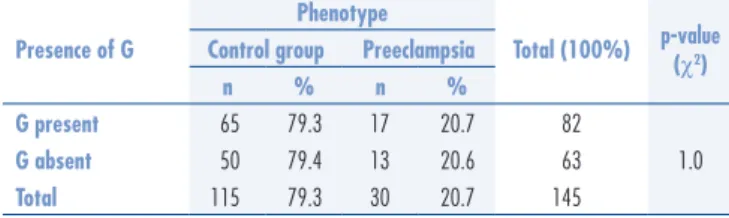
The frequencies of genotypes AA, AG, GG in the control and preeclampsia groups were analyzed and compared. Table 1 shows the distribution of the LT-α genotypes at position +252 (rs909253). No association was observed between genotypes and preeclampsia development (χ2=2.0; p=0.4). When the AG and GG genotypes were grouped as allele-G-present and the genotype AA as allele-G-absent, the results showed the presence of allele G was not signiicantly different between cases (women with preeclampsia) and controls (χ2=0.0; p=1.0) (Table 2). An odds ratio of 1.0 was observed for G presence (95%CI 0.4–2.2), which was statistically not signiicant.
Discussion
To our best knowledge, this is the irst study using LT-α
gene polymorphisms, position +252 (rs909253), in Brazilian women with preeclampsia. However, there are previous studies12,13,17 about the same issue in different populations.
The irst one was performed in a Dutch population and is a familial, case-control study. The authors did not ind any evidence of an association or linkage with familial preeclamp-sia12. Another study was performed in North American women (USA) with severe preeclampsia. It was a case-control study that analyzed the maternal and fetal genotype13, and did not observe an association with the polymorphism studied either. The third study genotyped 503 tagSNPs in 40 genes related
to inlammation and found that LT-α/TNF were associated
with PE in European Americans17. However, in this report, it was analyzed another LT-αgene polymorphism (rs2229094)17 instead of the one studied by us. Although there are some dif-ferences between the studies cited and ours, they all agree that there is no association between the respective polymorphism studied and the development of PE.
It is dificult to compare our results with those presented by Lachmeijer et al.12 because the strategy used was quite different. We performed a case-control study focusing a single polymorphism, while they analyzed a TNF-I haplo-type. The LT-α gene is located near the TNF gene, and the results presented by those authors include the LT-α gene, but in association with TNF (haplotype). Thus, although they suggest the absence of association with PE, we cannot say whose effect it is — of the TNF or of the LT-α gene.
Comparing our results with those of Livingston et al.13, we noticed some differences such as the selection of women with severe PE. In the current study, we did not categorize the PE according to its severity. We included women with
Presence of G
Phenotype
Total (100%) p-value (χ2)
Control group Preeclampsia
n % n %
G present 65 79.3 17 20.7 82
1.0
G absent 50 79.4 13 20.6 63
Total 115 79.3 30 20.7 145 Table 2. Allele G presence in women with and without preeclampsia
Table 1.LT-a genotypes, position +252, found in women with and without preeclampsia
Genotypes
Phenotype
p-value (χ2)
Control group Preeclampsia Total
n % n % n %
AA 65 79.3 17 20.7 82 56.6
0.4
AG 32 74.4 11 25.6 43 29.6
GG 18 90.0 02 10.0 20 13.8
519 Polymorphism in the lymphotoxin-alpha gene, position +252 (rs909253), is not associated with preeclampsia development in Brazilian women
Rev Bras Ginecol Obstet. 2015; 37(11):516-9
1. American College of Obstetricians and Gynecologists; Task Force on Hypertension in Pregnancy. Hypertension in pregnancy. Report of the American College of Obstetricians and Gynecologists’ Task Force on Hypertension in Pregnancy. Obstet Gynecol. 2013;122(5):1122-31.
2. Report of the National High Blood Pressure Education Program. Working group on high blood pressure in pregnancy. Am J Obstet Gynecol.2000;183(1):S1-S22.
3. Trogstad L, Magnus P, Stoltenberg C. Pre-eclampsia: risk factors and causal models. Best Pract Res Clin Obstet Gynaecol. 2011;25(3):329-42.
4. Hutcheon JA, Lisonkova S, Joseph KS. Epidemiology of pre-eclampsia and the other hypertensive disorders of pregnancy. Best Pract Res Clin Obstet Gynaecol. 2011;25(4):391-403.
5. Bezerra PC, Leão MD, Queiroz JW, Melo EM, Pereira FV, Nóbrega MH, et al. Family history of hypertension as an important risk factor for the development of severe preeclampsia. Acta Obstet Gynecol Scand. 2010;89(5):612-7.
6. Mütze S, Rudnik-Schöneborn S, Zerres K, Rath W. Genes and the preeclampsia syndrome. J Perinat Med. 2008;36(1):38-58. 7. Yong HE, Melton PE, Johnson MP, Freed KA, Kalionis B, Murthi P, et
al. Genome-wide transcriptome directed pathway analysis of maternal pre-eclampsia susceptibility genes. PLoS One. 2015;10(5):e0128230. 8. Sibai B, Dekker G, Kupferminc M. Pre-eclampsia. Lancet.
2005;365(9461):785-99.
9. Roberts JM, Hubel CA. Is oxidative stress the link in the two-stage model of pre-eclampsia? Lancet. 1999;354(9181):788-9. 10. Redman CW, Sacks GP, Sargent IL. Preeclampsia: an excessive
maternal inlammatory response to pregnancy. Am J Obstet Gynecol. 1999;180(2 Pt 1):499-506.
11. Best LG, Nadeau M, Davis K, Lamb F, Bercier S, Anderson CM. Genetic variants, immune function, and risk of pre-eclampsia among American Indians. Am J Reprod Immunol. 2012;67(2):152-9. 12. Lachmeijer AM, Crusius JB, Pals G, Dekker GA, Arngrímsson
R, ten Kate LP. Polymorphisms in the tumor necrosis factor and lymphotoxin-alpha gene region and preeclampsia. Obstet Gynecol. 2001;98(4):612-9.
13. Livingston JC, Park V, Barton JR, Elfering S, Haddad B, Mabie WC, et al. Lack of association of severe preeclampsia with maternal and fetal mutant alleles for tumor necrosis factor alpha and lymphotoxin alpha genes and plasma tumor necrosis factor alpha levels. Am J Obstet Gynecol. 2001;184(6):1273-7.
14. Vince G, Shorter S, Starkey P, Humphreys J, Clover L, Wilkins T, et al. Localization of tumour necrosis factor production in cells at the materno/fetal interface in human pregnancy. Clin Exp Immunol. 1992;88(1):174-80.
15. Upadhyay V, Fu YX. Lymphotoxin signalling in immune homeostasis and the control of microorganisms. Nat Rev Immunol. 2013;13(4):270-9. 16. Ruddle NH. Lymphotoxin and TNF: how it all began-a tribute to
the travelers. Cytokine Growth Factor Rev. 2014;25(2):83-9. 17. Harmon QE, Engel SM, Wu MC, Moran TM, Luo J, Stuebe AM,
et al. Polymorphisms in inlammatory genes are associated with term small for gestational age and preeclampsia. Am J Reprod Immunol. 2014;71(5):472-84.
18. Sambrook J, Fritsch EF, Maniatis T. Molecular cloning: a laboratory manual. New York: Cold Spring Harbor; 1989.
19. Warzocha K, Bienvenu J, Ribeiro P, Moullet I, Dumontet C, Neidhardt-Berard EM, et al. Plasma levels of tumour necrosis factor and its soluble receptors correlate with clinical features and outcome of Hodgkin’s disease patients. Br J Cancer. 1998;77(12):2357-62. References
mild to severe PE. Although this is an important issue to consider, their results did not differ from ours. Another point to take into account is that the populations were different in all the studies cited. It seems, however, that this did not inluence the association with PE.
On the other hand, Harmon et al.17 detected an
as-sociation between an LT-α gene polymorphism and PE
development, but the polymorphism analysed by them was different from the one analyzed here.
LT-α is related to the presence of a strong
inlam-matory proile and the induction of the generation of lymphoid chemokines and endothelial adhesion molecules during development. Although it would be expected that genetic variations in LT-α gene could contribute to the appearance of different phenotypes, our results were unable to show any difference between the two groups. Besides, we did not study other polymorphisms in the same gene that could contribute to PE development in this population. We are aware of the fact that our study suffers from some notable limitations, such as the lack of fetal DNA and the absence of data on the severity of the disease and the timing of clinical onset. These additional pieces of information may be important to detect some inluence of this polymorphism in the development of PE.
PE is a heterogeneous disease and may encompass a num-ber of distinct phenotypes with shared clinical presentation and with multiple manifestations. Its etiology is certain to be equally as complex. It is unlikely that a single causative gene exists. Rather, multiple maternal and fetal genes prob-ably interact with each other and with the environment to inluence the disease outcome17. The susceptibility to PE may also be the result of interactions between genetic susceptibility and exposure to environmental factors such as smoking, infections, nutrition or environmental toxi-cants17. Although the LT-α gene polymorphism, position +252 (rs909253), seems not to be a major candidate for the development of PE, other inlammatory genes should be investigated, and studies involving gene-environment interactions should be performed in order to reach a better understanding of the etiology of PE.
Acknowledgments
To Prof. Dr. Virmondes Rodrigues Jr. for providing
some reagents, and to Fundação de Amparo à Pesquisa do
Estado de Minas Gerais (FAPEMIG)