ORIGINAL ARTICLE DOI: 10.5007/1980-0037.2011v13n3p202
Abstract – A high prevalence of body image dissatisfaction has been observed among adolescents over the last decades. The aim of this study was to evaluate the association between body image dissatisfaction and demographic factors in adolescents. The sample consisted of 405 boys and girls (247 from an urban area and 158 from a rural area) aged 14 to 17 years enrolled in public schools of a small-sized municipality. The demographic variables analyzed were gender (male, female), age (14-15 years, 16-17 years), and area of residence (urban, rural). The perception of body image was evaluated using a igure rating scale. The prevalence of body image dissatisfaction was 56.5%. Both girls (26.5%) and boys (39.5%) wished to have a larger body silhouette. An association was observed between body image dissatisfaction and gender, with boys showing a 1.24 times higher chance (95%CI: 1.05-1.47) of body image dissatisfaction than girls. The prevalence of body image dissatisfaction is high even among adolescents from small-sized municipalities. Body image dissatisfaction is more prevalent among boys. Healthcare workers and teachers should be aware of the importance to encourage youngster to better understand themselves and their body and to relect about current body images.
Key words: Body image; Adolescents; Health; Social conditions.
Resumo – Nas últimas décadas, prevalências elevadas de insatisfação com a imagem corporal em adolescentes têm sido observadas. O presente estudo teve por objetivo veriicar a associação entre a insatisfação com a imagem corporal e os fatores demográicos em adolescentes. A amos-tra foi composta por 405 escolares (247 domiciliados na área urbana e 158 na rural), de ambos os sexos, de 14 a 17 anos, do ensino público de um município de pequeno porte. As variáveis demográicas analisadas foram sexo (masculino, feminino), idade (14-15 anos, 16-17 anos) e área de domicílio (urbana, rural). A percepção da imagem corporal foi avaliada por meio da escala de silhuetas corporais. A prevalência de insatisfação com a imagem corporal foi de 56,5%. Tanto os escolares do sexo feminino (26,5%) quanto o masculino (39,5%) desejam apresentar uma maior silhueta corporal. Observou-se associação do sexo com a insatisfação da imagem corporal, revelando que os rapazes apresentaram uma probabilidade 1,24 (IC95%: 1,05-1,47) vezes maior de insatisfação com a imagem corporal que as moças. A prevalência de insatisfação com a imagem corporal é elevada, mesmo em adolescentes residentes em municípios de pequeno porte, sendo mais evidente no sexo masculino. Recomenda-se que proissionais da área da saúde e educação atentem para a importância de incentivar os jovens a conhecerem melhor a si mesmos e ao seu corpo e a reletirem sobre os padrões corporais atuais.
Palavras-chave: Imagem corporal; Adolescentes; Saúde; Condições sociais.
1 1 1,3 2 1
1 Universidade Federal de Santa Catarina, Centro de Desportos, Programa de Pós Graduação em Educação Física, Núcleo de Pesquisa em Cinean-tropometria e Desempe-nho Humano, Florianó-polis, SC, Brasil.
2 Universidade Estadual de Montes Claros. Januá-ria, MG, Brasil.
3 Bolsista CAPES.
Received: 15 August 2010 Accepted: 22 November 2010
CC $ =
Yara Lucy Fidelix Diego Augusto Santos Silva Andreia Pelegrini Adelson Fernandes da Silva Edio Luiz Petroski
Body image dissatisfaction among adolescents from a
small town: Association with gender, age, and area of
residence
Body image dissatisfaction is deined as the nega-tive assessment of one’s physical appearance1 and
is generally diagnosed by means of igure (body silhouette) scales and questionnaires2. The
beauti-ful body concept has undergone various transfor-mations over the years. Beauty standards, which are inluenced by the media, require increasingly thinner anthropometric proiles for women and stronger proiles for men3. Growing attention is
paid to bodies shaped by physical exercise, plastic surgery, and esthetic technologies4.
According to the Brazilian Society of Plastic Surgery5, Brazil occupied second place after the
United States in terms of the annual number of plastic surgeries performed in 2004. A worrisome fact is that most interventions were due to esthetic reasons and 11% of these procedures were per-formed in adolescents aged 14 to 18 years.
The phase of adolescence is characterized by numerous physical and mental changes. Among these transformations, an ideal prototype of the body (thin for women and athletic for men) has been established6, with body image satisfaction
being directly related to better self-esteem7. Studies
on adolescents have shown that body image dis-satisfaction is highly prevalent during this phase of life, with rates of about 60% being reported8-10.
Women generally desire to lose body weight, whereas men want to gain weight especially to achieve an athletic build11. In this respect, some
studies reported greater body dissatisfaction among women8,12. However, Pelegrini and Petroski13 found
greater body image dissatisfaction among men compared to women.
The prevalence of body image dissatisfaction is also related to the area of residence. Triches et al.14, studying female schoolchildren from two
municipalities in the state of Rio Grande do Sul, observed a higher prevalence of body image dissat-isfaction among girls living in urban areas (65.6%) compared to those living in rural areas (52.6%). In contrast, Welch et al.15 found no signiicant
association between body image perception and geographic location.
Adolescents are inluenced by social and cul-tural trends16 and are under the pressure to
mate-rialize the ideal body of the culture to which they belong17. Body image dissatisfaction, which used
to be more frequent in large urban centers, is now also observed in small- or medium-sized towns. In the study of Adami et al.1, 67% of schoolchildren
were dissatisied with their body image, whereas a higher prevalence (82%) was observed among schoolchildren aged 8 to 11 years from the capital of Rio Grande do Sul18. Variations in prevalence
rates have also been reported for small towns, with rates ranging from 63.9% to 85%14,19. With respect
to age, body image dissatisfaction is observed among all age groups20,21.
Adolescents are constantly worried about their weight, seeking a beauty ideal, and the lack of ac-ceptance of the body makes them feel excluded from society22. In addition, controversies exist among
studies investigating body image dissatisfaction in adolescents (girls and boys, residence in rural or urban areas). Therefore, the objective of the present study was to evaluate the prevalence of body image dissatisfaction according to gender, age, and area of residence among adolescents from a small town.
METHODOLOGICAL PROCEDURES
This study investigating the association between body image dissatisfaction and demographic fac-tors in adolescents is part of a cross-sectional study entitled “Analysis of physical activity and health-related physical itness in rural and urban schoolchildren” approved by the Ethics Com-mittee of Faculdades Unidas do Norte de Minas (FUNORTE) (protocol 129/09). A representative sample of adolescents from state public schools, who lived in the urban and rural areas of the mu-nicipality of Januária, northern region of the state of Minas Gerais, southeastern Brazil, was studied. The municipality of Januária is a small municipality with an estimated number of 67,516 inhabitants23.
The town was founded on June 30, 1833, and comprises 65 districts divided into seven zones: north, south, east, west, south central, midwest, and north central.
Insatisfação com a imagem corporal em adolescentes Fidelix et al.
the classroom on the day of data collection were invited to participate in the study.
A prevalence of the outcome (body image dissatisfaction) of 80%, tolerable error of five percentage points, 95% conidence interval, and design effect of 1.5, adding 15% for possible losses and refusals, were adopted in the present study. Considering that 4,495 students were enrolled in the elementary and high schools of the region of Januária, Minas Gerais, a sample size of 402 ado-lescents was estimated. A total of 570 adoado-lescents from northern Minas Gerais participated in the study. After receiving detailed information about the objective of the study and the procedures, the parents or legal guardians signed a free informed consent form authorizing the participation of the adolescents in the study.
Demographic data (gender: male and female; age: 14-15 years and 16-17 years; area of residence: urban and rural) and body image perception were analyzed. Body image perception was evaluated using the scale of nine body silhouettes proposed by Stunkard et al.24. The set of silhouettes was
shown to the adolescents, who responded to two questions: Which silhouette best represents your current (true) body appearance? Which silhouette would you like to have (ideal)? The adolescents were classiied as satisied when the difference be-tween the true and ideal silhouette was zero, and as dissatisied when it was different from zero. A positive difference (true – ideal) indicated a desire of the adolescents to reduce their body silhouette and a negative difference indicated a desire to increase their body silhouette.
The chi-square test was used to determine pos-sible differences in frequency between variables. If the dependent variable (body image dissatisfaction) showed an elevated prevalence, Poisson regression with robust adjustment of variance was used to evaluate associations between the outcome variable and demographic factors. Prevalence ratios and con-idence intervals were calculated. All variables were entered into the regression model. The level of sig-niicance was set at 5% (95% conidence interval).
RESULTS
One-hundred sixty-ive students were excluded from the sample since they did not complete the body image questionnaire. Thus, the inal sample consisted of 405 adolescent boys and girls, includ-ing 247 from urban areas and 158 from rural areas.
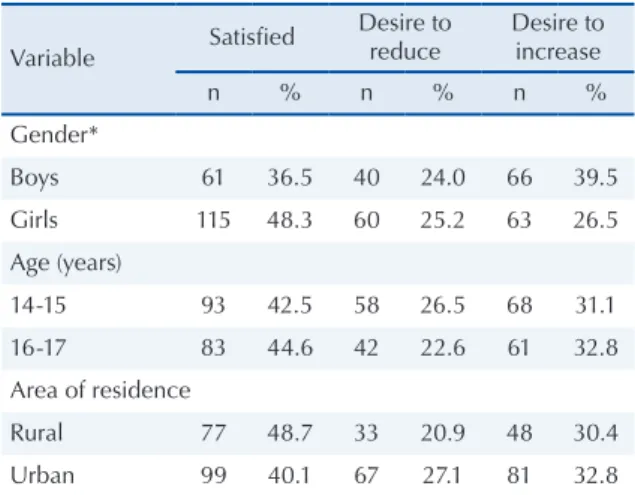
The prevalence of body image dissatisfaction was 56.5% and was higher among boys (63.5%) than among girls (51.7%; p < 0.05). When body im-age dissatisfaction was dichotomized into the desire to reduce or to increase body silhouette size, both boys (39.5%) and girls (26.5%) wanted to increase their body size (Table 1).
Table 1. Distribution of the sample according to body image
perception. Januária, Minas Gerais (n = 405).
Variable Satisfied
Desire to reduce
Desire to increase
n % n % n %
Gender*
Boys 61 36.5 40 24.0 66 39.5
Girls 115 48.3 60 25.2 63 26.5
Age (years)
14-15 93 42.5 58 26.5 68 31.1
16-17 83 44.6 42 22.6 61 32.8
Area of residence
Rural 77 48.7 33 20.9 48 30.4
Urban 99 40.1 67 27.1 81 32.8
* p < 0.05; x2 = 5.554.
Table 2 shows the prevalence ratios (crude and adjusted) between body image dissatisfaction and demographic variables (gender, age, and area of residence). Crude and adjusted analysis showed that gender was the only variable associated with body image dissatisfaction. Boys presented a 1.24 times higher chance of body image dissatisfaction upon adjusted analysis than girls.
Table 2. Crude and adjusted prevalence ratio between body
image dissatisfaction and demographic variables. Januária, Minas Gerais (n = 405).
Variable Crude PR (95% CI) Adjusted PR** (95% CI)
Gender
Boys 1.23 (1.04-1.45)* 1.24 (1.05-1.47)*
Girls 1 1
Age (years)
14-15 1.04 (0.88-1.23) 1.02 (0.86-1.21)
16-17 1 1
Area of residence
Rural 1.17 (0.97-1.40) 1.18 (0.98-1.42)
Urban 1 1
PR: prevalence ratio; 95% CI: 95% confidence interval. ** PR adjusted for all variables in the model.
The prevalence of body image dissatisfaction was 56.5%. A similar rate has been reported by Vilela et al.10, who observed body image dissatisfaction in
59% of students (7 to 19 years) from Porto Alegre, Rio Grande do Sul. On the other hand, Pinheiro and Giugliani18 found a higher prevalence (82%)
for schoolchildren aged 8 to 11 years from the same city. These results suggest an increase in body im-age dissatisfaction among children and adolescents of similar age from the same city within a short period of time (2004-2006, respectively).
In the present study, adolescent boys (63.5%) showed greater body image dissatisfaction than girls (51.7%). In the study of Pelegrini and Petroski13
involving adolescents (14 to 18 years) from public schools in Florianópolis, Santa Catarina, 72.6% of adolescent boys and 61.8% of girls were dissatisied with their body image. Similar prevalence rates of body image dissatisfaction in boys and girls have been reported by Graup et al.9 for students (9 to 16
years) from public and private schools (67.5% for boys and 67.6% for girls), demonstrating a balance in body image dissatisfaction between genders when compared to the present study. In contrast, no gender difference in body image dissatisfaction has been reported by Graup et al.9 for students (9
to 16 years) from public and private schools (67.5% for boys and 67.6% for girls).
Branco et al.12, using different instruments for
the evaluation of body image dissatisfaction in ado-lescents from São Paulo (14 to 19 years), observed that girls tended to be more dissatisied than boys. According to Graham et al.25, body image
dissat-isfaction seems to be a female trait, especially in adolescence, a phase when the body establishes its shape. However, recent studies9,13,26 show that body
image dissatisfaction is increasingly affecting males; however, further studies on this topic are needed.
Dichotomization of body image dissatisfac-tion into the desire to reduce or to increase body silhouette size showed a desire to increase body size in both adolescent boys and girls; however, the frequency of this desire was higher among boys (39.5%) than among girls (26.5%). These indings disagree with Pinheiro and Giugliani18
who observed that 55% of adolescent girls wanted a thinner body and 28% of boys wanted to increase their body size.
Even presenting some type of dissatisfaction, boys wanted larger body silhouettes, possibly desir-ing a more muscular body. These results agree with
reduce their body silhouette23, whereas boys want
stronger bodies10. These indings might be related
to cultural factors, with boys being encouraged to perform activities that stimulate physical and muscle development, whereas girls are urged to exercise and lose weight to improve their esthetic appearance27.
No association between body image dissatis-faction and age was observed in the present study. Triches et al.14 also found no signiicant association
between these two variables; however, the desire to lose weight tended to increase with age. The pre-sent results showed that all adolescents were prone to body image dissatisfaction, irrespective of age. Within this context, the literature demonstrates that body dissatisfaction can manifest throughout all phases of life, including children20, adolescents28,
adults21, and the elderly29.
The present study was unable to demonstrate an association between area of residence (rural and urban) and body image dissatisfaction. The prevalence of body dissatisfaction was similar among adolescents from rural (51.3%) and urban areas (59.9%), in agreement with a study conducted on 13- to 17-year-old adolescents from southern Brazil living in rural and urban areas (rural: 64.2%, urban: 62.8%)28. In contrast, Triches et al.14,
study-ing students from two different small municipalities who lived in rural and urban areas, found different levels of body dissatisfaction, with greater dis-satisfaction among those from urban areas. This dissatisfaction mainly consisted of the desire to reduce the body silhouette. A similar prevalence of body image dissatisfaction (67%) was observed among 9- to 16-year-old adolescents enrolled in public and private schools in Florianópolis, Santa Catarina, with dissatisfaction mainly being related to excess body fat9. These indings demonstrate
that the prevalence of body image dissatisfaction is high among both adolescents from small towns and those from large urban centers.
A higher prevalence of body dissatisfaction was expected for adolescents living in urban areas who, in theory, are more exposed to a culture of thinness since they have better access to means of communication and media. Thus, body image dissatisfaction probably affected adolescents ir-respective of the place of residence.
Insatisfação com a imagem corporal em adolescentes Fidelix et al.
Brazilian population. In addition, the body igures are two-dimensional, a fact leading to distortions in total body representation and weight distribu-tion. The small size of the municipality of Januária may have also inluenced the results regarding area of residence since the rural and urban areas are close to one another, with all adolescents thus having access to information. Further studies are needed that measure anthropometric variables in order to better reproduce the body composition of adolescents and to associate these variables with body image dissatisfaction.
CONCLUSIONS
The prevalence of body image dissatisfaction was high among the adolescents studied and was similar to that reported for other Brazilian cities. Boys were more dissatisied with their body image, desiring a stronger and more athletic body. Age and area of residence were not associated with body image dissatisfaction. Parents, teachers and health pro-fessionals should be aware of the high prevalence of body dissatisfaction among adolescents and of the need for strategies designed to improve body satisfaction in this group.
REFERENCES
1. Adami F, Frainer DES, Santos JS, Fernandes TC, De-Oliveira FR. Insatisfação corporal e atividade física em adolescentes da região continental de Florianópolis. Psic Teor e Pesq 2008;24(2):143-9.
2. Smolak L. Body image in children. In: Thompson J, Smolak L, editors. Body image, eating disorders and obesity in youth: Assessment, prevention and treat-ment. Washington, DC: American Psychological Association; 2001.
3. Pereira EF, Graup S, Lopes AS, Borgatto AF, Daronco LSE. Percepção da imagem corporal de crianças e adolescentes com diferentes níveis socioeconômicos na cidade de Florianópolis, Santa Catarina, Brasil. Rev Bras Saúde Matern Infant 2009;9(3):253-62.
4. Russo R. Imagem corporal: construção através da cultura do belo. Mov Percepção 2005;5(6).
5. Sociedade Brasileira de Cirurgia Plástica. Cirurgia plástica 2006. Available at: http://www.cirurgiaplastica. org.br/ publico/historico.cfm [April 9, 2010].
6. Fleitlich B. O papel da imagem corporal e os riscos de transtornos alimentares. Pediatr Moderna 1997;32(1-2):56-62.
7. Benedetti TB, Petroski EL, Gonçalves LT. Exercí-cios físicos, auto-imagem e auto-estima em idosos asilados. Rev Bras Cineantropom Desempenho Hum 2003;5(2):69-74.
8. Petroski EL, Pelegrini A, Glaner MF. Motivos e prevalência de insatisfação com a imagem corporal em adolescentes. Ciênc Saúde Colet – In press.
9. Graup S, Pereira EF, Lopes AS, Araújo VC, Legnani RFS, Borgatto AF. Associação entre a percepção da imagem corporal e indicadores antropométricos de escolares. Rev Bras Educ Fís Esp 2008;22(2):129-38.
10. Vilela JEM, Lamounier JA, Dellaretti Filho MA, Bar-ros Neto JR, Horta GM. Transtornos alimentares em escolares. J Pediatr 2004;80(1):49-54.
11. Vilela J, Lamounier J, Oliveira R, Ribeiro R, Gomes E, Barros Neto J. Avaliação do comportamento alimentar em crianças e adolescentes de Belo Horizonte. Psiquiatr Biol 2001;9:121-30.
12. Branco LM, Hilário MOE, Cintra IP. Percepção e satis-fação corporal em adolescentes e a relação com seu es-tado nutricional. Rev Psiquiatr Clín 2006;33(6):292-6.
13. Pelegrini A, Petroski EL. The association between body dissatisfaction and nutritional status in adolescents. Hum Mov 2010;11(1): 91-95.
14. Triches RM, Giugliani ERJ. Insatisfação corporal em escolares de dois municípios da região Sul do Brasil. Rev Nutr 2007;20(2):119-28.
15. Welch C, Gross S M, Bronner Y, Dewberry-Moore N, Paige DM. Discrepancies in body image perception among fourth-grade public school children from ur-ban, suburur-ban, and rural Maryland. J Am Diet Assoc 2004;104(7):1080-5.
16. Smolak L. Body image in children and adolescents: where do we go from here? Body Image 2004;1(1):15-28.
17. Tavares, MCC. Imagem Corporal: Conceito e Desen-volvimento. São Paulo: Manole (2003).
18. Pinheiro AP, Giugliani ERJ. Body dissatisfaction in Brazilian schoolchildren: prevalence and associated factors. Rev Saúde Pública 2006;40:489-96.
19. Corseuil MW, Pelegrini A, Beck C, Petroski EL. Prevalência de insatisfação com a imagem corporal e sua associação com a inadequação nutricional em adolescentes. Rev Educ Fís/UEM 2009; 20(1):25-31.
20. Pinheiro AP, Giugliani ERJ. Quem são as crianças que se sentem gordas apesar de terem peso adequado? J Pediatria 2006;82:232-235.
21. Coqueiro RS, Petroski EL, Pelegrini A, Barbosa AR. Insatisfação com a imagem corporal: avaliação comparativa da associação com estado nutricional em universitários. Rev Psiquiatr RS 2008;30(1):31-38.
22. Gomes RA. Análise de dados em pesquisa qualitativa. In: Minayo MCS, organizadora. Pesquisa social: teoria, método e criatividade. 4th ed. Petrópolis: Vozes 1994; 67-80.
23. Município de Januária, Minas Gerais. Januária - MG.]; Available at: <http://pt.wikipedia.org/wiki/ Janu%c3%A1ria [March 12, 2010].
tionship among body image, sex, and popularity of high school students. Percept Mot Skills 2000;90(3 Pt 2):1187-1193.
26. Alves D, Pinto M, Alves S, Mota A, Leirós V. Cultura e imagem corporal. Motricidade 2009;5(1):1-20.
27. Ricciardelli LA, McCabe MP, Banield S. Sociocultural Inluences on Body Image and Body Change Methods. J Adolesc Health 2000;26(1):3-4.
28. Petroski EL, Pelegrini A, Glaner MF. Insatisfação corporal em adolescentes rurais e urbanos. Motricidade 2009;5(4):13-25.
29. Tribess S, Virtuoso Junior JS, Petroski EL. Estado nu-tricional e percepção da imagem corporal de mulheres idosas residentes no nordeste do Brasil. Ciênc Saúde Colet 2009;15(1):31-38.
Address for Correspondence
Yara Lucy Fidelix
Universidade Federal de Santa Catarina Centros de Desportos
Núcleo de Cineantropometria e Desempenho Humano – UFSC/CDS/NuCiDH
Campus Universitário – Trindade – Caixa Postal 476