DOI: http://dx.doi.org/10.5007/1980-0037.2014v16n1p58
original article
RBCDH
Licence Creative Commom CC
1 Universidade do Estado de Santa Catarina. Centro de Ciências da Saúde e do Esporte. Programa de Pós-Graduação em Ciências do Movimento Humano. Florianópo-lis, SC, Brasil.
2 Universidade do Estado de Santa Catarina. Programa de Pós Gradu-ação em Fisioterapia. Florianópo-lis, SC. Brasil
Received: 22 April 2013 Accepted: 10 July 2013
Body image perception in women:
prevalence and association with
anthropometric indicators
Percepção da imagem corporal em mulheres: prevalência
e associação com indicadores antropométricos
Andreia Pelegrini1
Cinara Sacomori1
Mateus Carmo Santos1
Fabiana Flores Sperandio2
Fernando Luiz Cardoso1
Abstract– he aim of this study was to investigate the prevalence of body image perception and its association with anthropometric indicators (body mass index, waist circumference, waist-height ratio, and conicity index) in women undergoing cervical cancer screening at an institution in Florianópolis, Santa Catarina. he study included 736 women (≥ 18 years). Anthropometric variables (weight, height, waist circumference) were collected for the determination of body mass index, waist-height ratio, and conicity index. Body image perception was evaluated using a nine-body silhouette scale. he prevalence of body image dissatisfaction was 73% (dissatisfaction due to excess weight = 67.4%; dis-satisfaction due to thinness = 5.6%). Overweight women (PR=1.34; 95%CI=1.23-2.49, p<0.001) and women with an inadequate conicity index (PR=1.12; 95%CI =1.02-1.24, p=0.016) presented a higher prevalence of body image dissatisfaction. he prevalence of body image dissatisfaction is high and the proportion of inadequate anthropometric indicators requires attention. Moreover, body dissatisfaction was more prevalent among overweight women and women with an inadequate conicity index. hese results indicate the need for interventions and for the implementation of programs designed to control body weight and to reduce cardiovascular risk factors and body image dissatisfaction in women attending primary health care centers, such as cancer screening services. Key words: Anthropometry; Body image; Overweight; Self-esteem; Women.
In every period of history, society has adopted an ideal physical type. In the Renaissance painting of Mona Lisa by Leonardo da Vinci, the obese female igure was valued and represented the beauty standard of that time. By the 1960s, people started to search for a lean, athletic pattern with well-deined shapes. Today, the pursuit of beauty increasingly governs the life of people and there is growing concern about perfection of the body, represented by the relentless pursuit of a lanky body type in women and a muscular type in men1. Within this context, the pursuit of an ideal body
may have negative repercussions on body image.
Body image can be deined as a multidimensional construct2 that
represents how individuals think, feel and behave about their physical attributes3. In this respect, body image can be seen as the relationship
between a person’s body and cognitive processes such as personal beliefs, values and attitudes.
Recent studies have shown a high prevalence of body image dissatisfac-tion among men and women of diferent ages4-7. he pursuit of the ideal
body, which is oten imposed by the media and by society, may lead to the adoption of inadequate eating behaviors that range from a rigorous diet to the use of diuretics and laxatives, combined with strenuous physical activities8.
he interest of researchers in body image has increased in recent years and studies have focused on the relationship between body image and anthropometric indicators. Most of these studies investigated the relation-ship between body image and body mass index (BMI), and demonstrated that a higher BMI (overweight and obesity) is associated with greater body dissatisfaction6,9,10. Another indicator studied is body fat10, or simply the
sum of skinfolds11. In a literature search (Scielo, Pubmed and Scopus
da-tabases; keywords: body image, self-esteem, women), we found no studies associating waist circumference, waist-height ratio (WHtR) and conicity index in a sample of Brazilian women.
Within this context and considering the negative impact of body dissatisfaction on women’s quality of life8, spaces need to be created in
women’s health care services where these aspects can be investigated and minimized. herefore, the objective of the present study was to evaluate the prevalence of body image perception and its association with an-thropometric indicators (BMI, waist circumference, WHtR, and conicity index) in women undergoing cervical cancer screening at an institution in Florianópolis, Santa Catarina.
METHODOLOGICAL PROCEDURES
Participants
Women’s body image perception Pelegrini et al.
institution promoting the prevention of cervical and breast cancer (Rede Feminina de Combate ao Câncer de Florianópolis, SC). his institution provides medical care free of charge to 4,200 women per year. he sample of this study corresponds to approximately 18% of this population.
he women received detailed information about the objectives and methodology of the study and agreed to participate by signing the free informed consent form (> 18 years). In the case of girls younger than 18 years, the legal guardian signed the consent form. he study was approved by the Ethics Committee of UDESC (Protocol No.15/2011).
Procedures and instruments
Data were collected in the aternoon on Tuesdays, hursdays and Fridays between September 2011 and June 2012. he women attended the visits spontaneously without an appointment. Exclusion criteria were pregnancy, physical incapacity (walking), and cognitive deicit (anamnesis/conversa-tion with the patients).
Anthropometric measures (body weight, height, and waist circum-ference) and data regarding body image perception were collected. Body weight was measured with a Tanita digital scale to the nearest 0.1 kg. Height was measured with a wall-mounted stadiometer to the nearest 1 cm. he standardizations proposed by Alvarez and Pavan12 were used for
these measurements. Waist circumference was measured with a Sanny® inextensible measuring tape to the nearest 1 mm, at the narrowest point of the waist (without clothes)13.
Body weight and height were used for the calculation of BMI (kg/m²) and nutritional status was classiied according to World Health Organiza-tion criteria14: obesity (BMI ≥ 30 kg/m²), overweight (BMI 25.0 to 29.9 kg/
m²), eutrophic (BMI < 25 kg/m²), and low weight (BMI < 18.5 kg/m²). Two categories were established because of the small number of women in the “low weight” and “overweight” categories: no excess weight (low weight + normal weight) and overweight (overweight + obesity). Abdominal obesity was classiied based on waist circumference using cut-of values in relation to the risk of developing metabolic complications: inadequate (≥ 88 cm) and adequate (< 88 cm)14. WHtR was classiied using the
cut-of values suggested by Pitanga and Lessa15, with values higher than 0.53
indicating an increased WHtR. he conicity index was determined based on body weight, height and waist circumference using the mathematical equation of Valdez16. he cut-of values adopted for the classiication of an
inadequate conicity index were 1.18 and 1.22 for women aged 49 years and ≥ 50 years, respectively17.
he nine-body silhouete scale proposed by Stunkard et al.18 and
vali-dated for Brazilian adults19 was used for body image assessment. his scale
(true-ideal), dissatisfaction was due to excess weight (desire to reduce the body silhouette) and if it was negative, dissatisfaction was due to thinness (desire to increase the body silhouette).
Data analysis
he data were analyzed using the SPSS 20.0 program. Descriptive (mean, standard deviation, and distribution of frequencies) and inferential statis-tics (Poisson regression) were used. he association between body image perception and anthropometric indicators was evaluated using a Poisson regression model with robust variance estimation. Crude and age-adjusted analysis including all variables was used. he level of signiicance was set at p<0.05.
RESULTS
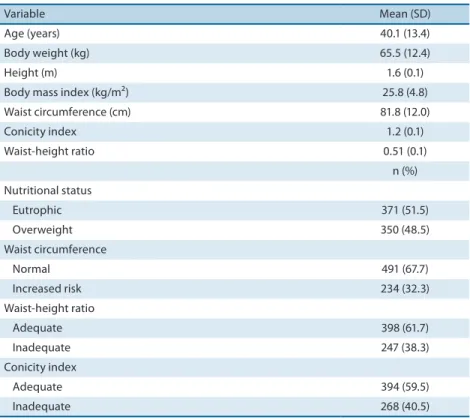
he general characteristics of the sample are shown in Table 1. he age of the participants ranged from 16 to 69 years, with a mean of 40.1 year (SD=13.4). Excess weight was observed in 48.5% of the women. Analysis of abdominal obesity showed that waist circumference was above the recom-mended values in 32.3% of the women. he WHtR and conicity index were inadequate in 38.3% and 40.5% of the participants, respectively.
Table 1. General characteristics of the sample studied (Florianópolis, SC).
Variable Mean (SD)
Age (years) 40.1 (13.4)
Body weight (kg) 65.5 (12.4)
Height (m) 1.6 (0.1)
Body mass index (kg/m²) 25.8 (4.8) Waist circumference (cm) 81.8 (12.0)
Conicity index 1.2 (0.1)
Waist-height ratio 0.51 (0.1) n (%) Nutritional status
Eutrophic 371 (51.5)
Overweight 350 (48.5)
Waist circumference
Normal 491 (67.7)
Increased risk 234 (32.3) Waist-height ratio
Adequate 398 (61.7)
Inadequate 247 (38.3)
Conicity index
Adequate 394 (59.5)
Inadequate 268 (40.5)
Women’s body image perception Pelegrini et al.
Analysis of body image perception showed that 27% of the women were satisied with their body image and 73% were dissatisied (p<0.05). Among the latter women, 67.4% were dissatisied due to excess weight and 5.6% were dissatisied due to thinness (p<0.05). Figure 1 illustrates the distribution of women according to body image perception.
Figure 1. Distribution of women according to body image perception (Florianópolis, SC). * p<0.05 (diferent letters indicate signiicant diferences between proportions).
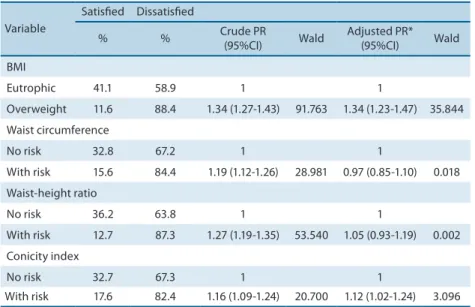
Crude analysis of body image perception (Table 2) showed that all anthropometric indicators were associated with the outcome variable (body image dissatisfaction). he age-adjusted prevalence ratios were 1.34 (95%CI: 1.23-1.47) for overweight and 1.12 (95%CI: 1.02-1.24) for inadequate conicity index when compared to peers with adequate BMI and conicity index, respectively.
Table 2. Prevalence and crude and adjusted analysis of body image satisfaction in women (Florianópolis, SC).
Variable
Satisied Dissatisied
% % Crude PR
(95%CI) Wald
Adjusted PR* (95%CI) Wald BMI
Eutrophic 41.1 58.9 1 1
Overweight 11.6 88.4 1.34 (1.27-1.43) 91.763 1.34 (1.23-1.47) 35.844 Waist circumference
No risk 32.8 67.2 1 1
With risk 15.6 84.4 1.19 (1.12-1.26) 28.981 0.97 (0.85-1.10) 0.018 Waist-height ratio
No risk 36.2 63.8 1 1
With risk 12.7 87.3 1.27 (1.19-1.35) 53.540 1.05 (0.93-1.19) 0.002 Conicity index
No risk 32.7 67.3 1 1
With risk 17.6 82.4 1.16 (1.09-1.24) 20.700 1.12 (1.02-1.24) 3.096
BMI: body mass index; PR: prevalence ratio; 95%CI: 95% conidence interval. *Odds ratio adjusted for age.
DISCUSSION
In addition, 32.3% of the women studied here presented with abdominal obesity. A higher proportion was observed among women attending a Family Health Strategy Unit in São Paulo (57.4%)21. On the other hand,
lower prevalence rates of abdominal obesity were reported for women from the State of Maranhão (15,5%)22 and for women from southern Brazil
(37.5%)23. In a study involving adults from the State of Pernambuco, 69.9%
of the women presented with abdominal obesity24. A possible explanation
for these diferences in the prevalence of abdominal obesity is related to diferences in the mean age of the participants of those studies; the results should therefore be analyzed with caution.
Inadequate WHtR and conicity index were observed in 38.3% and 40.5% of the women, respectively. In a study involving employees of a higher eduction institution, 29.1% and 32.3% of the sample had an inadequate WHtR and conicity index, respectively25. Obesity, especially central obesity,
predisposes to a series of risk factors for the development of cardiovascular diseases26. In this respect, the high prevalence of women with abdominal
obesity observed in the present study relects the magnitude of the problem. With respect to the prevalence of body image dissatisfaction (73%), 67.4% of the women were dissatisied due to excess weight and 5.6% due to thinness. Similar rates of body dissatisfaction have been reported in other Brazilian studies7,25. International studies also show a high prevalence of
body image dissatisfaction among women28. hese high rates of body image
dissatisfaction might be related to the inluence of media and the society, which impose a current beauty standard that is not always achievable by the general population. In addition, females are generally more dissatisied, a fact that might be explained by sociocultural, psychological and biological factors that subjectively determine the pursuit of the best physical appear-ance29. hese comparisons should be analyzed with caution considering
the diferences in the samples between studies, especially in terms of age. he greater dissatisfaction due to excess weight observed in the present study agrees with other studies conducted in diferent regions of Brazil7,27.
Within this context, it has been observed that body image dissatisfaction is more prevalent among women with excess weight. Silva et al.30 found
an association between body image dissatisfaction and excess weight in men and women when compared to their normal-weight peers. However, divergent results were reported in a study involving active elderly women27,
in which excess weight was not associated with body image dissatisfaction. his divergence should be analyzed with caution due to the diference in the age of the participants between studies and since active elderly women were studied. With respect to the association between body image percep-tion and conicity index, we found no study investigating this relapercep-tionship in adults, a fact impairing discussion.
Women’s body image perception Pelegrini et al.
the dependent variable and the independent variables (anthropometric indicators). In addition, the instrument used to identify body image per-ception was a set of two-dimensional images (silhouettes), a fact impairing presentation of the individual as a whole. However, this scale is commonly used in studied assessing body image perception.
CONCLUSIONS
he present results indicate that the prevalence of body image dissatisfac-tion is high among women undergoing cervical cancer screening and the proportions of inadequate anthropometric indicators require attention. Body image dissatisfaction was more prevalent among women with excess weight and women with an inadequate conicity index. hese results indi-cate the need for interventions and for the implementation of programs designed to control body weight and to reduce cardiovascular risk factors and, consequently, body image dissatisfaction, among women attending primary health care centers, such as cancer screening services.
REFERENCES
1. McCabe MP, Ricciardelli LA. Body image dissatisfaction among males across the lifespan: a review of past literature. J Psychosom Res 2004;56(6):675-85.
2. hompson JK. Body image disturbance: assessment and treatment. New York: Pergamon; 1990.
3. Muth JL, Cash TF. Body-image attitudes: what diference does gender make? J Appl Soc Psychol 1997; 27(16):1438-52.
4. Latzer Y, Tzischinsky O, Asaiza F. Disordered eating related behaviors among Arab schoolgirls in Israel: An epidemiological study. Int J Eat Disord 2007;40(3):263-70. 5. Corseuil MW, Pelegrini A, Beck CC, Petroski EL. Prevalência de insatisfação com a
imagem corporal e sua associação com a inadequação nutricional em adolescentes. Rev Educ Fís (UEM) 2009;20(1):25-31.
6. Pelegrini A, Petroski EL. he association between body dissatisfaction and nutri-tional status in adolescents. Hum Mov 2010;11(1):51-7.
7. Tribess S, Junior JSV, Petroski EL. Estado nutricional e percepção da imagem corporal de mulheres idosas residentes no nordeste do Brasil. Cien Saúde Colet 2010;15(1):31-8.
8. Vilela JEM, Lamounier JA, Filho MAD, Neto JRB, Horta GM. Transtornos alimen-tares em escolares. J Pediatr 2004;80(1):49-54.
9. Ricciardelli LA, McCabe M. Children’s body image concerns and eating distur-bance: a review of the literature. Clin Psychol Rev 2001;21(3):325-44.
10. Martins CR, Pelegrini A, Matheus SC, Petroski EL. Insatisfação com a imagem corporal e relação com estado nutricional, adiposidade corporal e sintomas de anorexia e bulimia em adolescentes. Rev Psiquiatr Rio Gd Sul 2010;32(1):19-23. 11. Coqueiro RS, Petroski EL, Pelegrini A, Barbosa AR. Insatisfação com a imagem
corporal: avaliação comparativa da associação com estado nutricional em univer-sitários. Rev Psiquiatr Rio Gd Sul 2008;30(1):31-8.
12. Alvarez, BR, Pavan AL. Alturas e comprimentos. In: Petroski EL, editor. Antro-pometria: Técnicas e padronizações. Blumenau: Nova Letra, 2007, 2007.p. 31-34. 13. Martins MO, Lopes MA. Perímetros. In: Petroski EL, editor. Antropometria:
Técnicas e padronizações. Blumenau: Nova Letra, 2007.p.57-59
Corresponding author
Andreia Pelegrini
Universidade do Estado de Santa Catarina.
Centro de Ciências da Saúde e do Esporte.
Rua Pascoal Simone, 358, Coqueiros 88080-350 - Florianópolis, SC. E-mail: [email protected]
16. Valdez R. A simple model-based index of abdominal adiposity. J Clin Epidemiol 1991;44(9):955-6.
17. Pitanga FJG. Antropometria na avaliação da obesidade abdominal e risco coronari-ano. Rev Bras Cineantropom Desempenho Hum 2011;13(3):238-41
18. Stunkard AJ, Sorenson T, Schlusinger F. Use of the Danish adoption register for the study of obesity and thinness. In: Kety SS, Rowland LP, Sidman RL, Matthysse SW. he genetics of neurological and psychiatric disorders. New York, NY: Raven, 1983. p. 115-120.
19. Scagliusi FB, Alvarenga M, Polacow VO, Cordás TA, de Oliveira Queiroz GK, Coelho D, Philippi ST, Lancha AH Jr. Concurrent and discriminant validity of the Stunkard’s igure rating scale adapted into Portuguese. Appetite 2006, 47(1):77-82. 20. Brasil. Ministério da Saúde. Secretaria de Vigilância em Saúde. Vigitel Brasil 2010:
vigilância de fatores de risco e proteção para doenças crônicas por inquérito tel-efônico. Brasília: Ministério da Saúde; 2010.
21. Cristóvão MF, Sato APS, Fujimori E. Excesso de peso e obesidade abdominal em mulheres atendidas em Unidade da Estratégia Saúde da Família. Rev Esc Enferm USP 2011;45(2):1667-72.
22. Veloso HJF, Silva AAM. Prevalência e fatores associados à obesidade abdominal e ao excesso de peso em adultos maranhenses. Rev Bras Epidemiol 2010;13(3):400-12. 23. Linhares RS, Horta BL, Gigante DP, Dias-da-Costa JS, Olint MTA. Distribuição
de obesidade geral e abdominal em adultos de uma cidade no Sul do Brasil. Cad Saúde Pública 2012;28(3):438-47.
24. Pinho CPS, Diniz AS, Arruda IKG, Filho MB, Coelho PC, Sequeira LAS, et al. Prevalência e fatores associados à obesidade abdominal em indivíduos na faixa etária de 25 a 59 anos do Estado de Pernambuco, Brasil. Cad Saúde Pública 2013; 29(2):313-324.
25. Almeida RT, Almeida MMG, Araújo TM, Lima DER. Prevalência de obesidade abdominal e fatores associados em trabalhadoras de uma instituição de ensino superior. Rev Baiana Saúde Pública 2011;35(4):911-31.
26. Canoy D, Boekholdt SM, Wareham N, Luben R, Welch A, Bingham S, et al. Body fat distribution and risk of coronary heart disease in men and women in the Eu-ropean prospective investigation into Cancer and Nutrition in Norfolk Cohort: a population-based prospective study. Circulation 2007;116(25):2933-43.
27. Pereira EF, Teixeira CS, Borgatto AF, Daronco LSE. Relação entre diferentes indi-cadores antropométricos e a percepção da imagem corporal em idosas ativas. Rev Psiq Clín 2009;36(2):54-9.
28. Kruger J, Lee CD, Ainsworth BE, Macera CA. Body size satisfaction and physical activity levels among men and women. Obesity (Silver Spring) 2008;16(8):1976-9. 29. Damasceno VO, Vianna VRA, Vianna JM, Lacio M, Lima JRP, Novaes JS. Imagem
corporal e corpo ideal. Rev Bras Cien Mov 2006;14(1):87-96.