2011 Nov.-Dec.;19(6):1377-84
www.eerp.usp.br/rlae
Corresponding Author: Laura Lorén Guerrero Av. Gómez Laguna, 12 8ºB 50009, Zaragoza, España E-mail: [email protected]
Biopsychosocial factors related to the length of hospital stay
in older people
Laura Lorén Guerrero
1Ana Gascón Catalán
2This study aimed to know what variables influence increased length of hospital stay. A
descriptive, cross-sectional study was conducted through an integrated geriatric assessment
of 81 people over 65 years of age, admitted to a tertiary acute care hospital. Data were
collected through the Pfeiffer Scale, Barthel Index, Goldberg Questionnaire, Family APGAR
and Gijón Scale. The length of hospital stay increased in people over 80 years, people living
alone or in a retirement home, patients with great physical dependence and those with a
risk or problem of social exclusion. The most influential variable for longer hospitalization
was cognitive impairment (p<0.05), due to greater collaboration or desire to overcome the
acute stage of the pathology that led to the hospital admission among patients without this
condition.
Descriptors: Hospital Planning; Length of Stay; Aging; Activities of Daily Living; Cognition;
Interpersonal Relations.
1 RN, Unidad Docente Matronas, Zaragoza, Spain. E-mail: [email protected].
www.eerp.usp.br/rlae
Variáveis biopsicossociais relacionadas à duração de hospitalização em idosos
Este estudo teve como objetivo conhecer quais as variáveis que inluenciam o aumento do tempo de internação hospitalar. Trata-se de estudo descritivo e transversal, conduzido
mediante ampla avaliação geriátrica de 81 pessoas com mais de 65 anos, internadas
em hospital terciário de cuidados agudos. Os dados foram coletados através da Escala
Pfeiffer, Índice de Barthel, Questionário de Goldberg, Apgar da Família e Escala de
Gijón. Observou-se aumento no tempo de internação entre pessoas com mais de 80
anos, pessoas que vivem sozinhas ou em lar de idosos, pacientes que tinham grande
dependência física, e entre aqueles com algum risco ou problema de exclusão social. A variável mais inluente, para a maior duração da hospitalização, foi a deterioração cognitiva (p<0,05), em comparação à maior colaboração do paciente sem essa condição
ou ao seu desejo de superar a fase aguda da patologia que levou à internação hospitalar.
Descritores: Planejamento Hospitalar; Tempo de Internação; Envelhecimento; Atividades
Cotidianas; Cognição; Relações Interpessoais.
Variables biopsicosociales relacionadas con la duración de la estancia hospitalaria en personas mayores
Este estudio tuvo como objetivo conocer qué variables inluyen en el aumento de la duración de la estancia hospitalaria. Se trata de un estudio descriptivo transversal en el
que se realizó una Valoración Geriátrica Integral a 81 personas mayores de 65 años de
edad que ingresaron en un hospital de agudos de tercer nivel. Para ello, los datos fueron
recogidos por medio de la Escala de Pfeiffer, el Índice de Barthel, el Cuestionario de
Goldberg, el APGAR familiar y la Escala de Gijón. Se observó un aumento de la duración
de la estancia hospitalaria entre los mayores de 80 años, las personas que vivían solas
o en una residencia geriátrica, los pacientes que presentaban gran dependencia física
y también, entre quienes tenían un riesgo o problema de exclusión social. La variable que más inluyó en la mayor duración de la hospitalización fue el deterioro cognitivo (p<0,05), por la mayor colaboración del enfermo o por la propia voluntad de superar el
estado agudo de la patología que motivó el ingreso.
Descriptores: Planiicación Hospitalaria; Tiempo de Internación; Envejecimiento;
Actividades Cotidianas; Cognición; Relaciones Interpersonales.
Introduction
Old age is a phase in the lifecycle when changes
occur that decrease people’s ability to adapt to new
environmental conditions. It is a progressive and
irreversible process that affects all living beings, but
nevertheless with distinctive characteristics in each of these. Although aging as a deinition is excessively biologistic, the concept “old age” is related to the time,
age, context and culture one lives and develops in(1).
As we can read in the European Council’s White
Paper on care delivery to people living in dependence
situations, dependent people demand continuous,
although not necessarily permanent, intervention,
based on support and care(2). Thus, care delivery to
dependence its into the social service context. A strong relation with the health context exists though, due to
the fact that health problems that need healthcare can
trigger or accelerate dependence processes in people
of advanced ages. Moreover, occasionally, dependent
people can be victims of acute processes in their health
the existence of an adequate network to cover the social
branch of dependence cases would discharge a large
cost volume from the health system which, on the other
hand, are disproportional to the care dependent people
need.
The number of dependent people is already on the
rise in all Western countries as a result of higher survival
rates and accelerated population aging(3-5). A larger
population of older and dependent people will impose
higher economic demands on the working population
and public budget. Therefore, dependent populations are
one of the themes for improvement through adequate
programs, which is one of the goals of the WHO’s (World
Health Organization) active aging programs, which
include Integrated Geriatric Assessment, an instrument
used to develop this study(6).
Today, Integrated Geriatric Assessment or
Comprehensive Geriatric Assessment is considered
a fundamental global diagnostic tool or method that
supports geriatric clinical practice at all care levels,
whose utility is universally accepted.
This Integrated Geriatric Assessment permits, at
primary care level as well as it hospitals and social health
centers, contact between patients and professionals, in
which the therapeutic relation is established and plenty
of information is obtained for care planning purposes.
Similarly, when a needs assessment interview is held,
an environment of trust is enhanced to start the relation
between nursing and users receiving care. Consequently,
when an individual plan is designed, adapted to the
needs the patients expressed, whether concerning
prevention, treatment or rehabilitation, a better care
quality is achieved.
This research is proposed to get to know the health
condition of elderly people hospitalized at an acute care hospital and to analyze what factors inluence a longer hospitalization length, with a view to planning the
necessary nursing care. Thus, the goal of this research is
to get to know the cognitive status, physical dependence
level, emotional status and social and family conditions
of people over 65 years of age hospitalized at the
Internal Medicine Unit. Also, the intent is to study and analyze which of these variables inluence the increased length of hospital stay.
Methods
A descriptive and cross-sectional study was
developed. Data were collected at the Internal
Medicine hospitalization ward B of the Hospital Clínico
Universitario “Lozano Blesa” between February and
April 2010. After obtaining approval from the hospital’s Institutional Review Board, all patients over 65 years of
age were selected who were hospitalized in that period,
totaling 151.
Patients who died within the irst 24 hours and patients isolated by the center’s Preventive Medicine
Service were excluded. Of course patients who did not want to cooperate and who did not sign the informed
consent term were also excluded. In total, 70 persons were excluded and the inal sample comprised 81 people.
Data collection took place on the indicated dates
and was extended until all patients had been discharged,
so as to collect information on the hospitalization length. The following socio-demographic data were collected:
gender, age, marital status and social group. Data on the
presence of degenerative diseases, psychopathological
disorders and psychoactive drugs consumption were
also included. After obtaining the necessary ethical
consent from the Nursing Director at the center, data
were collected from the computerized clinical history and the discharge report from the unit.
Interviews were held at the patients’ rooms, closely
considering non-verbal communication. To start the
interviews, the patients received explanations about
what the study involved and those willing to participate
were asked to sign the informed consent form. Cooperation was only requested from close relatives of
patients suffering from cognitive deterioration, so as to correctly ill out the physical dependence level.
The Pfeiffer Scale(7-10) was used to assess the
cognitive status and Barthel’s Index(7-9,11) for physical
independence. In addition, tools were adopted
that are useful for elderly people and assessed the emotional status, Goldberg’s Questionnaire(7-9,12-13),
family perception through the family APGAR(7-9,14),
besides Gijón’s Scale for the elderly’s social-family
assessment(7-9,15). The Goldberg Questionnaire was
preferred over others as it collects subjective data from
the patients and assesses depression separately, which
can provoke dependence and old age, and anxiety, which can be due to the hospitalization. All selected
instruments were validated in Spain and are widely
acknowledged among professionals.
The irst instrument to complete was the Pfeiffer Scale as, depending on its result, the family’s opinion
on physical dependence would be taken into account
and the other tools could not be used. That is, one
Rev. Latino-Am. Enfermagem 2011 Nov.-Dec.;19(6):1377-84.
www.eerp.usp.br/rlae
people suffering from cognitive deterioration, studied
through the selected indicator, as this research intends
to achieve the subjective consideration of these three
points.
Analysis
Data were analyzed in SPSS 15.0 statistical
software and frequency distribution and central trend
and dispersion measures were used. To establish the
relation among the variables, inferential statistics was
used. After studying the normality of variables through
the Kolmogorov-Smirnov test, the researchers decided
to analyze correlations among these variables through
non-parametric statistics: Mann Whitney’s U test and Kruskal Wallis’ test. Statistical signiicance was set as p<0.05.
Results
Socio-demographic variables
Men corresponded to 53.7% and women 46.3% of participants and the mean age was 81.24 years (SD=7.338).
A majority had a partner (50.6%), with only one
case of divorce and one single participant. Widowed people corresponded to 46.8%. In 47.4% of cases, the participants lived with their partner, 26.3% with
daughters or sons, 15.8% at a retirement home and
only 9.2% alone.
Degenerative diseases and psychopathological disorders
Degenerative diseases or psychopathological
disorders are present in about 50% of sample patients.
Moreover, nine participants suffer from more than one of
this kind of pathologies. The collected alterations include
22 cases of Cerebrovascular Accident, also including
lacunar infarctions and transitory ischemic accidents. Ten
patients suffered from Alzheimer’s Disease and two from
Parkinson’s. On the other hand, there were eight cases of Depressive Syndrome and, inally, ive patients with cognitive deterioration, without a concrete pathology.
Use of psychotropics
Psychotropic consumption was found in 55.6% of the sample. In this group, 53.3% takes anxiolytics, 4.4% antidepressants, and 31.1% a combination of both.
Intellectual function assessment
The median result on the Pfeiffer Test is three
wrong answers. Extreme sample data correspond to 52.4% of the total. About 28% mistakenly answered all questions, while 24.4% did not commit any mistake. Among people with normal intellectual functioning,
i.e. 0, 1 and 2 wrong answers, 21.21% presents
a degenerative disease or a psychopathological
disorder. On the opposite, people with severe cognitive
deterioration according to the scale, present some
type of these diseases in 79.2% of cases. The most prevalent conditions are dementias (54.55%), 40.74% of which are Alzheimer’s.
Functional independence assessment
The median score on the Barthel Index was 67.50.
Totally dependent people correspond to 35.36% of the
sample, 86.20% of whom have some degenerative
disease or psychopathological disorder. On the opposite, among the 14.63% of independent patients, none of them suffers from any of these pathologies.
Family and social assessment and emotional status
The family, social and emotional assessment focused on 34 patients with adequate cognitive functioning according to the Pfeiffer Test. Eight were women and 26 men, 24 were younger and ten older than 80 years.
The mean score on the family APGAR is 9.15
(SD=1.617), corresponding to 97.1% of the patients
whose family functioning is interpreted as normal. Only
one widowed woman younger than 80 and living along
presents a severe family dysfunction.
The mean score on the Gijón scale is 9.44 (SD=2.163). Considering that assessments in this
scale use two groups: between 5 and 9 points for good
or acceptable social situations and between 10 and 14 for social risk; the obtained mean score is on the borderline between both groups.
The mean score on the Anxiety Subscale is 2.06 (SD=2.486). Scores of less than four are interpreted as absence of anxiety disorder, corresponding to 73.5%
of the study sample. On the Depression Subscale, the mean score is 3.12 (SD=2.422), with scores higher than two representing the possibility of depressive disorder,
interpreted as absence of emotional disorder, in 52.9%
of the sample.
Results related to the length of hospitalization
About 11.5% of hospitalized people who
participated in the interviews, i.e. nine people, died
during hospitalization. An in-depth analysis of these
cases reveals that the mean age is 88.22 years (SD=5.26), with four women and ive men. Finally, six of these people suffered from some degenerative
disease or psychopathological disorder. Moreover,
none of the deceased showed adequate intellectual
functioning and all of them were totally or severely
dependent. Due to these deaths, these patients will not
be taken into account to analyze the length of hospital stay. The mean hospitalization length is 14.56 days (SD=10.344), without any signiicant relation with the patients’ gender, age, presence of degenerative
diseases or psychopathological disorders, nor with
marital status or where these people lived.
A statistically signiicant association was found between the length of hospitalization and the Pfeiffer Test results, that is, patients with severe intellectual deicit show longer hospital stays, on the average nine days longer
than patients with a normal cognitive level (Figure 1).
Normal Intellectual
Functioning (FIN)
12.65
11.29
21.32
Deficient Intellectual
Functioning (FID)
Severe Intellectual
Deficit (DIS)
0 5 10 15 20 25
Figure 1 – Length of hospitalization according to patient’s
cognitive level in mean number of days
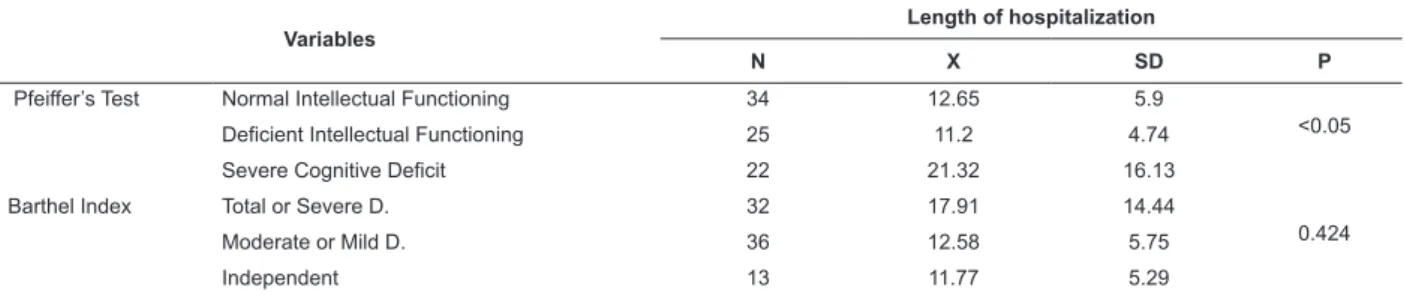
No signiicant relation was found between the other study variables when comparing them with the length of
hospitalization (Tables 1 and 2). Although no statistically signiicant relation was found, data analysis reveals that the mean length of hospitalization is longer among
women, people over 80 and living alone or in retirement
homes. The same is true for dependence and the
presence of social problems. The higher dependence and
social risk, the longer the patient remains hospitalized.
Table 1- Bivariate statistical analysis between different variables and length of hospitalization
Variables
Length of hospitalization
N X SD P
Gender Woman 37 15.03 10.35 0.943
Man 44 14.16 10.45
Age <80 years 33 12.76 4.64 0.977
>80 years 48 15.76 12.79
Neurological or emotional disease Yes 41 14.22 9.42 0.666
No 40 14.9 11.33
Marital status Married 39 14.26 7.59 0.834
Widowed or Single or Divorced 38 14.95 12.58
Home Husband/wife 36 14.03 7.3 0.998
Children or Brothers/Sisters 21 13 6.25
Retirement home or Alone 19 17.79 16.84
N=number of people; X=Mean; SD=Standard Deviation
Table 2 – Bivariate statistical analysis between different scales and length of hospitalization
Variables
Length of hospitalization
N X SD P
Pfeiffer’s Test Normal Intellectual Functioning 34 12.65 5.9
<0.05
Deficient Intellectual Functioning 25 11.2 4.74
Severe Cognitive Deficit 22 21.32 16.13
Barthel Index Total or Severe D. 32 17.91 14.44
0.424
www.eerp.usp.br/rlae
Rev. Latino-Am. Enfermagem 2011 Nov.-Dec.;19(6):1377-84.
Variables
Length of hospitalization
N X SD P
Family APGAR Normal function 33 12.67 5.99
-Severe dysfunction 1 -
Gijón Scale Good situation 16 11.44 4.91
0.224
Social risk or problem 18 13.72 6.61
Table 2 – (continuation)
N=number of people; X=Mean; SD=Standard Deviation
Discussion
The initial goal of this study was to investigate what
variables affected the length of hospitalization. Therefore,
personal, family and social variables were collected and
patients’ cognitive status, functional dependence level,
family and social support and emotional status were
analyzed through the use of validated scales.
The mean age of patients in this study, 81.24 years, is higher than in other research published(16-17),
which could be due to the fact that this sample came
from a hospital context. The same was found in a
study that compares the community and hospital
contexts(18). Moreover, in community research, cognitive
deterioration is more limited than in research using a
hospitalized sample(19). Therefore, the place the sample
was extracted from should constantly be taken into
account so as not to reach mistaken conclusions.
On the other hand, it should be proven whether
hospitalization represents a risk factor for greater
cognitive deterioration and functional dependence, or
whether this type of patients shows greater fragility and,
therefore, is hospitalized more frequently.
An observation on commonly used emotional status
and social and family risk assessment scales is due, as
the impossibility of using subjective scales with patients
with cognitive deterioration represents a limitation.
Therefore, scales should commonly be adjusted or
created to study the emotional status and the family
and social concept, with a view to the assessment
of patients with cognitive deterioration who cannot
complete the Comprehensive Geriatric Assessment
scales, which impedes the assessment of some aspects
and the establishment of a complete care plan for these
individuals.
The analysis of results reveals participants’
perception of their own family (family APGAR), with
97.1% presenting normal family functioning. Similar results were found in other studies, in which 84.3% consider their own family functions adequately(20).
In other studies, however, the results found are very
different, with only 12% of normal family functioning(21),
although it should be taken into account that that
research involved patients with longer hospital stays of
more than 20 days.
In the present research, the large majority of
participants feel loved, based on which one may say
that the traditional family is still important in the current
society, mainly at these ages. The main complaints
people in this study demonstrate is the lack of time spent
with their relatives. In other studies, the importance
of the family as the main caregiver is highlighted, in
addition to group activities as a family to maintain the
elderly’s social role and strengthen family bonds(20,22).
The mean score on the Gijón scale ranges between
a good or acceptable social situation and a social risk.
These results differ from other studies, with 88%
of moderate social risk(21). This higher percentage
is possibly due to the fact that participants remain
hospitalized longer, and social risk may be involved in
the longer length of hospitalization.
A lower anxiety level was observed than in other
studies, in which 52% was found(21). This difference can
be due to the fact that this research involved patients
with long hospitalization lengths, which may provoke
greater anxiety.
In the instrument used, the most frequent afirmative answers are related to the appearance of vegetative
symptoms and health concerns. The scale itself may
be hiding the results as, when talking about patients
hospitalized at a tertiary care institution, vegetative
symptoms may be due to the disease itself questions
and concern with the mere fact of being hospitalized. On
the other hand, high psychotropic consumption may be
reducing sample patients’ actual anxiety levels, which
the abovementioned article assesses(21).
Discrepancies were also observed in the assessment
of depression levels. More than half of the interviewees
seems to suffer from some kind of depressive disorder,
against only 23% in the other study(15). It should be
highlighted that one-third of the present sample is
in the cited study. One very important point that should
be considered, though, to assess depression in elderly
patients, is family dynamics and the environment they live in, which is modiied in the hospital context, in line with other studies(23-24). In the present study,
most patients answer that they feel slowed down and
have little energy, which could be due to the symptoms
themselves that motivated the hospitalization.
Based on comments about the Anxiety and
Depression Subscales of the Goldberg Scale, it is
concluded that another scale should be used that would
better assess the emotional status of elderly people
hospitalized in an acute care facility.
The analysis of results reveals that variables like
age over 80, living along or in a retirement home,
high dependence level and presence of social risk could be inluencing a longer length of hospitalization. In a published study with similar characteristics, an
association was found between physical dependence and
length of hospital stay(25). The analysis of the present
research variables showed, for some of them, a trend
towards longer hospitalization, but without statistical signiicance. Therefore, further research would be useful to clarify this possible association.
Finally, statistically signiicant differences were found between the cognitive status and the length
of hospital stay, possibly due to the patient’s great
cooperation and the desire itself to overcome the acute
phase of the disease that motivated the hospitalization.
Conclusion
Altered cognitive status increases the length of
hospital stay for older people in acute care hospitals.
References
1. Tarrés Chamorro S. Vejez y sociedad multicultural. Gac
Antropol. [periódico na Internet]. 2002; 18. [acesso 26
nov 2010]. Disponível em: http://www.ugr.es/~pwlac/
G18_05Sol_Tarres_Chamorro.html
2. Ministerio de Sanidad y Política Social (ES). Libro Blanco de la Dependencia. 2004. [acesso 26 nov 2010]. Disponível em:
http://www.imsersomayores.csic.es/documentacion/
libro-blanco-dependencia.html
3. United Nations Population Division. World Population
Prospects: the 2002 revision. [acesso 10 nov 2010].
Disponível em: http://www.un.org/esa/population/
4. United Nations. Population Division of the Department of Economic and Social Affairs of the United Nations
Secretariat, World Population Prospects: The 2008
Revision. [acesso 8 Oct 2010]. Disponível em: http://
esa.un.org/unpp
5. Ministerio de Sanidad y Política Social (ES). Gobierno
de Aragón. Informe anual del Sistema Nacional de Salud
2007: Aragón. [acesso 10 Oct 2010]. Disponivel em:
http://www.msps.es/organizacion/sns/planCalidadSNS/
6. Organización Mundial de la Salud. Departamento
de Promoción de la Salud. Hombres, envejecimiento y
salud. 2001. [acesso 26 nov 2010].
Disponivel em: http://www.imsersomayores.csic.es/
salud/psicologia/vejez/documentos.html
7. Gallud J, Guirao Goris JA. Escalas e instrumentos
para la valoración en Atención Domiciliaria. Valencia: Generalitat Valenciana. Conselleria de Sanitat, 2004. [acesso 26 nov 2010]. Disponivel em: http://www.san. gva.es/publicaciones/documentos/V.3785-2004.pdf 8. Servicio Andaluz de Salud (ES). Consejería de
Salud. [acesso 26 nov 2010]. Disponivel em: www.
juntadeandalucia.es/servicioandaluzdesalud/principal/
9. Programa de atención a enfermos crónicos
dependientes. Gobierno de Aragón: departamento de
salud y consumo. 2006.
10. Martínez de la Iglesia J, Dueñas Herrero R,
Onis Vilches MC, Aguado Taberné C, Albert Colomer
C, Luque Luque R. Cross-cultural adaptation and
validation of Pfeiffer’s test (Short Portable Mental Status
Questionnaire [SPMSQ]) to screen cognitive impairment
in general population aged 65 or older. Med Clin. 2001;117(4):129-34.
11. Baztán JJ, Pérez del Molino J, Alarcón T, San
Cristobal E, Izquierdo G, Manzarbeitia J. Indice de
Barthel: Instrumento válido para la valoración funcional
de pacientes con enfermedad cerebrovascular. Rev Esp Geriatr Gerontol 1993;28:32-40.
12. Montón C, Pérez-Echevarría MJ, Campos R, García
Campayo J, Lobo A y GMPPZ (Grupo de Morbilidad
Psíquica y Psicosomática de Zaragoza). Goldberg’s
anxiety and depression scales (E.A.D.G.): a useful
interview guideline for detection of psychological distress. Aten Primaria. 1993;12:345-9.
13. Lobo A, Montón A, Campos R, García-Campayo J,
Pérez, Echevarría MJ. Detección de morbilidad psíquica
en la práctica médica: el nuevo instrumento E.A.D.G.
www.eerp.usp.br/rlae
Rev. Latino-Am. Enfermagem 2011 Nov.-Dec.;19(6):1377-84.
14. Bellón Saameño JA, Delgado Sánchez A, Luna de Castillo J de D, Lardelli Claret P. Validity and reliability of
the Apgar-family questionnaire on family function. Aten
Primaria 1996;18(6):289-96.
15. Cabrera González A, Menenéndez Caicoya A,
Fernández Sánchez A, Acebal García V, García González
JV, Díaz Palacios A, Salamea García D. Evaluation of the
reliability and validity of a scale of social evaluation of the elderly. Aten Primaria. 1999;23(7):434-40.
16. Navarro Pardo E, Meléndez Moral JC, Tomás Miguel
JM. Relationship between psychological and physical
dimensions of life quality in elderly persons. Gerokomos.
2008;19(2):63-7.
17. Cuesta Antelo MI. Implementation of a socio-medical
assessment unit (UVASS) located in a hospital for acute
patients (Fundation Hospital Son Llatzer: FHSLL).
Gerokomos. 2008;1(1):16-20.
18. Martínez-Martín P, Fernández Mayoralas G,
Frades-Payo B, Rojo-Pérez F, Petidier R, Rodríguez-Rodríguez V,
et al. Validation of the Functional Independence Scale. Gac Sanit. 2009;23(1):49-54.
19. Hervas A, García de Jalón E. Cognitive state as a
conditioner of frailty in the elderly. Perspective from a health centre. An Sist Sanit Navar. 2005;28(1):35-47. 20. Mercedes Zavala G, Daisy Vidal G, Manuel Castros
S, Quiroga P, Gonzalo Klassen P. Social functioning of
elderly. Cienc Enferm. 2006;12(2):53-62.
21. Gómez González R, Sánchez Carrasco G, Rodríguez
Aguilar GA. Vulnerabilidad de los pacientes mayores de 64 años a través de una valoración multidimensional. Invest Cuid. 2004;2(3):16-23.
22. Rojas Ocaña MJ, Toronjo Gómez A, Rodríguez
Ponce C, Rodríguez Rodríguez JB. Autonomy and health
status perceived by elderly institutionalised people.
Gerokomos. 2006;17(1):6-23.
23. García Lozano L, Mérida Quiñones F, Mestre Reoyo I,
Gallego Parrilla MD, Duarte Romero AJ, Mesa Ramos RG,
et al. La depresión del anciano y el papel de la dinámica familiar. Aten Primaria. 2000;25(4):62-9.
24. Bocchi SCM, Silva L, Juliani CMCM, Spiri WC. Nurses’ behaviours and their impacts on elderly hospitalized
patients. Rev. Latino-Am. Enfermagem. 2007;15(2):1-7.
25. Blanca Gutiérrez JJ, Caraballo Núñez MA, Luque
Pérez M, Muñoz Segura R. The increase of patient
independence in hospital. Enferm. Global. 2009; 16.
[acesso 28 ago 2010]. Disponivel em: http://www. scielo.br/scielo.php?script=sci_issuetoc&pid=0104-116920070002&lng=en&nrm=iso