Universidade Federal do Espírito Santo - Vitória. Supported by Projeto Capes/ Nordeste and Funcitec/ES
Mailing address: José Geraldo Mill - Centro Biomédico da UFES - Av. Marechal Campos, 1468 - 29040-090 - Vitória, ES - Brazil
Objective - To compare the regression of left ventricu-lar hypertrophy in patients with moderate hypertension treated with enalapril, losartan or a combination of the two drugs at lower doses.
Methods - Patients of both sexes with moderate hy-pertension confirmed by ambulatory monitoring of arte-rial blood pressure and with left ventricular hypertrophy on echocardiogram were assigned to three groups: enalapril (35 mg/day, n=15), losartan (175 mg/day, n=15) and enalapril+losartan (15 mg+100 mg/day, n=16). The patients received the drugs for 10 months.
Results - The three therapeutic regimens were equal-ly effective in reducing blood pressure and left ventricular mass index (LVMI, g/m2): 141±3.9 to 123±3.6 in the enala-pril group (p<0.05), from 147±3.8 to 133±2.8 in the losar-tan group (p<0.05), and from 146±3.0 to 116±4.0 in the enalapril+losartan group (p<0.05). However, the percent reduction of LVMI was significantly greater (p<0.01) in the enalapril+losartan group (20.5±5.0%) than in ena-lapril (12.4±3.2%) and the losartan (9.1±2.1%) groups. Normalization of LVMI was obtained in 10 out of the 16 patients who received enalapril+ losartan, in 6 out of the 15 patients who received only enalapril and in 4 out of the 15 patients treated with losartan.
Conclusion - The combination of an angiotensin-con-verting enzyme inhibitor and an angiotensin II receptor antagonist (AT1 receptor antagonist) in patients produced an additional effect on the reduction of left ventricular hypertrophy. This finding may depend on a more complete inhibition of the cardiac renin-angiotensin.
Key words: hypertension, cardiac hypertrophy, angio-tensin-converting enzyme, losartan, renin-angiotensin system
Arq Bras Cardiol, volume 74 (nº 2), 111-117, 2000
Antônio Carlos Avanza Jr, Lilian Mameri El Aouar, José Geraldo Mill
Vitória, ES - Brazil
Reduction in Left Ventricular Hypertrophy in Hypertensive
Patients Treated with Enalapril, Losartan or the Combination
of Enalapril and Losartan
Left ventricular hypertrophy is a common complica-ting factor in patients with hypertension, represencomplica-ting an independent risk factor to morbidity and mortality from this disorder. Data from Framingham clearly demonstrate that left ventricular hypertrophy is the most important indepen-dent risk factor for acute myocardial infarction and heart failure in hypertensive patients 1. This fact explains why the
reduction of left ventricular hypertrophy has become, more and more, one of the therapeutic aims to be achieved in treatment of hypertension 2.
The increase in afterload constitutes the main factor for development of left ventricular hypertrophy in hypertension. However, little is known about molecular mechanisms of transduction between the mechanical signal (increase in wall stress) and growth of cardiac mass. A number of studies have shown that several factors, in addition to pressure stress, may independently influence the growth of cardiac mass 3.
Experi-mental and clinical studies have clearly demonstrated parti-cipation of the renin-angiotensin system in the development of cardiac hypertrophy in several pathophysiological states, including hypertension 3-6. Inhibition of the
renin-angio-tensin system has been shown to be an effective way of redu-cing increased cardiac mass in primary hypertension, states of catecholamine excess and hyperthyroidism 3,6,7.
Angio-tensin II, through the AT1 receptor, represents an important trophic factor not only for cardiac myocytes but also for the components of extracellular matrix in the heart 8,9, increasing
cardiac mass. Cardiac hypertrophy induced by growth effects of angiotensin II is not exclusively dependent on hemodyna-mic factors, because stimulation of AT1 receptors of cardiac myocytes in culture promotes a significant increase in protein synthesis and induces expression of the proto-oncogenes c-fos, c-junc and c-myc, associated with both myocyte growth and stimulation to deposition of cardiac extracellular matrix elements 10,11.
similar antihypertensive effects 12, but they differ in their
sites of action. Inhibiting angiotensin-converting enzymes not only decreases angiotensin II generation but also redu-ces the inactivation rate of bradykinin and substance P. Some studies suggest that the rise in the mean life of circulating bradykinin may contribute to both the antihy-pertensive and antihypertrophic effects of angiotensin-converting enzyme inhibitors 13,14. At the same time, these
drugs promote an important increase in synthesis and secretion of renin and a high elevation in plasma sin I levels, due to the lack of negative feedback of angioten-sin II on the juxtaglomerular apparatus of the kidneys 15. It
has been shown that even maximum doses of angiotensin-converting enzyme inhibitors do not completely suppress angiotensin II generation 16,17, since it is known that there are
several alternative pathways to generate this peptide from angiotensin I 18. This fact might explain the loss of
antihy-pertensive and antihypertrophic effects during long-term use of angiotensin-converting enzyme inhibitors in hyper-tensive patients 17. Due to these observations, some
authors have suggested combining angiotensin-conver-ting enzyme inhibitors and AT1 receptor antagonists in order to achieve a more complete inhibition of the renin-an-giotensin system, preserving, at the same time, the possible beneficial effect caused by the increase in mean life of kinins generated in the heart and blood vessels 12,19. Considering
the importance of the renin-angiotensin system in the deve-lopment of cardiac hypertrophy, a higher inhibition of this system might be a more efficient way of reducing hypertro-phied myocardium in hypertensive patients. Therefore, the purpose of this study was to compare the reduction in left ventricular hypertrophy caused by monotherapy with ena-lapril or losartan or the combination of these two drugs, in patients with moderate hypertension. Drug doses were adjusted to produce a similar reduction in blood pressure in the three groups of patients.
Methods
The study comprised hypertensive patients who were screened at the Clínica Vilacor, Vila Velha, Espírito Santo, or at the Clínica de Investigação Cardiovascular, Centro Bio-médico, Universidade Federal do Espírito Santo. Patients of both sexes, aged between 40 and 60 years, with moderate hypertension diagnosed by casual blood pressure rea-dings, were referred to one of the cited clinics, with or wi-thout previous treatment, and interviewed by one of the au-thors. Patient consent was obtained from all participants. After a washout period, when any medication that could alter blood pressure levels was discontinued for 12 days, those patients included in the study were screened again, when blood pressure was measured and blood was with-drawn for biochemical analyses (glucose, blood urea ni-trogen, creatinine, sodium and potassium). Blood pressure was measured by a mercury sphygmomanometer after a 10-minute period of rest in the sitting position. The first and the fifth Korotkoff sounds were considered indicative of
systo-lic and diastosysto-lic blood pressures, respectively. Patients who met criteria for moderate hypertension, according to the V
Joint National Committee 20, remained in the study. Patients
who had any event in the washout period, including blood pressure levels beyond the limits of moderate hyperten-sion, were excluded from the study and immediately medi-cated. Ambulatory monitoring of blood pressure and echo-cardiogram were performed in those patients who remained in the study.
Ambulatory monitoring of blood pressure was perfor-med in a SpaceLabs 90207 device and readings were re-corded every 20 minutes, during a 24- to 26-hour period. The equipment was always installed early in the afternoon (around 2:00 p.m.) for better detection of morning elevation of blood pressure. The same investigator, who knew no diagnoses or possible therapies, conducted all echocardio-graphic examinations. M-mode and pulsed Doppler recor-dings were performed with GERT 6800 equipment. Anato-mical and functional parameters were measured to evaluate left ventricular mass and cardiac performance, respectively. Left ventricular mass was calculated with the Devereux-Reichek algorithm 21, which has the greatest sensitivity and
accuracy when left ventricular mass obtained by echocar-diographic methods is compared with that seen on necropsy of hypertensive patients 22. Left ventricular mass index was
calculated by the ratio of left ventricular mass (g), obtained by echocardiogram, to body surface [(weight (kg) + height (cm) - 60)/100].
After these examinations, only those subjects who met criteria for moderate hypertension based on ambulato-ry monitoring of arterial blood pressure, according to the Brazilian Consensus for the Use of Ambulatory Blood Pres-sure Monitoring 23, and those with left ventricular mass
index greater than 110 g/m2 (for women) or 130 g/m2 (for men),
remained in the study. Among 90 patients who underwent ambulatory blood pressure monitoring, 29 (32%) did not meet criteria to classify them as patients with moderate hy-pertension 23. These subjects were excluded from the study.
Sixty-one patients met the two main inclusion criteria and were assigned to three groups: the enalapril group, trea-ted with enalapril maleate (35mg/day), 20mg at 8:00 a.m. and 15mg at 8:00 p.m.; the enalapril+losartan group, treated with enalapril maleate 15 mg/day at 8:00 a.m. and losartan potas-sium 100mg/day at 8:00 p.m.; and the losartan group, treated with losartan potassium (175mg/day), 100mg at 8:00 a.m. and 75mg at 8:00 p.m.
The first two groups, which included therapy with enalapril, were previously established. The patients were sequentially allocated to either the enalapril or the enala-pril+losartan group, which comprised 22 and 23 subjects, respectively. The 17 patients in the losartan group were re-cruited after the other two groups had been initiated.
Fifty milligrams of losartan potassium was considered equivalent to 10 mg of enalapril maleate, because it was shown that a similar fall in blood pressure occurs when this equivalence ratio is used in healthy subjects 19. Both
commer-cially available formulations. This therapeutic regimen was prolonged for 10 months, and patients were clinically reeva-luated 1, 3, 5, 7 and 10 months after commencing medication. These reevaluations allowed the authors to check adhe-rence to treatment, verify the antihypertensive effect of me-dication and detect adverse reactions. Only two patients did not show a satisfactory reduction in blood pressure after one month of medication (reduction in systolic blood pressure equal to or less than 5mmHg). These patients needed to receive other drugs and were excluded from the study. Blood biochemical analyses and echocardiogram, to obtain the degree of left ventricular hypertrophy regression, were performed again at the last evaluation (month 10).
Exclusion criteria were the following: black subjects, obesity (body mass index > 30kg/m2), diabetes, valvular
heart disease, secondary hypertension, complications of hypertension (myocardial infarction or heart failure) and long-term use of drugs that could interfere with the effect of enalapril or losartan, such as corticosteroids, neuroleptics and antidepressants.
Data are shown as mean ± standard deviation. Compa-risons among means observed in the three groups were done by one-way analysis of variance (ANOVA), followed by the post hoc Tukey test. Comparisons between two means for the same variable, before and after treatment, in the same group, were done by the Student’s t test for paired samples. Comparisons among several means in the same group were done by one-way ANOVA, followed by the post
hoc Bonferroni test, for comparison of a variable before and
during the therapy, or by the Tukey test, for comparison among different groups. All differences of the mean values with p<0.05 were considered significant.
Results
Of the 61 patients who were initially enrolled, 15 (24%) were excluded from the study during the treatment period. Se-ven of them had been included in the enalapril group (4 were excluded because of persistent cough, 2 due to noncom-pliance with the treatment and one due to acute myocardial infarction at month 4). Two excluded patients had been allocated to the losartan group (both stopped taking the study medication). Finally, 6 out of the 15 excluded patients had been assigned to the enalapril+losartan group (2 were ex-cluded due to unsatisfactory reduction in blood pressure in the first month, leading to the addition of other drugs to the therapeutic regimen, 2 stopped taking the study medication and 2 altered the medication schedule prescribed for their own account). Therefore, the following data represent the results obtained from the 46 patients who remained in the study until the end of the previously established period (10 months). No patient had been previously medicated with AT1 receptor antagonist, while 9 had already been treated with angiotensin-converting enzyme inhibitors for different periods of time, for treatment of hypertension. Most of them, however, used this medication without regularity.
The features of the patients who concluded the study protocol, in the three groups, are shown in table I. All the pa-tients were white or mulatto. Baseline levels of systolic and diastolic blood pressure in the sitting position, mean age, weight and body mass index were all similar in the three groups. Figure 1 shows systolic and diastolic blood pressure levels in the three groups throughout the 10-month treatment period. Reduction in blood pressure levels was significant and similar in the three groups until month 7, when systolic blood pressure was 146±1.9mmHg, 146±2.1 mmHg and 143±1.9mmHg in the enalapril group, losartan group and enalapril+losartan group, respectively (p>0.05). At the end of the treatment period, blood pressure levels in the losartan group were slightly higher than those in the other two groups. At the end of month 10, almost all the patients exhibited blood pressure levels in the normal range, i.e., systolic blood
Table I – Characteristics of patients in the three groups (enalapril, losartan and enalapril-losartan combination)
Treatment Enalapril Losartan Enalapril + Losartan
Sex (M/F) 10/5 8/7 9/7
Age (years) 53±3 55±4 54±4
Body weight (kg) 76±4 75±5 74±6 BMI (kg/m2) 27±1.2 26±1.6 27±1.3 SBP (mmHg) 173±2.9 170±1.9 173±2.8 DBP (mmHg) 104±1.8 103±1.7 104±1.5
M- male; F- female; BMI- body mass index; SBP- systolic blood pressure; DBP- diastolic blood pressure. Blood pressure (BP) readings were recorded in the sitting position. Data are reported as means ± standard deviation.
SYSTOLIC
DIASTOLIC
BLOOD PRESSURE (mmHg)
Time (months)
pressure lower than 140mmHg and diastolic blood pressure lower than 90mmHg. Five patients in the losartan group showed systolic blood pressure between 140 and 150mmHg at the end of the treatment period. One of them had diastolic blood pressure of 95mmHg at this time. Mean systolic and diastolic blood pressure levels during the 10 months of treatment, calculated from the levels obtained at each consultation (area under the curve), were similar in the three groups. Mean systolic blood pressure during the 10 months was 145±8mmHg in the enalapril group, 148±7mmHg in the losartan group and 144±9mmHg in the enalapril+losartan group (p>0.05). Mean diastolic blood pressure was not significantly different among the three groups, either. Therefore, considering a longer period of time, all three therapeutic regimens can be considered equally effective in reducing blood pressure, according to these data.
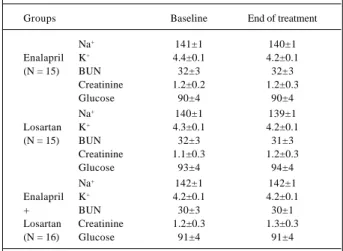
Plasma glucose, blood urea nitrogen, creatinine, sodi-um and potassisodi-um concentrations at baseline and month 10 were in the normal range in all patients. These data are sho-wn in table II.
Mean left ventricular mass index values for each group,
before and after treatment, are found in table III. Figure 2 shows these values for each patient, at the two conditions. At baseline, there was no statistically significant difference among left ventricular mass index values in the three groups. All the three regimens significantly reduce this index. However, left ventricular mass index at the end of the study was significantly lower (p=0.011) in the group treated with the enalapril-losartan combination (116±4.0g/m2) than in the
enalapril group (123±2.8g/m2) or in the losartan group
(133±2.8g/m2). These data suggest that the combination of
enalapril and losartan may promote a greater reduction in left ventricular hypertrophy than those seen when the two drugs are used in isolation. This finding can also be seen in figure 3, which shows the percent reduction in left ventricular mass index in the three groups. The reduction of 20.5±5.0% in the left ventricular mass index observed in the enalapril-losartan group was significantly greater (p<0.01) than the reduction obtained in the enalapril group (12.4±3.2%) and the losartan group (9.1±2.1%). From a statistical point of view, the reduction in left ventricular mass index was lower (p<0.05) in the losartan group than in the enalapril group.
An individual analysis of these data shows that re-duction in left ventricular hypertrophy was achieved in all patients (fig. 2). Nevertheless, a better response was seen in the enalapril-losartan group. Normalization of left ventricu-lar mass index was noted in 10 out of the 16 patients treated with both drugs, in 6 out of the 15 patients treated with ena-lapril alone and in only 4 out of 15 patients medicated only with losartan. We did not note a significant correlation bet-ween reduction in blood pressure and decrease in left ven-tricular mass index in any of the three groups.
Discussion
Several studies confirm that angiotensin-converting enzyme inhibitors and AT1 receptor antagonists, used in adequate doses, are equally effective in reducing blood pressure in patients with primary hypertension 12,24,25. Data
shown in the present study are in agreement with these fin-dings, because enalapril (35mg/day) and losartan (175mg/ day) promoted similar reduction of both systolic and diasto-lic pressures in patients with moderate hypertension. These drugs, in the same proportion of doses (1:5), caused similar decrease in blood pressure in normotensive subjects 19,26.
To create the enalapril+losartan group from the enalapril group, 20 mg of enalapril was replaced by 100mg of losartan, because this last drug can cause an additional antihyper-tensive effect, even when maximum doses of angiotensin-converting enzyme inhibitors are used 27. The results
confir-med that the three confir-medication schedules were equally effec-tive in reducing both systolic and diastolic blood pressures, normalizing blood pressure in almost all the patients. A small differentiation occurred in the losartan group, i.e., about one third of the patients remained slightly hyperten-sive at the end of the 10-month treatment period. This diffe-rence, however, was mainly due to the last readings, at mon-th 10. Previous measurements of bomon-th mean systolic and
Table II – Plasma metabolic variables in the three groups of patients, at baseline (before initiating the treatment) and after the
10-month treatment period.
Groups Baseline End of treatment
Na+ 141±1 140±1
Enalapril K+ 4.4±0.1 4.2±0.1
(N = 15) BUN 32±3 32±3
Creatinine 1.2±0.2 1.2±0.3
Glucose 90±4 90±4
Na+ 140±1 139±1
Losartan K+ 4.3±0.1 4.2±0.1
(N = 15) BUN 32±3 31±3
Creatinine 1.1±0.3 1.2±0.3
Glucose 93±4 94±4
Na+ 142±1 142±1
Enalapril K+ 4.2±0.1 4.2±0.1
+ BUN 30±3 30±1
Losartan Creatinine 1.2±0.3 1.3±0.3
(N = 16) Glucose 91±4 91±4
Sodium and potassium levels are expressed as mEq/l; other values are expressed as mg%. All values, before and after treatment, are in the nor-mal range.
Table III - Left ventricular mass index (LVMI, g/m2) before
initiating the treatment (at baseline) and after the 10-month treatment period, in the three groups of patients.
Baseline After treatment
Enalapril (N=15) 141±3.9 123±3.6+ Losartan (N=15) 147±3.8 133±2.8+ Enalapril + losartan (N=16) 146±3.0 116±4.0+
P 0.471 0.011
mean diastolic pressures were not statistically different among the groups, even though they were always slightly higher in the group treated with losartan. We do not have a reasonable explanation for this finding at the last clinical examination, but the occurrence of an blood pressure run off due to long-term use of the drug might be considered. Analysis of whole data, however, allows the conclusion that all the three therapeutic regimens caused a very similar reduction in blood pressure in moderate hypertension. Otherwise, different effects on the reduction of left ventricu-lar hypertrophy were observed among the groups. Thefore, the absence of a positive correlation between the re-duction in systolic and diastolic blood pressures and the reduction in left ventricular mass index may suggest that the antihypertrophic effect of these drugs may be primarily de-pendent on their direct actions on the myocardium, and not secondary to afterload reduction 3,4,7. Combining
angioten-sin-converting enzyme inhibitors and AT1 receptor antago-nists produces a more potent direct effect on the myocar-dium, by reasons still unknown. However, this conclusion is impaired by the fact that the drugs were used at very near maximum doses and, in most patients, blood pressure was already at its lower plateau after month 6. As all the patients
had similar blood pressure values at baseline, the interval of variation of the independent variable (fall in blood pressure during the treatment) was very short, making difficult the finding of a possible correlation with reduction in left ventri-cular mass index. In spite of these methodological difficul-ties, mean values in the three groups clearly show a higher re-duction in left ventricular hypertrophy when the two drugs are combined.
From a physiological point of view, the general mecha-nism of action of both angiotensin-converting inhibitor and AT1 receptor antagonist is the same, i.e., inhibition of the renin-angiotensin system. However, their sites of action are different, and therefore differences exist in their intrinsic mechanisms of action. Inhibition of angiotensin-converting enzyme reduces angiotensin II generation and, at the same time, increases mean life of bradykinin and other peptides metabolized by angio-tensin-converting enzyme or kininase II 14. As kinins have a
very short mean life, global effects of angiotensin-converting enzyme inhibitor and AT1 receptor antagonist (blood pressure levels, for instance) tend to be similar. Otherwise, their effects on specific organs (hypertrophy and hyperplasia) could be distinct one from another, because local effects of both angio-tensin II and bradykinin might be more dependent on their local generation, particularly of bradykinin. Another factor to be considered is the conversion of angiotensin I into angiotensin II, catalyzed not only by angiotensin-converting enzyme but also by other peptidases, such as chymase, tonin and cathepsin G 18. This explains why relatively high plasma
an-giotensin II levels are found in patients with hypertension or congestive heart failure treated with maximum doses of angio-tensin-converting enzyme inhibitor 27. One fact that produces
obstacles to our knowledge about the endocrine and paracri-ne effects of the renin-angiotensin system is that it has not been precisely established what amount of angiotensin I is con-verted into angiotensin II, in each organ, through angiotensin-converting enzyme or through the so-called alternative path-ways, from which the chymase pathway has deserved major concern, particularly in patients with congestive heart failure 18.
These data have led some authors to suggest that combining angiotensin-converting enzyme inhibitors and AT1 receptor antagonists might represent a therapeutic
ad-Reduction of L
VMI (%)
Ena Los Ena + Los
Fig. 3 - Percent reduction of left ventricular mass index (LVMI) in the groups treated with enalapril (Ena), losartan (Los) or enalapril+losartan combination (Ena+Los). Data are expressed as mean value ± standard deviation. (XX) p<0.05 versus Ena or Los; (+) p<0.05 versus Ena.
ENALAPRIL LOSARTAN ENALAPRIL + LOZARTAN
B T
L
V MASS (g/m
2)
Fig. 2 - Individual variation of left ventricular mass index in all patients, at baseline (B) and after the 10-month treatment period (T).
B T B T
30
20
10
vantage when a more complete inhibition of renin-angioten-sin-aldosterone is desirable 26. The need to promote faster
drops in blood pressure or greater reduction in left ventricu-lar hypertrophy is a possibility of concern. 26. Our results
only partially support this consideration; the three thera-peutic regimens caused similar decrease in blood pressure but different effects on the reduction of left ventricular hy-pertrophy. As this was a basic point of the study, we enrol-led only patients who had already had a clear development of left ventricular hypertrophy on echocardiogram, i.e., left ventricular mass index greater than 130g/m2 for men and
greater than 110g/m2 for women. Echocardiographic
exami-nations were always performed by the same investigator, who knew neither the diagnosis nor the drugs the patient was receiving. The duration of hypertension of each patient was not systematically assessed because of difficulties in establishing the exact beginning of the disease. Most pa-tients, however, reported knowing the diagnosis of hyper-tension for more than 2 years.
Our results showed that the combination of enalapril and losartan was clearly more efficient in reducing left ven-tricular hypertrophy than enalapril or losartan alone, which is in agreement with a recent finding in rats with sponta-neous hypertension (SHR strain). However, doses of enala-pril and losartan were simply added in this study 28 and the
greater reduction in left ventricular hypertrophy noted when the two drugs were combined was attributed to a greater decrease in blood pressure, compared with that achieved with monotherapies. Our results did not confirm this explanation. When we combined losartan and enalapril, we reduced their doses in order to obtain a uniform antihy-pertensive effect, allowing us to compare the reduction in left ventricular hypertrophy at similar conditions of after-load reduction. This aim was fully achieved in groups I (enalapril) and II (enalapril and losartan). In these groups, while the reduction in blood pressure was almost identical, the reduction in left ventricular mass index was different, suggesting that the presence of AT1 receptor antagonist may be important if a greater reduction in left ventricular hypertrophy is considered an additional objective of treat-ment in hypertension. Explanations for these different effects on left ventricular hypertrophy must be searched for. Differences in regulation of blood pressure during dose in-tervals and in organ-specific effects of these drugs (on kid-neys, heart and blood vessels) must be taken into account. The combination of enalapril (10mg) and losartan (50mg) in healthy volunteers caused similar reductions in blood pressure compared with enalapril 20mg. However, the area under the arterial blood pressure curve, which better evaluates the duration of the antihypertensive effect, was greater when the two drugs were combined 26. This finding
may be due to the fact that losartan, despite its relatively short half-life, generates a metabolite with much longer half-life and high capacity for blocking AT1 receptors 29. A
similar effect might have occurred in the present study, i.e., the combination of the two drugs might have promoted a more stable reduction in blood pressure levels during the 24
hours, determining a greater reduction in left ventricular hypertrophy, which is more related to the mean of blood pressure throughout the day than to casual measurements of blood pressure 30. However, it seems that this possibility
did not occur in our study, because ambulatory blood pres-sure monitoring at the end of the treatment period showed a similar pattern of blood pressure in the three groups.
Another hypothesis to explain our results relates to specific effects of the drugs on the heart. Rise in gene expression of angiotensin-converting enzyme and angio-tensinogen has been observed in both the myocardium and vascular wall of hypertensive laboratory animals 31. Under
these conditions, both angiotensin II generation and bradykinin inactivation would be enhanced in the heart. Ex-perimental studies show that the antihypertrophic effect of low doses of angiotensin-converting enzyme inhibitor on myocardium and vascular smooth muscle in rats can be par-tially reverted by concomitant use of bradykinin receptor an-tagonist 14. Another fact to be considered is that
angioten-sin-converting enzyme inhibitor increases renin synthesis and circulating angiotensin II levels. Under these condi-tions, angiotensin II generation through alternative pa-thways probably increases due to a rise in its substrate an-giotensinogen, allowing an run off the antihypertensive and possibly the antihypertrophic effects of the angio-tensin-converting enzyme inhibitor 17. The combination of
angiotensin-converting enzyme inhibitor and AT1 receptor antagonist could prevent effects of angiotensin receptor stimulation and, at the same time, preserve the antihyper-trophic effect of angiotensin-converting enzyme inhibitor related to an increase in bradykinin levels in the heart.
In conclusion, our results suggest that the combination of angiotensin-converting enzyme inhibitor and AT1 recep-tor antagonist do not provoke antihypertensive effects greater than those obtained when the two drugs are used in isolation at adequate doses, in patients with moderate hyper-tension. However, this combination can significantly enhan-ce reduction in left ventricular hypertrophy, providing greater protection to the heart against the overload caused by persis-tent hypertension. Moreover, the combination of these drugs did not increase the incidence of adverse effects. On the contrary, the possibility of using a lower dose of angiotensin-converting enzyme inhibitor, combined with an AT1 receptor antagonist, might in fact reduce the chance of persistent cough, the main factor limiting the use of angiotensin-con-verting enzyme inhibitor in hypertension. Therefore, com-bining angiotensin-converting enzyme inhibitors and AT1 receptor antagonists may be recommended as an alternative therapy when reduction in the angiotensin-converting enzyme inhibitor dosage is needed, preserving its antihyper-tensive effect, or when reduction in left ventricular hypertro-phy constitutes a major aim of antihypertensive treatment.
Acknowledgment
1. Levy D, Garrinson RJ, Savage DD, et al. Prognostic implications of echocardio-graphically determined left ventricular mass in the Framingham Heart Study. N Engl J Med 1990; 322: 1561-6.
2. Messerli FH, Aristizabel D, Soria F. Reduction of left ventricular hypertrophy: How beneficial? Am Heart J 1993; 125: 1520-4.
3. Morgan HE, Baker KM. Cardiac hypertrophy: mechanical, neural and endocrine dependence. Circulation 1991; 83: 13-25.
4. Baker KM, Cherin MI, Wixon SK, Aceto JF. Renin angiotensin system involve-ment in pressure-overload cardiac hypertrophy in rats. Am J Physiol 1990; 259: H324-H32.
5. Schunkert H, Dzau V, Tang SS, Hirsh AT, et al. Increased rat cardiac angiotensin converting enzyme activity and mRNA expression in pressure overload left ven-tricular hypertrophy: effects on coronary resistance, contractility, and relaxation. J Clin Invest 1990; 86: 1913-20.
6. Nagano M, Higaki J, Nakamura F, et al. Role of cardiac angiotensin II in isoprote-renol-induced left ventricular hypertrophy. Hypertension 1992; 19: 708-12. 7. Lindpaintner K, Wilhelm MJ, Jin M, et al. Tissue renin-angiotensin systems:
fo-cus o the heart. J Hypertension 1987; 5(suppl 2): 33-8.
8. Pfeffer MA. Left ventricular remodeling after acute myocardial infarction. Annu Rev Med 1995; 46: 455-66.
9. Crabos M, Roth M, Hahn AWA, Erne P. Characterization of angiotensin II recep-tors in cultured adult rat cardiac fibroblasts - coupling to signaling systems and gene expression. J Clin Invest 1994; 93: 2372-8.
10. Aceto JF, Baker KM. (Sar)Angiotensin II receptor-mediated stimulation of pro-tein synthesis in chick heart cells. Am J Physiol 1990; 258: H806-H813. 11. Sadoshima I, Izumo S. Signal transduction pathways of angiotensin II induced
c-fos gene expression in cardiac myocytes in vitro: roles of phospholipid deried second messengers. Circ Res 1993; 73: 424-38.
12. Tikkanen I, Omvik P, Jensen HÆ, et al. Comparison of the angiotensin II antago-nist losartan with the angiotensin converting enzyme inhibitor enalapril in pa-tients with essential hypertension. J Hypertension 1995; 13: 1343-51. 13. Bao G, Gohlke P, Qadri F, et al. Chronic kinin receptor blockade attenuates the
an-tihypertensive effect of ramipril. Hypertension 1992; 20: 74-9.
14. Linz W, Wiemer G, Gohlke P, Unger T, Schoelkens BA. The contribution of bra-dykinin to the cardiovascular actions of ACE inhibitors. In: Lindpaintner K, Ganten D (Eds) - The Cardiac Renin-Angiotensin System. New York: Futura Publishing Co, 1994; 253-87.
15. Mooser V, Nussberger J, Juillerat L, et al. Reactive hyperrreninemia is a major de-terminant of plasma angiotensin II during ACE inhibition. J Cardiovascular Pharmacol 1990; 15: 276-82.
16. Juillerat L, Nussberger J, Ménard J, et al. Determinants of angiotensin II genera-tion during converting enzyme inhibigenera-tion. Hypertension 1990; 16: 564-72. 17. Van Den Meiracker AH, Man in’t Veld AJ, Admiraal PJJ, et al. Partial escape of
an-giotensin converting enzyme inhibition during prolongued ACE inhibitor treatment: does it exist and does it affect the antihypertensive response? J Hyper-tension 1992; 10: 803-12.
18. Urata H, Healy S, Stewart RW, et al. Angiotenin-forming pathways in normal and failing human hearts. Circulation Res 1990; 66: 883-90.
19. Azizi M, Guyene TT, Chatellier G, Ménard J. Pharmacological demonstration of the additive effects of angiotensin-converting enzyme inhibition and angioten-sin II antagonism in sodium depleted healthy subjects. Clin Exp Hypertension 1997; 19: 937-51.
20. Joint National Committee on Detection and Treatment of High Blood Pressure. The Fifth Report. Arch Int Med 1993; 153: 154-83.
21. Devereux RB, Lutas EM, Casale PN. Standardization of M-mode echocardiogra-phic left-ventricular measurements. J Am Coll Cardiol 1984; 4: 1222-30. 22. Liebson PR, Savage DD. Echocardiography in hypertension: A review.
Echo-cardiography 1986; 3: 181-213.
23. Sociedade Brasileira de Cardiologia - Consenso brasileiro para uso de monitori-zação ambulatorial da pressão arterial. Arq Bras Cardiol 1993; 60: 129-34. 24. Goldberg AI, Dunlay MC, Sweet CS. Safety and tolerability of losartan
potassium, an angiotensin II receptor antagonist, compared with hydrochloro-thiazide, atenolol, felodipine ER, and angiotensin converting enzyme inhibi-tors for the treatment of systemic hypertension. Am J Cardiol 1995; 75: 793-5. 25. Ruff D, Gazdick LP, Berman R, Goldberg AI, Sweet CS. Comparative effects of
combination drug therapy regimens commencing with either losartan potassi-um, an angiotensin II receptor antagonist, or enalapril maleate for the treatment of severe hypertension. J Hypertension 1996; 14: 263-70.
26. Azizi M, Guyene TT, Chatellier G, Wargon M, Ménard J. Additive effects of losar-tan and enalapril on blood pressure and plasma active renin. Hypertension 1997; 29: 634-40.
27. Hamroff G, Blaufarb I, Mancini D, et al. Angiotensin II-receptor blockade further re-duces afterload safely in patients maximally treated with angiotensin-converting enzyme inhibitors for heart failure. J Cardiovasc Pharmacol 1997; 30: 533-6. 28. Richer C, Bruneval P, Ménard J, Giudicelli JF. Additive effects of enalapril and
lo-sartan in (mREN-2)27 trangenic rats. Hypertension 1998; 31: 692-8. 29. Wong PC, Price Jr WA, Chiu AT, et al. Nonpeptide angiotensin II receptor
anta-gonists: Pharmacology of EXP3174: An active metabolite of Dup 753, an orally active antihypertensive agent. J Pharmacol Exp Ther 1990; 255: 211-17. 30. Devereux RB, Pickering TG. Relationship between the level, pattern and
variability of ambulatory blood pressure and target organ damage in hyperten-sion. J Hypertension 1991; 9(suppl 8); S34-S8.
31. Schunkert H, Dzau VJ, Tang SS, et al. Increased rat cardiac angiotensin conver-ting enzyme activity and mRNA expression in pressure overload left ventricular hypertrophy: effects on coronary resistance, contractility, and relaxation. J Clin Invest 1990; 86: 1913-20.