452
CASE REPORTAbsence of Wharton’s jelly: case report
Ausência da geleia de Wharton: relato de caso
Cristiano Claudino Oliveira1; Rozany Mucha Duloth2; Kunie Iabuki Rabello Coelho3
First submission on 14/04/14; last submission on 06/10/14; accepted for publication on 07/10/14; published on 20/12/14
1. Resident at Department of Pathology of the Medical School of Botucatu (FMB)-Universidade Estadual Paulista (UNESP).
2. PhD in Obstetrics Gynecology-Universidade Estadual de Campinas (UNICAMP); assistant professor at Department of Pathology at FMB-UNESP. 3. PhD in Pathology by UNESP; assistant professor and volunteer at Department of Pathology at FMB-UNESP.
ABSTRACT
There are few reports in the literature of the absence of Wharton’s Jelly. Here we report the seventh case in a primigravida, 22 years old, admitted after vaginal delivery of stillborn. The umbilical cord have a long segment with disruption of cord structures and the three blood vessels were completely separated from each other, with a minimum amount of Wharton’s jelly remaining around each vessel. The absence of Wharton’ jelly is associated with fetal distress, intrauterine growth restriction, and fetal death. Quantitative/qualitative studies of Wharton’s jelly represent an open ield of research for possible correlations with obstetric conditions and fetal deaths.
Key words: umbilical cord; pathology; Wharton’s jelly; fetal death.
J Bras Patol Med Lab, v. 50, n. 6, p. 452-455, dezembro 2014
INTRODUCTION
Wharton’s jelly is a specialized tissue which is wrapped around the umbilical blood vessels, characterized by cellular elements and extracellular matrix, with the primary function of protecting the umbilical cord(6, 10). There are only six cases of absence of
Wharton’s jelly reported in three articles in literature: four cases were presented by Labarrere et al. (1985)(7), one case was presented
by Thomlon and Hoo (1996)(10), and one case was presented by
Kulkarni et al. (2007)(6). This article describes the seventh case
of the Absence of Wharton’s Jelly, diagnosed by pathological examination of the placenta (Table).
CASE REPORT
A primigravida, 22 years old was admitted to the health service after a vaginal delivery of a stillborn. The patient did not conduct appropriate prenatal monitoring. There is no information about gestational age at delivery or fetal anthropometric data. The fetus was not autopsied, and no malformation was noticed by the obstetrician. The placenta was sent for pathological examination to the Department of Pathology at Botucatu School of Medicine-São Paulo State University.
The placenta weighed 385 grams, was disk-shaped, measured 12.8 cm in diameter, and approximately 3cm in thickness. Based
TABLE – Main characteristics of cases where the absence of Wharton’s jelly was reported
Case 1(3) Case 2(3) Case 3(3) Case 4(3) Case 5(1) Case 6(10) Reported case
GA* (weeks) Not known 42 40 40 38 Not know Not known
Sex Not known Male Male Male Male Female Not known
Mode of delivery Not known Caesarean Caesarean Vaginal Vaginal Not known Vaginal
Placental weight Not known 560 g 500 g 405 g 500 g 515 g 385 g Umbilical cord
length
Not known 52 cm 51 cm 56 cm 50 cm Not known+ 21 cm+
Meconium
staining
Present Present Present Present Absent Not known Present
Fetal outcome Stillborn Death after 2 hours
Death after 5 hours
Stillborn Alive but discharged in a morbid condition
Alive but child with severe microcephaly and psychomotor retardation
Stillborn
GA*: gestational age; +:the total length of the umbilical cord was not received by the Department of Pathology.
453
on the weight of the placenta, a gestational age around 35 weeks was estimated. The fetal face of the placenta showed brown staining. The maternal face of the placenta has an unremarkable red wine stain. After the incisions, two well-deined white areas consistent with old infarction measuring 0.4 cm were observed. The membranes showed marginal insertion, yellowish staining and usual transparency.
The umbilical cord had paracentral insertion and its segment measured approximately 21.0 cm in the surgical specimen. The umbilical cord had three vessels (two arteries and one vein). The umbilical cord had green meconium stained with a long segment of disruption and complete separation of each vessel. The amount of Wharton’s jelly observed was lower than normal and unequally distributed with the lowest around
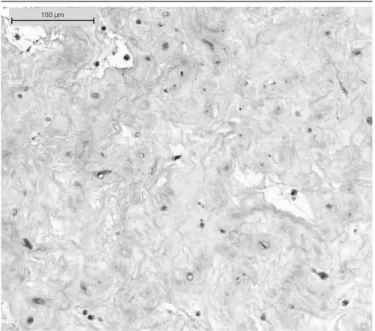
the arteries than the vein (Figure 1). Microscopically, the
umbilical cord showed reduction and edema of Wharton’s jelly
but otherwise normal aspect (Figure 2). Acute inlammatory
iniltrate consistent with stage 3 grade 3 chorioamnionitis was observed in placenta and extraplacental membranes. There was no allantochorial, vasculitis or omphalitis neither onfalomesenteric or allantois vestigial remnants. Areas of old placental infarction were conirmed, the chorionic villi exhibited increased syncytial knots and there is atheroma in uteroplacental vessels.
DISCUSSION
The umbilical cord is composed of two arteries and one vein, reaching variable lengths between 50.0 and 60.0 cm and diameter between 1.5 and 2.0 cm. The blood vessels are embedded in the Wharton’s jelly, a specialized connective tissue composed of myoibroblasts and extracellular matrix, primarily composed of proteoglycans, glycosaminoglycans, and hyaluronic acid(4).
Myoibroblasts are mesenchymal cells with smooth muscle cell characteristics and ibroblasts arranged amid contents of extracellular matrix, which the main component (about 70%) is the hyaluronic acid, an important molecule for the mechanisms of diffusion and osmosis in the umbilical cord(1, 4). This structure gives elasticity to
the umbilical cord so that the main function of Wharton’s jelly is the protection of the umbilical blood vessels, neutralizing the external pressure inluence on blood low between placenta and fetus(4).
Structural abnormalities of the umbilical cord are conditions increasingly recognized, in literature, as being associated with fetal
death in utero(3, 9, 11). Sun et al. (1995)(9) studied 25 cases of fetal
death associated with structural abnormalities of the umbilical cord which revealed that there was no correlation between these causes of fetal death and the age of the pregnant women, their health or the obstetric history(2, 9). In this report, the patient
was young and did not undergo a regular prenatal monitoring hindering the anatomical-clinical correlation.
The umbilical cord abnormalities that may cause damage to the fetal well-being includes rupture and thrombosis of the
FIGURE 2 − Histological section of umbilical cord showing normal appearance of Wharton’s jelly.
FIGURE 1 (A and B) − Linear disruption of Wharton’s jelly of the umbilical cord.
A green meconium stained segment of umbilical cord showing a long segment of linear disruption of Wharton’s jelly starting about two centimeters below the insertion point, with the three cord blood vessels far away from each other.
454
RESUMO
Na literatura, há poucos relatos sobre a ausência de geleia de Wharton. Relatamos o sétimo caso em uma primigesta de 22 anos, admitida após parto vaginal de feto natimorto. O cordão umbilical apresentava longo segmento com esfacelo da geleia e três vasos sanguíneos completamente separados uns dos outros, com mínima quantidade de geleia de Wharton remanescente ao redor de cada vaso. Ausência de geleia de Wharton associa-se a estresse, restrição de crescimento e óbitos fetais. Estudos quantitativos/ qualitativos sobre a geleia de Wharton representam campo de pesquisa aberto para possíveis correlações com condições e doenças obstétricas e óbitos fetais.
Unitermos: cordão umbilical; patologia; geleia de Wharton; óbito fetal.
umbilical vessels, umbilical artery agenesis, and stenosis/ obliteration/constriction of the cord, furcate and velamentous cord insertion, and absence of Wharton’s jelly. These structural changes are strongly associated with intrauterine growth restriction, fetal death and increased rates of cesarean
delivery(2, 3, 9).
Regarding Wharton’s jelly abnormalities, the quantitative alterations of Wharton’s jelly have been linked to conditions such as gestational hypertension, smoking and prematurity(1). Gogiel et al. (2005)(5) studied the changes in the percentage
distribution of the elements of the extracellular matrix of Wharton’s jelly in pregnant women with preeclampsia(5).
The authors demonstrated reduction of proteoglycans with consequential rearrangement of the extracellular matrix and reduced elasticity and the ability to regulate the blood flow(5). The placenta of this case had increased syncytial
knots, infarction, and acute atheroma, which are suggestive of gestational hypertension.
Kulkarni et al. (2005)(6) reported that the decrease in
Wharton’s jelly increases the vulnerability of the blood vessels of the umbilical cord, allowing compressive phenomena that
lead to fetal death(6). Barbieri et al. (2011) report that the
Wharton’s jelly has a progressive increase in its area during
pregnancy, reaching its highest value (70%) between the 31st
and 32nd week of pregnancy(1, 8). These authors also found
that in their series, until the 26th week of gestation, there is a positive correlation with linear growth between the area of Wharton’s jelly and fetal weight. So, umbilical cords with little thickness or where the area of representation of Wharton’s jelly is small, would be more related to stillbirths, prematurity,
and inadequate fetal growth(1). The low percentage of
Wharton’s jelly increases the fragility of the umbilical cord leaving it susceptible to damaging circulatory constrictive
hemodynamics phenomena(8). Filiz et al. (2011) report that
the progressive increases in Wharton’s jelly in accordance with gestational age is accompanied by an increase in fetal and placental weight(4). Both Barbieri et al. (2011) and Filiz et al. (2011) expose the possibility of using the data about
the composition of the umbilical cord, area, and density of Wharton’s jelly in the clinical follow-up of pregnant women, especially in correlation with obstetric complications, such as gestational hypertension, gestational diabetes, and intrauterine growth restriction(1, 4). However, the validity of
potential curves correlating this data with the gestational age, fetal and placental weight lacks in new studies and systematic approaches to the subject.
The extreme reduction, commonly named the Absence of Wharton’s jelly, is a very rare lesion with which the literature has presented a suggestive relationship to meconium staining, low Apgar score, and stillbirths(6, 7).
A typical feature of this lesion is the disruption of Wharton’s jelly with far away separation of umbilical vessels represented in ours and Kulkarni’s Figure 1. The pathogenesis has been attributed to Wharton’s jelly degeneration, early incomplete fusion of amniotic and mesenchymal umbilical tissue, or hypoplasia of amnion and secondary loss of Wharton’s jelly(6).
A relationship to meconium, suggested by Labarrere et al.(7)
but refuted by Thomlon & Hoo(10), is probable since it was
present in ours and in four out of the five previously reported cases.
Studies on Wharton’s jelly, both qualitative and quantitative, are still scarce in the literature, representing an open research field for possible correlations with obstetric problems, such as hypertension intrauterine, fetal growth restriction, as well as allowing the establishment of pathogenic mechanisms for some groups of stillbirths.
455
Cristiano Claudino Oliveira; Rozany Mucha Duloth; Kunie Iabuki Rabello Coelho
REFERENCES
1. BARBIERI, C. et al. Area of Wharton’s jelly as an estimate of the
thickness of the umbilical cord and its relationship with estimated fetal weight. Reprod Health, v. 8, p. 32-7, 2011.
2. BENIRSCHKE, K. Obstetrically important lesions of the umbilical cord.
J Reprod Med, v. 39, n. 4, p. 262-72, 1994.
3. CLAUSEN, I. Umbilical cord anomalies and antenatal fetal deaths.
Obstet Gynecol Surv, v. 44, n. 12, p. 841-5, 1989.
4. FILIZ, A. A. et al. Positive correlation between the quantity of Wharton’s jelly in the umbilical cord and birth weight. Taiwan J Obstet Gynecol,
v. 50, p. 33-6, 2011.
5. GOGIEL, T. Pre-eclampsia associated alterations in Wharton’s jelly proteoglycans. Acta Biochim Pol, v. 52, n. 2, p. 501-5, 2005.
6. KULKARNI, M. L. et al. Absence of Wharton’s Jelly around the umbilical arteries. Indian J Pediatr, v. 74, n. 8, p. 787-9, 2007.
7. LABARRERE, C. et al. Absence of Wharton’s jelly around the umbilical arteries: an unusual cause of prenatal mortality. Placenta, v. 6, p. 555-9, 1985. 8. SKULSTAD, S. M. et al. Effect of umbilical ring constriction on Wharton’s jelly. Ultrasound Obstet Gynecol, v. 28, p. 692-8, 2006.
9. SUN, Y. et al. Umbilical cord stricture and intrauterine fetal death.
Pediatr Pathol Lab Med, v. 15, n. 5, p. 723-32, 1995.
10. THOMLON, L. L.; HOO J. J. Linear disruption of umbilical cord: a rare anomaly of the cord associated with acute fetal distress and perinatal death/profound psychomotor retardation. Am J Med Genet, v. 62, n. 4, p. 348-9, 1996.
11. VIZZA, E. et al. The collagen ibrils arrangement in the Whartons jelly of full-term human umbilical cord. Ital J Anat Embryol, v. 100, Suppl 1, p. 495-501, 1995.
MAILING ADDRESS
Rozany Mucha Duloth