Cervical squamous intraepithelial lesions grades
1 and 2: value of an alternative morphological
classiication and of p16 immunohistochemistry
in the prediction of clinical outcome
Lesões intraepiteliais escamosas cervicais graus 1 e 2: valor de uma
classificação morfológica alternativa e do estudo imuno-histoquímico
com p16 na predição do desfecho clínico
Rafael C. Salim; Tatiana M. Lima; Thais Heinke; Karla C. K. Prigenzi; Neila Maria G. Speck; Gustavo R. A. Focchi
Universidade Federal de São Paulo (Unifesp), São Paulo, Brazil.
First submission on 29/04/17; last submission on 23/10/17; accepted for publication on 24/10/17; published on 20/10/17
ABSTRACT
Introduction: Diagnostic reproducibility and determination of prognostic factors in cervical intraepithelial neoplasias grades 1 and 2 are still relevant problems in the daily practice of gynecological histopathology. Objective: To correlate the value of morphological reclassiication and of p16 immunoexpression in cervical intraepithelial neoplasias grades 1 and 2 with clinical outcome. Materials and methods: Sixty-six patients were included (34 with cervical intraepithelial neoplasia grade 1, and 32 with grade 2); an immunohistochemical study with p16 and reclassiication according to the Lower Anogenital Squamous Terminology (LAST) Consensus and by the alternative proposal of Herfs and Crum were done; unfavorable outcome was deined as a subsequent histologic diagnosis of cervical intraepithelial neoplasia grade 3 or invasive squamous cell carcinoma. Results: We observed superior performance of the alternative morphological classiication (p = 0.002)
to determine unfavorable outcome. We also detected superior performance of p16 in the same determination (p = 0.002). Conclusion:
The use of an alternative morphological classiication is promising; in the context of the use of immunohistochemical antibodies as biomarkers, p16 showed good sensitivity and negative predictive value in the determination of cases in which the outcome was unfavorable.
Key words: cervical intraepithelial neoplasia; cyclin-dependent kinase inhibitor p16; outcome assessment (health care).
INTRODUCTION
Cervical cancer is a neoplasia with a high incidence worldwide, with 528,000 new cases/year, 85% of which occur in developing countries, being responsible for 266,000 deaths(1).
In Brazil, for the year 2016, 16,340 new cases were estimated, with a rate of 15.85/100,000 women(2).
Multiple nomenclature and criteria are still used for diagnostic interpretation of preinvasive squamous lesions in cervical biopsies, contributing to the great intraobserver and interobserver variability. The lowest indices of diagnostic agreement are observed in the
categories of cervical intraepithelial neoplasia grade 2 (CIN 2) and grade 1 (CIN 1). At a study using samples originally interpreted by pathologists from Costa Rica, two independent reviewing pathologists of the National Cancer Institute agreed with only
13% and 31% of the CIN 2 diagnoses, and only 24% and 20% of
CIN 1 diagnoses. There was no agreement between them for any cases diagnosed as CIN 2(3). Additionally, at a more recent
North-American study, agreement of independent reviewing gynecologic pathologists with the initial diagnosis made by pathologists of the state of New Mexico was 38.2% for CIN 1 and 38% for CIN 2(4). At a
study using the diagnostic categories benign, low-grade squamous intraepithelial lesion (LSIL) (CIN 1), and high-grade squamous
intraepithelial lesion (HSIL) (including CIN 2 and CIN 3) in 56 analyzed histological slides by 22 pathologists of four continents, only 20% of the cases received a unanimous diagnosis from all pathologists; and 27%, diagnoses that ranged from benign to HSIL(5).
In the transforming infections by human papillomavirus (HPV) of high oncogenic risk, there is overexpression of p16, which can be detected by immunohistochemistry. This happens due to oncoprotein E7-mediated E2F displacement from its binding site on pRb. Increase in free E2F levels stimulates nuclear and cytoplasmic p16 overexpression(6).
The use of adjunct p16 immunohistochemistry increases inter- and intraobserver agreement in the evaluation of histopathological cervical specimens(6, 7), being recommended
by the Lower Anogenital Squamous Terminology (LAST) Consensus – that oficially introduced complementary methods to the anatomopathologic exam in the diagnostic lowchart of cervical tissue samples – in the following contexts: 1st) samples in which there is doubt between precancerous lesion and benign mimics; 2nd) cases in which the pathologist is considering (or wants to conirm) the diagnostic interpretation of CIN 2(8); and 3rd) diagnostic disagreement between two professionals analyzing the specimen, and whose differential diagnosis includes precancerous lesion. The use of p16 in samples of non-neoplastic cervical tissue or presenting CIN 1 is contraindicated – except in situations of high risk for misdiagnosis of high-grade lesion (deined by previous colpocytologic exam as HSIL, atypical squamous cells – one cannot rule out a high grade lesion (ASC-H) –, atypical squamous cells of uncertain signiicance (ASC-US)/HPV-16+ or atypical glandular cells (AGC) or not otherwise speciied (NOS) (4th context)(9).
The application of p16, despite its high negative predictive value (NPV)(10, 11), is considered limited in predicting evolution or stratifying
the risk of patients with CIN 1, probably not altering management
protocols currently recommended(12, 13). By contrast, the use of p16 in
samples with diagnosis of CIN 2 is associated with downgrading – that is from -IN 2 to LSIL, when p16 is negative – in up to around one third of the cases and, therefore, potentially reduces the frequency of unnecessary excisional procedures in patients with lesions of lower biological risk(14, 15). However, it is important to remember that some
cases of HSIL can exhibit negative or doubtful results for p16, that the marker is not also 100% speciic, and interpretation is made dificult in small or scanty samples, tangential histological sections
or unoriented tissue(16).
More recently, taking into account the limitations of morphological analysis and also immunohistochemical
complementary exam with p16, another group of researchers proposed a pragmatic subdivision of histopathological diagnoses of cervical biopsies into LSIL, HSIL, and questionable grade squamous intraepithelial lesion (QSIL), suggesting that the patients with lesions classiied as QSIL should initially undergo a more rigorous follow-up(17).
Considering the persisting problems in the histopathological diagnosis of CINs (especially CIN 2, a category of low diagnostic reproducibility, variable/uncertain biology, which can generate unnecessary interventions, costs and psychological stress), our study aimed to assess the performance of different
systems of morphological classiication and also of p16 immunohistochemistry in predicting an unfavorable outcome in cases of CIN 1 and CIN 2.
MATERIALS AND METHODS
Cases and clinical outcome
This is a retrospective longitudinal study, which used initial biopsies with histological diagnosis of CIN 1 or CIN 2 of patients treated at Núcleo de Prevenção de Doenças Ginecológicas (NUPREV)
of Universidade Federal de São Paulo (UNIFESP) between January 2008 and March 2015. We evaluated sections obtained from parafin blocks with tissue microarrays (TMA) – previously prepared with samples from NUPREV for use in studies about biomarkers in CINs – and also sections obtained from conventional parafin blocks: using samples of TMA blocks previously constructed, 17 CIN 1 and 13 CIN 2 cases were included; using conventional parafin blocks, 17 CIN 1 and 19 CIN 2 additional cases were included.
Cases were selected for this study based on suitability of samples (that is, presence of the area of interest in the sections for p16 immunohistochemical evaluation) and also on the presence of clinical follow-up with anatomopathological examination. The outcome was obtained through the active search of subsequent diagnoses for all tested cases in the iles of the Department of
TMA construction
The technique was performed as described by Kononen et al. (1998)(18), using a device of ixed base for withdrawal of 1-mm
tissue cylinders. According to availability and size of material, one to three cylinders were obtained per parafin block. From the new slides obtained after TMA confection, and when necessary, from the whole histological sections, we carried out a review of initial diagnosis by Richart’s classiication with division of cases into CIN 1 and CIN 2, according to classical criteria previously established(19), performed in consensus by two pathologists.
Morphological and immunohistochemical
reclassification
According to sample availability, we conducted reclassiication according to: a) alternative morphological evaluation as proposed
by Herfs and Crum(17), distributing cases into LSIL, QSIL and
HSIL; and b) reclassiication of CIN 2 cases with the use of p16 immunohistochemistry (see the following criteria), distributing the cases into LSIL and HSIL.
application of primary antibody (p16INK4a clone G175-405, Zeta
Corporation, in titers standardized by the service in 1/50); reaction ampliication by the use of polymer EnVision Flex (Dako) for 20 min, washing in buffer solution for 5 min, color development of reaction in diamenobenzidine [(DAB); Sigma-Aldrich Chemical] Flex for 5 min and counterstaining with hematoxylin Flex for 10 min. Interpretation was made according to LAST(9)
recommendations into: negative – absence of immunoexpression or focal and/or discontinuous immunoexpression; and positive – diffuse block-positivity (nuclear, with or without associated cytoplasmic positivity) affecting at least the lower third of the epithelium (Figure). The cervical sample with CIN 3 was used as positive external control. The typical endocervical columnar epithelium was used as external negative control; and plasmocytes, used as positive internal control.
Statistical analysis
The categorical variables were described as graphs and tables. The only discrete quantitative variable (age in completed years) was described using mean and standard deviation. If applicable, Fisher’s exact test or its extension was conducted for evaluation of signiicance probability. Value of p < 0.05 was considered
statistically signiicant.
RESULTS
Sample description
When the inclusion and exclusion criteria were applied, 66 patients were included, of which 34 presented initial diagnoses of CIN 1, and 32, of CIN 2, with mean age of 32 ± 9 years. After a minimum follow-up period, we observed nine (13.6%) cases in which there was subsequent histological diagnosis of lesion of higher histological severity (CIN 3 or more severe): two occurred in patients with biopsies initially classiied as CIN 1; the other seven, in patients with biopsies initially classiied as CIN 2 (Table 1).
We must highlight that seven of the nine patients with an unfavorable outcome had presented a concomitant cytology of HSIL; one, previous recent cytology of HSIL; and one, previous concomitant cytology of ASC-H. Besides, all later histopathology diagnoses of more severe histology [eight cases with CIN 3 and one case with squamous-cell carcinoma (SCC) stage IB1] occurred in the irst six months of follow-up, indicating that the most severe lesions were probably already present, but were not sampled in the biopsies used in this study.
FIGURE − Photomicrograph of p16 immunohistochemical staining in cervical squamous intraepithelial lesion, demonstrating minimum criteria for positivity determination according to recommendation of LAST Consensus: strong and diffuse block staining, continuous from the basal layer, nuclear (or nuclear and cytoplasmic), affecting at least the lower third of epithelium (and preferably reaching the middle third) (100×)
LAST: Lower Anogenital Squamous Terminology.
Immunohistochemical reactions and
interpretation
TABLE 4 − Outcome of cases according to the different classiications
Outcomes
Favorable Unfavorable Total p-value Richart’s classiication
CIN 1 32 94.1% 2 5.9% 34 100% 0.079a
CIN 2 25 78.1% 7 21.9% 32 100%
Total 57 86.4% 9 13.6% 66 100%
LAST Consensus
LSIL 41 93.2% 3 6.8% 44 100% 0.051a
HSIL 16 72.7% 6 27.3% 22 100%
Total 57 86.4% 9 13.6% 66 100%
Alternative classiication
LSIL 32 97% 1 3% 33 100% 0.002a
QSIL 15 83.3% 3 16.7% 18 100%
HSIL 6 54.5% 5 45.5% 11 100%
Total 53 85.5% 9 14.5% 62 100%
CIN 1: cervical intraepithelial neoplasia grade 1; CIN 2: cervical intraepithelial neoplasia grade 2; LAST: Lower Anogenital Squamous Terminology; LSIL: low-grade squamous intraepithelial lesion; HSIL: high-grade squamous intraepithelial lesion; QSIL: questionable grade squamous intraepithelial lesion.
a: Fisher’s exact test or its extension. TABLE 1 − General data on the cases (n, age group, and outcome)*
n Age (mean ± SD) Unfavorable outcome
CIN 1 34 32.46 ± 8.47 2
CIN 2 32 32.06 ± 8.82 7
Total 66 32.27 ± 8.58 9
CIN 1: cervical intraepithelial neoplasia grade 1; CIN 2: cervical intraepithelial neoplasia grade 2; SD: standard deviation.
*See text of “Results” (in the section “Sample description”) for more details regarding cases that presented unfavorable outcome.
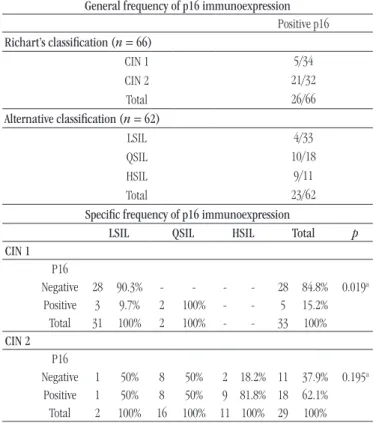
TABLE 2 − General frequency of p16 immunoexpression in Richart’s and the
alternative classiications, and speciic frequency of p16 immunoexpression (correlating both different classiications)
General frequency of p16 immunoexpression
Positive p16
Richart’s classiication (n = 66)
CIN 1 5/34
CIN 2 21/32
Total 26/66
Alternative classiication (n = 62)
LSIL 4/33
QSIL 10/18
HSIL 9/11
Total 23/62
Speciic frequency of p16 immunoexpression
LSIL QSIL HSIL Total p
CIN 1
P16
Negative 28 90.3% - - - - 28 84.8% 0.019a
Positive 3 9.7% 2 100% - - 5 15.2%
Total 31 100% 2 100% - - 33 100%
CIN 2
P16
Negative 1 50% 8 50% 2 18.2% 11 37.9% 0.195a
Positive 1 50% 8 50% 9 81.8% 18 62.1%
Total 2 100% 16 100% 11 100% 29 100%
CIN 1: cervical intraepithelial neoplasia grade 1; CIN 2: cervical intraepithelial neoplasia grade 2; LSIL: low-grade squamous intraepithelial lesion; HSIL: high-grade squamous intraepithelial lesion; QSIL: questionable grade squamous intraepithelial lesion. a: Fisher’s exact test or its extension.
TABLE 3 − Correlation between p16 immunoexpression and outcome
Outcome
Favorable Unfavorable Total p-value S Sp PPV NPV
p16
Negative 39 68.4% 1 11.1% 40 60.6% 0.002a 0.889 0.684 0.308 0.975
Positive 18 31.6% 8 88.9% 26 39.4%
Total 57 100% 9 100% 66 100%
S: sensitivity; Sp: specificity; PPV: positive predictive value; NPV: negative predictive value. a: Fisher’s exact test.
P16 immunohistochemistry
Positivity for p16 was observed in 26 (39.4%) of the cases – ive (14.7%) of the 34 CIN 1 and 21 (65.6%) of the 32 CIN 2. Comparison of the marker frequency distribution in the alternative classiication demonstrated increasing positivity indices in the three proposed
tiers. In the cases initially classiied as CIN 1, positive p16 was more
frequent in the patients reclassiied as QSIL than in those reclassiied as LSIL (p = 0.019) (Table 2). The p16 marker alone – even independently of any classiication – obtained statistical signiicance
in outcome prediction, besides expressive values of sensitivity and NPV for this determination (Table 3).
Classification according to LAST consensus,
alternative morphological classification and
correlation with outcome
DISCUSSION AND CONCLUSION
It is necessary to give a name to everything that is discovered in order to make communication and understanding easy. However, for this to happen, criteria that deine that name must be widely known and also applied in a uniform and objective manner – a process that can take decades. Richart (1967)(19)
formulated a nomenclature that still remains in use in gynecology and pathology clinical practice in many centers, even after it has been the subject of criticism from its own author(20), despite its
limitations(3-5) and the publication of LAST(9), which introduced
new terminology (revised) as gold standard for classiication of non-invasive cervical squamous lesions. That is, CIN still plays an important role in everyday clinical communication due to
its propagation and sedimentation in the scientiic setting; many times the role and limitations – even more important – of biopsy as diagnostic test, endowed with sensitivity, speciicity, predictive values, diagnostic reproducibility, among other characteristics, remaining in second plan. Once medical science always searches for better diagnostic tests, we consider the act of inding new forms of classifying familiar lesions necessary and healthy for progress.
In order to conduct this study, the fundamental classiications for comparison of any new proposal were included: the most widespread and the departure point of the study, Richart’s original (three grades: CIN 1, CIN 2, and CIN 3), and the currently adopted by the World Health Organization (WHO) – that of the LAST Consensus (two grades: LSIL and HSIL). We also tried to evaluate an alternative system that permits a more practical approach: the model proposed by Herfs and Crum, of pure morphological character, without the stringency of the criteria proposed by Richart and admitting the existence of a subgroup of lesions in which one cannot determine the grade, the QSIL (besides LSIL and HSIL).
Reclassiications impacted only the group of cases more subject to diagnostic variability(3-5). The cases belonging to group
CIN 1, in most situations, remained in analogous categories or categories of equivalent meaning; the same cannot be afirmed for group CIN 2: a signiicant proportion of the cases would be reclassiied in categories of potentially divergent management
in the other two analyzed classiication systems. For example, in our case analysis, only 65% of the CIN 2 would be classiied as HSIL according to LAST(8, 9) recommendations, and 40% would
be kept in the same category if we applied the alternative system proposed by Herfs and Crum(17).
The -IN terminology, regardless of site, is prone to subjectivity of criteria application by many diverse reasons, such as intra- and
interobserver variability(3-5), limitations intrinsic to the material
received for analysis(21) – the latter with potential selection bias of
this and several studies on the theme – and also the basic question of these diagnostic terms being applied to lesions with variable morphologic spectra – and possibly different clinical behaviours. The presented data conirm this already evidenced limitation of Richart’s classiication.
Although the present study has not demonstrated statistically signiicant difference between groups determined by LAST Consensus and outcome, we can point there is a non-conirmed tendency possibly because of lack of statistical power (p = 0.051).
The search for information able to determine the presence of a disease or risk of a disease to progress/regress has been the recent aim of numerous studies in the varied ields of medicine. We search what we could call ideal biomarker: cheap, reproducible, with high predictive values, high sensitivity and speciicity(22). In the present
study, with the use of a biomarker in an attempt to predict outcome in cases of non-invasive squamous cervical lesions, we obtained results that contribute with scientiic literature about the theme.
p16 is the most studied marker in the context of non-invasive HPV-related squamous lesions and the only currently oficially indicated for routine use as an ancillary method in evaluation of
these lesions(9). The frequencies observed for p16 immunostaining
agree with descriptions available in the scientiic literature(9).
Data from medical literature widely demonstrate the value of dichotomic classiication of non-invasive cervical squamous lesions attached to the routine application of p16(9).
This work corroborates the previously described information, demonstrating the power of p16 of eventually predicting in which cases there is higher risk of association with diagnosis of more severe, concomitant or future lesion, although with low speciicity. It was also possible to note the high NPV of this marker, as also already demonstrated in the literature(10, 12).
Due to the small dimensions of residual samples in parafin blocks after obtainment of sections for p16 immunohistochemistry and also to non-availability of iquid
based cytology, it was not possible to perform additional methods
such as, for instance, HPV genotyping. However, we must highlight that although the cases of this work did not present better detailing regarding HPV types, the authors believe this case study is the closest to everyday situation in which, frequently, there are no detailed clinical reports, HPV test results, or even previous or concomitant cytological slides for review.
not present any deinitive criterion for the assisting physician to use it, just uncertainty. This allows such terminology to potentially become a subterfuge of technical quality and also a confounding factor for the gynecologist that will provide the deinitive treatment. In spite of the above, in this study, the alternative system was the only that obtained statistical signiicance (p = 0.002), including the highest rate of cases classiied as HSIL displaying unfavorable outcome (45.5%). Based on the results of this study, some considerations are relevant: the lines of the used alternative system have been
just recently described and not well studied, requiring further studies with more cases to determine their actual applicability; the absence of rigid criteria that deine QSIL, despite open to criticism, could on the other hand allow a more complete or comprehensive evaluation of the sample, which should include correlation with results of other inter-related exams(12); the
system is of simple application, and at an initial evaluation, without ethical obstacles for the proposition of its author that cases classiied as QSIL be reassessed in six months, taking into consideration the potentially benign natural history of CIN 2(23).
REFERENCES
1. IARC. Globocan 2012: Estimated cancer incidence, mortality and prevalence worldwide in 2012 [cited 4 Mar. 2017]. Available at: http:// globocan.iarc.fr/Pages/fact_sheets_cancer.aspx.
2. INCA. Estimativa 2016: incidência de câncer no Brasil [cited 4 Mar. 2017]. Available at: http://www.inca.gov.br/estimativa/2016/mapa. asp?ID=5.
3. Carreon JD, Sherman ME, Guillén D, et al. CIN2 Is a much less reproducible and less valid diagnosis than CIN3: results from a histological review of population-based cervical samples. Int J Gynecol Pathol. 2007; 26: 441-6.
4. Stoler MH, Ronnett B, Joste NE, Hunt WC, Cuzick J, Wheeler CM. The interpretive variability of cervical biopsies and its relationship to HPV status. Am J Surg Pathol. 2015; 39: 729-36.
5. Ceballos KM, Chapman W, Daya D, et al. Reproducibility of the histological diagnosis of cervical dysplasia among pathologists from 4 continents. Int J Gynecol Pathol. 2007; 26: 101-7.
RESUMO
Introdução: A reproducibilidade diagnóstica e a determinação de fatores prognósticos em neoplasias intraepiteliais cervicais
graus 1 e 2 ainda são problemas relevantes na prática diária da histopatologia ginecológica. Objetivo: Correlacionar o valor
da reclassificação morfológica e da imunoexpressão do marcador p16 em neoplasias intraepiteliais cervicais graus 1 e 2 com o
desfecho clínico. Materiais e métodos: Incluídas 66 pacientes (34 com neoplasia intraepitelial cervical grau 1 e 32 com grau 2);
realizou-se estudo imuno-histoquímico com p16 e reclassificação segundo o Consenso Lower Anogenital Squamous Terminology (LAST) e a proposta alternativa de Herfs e Crum; desfecho desfavorável foi definido como diagnóstico histológico subsequente de
neoplasia intraepitelial cervical grau 3 ou carcinoma de células escamosas invasivo. Resultados: Observamos performance
superior da classificação morfológica alternativa (p = 0,002) para determinação de desfecho desfavorável. Também detectamos
performance superior do marcador p16 na mesma determinação (p = 0,002). Conclusão: A utilização de uma classificação
morfológica alternativa é promissora. No âmbito da utilização dos anticorpos imuno-histoquímicos como biomarcadores, o p16 apresentou boa sensibilidade e valor preditivo negativo na determinação dos casos em que o desfecho foi desfavorável.
Unitermos: neoplasia intraepitelial cervical; inibidor p16 de quinases dependentes de ciclina; evolução clínica.
6. Horn LC, Reichert A, Oster A, et al. Immunostaining for p16INK4a used as a conjunctive tool improves interobserver agreement of the histologic diagnosis of cervical intraepithelial neoplasia. Am J Surg Pathol. 2008; 32(4): 502-12.
7. Dijkstra MG, Heideman DA, de Roy SC, et al. p16(INK4a) immunostaining as an alternative to histology review for reliable grading of cervical intraepithelial lesions. J Clin Pathol. 2010; 63(11): 972-7. 8. Maniar KP, Nayar R. HPV-related squamous neoplasia of the lower anogenital tract: an update and review of recent guidelines. Adv Anat Pathol. 2014; 21: 341-58.
9. Darragh TM, Colgan TJ, Cox JT, et al. The lower anogenital squamous terminology standardization project for HPV associated lesions: background and consensus recommendations from the College of American Pathologists and the American Society for Colposcopy and Cervical Pathology. Arch Pathology Lab Med. 2012; 136: 1-32.
11. da Costa LB, Triglia RM, França Junior MC, Andrade LA. p16INK4a expression as a potential marker of low-grade cervical intraepithelial neoplasia progression. APMIS. 2015; 123: 185-9.
12. Mills AM, Paquette C, Castle PE, Stoler MH. Risk stratiication by p16 immunostaining of cin1 biopsies: a retrospective study of patients from the quadrivalent HPV vaccine trials. Am J Surg Pathol. 2015; 35: 611-7. 13. Sagasta A, Castillo P, Saco A, et al. p16 staining has limited value in predicting the outcome of histological low-grade squamous intraepithelial lesions of the cervix. Mod Pathol. 2016: 29: 51-9. 14. Maniar KP, Sanchez B, Paintal A, Gursel D, Nayar R. Role of the biomarker p16 in downgrading-in 2 diagnoses and predicting higher-grade lesions. Am J Surg Pathol. 2015; 39: 1708-18.
15. de Sam Lazaro S, Newbill CP, Berlin M, Morgan TK. p16 staining of cervical biopsies may decrease the frequency of unnecessary loop electrosurgical excision procedures. J Low Genit Tract Dis. 2016; 20(3): 201-6.
16. Mahajan A. Practical issues in the application of p16 immunohistochemistry in diagnostic pathology. Hum Pathol. 2016; 51: 64-74.
17. Herfs M, Crum CP. Laboratory management of cervical intraepithelial neoplasia: proposing a new paradigm. Adv Anat Pathol. 2013: 20: 86-94. 18. Kononen J, Bubendorf L, Kallioniemi A, et al. Tissue microarrays for high-throughput molecular proiling of tumor specimens. Nat Med. 1998; 2: 844-7.
19. Richart RM. Natural history of cervical intraepithelial neoplasia. Clin Obstet Gynecol. 1967; 10: 748-84.
20. Richart RM. A modiied terminology for cervical intraepithelial neoplasia. Obstet Gynecol. 1990; 75: 131-3.
21. Lee S, Sabourin J, Gage J, Franko A, Nation JG, Duggan MA. Squamous intraepithelial lesions in cervical tissue samples of limited adequacy and insuficient for grading as low or high grade: outcomes, clinico-pathological correlates, and predictive role of p16INK4a and Ki67 biomarker staining. J Low Genit Tract Dis. 2015; 19(1): 35-45.
22. Parikh NI, Vasan RS. Assessing the clinical utility of biomarkers in medicine. Biomarkers Med. 2007; 1: 419-36.
23. Moscicki A-B, Schiffman M, Burchell A, et al. Updating the natural history of human papillomavirus and anogenital cancers. Vaccine. 2012; 30: F24-33.
CORRESPONDING AUTHOR
Thais Heinke