Artigo Original
Maria Thereza Mazorra dos Santos1 Debora Maria Bei-Lopes1
Descritores
Testes de linguagem Aprendizagem Estudos de linguagem Educação Escrita manual
Keywords
Language tests Learning Language arts Education Handwriting
Correspondence address: Maria Thereza Mazorra dos Santos Alameda Rio Negro, 911/707, Alphaville, Barueri (SP), Brazil, CEP: 06454-000. E-mail: [email protected]
Received: 07/26/2012
Accepted: 09/13/2012
Study carried out at the Physical Therapy, Speech-Language Pathology and Audiology and Ocupational Therapy Department, School of Medicine, Universidade de São Paulo – USP – São Paulo (SP), Brazil.
(1) Physical Therapy, Speech-Language Pathology and Audiology and Ocupational Therapy Department, School of Medicine, Universidade de São Paulo – USP – São Paulo (SP), Brazil.
Conlict of interest: nothing to declare.
based on a word dictation task
Análise da ortograia de alunos do 4º ano do Ensino
Fundamental a partir de ditado de palavras
ABSTRACT
Purpose: Thepurpose of this study was to establish a proile of the spelling patterns studied in students from public and private schools and to describe a word spelling task for clinical and educational settings. Methods:
Eighty-two fourth grade students belonging to the elementary school of public and private schools in São Paulo, ranging in age from nine to ten years, took part in this study. The spelling task consisted of a list of ten high frequency words (HFW), ten low frequency words (LFW), and ten pseudowords (PW), in which the typology and number of spelling errors were described. To compare the average number of mistakes on the HFWs, LFWs, and PWs, we used an analysis of variance and Tukey’s multiple comparisons (p<0.05). Using a cluster analysis, homogeneous groups were formed based on their performance. Results: Results indicated that the average number of mistakes in the LFWs was higher than in the HFWs (p=0.000) and PWs (p=0.000), and the number of mistakes in the HFWs was lower than in the PWs (p=0.009). The highest number of mistakes was found in the following categories: “others”, “rule generalization”, “omission”, “voiced-voiceless”, and “addition”. There were no mistakes of the type “ão-am” and “blend-separation” in the HFWs. Conclusion:
Spelling errors are a part of the process of learning to write, and students can show some variance in spelling performance. Furthermore, students need to be stimulated to analyze words and their aspects of phonology, morphology, and semantics. An analysis from the types of errors is not enough to plan intervention programs, but instead is necessary to understand the strategies that the child uses to write.
RESUMO
INTRODUCTION
Until the second half of the last century, a notion pre-vailed that children learned to spell by memorizing the letters of a printed word because writing is not a linear representa-tion of the spoken language, thus being arbitrary and many times irregular and illogic. With the research developed by psycholinguistics in the 1970’s, children started to be seen as strategic apprentices who are actively involved in the tasks with which they are confronted, and among these tasks is learning to spell. A revision on the theories and methods of how to read and write revealed a progression that followed a regular evolutionary line with three distinct major periods: differentiating between the ways of iconic and non-iconic representation, building forms of differentiation between writings by progressively controlling the variations of quali-tative and quantiquali-tative viewpoints, and writing phonetization. Thus, four consecutive phases were described: pre-syllabic, syllabic, syllabic-alphabetical, and alphabetical(1). In the
1980’s, other theories described the spelling development in a series of qualitatively different stages. In general lines, these theories advocated that in order to write, children would, at irst, be worried about symbolizing sounds using their knowledge of phoneme-grapheme associations and the names of the letters to represent them. Only later would chil-dren start to represent sounds in a different way, depending on their context in the word. Later still, they would use their morphological knowledge, representing morphemes instead
of phonemes(2,3). Although the phoneme-grapheme
associa-tion plays a central role in the beginning of spelling learning, children also use morphological knowledge and information on the sequences of letters that are possible to occur in the
written word(4). The words can be written by memory, by
analogy, or invented. To write a word by memory requires that the individual should know the spelling of this word beforehand. To write by analogy requires that the individual should recognize the phonological similarities between the target word and other known words so that the parts of known words which represent the similarity between them, are transferred to the spelling of the new word. And inally, to write by inventing requires the analysis of the words by phonemes and the application of the alphabetical knowledge of the grapheme-phoneme correspondence to create the spelling, using clues such as the names of the letters(5-7).
During the assessment of the writing system by children, orthographic trials are frequently incorrect because the child’s phonological conscience is still developing, as well as his/her knowledge of the alphabetical system. The errors also become less common as the child advances as a result of exposure to reading. By means of the experience acquired with printed words(8), children start developing orthographic
knowledge, which is related to the understanding of the writing system conventions, including the notion of spaces between words, sequences of acceptable and inacceptable letters, and several representations of certain phonemes, depending on their positions in words. This knowledge plus
the phonological conscience, determines how spelling is mastered. To write any word, even those of low frequency and pseudowords (PW), implies a lexicon search. To ind a lexical representation, a process is invoked that is both orthographic and phonological because such information is intrinsic to the word representation. The failure in inding a lexical representation triggers a process of conversion of phonemes in graphemes, probably by consulting the entries in the lexicon that share the phonemes with an unfamiliar word or PW(9). Traditionally, it was advocated that writing
by analogy would appear only from ten years of age and forward(10). However, children of ages between six and seven
are capable of making orthographic analogies(8). This
hap-pens as soon as they are familiar with relevant patterns of association between phonological segments and graphemes,
letter sequences, or PWs(11) because the presentation of a
familiar or unfamiliar word simultaneously activates its representation in the orthographic lexicon and the various phoneme-grapheme associations that characterize it in the writing system.
Another source of knowledge used by children to guide their spelling learning is the morphologic relationship between words. English language studies(12,13) suggest that children
initially write verbs and non-verbs in the past tense using a phonetic strategy. As their morphologic conscience increases, their orthographic competence improves considerably by en-abling a wider understanding of the word-forming processes. Speciic training in morphologic conscience has been indicated to improve the child’s performance in spelling words(14,15).
Children adapt their writing strategy according to the type of word they have to write(16).
It is commonly accepted that the orthographic perfor-mance improves as schooling progresses. This fact has been conirmed and a classiication of spelling errors for students from the second to the ifth grade of elementary school in private schools in the city of São Paulo has been proposed(17).
The process of learning how to spell is not linear because it depends on the characteristics of the written language itself, which can be more or less complex for a student to under-stand. They should be analyzed within an evolutionary process that occurs progressively, the errors being inherent to such a process(18). Some studies concerning the Portuguese language
have analyzed the performance of elementary school students using the typology of the errors cited above. A high incidence of errors, such as multiple representations, support on oral-ity, rule generalization, omissions, blend/separation(19,20),
and lack of stress accents, has been found(21). A difference
in orthographic performance has also been observed in the spelling task and writing(19), in addition to an average decrease
of spelling errors as schooling progresses(19). Due to the
dis-crepancy between performances in spelling words and PWs, it was suggested that children use a memory strategy in spell-ing. This can be achieved once the child do not necessarily transfer the generative use of rules that he/she conventionally use in the writing of words, to the writing of PWs(20). The
frequency words (LFW), followed by PWs and inally, high frequency words (HFW)(22).
The objectives of this study were to characterize the spell-ing pattern of students from the fourth grade of the elementary school of public and private schools and to present a tool involving dictation of words that is easily applied, both in the clinical and educational contexts.
METHODS
Participants
This research was approved by the Committee on Ethics in Research, Hospital das Clínicas, School of Medicine of São Paulo University (FMUSP) under the number 410/04.
Eighty-two children from nine to ten years of age from the fourth grade of the elementary school of public (n=41) and private (n=41) schools of São Paulo (Brazil), participated in the research. They were selected according to the following criteria: (1) recommendations from teachers, as they did not show any speech, language, or learning problems, (2) no history of language disorder, phonological disorder, and/or previous speech therapy, as revealed by a questionnaire answered by parents or their representatives, and (3) normal performance in the appointment in the phonology area examination – ABFW(23)
that is standardized for Brazilian Portuguese. All the people responsible for the participants signed the terms of free and informed consent.
Material
In order to identify possible writing strategies, we used dif-ferent categories of stimulus words in dictation, which consisted of ten HFWs and ten LFWs that were randomly selected from a computerized program – “counting the frequency of words exposed to children in the pre-school and initial grades of the elementary school”(24); the words for dictation also included ten
PWs. To avoid similarity with frequent words, the PWs were created from LFWs that were not used in this list, changing one or two letters (Appendix 1).
Procedures
The test that composes the protocol of this research was applied in the school at the time when the student was there, in a group session. Firstly, HFWs, then the LFWs, and inally the PWs were dictated. Each word was dictated twice. The data analysis for this test consisted in obtaining the number and the classiication of the errors according to the criteria established by Zorzi(17). Errors of the types “multiple representations” and
“support on orality” were not considered in the case of PWs because it was expected that orality would be the base for the child to write such words and that any grapheme possible would be chosen to represent them, according to the Brazilian Portuguese phonotactic rules.
Statistical analysis
A descriptive statistical analysis of the dictation results was carried out with the objective of summarizing the obser-vations. The average number of errors in a certain category and word type was calculated as follows: the total number of errors in this typology and word type divided by the total number of participants (n=82). To compare the average num-ber of errors in the three word categories (HFW, LFW, and PW), the repeated-measures analysis of variance technique was adopted(25). The square root of the number of errors was
considered in the analysis so as to satisfy the suppositions nec-essary to apply the technique. Tukey’s multiple comparison method was also employed to compare the average numbers of HFWs, LFWs, and PWs.
To complete the analyses and with the objective of forming homogeneous groups by establishing performance parameters regarding the dictation test results, the mean distance method was employed, the Euclidean distance being adopted as a measure of dissimilarity between the individuals from which four groups of participants were established and characterized using the cluster analysis technique(26).
The signiicance level used for all the inferential analyses was p<0.05.
RESULTS
The dictation tests conducted for the 82 children were analyzed, and the results are presented below.
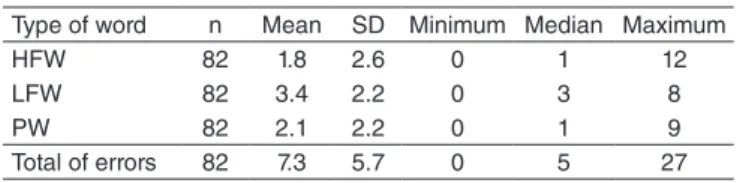
Table 1 shows the results of the descriptive statistics for the number of errors from the dictation of HFWs, LFWs and PWs.
By comparing the average number of errors in the three word categories, it was observed that such values were different for HFWs, LFWs, and PWs (p=0.000). Multiple comparisons showed that the average number of errors for LFWs were higher than that for HFWs (p=0.000) and PWs (p=0.000), and the number of errors for HFWs was smaller than that for PWs (p=0.009).
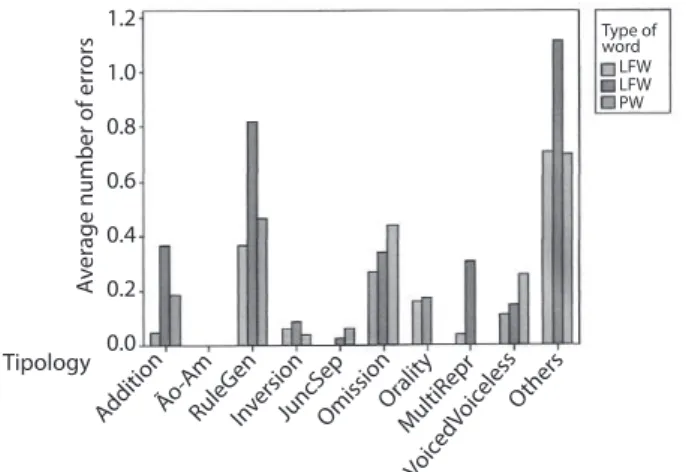
The average numbers of errors per student, according to typology and word category are presented in Figure 1.
We could observe that in the three word categories, most errors occurred in the error types “others”, “rule generalization”, “omis-sion”, “voiceless-voiced”, and “addition”. Errors of the “ão-am” type did not occur in any of the three categories. There were no errors of the “blend-separation” type in the HFW category. Table 1. Descriptive statistics for the number of errors during spelling of high frequency words, low frequency words, and pseudowords
Type of word n Mean SD Minimum Median Maximum
HFW 82 1.8 2.6 0 1 12
LFW 82 3.4 2.2 0 3 8
PW 82 2.1 2.2 0 1 9
Total of errors 82 7.3 5.7 0 5 27
Aiming at providing performance parameters in the test for the age interval of the study, an analysis of the quantity of errors made by the children was carried out. Table 2 represents the averages of the quantity of errors, which helped in the forma-tion of four groups; the table also presents the total number of spelling errors from the children’s performance.
had already mastered the grapheme-phoneme correspondence and had begun to face the contradiction that the sound identity does not guarantee the letter identity and vice-versa, meaning that the children had already understood orthographic dif-iculties.In our study, there were a greater number of errors in the LFW category, followed by PWs and lastly by HFWs, which agree with data already reported in the literature(22). Not
all HFWs used in our study are regular words, and thus, the participants had to know their spelling beforehand. It seems plausible to conclude that by writing these words, they also made use of a writing-by-memory process that resulted from a greater exposure(8) to reading, which is already expected of
the children from this grade. Writing PWs, on the other hand, requires that the participant makes use of a phonologic codi-ication. Provided that the child has some domain knowledge in grapheme-phoneme correspondence, and understands the writing system conventions and the acceptable and inaccept-able sequences of letters, he/she would not have much dif-iculty in writing invented words, which is, in fact, what we observed in our study. However, as we analyzed some examples of errors in this category, we noticed that the children also used some strategy of word analogy with their orthographic lexicon to write these words, for example: jonisgo instead of joãoisgo(9-11). Likewise, some LFWs seem to have been
writ-ten by analogy with their lexicon(9), such as cota, which was
spelled corta, causing an increase in number of errors of the “addition” type. According to the results, there were a greater number of errors of the “others” type in all word categories. What may have contributed to this fact were the ive types of stress errors made by the students. The stress errors observed in this study were of ive types: (a) lack of stress accent, e.g. comprará for comprara, (b) unnecessary stress accent in the correct tonic syllable, e.g. juba for júba, (c) unnecessary stress accent in the wrong tonic syllable, e.g. veja for vejá, (d) use of the wrong stress accent, but necessary in the correct syllable, e.g. também for tambêm, and (e) use of the neces-sary and correct stress accent, but on the wrong syllable, e.g. também for tambêm. These data indicate that the fourth grade children already have concerns about stress accents and that they have still not mastered the application rules. The study of Portuguese, in which the authors added this category in the typology of error analysis(21), attested a high number of errors
related to stress accents. Studies on error typology in word spelling(18-21) report high error indexes of the type: “multiple
representation”, “rule generalization”, “omission”, and “sup-port on orality”. Excluding the typology “others”, the results obtained in this study also point to a higher number of errors in these four typologies, in particular in the “rule generalization” category. Probably, considering the age interval of the children of our study, the orthographic rules have not been totally in-ternalized and automatized yet. However, we were surprised to ind a larger number of errors in the category “support on orality” than in “multiple representations” when it came to spelling HFWs. This fact led us to think whether the “support on orality” error type should be considered a natural phase in writing development, especially in a relatively transparent spelling language such as the Brazilian Portuguese, in which
1.2
1.0
0.8
0.6
0.4
0.2
0.0
A
ver
age number of er
rors
Tipology
Additionà o-Am
RuleG en
InversionJuncS ep
OmissionOr ality
MultiR epr
Others
Voic edV
oiceless
LFW LFW PW Type of word
Legend: HFW = high frequency words; LFW = low frequency words; PW = pseu-dowords; MultiRepr = multiple representation; Orality = exchange based on speech; Omission = omission of letters or syllables; JuncSep = junction or separation of words; Ão-Am = exchange of <ão> by <am> and vice-versa; RuleGen = Rule Generalization; SurdSon = exchange of voiceless and voiced; Addition = addition of letters or syllables; Inversion = inversion of letters or syllables
Figure 1. Average number of errors by typology in the spelling of high frequency words, low frequency words, and pseudowords
DISCUSSION
According to the results presented here, we observed that the children from the fourth grade of the elementary school, re-gardless of whether they came from a public or private school, Table 2. Average of the number of errors in the spelling of high frequency words, low frequency words and pseudowords and the total of errors in the groups obtained from the cluster analysis.
Variable Group n Average
HFW
1 52 0.8
2 22 2.2
3 2 12.0
4 6 4.8
LFW
1 52 2.5
2 22 4.1
3 2 7.0
4 6 6.7
PW
1 52 1.4
2 22 3.5
3 2 5.5
4 6 3.0
Total of errors
1 52 4.7
2 22 9.8
3 2 24.5
4 6 14.5
the strategy known as “support on orality” is very eficient at the beginning of the alphabetization. It seems that this strategy is still much used by the fourth grade students, even if they demonstrate a certain orthographic domain related to “multiple representations” in the HFWs. This is an interesting aspect because it has a direct inluence on teaching how to spell and may aid in the rehabilitation of reading and writing disorders. In alphabetization, children are encouraged to base their understanding on orality to reach the domain of the writing alphabetic principle. However, as schooling progresses, this strategy only correlates with the correct spelling of regular words(16). Therefore, it cannot be expected that they would
naturally abandon this strategy. It is necessary to stimulate them to carry out the intralexical and morphologic analysis of the words to reach the orthographic domain(14,15). We cannot
avoid mentioning the errors of the “voiceless-voiced” type, which in theory should not be expected in any age interval. However, they occurred mainly in pseudowords (e.g. resvilar for resilar) and LFWs (e.g. zurrar for surra) or in longer HFWs (e.g. adição for atição and complete for combreti). A possible explanation would be that, with a higher demand of phonologi-cal processing to write such words, some interference in the phoneme-grapheme codiication occurred which indicated that children acquiring the written code could eventually present this type of exchange. Another aspect in which our study is discordant with those cited before, is the lack of errors of the “ão-am” type. As the stimulus words of our study were selected randomly(24), only two contained the termination <-ão> and
exactly in the HFW category; these words were “adição” and “operação”. Besides, it is possible that this type of error was not found with a higher frequency in our study because this confusion is much stronger in the <-am> for <-ão> conversion, such as <estavam> for <estavão>, and also because we did not have any word terminating with <am> in our dictation. Many of the “support on orality” errors, such as infame for infami and “ão-am” substitutions could have been minimized if the children had been taught to pay more attention to su-prasegmental traces, which are correlated not only to stress but also to spelling. The analysis of the use of morphologic strategy in writing was not the initial proposal of this study as this would require a different research procedure controlling other orthographic variables. However, in our experiment with LFWs, we presented the word comprará, whose last syllable is a morpheme that designates the third person singular of the present future and which was very often written without the accent, indicating that besides not mastering the stress rules, the children did not use other hints to write this word but used the grapheme-phoneme association. This is in agreement with authors who have suggested that children initially write verb tenses using a phonetic strategy, but as their morphologic con-science increases, their orthographic competence signiicantly increases(4,13,15). However, this supposition must be taken with
caution because a morphologic analysis in this level depends on a speciic teaching of the topic, which probably has not happened in the fourth grade. As a result, we agree with au-thors(14,15) who indicate training in morphologic conscience
to improve the performance in spelling. For example, many
errors of the “multiple representations” type would be reduced if the children were taught to analyze the morphologic charac-teristics of the word, enhancing the orthographic similarities between them, stimulating the children to create larger units of orthographic recognition, and reducing memory overload, e.g. the use of <ss> in the subjunctive imperfect past: falasse, vendesse, or partisse.
The four groups of individuals established and character-ized by the cluster analysis technique seem to demonstrate that learning how to spell is a not linear process; it depends on the characteristics of the written language itself, which can be more or less complex for students to understand and which should be analyzed within an evolutionary process that occurs progressively. The errors are an inherent part of this process(18) and therefore, variations in mastering the
rules will occur.
Orthographic mastering involves several factors, and an analysis based only on the types of errors is not totally satisfac-tory. It is also necessary to understand which strategies the child uses to write. In this regard, future research should contemplate controlled procedures to analyze the types of strategies used, in addition to the comparison of orthographic performance in written tasks involving dictation, spelling, and lexical ortho-graphic decision. Such procedures could supply data in order to develop more stimulating methods of teaching students to spell correctly. What we observed in our study was that errors are an inherent part of the writing development process and that to master spelling, the students must be encouraged to analyze words in their phonological, morphologic, and semantic as-pects. To most people, spelling is an ever-lasting learning which accompanies vocabulary acquisition. Thus, teaching should not focus on memorization of how words are written but on helping the student to develop orthographic analysis resources that could be the real tools leading to domain knowledge of the orthographic code.
CONCLUSION
The general objectives of this study were the analysis and characterization of spelling patterns by testing students of the fourth grade of the elementary school from public and private schools in São Paulo and the development of a word spelling tool that is easily applicable in both clinical and educational contexts.
We could observe that errors are a part of the writing process development and that the students may show some variability in mastering spelling. In order to correctly spell words, the students should be encouraged to analyze words according to their phonological, morphologic, and semantic aspects. As the orthographic mastering involves several factors, an analysis based only on the types of errors is not enough; it is also nec-essary to understand which strategies the child uses to write.
REFERENCES
1. Ferreiro E, Teberosky A. Psicogênese da lingua escrita. 2a ed. Porto Alegre: Artes Médicas; 1989.
2. Ehri L. Sources of dificulty in learning to spell and read. In: Wolraich ML, Routh DK. Advances in Developmental and Behavioral Pediatrics. v. 7. Greenwich, Connecticut: JAI Press; 1986. p. 121-95.
3. Gentry JR. An analysis of developmental spelling in GNYS AT WORK. The Reading Teacher.1982;36:192-200.
4. Treiman R, Cassar M. Effects of morphology on children’s spelling of inal consonant clusters. J Exp Child Psychol. 1996;63(1):141-70. 5. Treiman R, Kessler B. The role of letter names in the acquisition of
literacy. Adv Child Dev Behav. 2003;31:105-35.
6. Cardoso-Martins C, Batista ACE. O conhecimento do nome das letras e o desenvolvimento da escrita: evidência de crianças falantes do português. Psicol Rel Crít. 2005;18(3):330-6.
7. Pollo TC, Kessler B, Treiman R. Vowels, syllables, and letters names: differences between young children’s spelling in English and Portuguese. J Exp Child Psychol. 2005;92(2):161-81.
8. Nation K, Angell P, Castles A. Orthographic learning via self-teaching in children learning to read in English: effects of exposure, durability, and context. J Exp Child Psychol. 2007;96(1):71-84.
9. Perfetti CA. The psycholinguistics of spelling and reading. In: Perfetti CA, Rieben L, Fayol M. Learning to spell: research, theory, and practice across languages. Mahwah, New Jersey: Lawrence Erlbaum; 1997. p. 21-38. 10. Campbell R. When children write nonwords to dictation. J Exp Child
Psychol. 1985;40(1):133-51.
11. Barry C, Seymour PHK. Lexical primming and sound-to-spelling contingency effects in nonword spelling. Q J Exp Psychol.1988;40(1A):5-40.
12. Treiman R, Cassar M, Zukowski A. What types of linguistic information do children use in spelling? The case of laps. Child Dev. 1994;65(5):1310-329.
13. Nunes T, Bryant P, Bindman M. Morphological spelling strategies: developmental stages and processes. Dev Psychopathol. 1997;33(4):637-49.
14. Nunes T, Bryant P, Olsson JM. Learning morphological and phonological spelling rules: an intervention study. Scientiic Studies of Reading. 2003;7:289-307.
15. Queiroga BAM, Lins MB, Pereira MALV. Conhecimento morfossintático e ortografia em crianças do Ensino Fundamental. Psi Teor e Pesq. 2006;22(1):95-100.
16. Sénéchal M, Basque MT, Leclaire T. Morphological knowledge as revealed in children’s spelling accuracy and reports of spelling strategies. J Exp Child Psychol. 2006;95(4):231-54.
1 7. Zorzi J. Aprender a escrever: a apropriação do sistema ortográico. Porto Alegre: Artes Médicas; 1998.
18. Zorzi J. Desvios na ortograia. In: Ferreira LP, Bei-Lopes DM, Limongi SCO, organizadores. Tratado de fonoaudiologia. São Paulo: Rocca; 2005. p. 877-91.
19. Bacha SMC, Maia MBA. Ocorrência de erros ortográicos: análise e compreensão. Pro Fono. 2001;13(2):219-26.
20. Queiroga BAM, Borda DM, Vogeley ACE. Habilidades metalinguísticas e a apropriação do sistema ortográfico. Rev Soc Bras Fonoaudiol. 2004;9(2):73-80.
21. Ávila CRB, Ramos CS, Frigerio MC, Lucas S. Análise da escrita de escolares de 4ª série do ensino fundamental das redes pública e particular. Rev Soc Bras Fonoaudiol. 2001;1:23-8.
22. Dias RS, Ávila CRB. Uso e conhecimento ortográico no transtorno especíico da leitura. Rev Soc Bras Fonoaudiol. 2008;13(4):381-90. 23. Wertzner HF. Fonologia. In: Andrade CRF, Bei-Lopes DM, Fernandes
FDM, Wertzner HF. ABFW, teste de Linguagem infantil nas áreas de fonologia, vocabulário, luência e pragmática. Carapicuíba (SP): Pró Fono; 2000. p. 5-40.
24. Pinheiro A. Contagem de frequência de ocorrência e análise psicolinguística de palavras expostas a crianças na faixa pré-escolar e séries iniciais do 1º Grau. São Paulo: Associação Brasileira de Dislexia; 1996.
25. Neter J, Kutner MH, Nachtsheim CJ, Wasserman W. Applied Linear Statistical Models. 4th ed. Chicago: Irwin; 1996.
26. Johnson RA, Wichern DW. Applied Multivariate Statistical Analysis. 3rd ed. New Jersey: Prentice-Hall; 1992.
Appendix 1. Dictation*
High frequency words Low frequency words Pseudowords
isto Juba guco
veja cota ceor
hora riem avem
cada Cera oxal
também Infame dropel
adição Abater golato
cidade Zurrar fercar
problema descarga quesbeita
operação amarrava jonfisgo
complete comprará resvilar