Experimental evidence of pharmacological management of anchorage
in Orthodontics: A systematic review
Felipe José Fernández-González1, Aránzazu Cañigral2, Felipe Balbontín-Ayala3, José Manuel Gonzalo-Orden4, Felix de Carlos5, Teresa Cobo5, Jose Pedro Fernández-Vázquez6, Fernando Sánchez-Lasheras7, José Antonio Vega8
Introduction: Orthodontic anchorage is one of the most challenging aspects of Orthodontics. Preventing undesired movement of teeth could result in safer and less complicated orthodontic treatment. Recently, several reviews have been published about the ef-fects of different molecules on bone physiology and the clinical side efef-fects in Orthodontics. However, the efef-fects of local application of these substances on the rate of orthodontic tooth movement have not been assessed. Objectives: The aim of this research was to analyze the scientific evidence published in the literature about the effects of different molecules on orthodontic anchorage. Methods: The literature was systematically reviewed using PubMed/Medline, Scopus and Cochrane databases from 2000 up to July 31st, 2014.
Articles were independently selected by two different researchers based on previously established inclusion and exclusion criteria, with a concordance Kappa index of 0.86. The methodological quality of the reviewed papers was performed. Results: Search strategy identified 270 articles. Twenty-five of them were selected after application of inclusion/exclusion criteria, and only 11 qualified for final analysis. Molecules involved in orthodontic anchorage were divided into three main groups: osteoprotegerin (OPG), bisphosphonates (BPs) and other molecules (OMs). Conclusions: Different drugs are able to alter the bone remodeling cycle, influencing osteoclast function and, therefore, tooth movement. Thus, they could be used in order to provide maximal anchorage while preventing undesired movements. OPG was found the most effective molecule in blocking the action of osteoclasts, thereby reducing undesired movements.
Keywords:Tooth movement. Orthodontic anchorage procedures. Osteoprotegerin. Bisphosphonates. Anti-inflammatory agents.
How to cite this article: Fernández-González FJ, Cañigral A, Balbontín-Ayala F, Gonzalo-Orden JM, Carlos F, Cobo T, et al. Experimental evidence of pharmaco-logical management of anchorage in Orthodontics: A systematic review. Dental Press J Orthod. 2015 Sept-Oct;20(5):58-65.
DOI: http://dx.doi.org/10.1590/2177-6709.20.5.058-065.oar
Submitted: October 27, 2014 - Revised and accepted: March 07, 2015
» The authors report no commercial, proprietary or financial interest in the products or companies described in this article.
Contact address: Felipe José Fernández González E-mail: [email protected]
1 Professor, University of Oviedo, Postgraduate program in Orthodontics and
Dentofacial Orthopedics, Asturias, Spain.
2 Professor, University of Valencia, Postgraduate Program in Orthodontics and
Dentofacial Orthopedics, Valencia, Spain. 3 Private practice, University of Andes, Chile.
4 Full Professor and Chair, University of León, School of Veterinary Medicine,
Department Surgery and Radiology, Léon, Spain.
5 Professor, University of Oviedo, Department of Surgery and Medical-Surgical
Specialties, Asturias, Spain.
6 Private practice, University of Oviedo, Spain.
7 Department of Construction and Manufacturing Engineering, University of
Oviedo.
8 Full professor and Chair, University of Oviedo, School of Medicine,
Department Morphology and Cell Biology, Asturias, Spain. DOI: http://dx.doi.org/10.1590/2177-6709.20.5.058-065.oar
Introdução: a ancoragem ortodôntica é um dos aspectos mais desafiadores da Ortodontia. A prevenção de movimentos dentários indese-jados poderia resultar em um tratamento ortodôntico mais seguro e menos complexo. Recentemente, foram publicadas várias revisões de literatura sobre os efeitos de diferentes substâncias na fisiologia do tecido ósseo e os efeitos colaterais clínicos na Ortodontia. Porém, os efeitos da aplicação local dessas substâncias no grau de movimentação dentária ortodôntica não foram avaliados. Objetivos: o objetivo da presente pesquisa foi analisar a evidência científica publicada na literatura sobre os efeitos de diferentes substâncias na ancoragem ortodôntica. Méto-dos: a literatura foi sistematicamente revisada utilizando-se as bases de dados PubMed/Medline, Scopus e Cochrane, de 2000 a 31 de julho de 2014. Os artigos foram selecionados, de maneira independente, por dois pesquisadores diferentes, tendo como base critérios de inclusão e exclusão previamente estabelecidos, com um índice Kappa de concordância de 0,86. A qualidade metodológica dos artigos revisados foi analisada. Resultados: a estratégia de pesquisa identificou 270 artigos; 25 artigos foram selecionados após a aplicação dos critérios de inclusão e exclusão, mas apenas 11 foram qualificados para a análise final. As substâncias envolvidas na ancoragem ortodôntica foram divididas em três grupos principais: osteoprotegerina (OPG), bisfosfonatos (BFs) e outras substâncias (OSs). Conclusões: diferentes substâncias são capazes de alterar o ciclo de remodelação óssea, influenciando na função dos osteoclastos e, portanto, na movimentação dentá-ria. Sendo assim, essas substâncias podem ser utilizadas para promover o máximo de ancoragem e prevenir movimentos indesejados. A OPG foi a substância mais eficaz no bloqueio da ação dos osteoclastos, reduzindo os movimentos indesejados.
INTRODUCTION
Orthodontic tooth movements are based on bone re-modeling that occurs ater the application of
mechani-cal forces.1 At present, despite the eicacy of orthodontic
techniques, there are a number of circumstances in which treatment eiciency might be improved by modulating
the activity of osteoclasts, and therefore, bone turnover.2
Diferent drugs are able to alter the bone remodeling cycle, thus inluencing tooth movement, as shown in diferent experimental models. Several drugs that mod-ify osteoclasts function, such as bisphosphonates (BPs), anti-inlammatories and other molecules (OMs), have
been used to prevent anchorage loss in Orthodontics.3-8
On the other hand, recent research suggests that biologi-cal modulators, able to inhibit osteoclasts, could be used to address these problems, thereby providing new ad-junctive approaches to orthodontic treatment. This is the case of osteoprotegerin (OPG), a glycoprotein involved in bone metabolism that inhibits osteoclast
diferentia-tion and activadiferentia-tion.9 The local delivery of OPG adjacent
to anchorage teeth may provide a novel
pharmacologi-cal approach in preventing undesired tooth movement.10
If undesirable tooth movement could be prevented with blockers of bone loss, orthodontic treatment could be less complicated and safer.
In the present study, we present a systematic review of the scientiic literature that analyzes available experi-mental data about the local application of diferent drugs used to provide orthodontic anchorage.
MATERIAL AND METHODS
Search criteria: An electronic search was conducted in PubMed-Medline, Scopus and Cochrane databases cover-ing the period from 2000 to July 2014, and uscover-ing the fol-lowing keywords: bisphosphonates, osteoprotegerin and pharmacological anchorage, combined with orthodontic or tooth movement. Only studies associating pharmaco-logical application for anchorage purposes were consid-ered. The search was performed by two calibrated review-ers who independently applied the inclusion and exclusion criteria to every article with adequate concordance (Kappa
index, 0.86; Landis and Koch, 1977).11 Disagreements
be-tween the two reviewers were discussed with a third re-viewer for consensus. Articles wherein at least one of the reviewers felt that relected the purpose of this study were fully reviewed. Selected article references were reviewed in order to extend the search for relevant articles.
Criteria for inclusion — The following criteria were taken into account:
1. Animal studies considering drugs as a new ap-proach to provide orthodontic anchorage.
2. Experimental animal studies including at least one experimental group and one control group.
3. Minimum of six animals or samples per experi-mental group.
4. Local administration - delivery of substances. 5. Application of forces throughout orthodontic or orthopedic devices.
6. Appropriate data analysis.
7. English, Spanish, German or French languages. Descriptive studies, case reports, case series, review articles, letters and articles that did not correspond with the aim of this review were excluded.
The initial selection of articles was based on title and abstract, with a review of the complete article whenever there was any doubt about its inclusion. Studies were classiied and stored by main author, publication year, study design, sample size, type of substance and via of administration, amount of applied forces, tests conduct-ed and conclusions.
The methodological quality of the selected papers was assessed using the method described by
Iglesias-Li-nares et al,12 based on that proposed by Antczak et al and
Jadad et al.13,14 The following characteristics were
con-sidered: sample size, previous estimation of sample size, validity of measurement taking methods, appropriate statistics, method error analysis, blinding of measure-ments, and loss of subjects/animals to the study. Quality was classiied as low, medium and high.
RESULTS
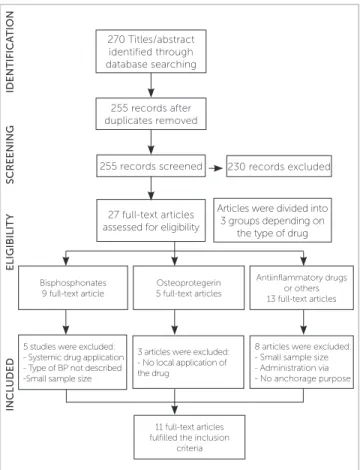
Search results: Search strategy yielded 270 titles/ab-stracts. Ater applying the inclusion/exclusion criteria, 245 papers (about 90%) were removed, primarily be-cause they were reviews, case reports, human studies or unrelated to orthodontic anchorage. The remaining 27 articles (10%) were read entirely and divided into three groups based on the type of substance used to provide orthodontic anchorage. The BPs group comprised nine studies; further on, ive papers were excluded: three
due to systemic drug application,6,15,16 one because it
did not state the type of BP used17 and one because
the experimental group size was too small.18 The OPG
Table 1 - Quality assessment of the articles included in the review.
* Loss of animals or devices not clearly specified. ** No blinded measurements specified.
Figure 1 - PRISMA flow chart showing the process of study inclusion.
because local application of molecule was not used.8,19,20
The OMs group comprised 13 articles of which seven were rejected because the via of administration was
in-tragastric (ive cases),21-25 intraperitoneal (one case),26
or intramuscular,27 and one due to the small size of the
experimental groups.28
Ater careful analysis was carried out, 11 articles ful-illed all criteria for inclusion in the review (Fig 1).
Quality assessment: The eleven articles selected were based on animal studies; only two were considered to have high methodological quality, four were rated as of medium quality and ive articles were of low quality. The main quality defects were inadequate size of study sample subgroups, absence of method error analysis and absence of blinding in measurements. The results of quality analysis are presented in Table 1.
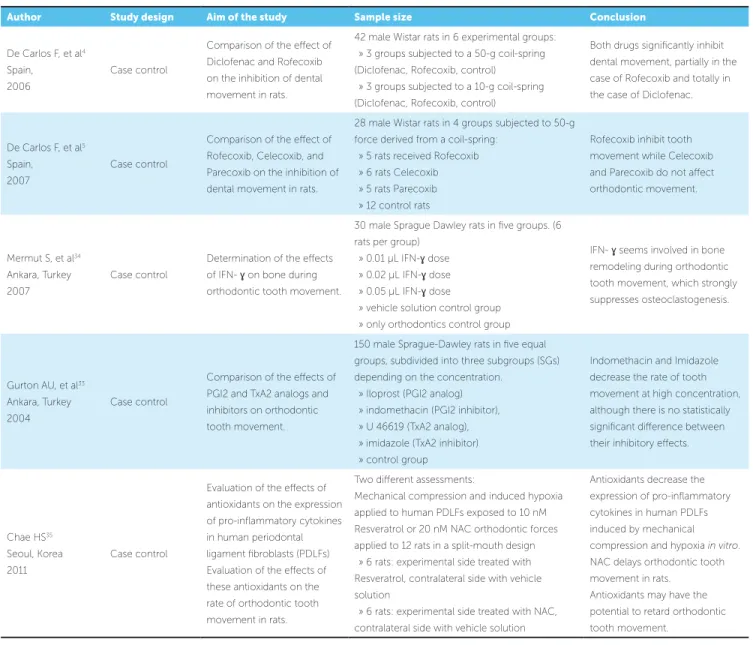
Orthodontic anchorage: There is general consensus in the selected papers that orthodontic tooth move-ment is reduced ater administration of the substances included in the present analysis. This lends support to the clinical use of these compounds in preventing un-desired movements. Results for each type of drug under consideration are shown from Table 2 to Table 4.
Molecules used for anchorage
Article Sample size
Predetermined sample size
Measurement methods
Appropriate statistics
Method error analysis
Blinded measurements
Loss of animals to the study
Quality
BPs
Liu et al3 Suitable No Suitable Yes No No No ($) Low
Choi et al29 Suitable No Suitable Yes No No No ($) Low
Ortega et al7 Suitable Yes Suitable Yes Yes Yes No High
Toro et al30 Suitable Yes Suitable Yes Yes No No ($) Medium
OPG Keles et al
31 Small No Suitable Yes No No No Medium
Dunn et al32 Suitable No Suitable Yes Yes Yes No High
OMs
de Carlos
et al4 Small No Suitable Yes No Yes No Medium
de Carlos
et al5 Small No Suitable Yes No Yes No Medium
Gurton et al33 Suitable No Suitable Yes No No** No* Low
Mermut
et al34 Small No No Yes No No** No* Low
Chae et al35 Small No Suitable Yes No No** No* Low
270 Titles/abstract identified through database searching
255 records after duplicates removed
255 records screened
27 full-text articles assessed for eligibility
INCL
UDED
ELIGIBILIT
Y
SCREENING
IDENTIFICA
TION
230 records excluded
Articles were divided into 3 groups depending on
the type of drug
Bisphosphonates 9 full-text article
5 studies were excluded: - Systemic drug application - Type of BP not described -Small sample size
11 full-text articles fulfilled the inclusion
criteria Osteoprotegerin 5 full-text articles
3 articles were excluded: - No local application of the drug
Antiinflammatory drugs or others 13 full-text articles
Table 2 - Articles related to bisphosphonates enclosed in the present review according to the inclusion/exclusion criteria.
Table 3 - Articles related to osteoprotegerin enclosed in the present review according to the inclusion/exclusion criteria.
Author Study design Aim of the study Sample size Conclusion
Choi J, et al29
Korea 2010 Case control
Evaluation of the short-term efects of clodronate on early alveolar bone remodeling and root resorption related to orthodontic tooth movement.
54 sex-matched Wistar rats allocated into 3 groups of 18 rats:
» 2.5 mmol/L clodronate, » 10 mmol/L clodronate » Control group
Clodronate inhibits bone resorption induced by orthodontic force. Both clodronate groups show signiicantly less tooth movement than controls, although the inhibition is greater in 10 mmol/L.
Liu L, et al3
Japan 2004 Case control
Evaluation of the efect of local administration of clodronate on tooth movement.
26 male Wistar rats Split-mouth design:
» 2.5 mM clodronate experimental side; vehicle contralateral side
» 10 mM clodronate experimental side; vehicle contralateral side
» 40 mM clodronate experimental side; vehicle contralateral side
Clodronate strongly inhibits orthodontic tooth movement.
Ortega A, et al7
USA 2012 Case control
Evaluation of the use of local application of zoledronate to avoid loss of anchorage during extraction space closure in rats.
30 rats into 2 groups: » 15 control rats (vehicle) » 15 experimental rats (16 mg of zoledronate)
A single, small, locally applied dose of zoledronate was suicient to provide maximal anchorage in extraction space closure.
Toro E, et al30
Gainesville USA 2013 Case control
Evaluation of the efectiveness of Bis-enoxacin (BE) in the inhibition of bone resorption and orthodontic tooth movement.
30 Sprague Dawley into 3 groups: » Control: 10 rats (vehicle) » 2.5 mg/kg BE: 10 rats » 1 mg/kg Aledronate: 10 rats
BE inhibits osteoclast formation and bone resorption.
Keles A, et al31
Boston USA 2007 Case control
Evaluation of the eicacy of pamidronate versus osteoprotegerin (OPG) in the inhibition of bone resorption and tooth movement.
18 C57Bl/6 male mice into 3 groups of 6 mice:
» Control group (vehicle) » 5 mg/kg-1 pamidronate » 10 mg/kg-1 OPG
OPG results in a more powerful inhibitor of osteoclast recruitment and activity than pamidronate, with a reduction of osteoclasts number of 95% and tooth movement of 77%.
Author Study design Aim of the study Sample size Conclusion
Dunn M, et al32
Michigan, USA 2007 . Case control
Assessment of OPG in regulating mechanically induced bone modeling in a rat model of orthodontic
tooth movement.
39 male Sprague-Dawley rats
» 9 rats without appliances: (3 rats without injections, 3 rats with vehicle and 3 rats with high-dose OPG)
» 30 rats with orthodontic forces: (10 rats with 0.5 mg/Kg OPG-Fc, 10 rats with 5.0 mg/ Kg OPG-Fc and 10 rats with vehicle)
Local delivery of OPG-Fc inhibits osteoclastogenesis
and tooth movement at targeted dental sites.
Keles A, et al31
Boston USA 2007 Case control
Evaluation of the eicacy of pamidronate versus osteoprotegerin (OPG) in the inhibition of bone resorption and tooth
movement.
18 C57Bl/6 male mice into 3 groups of 6 mice:
» Control group (vehicle) » 5 mg/kg-1 pamidronate » 10 mg/kg-1 OPG
OPG results in a more powerful inhibitor of osteoclast recruitment and activity than pamidronate, with
a reduction of osteoclasts number of 95% and tooth
Author Study design Aim of the study Sample size Conclusion
De Carlos F, et al4 Spain, 2006
Case control
Comparison of the efect of Diclofenac and Rofecoxib on the inhibition of dental movement in rats.
42 male Wistar rats in 6 experimental groups: » 3 groups subjected to a 50-g coil-spring (Diclofenac, Rofecoxib, control)
» 3 groups subjected to a 10-g coil-spring (Diclofenac, Rofecoxib, control)
Both drugs signiicantly inhibit dental movement, partially in the case of Rofecoxib and totally in the case of Diclofenac.
De Carlos F, et al5 Spain, 2007
Case control
Comparison of the efect of Rofecoxib, Celecoxib, and Parecoxib on the inhibition of dental movement in rats.
28 male Wistar rats in 4 groups subjected to 50-g force derived from a coil-spring:
» 5 rats received Rofecoxib » 6 rats Celecoxib » 5 rats Parecoxib » 12 control rats
Rofecoxib inhibit tooth movement while Celecoxib and Parecoxib do not afect orthodontic movement.
Mermut S, et al34 Ankara, Turkey 2007
Case control
Determination of the efects of IFN- ɣ on bone during orthodontic tooth movement.
30 male Sprague Dawley rats in ive groups. (6 rats per group)
» 0.01 µL IFN-ɣ dose » 0.02 µL IFN-ɣ dose » 0.05 µL IFN-ɣ dose
» vehicle solution control group » only orthodontics control group
IFN- ɣ seems involved in bone remodeling during orthodontic tooth movement, which strongly suppresses osteoclastogenesis.
Gurton AU, et al33 Ankara, Turkey 2004
Case control
Comparison of the efects of PGI2 and TxA2 analogs and inhibitors on orthodontic tooth movement.
150 male Sprague-Dawley rats in ive equal groups, subdivided into three subgroups (SGs) depending on the concentration.
» Iloprost (PGI2 analog) » indomethacin (PGI2 inhibitor), » U 46619 (TxA2 analog), » imidazole (TxA2 inhibitor) » control group
Indomethacin and Imidazole decrease the rate of tooth movement at high concentration, although there is no statistically signiicant diference between their inhibitory efects.
Chae HS35 Seoul, Korea 2011
Case control
Evaluation of the efects of antioxidants on the expression of pro-inlammatory cytokines in human periodontal ligament ibroblasts (PDLFs) Evaluation of the efects of these antioxidants on the rate of orthodontic tooth movement in rats.
Two diferent assessments:
Mechanical compression and induced hypoxia applied to human PDLFs exposed to 10 nM Resveratrol or 20 nM NAC orthodontic forces applied to 12 rats in a split-mouth design
» 6 rats: experimental side treated with Resveratrol, contralateral side with vehicle solution
» 6 rats: experimental side treated with NAC, contralateral side with vehicle solution
Antioxidants decrease the expression of pro-inlammatory cytokines in human PDLFs induced by mechanical compression and hypoxia in vitro. NAC delays orthodontic tooth movement in rats.
Antioxidants may have the potential to retard orthodontic tooth movement.
Table 4 - Articles related to other molecules (OMs) enclosed in the present review according to the inclusion/exclusion criteria.
DISCUSSION
This systematic review was carried out to assess the efectiveness of diferent substances used to provide orth-odontic anchorage. Ater exhaustive search and com-prehensive evaluation, 11/270 articles were analyzed and categorized according to their methodological quality as low, medium and high. Due to the heterogeneity of the molecules found in the literature, three diferent groups were considered and analyzed separately.
The articles related to the use of BPs to provide orth-odontic anchorage were included in the irst group.
BPs are potent bone resorption inhibitors frequently used to treat bone metabolism disorders, such as Paget disease, osteoporosis and bone metastases. Essentially, these drugs are internalized into osteoclasts, leading to inhibition of bone resorption and induction of osteoclasts
apoptosis.36 Due to the wide range of information
avail-able about the action of these drugs and their ability to in-terfere in osteoclast activity and, thus, tooth movement, their use as pharmacological anchorage agents has been
more referred in the literature than other drugs.12
the present review, only four articles were selected in this group. All of them were case-control studies carried on
rats or mice. Choi et al29 used two diferent
concentra-tions of clodronate and assessed alveolar bone remodel-ing and root resorption. This study showed signiicantly decreased root resorption with new bone formation, es-pecially in the lower third of the roots; they also observed dose-dependent reduction of molar movement. These
data agree with those provided by Liu et al3 who also
recommended the local use of clodronate due to its anti-inlammatory properties that may be helpful in the treat-ment of increased bone resorption, such as periodontitis. This research defends the local application of BP in order to minimize potential systemic efects. Other studies fo-cused on the analysis of the efects of BP on orthodontic anchorage. Zoledronate was applied locally in the extrac-tion site of irst molars and in second molars that were going to be protracted, resulting in signiicant reduction of tooth movement associated to bone preservation and
ill.7 The efect of pamidronate was analyzed by Keles et
al.31 The results of this study demonstrate tooth
move-ment inhibition with a reduction in osteoclasts on the compression side.
The second group of molecules under consideration consisted of OPG. It is a soluble protein that inhibits the binding of receptor-activator of nuclear factor-B ligand (RANKL) to its cognate receptor, and prevents
osteoclasts diferentiation and activation. Dunn et al32
used two diferent doses of recombinant fusion protein OPG-Fc in a rat model and observed that this resulted in reduced molar movement and reduction in the num-ber of osteoclasts. In comparing the efectiveness of
OPG or BPs in tooth anchorage, Keles et al31 observed
that OPG was more potent than pamidronate inhibition of tooth movement.
The third group included the OMs that are used in orthodontic anchorage. Anti-inlammatory drugs are frequently used to avoid pain and discomfort caused by orthodontic treatment, but these drugs could also produce decreased or slow-down tooth movement.
De Carlos et al4 compared the efects of Diclofenac®
and Rofecoxib®, a conventional non steroideal
anti-inlammatory and a COX-2 inhibitor, respectively. They found that both compounds are able to block tooth movement, being more potent the efect of
Ro-fecoxib® without signiicant statistical diferences
be-tween groups. Thereater, De Carlos et al5 also analyzed
the efect of diferent anti-inlammatory substances on dental movement in a rat model. They found that
Ce-lecoxib® and Parecoxib®, two compounds that
specii-cally inhibit cyclooxygenase-2 (COX-2), did not afect
tooth movement, while Rofecoxib®, which also afects
COX-2, completely inhibited tooth movement in rats ater 50-g force application. Inherent characteristics of these drugs, such as bioavailability, half live, etc., may account for discrepant efects of these compounds. Oth-er drugs investigated in this group are the antioxidants.
Chae et al,35 in their complete study, assessed the
ef-fects of antioxidants on the compression and hypoxia-induced production of pro-inlammatory cytokines in
an in vitro evaluation of human periodontal ligament
ibroblasts (PDLF). Moreover, based on the results ob-tained, they designed an animal study to assess the ef-fect of these drugs on orthodontic tooth movement in rats. They used two diferent antioxidants; NAC, a pre-cursor of glutathione that acts inhibiting the synthe-sis of pro-inlammatory molecules and Resveratrol, a naturally occurring phytoalexin present in grapes that has been shown to suppress osteoclast diferentiation and promote osteoblast diferentiation. These anti-oxidants demonstrated a decrease in the expression of proinlammatory, and NAC also produced a delay in orthodontic tooth movement in rats. Therefore, anti-oxidants, as it is suggested in these results, may have the potential to retard orthodontic tooth movement.
On the other hand, Interferon-ɣ (IFN-ɣ) could result
clinically useful for anchorage orthodontic control, as
it has been observed in the study by Mermut et al.34
The authors found greater antiosteoclastic activity in the experimental groups compared to controls,
there-by suggesting that IFN-ɣ is involved in bone
remodel-ing durremodel-ing orthodontic tooth movement, actremodel-ing as a strongly suppressor of osteoclastogenesis.
Several reviews have been published about the ef-fects of diferent drugs on bone physiology and clinical
side efects in Orthodontics.37-40 Even a recent review
assessed the efects of medication on the rate of
orth-odontic tooth movement;41 however, to date, no review
these drugs should be local in order to obtain proper anchorage, this study only includes researches that in-volved local administration of these drugs. Thus, tooth movement of no anchorage teeth should be allowed and possible systemic efects avoided.
Due to the heterogeneity of the methods used to assess the efectiveness of drugs in experimental tooth anchorage, the results of this review cannot be ana-lyzed together in a meta-analysis. Molar movement largely varied; the coil systems and the use of mini-screws, incisors or contralateral molars to maintain the coil were very diferent; as well as the time-points of analysis of the results ranged widely. Nevertheless, all studies analyzed agree with the fact that these drugs af-fect and reduce tooth movement. In the control group or side, tooth movement follows three diferent stages: a irst phase of rapid movement, a lag phase and a pro-gressive movement phase. In the experimental groups or side, the efects of the drugs are reveled at this late stage, which is considered to be due to bone resorption by osteoclasts. This suggests that their local adminis-tration inhibit bone resorption induced by orthodontic mechanical stress. Moreover, as it has been shown in Table 1, only a few articles in this study could be clas-siied as high-quality, being most of them included in the medium and lower rank. Although these indings are promising, especially in the case of OPG, future re-search considering methodological quality is necessar-ies in order to determine the optimal dosage (quantity/ frequency) and optimal administration methods that will allow greater amount of incisor retraction with the least anchor teeth movement, in addition to highly lo-calized and long-term pharmacologic efects.
CONCLUSIONS
Based on the indings extracted from the 11 selected articles, it can be concluded that: topical administration of BPs reduces tooth movement, which may be benei-cial for anchorage procedures; also, osteonecrosis of the jaws was not found in any of the articles reviewed. Topi-cal application of OPG reduces undesired tooth move-ments. OPG appears to be the most efective substance in blocking osteoclast function, being able to provide maximal anchorage ater the application of orthodontic force. Topical application of anti-inlammatory drugs alters osteoclast function and, as a consequence, reduces tooth movement. Future studies are necessary to prove its efectiveness in humans.
In order to obtain better-quality scientiic evidence, more prospective studies or randomized clinical trials are required on the use of these molecules in orthodon-tic therapy and their possible adverse efects.
Author’s contribution
1. Yokoya K, Sasaki T, Shibasaki Y. Distributional changes of osteoclasts and pre-osteoclastic cells in periodontal tissues during experimental tooth movement as revealed by quantitative immunohistochemistry of H(+)-ATPase. J Dent Res. 1997;76(1):580-7.
2. Rody WJ Jr, King GJ, Gu G. Osteoclast recruitment to sites of compression
in orthodontic tooth movement. Am J Orthod Dentofacial Orthop. 2001;120(5):477-89.
3. Liu L, Igarashi K, Haruyama N, Saeki S, Shinoda H, Mitani H. Efects of local
administration of clodronate on orthodontic tooth movement and root resorption in rats. Eur J Orthod. 2004;26(5):469-73.
4. De Carlos F, Cobo J, Díaz-Esnal B, Arguelles J, Vijande M, Costales M.
Orthodontic tooth movement after inhibition of cyclooxygenase-2. Am J Orthod Dentofacial Orthop. 2006;129(3):402-6.
5. De Carlos F, Cobo J, Perillan C, Garcia MA, Arguelles J, Vijande M, et al. Orthodontic
tooth movement after diferent coxib therapies. Eur J Orthod. 2007;29(6):596-9.
6. Karras JC, Miller JR, Hodges JS, Beyer JP, Larson BE. Efect of alendronate
on orthodontic tooth movement in rats. Am J Orthod Dentofacial Orthop. 2009;136(6):843-7.
7. Ortega AJ, Campbell PM, Hinton R, Naidu A, Buschang PH. Local application
of zoledronate for maximum anchorage during space closure. Am J Orthod Dentofacial Orthop. 2012;142(6):780-91.
8. Yabumoto T, Miyazawa K, Tabuchi M, Shoji S, Tanaka M, Kadota M, et al.
Stabilization of tooth movement by administration of reveromycin A to osteoprotegerin-deicient knockout mice. Am J Orthod Dentofacial Orthop. 2013;144(3):368-80.
9. Baud’huin M, Duplomb L, Teletchea S, Lamoureux F, Ruiz-Velasco C,
Maillasson M, et al. Osteoprotegerin: multiple partners for multiple functions. Cytokine Growth Factor Rev. 2013;24(5):401-9.
10. Li Y, Tang L. Local delivery of osteoprotegerin may be a way of reinforcing orthodontic anchorage. Med Hypotheses. 2009;72(2):178-9.
11. Landis JR, Koch GG. The measurement of observer agreement for categorical data. Biometrics. 1977;33(1):159-74.
12. Iglesias-Linares A, Yáñez-Vico RM, Solano-Reina E, Torres-Lagares D, González Moles MA. Inluence of bisphosphonates in orthodontic therapy: systematic review. J Dent. 2010;38(8):603-11.
13. Antczak AA, Tang J, Chalmers TC. Quality assessment of randomized control trials in dental research. 1. Methods. J Periodontal Res. 1986;21(4):305-14. 14. Jadad AR, Moore RA, Carroll D, Jenkinson C, Reynolds DJ, Gavaghan DJ,
et al. Assessing the quality of reports of randomized clinical trials: is blinding necessary? Control Clin Trials. 1996;17(1):1-12.
15. Sato Y, Sakai H, Kobayashi Y, Shibasaki Y, Sasaki T. Bisphosphonate administration alters subcellular localization of vacuolar-type H(+)-ATPase and cathepsin K in osteoclasts during experimental movement of rat molars. Anat Rec. 2000;260(1):72-80.
16. Sirisoontorn I, Hotokezaka H, Hashimoto M, Gonzales C, Luppanapornlarp S, Darendeliler MA, et al. Orthodontic tooth movement and root resorption in ovariectomized rats treated by systemic administration of zoledronic acid. Am J Orthod Dentofacial Orthop. 2012;141(5):563-73.
17. Fujimura Y, Kitaura H, Yoshimatsu M, Eguchi T, Kohara H, Morita Y, et al. Inluence of bisphosphonates on orthodontic tooth movement in mice. Eur J Orthod. 2009;31(6):572-7.
18. Kaipatur NR, Wu Y, Adeeb S, Stevenson TR, Major PW, Doschak MR. Impact of bisphosphonate drug burden in alveolar bone during orthodontic tooth movement in a rat model: a pilot study. Am J Orthod Dentofacial Orthop. 2013;144(4):557-67.
19. Kanzaki H, Chiba M, Takahashi I, Haruyama N, Nishimura M, Mitani H. Local OPG gene transfer to periodontal tissue inhibits orthodontic tooth movement. J Dent Res. 2004;83(12):920-5.
20. Tan L, Ren Y, Wang J, Jiang L, Cheng H, Sandham A, Zhao Z. Osteoprotegerin and ligand of receptor activator of nuclear factor kappa-B expression in ovariectomized rats during tooth movement. Angle Orthod. 2009;79(2):292-8. 21. Ong CK, Walsh LJ, Harbrow D, Taverne AA, Symons AL. Orthodontic tooth
movement in the prednisolone-treated rat. Angle Orthod. 2000;70(2):118-25.
REFERENCES
22. Arias OR, Marquez-Orozco MC. Aspirin, acetaminophen, and ibuprofen: their efects on orthodontic tooth movement. Am J Orthod Dentofacial Orthop. 2006;130(3):364-70.
23. Carvalho-Filho EP, Stabile AC, Ervolino E, Stuani MB, Iyomasa MM, Rocha MJ. Celecoxib treatment does not alter recruitment and activation of osteoclasts in the initial phase of experimental tooth movement. Eur J Histochem. 2012;56(4):e43.
24. MirHashemi AH, Afshari M, Alaeddini M, Etemad-Moghadam S, Dehpour A, Sheikhzade S, et al. Efect of atorvastatin on orthodontic tooth movement in male wistar rats. J Dent (Tehran). 2013;10(6):532-9.
25. Hammad SM, El-Hawary YM, El-Hawary AK. The use of diferent analgesics in orthodontic tooth movements. Angle Orthod. 2012;82(5):820-6.
26. Hauber Gameiro G, Nouer DF, Pereira Neto JS, Siqueira VC, Andrade ED, Duarte Novaes P, et al. Efects of short- and long-term celecoxib on orthodontic tooth movement. Angle Orthod. 2008;78(5):860-5.
27. Knop LA, Shintcovsk RL, Retamoso LB, Ribeiro JS, Tanaka OM. Non-steroidal and steroidal anti-inlammatory use in the context of orthodontic movement. Eur J Orthod. 2012;34(5):531-5.
28. Bao X, Hu M, Zhang Y, Machibya F, Zhang Y, Jiang H, Yu D. Efect of fangchinoline on root resorption during rat orthodontic tooth movement. Korean J Orthod. 2012;42(3):138-43.
29. Choi J, Baek SH, Lee JI, Chang YI. Efects of clodronate on early alveolar bone remodeling and root resorption related to orthodontic forces: a histomorphometric analysis. Am J Orthod Dentofacial Orthop. 2010;138(5):548. e1-e8.
30. Toro EJ, Zuo J, Gutierrez A, La Rosa RL, Gawron AJ, Bradaschia-Correa V, et al. Bis-enoxacin inhibits bone resorption and orthodontic tooth movement. J Dent Res. 2013;92(10):925-31.
31. Keles A, Grunes B, Difuria C, Gagari E, Srinivasan V, Darendeliler MA, et al. Inhibition of tooth movement by osteoprotegerin vs. pamidronate under conditions of constant orthodontic force. Eur J Oral Sci. 2007;115(2):131-6. 32. Dunn MD, Park CH, Kostenuik PJ, Kapila S, Giannobile WV. Local delivery of
osteoprotegerin inhibits mechanically mediated bone modeling in orthodontic tooth movement. Bone. 2007;41(3):446-55. Epub 2007 May 8.
33. Gurton AU, Akin E, Sagdic D, Olmez H. Efects of PGI2 and TxA2 analogs and inhibitors in orthodontic tooth movement. Angle Orthod. 2004;74(4):526-32. 34. Mermut S, Bengi AO, Akin E, Kürkçü M, Karaçay S. Efects of Interferon-Gamma
on bone remodeling during experimental tooth movement. Angle Orthod. 2007;77(1):135-41.
35. Chae HS, Park HJ, Hwang HR, Kwon A, Lim WH, Yi WJ, et al. The efect of antioxidants on the production of pro-inlammatory cytokines and orthodontic tooth movement. Mol Cells. 2011;32(2):189-96.
36. Drake MT, Clarke BL, Khosla S. Bisphosphonates: mechanism of action and role in clinical practice. Mayo Clin Proc. 2008;83(9):1032-45.
37. Pavlin D, Goldman ES, Gluhak-Heinrich J, Magness M, Zadro R. Orthodontically stressed periodontium of transgenic mouse as a model for studying mechanical response in bone: the efect on the number of osteoblasts. Clin Orthod Res. 2000;3(3):55-66.
38. Masella RS, Mesiter M. Current concepts in the biology of orthodontic tooth movement. Am J Orthod Dentofacial Orthop. 2006;129(4):458-68. 39. Krishnan V, Davidovitch Z. Cellular, molecular and tissue-level reactions to