PARANOIA IN THE GENERAL POPULATION: A
REVISED VERSION OF THE GENERAL
PARANOIA SCALE FOR ADOLESCENTS
Celia Barreto Carvalho, PhD
Department of Educational Sciences, University of Azores, Portugal; CINEICC, Faculty of Psychology and Educational Sciences, University of
Coimbra, Portugal
Vera Pereira, MA
Marina Sousa, MA
Department of Educational Sciences, University of Azores, Portugal
Carolina da Motta, MA
Department of Educational Sciences, University of Azores Portugal; CINEICC, Faculty of Psychology and Educational Sciences, University of
Coimbra, Portugal
Jose Pinto-Gouveia, PhD
CINEICC, Faculty of Psychology and Educational Sciences, University of Coimbra, Portugal
Suzana Nunes Caldeira, PhD
Ermelindo Bernardo Peixoto, PhD
Department of Educational Sciences, University of Azores, Portugal
Allan Fenigstein, PhD
Department of Psychology, Samuel Mather Hall, Kenyon College, Gambier, Ohio
Abstract
The aim of the current study was to validate the General Paranoia Scale for Portuguese Adolescents population (GPS-A). This scale assesses the paranoid ideation in non-clinical population. Results from a confirmatory factor analysis of the scale on 1218 youths confirmed an alternative model to the one-dimensional model proposed by Fenigstein and Vanable (1992) comprising three different dimensions (Mistrust thoughts, persecutory ideas and depreciation). This alternative model presented a good fit: χ2
(162)= 727.200, p = .000; CFI = .925; RMSEA = .054, P(rmsea ≤0.05) = .000; PCFI = .788; AIC = 863.200. All items presented adequate factor loadings (λij ≥0.5) and individual reliability ((λij)2 ≥0.25). Further data analysis on the
scale revealed that the GPS-A is an adequate assessment tool for adolescents, with good psychometric characteristics and high internal consistency.
Keywords: Paranoid ideation, adolescence, continuum, social defense Introduction
A large body of research has emphasized the social nature of paranoid ideation, and how it can be described by biased perceptions observed in the relationships established between individuals (Fenigstein, Scheier & Buss, 1975 cit in Fenigstein & Vanable, 1992). Paranoid ideation has then been conceptualized as a cognitive process (Fenigstein & Vanable, 1992; Verdoux & van Os, 2002; Combs, Michael & Penn, 2006; Campbell & Morrinson, 2007; vanOs, Linscott, Myin-Germeys, Delespaul & Krabbendam, 2009; Melo, 2010; Michael, Shaffner & Shultze, 2011) used by individuals to cope with the social world. Fenigstein & Vanable (1992) distinguished subclinical paranoia as a form of thought marked by exaggerated self-reference and stable tendencies to Mistrust, hold grudges or resent others, and a belief in external control or influence (Fenigstein & Vanable, 1992; Combs & Penn, 2004) that can occur in normal daily behavior. On the other hand, clinical paranoia includes persecutory delirious and Mistrust. With the exception of a few studies exploring the processing of social information in paranoia (e.g. Combs & Penn, 2004), the majority of the studies investigates only the cognitive abilities and do not include social-cognitive measures of processing.
Individuals explain everyday events and their own behavior by engaging and manifesting some degree of paranoid ideation (Eaton, Ramanoski, Anthony & Nestad, 1991; Fenigstein & Vanable, 1992; Ellet, Lopes & Chadwick, 2003; Freeman, Garety, Bebbington, Smith, Rollinson, Fowler, et al., 2005; Binbay, Drukker, Elbi, Aksu, Tanik & Ozkinay, et al., 2011). Bentall, Kinderman & Kaney (1994) suggested that paranoia is related to external attributional styles, as a defense against negative threat to self and, therefore, related to social comparison, social submission and external shame behaviors (Fenigstein & Vanable, 1992; Freeman et al., 2005; Gilbert, Boxall, Cheung & Irons, 2005; Combs, Michael & Penn, 2006; Castilho, Gouveia & Duarte, 2013; Barreto Carvalho, Pinto-Gouveia, Peixoto & da Motta, 2014a, Barretto Carvalho et al., 2014b). In accordance with these studies, Martin & Penn (2001) and Freeman et al. (2005) found that avoidance and fear of negative evaluation were two of the best predictors of paranoid ideation.
These conceptualizations are in accordance to the perspective of a continuum between normal and pathological paranoia, and to the acceptance of paranoia as a common experience in the general population (Beck,
Freeman & Associates, 1990, van Os, Hanssen, Bijl & Raveli, 2000; Freeman, et al., 2002; Verdoux & vanOs, 2002; Ellet, Lopes & Chadwick, 2003; Freeman, et al., 2005; Esterberg & Compton, 2009; Yung, Nelson, Baker, Buckby, Baksheev & Cosgrave, 2009; Freeman, Pugh, Vorontsova, Antley & Slater, 2010; Binbay, et al., 2011; Barreto Carvalho, et al., 2014a, 2014b). For this reason, paranoia is a phenomena that should also be explored in non-clinical populations (Freeman et al., 2005; Barreto Carvalho et al., 2014a, 2014b), and not be exclusively abridged by severe psychopathological entities. Freeman et al., (2005), referred that about 15% to 20% of the general population present paranoid thoughts regularly.
In this line of research, Ellet, Lopes & Chadwick (2003), explored the incidence of paranoid ideation in a sample of college students. These researchers described that social anxiety and paranoid ideation share cognitive, behavioral and affective components amongst them. According to Ellet, Lopes & Chadwick, 20003, a distinguishing feature of paranoid ideation from cognitions related to social anxiety is the attribution of malevolent intentions of others. Paranoid ideations imply that individuals are seen as “targets” by other people who are competing for social status in the social hierarchy.
Because social interactions gain a particular importance during adolescence, it is plausible that paranoid ideation becomes more salient during this developmental period. Aside from several transformations, in terms of physical, social, cognitive and emotional growth (Yung, et al., 2009), significant experiences may have repercussions in adolescence phase and in the future, as adults (Yung et al., 2009). This renders youths particularly vulnerable to the development of psychopathology, and possibly to the development of paranoid ideations. There is evidence that the presence of social maladjustment, such as social anxiety and shame in early age, could be a predictor of paranoid ideation in adulthood (Freeman et al., 2002; Matos, Pinto-Gouveia & Gilbert, 2011; Pinto-Gouveia, Matos, Castilho e Xavier, 2012). This suggests that not only paranoia is a normal phenomenon, constituting a part of everyday experiences (Verdoux, van OS, Maurice-Tison, Gay, Salamon & Bourgeois, 1998; Dagnan, Trower & Gilbert, 2002; Ellet, Lopes & Chadwick, 2003; Freeman et al., 2005; Matos, Pinto-Gouveia & Gilbert, 2011; Pinto-Gouveia, Matos, Castilho e Xavier, 2012), but also reflects the continuum between normal and pathological paranoid ideation, and can also be regarded as a continuum from a developmental perspective.
With the purpose of studying the connection between paranoia and feelings of suspicion and self-awareness, Fenigstein and Vanable (1992) developed a self-report questionnaire as the first step to explore paranoia amongst the non-clinical population. This questionnaire took into account the general experiences and interpersonal aspects of paranoia experienced, like
resentment and suspicion towards others, as well as the idea of depreciation and rejection by others. In their original study, Fenigstein and Vanable (1992) found a single factor of general paranoia though a factor analysis.
It is also noteworthy that an often neglected aspect in research and clinical practice is the use of assessment tools that are devised or properly adapted to a specific population. Due to the fact that Portuguese is currently the fourth most spoken language in the world (Portuguese Language Observatory, 2010), the dissemination and use of assessment tools that are properly adapted to the Portuguese language and that are psychometrically sound is relevant to a wide range of professionals working in clinical and research settings across the five continents. Thus, the present study aims to (1) adapt and validate the Portuguese version of General Paranoia Scale in an adolescent sample, (2) to explore the latent structure of GPS and (3) to further refine current conceptualization of paranoid ideation in youths from the general population.
Method
Participants and Procedures
Data was collected in public high schools in S. Miguel Island, Azores. Information on the study goals and confidentiality was provided to all participants, who gave their informed consent (or parents, when applicable) prior to filling the assessment protocol. After observing the existence a three-factor model, the remaining 1218 participants constituted a sample to confirm the latent structure of GPS in a second study.
Statistical analysis
Data analysis was carried out using SPSS v. 20.0, and Confirmatory Factor Analysis (CFA) was carried out with Amos v. 20 (IBM, 2011).
In CFA, the quality of model adjustments was made through the following fit indices: Comparative Fit Index (CFI) and Tucker-Lewis Index (TLI), with reference values of adjustment above .90; Parsimony CFI with acceptable values above.06; Root Mean square Error of Approximation (RMSEA) below .05, and Akaike Information Criterion (AIC) for model comparisons. The reference values are accordingly to those suggested by Kline (2010) and Maroco (2010). Construct reliability and validity was evaluated through Composite Reliability (CR) and construct validity was assessed through Average Variance Extracted (AVE) as proposed by Fornell & Larker (1981), with values of CR ≥ .70 and AVE ≥ .50 as indicators of good construct validity and reliability.
Measures
General Paranoia Scale (GPS; Fenigstein & Vanable, 1992; translated and adapted to the Portuguese adolescent population by Barreto Carvalho, Castilho & Pereira, 2012). The study of the GPS latent structure and psychometric properties is the primary aim of the current study, therefore, confirmatory models and psychometric properties will be presented in the results section. This self-report scale widely used in the assessment of paranoia in the general population. The scale is comprised of a set of 20 items, answered in a Likert-like scale ranging from 1 (never) to 5 (always). Scores can vary between 20 and 100, where higher scores indicate greater paranoid ideation. In the original study by Fenigstein and Vanable (1992) the Cronbach's alpha is 0.84. For the present study, the scale shows good internal consistency, with a Cronbach's alpha of 0.90.
Results
Sample characteristics
Our study comprises a sample of 1718 adolescent, with ages between 14 and 22 years old (M = 16.75, SD = 1.30), 802 males (47%) and 916 females (53%), randomly selected from public and private high schools in the São Miguel island (Azores-Portugal). From this sample, 500 participants were randomly selected for exploratory factor analysis, 238 (48%) males and 262 (52%) females with and average age of 16.81 (SD = 1.35). Data on the remaining 1218 participants, 572 (47%) males and 646 (53%) females with average age of 16.80 (SD = 1.33) were analysed in subsequent studies. Samples were equivalent concerning age and gender distribution. Regarding to Socio Economic Status (SES), were calculated from parent’s job class. The “Lower” SES was the most representative of the sample with 50.8% (n=871), followed by “Medium” SES with 42.15% (n=716) and, finally the “Higher” SES with 7.4% (n=126).
Item analysis and scale dimensionality
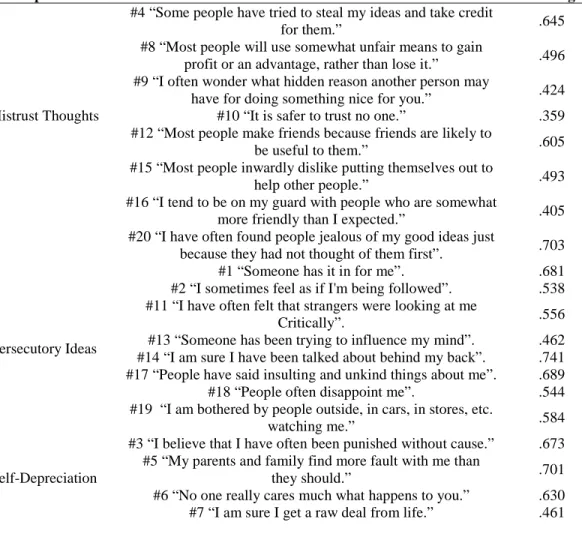
An exploratory factor analysis was carried out with 500 participants from the total sample (n = 1718),Scale reliability (n=500) for the total scale showed very good internal consistency (α =.893). Bartlett sphericity test (χ2= 3078.697; p = 000) and Kaiser-Meyer-Olkin index (KMO = .914) showed that the data is factorable. The results from the Principal Components Analysis with oblique rotation (Direct oblimin) revealed with extraction set to Eigenvalues > 1 revealed 4 latent components, explaining 52.1% of the total variance of the scale. Through the examination of pattern and structure matrixes, results presented a fourth component comprised of 2 items with shared variance across all factors. In order to explore a more parsimonious solution, factor extraction was fixed to 3 factors. The three components
explained 46.61% of the total variance of the scale. This has led to the creation of an alternative three-factor model (including persecutory ideas, mistrust thoughts and self-depreciation) to be tested in further analyses (Table 1).
Table 1: Factor structure and unique item contributions (loadings)
Confirmatory factor analysis
In a second study, model comparisons through Confirmatory Factor Analysis were performed with the 1218 remaining participants. Based on the model proposed by Fenigstein and Vanable (1992), an initial one-dimensional model was tested, grouping 20 items of the scale in a single latent factor (general paranoia). All items presented adequate factor loadings (λij ≥0.5) and model fit indexes for the proposed model suggested a poor fit: χ2
(170)= 1353,468, p = .000; TLI = .824; CFI = .842; RMSEA = .076, P(rmsea ≤0.05) = .000; PCFI = .754; AIC = 1473.468. However, modification indices indicated that freeing some parameters would improve the fit of this model.
Components Items on the Paranoia Scale Loadings
Mistrust Thoughts
#4 “Some people have tried to steal my ideas and take credit
for them.” .645
#8 “Most people will use somewhat unfair means to gain
profit or an advantage, rather than lose it.” .496
#9 “I often wonder what hidden reason another person may
have for doing something nice for you.” .424
#10 “It is safer to trust no one.” .359
#12 “Most people make friends because friends are likely to
be useful to them.” .605
#15 “Most people inwardly dislike putting themselves out to
help other people.” .493
#16 “I tend to be on my guard with people who are somewhat
more friendly than I expected.” .405
#20 “I have often found people jealous of my good ideas just
because they had not thought of them first”. .703
Persecutory Ideas
#1 “Someone has it in for me”. .681
#2 “I sometimes feel as if I'm being followed”. .538
#11 “I have often felt that strangers were looking at me
Critically”. .556
#13 “Someone has been trying to influence my mind”. .462
#14 “I am sure I have been talked about behind my back”. .741
#17 “People have said insulting and unkind things about me”. .689
#18 “People often disappoint me”. .544
#19 “I am bothered by people outside, in cars, in stores, etc.
watching me.” .584
Self-Depreciation
#3 “I believe that I have often been punished without cause.” .673
#5 “My parents and family find more fault with me than
they should.” .701
#6 “No one really cares much what happens to you.” .630
Further adjustments were calculated in the single general model, freeing five parameters based on the highest modification indices. Correlations were established between the errors of items #3 and #5, #6 and #7, #1 and #17, #15 and #16, #4 and #7. After freeing those parameters, model fit indices improved, but were still below acceptable values: χ2
(165)= 911.791, p =.000; TLI = .885; CFI = .900; RMSEA = .061, P(rmsea ≤0.05) =.000; PCFI = .782; AIC = 1041.791.
Taking into account the components obtained in the aforementioned preliminary analysis an alternative three-factor model was created, grouping items in latent factors designated as Persecutory Ideas, Mistrust thoughts and Self-depreciation. This alternative model showed adequate adjustment indices: χ2
(167)= 862.184, p = .000; TLI = .895; CFI = .907; RMSEA = .058, P(rmsea ≤0.05) = .000; PCFI = .797; AIC = 988.184. Further adjustments were calculated in the 3-factor model, freeing parameters based on the highest modification indices. Correlations were established between the errors of items #4 and #10 from the mistrust thoughts factor, #1 and #2; #2 and #13; #11 and #19 from the persecutory ideas factor; items #3 and #5 from the self-depreciation perception factor. After freeing those parameters, the model presented good fit indexes: χ2
(162)= 727.200, p = .000; TLI = .912; CFI = .925; RMSEA = .054, P(rmsea ≤0.05) =.000; PCFI = .788; AIC = 863.200.
All factors presented good Composite Reliability (≥ .70): Mistrust thoughts = .80; Persecutory Ideas = .83; Self-depreciation = .70. Construct validity was assessed through AVE, with all factors presenting slightly less desirable consistency values than defined by Fornell & Larker (1981): AVEmistrust thoughts = .33; AVEpersecutory ideas = .39 and AVE Self depreciation = .37. Correlations between three factors in the model were: Mistrust thoughts and Persecutory Ideas r = .70 (p = .000); Mistrust thoughts and Self-depreciation r = .48 (p = .000); Persecutory Ideas and Self-depreciation r =.57 (p = .000).
Scores on the dimensions obtained from CFA analysis were calculated for the studied sample (n = 1218). Highest scores were observed in mistrust thoughts (M = 2.72, SD = .715), followed by persecutory ideations (M = 2.41, SD = .727) and self-depreciation (M = 2, SD = .775).
Reliability analysis
Reliability analysis was calculated for each factor in the final three factor model: Mistrust thoughts, α = .792; Persecutory Ideas, α = .835; and Self-depreciation, α =.719. All values indicate good or very good reliability.
Discussion
According to the prevailing perspective in the literature, paranoid ideation is a social phenomenon and functions as a defense against perceived
or real social threats (Gilbert, 1989, 1998, Fenigstein & Vanable, 1992; Freeman et al., 2005; Ellet, Lopes & Chadwick, 2003; Combs, Michael & Penn, 2006; Yung et al., 2009; Barreto Carvalho et al., 2014a; Barreto Carvalho, 2014b), which are associated to the different social roles adopted by individuals (Gilbert, 1998, 2001) and closely related to perceptions of social rank, and behaviors of dominance or submission (Gilbert et al., 2005). Considering the developmental tasks and the vulnerabilities associated to adolescence, it is important to dispose of adequate measures of paranoid processes and related construct in this developmental phase.
The main goal of the current study was to adapt and explore the latent structure and the psychometric properties of GPS in Portuguese adolescents. After exploring the factor structure in a subsample of 500 youths, we compared the one-dimensional model found in adults by Fenigstein & Vanable (1992) with an alternative model through Confirmatory Factor Analysis. The results of the present study suggested that the GPS presents a latent structure somewhat different from the original studies by Fenigstein & Vanable (1992). Results pointed out that the three-factor model presented better a fit in a large Azorean adolescent sample, suggesting that paranoid ideation in adolescents encompasses ideations reflecting distinct aspects of social interactions.
Concerning the first and second dimensions (Mistrust thoughts and Persecutory ideas), results showed that adolescents endorsed paranoid ideations with a considerable frequency. On one hand, these thoughts concern more frequently the normative ideations of mistrust towards others, who are seen as a possible threat and/or as social competitors (“top dog” vs. “underdog” view of the world) and who may not spare means to take advantage from others, if necessary. Thoughts of this nature can be considered adaptive, to the extent that this “better safe than sorry” approach to social interactions can act as a defense against social threats, particularly in the case of strangers (Gilbert, 1998, 2001). On the other hand, the persecutory ideation dimension included rather frequent endorsements of cognitions related to hostile critic, or others having a negative view of the self and talking on one’s back, or even ideations of actual persecution from others, like being followed or having one’s mind influenced by others (Freeman et al., 2002). The emergence of separate dimensions reflecting different types of paranoid ideation are in accordance to the hierarchy of paranoid thoughts proposed by Freeman et al. (2005), ranging to more common everyday thoughts of suspicion towards strangers or friends to more exaggerated ideas of malevolence and persecution by others, that can reach a delusional stance.
Since adolescence is a developmental phase in which youths begin to establish more significant relationships within a group of peers, competition
for occupying a place in a superior rank becomes an issue of utmost importance. Power, competition and feelings of belonging to a group become also important in the definition of one’s identity (Gilbert, Clarke, Hempel, Miles & Irons, 2004), a major developmental task that takes place in this period. Therefore, adolescents are likely to regard others as potential competitors or as a threat to their social rank, and these suspicion may be useful in defending their position within their peer group, for example. These paranoid processes are distinct from social anxiety, for example, because there is a clear attribution of hostile intentionality that come from others, instead of a negative view or the attribution of negative features in the self. In addition, it is during adolescence or earlier in life, when individuals feel vulnerable or threatened by others, the belief in the malevolence of others may rise (Beck, Freeman & Associates, 1990; Beck & Rector, 2005). As suggested by Freeman et al., (2002), persecutory ideas are more likely to occur in individual that become convinced about other’s intentions to harm them (Freeman, Garety, Fowler, Kuipers, Dunn, Bebbington & Hadley, 1998). These beliefs seem to result in feelings of suspicion and mistrust of other’s motives and intensified hostility when reacting to perceived threats (Shapiro, 1965 cit in Fenigstein & Vanable, 1992). This perspective is reinforced by the findings of Matos, Pinto-Gouveia & Gilbert (2011), in which traumatic memories of being rejected, humiliated, or subordinated by others would better explain paranoid anxiety in adolescents. The pervasive feelings of social threat generated by these experiences, in which the self is regarded as low-rank and more vulnerable when compared to others, regarded as more dominant and threatening, may also explain the development of a negative and hostile view of others and the adoption of strategies to protect and defend the self (Matos, Pinto-Gouveia & Gilbert 2011; Pinto-Gouveia, Matos, Castilho & Xavier, 2012).
Interestingly, the third dimension reflects a depreciative vision from the self and resentment towards others. Authors such Yung et al., (2009), advocate that youths are predisposed toward paranoid thoughts, because they have a heightened self-consciousness and a consequent sense of being observed by others, leading to preoccupations with the way in which they are seen by others, and exaggerating the impressions that others are watching or noticing them (Fenigstein & Vanable, 1992; Yung et al., 2009). According to Fenigstein & Vanable (1992), the awareness of oneself as an object of attention from others may render individuals susceptible to the idea that others are more interested in them than they actually are. Based on this premise, it is expected that self-focused individuals would tend to think in more paranoid ways (Fenigstein & Vanable, 1992). Another possible explanation to this result is related to a “poor me” view of the self, in which adolescent see themselves as victims and paranoid ideation may protect them
against the indifference or rejection form others, which is understood by the individual as persecutory (Trower & Chadwick, 1995).
Overall, results corroborate not only the existence of paranoia in the general population, in a continuum between normal and pathological paranoid ideations (Fenigstein,1997; Garety & Freeman, 1999; Combs, Penn e Fenigstein, 2002), but also suggest the continuity of paranoid ideation throughout development. It is important to highlight that, despite paranoid ideations are a normative phenomenon in non-clinical populations, the occurrence of these cognitive processes in a more young population (e.g. adolescents) may take particular relevance, to the extent that the presence of paranoid ideation may render youths at a higher risk of engaging in risk behaviors, deviant groups or even developing psychopathology. This may not only have a considerable impact in current conceptualizations of paranoid ideation, but also in the efforts to develop more refined intervention strategies (preventive programs, development of emotional and interpersonal skills), as a way to prevent disruptive behaviors or psychopathology in youths or later in life.
This study is not free from limitations. In the current validation study, it was not possible to collect data on the temporal stability of the scale. In addition, AVE values were slightly below desired to assure proper correlation of all items with the parent factor. However, the findings in the current study have the strength of being generalizable for the adolescent Azorean population, since this was the first study of GPS latent structure in a representative sample of Portuguese adolescents. In addition, identical outcomes have been found in adult samples (Barreto Carvalho et al., 2014a, 2014b), further strengthening those findings.
For these reasons, results pose important future implications in research, such as the development of characterization studies of paranoia in adolescence, the increment in comprehension of predictors of paranoia in youths and their association to risk behaviors and psychopathology, and further developments in the different models relating paranoid processes and other social and clinical variables (shame, social comparison, submission, anxiety and depression), that are key in the development of effective preventive interventions.
Conclusion
This research provide evidence that paranoia ideation is a common phenomena, not constricted to clinical populations. The present research also suggests that although paranoia though has usually been regarded as a form of psychopathology, there are at least certain characteristics of paranoia that are not common in normal students (vanOs, et al., 2000; Verdoux & vanOs, 2002; Ellet, Lopes & Chadwick, 2003; Freeman, et al., 2005; Esterberg &
Compton, 2009; Yung, et al., 2009; Barreto Carvalho, et al., 2014a, 2014b). More, it was clear evidence that these continuum observe in terms of health and pathology, also is present in developmental viewpoint. It was clear that adolescent developmental phase is crucial to emerging of paranoid ideation as a defence from social interactions.
These findings suggest that paranoid ideation may be present across developmental phase, what could provide better understanding about construct, as a pattern of though used like everybody else in their social interactions as defence. Our results point future directions to clinical practice and research, in way of youth paranoid ideation better comprehension.
References:
Barreto Carvalho, C., Pinto-Gouveia, J., Peixoto, E., & Motta, C. (2014). Paranoia as a continuum in the population. Asian Journal of Humanities and Social Studies, 2 (3), 382-391.
Barreto Carvalho, C., Pinto-Gouveia, J., Peixoto, E., & Motta, C. (2014). Emotional, cognitive and behavioral reactions to paranoia in clinical and nonclinical populations. Clinical Schizophrenia & Related Psychoses. Aceppted.
Beck, A. T.; Freeman, A., & Associates (1990). Cognitive Therapy of Personality Disorders. New York: Guilford.
Bentall, R., Kinderman, P. & Kaney, S. (1994). The self, attributional processes and abnormal beliefs: Towards a model of persecutory delusions. Behavior Research and Therapy, 32, 331-341. DOI: 10.1016/0005-7967(94)90131-7;
Bebbington, P., Bhugra, D., Brugha, T., Singleton, N., Farrell, M., Jenkins, R. (2004). Psychosis, victimization and childhood disadvantages: Evidence from the second British National Survey of Psychiatric Morbidity, 185, 220-226.
Binbay, T., Drukker, M., Elbi, H., Aksu Tanik, F., Ozkinay, F., Onay, H., Zagli, N., van Os, J., & Alptekin, K. (2011). Testing the Psychosis Continuum: Differential Impact of Genetic and Nongenetic Risk Factors and Comorbid Psychopathology Across the Entire Spectrum of Psychosis. Schizophrenia Bulletin, 38(5), 992-1002; DOI: 10.1093/schbul/sbr003.
Campbell, M., & Morrison, A. (2007). The Subjective Experience of Paranoia: Comparing the Experiences of Patients with Psychosis and Individuals with No Psychiatric History. Clinical Psychology and Psychotherapy, 14(1), 63-77; DOI: 10.1002/cpp.510.
Combs, D. R., & Penn, D. L. (2004). The role of subclinical paranoia on social perception and behavior. Schizophrenia Research, 69, 93-104.
Combs, D., Michael C., & Penn D. (2006). Paranoia and emotion perception across the continuum. The British Journal of Clinical Psychology, 45(1), 19-31; DOI: 10.1348/014466505X29099.
Dagnan, D., Trower P. & Gilbert P. (2002). Measuring vulnerability to threats to self-construction: The self and other Scale. Psychology and Psychotherapy, 75, 279-293. DOI: 10.1348/147608302320365271.
Eaton, W.W., Romanoski, A., Anthony, J. C., & Nestadt, G. (1991). Screening for psychosis in the general population with a self-report interview. Journal of Nervous and Mental Disease, 179(11), 689-93; DOI: 10.1097/00005053-199111000-00007.
Ellett, L.; Lopes, B., & Chadwick, P. (2003). Paranoia in a Nonclinical Population of College Students. Journal of Nervous and Mental Disease, 191, 425-430.
Esterberg, M. L., & Compton, M.T. (2009). The psychosis continuum and categorical versus dimensional diagnostic approaches. Current Psychiatry Reports, 11(3),179-84; DOI: 10.1007/s11920-009-0028-7.
Fenigstein, A., & Vanable, P. A. (1992). Paranoia and self-conscienciousness. Journal of Personality and Social Psychology, 62, 129-138.
Freeman, D., Garety, P., Fowler, D., Kuipers, E., Dunn, G., Bebbington, E. & Hadley, C. (1998). The London-East Anglia randomised controlled trial of cognitive behavior therapy for psicosis. IV: Self-esteem and persecutory delusion. British Journal of Clinical Psychology, 37, 415-430.
Freeman, D., Garety, P., Kuipers, E., Fowler, D., Bebbington, E. (2002). A Cognitive model of persecutory delusions. British Journal of Clinical Psychology, 41, 331-347.
Freeman, D., Garety, P.A., Bebbington, P.E., Smith, B., Rollinson, R., Fowler, D., Kuipers, E., Ray, K. & Dunn, G., (2005). Psychological investigation of the structure of paranoia in a non-clinical population. British Journal of Psychiatry, 186, 427-435. DOI: 10.1192/bjp.186.5.427;
Freeman, D., Garety, P., Kuipers, E., Colbert, S., Jolley, S., Fowler, D., Dunn, G., & Bebbington, P. (2005). Delusions and Decision-making style: Use of Need for Closure Scale. Behavior Research and Therapy, 44(8), 263-283; DOI: 10.1016/j.brat.2005.09.00.
Freeman, D., Pugh, K., Vorontsova, N., Antley, A., & Slater, M. (2010). Testing the Continuum of Delusional Beliefs: An Experimental Study Using Virtual Reality. Journal of Abnormal Psychology, 119(1), 83-92; DOI: 10.1037/a0017514;
Gilbert, P. (1989). Human Nature and Suffering. London: Erlbaum.
Gilbert, P. (1998). Evolutionary – psychopathology: Why isn’t the mind designed better than it is? British Journal of Medical Psychology, 71, 353-401.
Gilbert, P., & Miles, J. N. V. (2000). Sensitivity to Social Put-Down: it`s relationship to perceptions of social rank, shame, social anxiety, depression, anger and self-other blame. Personality and Individual Differences, 29, 757-774.
Gilbert, P., Clarke, M., Hempel, S., Miles, J. N. V. & Irons, C. (2004). Criticizing and reassuring oneself: An exploration of forms, styles and reasons in female students. British Journal of Clinical Psychology, 43, 31-50. Gilbert, P., Boxall, M., Cheung, M., Irons, C. (2005). The Relation of Paranoid Ideation and Social Anxiety in a Mixed Clinical Population. Clinical Psychology and Psychotherapy, 12, 125–133.
Martin, J. A, & Penn, D. L. (2001). Brief report: Social cognition and subclinical paranoid ideation. British Journal of Clinical Psychology, 40, 261-265.
Matos, M. Pinto-Gouveia, J., & Gilbert, P. (2011). The effect of shame and shame memories on paranoid ideation and social anxiety. Clinical Psychology and Psychotherapy. Manuscript submitted for publication.
Melo, S., & Bentall, R. (2010). Coping in subclinical paranoia: A two nations study. Psychology and Psychotherapy: Theory, Researche and Practice, 83(4), 407-420; DOI: 10.1348/147608310X487542.
Michael.C., Schaffner, N., Shimmelmann, B. & Shultze-Lutter, F. (2011). What percentage of people in the general population satisfies the current clinical at-risk criteria of psychosis? Schizophenia Research, 125, 99-100. DOI: 10.1016/j.schres.2010.09.018.
Pinto-Gouveia, J., Matos, M., Castilho, P., & Xavier, A. (2012). Differences between depression and paranoia: the role of emotional memories, shame and subordination. Clinical Psychology and Psychotherapy, 21(1), 49-61. Pereira, V. (2012). Paranoid Ideation in adolescence. A communitarian focus. Master Thesis Dissertation, University of Azores, Portugal.
Portuguese Language Observatory (2010, March 8). Retrevied June 2, 2014, from Portuguese Language Observatory, Top 10 Most Spoken Languages in the World, http://observatorio-lp.sapo.pt/pt/dados-estatisticos/as-linguas-mais-faladas/10-linguas-mais-faladas-no-mundo.
Trower, P., Chadwick, P. (1995). Pathways to the defense of the self: A theory of two types of paranoia. Clinical Psychology: Science and Practice, 2, 263-278.
van Os, J., Hanssen, M., Bijl, R., & Raveli, A. (2000). Strauss (1969) revisited: a psychosis continuum in the general population? Schizophrenia Research, 45(1-2), 11-20; DOI: 10.1016/S0920-9964(00)90323-2.
van Os, J., Linscott, R.J., Myin-Germeys, I., Delespaul, P. & Krabbendam, L. (2009). A systematic review and meta-analysis of the psychosis continuum: evidence for a psychosis proneness-persistence-impairment
model of psychotic disorder. Psychological Medicine, 39(2), 179-95; DOI: 10.1017/S0033291708003814.
Verdoux, H., van Os, J., Maurice-Tison, S., Gay B., Salamon, R., & Bourgeois, M. (1998). Is earl adulthood a critical developmental stage for psychosis proneness? A survey of delusional ideation in normal subjects. Schizophrenia Research, 29(3), 247-254; DOI: 10.1016/S0920-9964(97)00095-9.
Verdoux, H., & van Os, J. (2002). Psychotic symptoms in non-clinical populations and the continuum of psychosis. Schizophrenia Research, 54(1-2), 59-65.
Yung, A. R., Nelson, B., Baker, K., Buckby, J. A., Baksheev, G., & Cosgrave, E. M. (2009). Psychotic-like experiences in a community sample of adolescents: implications for the continuum model of psychosis and prediction of schizophrenia. The Australian and New Zealand Journal of Psychiatry, 43(2), 118-28. DOI: 10.1080/00048670802607188.