Recruitment and growth of Megabalanus azoricus (Pilsbry,
1916) on artificial substrates: first steps towards
commer-cial culture in the Azores
CHRISTOPHER K. PHAM, MIRKO DE GIROLAMO & EDUARDO J. ISIDRO
Pham, C.K., M. De Girolamo & E.J. Isidro2011. Recruitment and growth of Megabalanus azoricus (Pilsbry, 1916) on artificial substrates: first steps towards commercial culture in the Azores. Arquipelago. Life and Marine Sciences 28:47-56.
This paper reports the results of preliminary research evaluating the potential of farming
Megabalanus azoricus. From March 2006 to September 2006, artificial substrates were
immersed bi-monthly in a shallow water bank located in the channel separating the islands of Faial and Pico, Azores. They were monitored monthly for a period of 12 months by scuba-diving. M. azoricus rapidly colonised the immersed substrates, establishing itself as the dominant organism. Even though recruitment was observed year round, there was a peak in recruitment between June and October. The substrate immersed for the longest pe-riod (15 months) presented final densities of 1109 ind. m-2, from which 20.2% were of edi-ble size. Growth was monitored for 18 isolated barnacles for 8 months. Growth rate proved to be high (base diameter; 0.08 ± 0.02 mm day-1; mean ± SD), with individuals reaching di-ameters of 21.35 ± 6.2 mm after 8 months. Considering this growth rate, it was estimated that after a further 9 months, over 80% of the total densities (on the oldest substrate ) would be harvestable, thus suggesting a production cycle of 17 to 24 months. Although much fur-ther research is needed, the species presents all characteristics of a potential candidate to initiate the aquaculture industry in the Azores.
Key words: Azores, giant barnacle, growth, mariculture, recruitment
Christopher K. Pham (e-mail: [email protected]), Mirko De Girolamo & Eduardo J. Isidro, Universidade dos Açores, Departamento de Oceanografia e Pescas, PT- 9901-862 Horta, Portugal.
INTRODUCTION
The market demand for many seafood products coupled with the overexploitation of natural stocks has resulted in an urgent need for diversi-fying marine products worldwide. Although bar-nacles (Crustacea: Cirripedia) are widespread, their consumption is localised in a few parts of the globe (Lopez et al. 2010). Mainly, the goose barnacles of the suborder Lepadomorpha are subject to intense fisheries in British Columbia, (Pollicipes polymerus; Lauzier 1999) and in the North-East Atlantic (P. pollicipes; Borja et al. 2006), while only a few members of the acorn barnacles (suborder Balanomorpha) are
har-vested. The giant barnacle “picoroco”, Aus-tromegabalanus psittacus is a highly appreciated acorn barnacle throughout its distribution, with landings varying between 200-600 tons per year, along the Chilean coastline (López et al. 2005). Other species of acorn barnacles are consumed in Japan (Fujit-subo, Balanus rostratus) and on the west-coast of the United States (Balanus nubilus). However, little information about their exploita-tion is available (López et al. 2010). In the Azores, the giant barnacle, Megabalanus azori-cus, is one of the most well known components of local gastronomy (Santos et al. 1995), reaching a market price ranging between 0.50 to 1€ per indi-vidual.
This barnacle is found in abundance below the low tide mark of exposed rocky shores of the Azores but also those of Madeira and the Canary islands (Southward 1998; Hawkins et al. 2000). In the Azores, natural populations are believed to be threatened by the intense harvesting activities occurring in some areas of the archipelago (San-tos et al. 1995; Regala 1999). In fact, the OSPAR convention (Oslo/Paris convention for the Protec-tion of the Marine Environment of the North-East Atlantic2008) has included M. azoricus in its list of threatened species in need of special attention. Consequently, discussions during the first work-shop on aquaculture development in the Azores have selected this species as a potential organism for initiating the aquaculture industry in the ar-chipelago (Pham et al. 2008). So far, Chile is the only nation farming giant barnacles (Aus-tromegabalanus psittacus) on a semi-industrial scale in suspended systems (López et al. 2005). With this species, commercial size can be attained in as little as 18 months with production of up to 50 gross tonnes using long lines in an area of 1 ha (López 2008). Results from an economic analysis suggest that the production of “picoroco” is eco-nomically feasible with potential exports to Japan and Europe as both canned and frozen product (Bedecarratz et al. 2011).
Although very little information is available on the biology, life history and ecology of M. azori-cus, in the Azores this species seems to present key attributes favouring its commercial produc-tion, similar to its Chilean counterpart: 1) larvae settle on submerged objects of different materials (Isidro et al. 2009a); 2) barnacles are gregarious and can be stocked at very high densities (López 2008); 3) as a suspension feeding organism, no costs are involved in feeding; 4) rapid growth has been observed; 5) it is a simultaneous hermaph-roditic species that reproduces throughout the year with reproductive peaks in January and June (Dionisio et al. 2007); and 6) it has a high market price.
With the long term aim of developing a culture technology for this species, the focus of this study was to obtain information on the recruitment and growth of M. azoricus on artificial substrates. It was intended to specifically answer three ques-tions: 1) Do barnacles settle readily on artificial surfaces? 2) What is the timing of settlement on
the artificial substrates? and, 3) How fast do they grow?
MATERIAL AND METHODS STUDY SITE
This study was conducted in Baixa do Norte (38º32' 26,342”N 28º33' 50,726”W) in the Portu-guese archipelago of the Azores. The site is a shallow water bank (minimum depth of 17.5 meters) located in the channel separating the islands of Faial and Pico and is a zone character-ised by strong currents of up to 1m/s (Isidro et al. 2009b). Each artificial substrate consisted of a single PVC pipe (3m long; diameter 125 mm) tied to a mooring on the seabed and to a buoy on the upper end. The buoy was submerged at a depth of 8 metres. One substrate was deployed every two months from March 2006 until September 2006, ending with a total of 4 substrates (A, B, C and D). Sampling was performed bimonthly from March 2006 to June 2007.
RECRUITMENT
Recruitment data was collected bimonthly by scuba diving, taking photographs of the same two quadrats (Q1, and Q2, 300 x 100 mm) on two opposite sides of each tube. The sampling area covered more than 10% of the whole surface of the tube. The images were analysed using the ImageJ software. The total number of new re-cruits identified (>1mm) in each quadrat was recorded for each sampling period. The two sides of each tubes were clearly distinguishable, by the photos, by their high (Hs) and low (Ls) abun-dance of algae. Before verifying whether the two sides had different recruitment patterns due to differences in algal cover, it was verified that there were no differences in recruitment between two quadrats of the same side (t-test for depend-ent samples: Q1Hs vs Q2Hs, t=0.29, n=52, p=0.770; Q1Ls vs Q2Ls, t=0.05, n=52, p=0.959). Data were then averaged for Hs and Ls and ana-lysed using a t-test for dependent samples. Start-ing from the period when all the structures were in the water (September-October 2006) an analy-sis of variance (ANOVA) for repeated measures was performed with 5 levels within-subject factor (sampling period) and four categorical factors
(structure A, B, C and D). When the data did not match the assumptions for the tests, logarithmic transformations were applied. Total number of recruits per square metre and per substrate was then calculated and plotted along the sampling period. In addition to the target species, one other cirripede (Balanus trigonus) settled and grew on the tubes. It was difficult to distinguish between young recruits of the two species and therefore combined counts were recorded. By the end of the study the presence of adult B. trigonus never exceeded 1%.
POTENTIAL FOR PRODUCTION AND GROWTH
To estimate the potential for production, final barnacle density for each tube was calculated based on the recruitment data gathered throughout the study period. By the end of the study, size distribution frequency was obtained for the oldest substrate (A) by image analysis. This was ob-tained by measuring the basal diameter (distance between the carinal and rostral plate at the base) of all individuals in the four quadrats. Although López et al. (2007) suggested the best measure of growth to be the carino-rostral length (i.e. maxi-mum distance between the carinal and rostral plate at the top of the animal), we used basal diameter as this was more practical to measure for small specimens). The percentage of harvestable barnacles was then estimated based on the size of barnacles sold to the local market. Even if market size of the specimens is not precisely defined, an individual of approximately 10 mm carino-rostral length can be sold. This measure corresponds to 21 mm in basal diameter (Carino-rostral length (mm) = 2.47 + 0.362 Basal diameter (mm): R2 = 80.8; p<0.001; df = 180)) (Pham et al. unpub-lished data). As larger barnacles are more com-mercially valuable, 28 mm basal diameter was chosen to be the commercial size, corresponding to a carino-rostral length of 12.6 mm.
In order to get an estimation of the growth rate, eighteen isolated individuals were randomly cho-sen from a single tube (tube B). The barnacles were estimated to be between 1 and 2 months old. Basal diameter (see above) was obtained via photography both in November 2006 and again 237 days later, at the end of the study. Instantane-ous growth rate was estimated by dividing the growth increment by the number of intervening
days. To verify the efficiency of the image meas-urements, the basal diameter of a subsample of specimens (n=47) was measured both in situ using a Vernier callipers (to the nearest mm), and through photographs. The percentage of error between the two systems was calculated as fol-lows: [(basal diameter measured in situ – basal diameter estimated by image) / basal diameter estimated by image] x 100. The image system tended to overestimate basal diameter with an error between the two methods of -2.25mm ± 9.4% (mean ± SD). The mean basal diameter from in situ measurements was 20.7 ± 8.3mm while the mean from images was 21.2mm ± 8.1. No statistical difference was found between the two measurement systems (t-test for dependent samples: t=-1.56, n=47, p=0.126).
REPRODUCTION
Barnacles were randomly collected bimonthly from substrate B (total number of individual sam-pled = 204) beginning in November 2006. The basal diameter of each specimen was measured in the laboratory. In addition, each individual was dissected and four different developmental stages of the ovaries were classified at macroscopic level based on previous scales devised for M. azoricus (Dionisio et al. 2007; Matos 2006). The scale considered the colour and texture of the ovaries, as well as the presence of eggs in the ovary and/or ovigerous lamellae.
RESULTS
RECRUITMENT
Artificial substrates were rapidly colonised by M. azoricus (Fig. 1), and bi-monthly recruitment values are shown in Fig. 2. Barnacles consistently recruited within 3 to 4 months following immer-sion of the apparatus. However, recruitment on substrate B (deployed in May-June 2006) hap-pened earlier, within 2 months post-immersion. The analysis highlighted a difference in the re-cruitment between the opposite sides of the struc-tures (t-test for dependent samples: Hs vs Ls, t=-0.26, n=52, p<0.01). The side with high abun-dance of algae presented on average fewer re-cruited individuals (Hs, mean = 1.5 ± 2.1
indi-viduals m-2) than on the opposite side (Ls, mean = 6.3 ± 10.6 ind. m-2). Total recruitment did not differ between the four substrates (Table 1), solely considering the period when all substrates were in the water simultaneously (Sep-Oct 2006). Moreover, the results from the ANOVA indicated a significant effect of time on recruitment: the period September - October showed the higher recruitment with an average of 310.4 ± 432.1 ind. m-2 (Fisher’s LSD test, p<0.05). No evidence of an interaction among the different substrates and time was highlighted (Table 1).
POTENTIAL FOR PRODUCTION AND GROWTH
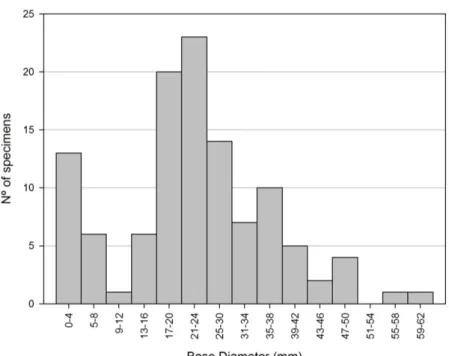
At the end of the study period, the highest esti-mated density was reached on substrate B with 1808 ind. m-2. Substrate A was immersed for the longest period (15 months) but had a lower final density (1109 ind. m-2). For the other substrates, the highest density was estimated for substrate C (400 ind. m-2) after 11 months while the density of the last substrate deployed (D) was 67 ind. m-2. Throughout the study, individuals showed a fast growth rate (basal diameter; 0.08 ± 0.02 mm day -1). By the end of the study, the monitored indi-viduals had a mean basal diameter of 21.35 ± 6.2 mm. The final size distribution of barnacles on substrate A is illustrated in Figure 3 and suggests that by the end of the study, 20.2% of the barna-cles were harvestable (i.e. larger than 28 mm basal diameter; 12.6 mm carino-rostral length). With the growth rate obtained, it was estimated that 82.7% of the barnacles on substrate A would reach commercial size and be harvestable after 9 more months (total production cycle of 24 months).
REPRODUCTION
During the sampling period there was a wide variability in the percentages of the different developmental stages of the ovaries (Table 2). The more developed stages (stages 3 and 4) were present in almost all of the samples. During No-vember-December 2006, 6.8% of the individuals had egg lamellae (i.e. stage 4). This percentage reached the value of 38.6% when individuals with the eggs in the oviducts (stage 3) were also con-sidered. In January-February and March-April the percentage of individuals with female gonads at stage 3 and 4 was 13.9% and 38.9%, respectively.
The highest percentage of individuals with egg lamellae was recorded in May-June (50 %). Dur-ing this samplDur-ing period the early stages (1 and 2) were always above 40%. The basal diameter of individuals brooding egg masses (stage 4) varied between a minimum of 11 mm and a maximum of 32 mm with an average size of 21 ± 5 mm (n=26). The size distribution of these individuals indi-cated that 50% of the specimens reproduced when their basal diameter was less than or equal to 20 mm with an average size of 17 ± 2 mm (n=13).
Fig. 1. Artificial substrate (A) for Megabalanus
azoricus culture after 9 months in Baixa do Norte,
Fig. 2. Recruitment intensity of M. azoricus on four artificial substrates (A, B, C, and D) placed in Baixa do Norte at different times of the year (arrows indicate time at which each structure was placed in the water).
Table 1. ANOVA Table for repeated measures with data of recruits per square metre (Fig. 2). Sources of variance are four categorical factors (structure A, B, C and D) and 5 levels within-subject factor (sampling period). It is also reported the Error variance. SS sums of squares, MS mean square, F statistics and p values.
Source SS df MS F p Structure 203909.7 3 67969.9 0.93 0.505 Error 203909.7 4 73256.9 Time 410388.9 4 102597.2 3.09 0.046 Structure* Time 388555.2 12 32379.6 0.98 0.507 Error 530722,2 16 33170,1
Table 2. Percentage (%) and number (N) of individuals with ovaries in different developmental stages: 1 = ovaries undifferentiated, 2 = ovaries recognizable as pale-orange spot on the base of the mantle cavity and eggs not evident by eye, 3 = ovaries evident as orange masses with eggs distinguishable by eye, 4 = presence of egg lamellae in the mantle cavity.
stage 1 stage 2 stage 3 stage 4
Sampling % n % n % n % n total
Nov-Dec 06 38.6 17 22.7 10 31.8 14 6.8 3 44
Jan-Feb 07 33.3 12 52.8 19 13.9 5 0.0 0 36
Mar-Apr 07 11.1 8 50.0 36 36.1 26 2.8 2 72
Fig. 3. Size distribution (base diameter) of M. azoricus in the four quadrates on substrate A after an immersion period of 15 months.
DISCUSSION
The overexploitation of marine organisms has been a driving force for the expansion of maricul-ture throughout the world. The giant Azorean barnacle, M. azoricus is a key species in the Azorean rocky littoral, suffering intense exploita-tion (Santos et al. 1995); an alternative method of production through aquaculture would fulfil de-mand and relieve fishing pressure on natural populations.
This study has demonstrated the potential of this new species for mariculture. The farming techniques would closely resemble those of tradi-tional mussel or oyster culture; involving spat collection on artificial substrates and on-growing in the same or in a different location. The major difficulty lies in the Azorean sea conditions, which require strong systems capable of with-standing rough weather.
Little information exists on the life cycle of M. azoricus, and a good understanding of recruit-ment dynamics and spawning cycle is essential for developing such a farming technology that relies on natural seed production. Adequate
tim-ing of artificial substrate immersion is a key fac-tor to optimise the spat collection phase as it should synchronise with peaks in cyprid abun-dance (Andrade et al. 2011). As previously sug-gested for this species (Regala 1999; Matos 2006), the results confirm a temporal variation in recruitment, typical for barnacles (e.g. Pineda 1994; Jenkins et al. 2000; Watson et al. 2005; Lee et al. 2006). Although recruitment was recorded year round, the highest levels occurred between June and October. Deploying the substrate at the beginning of the settlement period (i.e. May-June) was optimal for colonisation, but when immersed prior to or after the recruitment peak it is probable that a large amount of macroalgae reduced re-cruitment intensities. This is supported by the fact that substrate B (placed in early June during re-cruitment peak) yielded densities almost twice as high as those on the substrate placed only two months before (substrate A). However, the ab-sence of replication does not permit to firmly confirm this phenomenon. Nevertheless, the dif-ferences detected in recruitment between the two opposite sides of the apparatus, with distinct algal communities, further emphasises the existence of
an inverse relationship between macroalgal cover and barnacle settlement, which requires further investigation.
A large amount of literature exists on the fac-tors influencing settlement in barnacles, princi-pally because barnacles are a common fouling marine invertebrate (Christie & Dalley 1987). A wide range of physical and biological factors have been shown to influence attachment choice of barnacle larvae. These include algal cover (Le Tourneux & Bourget 1988), surface colour (Taki et al. 1980), surface roughness (Hills & Thoma-son 1996), surface “wettablility” (Dahlström et al. 2004), biofilm development (Hung et al. 2008) and presence of conspecifics (Crisp & Meadows 1962), the latter often overlapping other cues (Thompson et al. 1998). Determining the scale of importance for each factor for the settlement choice of M. azoricus should be the focus of fur-ther research to optimise culture practices.
The pattern of recruitment was consistent with the trend observed in the percentages of individu-als with egg lamellae in the mantle cavity. Indi-viduals with eggs occurred almost all year around with a major peak starting in late spring. The occurrence of this peak was also found by Dion-isio et al. (2007). In their work they highlighted the presence of a second peak in winter which was not identified in this study. First maturity occurred at small size at an age of less than 5 months, and an average of 50% of the specimens reproduced after seven months. Thus, as shown for Austromegabalanus psittacus (López 2008), some of the life history traits of Megabalanus. azoricus such as recruitment occurring within a narrow temporal window, early sexual maturity, production of several broods per year and high fecundity (Dionisio et al. 2007) are all positive attributes for commercial production (Lopez et al. 2010).
Since the scale of production also depends on the degree of natural spat settlement on the sub-strates, another important factor in the evaluation of farming the Azorean giant barnacle is the re-cruitment intensity, as it will determine whether hatchery operation will be necessary. Although this work could not determine if the larval supply is high enough to support a commercial activity, the observed final density values are encouraging. It is noteworthy, however, that larval supply
might not be spatially homogeneous and at some sites particular local oceanographic conditions might favour larval retention, which may result in large differences in larval abundance (e.g. Jenkins & Hawkins 2003). As our study was carried out in just one location, it is essential to gather more knowledge on larval dispersal and on local oceanographic processes to identify if certain areas around the islands are more suitable for spat collection. Furthermore, inter-annual variation in recruitment intensity is recognised by various authors for intertidal barnacles (e.g. Barnes 1956; Hawkins & Hartnoll 1982; Kendall et al. 1985; Jenkins et al. 2000) therefore care must be taken to anticipate such variation for the development of commercial production.
No data exists on the growth of M. azoricus and the fast growth rate, documented here (although sample size was small), further supports this spe-cies as a potential candidate for farming. Al-though some individuals are known to exceed 55 mm (basal diameter) (Dionisio 2007), previous studies indicated mean basal diameters of 30 mm and heights of 40 mm could be achieved (Pilsbry 1916; Newman & Ross 1976; McLaughlin 1980; Henry & McLaughlin 1986). In this study, some individuals reached basal diameters of 40 mm (~30 mm carino-rostral length) in less than 14 months with an average growth rate of 0.08 ± 0.02 mm day-1 (mean ± SD). This fast growth is a strong asset for its production.
The aggregation settlement behaviour of barna-cles complicates growth studies since individuals at high densities increase in height once space on the substrate becomes restricted (Bertness et al. 1998). For this reason, only isolated individuals were monitored but since, a large amount of bar-nacles on the tubes were found in tight hum-mocks, it will be important to include them in the future. For detailed growth studies of clumped individuals, the best size measurement to be used is the carino-rostral length (see above) as it has been shown to be density independent (López et al. 2007).
Growth in barnacles is influenced by a number of factors, including tidal level (Bertness et al. 1998), water flow (Crisp 1960), orientation to current and population density (Bertness et al. 1998; Hills & Thomason 2003). It is evident that all these factors are intimately linked to food
supply and further work should focus on deter-mining the best conditions for optimal growth in M. azoricus, while at the same time minimising operational costs.
The commercial size of M. azoricus has not been defined adequately and the variability in their morphology complicates this process. Lo-cally, barnacles are sold in hummocks, formed by many individuals growing on each other. The price of the hummocks fluctuate between 0.42 and 7.18 Euro/kg (data from 2008-2011 from Lotaçor) and it depends on the number of edible individuals present rather than on their dimen-sion. Giant barnacles are considered edible when the carino-rostral length is larger or equal to 10 mm (see above). However, for convenience, and in a conservative way, we have used a carino-rostral length of 12.6 mm (see methods), and our preliminary evaluation shows that on the first substrate immersed (substrate A), 20.2% of the barnacles were harvestable (after 15 months) and suggests that if waited a further 9 months, 82.7% of the barnacles would have reached commercial size. Thus, a total production cycle of 24 months is grossly expected.
Although not quantified, mortality levels were low. The predatory gastropod Thais haemostoma, commonly seen on natural populations (Regala 1999) was never observed on the artificial sub-strates. On the other hand, by the end of the study, the occurrence of predatory flatworms (Plathyheminthes: Stylochidae) was recorded several times within the shell of dead barnacles. Members of this group are known to be voracious predators of barnacles and bivalves (Branscomb 1976; Galleni et al. 1980), sometimes causing huge economic losses to shellfish cultures and should be one of the research priorities for the near future.
This pilot study showed that M. azoricus pos-sesses many characteristics favorable to maricul-ture. Growth is rapid and cyprids readily settle on the substrate provided, reaching high densities after one year and having an estimated complete production cycle lasting 24 months. It is probable that the cycle can be optimised if further research is conducted to improve spat collectors and grow-ing conditions. Determingrow-ing spatial and temporal variation in larval abundance is important to know whether natural spat fall can support
com-mercial exploitation. Sexual maturity is reached very early allowing farmed individuals to con-tribute to recruitment into natural populations that could help recover natural populations in a simi-lar way to stock enhancement programs. Fur-thermore, such suspended culture is based on natural processes for recruitment and food pro-duction, thus offering great potential for being an environmentally sustainable activity for the Azores
.
ACKNOWLEDGEMENTS
This study was supported by the Projecto EPA – I; PRODESA ref. 2004.91.001645.0 (action 2.3.12). We are grateful for the help of Rodrigo Delgado, Valentina Matos and Norberto Serpa during the field and laboratory work. We would like to thank Daniel López and Fernando Jara for their suggestions given during the preparation of this manuscript. Finally, thanks are due to the two anonymous reviewers for their suggestions.
REFERENCES
Andrade L.I., D.A. López & B.A. López 2011. Dynamic models applied to giant barnacle culture.
Aquaculture International. doi
10.1007/s10499-011-9421-4
Barnes, H. 1956. Balanus balanoides (L.) in the Firth of Clyde: the development and annual variation in the larval population and the causative factors.
Journal of Animal Ecology 25: 72–84.
Bedecarratz P.C., D.A. López, B.A. López & O.A. Mora. 2011. Economic Feasibility of Aquaculture of the Giant Barnacle Austromegabalanus psittacus in Southern Chile. Journal of Shellfish Research 30(1):147-157.
Bertness, M.D., S.D. Gaines & S.M. Yeh 1998. Making mountains out of barnacles: the dynamics of hummock formation. Ecology 79:1382-1394. Borja A., P. Liria, I. Muxika & J. Bald 2006.
Relationships between wave exposure and biomass of the goose barnacle (Pollicipes pollicipes Gmelin, 1790) in the Gaztelugatxe Marine Reserve (Basque Country, Northern Spain). ICES Journal of Marine
Science 63:626-636.
Branscomb, E.S. 1976. Proximate causes of mortality determining the distribution and abundance of the barnacle Balanus improvisus Darwin in
Chesapeake Bay. Chesapeake Science 17:281–288. Christie, A.O & R. Dalley 1987. Barnacle fouling and its prevention. Pp. 419–433 in: Southward, A.J, (Ed.) Crustacean issues 5: barnacle biology. A.A. Balkema, Rotterdam, The Netherlands.
Crisp, D.J. 1960. Factors influencing growth-rate in
Balanus balanoides. Journal of Animal Ecology
29:95–116.
Crisp, D.J. & P.S. Meadows 1962. The chemical basis of gregariousness in cirripedes. Proceedings of the
Royal Society of London B 156:500-520.
Dahlström, M., H. Jonsson, P.R. Jonsson & H. Elwing 2004. Surface wettability as a determinant in the settlement of the barnacle Balanus improvisus Darwin. Journal of Experimental Marine Biology
and Ecology 305 (2): 223-232.
Dionisio, M., A. Rodrigues & A. Costa 2007. Reproductive biology of Megabalanus azoricus (Pilsbry), the azorean barnacle. Invertebrate
Reproduction and Development 50(3): 155-162.
Galleni, L., P. Tongiorgi, E. Ferrero & U. Salghetti 1980. Stylochus mediterraneus (Turbellaria: Polycladida), predator on the mussel Mytilus
galloprovincialis. Marine Biology 55:317–326.
Hawkins, S.J. & R.G. Hartnoll 1982. Settlement patterns of Semibalanus balanoides (L.) in the Isle of Man (1977–1981). Journal of Experimental
Marine Biology and Ecology 62: 271–283.
Hawkins, S.J., H.B.S.M. Côrte-Real, F.G. Pannacciulli, L.C. Weber & J.D.D. Bishop 2000. Thoughts on the ecology and evolution of the intertidal biota of the Azores and other Atlantic islands.
Hydrobiologia 440:3–17.
Henry, D.P. & P.A. McLaughlin 1986. The recent species of Megabalanus (Cirripedia: Balanomorpha) with special emphasis on Balanus
tintinnabulum (Linnaeus) sensu lato. Zoologische Verhandelingen 235:1-69.
Hills, J.M. & J.C. Thomason 1996. A multi-scale analysis of settlement density and pattern dynamics of the barnacle Semibalanus balanoides. Marine
Ecology Progress. Series, 138:103-115.
Hills, J.M. & J.C. Thomason 2003. Recruitment density can determine adult morphology and fecundity in the barnacle, Semibalanus balanoides. Biofouling 19(3): 205-213.
Hung, O.S., V. Thiyagarajan & P.Y. Qian 2008. Preferential attachment of barnacle larvae to natural multi-species biofilms: Does surface wettability matter? Journal of Experimental Marine
Biology and Ecology 361: 36-41.
Isidro, E., M. De Girolamo & C. Pham 2009a. PEDAPCA-1 Experimental Project for the Support and Development of Barnacle Aquaculture (Megabalanus azoricus). Arquivos do DOP, Série
Estudos, nº3/2009: 35 pp.
Isidro, E., M. De Girolamo, C. Pham, I. Bashmanikov & M. Juliano 2009b. Evaluation of the potential impacts of barnacle farming in Baixa do Norte.
Arquivos do DOP, Série Estudos, nº2/2009: 36 pp.
Jenkins, S.R. & S.J. Hawkins 2003. Barnacle larval supply to sheltered rocky shores: a limiting factor?
Hydrobiologia 503: 143-151.
Jeffery C.J. & A.J. Underwood 2001. Longevity determines sizes of an adult intertidal barnacle.
Journal of Experimental Marine Biology and Ecology 256(1):85-97.
Jenkins, S.R., P. Åberg, G. Cervin, R.A. Coleman, J. Delaney, P. Della Santina, S.J. Hawkins, E. LaCroix, A.A. Myers, M. Lindergarth, A.M. Power & R.G. Hartnoll 2000. Spatial and temporal variation in the settlement and recruitment of the intertidal barnacle Semibalanus balanoides (L.) (Crustacea: Cirripedia) over a European scale.
Journal of Experimental Marine Biology and Ecology 243: 209-225.
Kendall, M.A., R.S. Bowman, P. Williamson, J.R. Lewis 1985. Annual variation in the recruitment of
Semibalanus balanoides on the North Yorkshire
coast. Journal of the Marine Biological Association
of the United Kingdom 65: 1009–1030.
Lauzier, R.B. 1999. A review of the biology and
fisheries of the goose barnacle (Pollicipes polymerus Sowerby, 1833). Fisheries and Oceans
Canada, Canadian Stock Assessment Secretariat Research Document 99: 1110 pp.
Lee, W.J., R.M. O’Riordan & L.L. Koh 2006. Spatial and temporal patterns in the recruitment of the intertidal barnacle Chthamalus malayensis Pilsbury (Crustacea: Cirripedia) on the equatorial shores of Peninsular Malaysia and Singapore. Journal of
Experimental Marine Biology and Ecology 333:
296-305.
Le Tourneux, F. & E. Bourget 1988. Importance of physical and biological settlement cues used at different spatial scales by the larvae of
Semibalanus balanoides. Marine Biology 97:
57-66.
López, D., B. López, M.L. González & S. Arriagada 2005. Aquaculture diversification in Chile: culture of the giant barnacle. Global Aquaculture Advocate 8: 73-74.
López, D.A., B.A. López, I.C. Burgos, S.E. Arriagada & M.L. Gonzalez 2007. Consequences of base modification in hummocks of the barnacle
Austromegabalanus psittacus. New Zealand Journal of Marine and Freshwater Research
41:291–298.
López, D. 2008. Giant barnacle “picoroco” culture in Chile. Pp. 56-57 in: Pham, C.K., R.M. Higgins, M.
De Girolamo & E. Isidro (Eds). Abstract Proceedings of the International Workshop: Developing a Sustainable Aquaculture Industry in the Azores. Arquipélago. Life and Marine Sciences. Supplement 7: xiii + 81 pp.
López, D.A., B.A. López, C.K. Pham, E.J. Isidro & M. De Girolamo 2010, Barnacle culture: background, potential and challenges. Aquaculture Research 41:367–375.
Lotaçor (internet). Pescado Descarregado na R.A.A. Availablefrom: http://www.lotacor.pt/
Matos, V.K.F. 2006. Estudo de alguns aspectos da
morfologia e da reprodução de Megabalanus azoricus. Relatório de Estágio do Curso de
Licenciatura em Biologia Marinha. Departamento de Biologia, Universidade dos Açores. [in Portuguese]
McLaughlin, P.A. 1980. Comparative morphology of
Recent Crustacea. W.H. Freeman & Company. San
Francisco. 177 pp.
Newman, W.A. & A. Ross 1976. Revision of the balanomorph barnacles, including a catalogue of the species. San Diego Society of Natural History
Museum 9: 1-108.
OSPAR, 2008. OSPAR List of Threatened and/or Declining Species and Habitats Agreement number: 2008-6), OSPAR Commission.
Pham, C.K., R.M. Higgins, M. De Girolamo & E. Isidro 2008. (Eds) Proceedings of the International Workshop: Developing a Sustainable Aquaculture Industry in the Azores. Arquipelago. Life and Marine Sciences. Supplement 7: xiii + 81 pp. Pilsbry, H.A. 1916. The sessile barnacles (Cirripedia)
contained in the collections of the U.S. National Museum; including a monograph of the American
species. Bulletin the United States National
Museum 93: 1-366.
Pineda, J. 1994. Spatial and temporal patterns in barnacle settlement rate along a southern California rocky shore. Marine Ecology Progress Series 107: 125-138.
Regala, J.T. 1999. Contribuição para o estudo da
biologia da craca dos Açores, Megabalanus azoricus (Pilsbry, 1916). Relatório de Estágio do
Curso de Licenciatura em Biologia Marinha. DOP, Universidade do Algarve, Faro. [in Portuguese] Santos, R.S., S.J. Hawkins, L.R. Monteriro, M. Alves
& E.J. Isidro 1995. Marine research resources and conservation in the Azores. Aquatic Conservation Marine and Freshwater Ecosystems 5: 311-354. Southward, A.J. 1998. New observations on barnacles
(Crustacea: Cirripedia) of the Azores region.
Arquipelago. Life and Marine Sciences 16A:11-27.
Taki, Y., Y. Ogasawara, Y. Ido & N. Yokoyama 1980. Colour factors influencing larval settlement of Barnacles, Balanus amphitrite sub spp. Bulletin of
the Japanese Society of Scientific Fisheries. 46:
133–138.
Thompson, R.C., T.A. Norton & S.J. Hawkins 1998. The influence of epilithic microbial films on the settlement of Semibalanus balanoides cyprids - a comparison between laboratory and field experiments. Hydrobiologia, 375/376:203-216. Watson, D.I., D.K.A. Barnes, R.M O’Riordan & T.F.
Cross 2005. Temporal and spatial variability in the recruitment of barnacles and the local dominance of Elminius modestus Darwin in SW Ireland.
Estuarine, Coastal and Shelf Science 63:119-131. Accepted 18 June 2011.