Martins, A., A. L. Santos & I. Duarte (2017) Syntactic complexity in children with Autism Spectrum Disorder and Specific Language ImpairmentEscobar, L., Torrens, V. and Parodi, T. (eds.) Language Processing and Disorders. Newcastle: Cambridge Scholars Publishing.
SYNTATIC COMPLEXITY IN CHILDREN WITH
AUTISM SPECTRUM DISORDER AND SPECIFIC
LANGUAGE IMPAIRMENT
ALEXANDRINA MARTINS,
ANA LÚCIA SANTOS, INÊS DUARTE
1.
Introduction
Traditionally, Specific Language Impairment (SLI) and Autism Spectrum Disorders (ASD) have been seen as two distinct conditions with different etiologies. More recently, there has been much discussion about the points which separate these pathologies, but mainly concern about the similarities between both, as well as about the possibility of a common etiology and an intersection at the genetic level. Some authors present evidence suggesting that these two conditions share common factors.
Several studies focused on language acquisition of children diagnosed with autism and described different atypical language characteristics in the group, emphasizing what are considered to be similarities between them and children with other developmental language disorders (Tager-Flusberg, 2006).
The study of language acquisition in autism spectrum disorders plays an important role, since speech delay continues to be an issue of great interest for parents, as it is one of the most common signals that alerts for the possibility of some nonconformity with the normal course of development. Tager-Flusberg and Joseph
(2003) developed two studies to investigate the language difficulties in children diagnosed with autism, particularly with regard to issues of formal language. Taking into account the results of the studies, which identified similar performance in formal language tests as well as similar deficits in non-word repetition and tense marking in
children with ASD and SLI, the authors claim that there are clear similarities between SLI and ASD with respect to language.
In another study, Whitehouse, Barry, & Bishop (2008) identified performances similar to SLI children on the TROG - E, on the subscales of formal language of the CCC-2, as well as in MLUw measures, thereby demonstrating that children with autism have language difficulties covering various language areas, both at the level of comprehension and production. However, after a more detailed analysis of the linguistic profiles, the authors found that there are marked differences at the level of performance in certain tasks, such as those which involve oro-motor and speech skills, as well as in sentence repetition tasks. In this case, SLI children showed lower performances when compared to ASD children. Although the global scores in the two groups seem similar, SLI children tend to fail more often in longer non-words, whereas in the case of ASD children the errors are independent of the number of syllables.
On several studies, similarities between children diagnosed with ASD and children with SLI are highlighted, even though the same studies show some performance differences. In a study by Tuller, Prévost, Morin & Zebib (2011), the authors found that ASD children (aged 6 to 12) and SLI children (aged 6 to 11) more often preferred less complex interrogatives than typically developing children. They concluded that both SLI and ASD children tend to avoid syntactic complexity. However, after a closer examination of the results, the authors found that in an elicited production task targeting wh-questions, ASD children differed from SLI children since the former more often produced inappropriate questions.
The present study continues this line of research, by evaluating the performance of both SLI and ASD children in tasks involving complex syntax and by comparing the performance of both groups in different experimental tasks. In particular,
we evaluate the performance of these two groups of children in the production (sentence repetition) and comprehension (truth value judgment) of subject and object relatives, including both simple relatives and relatives involving long distance extractions.
1.1
Syntactic impairment in SLI and ASD Children
Much is known about the performance of SLI children in what regards formal syntax. The same is not true in the case of children diagnosed with ASD. However, as far as relative clauses are concerned, some difficulties in the comprehension of object relatives were already found in ASD groups, mirroring what was found for SLI children.
A prolonged asymmetry between subject and object relatives is a well-known characteristic of SLI, as described by Novogrodsky & Friedmann (2006). The authors report difficulties in the production of these structures by children with SLI, who produced some distinctive response types, such as thematic role errors, the production of subject relatives and of simple sentences when an object relative is the target. This unequal performance level in subject and object relatives, well studied in typical language development (see Friedmann, Belletti, & Rizzi, 2009) but which is prolonged in the case of SLI, was also found in European Portuguese SLI children (Costa, Lobo, Silva, & Ferreira, 2009).
In the particular case of individuals with ASD, Durrleman et al. (2014) found that, despite their language development history, subjects performed better in the comprehension of subject than object relatives.
In addition, a study by Riches et al. (2010), which was based on a sentence repetition task centred on relatives and was applied to adolescents with SLI or ASD, found higher error rates in these groups, when compared with errors rates obtained by
typically developing subjects (TD). The task involved repetition of relative clauses which varied in the level of syntactic complexity. In this study, the authors also found a high tendency to transform object relatives into subject relatives.
In the case of SLI children, Jakubowicz and Strik (2008) found that children in this group (ages 6;11-14;0) behave similarly to younger TD children (3 and 4 years old) when answering an elicited production task requiring successive cyclic wh-movement. A tendency to avoid long-distance movement was found, through the use of different syntactic strategies such as simple partial movement and wh-copying. Delage et al. (2008) studied relative clauses in spontaneous production samples from SLI children and found that even though they produce relative clauses they tend to avoid those involving long distance dependencies or a higher level of embedding.
As for subordination in general, Hamann et al. (2007) examined subordination structures in samples of spontaneous speech of SLI children aged 5 to 10 years and adolescents (between 10 to 15 years), having found that SLI subjects less often use forms of subordination than TD children. Besides, the sentences containing a subordinate clause showed higher error rates in the SLI group. The same study also found that whereas the frequency of embedding increased with age in the TD groups, it stagnated in the SLI groups, although a decrease in ungrammaticality was observed.
As stated at the end of section 1, in this study, we evaluate SLI and ASD children’s performance in subject and object relatives, including relatives involving long distance extractions. By comparing the results obtained by atypically developing children with their typically developing controls, we expect to confirm the existence of a prolonged subject / object asymmetries in the SLI population. We also aim at comparing the results obtained by SLI children with those obtained by ASD children, thus contributing to the debate concerning the similarities of these two groups in terms
of linguistic development. In addition, we aim at identifying the impact of syntactic complexity (here identified with embedding and long distance extraction) in the production and comprehension results of both impaired populations.
2.
The study
2.1.
Research questions
Motivated by some of the results obtained in the studies summarized in the previous section, as well as by some of the questions they left open, we aim at answering the following research questions:
I. What are the similarities and differences between children diagnosed with ASD and SLI and children with typical language development, with respect to the production and comprehension of complex syntactic structures, namely relatives involving short movement and relatives involving extraction from a complement clause?
II. What is the nature of the syntactic difficulties observed in children with ASD and SLI?
2.2.
Participants
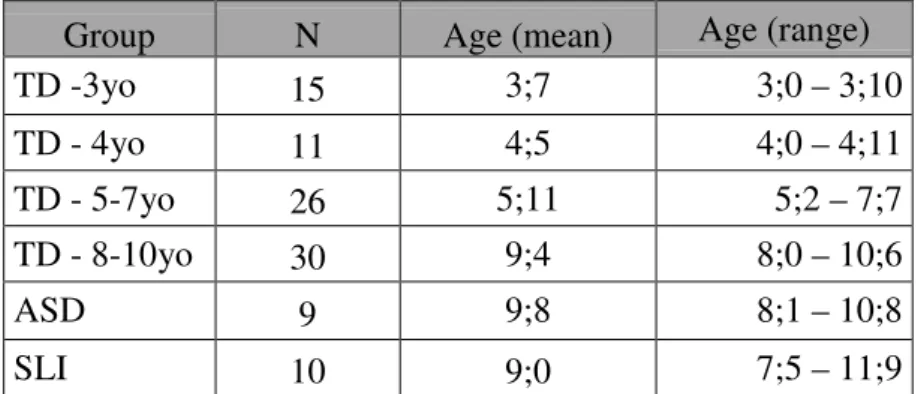
In our study, we consider the two conditions of atypical development referred above and we compare children diagnosed with SLI and ASD with children with Typical Development (TD). The general characterization of the subjects is provided in table 1. All participants are monolingual speakers of European Portuguese (EP).
Table 1. Subjects
In order to be included in TD groups, children must meet the following inclusion criteria: absence of hearing, neurological or cognitive impairment and no diagnoses or history of abnormal language development. All the children included in this group were evaluated with the Schlichting Test for Sentence Development – PT (Vieira, 2011) and scored within their age level or at ceiling in the case of older children (the test is standardized for pre-school population; no similar standardized test is available for school age children). These children were divided in four different groups according to age. The older TD group matches in age the two atypically developing groups and is used as a control group to evaluate their performance.
As for the children in the SLI group, they all have diagnoses recognized by independent language speech therapists. Additionally, syntactic impairment was confirmed by the Schlichting Test for Sentence Development – PT (Vieira, 2011): in this test, SLI children included in the group scored at the same level as TD children between 4;0-4;5 at percentile 50.
All the children in the ASD group meet the criteria for the condition described in the DSM – IV TR. In addition, the diagnoses were confirmed by Autism Diagnostic Interview–Revised (ADI-R) (Lord et al. 2000) or Autism Diagnostic Observation
Group N Age (mean) Age (range)
TD -3yo 15 3;7 3;0 – 3;10 TD - 4yo 11 4;5 4;0 – 4;11 TD - 5-7yo 26 5;11 5;2 – 7;7 TD - 8-10yo 30 9;4 8;0 – 10;6 ASD 9 9;8 8;1 – 10;8 SLI 10 9;0 7;5 – 11;9
Schedule (ADOS) (Lord, Rutter & Le Couter 1994). In the Schlichting Test for Sentence Development – PT (Vieira, 2011), the ASD group scored at the same level as TD children between 5;0-5;5 at percentile 50.
2.2.1.
Materials and procedure
In order to investigate the ability to produce and understand complex sentences in the different groups, two tasks were applied: a sentence repetition (SR) task and a truth value judgment (TVJ) task. Both tasks tested subject and object relatives both in cases of short and of long movement. We thus test simple cases of subject (1) and object relatives (2), as well as subject relatives and object relatives involving extraction from a complement clause (3 and 4, respectively):
Relatives with short movement:
SR (1) Este é o elefante que mordeu o urso. this is the elephant that bit the bear. OR (2) Este é o cavalo que o urso empurrou.
this is the horse that the bear pushed.
Relatives involving extraction from complement clauses:
SRwC (3) Este é o urso que o porco disse que lambeu o elefante. this is the bear that the pig said that licked the elephant. ORwC (4) Este é o macaco que o cão disse que o elefante empurrou. this is the monkey that the dog said that the elephant pushed.
With these tasks we tried to ascertain the child’s capacity to produce and understand subject (1) and object relatives (2), expecting to confirm well-known subject-object asymmetries (see Friedmann, Belletti & Rizzi, 2009), as well as to
determine the extent to which these asymmetries may be found in these two groups of atypically developing children. In addition, we intend to determine how children behave when faced with different levels of syntactic complexity - the level of embedding is increased in (3) and (4), due to the fact that the relativized NP is extracted from a complement clause.
Task 1 - Sentence Repetition Task
Given its sensitivity to syntax, sentence repetition has been widely used to investigate typically developing children’s syntactic competence (see Kidd et al., 2007). Moreover, Riches et al. (2010) found that sentence repetition demonstrated sensitivity as a phenotypic marker of language impairments, with higher error rates in the clinical groups, and lower error rates in the typically developing participants. Sentences in (1) to (4) exemplify the conditions included in the task. Five sentences were tested in each condition.
Task 2 – Truth Value Judgment Task
The truth value judgment task is an experimental tool which involves the presentation of a sentence in one context at a time. By manipulating the context, the experimenter seeks to determine the range of interpretations (or truth-conditions) that are consistent with the child's interpretation, for a given linguistic structure (Crain e Thornton, 1998).
In this task children were presented with a scenario where there are several animals, described as being stubborn and mischievous and who are always complaining of each other to a farmer, who is supposed to take care of them, but who is very sleepy. When he is telling the story, the experimenter acts-out the sentence representing the action in the relative clause, followed by the animal whispering to the farmer in the case
of the relatives with extraction from a complement clause (this is the case of items (3) and (4), as well as (5) and (6) below).
SRwC (5) Este é o elefante que o cão disse que empurrou o cavalo. this is the elephant that the dog said that pushed the horse. ORwC (6) Este é o leão que o cavalo disse que o porco lambeu. this is the lion that the horse said that the pig licked.
In order to test the comprehension of a sentence such as (1), in a case in which it corresponds to a false assertion by the farmer, the experimenter provides the scenario with two elephants and a bear and acts-out the action in which the bear bites one of the elephants. Then the child is asked to judge whether the farmer is pointing to the right referent, as he is saying the sentence. In order to test the sentence in (6), in a case in which it corresponds to a false assertion by the farmer, the experimenter sets out a lion (out of two) licking the pig, an action which represents reversed roles, followed by the horse whispering to the farmer. Then the child is asked to judge the farmer’s sentence.
2.3.
Results
In this section, we present the results obtained in these tasks. The statistical analysis was performed using Rbrul, a text-based interface to existing functions in the R environment (Johnson, 2009) and applying a Generalized Linear Mixed Model (GLMM).
In the case of each task, we separately considered typical development and atypical groups compared to an age-matched typically developing group of children. Therefore, we separately consider two groups of results, one including TD children (TD -3yo; TD - 4yo; TD - 5-7yo; TD - 8-10yo) and the other including the ASD and SLI
children compared with the older TD group, matching in age the ASD and the SLI groups (ASD; SLI; TD - 8-10yo). The fixed factors tested in the statistical model are group (defined in terms of age in the case of typically developing children), grammatical relation (subject or object) and level of complexity (relative with or without complement clause); the subject was included in the model as a random factor. We also analyse the interaction between grammatical relation and level of complexity. For the TVJ task, the analysis only included the items expected to be considered false (good results with items expected to be considered true could be due to yes-bias effects).
Task 1 - Sentence Repetition Task
The general results obtained by the typically developing groups in the sentence repetition task are presented in graph 1.
Graph 1 – Percentage of correct answers in typically developing groups for the RT
In the case of this task, the GLMM model shows that all the fixed factors which were tested were selected as predictors for the accurate repetition of the sentences
55% 84% 94% 97% 44% 73% 85% 98% 4% 16% 32% 68% 0% 9% 15% 47% 0% 10% 20% 30% 40% 50% 60% 70% 80% 90% 100% Group 1 -
3Y-3Y;11M Group 2 - 4Y-4Y;11M Group 3 - 5Y-7Y;11M Group 4 - 8Y-10Y;11M SR OR SR with Compl OR with Compl
in study: group (p < .001), grammatical relation (p < .001) and level of complexity (p <.001). The interaction between grammatical relation and level of complexity was not selected as a significant predictor in the model.
Considering the factor group, defined according to age in typically developing children, it is possible to verify that in the four conditions the percentage of accurate answers increases with age. The results show positive logodd values for the oldest groups (2.991 for children aged 8-10 years old and .497 for children aged 5 to 7 years old). In the case of the two younger groups, the logodd values are negative (-.690 for children aged 4 years old and -2.799 for children aged 3 years old). The chance to produce the accurate sentence increases with age.
With respect to the factor grammatical relation, it is possible to verify that the highest accuracy rate corresponds to subject relatives (logodds values: .582 to subject structures,-.582 for object structures). In graph 1, we indeed observe higher percentages of correct answers to subject relatives in the four groups. The exception to this finding is the oldest group, who does not show a subject-object asymmetry in relatives involving short movement, but shows that type of asymmetry in the repetition of relatives involving extraction from complement clauses (only in this last case, performance with object extractions is lower than extraction from subject position).
As for the factor level of complexity, the logodd values confirm that relatives with extraction out of complement clauses are more problematic for children to repeat (2.577 for simple relatives and -2.577 for relatives involving extraction from complement clauses). In graph 1, we can see that TD children, regardless of age, find it hard to repeat this type of sentences, when compared with simple relatives, although the difficulty is even clearer in younger children. We should acknowledge the fact that the sentences involving long extraction are longer than the ones involving short extraction
(see 1 and 2 vs. 3 and 4) and the length of the sentence is a relevant factor in a sentence repetition task. Although, notice that in the case of the older TD group, we see a subject-object asymmetry in the case of the longer sentences, thus failure in repeating them cannot be explained only by simple memory difficulties: the child is indeed processing the syntactic structure and the difficulty in processing the complex structure exacerbates the difficulty of producing an object relative.
We now turn to the results obtained by the groups with language impairment. In graph 2, we present the results obtained by the SLI and the ASD groups as well as an age-matched typically developing group (8-10 years).
Graph 2 - Percentage of correct answers in groups SLI; ASD and TD 8-10yo for the RT
The general observation of the graph shows lower results obtained by the atypically developing groups when compared to the TD group. Another general observation concerns a comparison between the SLI and the ASD groups, namely the fact that the ASD group seems to have better results, especially in simple relatives: in fact, in simple relatives, the ASD group does not seem to show a clear subject – object asymmetry, exactly as it happens with the typically developing group (although the
97% 80% 88% 98% 60% 85% 68% 15% 38% 47% 20% 25% 0% 10% 20% 30% 40% 50% 60% 70% 80% 90% 100%
Group 4 - 8Y-10Y;11M Group SLI Group ASD SR OR SR with Compl OR with Compl
ASD children have lower success scores); the subject-object asymmetry is observed only in relatives involving long extraction.
A GLMM model was also built for the results obtained by these groups. Once again all factors were selected as predictors for accurate repetition: group (p < .001), grammatical relation (p < .001) and level of complexity (p <.001). Again an interaction between grammatical relation and complexity was not selected as a significant predictor.
As for the factor group, we can verify that the chance of success is higher in the TD group in all conditions: the TD group is the only group with a positive logodd value (1,731) in the model, contrasting with the negative logodd values corresponding to the ASD (-.283) and the SLI (-1.448) groups. These values also confirm that the chance of accurate production of the target syntactic structures is even lower in SLI group than in the ASD group.
Considering the factor grammatical relation, subject extractions obtain a positive value (.501) and object extractions the reverse negative value (-.501). With respect to the factor level of complexity, the statistical model shows a positive logodd (2.103) for simple relatives and the reverse negative logodd (-2.103) in the case of relatives involving extraction from a complement clause. Relative clauses with higher level of complexity are therefore more problematic (see also graph 2).
Nevertheless, the analysis of the results obtained in this task by the language impaired groups will not be complete if we do not consider the different types of errors found in the different groups.
Error Analysis
In Graph 3, we present a qualitative analysis of errors found in answers given by the SLI group.
Graph 3- SLI Group: errors
The most common error made by the SLI group in the case of simple subject relatives (SR) is the transformation of the relative in a simple sentence (7), such as:
(7) Item: Este é o porco que lambeu o macaco. this is the pig that licked the monkey. Answer: Este porco lambeu o macaco.
this pig licked the monkey.
As for the simple object relatives (OR), the highest percentage of incorrect answers is the transformation of the object relative into a subject relative (“OR/SR” in the graph) (see 8):
(8) Item: Este é o porco que o cão lambeu. this is the pig that the dog licked. Answer: Este é o cão que lambeu o porco this is the dog that licked the pig.
ambiguous (Sub/Obj) Complementizer omission long - short extraction OR / SR sentence fragment elimination of complement clause simple sentence SR 0% 0% 0% 0% 21% 0% 47% OR 6% 3% 0% 37% 20% 0% 3% SRwC 6% 11% 28% 0% 9% 15% 2% ORwC 17% 3% 16% 7% 16% 6% 1% 0% 5% 10% 15% 20% 25% 30% 35% 40% 45% 50%
With respect to subject relatives involving extraction from complement clauses (SRwC), the most common error is the transformation of long extraction into short extraction (“long - short extraction” in the graph) (see 9):
(9) Item: Este é o cão que o boi disse que molhou o porco. this is the dog that the ox said that wet the pig.
Answer: Este é o cão que disse que o boi molhou o porco this is the dog that said that the ox wet the pig.
Another common error in these structures is the elimination of the complement clause, as we can see in the following example (10):
(10) Item: Este é o urso que o porco disse que lambeu o elefante. this is the bear that the pig said that licked the elephant. Answer: Este é o urso que lambeu o elefante.
this is the bear that licked the elephant.
In the case of object relatives involving extraction from complement clauses (ORwC), the most common error is the production of an ambiguous sentence between a subject relative and an object relative with a null subject (11):
(11) Item: Este é o cão que o leão disse que o boi mordeu. this is the dog that the lion said that the pig bit.
Answer: Este é o cão que o leão disse que mordeu. this is the dog that the lion said that bit.
The transformation of a long extraction into a short extraction, along with the production of sentence fragments, such as in (12), were other common errors in the repetition of ORwC by the SLI group.
(12) Item: Este é o cão que o leão disse que o boi mordeu. this is the dog that the lion said that the pig bit. Answer: Este é o cão.
The most common errors found in the answers given by the ASD group are presented in graph 4.
Graph 4 - ASD Group: errors
In the case of simple relatives, the ASD group reveals a different error pattern, since the errors both in the case of subject and object relatives do not primarily signal a subject-object asymmetry, they signal a problem with embedding instead: the errors found in the repetition of simple relatives are either complementizer omission or the transformation of the complex sentence into a simple sentence. This is indeed in agreement with our previous observation concerning graph 4: ASD children do not show a subject – object asymmetry in simple relatives, this is only shown in relatives with long extraction.
As for the subject relatives involving extraction from complement clauses (SRwC), the highest percentage of error corresponds to the same type of error of the SLI group: transformation of long extraction into short extraction. This signals, again, a problem with embedding and long extraction.
ambiguous
(Sub/Obj) Complementizeromission long - shortextraction OR / SR simple sentence
SR 0% 33% 0% 0% 33% OR 0% 17% 0% 0% 67% SRwC 5% 18% 40% 0% 3% ORwC 19% 10% 26% 12% 2% 0% 10% 20% 30% 40% 50% 60% 70%
In the case of object relatives involving extraction from complement clauses (ORwC), the ASD group equally reveals a marked preference for the production of short extraction instead of long extraction. However, in this case we already see error patterns suggesting that an object extraction is more difficult than the subject extraction: we find in this case transformation of object relatives into subject relatives (12%) and production of relatives which are ambiguous between a subject or an object extraction reading (19%). The qualitative analysis of errors in this task does confirm that the subject-object asymmetry in the case of ASD children only emerges when the sentences involve an extra level of complexity.
Task 2 - Truth Value Judgment (TVJ) Task
Let us now compare the elicited imitation results with comprehension results, obtained in the TVJ task. The results obtained by the TD groups in the TVJ task are shown in Graph 5.
Graph 5 - TVJ: % of correct answers in typically developing (TD) groups
84% 97% 86% 99% 47% 64% 62% 91% 71% 79% 78% 89% 62% 64% 46% 80% 0% 10% 20% 30% 40% 50% 60% 70% 80% 90% 100%
Group 1 - 3Y-3A;11M Group 2 - 4Y-4A;11M Group 3 - 5Y-7A;11M Group 4 - 8Y-10A;11M SR OR SR with Compl OR with Compl
The results obtained in the truth value judgment task are similar to those in the elicited imitation task, to the extent that the GLMM model included as predictors group (p < .001), grammatical relation (p < .001) and level of complexity (p <.001) . However, in this task we also found an interaction between grammatical relation and level of complexity (p=.02).
With respect to the variable group, the results show that the oldest group obtained a positive logodd value (1.428). The logodd values for the youngest children were negative, the group of 3yo being the one with lowest logodd value (-.757). In this task, children in the 4yo group achieved higher accuracy rates than the children in the 5 to 7 yo group, with logodd values of -.083 and -.588, respectively.
As for the variable grammatical relation, the logodd values show a positive effect in the case of subject relatives (.791). In graph 5, it is possible to see a subject-object asymmetry in all groups, which is clearer in the case of younger children (groups 1 to 3).
With respect to the factor level of complexity, the logodd values confirm the results presented in graph 5, which indicate that the conditions corresponding to relatives involving extraction from complement clauses (.386) are more problematic than the simple relatives one (-.386).
The observation of Graph 5 suggests that the youngest groups of children (groups 1, 2 and 3) show a more obvious asymmetry between relatives with and without extraction from a complement clause. This subject-object asymmetry is less marked in the case of simple relatives in the older group than in the other groups.
In graph 6, we present the results obtained by the SLI and the ASD groups, as well as by their age-matched TD group.
Graph 6 - Percentage of correct answers in groups SLI; ASD and TD 8-10yo for the TVJ
The GLMM model included the following predictors: group (p < .001), grammatical relation (p < .001) and level of complexity (p <.001). An interaction between grammatical relation and level of complexity (p=.002) was also selected as a significant predictor.
The results show differences between the groups: we found a positive logodd only for the TD children (1.564). The accuracy rate drops in the atypically developing groups, with negative values of logodd in the ASD group (-.607) and, as it happened in the sentence repetition task, even lower in the SLI group (-.957).
In the case of the variable grammatical relation, we can verify that object relatives are more problematic to children in all groups (Graph 6): object relatives present a negative logodd (-1.115), in contrast with the positive value associated with subject relatives (1.115).
With respect to the factor level of complexity, the results show a positive logodd for simple relatives (1.015) and the reverse value for relatives with extraction
99% 91% 91% 100% 67% 56% 89% 61% 74% 80% 52% 37% 0% 20% 40% 60% 80% 100%
Group 4 - 8Y-10A;11M Group SLI Group ASD SR OR SR with Compl OR with Compl
from embedded clauses (-1.015). Sentences with higher degree of embedding are generally more problematic (graph 6), since children show higher rates of accuracy in simple relatives than in relatives with long movement.
Let us now more generally comment the results concerning the effects of complexity (embedding) vs. grammatical relation (subject-object asymmetry) in the two atypical groups. In general, the two groups show effects of complexity and a subject-object asymmetry. However, in the case of the ASD group, the results contrast with those obtained in the elicited imitation task: in the TVJ task, a comprehension task, complexity seems to be less relevant than in the production task, since in this case better performance is observed in subject relative clauses with long extraction from complement clauses than in simple object relatives; this contrasts with the results obtained by SLI and TD children, who have worst results with long extractions (even with extractions from a subject position) than with structures showing short movement.
3.
Discussion
In general, our results show that both children with SLI and ASD present higher errors rates than TD children, both in sentence repetition and comprehension tasks involving simple relatives and relatives with long extractions.
As expected, both SLI and ASD groups revealed an asymmetry between subject and object relatives, in both tasks. These results agree with previous studies that described the same asymmetry. In the case of SLI children, Novogrosky and Friedmann (2006) described prolonged difficulties in the production of object relatives. Our own results confirm this fact and extend it to ASD children. If both the results in the sentence repetition and in the truth-value judgment task are taken together, both SLI and ASD
children show lower scores in object relatives than typically developing children of similar age.
Novogrosky and Friedmann (2006) also describe the type of errors affecting relatives produced by SLI children. These error patterns are very similar to those observed in our sentence repetition task. Interestingly, these authors refer the absence of complementizer omission in the case of the SLI children they tested. The authors only tested simple relatives and in simple relatives complementizer omission is indeed residual also in the case of our own results; however, SLI children do show complementizer omission when the level of embedding is increased, i.e. in relatives involving long extraction from a complement clause.
Another interesting result concerns the particular results of ASD children in the sentence repetition task. In this task, even though ASD children seemed closer to the behaviour of TD children in terms of general scores obtained in simple relatives, they show an interesting behaviour of complementizer omission (both in simple relatives and in relatives with long extraction) and general avoidance of long extraction, which is not found in typically developing children of similar age. Indeed, in the sentence repetition task, complexity seems to play a different role in the ASD and the SLI results, when a subject – object asymmetry is also considered: in this task, ASD production results seem to be more heavily affected by complexity than by a subject-object asymmetry; the same is not observed in the SLI children, a fact in agreement with the different error patterns identified in the answers given by SLI children. Other authors have already highlighted the relevancy of different error patterns in different clinical groups (Riches et al, 2010).
Finally, the results obtained in the TVJ task confirm a subject-object asymmetry in the comprehension of relative clauses which is more marked in the
atypically developing groups than in the matched TD group. However, these results do not confirm the idea that structural complexity is more relevant than the subject-object asymmetry in the ASD group, as we have seen in the description of results. Is this a task asymmetry? We acknowledge that our groups are small (data collection is still ongoing) and that this necessarily limits the conclusions we can reach at this point. In future research, the effects of complexity in production (in this particular case, sentence repetition) and in comprehension must be discussed in light of more data. The data collected at this point strongly suggests (i) a prolonged subject-object asymmetry both in SLI and in ASD children and (ii) a different role played by syntactic complexity in ASD and in SLI children, at least in particular tasks.
References
Costa, J., Lobo, N., Silva, C., & Ferreira, E. (2009). Produção e compreensão das orações relativas em Português Europeu: dados do desenvolvimento típico, de PEDL e do agramatismo. Textos Seleccionados. XXIV Encontro da Associação Portuguesa de
Linguística. Lisboa: APL.
Crain, S., & Thornton, R. (1998). Investigations in Universal Grammar: A Guide to
Experiments on the Acquisition of syntax and Semantics. Massachusettes: The MIT
Presse.
Delage, H., Monjauze, C., Hamann, C., & Tuller, L. (2008). Relative clauses in atypical acquisition of french . In Gavarró, A. & Freitas, M. J. (eds), Language Acquisition and
Development: Proceedings of GALA 2007 (pp. 166-176). Newcastle: Cambrigde
Scholars Publishing.
Durrleman, S., Hippolyte, L., Zufferey, S., Iglesias, K., & Hadjikhani, N. (2014). Complex syntax in autism spectrum disorders: a study of relative clauses. International Journal
of Language & Communication Disorders, VOL. 00,NO. 0, 1–8.
Friedmann, N., Belletti, A., & Rizzi, L. (2009). Relativized relatives: types of intervention in the acquisition of A-bar dependencies. Lingua, 119, 67–88.
Hamann ., C., Tuller, L., Monjauze, C., Delage, H., & Henry, C. (2007). (Un)successful
Subordination in French-speaking Children and Adolescents with SLI. In Caunt-Nutton, S. K. H. Proceedings of BUCLD 31. Somerville: Cascadilla Press.
Jakubowicz, C., & Strik, N. (2008). Scope-marking Strategies in the Acquisition of Long Distance wh-Questions in French and Dutch. Language and Speech, 51, 101-132. Johnson, d. (2009). Getting off the GoldVarb Standard: Introducing Rbrul for Mixed Effects
VariableRule Analysis. Language and and Linguistics Compass, 3 (1) , 359-383. Kidd, E., Brandt, S., Lieven, E., & Tomasello, M. (2007). Object relatives made easy: A
cross-linguistic comparison of the constraints influencing young children's. Language and
Cognitive Processes, 22(6), 860 - 897.
Lord, C., & Risi, S. (2000). The Autism Diagnostic Observation Schedule–Generic: A Standard Measure of Social and Communication Deficits Associated with the Spectrum of Autism. Journal of Autism and Developmental Disorders, Vol. 30, 205-223. Lord, C., Rutter, M., & Le Couteur, A. (1994). Autism Diagnostic Interview-Revised: A
Revised Version of a Diagnostic Interview for Caregivers of Individuals with Possible Pervasive Developmental Disorders. Journal of Autism and Developmental Disorders,
24, 659-685.
Novogrodsky, R., & Friedmann, N. (2006). The production of relative clauses in syntactic SLI: A window to the nature of the impairment. Advances in Speech–Language Pathology,
8(4), 364 – 375.
Riches, N. G., Charman, T., Simonoff, E., & Baird, G. (2010). Sentence Repetition in children with specific language impairment and autism: a study of linguistic factors affecting recall. International Journal of Language and Communication Disorders, 45, 47-60. Tager-Flusberg, H. (2006). Defining language phenotypes in autism. Clinical Neuroscience
Tager-Flusberg, H., & Joseph, R. M. (2003). Identifying neurocognitive phenotypes in autism.
The Royal Society, 303–314.
Tuller, L., Prévost, P., Morin, E., & Zebib, R. (2011). Formal Language Impairment in French-speaking Children with ASD: A Comparative ASD/SLI Study. GALA .
Vieira, S. (2011). A Test for Sentence Development In European Portuguese (STSD-PT) - PhD
dissertation. Lisbon: Faculty of Letters of Lisbon University.
Whitehouse, A. J., Barry, J. G., & Bishop, D. (2008). Further defining the language impairment of autism: Is there a specific language impairment subtype? Journal of Communication