Tiago Fernando
Alves de Freitas
Práticas Ágeis no Desenvolvimento de
Sistemas Embutidos
Agile Practices in Embedded Systems
Development
Tiago Fernando
Alves de Freitas
Práticas Ágeis no Desenvolvimento de
Sistemas Embutidos
Agile Practices in Embedded Systems
Development
Dissertação apresentada à Universidade de Aveiro para cumprimento dos requisitos necessários à obtenção do grau de Mestre em Engenharia de Computadores e Telemática, realizada sob a orientação científica do Doutor Pedro Nicolau Faria da Fonseca, Professor Auxiliar do Departamento de Eletrónica, Telecomunicações e Informática da Universidade de Aveiro, e do Doutor Ilídio Fernando de Castro Oliveira, Professor Auxiliar do Departamento de Eletrónica, Telecomunicações e Informática da Universidade de Aveiro.
o júri / the jury
presidente / president Prof. Doutor Paulo Bacelar Reis Pedreiras Professor Auxiliar da Universidade de Aveiro vogais / examiners committee Prof. Doutor Luís Miguel Pinho de Almeida
Professor Associado da Faculdade de Engenharia da Universidade do Porto
Prof. Doutor Pedro Nicolau Faria da Fonseca
agradecimentos / acknowledgements
Agradeço aos meus orientadores Pedro Fonseca e Ilídio Oliveira pelo tempo, disponibilidade e paciência que tiveram comigo. Quero agradecer também à empresa Exatronic pela disponibilização de espaço e meios que tornaram possível o desenvolvimento desta dissertação.
Agradeço também a todos os que se cruzaram comigo no teatro, ao GrETUA, à minha equipa de voleibol e todos os meus colegas de curso por terem me ajudado e acreditado em mim.
Por fim, quero agradecer à minha família pelo enorme apoio e confiança e a todos os meus amigos mais próximos: Anderson, Cide, David C., David S., Mascarenhas, Max, Paulinho, Vânia e Victor.
palavras-chave Sistemas embutidos, metodologias ágeis, integração contínua, desenvolvimento orientado por testes, ferramentas de análise estática, processos de desenvolvimento, Atmel, CppUTest, Jenkins, Cygwin, Testes Unitários.
resumo As metodologias ágeis ganharam popularidade depois de um grupo de profissionais em diferentes métodos de desenvolvimento se juntar e criar um manifesto ágil. Estas metodologias foram criadas com o intuito de melhorar a forma de desenvolver software, tendo como foco principal a satisfação do cliente. Cada vez mais estão a ser usadas em diversos projetos substituindo a abordagem mais tradicional que atualmente ainda está muito presente. Por exemplo, Waterfall é uma metodologia tradicional onde todo o desenvolvimento é planeado deixando pouco espaço para alterações por parte do cliente. O interesse das empresas nestas metodologias tem aumentado. As empresas querem saber mais sobre esta nova forma de desenvolvimento e quais as vantagens que estas vão ter comparando com o seu atual método de desenvolvimento, que geralmente é um método tradicional. A aplicação de metodologias ágeis na área de programação para sistemas embutidos é diferente dos sistemas de informação. O desenvolvimento deste tipo de sistemas tem de ter em conta a parte do hardware e software.
No contexto da empresa Exatronic, esta dissertação tem como objetivo investigar a abordagem ágil de forma a recomendar práticas que podem ser adaptadas por esta empresa e com elas obter melhores resultados. A empresa disponibilizou um projeto já terminado para as praticas escolhidas serem aplicadas e simuladas, tendo em conta a plataforma de desenvolvimento AtmelStudio e tipo de processadores Atmel usados pela empresa. As práticas recomendadas foram duas, integração contínua e desenvolvimento orientado por testes, pois são as únicas onde é possível criar um ambiente para a sua utilização e simulação. Por fim, são analisadas as vantagens do uso destas praticas no projeto da empresa.
keywords Embedded systems, agile methodologies, continuous integration, test driven development, static analysis tools, development process, Atmel, CppUTest, Jenkins, Cygwin, Unit Tests.
abstract Agile methodologies gained popularity after a group of professionals in different development methods join and create an agile manifesto. These methodologies were created in order to improve the way to develop software, focusing mainly on customer satisfaction. They are increasingly being used in several projects, replacing the more traditional approach currently very present. For example, Waterfall is a traditional approach in which all development is planned, leaving little space for customer changes. The interest of companies in these methodologies has increased. Companies want to know more about this new way of development and what advantages they will have compared to their current development method, which is usually a traditional one. The application of agile methodologies in embedded systems is different from the informational systems. The development of such systems has to take into account the part of hardware and software. In the context of Exatronic company, this dissertation aims to investigate the agile approach in order to recommend practices that could be adapted in the company. Exatronic provided a finished project for the selected practices be implemented and simulated, taking into account the Atmel Studio development platform and the Atmel processors used by the company. The recommended practices were two, continuous integration and test driven development, because they are the only ones where is possible to create an environment for its use and simulation.
i
Contents
Contents ... 1 List of Figures ... 3 List of Tables ... 5 List of Acronyms ... 7 1 Introduction ... 1 1.1 Motivation ... 1 1.2 Objectives ... 2 1.3 Structure ... 22 The Agile Value Proposition ... 3
2.1 The Agile Approach ... 4
The Waterfall Process Model ... 4
The Agile Process Model ... 6
The Agile Project Team... 7
2.2 The Practices of Agile ... 7
Selected Methods Survey ... 11
Accessing the Impact of Agile Practices ... 14
2.3 Software Engineering Practices for Embedded Systems... 15
Specific Challenges ... 16
Embedded Process Model ... 17
2.4 Agile Practices Adoption in Embedded Systems Development ... 18
Literature Review ... 19
Agile Practices that Can Lead to Success ... 22
2.5 Summary ... 25
3 Proposal for Agile Practices Adoption ... 27
3.1 Requirements from the target company context ... 27
3.2 Planning the Agile Intervention ... 30
4 Agile Practices Implementation ... 35
4.1 Test Driven Development ... 35
4.1.1 Unit Testing with CppUTest ... 38
4.1.2 Unit Testing and Atmel Studio ... 45
ii
4.3 Static analysis tools ... 54
4.4 Continuous Integration Server ... 60
4.5 Summary ... 66
5 Results and Validation ... 67
a. Led Driver Project ... 67
b. Mafalda Project ... 71
6 Conclusion ... 79
6.1 Future Work ... 80
References ... 81
Annexes ... 87
A n n e x A - Study results and Recommendations ... 89
A n n e x B - Code Example to test the Static Analysis Tools ... 95
A n n e x C - CppUTest Information and Examples ... 99
iii
List of Figures
Figure 2.1: Waterfall Process Model, adapted from [9] ... 5
Figure 2.2: Agile Process model, adapted from [6] and [12]... 6
Figure 2.3: Different Agile Methodologies, presented in [16] ... 12
Figure 2.4 Typical embedded system process model, adapted from [44] ... 18
Figure 2.5: Embedded systems and other mainstream system shipments, presented in [74] ... 18
Figure 2.6 Use of Scrum practices in European embedded software , presented in [17] ... 20
Figure 2.7: Use of XP practices in European embedded software, presented in [17] ... 20
Figure 3.1: Develop and merge workflow in Exatronic ... 30
Figure 3.2: TDD workflow used in the Exatronic project provided ... 31
Figure 3.3: Workflow for the embedded software development with TDD ... 32
Figure 3.4: Workflow for the embedded software development with CI and TDD ... 32
Figure 4.1: Bug lifecycle without TDD, adapted from [63] ... 36
Figure 4.2: Bug lifecycle with TDD, adapted from [63] ... 36
Figure 4.3: The embedded TDD cycle, presented in [63] ... 37
Figure 4.4: CppUTest Test File structure presented in [63] ... 39
Figure 4.5: Main to run all CppUTest Tests presented in [63] ... 39
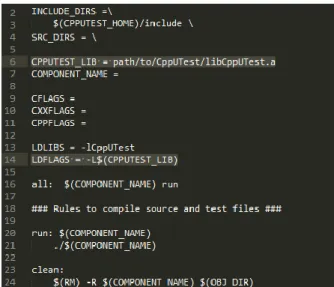
Figure 4.6: Makefile skeleton to compile CppUTest tests (with import) ... 40
Figure 4.7: Makefile skeleton to compile CppUTest files (without import) ... 41
Figure 4.8: Makefile skeleton to compile CppUTest files if the framework was installed using the apt-get command ... 41
Figure 4.9: Factorial test cases ... 43
Figure 4.10: First build result ... 44
Figure 4.11: Factorial test results ... 44
Figure 4.12: Example of an IO register definition ... 45
Figure 4.13: <avr/io> include files to block ... 46
Figure 4.14: Direct access to memory, the original code and the adapted for tests. ... 46
Figure 4.15: A stub to fake a microcontroller memory ... 47
Figure 4.16: Structure of a register in a simple processor ... 47
Figure 4.17: Register adapted to allow unit testing ... 47
Figure 4.18: Solution with two projects ... 48
Figure 4.19: The inside of the avr_include folder ... 49
Figure 4.20: An example of a complete project structure to develop tests, using CppUTest, in Atmel studio. ... 49
Figure 4.21: Line code from MakefileWorker.mk where the argument cpputest_*.xml needs to be deleted. ... 50
Figure 4.22: Example of a makefile using import ... 51
Figure 4.23: Commands to run the CppUtest output file ... 51
Figure 4.24: Unit testing project properties ... 52
Figure 4.25: Error list containing the failed tests ... 52
Figure 4.26: Output window with the CppUTest execution result ... 52
Figure 4.27: Workflow example of a project using Git ... 54
iv
Figure 4.29: Inline suppression using Cppcheck ... 56
Figure 4.30: Compilation results ... 57
Figure 4.31: Cppcheck analysis result from the code available in Annex B ... 57
Figure 4.32: Command line to execute CPD ... 58
Figure 4.33: Duplicated code suppress warning ... 59
Figure 4.34: CPD analysis result from code in Annex C ... 60
Figure 4.35: Example of a Jenkins build step to execute Cppcheck ... 61
Figure 4.36: An example of the xUnit plugin configuration ... 63
Figure 4.37: An example of the Cppcheck plugin configuration ... 63
Figure 4.38: An example of the dry plugin configuration ... 64
Figure 4.39: Jenkins build steps... 65
Figure 4.40: Flow to fix failed tests ... 65
Figure 4.41: Final workflow for the embedded software development ... 66
Figure 5.1: Led_Driver project structure ... 68
Figure 5.2: Led_Driver Failed Tests ... 68
Figure 5.3 Led_Driver output window after compilation ... 69
Figure 5.4: Build output of the Led_Driver solution. ... 69
Figure 5.5: Led_Driver results on Jenkins ... 70
Figure 5.6: Detailed Cppcheck results for Led_Driver ... 70
Figure 5.7: Main code dependencies ... 71
Figure 5.8: Isolating Mafalda from unnecessary dependencies ... 72
Figure 5.9: First result of Mafalda on Atmel Studio ... 72
Figure 5.10 Mafalda project structure ... 72
Figure 5.11: Mafalda testing result ... 73
Figure 5.12: Jenkins build result for Mafalda ... 74
Figure 5.13: CPD detailed results ... 74
Figure 5.14: Duplicated code with more than 25 lines in the file control.c ... 75
Figure 5.15: Duplicated code inside of all the if…else statements ... 75
Figure 5.16: Open task scanner result ... 76
Figure 5.17: Line with an open task ... 76
Figure 5.18: Detailed Cppcheck results ... 77
Figure 5.19: Warning about missing include files ... 77
v
List of Tables
Table 3.1: Motivation to use the recommended practices ... 29
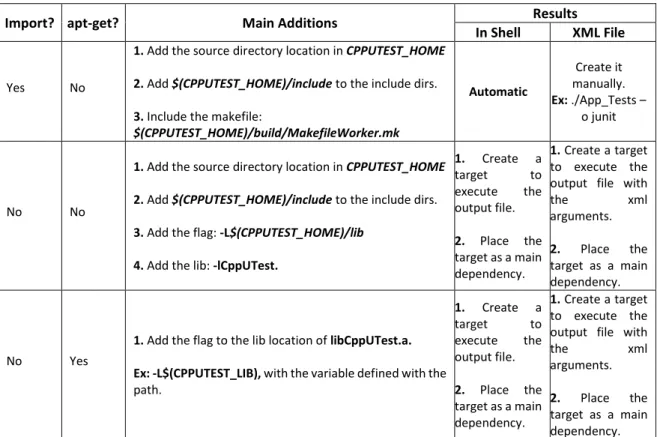
Table 4.1: Guide to know the essential additions to place in the makefile that compiles CppUTest files ... 42
Table 4.2: Different types of Cppcheck issues. ... 55
Table 4.3: Options used to execute Cppcheck ... 56
Table 4.4: Comparative results between GCC compiler and Cppcheck ... 58
Table 4.5: Options used to execute CPD ... 59
Table 4.6: Jenkins build status ... 62
vii
List of Acronyms
CI
Continuous Integration
TDD
Test Driven Development
MoSCoW
Musts, Shoulds, Coulds and Won't
haves
FDD
Feature-driven development
XP
Extreme Programing
ATM
Automated Teller Machine
MP3
MPEG-1/2 Audio Layer 3
SW
Software
HW
Hardware
HDL
Hardware Description Language
VHDL
VHSIC Hardware Description
Language
UML
Unified Modeling Language
SVN
Subversion
ARM
Advanced RISC Machine
GNU
GNU's Not Unix! GNU
LTA
Local Test Automation
SCM
Source Code Management
CPD
Copy/Paste Detector
OS
Operating System
XML
Extensible Markup Language
GCC
GNU Compiler Collection
ASF
Atmel Software Framework
SFR
Special Function Registers
CPU
Central Processing Unit
POSIX
Portable Operating System Interface
I/O
Input / Output
IDE
Integrated Development
Environment
LED
1
c h a p t e r
1
1
Introduction
1.1 Motivation
Nowadays all companies are competing to be more successful in the market. However, to achieve this, they need to deliver quality products and meet deadlines. Agile methodologies try to change developers’ minds by using non-traditional practices like Waterfall to deliver better products in the shortest time. These methodologies promise to reduce development time, improve communication within the team and between team and costumer, and deliver a cleaner code with better quality in time. Yet, these practices are seen as hard to implement, especially for embedded development which has some dependencies and limitations compared to informational systems. It is necessary to take into consideration not only the software but also the hardware part and there is also the performance constraints to respect. Regarding the development of embedded systems, there is a big interest in trying to adapt agile methodologies, or at least some practices. If we look around, we are surrounded by microprocessors, and there is a lot of competition in this business. There is a need for the embedded world to improve their products in order to survive in the market. Exatronic [1], is a company specialized in research, design, development and industrialization of innovative solutions in Information Technology, Communication and Electronics. It has been In the market since 1995 and its mission is to deliver innovative solutions with integrated electronics for the business and/or products for customers, adding value to their ideas. It is my aim in this dissertation to find a solution to apply agile methodologies to the embedded software development in this company whilst considering their current developing method.
2
1.2 Objectives
In the context of embedded systems and the company Exatronic, the objectives of this dissertation are:
Understand agile practices and recommend which are better suited to embedded development.
Present a solution to change the development process of embedded software projects in Exatronic from the traditional way to a more agile approach.
1.3 Structure
The structure of this dissertation is as follow:
Chapter 1: As seen, this chapter presents this dissertation’s motivation and its objectives.
Chapter 2: Presentation of the agile methodologies, the practices, some concepts and methods currently used. Description of problems faced when working with embedded systems and some recommended solutions.
Chapter 3: Description of the requirements and planning the agile intervention. Chapter 4: Presentation of process and tools to the recommended solution. Chapter 5: Results and Validation of the solution using different examples and projects.
3
c h a p t e r
2
2
The Agile Value Proposition
Software development methods are used to manage complex projects in order to make developers aware of project priorities and deadlines, by following guidelines and recommended practices. First and foremost, in order to develop a product, we need to know what to develop, that is, we must have goals and follow some guidelines to answer questions such as what the product should do and how. This process is called requirements elicitation [2]. In the mid-1990s, development teams always attempted to obtain all the product requirements before the development process [3]. At that time, the most commonly used development method was the Waterfall Based Model. In this model, it was essential to get requirements first, to be able to specify in greater detail what to develop [3]. However, it was frustrating for developers to obtain all the requirements before the product development. This was because the customers are often unsure of what they really seek to obtain, and only during the project development the requirements become more detailed and fixed [3], [4]. When a first version of a product is released and presented to a customer, they sometimes may not like it and want to change things, which forces the development process to begin again [3]. Due to this began a need to keep the customer informed about the process, asking their opinion about the development process so far. This essentially happened to prevent making any abrupt changes to the product in the future after the initial product demonstrations. Developers unconsciously started to release working versions of a product, and do product tests throughout the development, in order for the client to be better informed. Gradually, this method of developing software was tailored to match the customer’s interests [4]. Additionally, the market was under pressure to produce more innovative developmental processes, as well as to increase flexibility between developers and customers in both a quick and economical way [3]. In turn, pressure also began to mount for companies to look for new technologies and new products.
4
Consequently, the need to find a new method that would meet all these essential changes started to emerge. However, this new method had in fact already begun, but it did not yet have a name. The name chosen was agile methods, a new kind of approach that claimed to be the answer to the problems mentioned above.
2.1
The Agile Approach
Agile methods gained popularity in 2001 when a group of experts from various methodologies of software development established a set of common principles in a document entitled “The Agile Manifesto” [5].These principles define what being agile really means in an iterative development process [6]. Agility involves using strategies to respond quickly to market changes, create new products, and specify customer requirements not before but during the project development. This methodology encourages teams to be proactive by developing products with only the necessary details to achieve the goal. There is a focus on working software, keeping simple planning with short iterations and early releases, and leaving space for subsequent changes during development [3], [4]. Development teams must be adaptable and prepared for anything unpredictable and, in view of this, communication is the key, not only between customers and developers, but also between the developers themselves [7]. In traditional methodologies, such as Waterfall, development teams try to plan their products with minimal detail, organizing all the steps before starting development, and trying to predict changes that the customer may make [3], [8]. This approach leaves little room for change or the unpredictable.
The Waterfall Process Model
The Waterfall Process Model was introduced in 1970 and accredited to the Walter Royce article [9], [10]. This model is the oldest software development process model, and used to be the method most frequently used by developers [6]. It was successful in some areas, but also had some flaws such as inflexibility, manifested in its difficulty of responding to changes [4]. Consequently, these flaws were observed in some traditional methods too.
5
The Waterfall Process Model is divided into sequential phases which must be completed in order [9]. The first stage is to gather all the customer requirements, as well as to carry out extensive and detailed planning before beginning the development process [9], [10]. This extensive planning shows waterfall as a secure method because the detailed planning facilitates the estimation of the budget, the development duration and predictable customer changes, among other things [10]. The downsides of this method occur when it is necessary to modify the project design in late stages. This is because the risk for delayed delivery product increases, alongside the consequent increase of development costs [8], [10]. If the modifications cannot be applied, due to, for example, short deadlines, the customer will end up unsatisfied with the product functionalities, or lack of them [8], [10]. Such need to make modifications at late stages may be due to negative customer feedback and/or crucial errors found in the testing stage that forces the alteration of the project design, since testing and feedback are done at the late stages [8], [9], [10]. Currently, researchers associate the Waterfall Model with great risks, failures and low productivity [10]. Royce, however, recommends to do the development cycle twice if the software is being developed for the first time. Although this would increase production time, it would also increase the quality of the product. Royce did hint at iterative development in the article, including some feedback and adaptation, but this was lost in the descriptions that followed this method [11]. The iterative development consists of several sequential iterations. Each iteration corresponds to a goal or part of the project being developed [6]. At the end of each iteration, the aim is to make a stable release of the integrated and tested project. Waterfall methodology was far from being an iterative development.
6
The Agile Process Model
The Agile Process Model was built based on iterative development [6].Figure 2.2 shows a more flexible model with more space for change during software development. In this process model the requirements, architecture or design are not considered as something static [6]. The model divides the project into smaller mini-projects and for each iteration it is necessary to have something working, a feature [3], [12]. The development team only advances to the next feature after finishing the current mini-project. There are not distinct stages during the development, instead, each feature is taken from start to finish within an iteration [12].
Comparing both process models, agile has an easy rollback during the development process. For example, if an error occurs at implementation due to an aspect of the design stage, it may be necessary to change all the design in the waterfall process. In the agile process model, because these errors are detected sooner, it would only be necessary to modify the design done for the last developed features, not all the design. In the waterfall process model, there are no iterations. Each stage is performed in a detailed way and any project modifications at late stages are very complex and time consuming. However, one criticism of agile processes is that they can be vague. Whereas agile processes only focus on the current iteration, waterfall takes account of everything and can, for example, estimate the product budget.
Figure 2.2: Agile Process model, adapted from [6] and [12]
7
The Agile Project Team
Agile teams have a team concept different from other methodologies of software development [13]. In the agile method, there are a lot of meetings between team members in which they receive feedback from each other about the work being done [13]. This feedback is given not only by the team manager, but also by other team members in order to know what the current project status is, what has been developed so far, what the difficulties are, as well as to give support to colleagues. The agile teams always try to be cohesive, working together towards a common goal, increasing the members’ ability to listen and respond constructively to others’ opinions, and to collaborate with and respect one another’s work [7], [13]. As a consequence of this, the company has a better work environment [14]. Developers that use agile methods often have great motivation and high job satisfaction [15]. In result, the individual satisfaction increases performance, which in turn increases team performance, and therefore ultimately the performance of the company [13]. By having the customer on-site and having regular meetings, the team is provided with continuous feedback and can easily make any modifications on the project [16]. This increased collaboration between developer and customer means that the customer can always have an idea of how the project is being developed and may improve the requirements and change them according to what they really want, avoiding future errors and confusions that could arise [16].
2.2
The Practices of Agile
So far, some fundamental principles of being agile have been discussed. In order for a software development method to be agile, it needs to adhere to these previously mentioned principles. The practitioners who wrote the “Agile Manifesto” proposed particular agile development methods and specified in detail which characteristics may lead to better development, as well as which practices [5], [14]. These practices vary according to what is intended in each project and the type of product that is to be developed. After an analysis of the practices of some the most popular agile methods, for this section we choose the most notorious and distinctive for two reasons. On one hand, the practices which are considered essential for a method to be agile. This is based firstly on practices that differentiate this method from traditional ones and define it as being agile, and secondly on the most applied practices with positive results in articles mentioned throughout this dissertation [14], [16]–[18]. On the other
8
hand, I selected additional practices which can be used according to the preferences of the development team. These practices are more specific, and less used than the others [14], [16]– [18]. All these practices will be described, as follows, beginning with the essential ones.
Coding Standards [19], [20]: The code should follow coding standards in order to
make the code perceptible for the whole team to read and refactor. Hence, make someone’s code available to all team developers, without wasting time on understanding it.
Continuous Integration (CI) [21]: In continuous integration, developers frequently
integrate their daily work on a central repository in order to ensure that system releases are fully-working and bug-free. Having continuous integration improves quality of code and prevents risks because it anticipates possible future errors that would otherwise be invisible without the integration of all the product code.
Customer Feedback [3], [14], [16], [22]: The agile development team cannot
consider the initial requirements as definitive, since they can change during the course of the project. This happens because the customer may alter the features’ priorities, and developers must be prepared to adapt and react quickly to changes in order to satisfy the customer. Customer feedback involves frequent meetings between the customer and the developers. These meetings usually happen during the demonstration of system releases, after each project’s iteration.
Frequent releases [21]: This practice, together with test driven development and
continuous integration, aims to ensure that working software is always available.
Product backlog [22]: This consists of a priority list of functionalities not yet
implemented in the product. The customer makes a brief description of the high level functionalities that he wants, which are written in the product backlog. During project development, the items can be changed (added, removed or given a new priority), which makes the difference with the typical list of traditional methods. It is important to have a list of what is intend to be developed because these priorities force the team to be more focused on what is really essential.
Refactoring [19]: Refactoring is about restructuration of the code by removing
duplicated code and simplifying or adding flexibility, without changing its behavior. This practice attempts to facilitate modifications of the code, for example, on adding new functionalities. If the code is simple, the time and effort to do it will be just enough.
Simple design [21]: Keeping the design simple is about not implementing features
that are not requested by the client. This technique is known as YAGNI, for "You Aren’t Gonna Need It". The developer may think that a more complex design may be useful or requested by
9
the customer in the future, planning what might change during the project development, which is generally a traditional thought. However, the agile principles suggests leaving it simple and not make the system unnecessarily complex. Thus, there is space for unpredictable changes and any future complex problems can be prevented.
Test driven development (TDD) [21], [23]: The principle of TDD is firstly to think
about the code to be written, then write tests, and only afterwards write the code. TDD encourages the use of automated tests to be done after any changes in the program, ensuring that these changes will not negatively affect the existing code. The functional tests, which happen in the late stage of the agile process model, must continue to be done after the completion of each new feature. The resulting benefits are a more maintainable code, a higher probability of a bug-free product and a lower probability of finding complex errors requiring time-consuming solutions.
These eight practices can clearly describe where agile methodologies aim to make a difference, compared to traditional methods. Other, more specific agile practices will now be described. The adaptation of the next practices depends on what the company objective is: whether it wants to be agile in a more management way or whether it is prepared to embrace different ways to work with.
40-Hour Week [14], [20]: Teams usually tend to strive too much to delivery projects
on the due date. This can result in a lack of ideas, tiredness, rash decisions, and overcommitted deliverables. This technique encourages the use of only 40 hours of weekly programming. If the team want to do more work on a week, the following one must be normal, without the same amount of previous effort. This technique is not to be taken literally, but rather to control the number of additional working hours.
Collective Ownership [19]–[21]: This technique conveys a feeling that everyone is
responsible for the code produced on the project. This practice does not distinguish who did what. All the team owns the code, and all developers can change it to improve the implementation by fixing any error or contributing with new ideas. It is intended that developers learn other parts of the system and feel responsible for the quality of the code.
Daily meetings [21]: The purpose of daily meetings is to put the whole team abreast
of what was done until the meeting, what will be done after, as well as any team difficulties. There may also be feedback on the current status of the project or discussion of ideas to solve problems that the development team may have. However, the duration of daily meetings is usually short to not become exhaustive or an unnecessary waste of time.
10
Pair Programing [19]–[21]: This consists of two programmers sharing a single
machine, both having an important role. Whoever has the keyboard is called "driver", because it is their responsibility to consider the best way to implement methods. The other programmer’s responsibility is to think strategically about what is being developed. Both are actively involved in the development and they switch roles throughout the process. Having pair programing increases the chance of finding and avoiding early errors and makes both developers learn new programming skills with each other.
Sprints [3]: The definition of sprint intends to give the idea of an iteration, a certain
amount of time where some product features must be developed. Sprints can usually last between one week and one month. On every sprint, developers must implement functionalities that were prioritized in the sprint backlog in the sprint planning meeting. Inside the concept of sprint, there are four more practices to explore:
Sprint backlog [22]: A priority list of functionalities taken from the product
backlog, which must be developed during the sprint. The backlog belongs only to the development team. In other words, only the development team can modify the list during a sprint. Customers can do it only in exceptional situations.
Sprint planning meeting [24]: The development team defines new
priorities for the next sprint. Only the development team can say what they can or cannot develop in the next iteration, creating or redefining the sprint backlog with new objectives. This meeting is essential for the purpose of letting the entire development team know what is really necessary to make on the next iteration.
Sprint review meeting [24]: An informal meeting that involve the customer
and the team leader to demonstrate the product functionalities already done. The objective is to get feedback about the last iteration development and if necessary adjust the product backlog with the customer.
Sprint retrospective meeting [24]: The development team tries to
understand what went well in last iteration, and proposes improvements for the next one. The main topics discussed can be agile practices, tools used or the team itself, for example.
User Stories [20]: User stories are like customer requirements, the difference is the
level of detail given. They are less detailed than the normal requirements. Developers go to the customer and get a detailed description of the requirement only when they have to implement the feature of that user story.
11
These practices are oriented to the project management, essentially the meetings and the 40 hour rule. The pair programing, for example, it is a practice that must be well considered depending on the type of team and product being developed.
Selected Methods Survey
It has been mentioned, across this chapter, the existence of agile methodologies and agile practices. Yet, these methodologies will now be described and practices of each method will be enumerated. Some of the lesser known methods will be simply described and followed by two of the most known agile methods.
Dynamic software development method [25]: This method is based on nine
principles: Addressing current business needs; Active user involvement; Team must be empowered to make decisions; Focus on frequent delivery; Integrated testing; Stakeholder collaboration. It is suited for software development that places a high importance on the user interface or usability aspects of products. The projects are divided in three phases (pre-project, project life-cycle and post project) and prioritized using MoSCoW Rules (musts, shoulds, coulds and won't haves) in order to deliver the product on time.
Crystal methodologies [26]: A family of agile methodologies that vary based on the
size and complexity of the project. Crystal Clear, Crystal Yellow and Crystal Orange are some examples. Each color represents the project size and criticality. Size is defined as the number of people involved in a project and criticality is defined as the potential for the system to cause damage. They are considered and described as lightweight and easy to adapt.
Feature-driven development [27]: The domain model is one of the central artifacts
of FDD. While most agile methods start with a set of principles, the center of FDD is the domain model. The iteration development is based on features. This practice relies on specific team roles, tending to move away from the practice of collective ownership since each role has its own responsibilities.
Lean software development [28]: Its principles are based on the Lean Enterprise
movement and the practices of companies like Toyota. The main principles are eliminating waste, amplifying learning, deciding as late as possible, delivering as fast as possible, empowering the team, building integrity and seeing the whole picture. This method is similar to Scrum (it will be described later), it focuses much more on the project management aspects of software development. However, requirements are measured based on their impact to the
12
business, and must be specifically defined in a clear and complete way. Incomplete requirements are filtered out during the analysis of requirements’ phase.
Among many agile methodologies, there are two that stand out for being the most studied and well known. These are Extreme Programing (XP) and Scrum [14], [16], [17], [29]. This does not mean that using one makes it impossible to use the other [30]. It is possible to use both according to whichever best fits the project. While Scrum uses practices related to management and control, XP focuses on programming practices [30]. Figure 2.3 presents the results of an empirical study, conducted at Microsoft, and refers to which agile method developers use. The results show that Scrum is the method most used. For developers who did not know which agile method they use, they were asked to specify the method used, and the study concluded that most of them were variants of Scrum.
Extreme Programming
Extreme programing (XP), originally proposed by Kent Beck, is another way to develop software. In this method, customers write user stories and, as previously mentioned, when the developers have to implement a user story, they go to the customer and get a detailed description of the requirement. It can be concluded that the availability of the customer is a requirement for the use of XP [31]. The customer is part of the team for all phases of XP, thus, communication with the customer (preferably face-to-face) is required [20].
13
After defining user stories, a release plan is made containing the user stories that will be implemented in each system release and the date of those releases [20], [31]. This plan is defined in a release planning meeting, where the customer can specify which implementations should be implemented in the first place, according to the costumer’s interests [20], [31].
For each iteration, an iteration planning meeting is held where developers take the user stories and break them into tasks [20], [31]. At the end of each iteration, the system release must be tested and functional, in order to be shown to the customer [20], [31].
XP is most known for its technical practices, especially test driven development, pair programming and collective ownership [19]. Among the practices mentioned in the section 2.2, characteristics of XP are continuous integration, simple design, coding standards and 40-hour week [17], [19], [20].
Scrum
Scrum is a way to develop software in small pieces, with each piece building upon previously created pieces. A scrum team is composed of the product owner, the development team and the scrum master. The product owner is typically a stakeholder who determines what needs to be built by creating a prioritized wish list called a product backlog [22]. The development team is responsible for delivering the items defined on the product backlog. The scrum master is in charge of solving problems and keeping the team focused on its goal [6].
In scrum, iterations are named sprints and usually lasts for one month or less [32]. For each sprint, the scrum team pulls a small chunk from the top of the product backlog, puts it in a sprint backlog, and then develops these items. The sprint backlog is made during a planning meeting, and after each sprint the development ends with a retrospective and review meeting [22]. Furthermore, there are daily meetings where the team members coordinate work [22]. As the next sprint begins, the team takes another chunk of the product backlog created by the product owner and begins to work again. The cycle is repeated until the items in the product backlog has been done. Among the practices mentioned in the section 2.2, characteristics of scrum are daily meetings, customer feedback, product/sprint backlog, and sprint meetings are Scrum characteristics [22].
14
Accessing the Impact of Agile Practices
Survey results in the integration of agile methods in development team can change according to which method they are using, their experience and the size of the team [14]. Agile methodology is considered something new and, therefore, developers argue that an introduction is necessary before using it [14]. In relation to scaling this methods to larger teams, most people agree that these methods are only appropriate for small teams where communication is easier [16]. In general, companies which adopt an agile method are satisfied with it, developers are more cohesive and happier with the job, regardless the product quality being superior or equal compared to the old method [14].
In general there are good and bad experiences with agile practices. For example, having customer feedback is something that requires hard work and customer concentration [14]. The customer may have to learn some things about being agile and developers must spend time on that and/or the customer may be unable to attend many meetings [16]. But on the other hand, some clients praise the continuing involvement with the project because this made them to have control over the development process [14], [18]. For developers, this involvement is important to make early modifications on the project, improving the quality of products [14]. The fact that the customer has some control in the project makes the product vulnerable to changes [3], [6]. There is a competitive advantage on this. The ability to produce new and different products for the market is bigger because the customer is aware of what is happening in the market and rapidly changes this requirements, leading the team to develop more innovative products [18].
As mentioned throughout this chapter, in agile methodologies communication is key. Daily meetings is an example of a practice which encourages it. The higher the communication is between team members, the better the awareness of the project status is. Communication favors aid among team members, making the discovery of errors much easier to resolve [16]. Agile always tries to encourage the communication, and consequently, the individual motivation and satisfaction grows. As a result, team performance is better, causing the products to be delivery on time [7], [18]. However, the team meetings, which generate communication, are often only used to report to the team manager what each developer did that day, in particularly, the daily meetings [14], [16]. This could be a management problem. Many team managers do not have the skills necessary to manage an agile team [16]. If a manager does not know how to apply good practices of agile methods, then the project may be at risk. The same problem happens in less experienced teams because they may not have the practical
15
domain to adapt some agile practices as the experienced developers have or they may not be so flexible to quickly adapt to changes [14]. Clearly, agile development is not suitable for everyone. Indeed, there are teams that cannot adapt to agile methods, even with experienced developers [16]. Anyway, there are agile practices that allow to have a better management to the development team not lose track of the real goal, and delivery the product on time, but it must be well oriented by the team manager.
Finally, many developers compared the waterfall process model to the agile one, saying that there is a big disadvantage in changing from one to another when it comes to planning the project. It is hard to predict the budget and the time wasted on the product. Agile projects do not have a good detailed planning and the project development may be a little bit vague, as mentioned before. The second concern in changing is the difficulty with introducing an agile method in a complex organization, because complex projects have much more teams and even more elements. The communication between everyone involved is more difficult and sometimes impossible, making coordination very difficult [14], [16].
2.3
Software Engineering Practices for
Embedded Systems
An embedded system is a combination of software and hardware, a system that has software embedded into hardware [33]. Embedded means built into the system, specifically designed for a particular function which may be a part of a bigger system [33]. Usually, embedded systems do not need a full operating system, but like any computer, it has an input and output [33]. They are typically referred as reactive systems because embedded systems produce different results on the output according to the changes in the input [33]. For example, an elevator controller is embedded in an elevator and tell him to move to different floors based on the input. Traffic lights, automobiles, wireless handsets, mobile phones, vending machines, medical equipment, toys, airplanes, clock radios, ATMs, network routers, MP3 players and video game consoles are examples of possible hosts of an embedded system. If we look around, embedded systems are found everywhere. Embedded computer systems are diverse and control many aspects of modern life. In our house, we may have around 50 embedded systems [34]. They are built to perform tasks more reliably using simple and cheaper hardware.
The development of embedded systems is different than software applications, like a website development, and therefore require a different approach [35]. On this section, it is
16
presented a review of engineering process for embedded systems, focusing on special requirements.
Specific Challenges
Develop embedded software it is a hard challenge for those who are accustomed to application development [35], [36]. They have unique characteristics that differentiate it from other software developments [35]. Embedded Systems are quite complex, if a computer has an error on the software, once discovered, a software patch can easily fix the problem, or a simple reboot. On the other hand, embedded systems are often programmed once and the software cannot be fixed, unlike the computer software [37]. Even if it is possible to correct the problem, frequently the process is too complex for the user. Software applications such as music player, or pdf viewer, may fail, but the consequences are the loss of data or the music stops playing. In some embedded systems, an error results in a product that no longer works and maybe needs replacement [38]. Some embedded systems do not allow unreliability, errors are unacceptable, and the product is not allowed to fail [39]. Some systems can cause serious damage on valuable equipment or threaten human life, if they fail (e.g. in spaceflight and automotive systems) [39]. Reliability, maintainability, efficiency, safety, security, and cost are some of important characteristics to have in mind when developing embedded systems [33]. Reliability and maintainability, in some ways, are complementary. Some products require technical support to respond to failures, or to make routine system checkups [33]. With higher product reliability, technical support will be less needed[33]. Having more reliable systems means having a less corrective system [33].
Another challenge that is an increasing concern in embedded systems is security [40]. These systems are ever more getting involved in telecommunications and network industries, and therefore in transfer of secure data, for example, through public networks that need protection from unauthorized access [40]. Security requirements must be addresses in order to meet the variety of challenging security [40].
There are also embedded systems that must meet hard real-time constraints and some of them can cause catastrophic consequences [33]. For example, a pacemaker is a real-time system which it reacts to an input within a specific real-time period [33]. If the pacemaker has a delay, it may result in death.
That said, agile is more directed to less planned systems, not critical ones, because these systems need a very detailed plan before the development. Non critical embedded
17
systems are dedicated to specific applications and are normally compact systems with resource constraints, such as limited memory, simple processors and low power. The software must respond to any hardware limitations. However, initially, developers may not have the target machine to test these limitations and may need to use alternative testing to overcome this problem. This happens because developing embedded systems is about developing both hardware and software concurrently, and the hardware may not be available.
All these challenges make embedded software development different than the application development. The lack of methodologies and tools to support specific embedded requirements makes the development even more difficult [41].
Embedded Process Model
Typically, embedded systems have a workflow like the one in Figure 2.4. This process model attempts to satisfy the requirements of hardware and software to integrate and develop the final product. The model starts with the specification of functional requirements, with simple details of the implementation and non-functional requirements such as memory, power or cost. In other words, performance constraints [42], [43]. Since embedded systems are SW/HW architecture, after the architecture stage, there are two developments in parallel [44]. On the hardware path, there is the design creation where some developers use hardware description language (HDL) [45]. VHDL[46] is an example of HDL. After implementation, tests are done to ensure some performance constraints applied [45]. On the other path, the first step is the software design which can be done using UML, for example [47], [48]. After the implementation, tests are done to finally have a prototype to integrate with the one made on the hardware path. Then, software and hardware implementations must be integrated, tested and searched for defect, to ensure that they meet the specifications [42], [45]. If any errors are found, the team may have to re-design the hardware or software part, depending on the type of error [45]. The last stage focuses on the maintenance and support of the developed product. The next sections intend to study the application of agile methodologies on the software path, taking hardware limitations into account.
18
2.4
Agile Practices Adoption in Embedded
Systems Development
Embedded systems are becoming increasingly smaller and cheaper which in turn has led to a great demand on the market [49]. They are cost-effective, which makes them used more frequently in large and complex projects.
Figure 2.4 Typical embedded system process model, adapted from [44]
Figure 2.5: Embedded systems and other mainstream system shipments, presented in [74]
19
The growth visible in Figure 2.5 shows that companies are increasingly focusing on developing embedded systems. They have to develop cheap quality products within a well-defined time limit to meet time-to-market goals[43]. However, this has been challenging for companies [43]. The pressure to deliver a quality product on time is high because the state of the market is unpredictable. Another company can release the same or better product at any moment, and the customer may want to change requirements in middle of development because of this. Late changes, in the development of embedded systems can be critical, since these systems depend not only on the software side but also on the hardware integration [50], [51]. Changes in hardware architecture at advanced stages can create more costs and increase the development time. The consequences of this on the implementation of software is not known for certain [50], [51]. Having space for change, using agile methodologies which not detail the architecture so early on, makes possible to quickly respond to requirement changes and future problems.
In addition, independent and parallel development of the hardware and software, as seen in Figure 2.4, may result in a very complicated integration with too much risk for the product delivery time [50]. If a design error is discovered during the development, either the software developer is restricted to the hardware architecture and it must be modified, or the hardware developer needs to, for example, create a new component. If the development team is restricted to the hardware architecture, they have to develop the software taking into account the hardware design and his limitations. Companies that have all these problems may need to adapt their normal lifecycle to this new complexity. They must use appropriate methodologies to be able to follow the market [43].
Agile methodology claims to resolve some of these problems, but it is necessary to carefully study the agile methods, and try to adapt them, to be well applied in the development of embedded software [41].
Literature Review
This section will analyze the most used agile practices according to a study on European companies [17], by using study results and recommendations of applying agile methods in embedded projects. The study results are presented in a table in the Annex A. For each work the table contains a set of adopted practices and its results.
20
Figure 2.6 shows the results of a survey on the actual use of Scrum in European embedded software development organizations. The most used practice is the product backlog. According to the study having a prioritized list can be something universal, not necessarily a Scrum thing since it is always used anyway.
Daily meetings is the second most used Scrum practice. They were important in the initial phase of a project in [35] because they gave really good feedback, but team members quickly got tired of these meetings because they turned to be only with what each team member did at the present. This is also supported by the studies done in [16], where developers felt uncomfortable stating their progress every single day. However, it was seen as benefit too, by making team members aware of what the others members were working on, and promoting the early discovery and handling of development issues.
According to the survey, Sprint planning meetings is the third practice most used in european companies. The article in [35] states that, before applying this practice it was hard to understand how far from the end the tasks really were, which led to a lot of unfinished tasks for a long period.
Figure 2.6 Use of Scrum practices in European embedded software , presented in [17]
21
While Figure 2.6 is related to Scrum practices, Figure 2.7 is related to the XP method. The practices 40 hours for week, coding standards and open office space are the most applied techniques, but these ones are more simpler and easy to adapt.
The next practices most used are refactoring and continuous integration. According to [52], refactoring work is better to do in the early project because it can fix a lot of bugs which would otherwise take a long time to debug. In [35] developers were already applying it without having a name for it, but after knowing what refactoring was, they always looked for chances to use it. The same study states that refactoring is slowly improving the quality of their legacy code. For [49], this continuous process of refactoring cut out duplicated code, reduced the amount of system functions, and improved the system performance.
Regarding continuous integration, in [52] this practice is used for each component, but the full system integration is done only when releasing the product, because it is a complex system and they need external test equipment to do it. In [53], this technique allowed them to identify areas of functionally which had been unintentionally left public and been used by other components.
Fourthly in the survey comes the collective ownership. In [52], before this practice, either developers maintained the code or spent time teaching it to someone else. However, they only found this practice appropriate for single teams, not crossing teams. Collective ownership was applied in [35] too, but was initially complicated because team members did not felt secure when other developers improved/changed their code, but in the end they accepted. Studies made in [17] concluded that collective ownership is one of the most used and appreciated XP practices, with no negative experiences.
Pair programing is the least used systematically. This practice was seen as something efficient in the first stages of the project in [35], because the practice finds defects sooner than testing. But after that was just inefficient. Now the team just do pair programming during the design phase and initial code phase. In [52], after using pair programming, the team concluded that the required quality code level was achieved earlier and the pair developers learn a lot from developing together, which is also supported in [53]. On the other hand, it was found to be unsuitable for simple or well-understood problems, which could be fixed as quickly as a single developer could type. Studies in [53] add that with pair programming the objectives for the pair was achieved with lower time and lower bugs than a single team member.
On-site costumer is one of the least used practices in conjunction with test-driven development, perhaps due to the complexity, the big culture change and the limited financial resources for applying them. In [53] the flexibility and involvement of customers on daily basis changed the team focus to the customer’s interests. They were focused on helping to meet the
22
requirements of their customers. In [35] they do not have an external costumer to negotiate with, however they made the hardware design team their customers. In [52] developers did not use this practice, because they do not have specific customers.
In TDD, according to [35], it forced developers to think about the code that they would do before coding. In [52], developers could better understand the required functionalities from a client’s point of view. The studies made in [16] report that test-driven was one of the factors that improves the high quality of the produced code.
Agile Practices that Can Lead to Success
Before a team starts thinking about applying agile methods, it is necessary to organize what is important to apply and what is necessary to change. This is named process tailoring, where the team is organized in order to use the best practices for agile project development [50]. This process is fundamental and it is used in this dissertation by combining agile practices from different development methodologies, whilst trying to meet the needs of embedded projects.
This section will identify what the key factors to adopt agile in embedded could be, based on the information gathered from the literature review, in the previous section and resumed in the table in Annex A. Previously mentioned challenges will then be discussed. The first practices to be mentioned refer to the way of programing code.
Coding Standards: Usually companies require developers to use coding standards.
It is worth mentioning that if someone wants to, for example, refactor or fix code already done by other developer, the time spent on understanding the code is wasted time. With coding standards and code improved/refactored it is easier and faster to understand and modify code.
Continuous Integration: Developers have to integrate new changes on their
workstation before they can commit to the repository, preventing future errors that if only detected at the end of the project it would delay the delivery. This practice ensures that the embedded systems constraints are met, when integrated with what has been developed so far. This can be done using a continuous integration server which will ensure the build of the project as well the usage of tools to analyze the code. For example, every build made on the CI server, can run a set of tests and, if errors are found, the developers will be immediately warned. When Test driven development and Continuous integration are used together, the product has less
23
probability to have errors and integration problems. When is almost certain that errors will be found early, it will be cheaper to correct if it involves hardware components.
Refactoring: Refactoring is done at the end of each functionality to improve the
structure of code, making it more flexible and consistent. During the creation of automated tests, when a test passes it is a good opportunity to clean the code and verify if the test does not fail. This technique can eliminate some time wasted on debugging code, if done from the beginning. The quality of a product will improve with the elimination of unused and unnecessary code along with the reduced size. Refactoring may be thought as non-priority thing to do, but it is almost certain that it will help to release quality products.
Test-Driven Development: Making tests before implementing features helps
developers to understand more about the functionalities and what the customer really wants. After developing a functionality, it is necessary to do more testing including both functional and integration tests. It is essential to do this during the project development. Running automated tests will save time that would be wasted on late debugging and manual testing. Continuous testing helps to anticipate future decisions of changing the hardware design and to prevent the use of software solutions to resolve problems that cannot be resolved due costs and limitations. Additionally, embedded systems have performance limitations that need to be taken into account and the early and continuous testing of hardware characteristics is essential to ensure these non-functional requirements. However, in the first stages of the development process, the hardware may not be available. The solution is to use evaluation hardware (evaluation boards) and the development system, they may be the only way to ensure early tests. Anticipating future changes leads to a fast development to meet the time-to-market goals.
In order to carry out the next recommended practices, the team should be organized. It is necessary to assign roles and responsibilities, determining who is best suited to do certain work. It is also fundamental to have someone responsible to make sure that the recommended practices will be well applied. The next described practices will identify the key factors of management practices.
Customer Feedback: By having customer feedback, it is possible to know what the
customer actually wants, enabling developers to focus on what they really must implement. It is possible to get this feedback through the iteration planning meetings, where the customer sees a demonstration of the product functionalities developed so far, giving their opinion and explaining the next necessary features to develop in the next iteration. Customers can ensure,
24
for example, whether the hardware requirements are being fulfilled, and developers can prevent late changes.
Daily meetings: This technique makes knowledge transfer and sharing both
possible and easy, which is essential for agile teams. The hardware and software teams can discuss the design in these meetings to ensure a development of dependency, not independency. Complex HW and SW integration errors may lead to the redesign of the architecture, something that can delay the development of the product considerably. However, there are reports that daily meetings only covered what each team member had done at that point in time. Therefore, if meetings get to this point, they must be brief, not taking too much time from the development, or they must be stopped. These meeting are very useful in the beginning of the development and the team must decide whether to continue meetings based on their usefulness.
Sprints, Sprint planning meeting and sprint/product Backlog: These Scrum
practices make developers focused on project objectives, which should be achieved in each iteration. Scrum is the most agile methodology used and if combining these practices with others, the development teams may have a successful methodology. Product and sprint backlog make developers aware of what they have done and what they still must do, without losing track of the project. Sprints allow developers to commit themselves to complete their tasks on time, while having flexibility to any changes. To do so, the sprint planning meeting is essential to plan what features are necessary to develop.
User Stories: User stories can be very useful because encourages more
communication with the costumer. For each iteration it is necessary to talk with the costumer to specify the respective features. This leaves no space for misunderstandings with regards to what the customer really wants.
Some practices can only be advantageous if well applied, others must be well-considered. It depends on the type of product being developed and on the developers. The next final practices give an example of techniques that only work in some projects and teams.
Collective ownership: Using collective ownership makes everyone feel responsible
for the code developed for the project. All the team developers can make changes to anyone else’s if that person is busy doing, for example, another functionality. The time saved using this technique can be a step to shorten the product development. However, some teams may not be comfortable with this, and for others it can be irrelevant because developers may not have the knowledge to do other things.
![Figure 2.1: Waterfall Process Model, adapted from [9]](https://thumb-eu.123doks.com/thumbv2/123dok_br/15742902.1072755/25.892.230.660.104.367/figure-waterfall-process-model-adapted-from.webp)
![Figure 2.4 Typical embedded system process model, adapted from [44]](https://thumb-eu.123doks.com/thumbv2/123dok_br/15742902.1072755/38.892.288.572.99.497/figure-typical-embedded-process-model-adapted.webp)
![Figure 2.6 Use of Scrum practices in European embedded software , presented in [17]](https://thumb-eu.123doks.com/thumbv2/123dok_br/15742902.1072755/40.892.239.605.826.1026/figure-use-scrum-practices-european-embedded-software-presented.webp)


![Figure 4.1: Bug lifecycle without TDD, adapted from [63]](https://thumb-eu.123doks.com/thumbv2/123dok_br/15742902.1072755/56.892.137.787.311.565/figure-bug-lifecycle-tdd-adapted.webp)