Online Styling Boxes: Understanding
Portuguese Consumers’ Perceptions and
Intention to Adopt
Maria Inês Marques
Dissertation written under the supervision of Miguel Rita
Dissertation submitted in partial fulfillment of requirements for the MSc in Management with specialization in Strategic Marketing, at the Católica Lisbon School of Business and Economics
Abstract
Title of the dissertation: Online Styling Boxes: Understanding Portuguese Consumers’
Perceptions and Intention to Adopt
Author: Maria Inês Marques
Objectives, findings/ arguments and conclusion
Online Styling Boxes offer consumers the possibility to receive orders filled with products selected by fashion experts. Motivated by the success of this business model internationally and the growing interest in online purchases by Portuguese consumers, this study proposes to identify their perceptions regarding this innovative service as well as identify motivators and barriers to the intention to adopt the service, if it were available in Portugal.
With this aim, 13 in-depth interviews were carried out, followed by an online questionnaire that collected 165 valid answers. The results were analyzed using statistical methods including correlation tests and multiple linear regressions.
This study made it possible to observe that the general reaction of the participants to the service was positive, as well as the intention to try it.
The curation and advice by a professional stylist, flexibility to order whenever desired, not having to look for apparel, convenience, customization and the surprise factor are some of the main motivations to try the Online Styling Boxes. Not trusting another person to choose their clothes, price and complexity were the identified inhibitors.
Sumário
Título da dissertação: Compreender as percepções e a intenção dos consumidores portugueses
em adotar Online Styling Boxes
Autor: Maria Inês Marques
As Online Styling Boxes oferecem aos consumidores a possibilidade de receber por correio caixas recheadas de produtos selecionados por especialistas na área da moda. Motivado pelo sucesso deste modelo de negócio a nível internacional e o crescente interesse em compras online por parte dos consumidores portugueses, o presente estudo propõe visa identificar as percepções dos mesmos em relação a esta inovação assim como identificar motivadores e barreiras para intenção de adotar o serviço, caso este estivesse disponível em Portugal.
Com esse objectivo, foram realizadas 13 entrevistas e posteriormente um questionário online que recolheu 165 respostas válidas. Os resultados foram analisados através de métodos estatísticos que incluíram testes de correlação e múltiplas regressões lineares.
Este estudo permitiu observar que a reação geral dos participantes ao serviço foi positiva, assim como a intenção de o experimentar.
A curadoria e aconselhamento por um estilista profissional, flexibilidade para encomendar, não ter que procurar roupa, conveniência, personalização e fator surpresa são algumas das principais motivações para experimentar as Online Styling Boxes. Não confiar noutra pessoa para escolher suas roupas, preço e complexidade foram os inibidores identificados.
1
Table of Contents
1 - INTRODUCTION ... 2
2 -THEORETICAL BACKGROUND ... 4
2.1. Online Fashion Shopping ... 4
2.2. Subscription e-commerce ... 4
2.3. Clothing Subscription Services ... 6
2.3.1 Online Styling Boxes ... 7
2.4. Consumer Behavior ... 8
2.4.1 Attitude Towards Innovation ... 8
2.4.2 E-commerce trust ... 10
3. METHODOLOGY ... 11
3.1. Qualitative Research ... 11
3.1.1. Shopping Habits ... 12
3.1.2. Attitudes towards Online Styling Boxes ... 13
3.1.3. Intention to adopt ... 14 3.2. Hypotheses Formulation ... 15 3.3. Quantitative Research ... 15 3.4. Data Analysis ... 16 4. RESULTS ... 17 4.1. Sample Profile ... 17 4.2. Hypotheses testing ... 17
4.3. Online Styling Boxes vs. Conventional Shopping methods ... 23
4.4. Willingness to pay ... 24
5. LIMITATIONS AND CONSIDERATIONS FOR FUTURE RESEARCH ... 25
6. CONCLUSION ... 26
7. REFERENCES ... 28
8. APPENDICES ... 31
Appendix 1: In-depth Interview Guide ... 31
Appendix 2: Online Survey ... 32
2
1 - Introduction
The Guardian presents online boxes as an alternative “shopless shop, where customers pay for decisions to be taken out of their hands” (Elan, Wiseman, & Moore, 2018).
The roots of subscription trading can be tied to the beginnings of mail marketing. Local magazines, newspapers and local food delivery companies were some of the pioneers. Brands have continually improved the convenience factor associated with home shopping. And marketing just made everything easier. Subscriptions service model as know today can be traced back Columbia Record Club in the early 1970s that offered a new music LP every month, or Book of the Month Club, founded in 1926 which still sends its subscribers the latest trends in literature.
Fashion and beauty segments dominate the market, but the subscription box business is limitless and covers a tremendous range of categories from meal-kits that deliver customers pre-measured ingredients and recipes to prepare the dishes at home, pet toys’ boxes that surprise customers with different sets of items every month. Services like Stitch Fix add a curatorial experience to the subscription business. This business model presents benefits for both brands and customers. Customers receive a variety of products that maybe they would not buy otherwise, and brands have the opportunity to reach consumers outside the traditional physical and online stores and introduce customers to new products.
Today, the focus is on the subscription boxes. Many associate the origin of this industry boom with Birchbox, launched in 2010 and specialized in beauty products. In just one year up to 45,000 consumers subscribed to receive hand-picked beauty and care products. This market has great potential due to the simplicity of the process and the enormous convenience it brings to the consumer. Brands can adopt subscription services as a simple and effective marketing tool. The spike of interest in the model has lea large retailers such as Amazon to get into this business. In Portugal, several brands have also been created based on this concept, but there is still no big fuss around them. According to Euromonitor (2018), internet retailing was the best performing channel in Portugal, in 2017. Consumers perceive it as both secure and convenient. Apparel and footwear are pointed as some of the most popular non-food products bought online in Portugal. In 2016 it is estimated that 43% of the Portuguese online population shopped online which represents 35% of the population above 15 years (Abraham, Lone, & Couenberg, 2017).
3 Nielsen's "Global Connected Commerce" international report, drawn from an online sample, shows 51% of Portuguese consumers bought clothing online. (Nielsen, 2017).
Given the success of subscription boxes internationally, the growing interest in online shopping by Portuguese consumers and the scarceness of literature and research on the subject, the present study proposes to identify what are their perceptions of Online Styling boxes and what are the drivers and barriers to intention to adopt the service, specifically among the Portuguese market.
The findings of this research are expected to contribute to getting a better understanding of consumers’ perceptions and attitudes towards online styling boxes, especially given the lack of research on the topic. Moreover, it helps managers gather insights on what the reaction of Portuguese consumers to the launch of a similar service could look like.
The methods used in this thesis include primary and secondary research. Initially, secondary research was conducted by gathering knowledge and relevant information from previous literature. Secondly, to gather further understanding on the subject, in-depth interviews were performed. Finally, the developed hypotheses were tested through the collection of primary data via an online survey. The responses received were later analyzed using SPSS and Excel. The present dissertation consists of six chapters. The next section presents a Literature Review developed around existent academic research. First regarding online fashion shopping, subscription e-commerce, clothing subscription services and, more specifically Online Styling Boxes and then concerning consumer behavior and attitude towards innovation that serves as a starting point for the research hypothesis. The third chapter covers the methodology, including an explanation of the methods used for both qualitative and quantitative research. The qualitative research results are also included in this chapters before the presentation of the hypothesis formulated to be tested through qualitative methods. Data analysis and findings are exposed on chapter 4. The penultimate chapter addresses limitations faced during this research, and notes for future research. In the last chapter, relevant conclusions drawn from the findings of this study are discussed.
4
2 -Theoretical Background
2.1. Online Fashion Shopping
Almost all fashion brands have some kind of presence online. Either through earned, owned or paid media, consumers can encounter most fashion brands on the web. By using social media or by going directly to each brand’s website, one can easily purchase clothing items and get them delivered to a desired or a preset pickup point.
Two of the most commonly stated reasons for shopping online are price and convenience. Internet shopping experience was found to be influenced by several factors related to “interactivity”, which included those related to the online shopping site itself such as Internet connection, Website design and appearance, “transaction” such as price/value, convenience, assurance evaluation and entertainment, “fulfillment” on delivery, exchange and return policies, and post-purchase services (Su & Tung, 2003).
Furthermore, when consumers buy clothes and shoes online, they tend to buy more than when visiting physical stores (Sporn & Tuttle, 2018). This difference is true for all shopping journeys happening online purchases and more accentuated when consumers visited the store and then purchased on the internet. It happens because consumers tend to select extra items to reach the minimum value for free shipping. Additionally, brands usually have larger product ranges online than on each physical store, and use information gathered on the consumer to more easily incentivize larger basket sizes via impulsive buys. Furthermore, contrary to what could be expected, consumers take longer and make more stops online than when shopping at physical stores and seek repeat purchases, especially for basics and intimates (Sporn & Tuttle, 2018).
2.2. Subscription e-commerce
Subscription has been a fairly common business model in industries like telecommunications, internet, gym, and insurance, where a supplier alone is enough to meet all consumers’ requirements within its category (Sharp, Wright, & Goodhardt, 2002).
However, the application of subscription to retail products online is rather recent, and for that reason, little research is available on the topic. Also referred to as subscription e-commerce or little-box retailing, a subscription service is an online business that offers periodic deliveries of
5 customized boxes of merchandise directly to the consumer’s address for a weekly, monthly or annual fee. Subscription companies are not creating new types of products or changing what consumers want. Instead, they found a new way to sell existing products in categories consumers already know (Kestenbaum, 2017).
The subscription e-commerce market covers a wide range of categories including pet toys, meal kits, traditional Portuguese items, wines, beauty products, and women’s and men’s apparel. This list could go on forever. With this business model, customers receive a variety of products, including items they would not buy otherwise, and companies are able to reach consumers outside the physical store and traditional online shopping channels, by offering introductory products that might spark an interest in consumers to purchase.
Generally, most e-commerce subscriptions are done by individuals who are subscribers of streaming-media services as well (Chen, Fenyo, & Yang, 2018). Consumers are also most likely to be younger, have higher incomes and live in urban environments (Chen et al., 2018). Continuing, a Mckinsey report (Chen et al., 2018) identified three broad types of subscription. The first one is Replenishment, which aggregates services that substitute the routine purchasing of commodity items like razors, dippers or contact lenses by shipping them regularly to customers’ doors.Itsmain value proposition is Convenience, as consumers are able to pre-order and/or automate the purchase of goods they can predict the usage of. Subscription services eliminate the need for a trip to the store and the effort of rememberingto buy products for which one has a continuing need such as replacements or recurring purchases (Randall, Lewis, & Davis, 2016).
Secondly, Curation subscription services are the most popular and refer to the subscriptions which include some kind of personalization (Chen et al., 2018). They evoke “surprise and delight” as items are selected by a curator based on customers’ interests or preferences and sent without the need for them to select each product. In a way, it shortens and simplifies the typical decision-making process for consumers (Woo & Ramkumar, 2018). When buying online or at a physical store, consumers usually go through the phases of Problem or Need Recognition, Information Search, Evaluation of Alternatives, Purchase, and Post-Purchase Behavior (Solomon, Polegato, & Zaichkowsky, 2008). In this category, consumers do not have to worry about the three stages in the middle. They do not need to search for information, be updated on new trends, find, compare and choose among different products or even interact with sales personnel. Instead, they have professional curators or stylists doing all that work and putting
6 together a basket of items created and delivered to each customer for a preset fee (Woo & Ramkumar, 2018). Without much effort, consumers can choose to be introduced to new products such as beauty-care, fashionable clothes, books, healthy snacks or any other product. Finally, the third group of subscription e-commerce services identified is Access, meaning customers can gain member-only perks or get lower prices by enrolling and paying a periodic fee (Chen et al., 2018).
2.3. Clothing Subscription Services
The online application of subscription services to fashion and beauty is fairly recent but it is rapidly growing (Tao & Xu, 2018). This format is said to have disrupted traditional fashion by combining membership with custom selected items and try-at-home experience, and by presenting a radical transformation in the way consumers purchase products and services, from a pay-per-product model to one that is membership-based, by focusing on consumers’ needs and long-term relationships (Tao & Xu, 2018). Due to its recency, very little literature is available on the subject. Moreover, this category is very broad and hard to describe as it comprehends an extensive list of services, some very different from each other. Besides what clothing lines are sold (for example men, women, plus-size, fitness, etc.), services also vary in key features such as subscription/payment model, and styling/personalization and try-at-home before purchase offer.
Services like Amazon Prime Wardrobe, are available to subscribers only (in this case Prime members), meaning customers are required to pay a monthly or annual fee to access the service. Like Amazon’s main retail platform, the fashion subscription only provides general recommendations but there is no curation of the package involved. Instead, the customer him or herself selects a limited number of items and receives those at home for free. This membership offers customers the possibility to try the items at home before purchasing them, without any costs (excluding the subscription fee). Shipments both ways are free, and customers only pay for the items they keep, having a period of seven days to send back what they do not want to keep.
Menlo Club and Trendy Butler are also subscription programs, but they offer curation. Users
complete a style quiz, and every month or every other month the company will send them a personalized box of items selected by professional stylists. However, returns are not allowed,
7 customers can only exchange items for a different size. The regular subscription fee is fixed and it is the only cost for customers, regardless of the bundle of items included each month. Finally, Stitch Fix, Trunk Club, and Frank and Oak are online services that offer the personal styling component with no subscription required and allow customers to pay only for the items they intend to keep. This research will focus solely on this last group, described in detail in the next section.
2.3.1 Online Styling Boxes
Stitch Fix is one of the most popular online clothing services and was used as a benchmark
reference for this study. The service functions as follows: Users start by creating an account and filling a comprehensive questionnaire about their personal fashion preferences, body measurements, and budget. These are not actual subscriptions as there is no monthly, quarterly, or annual fee associated. Consumers can choose when to order and can do so as frequently as desired. They may also choose to set automatic regular deliveries from every two weeks to every three months, which can be easily skipped or canceled. Each box has an associated styling fee of twenty dollars charged right before the stylist starts working on the order. This is the only charge customers pay and is charged per order. Based on the questionnaire and possible feedback from previous orders, a professional stylist hand-picks five items of clothing, shoes, and accessories. Additionally, a personal note from the stylist is included in the box as well as advice on how to wear and pair the items. Moreover, users can choose to order extras from a selection of intimates to be added to the delivery and charged separately. Upon receiving the package, customers have up to three days to try the pieces on and decide on the ones to purchase. Only those are charged, as deliveries and returns are free and the twenty dollars paid in advance as a styling fee are credited to any purchase. Users must checkout online the items to keep within the three-day period and return the remaining ones using a prepaid envelope/box. Customers are encouraged to share their opinions, “likes” and “dislikes” on the items received, update their profile and preferences, and fill in periodic style quizzes. Additionally, it is possible to add social media profiles, such as Instagram or Pinterest, to the Subscription account, allowing stylists to use all the information available to curate each box. The Stitch Fix’s website also includes a blog where it is possible to find fashion tips and outfit ideas, to read about how Stitch Fix works, to send a message to the company’s stylist, and to take insights from other customers’ questions or stylists’ “must-read” articles.
8 As mentioned before, one of the major features of these type of Online Fashion Subscription Services is the personal stylist/curator component, which ultimately replaces the online shopping experience and simplifies the traditional decision-making process for consumers. The high demand for services such as personalized product recommendation is triggering the emergence of new businesses, websites and mobile applications offering this service. Several online fashion retailers use personalization as a strategy to improve shopping experiences, to bring traffic to their websites and to increase sales (Guan, Qin, Ling, & Ding, 2016). Ultimately online subscription services enable fashion brands to deliver customers with individually curated offers based on information that is voluntarily provided by customers regarding fashion preferences, body type, and budget.
2.4. Consumer Behavior
2.4.1 Attitude Towards Innovation
Rogers (2003) recognizes that new ideas or technologies are not automatically embraced by individuals as its adoption is a part of a conscious decision. The diffusion of innovations theory (Rogers, 2003) identifies five attributes of innovations that determine consumers’ adoption intention, these being: relative advantage, compatibility, complexity, trialability, and observability. In an exploratory study, Tao and Xu (2018) gathered some insights on consumers’ perceptions of the five innovation attributes of fashion subscription services. Some of their findings are included in the following paragraphs and will be further explored in this study in the context of the Portuguese market.
Relative advantage is the measurement of how a new service is perceivably better than past
innovations (Rogers, 2003) and it is measured in terms that are relevant to users, like cost saving, social prestige, satisfaction. The greater the perceived relative advantage of an innovation, the faster it is predicted to be adopted. Perceived usefulness, measured in a scale first introduced by Davis (1989), is used by several authors to forecast the intention to adopt a particular technology or to assess its usage. However, authors such as Ramayah and Ignatius (2005) challenged the significance of usefulness in influencing individuals’ online shopping decisions.
Tao & Xu's research (2018) identified several qualities consumers associated with styling subscriptions thus posing as relative advantages.
9 The first one is one of the most straightforward advantages of subscription services:
Convenience. Consumers value the ability to limit or avoid store trips and automating
purchases (Chen et al., 2018). Subscriptions allow users to save time by resourcing to a hassle-free service that eliminates the need to drive to stores in search of clothing through the delivery of a package to one’s doorstep with items to try at home (Tao & Xu, 2018).
Secondly, consumers value the Curation nature of the service that provides them with a tailored and personalized experience. Research shows that customization leads to a higher perception of service quality as well as customer satisfaction and trust. Furthermore, it has a positive effect on customer loyalty towards the service provider. (Coelho & Henseler, 2012). The mere presence of a “customized” label, by itself, can positively impact perceived fit, especially when customers do not have clearly-defined preferences (Simonson, 2005). The greater the company is regarded as competent, reliable and to have access to attractive solutions, the higher is the evaluation of a customization promise it offers (Simonson, 2005).
Another relative advantage is the Excitement intrinsic in not knowing exactly what to expect from each box. There is a great deal of literature on whether online shopping is better targeted for goal-oriented motivations as the will to minimize time and costs, compare products or buy commodities, or experiential, fun-oriented ones (Wolfinbarger & Gilly, 2001). For consumers, online shopping might be a way to pursue utilitarian benefits, such as ease-of-use and satisfactory outcome, and/or hedonic benefits, related with the enjoyment of the experience (Bridges & Florsheim, 2008). The personalization taps into the hedonic side. By getting curated packages, instead of picking the items themselves, consumers enjoy a stimulating experience triggered by the surprise element (Woo & Ramkumar, 2018).
Compatibility refers to the way the service fits into the lives of consumers and whether it is
consistent with consumers’ values, beliefs, and experiences. Online styling boxes are a disruptive innovation since they purpose a new technology and process to an existent market, the apparel one. Ultimately this new way of shopping for clothes could be taken as an alternative to conventional methods.
Complexity relates to how difficult to understand and use consumers perceive the innovation
to be (Rogers, 2003). Ideas that are simpler to understand are adopted faster than innovations that require the user to acquire new skills and knowledge.
Trialability conveys how easily an innovation can be experimented with or tested on a limited
10 represents less uncertainty to the individual who is considering it and promotes learning through experience (Thomas, 2004). Free trials, promotions or discount offers in the first order are examples of initiatives that promote trialability. With online sales such as styling boxes, the consumer cannot examine the product delivered. Plus, consumers’ decisions to order and to keep or return the item are separated in time. Wood's research (2001) showed that higher lenience in return policy increased the probability of order. Moreover, lenient return policies reduced deliberation time for the order decision without increasing subsequent deliberation to keep or return products (Wood, 2001). It is interesting to study how consumers compare Stitch Fix’s model to online return policies, as the styling service does not require a front payment for every item. As no similar services are available in the Portuguese market, this variable will not be measured.
Observability is the degree to which the results of an innovation are visible to individuals
(Rogers, 2003). Observable results lower uncertainty and stimulate peer discussion of the new product or service, as friends of adopters often approach them, to learn more. information about it. Consumers are only willing to try a subscription service if they recognize concrete benefits (Chen et al., 2018). For that reason, it is important to identify potential factors that could influence consumers’ decision to subscribe to fashion. Moreover, with Online Styling boxes, consumers must order a box without knowing what they will receive. The uncertainty associated with not previewing the items before they are shipped could have a negative impact on willingness to adopt.
2.4.2 E-commerce trust
Woo & Ramkumar (2018) concluded that higher e-tailer trust has a significant influence on the consumers’ use of beauty and fashion subscription services. In fact, customers’ satisfaction is highly correlated with website trust which is influenced by the company’s awareness and reputation as well as consumers’ familiarity and prior satisfaction with online commerce (Yoon, 2002). Ultimately, together with website awareness, and satisfaction, trust has a positive impact on online-purchase intention (Yoon, 2002). In fact, the perception of any type of risk in buying online has a negative impact on future online purchase intention (Liebermann & Stashevsky, 2002).
11
3. Methodology
The objective of this research was to explore the Portuguese consumers’ perceptions and attitudes towards a rather unknown concept of Online Styling boxes. More concretely, this study focused on three main research questions research questions:
RQ1: What are consumers’ perceptions of Online Styling boxes? RQ2: What drives consumers' intention to adopt Online Styling boxes? RQ3: What are the barriers to adoption of the service?
For this purpose, secondary data was initially collected through exploratory research on previous literature, followed by primary data collection on the Portuguese market. Qualitative research was conducted focusing on understanding the acceptance, barriers and overall perception of Online styling boxes via in-depth interviews. Finally, for quantitative data collection, an online questionnaire was designed covering the topics previously found.
3.1. Qualitative Research
To gather an initial understanding of Portuguese consumers’ behaviors and perceptions, in-depth interviews were conducted. Eleven individuals were interviewed, including six females and five males, all Portuguese and currently living in Portugal since that is the market being examined in this research. The mean age of the participants for the qualitative research was 27 years with a majority in the age range of 21-26 and one over 50. Seven were students, and the remaining four were employed. The participants were recruited via a convenience sampling technique due to the lack of resources and time constraints.
The interview guide (Appendix 1) followed the subsequent structure: - General fashion shopping behavior
- General Attitudes towards online apparel shopping - General Attitudes towards Online Styling Services
The interviewees were initially asked about their apparel shopping habits and motivations and were encouraged to explain their experiences with their own words. The second part was
12 focused on the online styling boxes’ concept with several questions aimed to gather insights on which degree and why consumers would appreciate or not having access to a similar service.
3.1.1. Shopping Habits
It was clear from the beginning that not everyone has the same lifestyle or habits and motivations when it comes to shopping for apparel. Wandering through shopping malls or scrolling endlessly on online stores’ pages is something some people might do for fun, with no specific intention to buy anything before they started. For this people, purchases happen not just out of premeditated willingness to acquire certain clothes, but also as impulsive buys sparked by casual trips to fashion stores, as one participant explains “There are two types of purchases (…) First, out of necessity: when I need a specific item or want to replace an old piece of clothing, I already know what I want and in what stores I can find it, it's easy. Then there is the kind of shopping that happens when I go for a walk and I buy something because I see it and like it (male, 24). Some participants supported this idea of shopping for clothes as not only a means to an end but also as an end by itself. They described going to malls as “something to do other than work” (male, 23), “a way to pass time and relieve some stress” (female, 60) or a bonding activity to share with friends (female, 24).
Nonetheless, while some take on the clothing shopping process as a leisure activity, others despise just the thought of it. These individuals usually keep the shopping trips to a minimum or postpone them until they really need to replace old clothes or update their wardrobe. Most participants reported going to malls at least twice a year, specifically during sales season, even though they admit the usual havoc associated with these times worsens the experience, which reveals them as quite price sensitive. Every participant almost always visits the same stores they are used to because of brand familiarity and price expectations, “I usually go to the stores I already know which are either cheap or have things I like” (male, 23). Most participants find it essential to touch the items and try them on before purchase and for this reason, they shop for clothes in physical stores and describe online shopping as “too much of a hassle” (female, 24). They justify their lack of interest in online shopping with the difficulty to get the sizes right, uncertainty regarding materials’ quality, the shipping time and costs and the hassle to return or exchange unsatisfactory items. For them “the convenience of online does not compensate for the disadvantages” (male, 25). On the other hand, three interviewees reported how they recur to the internet to buy clothes since online it is possible “see much more items in less time than
13 in the actual physical store” (female, 23) and find “more variety […] different items, quality brands and very competitive prices” from the comfort of their homes at any time.
Interviewees were also asked whether or not they enjoyed shopping with friends and family. Again, preferences diverge, some shop accompanied because they appreciate getting a second opinion before purchasing, as this participant who referred “I almost never go [shopping] alone. I like someone else's approval before buying an item” (female, 22), others go shopping together with friends just because they appreciate the company, and even though they value their suggestions the buyer has the last say:” Sometimes even if [my friends] tell me they do not like it, I still buy the piece of clothing. My opinion is worth more” (female, 21), “my opinion is more important and we have different tastes”. Finally, there were participants who go shopping alone as they enjoy having the time for themselves, being able to take their time with choosing and trying on clothes “without the stress of having someone waiting for me” (female, 60). Before the Online Styling Boxes concept was introduced, participants shared their thoughts about the hypothetic possibility of having a personal stylist responsible for buying their clothes. For this exercise, they were asked to take costs out of the equation. Surprisingly, even without considering expenses with such service, not everyone was fond of the idea of having someone else do their shopping. There seemed to be a pattern between interviewees who enjoy shopping and the ones who do not, as the first group had lower interest in the service. The most relevant advantages mentioned were the professional styling advisory and convenience of not having to search for items.
3.1.2. Attitudes towards Online Styling Boxes
The service was described in detail during for the second part of the interviews. The concept was unfamiliar to all participants, no one had heard of similar and most participants’ initial reaction was very positive. Only one showed no interest at all to try a similar service.
The most preferred features and characteristics among the participants included convenience, not having to go physically go shopping and the ability to try the items at home before purchase: “I think it's very practical not having to reserve a day to go shopping, be able to get home at night and have the items for me to try” (female, 22), “since the designer knows my measurements and preferences it facilitates the work for people with more particular sizes and will send things that fit me and that I like” (male, 24). The fact that the styling fee is credited
14 towards the items and the possibility to return undesirable items were also mentioned by the majority of participants. One commented on the fact that if the value of purchased items surpassed the styling fee, he would feel like getting a service for free. In his words: “the fact that the styling fee is credited towards the things I buy (…) I do recognize some value in the service of having someone picking out clothes for you and not paying for it. Not having to worry about going shopping when you don't have the time” (male, 26). Furthermore, the feedback loop increases the amount of information available to the stylist and probably reduces the number of unwanted items. Three interviewees were enthusiastic about the surprise component: “it’s like getting a gift” (female, 24), “you never know what's coming! And maybe there is a person who knows what you would like even better than yourself” (female, 21). Finally, personal styling consultancy “have a professional opinion of someone who can look at you and know which pieces would suit you better and favor your body type”
The uncertainty poses as the biggest barrier to adoption and was stated by every participant. The fear of not liking any of the items or the stylist failing to meet expectations could result in losing the styling fee which represents the main setback of Online Styling Boxes.
3.1.3. Intention to adopt
Most participants showed interest in adopting or at least trying the service described, were it to be available in Portugal. For all cases, repurchase would depend on the first experience with online styling boxes. Some would use it only occasionally as an additional complement to their regular shopping habits, “especially for times I don't feel like going to the shopping mall” (male, 23) or as “a punctual treat to myself” (female, 23). Participants also commented on the intention to use the service for specific situations with dress code constraints: “imagine a party where I would not know what to look for or where to look, in that case, it would be useful […] and would facilitate my search” (female, 24). For others, this retailing model could become a viable alternative to avoid in-store shopping altogether in the long-run, “if everything went well, I’d slowly replace my normal purchases until I bought clothes using method exclusively” (male, 25).
15
3.2. Hypotheses Formulation
The primary research gathered through the interviews deepened the theories exposed during the secondary research. From all the research gathered up to this point the following hypotheses were formulated with the objective of being tested with quantitative methods:
H1: More consumers shop for apparel in physical stores than online
H2: Consumers trust online shopping
H3: Consumers would like to replace the traditional shopping format with Online Styling Boxes
H4: Consumers unwilling to try the service perceive it as too complex
H5: Perceived convenience will positively influence consumers’ intention to try Online Styling
Boxes
H6: Curation will have a positive influence on willingness to try personal Online Styling Boxes
H7: The element of surprise will have a positive influence on the intention to try Online Styling
Boxes
H8: Uncertainty will have a negative impact on the intention to try Online Styling Boxes
3.3. Quantitative Research
The questionnaire (Appendix 2) followed a structure similar to the one used in the interviews. It was essentially composed of three parts: firstly, general shopping habits and attitudes towards online and offline shopping were accessed, secondly, perceptions and attitudes towards Online Styling Boxes and, finally, demographics. At the beginning of the second part, participants were presented with the following description of the Online Styling Box service:
16 In order to later access willingness to pay for the service and avoid anchoring effect, no reference price was included in the description or anywhere else throughout the questionnaire. Respondents were directly asked how much they would be willing to pay as a styling fee. Additionally, they were inquired on a maximum and a minimum price for the styling using two questions formulated by Marbeau (1987):
1. “Above which price would you definitely not buy the product, because you can’t afford it or because you didn’t think it was worth the money?
2. Below which price would you say you would not buy the product because you would start to suspect the quality?”
3.4. Data Analysis
In order to analyze the relationships of the dimensions, an online survey was developed. Since the scope of the research respects to the Portuguese market, the survey was designed and distributed in Portuguese, the native and sometimes the only language of the target consumers, to avoid misunderstandings or doubts due to mistranslations. Additionally, a filter question was included at the beginning of the questionnaire in order to ensure the responses collected are from Portuguese consumers residents in Portugal. During the course of one week, 165 valid responses were gathered through the online platform Qualtrics. The data collected was analyzed through the statistical software SPSS and spreadsheet program Excel. To test the formulated
Upon signing up in the website you fill out a comprehensive questionnaire about your tastes and fashion preferences, body measurements and desired budget or usually spend on clothing.
Each time you order a box, a fixed styling fee* is charged. You can do this any time you want, with no commitment or periodic subscription.
Based on the initial questionnaire and feedback from previous requests, a Professional stylist selects five items of clothing for you. Additionally, he writes a personal note and advice on how to use and match the pieces. After receiving the order, you have up to three days to try out the items at home and decide which ones you want to keep. You only pay for the items you want to keep and return the remaining ones for free. The styling fee initially paid is now credited towards the total amount of the purchase.
You are encouraged to share your opinions on the items received and to update your profile and preferences. In addition, you can connect your social networks, such as Instagram or Pinterest, with your account, allowing stylists to use all available information to better curate each box.
17 hypothesis a confidence level of 95% was assumed and several statistical tests were used: frequencies ANOVA, Sample-T test and Linear regression.
4. Results
4.1. Sample Profile
The sample was composed of 165 respondents, including 113 (68,5%) females and 52 (31,5%) males. The ages ranged between 17 and 66, with a mean of 26,2 years old and a standard deviation of 11.51. Regarding current occupation, the majority of the respondents were students (61,2%), while 35,2% were workers and the remaining 3,6% were unemployed, reformed or other. About half the respondents (50,3%) had a monthly income or allowance under 500€, 19,4% earned between 500€ and 999€, 13.3% reported an income in the 1.000€ to 1.499€ interval and the others 17% had more than 1.500€ monthly.
4.2. Hypotheses testing
H1: More consumers shop for apparel in physical stores than online
To address the first hypothesis, frequencies of Q2.3_1 were analyzed. 36,4 % of respondents reported never shopping for apparel online and 46,7% reported that out of all the times they shop for clothes, less than half are online. Hence, only 16,9% of the participants shop online as often or more frequently than they do offline. These results are consistent with H1. Moreover,
“How often respondents shop” and “How many times are online” have a Pearson correlation of 0,15, however, with a P-value= 5,5%, it is not a statistically significant correlation.
H2 - Consumers trust online shopping.
Using Semantic-differential Scales, participants were asked to rate several attributes associated with online shopping on five-point rating scales bounded by polar adjectives. Q2.8_2 measured where consumers positioned online shopping on a spectrum from risky (1) to safe (5). The mean for all responses was 2,27 out of 5 (standard deviation of 1,12), indicating that consumers perceive online shopping as rather risky. In fact, the majority (66,1%) believed online shopping is risky and only 15,2% of respondents attributed a score on the “Safe” side of the scale. 18,8% were neutral responses. These results contradict H2. Additionally, Correlations and Paired
18 In fact, perceived safety and perceived fastness of Physical Stores compared to Online channels are negatively correlated whereas pleasantness and cheapness are positively correlated.
Mean Std. Deviation Std. Error Mean Correlation Sig
Slow - Fast Physical Store 2,96 0,984 ,077 -,335 ,000
Online 3,79 1,324 ,103
Risky - Safe Physical Store 4,46 1,123 ,087 -,327 ,000
Online 2,27 1,116 ,087
Unpleasant - Nice Physical Store 3,52 1,063 ,083 ,046 ,000 Online 3,38 ,940 ,073
Waste of time - Time well spent Physical Store 3,14 ,943 ,073 -,040 ,609 Online 3,52 ,991 ,077
Complicated - Practical Physical Store 3,38 1,112 ,087 -0,139 ,076 Online 3,42 1,159 ,090
Not necessary - Convenient Physical Store 3,51 1,034 ,080 ,011 ,885 Online 3,57 1,117 ,087
Difficult - Easy Physical Store 3,61 1,063 ,083 ,176 ,023 Online 3,40 1,125 ,088
Expensive - Cheap Physical Store 2,89 ,741 ,058 ,324 ,000 Online 3,12 ,815 ,063
Table 1 - Sample Statistics and Correlations: Physical Store & Online Shopping (Q2.7 and Q2.8)
Paired Differences Mean Std. Deviation Std. Error Mean 95% Confidence Interval
of the Difference Sig. (2-tailed) Lower Upper t
Store vs. Online: Slow - Fast -0,83 1,896 ,148 -1,122 -0,539 -5,627 ,000 Store vs. Online: Risky - Safe 2,194 1,824 ,142 1,914 2,474 15,448 ,000 Store vs. Online: Unpleasant - Nice ,133 1,386 ,108 -0,08 ,346 1,236 0,218
Store vs. Online: Waste of time - Time well spent -0,376 1,341 ,104 -0,582 -0,17 -3,601 ,000
Store vs. Online: Complicated - Practical -0,048 1,714 ,133 -0,312 ,215 -0,363 ,717 Store vs. Online: Not necessary - Convenient -0,061 1,513 ,118 -0,293 ,172 -0,515 ,608 Store vs. Online: Difficult - Easy ,212 1,405 ,109 -0,004 ,428 1,94 ,054
Store vs. Online: Expensive - Cheap -0,224 ,906 ,071 -0,364 -0,085 -3,178 ,002
Table 2 - Paired Samples Test: Physical Store & Online Shopping (Q2.7 and Q2.8)
H3 - Consumers would like to replace the traditional shopping format with Online Styling Boxes
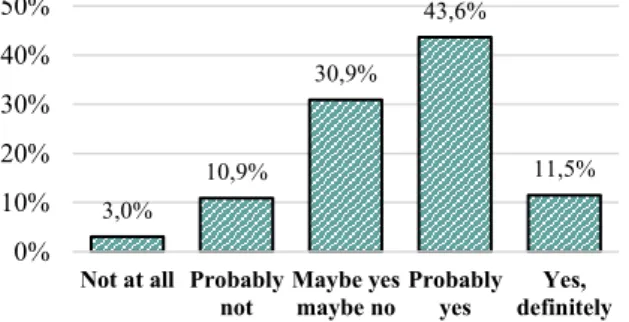
The initial reaction to the Online Styling Box concept seemed to be quite positive. Immediately after reading the description of the service consumers were inquired on their first impression about the service (Q3.2) and whether they would be interested in trying the service were it available in Portugal (Q3.3). Both questions were answered using Likert-scales from 1 - “Very negative” or “Not at all” respectively - to 5 - “Very positive” or “Yes, definitely”. Only 4,8% had a negative or very negative first impression, while 21,2% were neutral and the majority 73,9% had a positive or very positive reaction to the description. This question’s mean score was 3,88 with a Standard Deviation of 0,81. Regarding intentions to try Online Styling Boxes
19 (Figure 1), 13,9% respondents were not interested all or at least thought they would probably not try it, 30,9% were indecisive at this stage and, 55,2% showed positive intention to try the service. Women were slightly more favorable towards trying the service than men (58,4% of women respondents answered positively vs. 48,1% of men; 9,7% of women respondents answered negatively 23,1%). Furthermore, age has a negative correlation with intention to buy (Appendix 3).
To get a further understanding on what type of use consumers would seek for Online Styling Boxes the scores of questions Q3.11_10 - Intention to use as a complement score - and Q3.11_11- Intention to use as a substitute to regular method of shopping score were analyzed. The results presented in Tables 3 and 4 show a clear preference for using the service only as a complement to the conventional shopping methods rather than a substitute, as 67,9% of the respondents gave the complement option a greater score on the five-point scale than the substitute option. In fact, the score attributed to Intention to use as a complement was on average, 1,15 points greater than the score attributed to Intention to use as a substitute. H3 is
therefore rejected. Intention to use as a complement Intention to use as a substitute Complement > Substitute Complement = Substitute Complement < Substitute Total >2 >2 20,61% 20,00% 4,24% 44,85% <=2 >2 45,45% 0,00% 0,00% 45,45% >2 <=2 0,00% 0,00% 1,21% 1,21% <=2 <=2 1,82% 5,45% 1,21% 8,48% Total 67,88% 25,45% 6,67% 100,00%
Table 3- Cross-tabulation: Intention to use as a complement score * Intention to use as a substitute to regular method of shopping score (Q3.11_10 and Q3.11_11)
N=165 Mean Mode Std. Deviation Would you be interested in trying the
described service, if it existed in Portugal? 3,5 4 0,941 I would like to use the service as a substitute
for my current shopping method 2,53 2 1,102 I would use the service as a complement to my
current purchasing method 3,68 4 0,897
Table 4 - Statistics (Q3.3, Q3.11_10 and Q3.11_11)
3,0% 10,9% 30,9% 43,6% 11,5% 0% 10% 20% 30% 40% 50%
Not at all Probably not Maybe yes maybe no Probably yes Yes, definitely
20
H4: Consumers unwilling to try the service perceive it as too complex
Respondents who showed little or no intention of trying the service were then asked to state which reason justified that feeling. The most frequent reasons were not trusting another person to choose their clothes (69,6%), believing it would be too expensive (43,5%) and perceiving it as too complex (30,4%). The scores on Q3.9 of “Complicated - Practical” and “Difficult - Easy” were recoded into new symmetrical variables and a Correlation test was performed to verify their impact on Intention to try measured in Q3.3. The Pearson Correlation coefficients indicate that both variables have a negative impact (-,281 and -,266) on Intention to try (p-values <0,05), supporting H4.
Complicated Difficult Intention to try Pearson Correlation -,281 -,266
Sig. (2-tailed) ,000 ,001 Complicated Pearson Correlation 1 ,711**
Sig. (2-tailed) ,000
Table 5 - Correlations: Intention to try * Complicated * Difficult
H5: Perceived convenience will positively influence consumers’ intention to try Online Styling Boxes
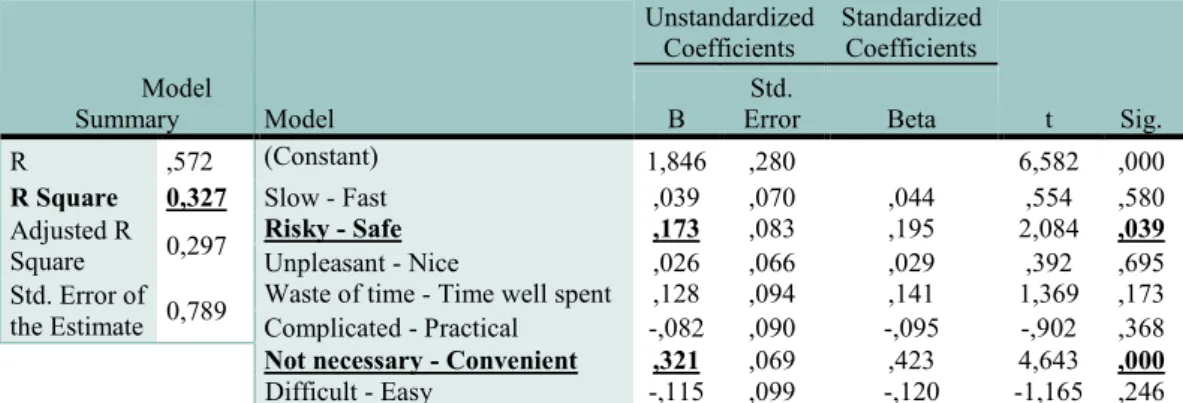
Similar to what was done previously with online and offline shopping, respondents rated several attributes of Online Styling Box service using the same semantic-differential scales as before. A Linear Regression was conducted to address the fifth research hypothesis, having as a dependent variable Intention to try the service - measured on a five-level scale in question Q3.3 - and independent variables several attributes from the question Q3.9. The assumptions that the residuals are normally distributed, and that there is no correlation between the independent variables (known as collinearity) are met. Even though the R squared is only 0,327, meaning
30,4% 69,6% 26,1% 13,0% 43,5% 13,0% 0% 10% 20% 30% 40% 50% 60% 70% 80%
It's too complex I do not trust another person
to choose my clothes
I do not like shopping online
I do not see any added value
I think it would be too expensive
Other
21 the variance in the independent variables explain 32,7% of the variance in the dependent variable, two variables with a statistically significant impact on Intention to try are identified. These are Pleasantness level and Convenience, both with positive coefficients, therefore having a positive impact in Intention to try the service.
Model
Summary Model
Unstandardized
Coefficients Standardized Coefficients
t Sig. B
Std.
Error Beta
R ,572 (Constant) 1,846 ,280 6,582 ,000
R Square 0,327 Slow - Fast ,039 ,070 ,044 ,554 ,580
Adjusted R Square 0,297 Risky - Safe ,173 ,083 ,195 2,084 ,039 Unpleasant - Nice ,026 ,066 ,029 ,392 ,695 Std. Error of the Estimate 0,789
Waste of time - Time well spent ,128 ,094 ,141 1,369 ,173 Complicated - Practical -,082 ,090 -,095 -,902 ,368
Not necessary - Convenient ,321 ,069 ,423 4,643 ,000
Difficult - Easy -,115 ,099 -,120 -1,165 ,246
Table 6 - Linear Regression Coefficients (Dependent Variable: Intention to try) (Q3.3 and Q3.9)
H6: Curation will have a positive influence on willingness to try personal Online Styling Boxes
In question, Q3.10 respondents were presented with several sentences relating to features of the service described and were asked to indicate the relevance attributed to each one, on a five-point Likert scale. Using those ratings as independent variables and Intention to try the service (Q3.3) as the dependent variable a linear regression was conducted, obtaining an R squared of 0,511 (Table 7). For a confidence level of 95%, the attributes with a statistically significant impact on Intention to try were: The items being chosen by a professional stylist, Not having to
look for clothes, Receiving advice from the stylist and Being able to order whenever desired.
All four of these attributes have a positive impact on the dependent variable, since there are coefficients greater than zero, as shown in Table 7. Hence, H6 is not rejected.
Model Summary Model
Unstandardized Coefficients Standardized Coefficients t Sig. B Error Std. Beta R ,715 (Constant) -1,114 0,47 -2,368 0,019
R Square 0,511 The items being chosen by a professional stylist The styling fee being non-refundable -0,014 0,065 0,191 0,078 -0,013 0,182 -0,217 0,829 2,449 0,015
Adjusted R Square 0,486
The styling fee being discounted at the total
purchase price -0,006 0,075 -0,005 -0,08 0,937 Std. Error
of the
Estimate ,715
a Being able to try the items before you buy Not having to look for clothes 0,163 0,089 0,136 0,066 0,119 0,147 1,836 0,068 2,058 0,041
Receiving advice from the stylist 0,361 0,085 0,32 4,256 0,000 Impossibility to view items before ordering a box 0,059 0,064 0,057 0,92 0,359
Being able to order whenever you want ,271 ,094 ,198 2,886 ,004
22
H7: The element of surprise will have a positive influence on the intention to try Online Styling Boxes and
H8: Uncertainty will have a negative impact on the intention to try Online Styling Boxes
A Linear regression was performed to test the effect of variables measured in Q3.11 - where participants were asked to indicate the degree of agreement or disagreement with a variety of statements related to the online service they had read about - on the Intention to try (Q3.3). using the Stepwise method. the Stepwise method does multiple regression several times, removing the weakest correlated variable each time. In the end, the variables that explain best the variation in the dependent variable are presented.
The ANOVA tests if all betas are equal to zero (i.e. if the independent variables (attributes) have no effect on the dependent variable (satisfaction), which was rejected. Even though the R squared is always under 40%, meaning that the proportion of the variation in the dependent variable that is predictable from the independent variables is really low, in the end, the variables that explain best the variation in the dependent variable are presented.
The final model obtained with this method has an R square of 0,374, i.e. the variance in the independent variables kept explains 37,4% of the variance in the dependent variable - intention to try Online Styling Boxes. The variables kept, and therefore the factors that have a significant influence on the Intention to try are as shown in Table 6.
The surprise element variable has a positive coefficient of 0,139 (p-value = 0,029), thus having a statistically significant positive impact on Intention to try.
With a coefficient of -0,162 and a p-value < 0,05 it is possible to conclude that the more respondents agree that the possibility of not liking any of the items reduced their desire to try the service the lower their intention to try it. Both H7 and H8 are supported by this test.
Model Summary Model
Unstandardized
Coefficients Standardized Coefficients
t Sig. B Std. Error Beta
R ,612 (Constant) 1,790 ,480 3,730 ,000
R Square 0,374 Each box is designed especially for me ,324 ,073 ,301 4,429 ,000 Adjusted R
Square 0,354 I would be interested in the service if I included the brands that I usually buy ,259 ,071 ,244 3,639 ,000 Std. Error
of the Estimate
,756
The possibility of not liking any of the items
reduces my desire to try the service -0,162 ,066 -0,166 -2,448 ,015
I like the surprise factor ,139 ,063 ,158 2,205 ,029
I think the stylist was going to try to foist his
tastes on my look -0,127 ,061 -0,138 -2,062 ,041
23
4.3. Online Styling Boxes vs. Conventional Shopping methods
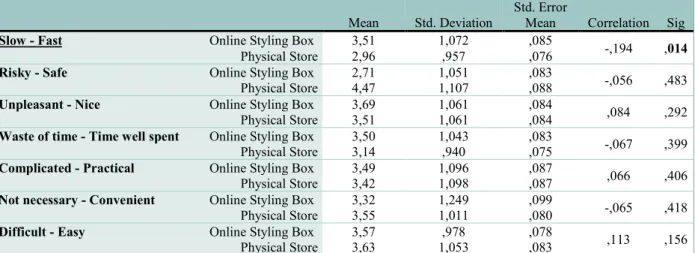
In questions Q2.7 and Q3.9, respondents rated the same attributes in similar Semantic-differential Scales for Physical Scores and then for Online Styling Box service respectively. A Paired Sample T-test was used to determine whether the mean difference between each pair of sets of observations was different than zero. The participants whose answers to Q2.3 - How
many of these times are online? - were “More than half” or “I always buy online” were excluded
from this analysis. Thus, the sample size was 159. The Paired-Samples Correlation shown in Table7 adds the information that the “Slow-Fast” attribute scores are significantly negatively correlated (r = -0,149, p-value < 0,05). There was a significant average difference between Physical Scores and then for Online Styling Box’s scores for the attributes “Slow-Fast”, “Risky
- Safe” and “Waste of time - Time well spent” (p-values < 0,05). On average the online service
presented was perceived to be faster, riskier and better spent time than the conventional shopping method.
Mean Std. Deviation
Std. Error
Mean Correlation Sig
Slow - Fast Online Styling Box 3,51 1,072 ,085 -,194 ,014
Physical Store 2,96 ,957 ,076
Risky - Safe Online Styling Box 2,71 1,051 ,083 -,056 ,483
Physical Store 4,47 1,107 ,088
Unpleasant - Nice Online Styling Box 3,69 1,061 ,084 ,084 ,292
Physical Store 3,51 1,061 ,084
Waste of time - Time well spent Online Styling Box 3,50 1,043 ,083 -,067 ,399 Physical Store 3,14 ,940 ,075
Complicated - Practical Online Styling Box 3,49 1,096 ,087 ,066 ,406 Physical Store 3,42 1,098 ,087
Not necessary - Convenient Online Styling Box 3,32 1,249 ,099 -,065 ,418 Physical Store 3,55 1,011 ,080
Difficult - Easy Online Styling Box 3,57 ,978 ,078 ,113 ,156
Physical Store 3,63 1,053 ,083
Table 9 - Sample Statistics and Correlations: Online Styling Box & Physical Store (Q2.7 and Q3.9)
Paired Differences Mean Std. Deviation Std. Error Mean 95% Confidence Interval
of the Difference Sig. (2-tailed) Lower Upper t
Box vs. Store: Slow - Fast ,553 1,570 ,124 ,308 ,799 4,446 ,000
Box vs. Store: Risky - Safe -1,761 1,569 ,124 -2,007 -1,515 -14,153 ,000 Box vs. Store: Unpleasant - Nice ,182 1,436 ,114 -,043 ,407 1,602 ,111
Box vs. Store: Waste of time - Time well spent ,352 1,450 ,115 ,125 ,579 3,062 ,003
Box vs. Store: Complicated - Practical ,075 1,499 ,119 -,159 ,310 ,635 ,526 Box vs. Store: Not necessary - Convenient -,226 1,657 ,131 -,486 ,033 -1,723 ,087 Box vs. Store: Difficult - Easy -,063 1,353 ,107 -,275 ,149 -,586 ,559
24
4.4. Willingness to pay
The only cost charged to consumers for this service is the styling fee, thus representing the price of the service. To measure willingness to pay respondents were asked three different questions. First, they were directly asked how much they would be willing to pay for the styling fee. Secondly, they were questioned on a ceiling price above which they believed they would never order a box either because they could not afford it or thought it was not worth the money. Finally, participants stated a minimum price below which price they would not trust the quality of the service. The willingness to pay ranged between 1 and 100 euros and averaged at 14,54 euros. Most respondents (62,7%) answered values up to 10 euros and only 13,3% would pay more than 20 euros. The ceiling and floor responses averaged at 33,06 euros and 5,24 euros respectively.
WTP €
WTP Ceiling Floor Ceiling € Floor € up to 5€ 35,2% 9,9% 77,5% mean 14,58 33,06 5,24 between 5,1€ and 10€ 27,5% 20,4% 13,4% mode 10 10 5 between 10,1€ and 20€ 23,9% 19,7% 7,7% median 10 22,5 5 between 20,1€ and 30€ 7,0% 17,6% 0,7% more than 30€ 6,3% 32,4% 0,7%
Tables 11 & 12 - Descriptive statistics and Frequencies (Q3.6, Q3.7 and Q3.8)
25
5. Limitations and Considerations for Future Research
This study is limited by several conditions that must be taken into consideration when interpreting its results.
The first limitation of this research concerns the lack of academic literature. Online Styling Boxes are a quite recent phenomenon and for that reason, there are very few research papers addressing box business models, online personal styling services and subscriptions and consumers’ behaviors towards these types of online commerce.
Since the questionnaire was distributed via social media and through my personal contacts the sample was not fully representative of the Portuguese consumers and was poorly diversified and therefore results are subjected to sampling errors. Moreover, the reduced size of the sample composed of only 165 people, difficulted the extraction of significant relationships from the data.
The questionnaire inquired consumers on their reactions to a complex and probably unfamiliar shopping concept to most respondents. This poses as a challenging task for them and might lead to a bias although it is unclear if participants are under or overstating the valuations of their perceptions. This limitation also influences the results regarding willingness to pay as respondents do not have a similar service to which they could compare Online Styling Boxes, making the monetary valuation of the service more ambiguous and complicated task. On the other hand, participants who had previously heard about similar services might be influenced by former perceptions.
Finally, the description of the service presented to participants was rather broad and lacked specific details regarding particular features of the - at this point - hypothetic service available in Portugal, such as delivery and returns’ times, locations and procedures, clothing lines covered, included brands, or website characteristics, among others. This was done, intentionally in order to broaden the scope of the research and to capture general insights and attitudes of respondents. Though, future research is recommended to understand consumers behavior towards each of the specific features so as to understand consumers preferences and intention to try.
It would be interesting to expand the analysis of the present study hypotheses to a larger and more diverse sample of Portuguese consumers in an effort to solve some of the previously mentioned limitations, in order to gather confirmatory results. Furthermore, a greater research
26 on consumers’ profiles is required in order to extract segmentation information from which type of consumers value which characteristics of the service as well as the influence of consumers’ individual backgrounds on their intention to adoption, including demographics and psychographics, such as their shopping preferences.
6. Conclusion
Subscription-based businesses and Online Styling Boxes are growing exponentially in the United States and have recently started to emerge overseas in countries like the United Kingdom, sometimes offering to ship the remaining European countries. Portugal’s digital landscape is also evolving while it enables consumers to access bicycle, scooter, and car sharing, stream movies and series or have groceries delivered in a couple of hours with just a few clicks on their mobile devices. The results obtained in this study, through the development of in-depth interviews and online questionnaires, provide insights regarding Portuguese consumers’ potential behavior and perceptions of an innovative service in the fashion retail industry, that is Online Styling Boxes.
First of all, it is not surprising to find that most participants do use online shopping but not as the principal method for purchasing clothes. In fact, from the factors measured, the safety of the shopping method is the one participants rated more differently when evaluating online shopping compared to when evaluating physical stores. Consumers believe purchasing clothes online is riskier even though they also think it is faster and cheaper. E-commerce trust poses as the pertinent barrier to online businesses as uncertainty keeps consumers from ordering products and services online.
When presented with the Online Styling Boxes service model, the overall reaction of the participants was positive as well as the intention to try. Participants in the quantitative study were more interested in using the service as a complement rather than a substitute to their current method of shopping which is consistent with the results from the interviews. Throughout in-depth interviews a trend seemed to be emerging regarding type of use preferred by consumers. During the conversations, consumers who disliked shopping revealed that Online Styling Boxes could be an affordable alternative to fill their evident desire end their need to go shopping in the long run. This insight was not evident in the questionnaires results because it is harder to capture more complex reactions to service, such as gradual adoption of
27 a service. As a new and generally unfamiliar service it is expected that the initial intention to adopt is more contained, hence only intention to try was captured. A lot of factors weigh in a decision to try an offer newly available in the market. For example, communication and pricing strategies are of uttermost importance to induce the first try. Subsequent uses will then also be dependent on the quality of previous experience.
Features like having a professional choosing the clothes and sending advice, flexibility to order whenever desired, not having to look, for clothes, convenience, customization and the surprise factor are some of the key motivators for trying Online Styling Boxes, as well as fastness, when compared to a physical store. Not trusting another person to choose their clothes, price and complexity were the indicated promoters of unwillingness to try the service. While it is possible to address price expectations to some extent and educate consumers on how to use the service or reduce its complexity through the website design and interface presented, other issues are intrinsic to the service. Thus, it might not wise for companies to focus on consumers who do not want someone else buying them apparel, as those consumers are probably not the target. Further market research should focus on younger consumers who seek convenient solutions and value curation.
The willingness to pay averaged close to 15€, which is not very far from the Stitch Fix’s (company used as benchmark) price, set at 20USD (17.53€). Given the economical differences between Portugal and US, 15€ seems to be plausible price for a similar service introduced in this market.
This study diminishes the gap in literature on the subject of consumers’ perceptions and attitudes regarding Online Styling Services but also provides relevant insights to managers seeking to introduce a similar service in the Portuguese market. However, the need to study the subject more in-depth should not be disregarded. As an unexplored market place with still no players yet there are a lot of opportunities to explore and shape consumers expectations and experiences in this field.
28
7. References
Abraham, J., Lone, S., & Couenberg, J. (2017). Ecommerce Report Portugal 2017, 1–46. Retrieved from
https://www.ecommercewiki.org/Prot:C_Light_Portugal_Ecommerce_Country_Report_ 2017-2-2
Bridges, E., & Florsheim, R. (2008). Hedonic and utilitarian shopping goals: The online experience. Journal of Business Research, 61(4), 309–314.
https://doi.org/10.1016/j.jbusres.2007.06.017
Chen, T., Fenyo, K., & Yang, S. (2018). Thinking inside the subscription box : New research on e-commerce consumers. McKinsey & Company, (February), 1–9. Retrieved from https://www.mckinsey.com/industries/high-tech/our-insights/thinking-inside-the-subscription-box-new-research-on-ecommerce-consumers
Coelho, P. S., & Henseler, J. (2012). Creating customer loyalty through service customization. European Journal of Marketing, 46(3–4), 331–356.
https://doi.org/10.1108/03090561211202503
Davis, F. D. (1989). Perceived Usefulness, Perceived Ease of Use, and User Acceptance of Information Technology. MIS Quarterly, 13(3), 319. https://doi.org/10.2307/249008 Elan, P., Wiseman, E., & Moore, S. (2018). Look what came in the post: the rise of
subscription shopping | Life and style | The Guardian. Retrieved from
https://www.theguardian.com/lifeandstyle/2018/may/20/look-what-came-in-the-post-the-rise-of-subscription-shopping-services
Euromonitor. (2018). Internet Retailing in Portugal. Internent Retailing in Portugal.
Guan, C., Qin, S., Ling, W., & Ding, G. (2016). Apparel Recommendation System Evolution: An empirical review. International Journal of Clothing Science and Technology, 28(6), 854–879. Retrieved from http://dx.doi.org/10.1108/IJCST-09-2015-0100
Kestenbaum, R. (2017, August). Subscription Businesses Are Exploding With Growth.
Forbes. Retrieved from
https://www.forbes.com/sites/richardkestenbaum/2017/08/10/subscription-businesses-are-exploding-with-growth/