83
Rev Bras Med Esporte – Vol. 19, No 2 – March/April, 2013
THE PRACTICE OF PHYSICAL EXERCISE IS A
MODIFIABLE FACTOR FOR URGE URINARY
INCONTINENCE IN OLDER WOMEN
ORIGINAL ARTICLE
Janeisa Franck Virtuoso1 Giovana Zapellon Mazo2
1. Physiotherapy – UDESC – University of Santa Catarina State, Laboratory of Gerontology – LAGER, Florianópolis, SC, Brazil.
2. Department of Physical Education – UDESC – University of Santa Catarina State, Laboratory of Gerontology – LAGER, Florianópolis, SC, Brazil.
Mailing address:
Laboratório de Gerontologia – LAGER, Centro de Ciências da Saúde e do Esporte Universidade do Estado de Santa Catarina,
Rua Paschoal Simone 358, Coqueiros 88080-350 – Florianópolis, SC, Brasil E-mail: [email protected]
EXERCISE AND SPORTS MEDICINE CLINIC
ABSTRACT
Introduction: The literature suggests that some risk factors for urinary incontinence can be modified by a healthy lifestyle; however, little is known about the factors associated with urge urinary incontinence (UUI), whose prevalence increases with age. Objective: To examine the modifiable risk factors of UUI in older women. Method: The sample consisted of 200 elderly (60 years or older) with a mean age of 69.06 ± 6.26 years. We identified the presence of UUI and behavioral risk factors (consumption of coffee, alcohol consumption, smoking and presence of constipation). Was also applied to the Domain 4 for International Physical Activity Questionnaire (IPAQ) to identify the level of physical activity and measured body mass index and waist circumference. The data were processed using descriptive and inferential statistics with a significance level of 5%. Results: The prevalence of UUI in the sample was 15,5%. Among the modifiable factors, only the level of physical activity was associated with the occurrence of UUI, and the physical exercise appeared as a protective factor among very active women (OR = 0.288) and less active (OR = 0.356). Conclusion: The symptoms of urgency can be softened by regular physical exercise. Through a healthy lifestyle can minimize a number of modifiable factors in the genesis of urge urinary incontinence.
Keywords: physical activity, risk factors, aging.
INTRODUCTION
Urge urinary incontinence (UUI) is considered all the invonlun-tary urine loss immediately followed or preceded by urgency1. Stress
Urinary incontinence (SUI) is usually the commonest type in the general population; however, it is observed that among the elderly the values are higher for the UUI symptoms. In a study conducted by Parazzini et al.2, the prevalence of UUI in women older than 62
years was of 34%, while for the EUI it was of 23%.
There are many factors aassociated with the development of urinary incontinence (UI) in older women3,4. Therefore, some studies
mention that a healthy lifestyle through regular physical activity practice and balanced diet, may alter some factors, such as constipa-tion and overweight5,6. These risk factors are considered changeable
in the genesis of the urinary incontinence.
Grewar and McLean5 developed a model based on evidence
ter-med “Continence Integrated System”. The authors suggest that motor control, musculoskeletal and behavioral factors are considered modi-fiable and may influence on the function of the urinary continence system. However, there is little research which analyses the correlation between UI incidence and a healthy lifestyle, since this behavior has been recommended by physicians and other health professionals. This research becomes less frequent when the UUI genesis is con-cerned. Thus, the aim of this study is to analyze the modifiable risk factors of the urge urinary incontinence in older women.
METHODS
This transversal and descriptive study was performed with older women (60 years or older), who are engaged in formal groups of
physical exercises for the elderly or who participate in interaction groups for the elderly in Florianópolis, Santa Catarina (SC).
Women aged above 60 years were selected in this study due to the scientific information that the female gender as well as age advance are important risk factors for the genesis of urinary in-continence (UI)7,8. Moreover, in this age group there is a series of
other associated risk factors, such as the menopause arrival and the delivery effects over the musculature of the pelvic floor8.
In this study, the elderly dependent on any function, who have reported any injury of the lower urinary tract, presence of pain to urinate or any other indication of urinary infection, were excluded. Thus, 200 older women, mean age of 69.06 ± 6.26 years, engaged in formal groups of physical exercise programs for the elderly or participating in interaction groups for the elderly in Florianópolis, SC participated in this study.
84 Rev Bras Med Esporte – Vol. 19, No 2 – March/April, 2013
Additionally, sociodemographic data, marital status, educational ba-ckground and current occupation were collected to characterize the sample. This information was obtained from the older women with questions structured and applied as an individual questionnaire.
In order to have the Body Mass Index (BMI) and waist circumference verified, body mass was checked on a digital scale (Plenna Wind MEA 07710), and stature with stadiometer WCS 217 cm with a platform (Cardiomed) and the circumferences with a round measure tape with 1.50 m (ISP). The BMI is calculated by the division of body mass (in kg) by the square of the stature (m2), and waist circumference by
the mathematical mean of the circumferences of the last rib and the iliac crest (cm).
Physical activity level was identified using the Domain 4 of the International Physical Activity Questionnaire (IPAQ), adapted for older individuals from the studies by Mazo and Benedetti9. This domain is
composed of three questions and refers to the recreational, sports, physical exercises and leisure activities the elderly does in a normal/ habitual week. The physical activities considered had minimum du-ration of ten continuous minutes and moderate or vigorous intensity. After the application of this questionnaire, the older women of this study were divided in three levels of physical activity (PA): Very Active (VAG), with 600 at 1,500 METs/minutes per week of PA; Little Active (LAG) with up to 600 METs/minutes per week; and Sedentary (SEG), with zero (0) METs/minutes per week.
Data collection occurred with an initial contact with the older women for presentation of the aims of the research, the importance of their participation, the used instruments, the information secret and the invitation to participate in the study. Those who accepted were individually interviewed before the physical exercise program classes or the activities proposed by the Interaction groups, in the premises where these activities take place.
The variables of the study were: presence of symptoms of urge urinary incontinence (dependent variable), frequent coffee con-sumption (yes/no), alcohol concon-sumption (yes/no), smoking (yes/no), presence of constipation (yes/no), physical activity level (very active/ little active/sedentary), Body Mass Index (normal/overweight) and waist circumference (normal/increased) (independent variables).
Statistical analysis was performed in the SPSS – Statistical Package for Social Sciences statistical package (version 17.0). The category variables were descriptively analyzed by simple frequency and percentages and the number ones by measurement of position and dispersion. A chi-square test was used for inferential analysis between the modifiable risk factors and the presence/absence of UUI, while those with p ≤ 0.200 were inserted in the binary logistics regression model. The significance level adopted was of 5%.
This research followed the ethical principles according to the resolution 196 from the National Health Board. The study was sent to the Ethics in Research Committee of the University of Santa Catarina State (UDESC) and approved under the protocol number 03/2010. After having agreed on participating in the research, the older wo-men signed the free consent form in two copies; one copy stayed with the older woman and the other with the researcher in charge.
RESULTS
Two hundred (200) older women with mean age of 69.06 ± 6.26 years were interviewed. Concerning sociodemographic data, they
were mostly married (50.5%) or widowed (36.0%), retired (53.0%) and did not finish elementary school (31.0%) or finish high school (27.5%).
The incidence of urge urinary incontinence (UUI) in the sam-ple was of 15.5%. As can be observed in table 1, the majority of the older women frequently ingest coffee (83.0%), but does not drink alcohol (95.5%) or smoke (97.0%). Moreover, 60.6% do not present constipation.
Concerning the physical activity level, association with the UUI onset was observed, and the sedentary older women presented higher frequency of urge incontinence symptoms (45.2%).
In the anthropometric variables, (table 1) high overweight inci-dence (77.5%) and increased waist circumference (88.5%) are ob-served among the older women of the sample, without association with UUI though.
In the logistic regression model three variables which presen-ted p ≤ 0.200 were added: frequent coffee consumption, physical activity level and Body Mass Index.
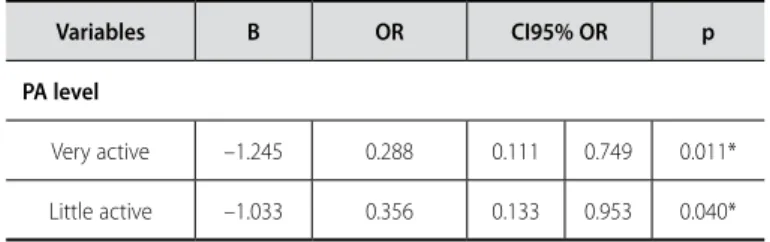
As can be observed in table 2, only the physical activity level aassociated with the UUI onset, and the practice of physical exer-cises was a protection factor among very active (OR = 0.288) and little active women (OR = 0.356).
Table 1. Association between modifiable risk factors and presence/absence of UI in elderly women (n = 200).
Modifiable factors
Presence of UUI f (%)
Absence of UUI f (%)
Total
f (%) X
2 p
Coffee consumption
Yes No
29 (93.5) 2 (6.5)
137 (81.1) 32 (18.9)
166 (83.0)
34 (17.0) 2.893 0.089
Alcohol consumption
Yes No
2 (6.5) 29 (93.5)
7 (4.1) 162 (95.9)
9 (4.5)
191 (95.5) 0.325 0.569
Smoking
Yes No
2 (6.5) 29 (93.5)
4 (2.4) 165 (97.6)
6 (3.0)
194 (97.0) 1.502 0.220
Constipation
Yes No
10 (32.3) 21 (67.7)
68 (40.7) 99 (59.3)
78 (39.4)
120 (60.6) 0.784 0.376
PA level
Very active Little active Sedentary
9 (29.0) 8 (25.8) 14 (45.2)¥
72 (42.6) 58 (34.3) 39 (23.1)
81 (40.5) 66 (33.0) 53 (26.5)
6.588 0.037*
Body mass index
Overweight Normal
27 (87.1) 4 (12.9)
128 (75.7) 41 (24.3)
155 (77.5)
45 (22.5) 1.938 0.164
Increased waist
Circumference Normal
29 (93.5) 2 (6.5)
148 (87.6) 21 (12.4)
177 (88.5)
23 (11.5) 0.919 0.338
85
Rev Bras Med Esporte – Vol. 19, No 2 – March/April, 2013
Table 2. Analysis of logistic regression of the modifiable factors in the onset of UUI in elderly women (n = 200).
Variables B OR CI95% OR p
PA level
Very active –1.245 0.288 0.111 0.749 0.011*
Little active –1.033 0.356 0.133 0.953 0.040*
PA = physical activity; B = logistic coefficient; OR (odds ratio) = risk ratio for UUI; CI 95% OR = confidence interval for the risk ratio; p = significance level. *p ≤ 0.05.
DISCUSSION
Concerning the typology of the urinary incontinence, the effort urinary losses (EUI) are usually the most prevalent in the general population; however, among the elderly, the values are higher for the urge symptoms. Tannenbaum et al.10 pointed ut incidence of
urge urinary incontinence (UUI) of 22% among women aged 55 years or older, while Zhu et al.11 found only 5.7% of older women
(60 years old or older) with these symptoms. In the present study, intermediate incidence between the studies mentioned above was found. This kind of alteration may be due to the different diagnostic instruments of the symptoms. In this study, the self-report of urinary loss immediately followed or preceded by urge was selected.
It is known that with the aging process, structural alterations of the detrusor muscle, such as development of fibrosis and hypersen-sitivity to noradrenaline, result in reduction of vesical capacity and development of involuntary contractions12, causing symptoms of
urinary urge and/or UUI. A study developed with 20,000 Chinese women11 demonstrated that age older than 60 years increases 2.329
(CI 95% = 1.419 to 3.821) times the chance to develop UUI and post-menopause status in 2.285 (CI 95% = 1.535 to 3.402).
Concerning the modifiable risk factors (behavioral) of urinary incontinence, it is observed that constipation, alcohol consumption, caffeine, tea, are risk factors for development of UUI among the older women in the present study. A study by Zerati
et al.13 demonstrated that the alterations of the intestinal rhythm
have been associated with increase of the urinary symptoms and incontinence episodes. Song et al.3 mention that constipation is an
important risk factor for UUI (OR = 2.3; CI 95% = 1.4 to 3.7), since when feces fills up the rectum, the bladder bottom and urethra are pressed, causing non-inhibited contraction of the detrusor and consequently, involuntary urine leaking.
Alcohol also plays a relevant role in the genesis of the urinary symptoms, both for its diuretic effect and a possible direct irritation of the vesical mucosa13. Song et al.3 found association between
alcohol consumption and UUI presence (OR = 4.7; CI 95% = 1.1 to 20.2); however, this relation does not usually occur in the older population 4,8,11.
Intake of caffeinated drinks as a risk factor for UUI is demonstrated in some studies. Arya et al.14 observed that daily consumption of
caffeine is significantly higher among women with involuntary con-traction of the detrusor (484 mg/day) than among those without contractions (194 mg/day). The risk to develop UUI may increase 25% in adult women who intake high amount of caffeine daily.
It is known that the amount of caffeine in tea is approximately one third of the amount in coffee; however, in the study developed
by Hannestad et al. (2003), the intake of three or more cups of
tea was considered a risk factor for UI (OR = 1.3; CI 95% = 1.2 to 1.5), while caffeine was not. The authors believe that tea presents other components which aggravate UI. According to Reis et al.
(2003), caffeine and alcohol cause polyuria, increasing urinary frequency and urge.
Smoking can also promote UI onset due to chronic increase of intra-abdominal pressure when coughing17,18. Danforth et al.19
found association between smoking and UI onset (OR = 1.34; CI 95% = 1.25 to 1.45); however, as mentioned above, this relation is not usually frequent in the older population4,8. Regarding UUI,
nicotine presents a direct effect in the muscular contractions of the bladder, causing symptoms of urinary urge20.
As age progresses, there are alterations in women’s body di-mensions, especially height and weight and body composition21.
These alterations include alterations in the Body Mass Index (BMI) and in the Waist Circumference (WC) perimeter, anthropometric factors analyzed in this study.
The presence of overweight is a common characteristic among women older than 60 years. According to Monteiro et al.22,
en-vironmental, cultural, economic and demographic alterations occurred in the last decades in the Brazilian society may have resulted in alterations in the patterns of food ingestion and ener-gy expenditure, indicating hence a possible way to explain this process of nutritional transition. According to Krause et al.23, both
BMI and WC increase may negatively act on the structures of the pelvic floor, similarly to pregnancy, causing vascular damage and mechanical impact on the urethra24.
Fenster et al.25 complement this idea stating that obesity leads
to disturb in the oxidative metabolism and resistance to insulin which, on its turn, may damage the vascular system of the pelvic floor and lead to dysfunction of the detrusor and of the urethral sphincter muscle. Song et al.3 found increase of BMI as a risk factor
for symptoms of urinary urge (OR = 1.5; CI 95% = 1.2 to 2.0), while
Zhu et al.11 point out waist circumference above 80 cm as a risk
factor in the adult population (OR = 1.431; CI 95% = 1.120 to 1.220). Concerning practice of physical exercises, it was observed that higher level of physical activity is a protection factor for UUI onset. In a transversal study, Song et al.3 observed that women who exercised
at least once a week were less prone to UUI. Townsend et al.24 also
found lower rates of UUI in women with higher level of physical activity (OR = 0.53; CI 95% = 0.31 to 0.90). These results demonstrate that the symptoms of urinary urge can also be alleviated with regular practice of physical exercises.
Studies developed by Masue et al.26 associated lifestyle and UI
presence in adult women. The results demonstrated overweight measured through the BMI. Smoking and low level of physical ac-tivity are risk factors for UI, but they can be altered by a healthy lifestyle. Therefore, physical inactivity is a modifiable behavioral fac-tor of urinary continence.
Some studies state that increase of moderate physical activity reduces urine loss episodes15,24. According to Bø27, simultaneously
to increase of intra-abdominal pressure during physical exercise, reflex contraction of the muscles of the pelvic floor occurs, which can justify the lower rates of UI among physically active women.
86 Rev Bras Med Esporte – Vol. 19, No 2 – March/April, 2013 CONCLUSION
The acknowledgement of these results will make it possible to the health professionals who deal with the older public to know that the urinary urge symptoms, common in the aging process, can be minimized with regular practice of physical exercises. Moreover, other modifiable factors can be reduced with a healthier lifestyle.
All authors have declared there is not any potential conflict of interests concerning this article.
of indirect benefits promoted by regular practice of physical exercises, such as reduction of diabetes incidence and of the number of hypertensive medication, considered clinical risk factors of UI28. Intestinal constipation and overweight can also
be directly modified by regular practice of physical exercises29,30.
Thus, besides being a modifiable factor in the prevention of cardiovascular diseases physical activity practice appears also as a modifiable factor of urinary continence which may influence on the remaining behavioral factors.
REFERENCES
1. Abrams P, Cardozo L, Fall M, Griffiths D, Rosier P, Ulmsten U, et al. The standardization of terminology of lower urinary tract function: report from the standardization sub-committee of the international continence society. Urology 2003;61:37-49.
2. Parazzini F, Chiaffarino F, Lavezzari M, Giambanco V; VIVA Study Group. Risk factors for stress, urge or
mixed urinary incontinence in Italy. BJOG2003;110:927-33.
3. Song YF, Zhang WJ, Song J, Xu B. Prevalence and risk factors of urinary incontinence in Fuzhou Chinese women. Chin Med J (Engl) 2005;118:887-92.
4. Smith AL, Wang PC, Anger JT, Mangione CM, Trejo L, Rodríguez LV, et al. Correlates of urinary inconti-nence in community-dwelling older latinos. J Am Geriatr Soc 2010;58:1170-6.
5. Grewar H, McLean L. The integrated continence system: A manual therapy approach to the treatment of stress urinary incontinence. Man Ther 2008;13:375-86.
6. Goode PS, Burgio KL, Richter HE, Markland AD. Incontinence in older women. J Am Med Assoc 2010;303:2172-81.
7. Alvaro R, Araco F, Gravante G, Sorge R, Overton J, Vellone E, et al. Epidemiological aspects of urinary incontinence in a female population of an Italian region. Int Urogynecol J 2010;21:873-83.
8. Tamanini JTN, Lebrão ML, Duarte YAO, Santos JLF, Laurenti R. Analysis of the prevalence of and factors associated with urinary incontinence among elderly people in the Municipality of São Paulo, Brazil: SABE Study (Health, Wellbeing and Aging). Cad Saúde Pública 2009;25:1756-62.
9. Mazo GZ, Benedetti TB. Adaptação do questionário internacional de atividade física para idosos. Rev Bras Cineantropom Desempenho Hum 2010;12:480-4.
10. Tannenbaum C, Corcos J, Assalian P. The relationship between sexual activity and urinary incontinence in older women. J Am Geriatr Soc 2006;54:1220-4.
11. Zhu L, Lang J, Liu C, Xu T, Liu X, Li L, et al. Epidemiological study of urge urinary incontinence and risk factors in China. Int Urogynecol J 2010;21:589-93.
12. Siroky MB. The aging bladder. Rev Urol 2004;6:S3-7.
13. Zerati M, Morais HCF, Ferreira CHJ. Alterações do Estilo de Vida: O Primeiro Passo? In: Palma P, editor.
Urofisioterapia:aplicações clínicas das técnicas fisioterapêuticas nas disfunções miccionais e do
assoalho pélvico. Campinas: Personal Link Comunicações, 2009;175-86.
14. Arya LA, Myers DL, Jackson ND. Dietary caffeine intake and the risk for detrusor instability: a case-control study. Obstet Gynecol 2000;96:85-9.
15. Hannestad YS, Rortveit G, Daltveit AK, Hunskaar S. Are smoking and other lifestyle factors associated with female urinary incontinence? The Norwegian EPINCONT Study. BJOG 2003;110:247-54.
16. Reis RB, Cologna AJ, Martins ACP, Paschoalin EL, Tucci Júnior S, Suaid HJ. Incontinência urinária no idoso. Acta Cir Bras 2003;18:47-51.
17. Nunes PL, Resplande J. Fisiopatologia da incontinência urinária feminina. In: Palma P. Urofisioterapia: aplicações clínicas das técnicas fisioterapêuticas nas disfunções miccionais e do assoalho pélvico. Campinas: Personal Link Comunicações, 2009;63-9.
18. Pietro LMG. Incontinencia urinaria en el adulto mayor. Rev Méd Inst Mex Seguro Soc 2007;45:513-21.
19. Danforth KN, Townsend MK, Lifford K, Curhan GC, Resnick NM, Grodstein F. Risk factors for urinary incontinence among middle-aged women. Am J Obstet Gynecol 2006;194:339-45.
20. Deng, D.Y. Urinary Incontinence in Women. Med Clin N Am 2011;95:101-9.
21. Kura GG, Ribeiro LSP, Niquetti R, Filho HT. Nível de atividade física, IMC e índices de força muscular estática entre idosas praticantes de hidroginástica e ginástica. Revista Brasileira de Ciências do Enve-lhecimento Humano Rev Bras Ci Env Hum 2004;1:30-34.
22. Monteiro CA, Conde WL, Popkin BM. The burden of disease from undernutrition and overnutrition in countries undergoing rapid nutrition transition: a view from Brazil. Am J Public Health 2004;94:433-4.
23. Krause MP, Albert SM, Elsangedy HM, Krinski K, Goss FL, Silva SG. Urinary incontinence and waist circumference in older women. Age Ageing 2010;39:69-73.
24. Townsend MK, Danforth KN, Rosner B, Curhan GC, Resnick NM, Grodstein F. Physical Activity and Incident Urinary Incontinence in Middle-Aged Women. J Urol 2008;179:1012-7.
25. Fenster CP, Weinsier RL, Darley-Usmar VM, Patel RP. Obesity, aerobic exercise, and vascular disease: the
role of oxidant stress. Obes Res2002;10:964-8.
26. Masue T, Wada K, Nagata C, Deguchi T, Hayashi M, Takeda N, et al. Lifestyle and health factors associated with stress urinary incontinence in Japanese women. Maturitas 2010;66:305-9.
27. Bø K. Urinary Incontinence, Pelvic Floor Dysfunction, Exercise and Sport. Sports Med2004;34:451-6.
28. Rolim RMC, Amaral SL, Monteiro HL. Hipertensão e exercício: custos do tratamento ambulatorial, antes e após a adoção da prática regular e orientada de condicionamento físico. Hipertensão 2007;10:54-61.
29. Wyman JF, Burgio KL, Newman DK. Practical aspects of lifestyle modifications and behavioural interven-tions in the treatment of overactive bladder and urgency urinary incontinence Journal compilation a 2009 Blackwell Publishing Ltd. Int J Clin Pract 2009;63:1177-91.
30. Hay Smith J, Berghmans B, Burgio K, Dumoulin C, Hagen S, Moore K, et al. Adult conservative manage-ment. In: Abrams P, Cardozo L, Khoury S, Wein A, editors. Incontinence – 4th International Consultation