FREE THEMES
1 Programa de Pós-Graduação em Saúde Coletiva, Universidade Federal Fluminense. Rua Marquês do Paraná 303, 4º andar, prédio anexo ao HUAP. 24033-900. Niterói RJ Brasil. renata.rrigotti@ gmail.com
2 Departamento de Epidemiologia e Bioestatística, Instituto de Saúde Coletiva, Universidade Federal Fluminense.
3 Departamento de Nutrição Social, Instituto de Nutrição, Universidade Estadual do Rio de Janeiro.
Association between the use of a baby’s bottle and pacifier
and the absence of breastfeeding in the second six months of life
Abstract Introduction: The World Health Orga-nization recommends breastfeeding for two years or more and advises against bottle feeding and pacifier use. Objective: Investigate the associa-tion between bottle feeding and pacifier use, and breastfeeding in the second half-year of life. Meth-ods: Survey in a municipality of Rio de Janeiro state, in 2006, interviewing those responsible for 580 children aged 6-11 months. Bottle feeding and pacifier use, and variables which in the bivariate analysis were associated with the outcome
‘ab-sence of breastfeeding’ (≥ 0.20), were selected for
multiple analysis. Adjusted prevalence ratios were obtained by a Poisson regression model. Results: 40% of the children 6-11 months were not being breastfed, 47% used a pacifier and 57% used a bottle. Pacifier use (PR = 3.245; CI95%: 2.490-4.228) and bottle feeding (PR = 1.605; CI95%: 1.273-2.023) were shown to be strongly associat-ed with the outcome, and also with: mother’s low schooling (PR = 0.826; CI95%: 0.689-0.990); low birth weight (PR = 1.488; CI95%: 1.159-1.910); mother not being the baby carer (PR = 1.324; CI95%: 1.080-1.622); and increasing age of the baby in days (PR = 1.004; CI95%: 1.002-1.006). Conclusions: The use of pacifiers and bottles can reduce continued breastfeeding. Stronger discour-agement of these artifacts should be adopted in public health policies.
Key words Breastfeeding, Bottle, Pacifiers, Infant nutrition, Epidemiological studies
Renata Ribeiro Rigotti 1
Maria Inês Couto de Oliveira 2
R
ig
ott
Introduction
There is a great deal of scientific evidence about the advantages of breastfeeding, both from the nutritional point of view – since mothers’ milk contains the components that are appropriate and have the ideal bioavailability for growth of the child – and also from the point of view of the protection that the species-specific nature of
hu-man milk confers1.
A trend to increased breast feeding has been observed in Brazil, which has been the result of public policies implemented in the last three de-cades, such as the Brazilian Standards for Sales
of Foods to Nursing Children, (Norma Brasileira
de Comercialização de Alimentos para Lactentes),
the World Breastfeeding Week Campaigns, and the incorporation of health services in the pro-motion of breastfeeding through the Children’s
Friend Hospital Initiative (Iniciativa Hospital
Amigo da Criança), the network of Human Milk
Banks, and the strategies directed to primary
healthcare2.
The median duration of exclusive breastfeed-ing has evolved from 1.1 months, in 1996, to 1.4 months, in 2006, while the median duration of breastfeeding has increased from 7.0 months in
1996 to 14.0 months in 20063. In the second
sur-vey carried out in capital cities of Brazilian states and in the Federal District, in 2008, exclusive breastfeeding was found in 41.0% of children less than six months old, and breastfeeding (includ-ing non-exclusive breastfeed(includ-ing) was found in 58.7% of children aged 9 to 12 months – higher than the figures for 1999. In spite of the prog-ress observed, the situation in Brazil is still not yet good, since the World Health Organization
(WHO)4 considers both exclusive breastfeeding
percentages below 50% and median total breast-feeding times below 18 months to be below the desire standard.
The WHO recommends exclusive breastfeed-ing for six months, and breastfeedbreastfeed-ing comple-mented by other foods for two years or more. It is against the use of bottles and other object with a teat-shaped profile, for their potential interfer-ence with optimal breastfeeding practices and for the association between their use and illness
or death from diarrheia5. However, in the survey
taken in 2008 in Brazilian state capital cities and Federal District, it was found that 58.4% of chil-dren aged less than one year used a bottle, and
42.6% a pacifier4.
Continuation of breastfeeding in the second half-year of life is important because absorption
of 500ml of mother’s milk per day is capable of providing approximately 75% of energy needs, 50% of protein needs, and 95% of the need for
vitamin A6. It also provides immunological
pro-tection to the child, reducing the rates of
hospi-tal admissions for diarrhea-related illness7 and
pneumonia8. By sucking on the areola region
of the mother’s breast, the child adopts a pos-ture that is appropriate for breathing through the nose, with the tongue in the proper position, favoring the function of chewing, production of the right sounds in speech and the proper
trans-port of food9.
In view of the importance of continued breastfeeding for both mother and child, for pub-lic health, and the limited pubpub-lication of studies on the subject, this article aims to investigate the degree of absence of breastfeeding in the second half-year of life in a municipality of the state of Rio de Janeiro, and also to investigate the factors associated with this practice, especially the use of bottle and pacifier.
Methods
This is a cross-sectional study, resulting from in-terviews of people caring for children less than one year old on the subject of feeding habits in the first year of life, during the 2006 National Vac-cination Campaign, in the town of Barra Mansa. The study was based on the ‘Breastfeeding and Municipalities’ (‘AMAMUNIC’) program, orga-nized by the Health Institute of São Paulo State since 1998, for the purpose of monitoring infant
feeding practices10.
The sampling plans of this enquiry were pre-pared by the São Paulo Health Institute (IS/SES/ SP), based on information supplied by the Munic-ipal Health Department of Barra Mansa, relating to the number of vaccination posts in each health district and estimation of the number of children less than one year old that would be vaccinated in each post. These estimates were built based on the spreadsheets of the vaccination campaign of the previous year and the number of children registered with the Basic Healthcare Information
System (Sistema de Informação da Atenção
Bási-ca, or SIAB). The municipality of Barra Mansa
is in the Central Paraíba River region of Rio de Janeiro State, and has an estimated population of
179,000, of whom 99% live in urban areas11.
aúd
e C
ole
tiv
a,
20(4):1235-1244,
2015
selection system was adopted in two stages, with probability proportional to the size of conglom-erated units. Selection was carried out systemati-cally by random choice in both of two stages: the vaccination points were selected in the first stage, and the children in each post in the second.
The sample developed is considered to be equiprobabilistic or self-weighted, that is to say, it is considered that all the children who went to the vaccination posts during the campaigns have the same probability of belonging to the sample that was arrived at by the lottery
meth-od, avoiding the need for subsequent weighting10.
In 2006 the sample size for the survey in Barra Mansa was calculated at 1,140 children less than one year old. A total of 1,287 mothers or persons responsible for children were interviewed in 36 vaccination posts, and 580 of these children were between the ages of six months and one year. In that year, the vaccination coverage was 96.0%, according to the Epidemiology Sector of the Mu-nicipal Health Department of Barra Mansa. For this present study, all children under the age of six months were excluded, and this sub-sample was sufficient to detect differences of 3%, with a sig-nificance level of 5% and testing power of 80%,
calculated a posteriori. Analysis by age groups has
been a usual procedure in studies based on
sur-veys carried out under the AMAMUNIC
meth-odology10,12, and in this present study children in
the second six months of life were almost 50% of those less than one year old, tending to support the hypothesis that the age group is faithfully represented in the total sample.
The interviews were carried out by commu-nity health agents and students on the under-graduate nursing course, trained by the team of the Women’s, Children’s and Adolescents’ Total
Healthcare Program (Programa de Assistência
Integral à Saúde da Mulher, Criança e
Adoles-cente, or PAISMCA) of Barra Mansa, under the
supervision of the Food and Nutrition Technical Department coordinator. The interviewers were oriented to use the data collection questionnaire in a standardized way when dealing with the in-fants’ mothers or other carers.
For selection of the children in the vaccina-tion queue, the interviewers were oriented about the practice of systematic lottery-choice. Before the questionnaire was applied, mothers were in-formed about the survey and the non-obligatory character of participation in it. Aiming for stan-dardization of the information necessary for ex-planation to mothers or carers about the nature of the survey, they were shown a Survey
Presen-tation Sheet prior to application of the question-naire, which they were not obliged to sign, so as not to interfere with the routine of the vaccina-tion activity. The quesvaccina-tionnaire was applied only after verbal consent by the person responsible for the child, who had the right to refuse, or to stop the interview, and a guarantee of secrecy of infor-mation was given.
The questionnaire used the ‘current status’ method, reflecting current practices in breast-feeding taking place in the prior 24 hours, and use of pacifier and bottle, according to the WHO recommendations for surveys on
breastfeed-ing5. Information was also collected about the
social-economic and reproductive profile of the mothers, characteristics of birth, and childcare. These data were tabulated by the PAISMCA proj-ect team, generating the database analyzed in this article.
This study was not submitted to the Ethics Committee for assessment in relation to risks to human beings, because it uses a secondary database, in which it is not possible to identify individuals – carers and children, in accordance
with Resolution 196/9613. The use of the
data-base was authorized by the Coordinating Office of the Food and Nutrition technical area of the Barra Mansa Municipal Health Department. Initially the profile of the mothers and children aged 6 to 12 months was characterized. The fol-lowing were used as independent factors: use of bottle: yes/no (reference variable); use of pacifier: yes/no (reference variable); child’s carer: mother (reference variable) or other; mother’s age: < 20, 20 to 34, > 34 (reference); type of birth: mother’s first birth or otherwise (reference); mother’s lev-el of schooling: secondary incomplete, or higher (reference); mother working: yes/no (reference); municipality of residence: Barra Mansa (refer-ence), or other; vaccination location area: rural or urban (reference); financing of birth hospital: private/public (reference); type of birth: caesar-ean/normal (reference); gender of baby: female/ male (reference); weight at birth: < 2,500g/2,500g of more (reference); baby’s age: 6 to 8 months (reference)/9–11 months; any prior hospital-izations: yes/no (reference). The association be-tween each exposure factor and the absence of breastfeeding was ascertained. The outcome was characterized in binary form, where zero equals children who received mother’s milk in the last 24 hours (reference); and 1 equals children who did not receive it.
R
ig
ott
and of the outcome under investigation, followed by a bivariate analysis between each independent variable and the outcome. Chi-squared hypoth-esis tests were carried out and gross prevalence ratios (PRs) were obtained, with their respective confidence intervals of 95% (CI95%). Indepen-dent variables, which in the bivariate analysis were shown to be associated to the outcome with an observed significance level of 20% or less in
the chi-squared test (p-value ≥ 0.20), were
select-ed for the multiple analysis.
The adjusted prevalence ratios were obtained by a Poisson regression model, with robust
vari-ance, due to the high prevalence of the outcome14.
The final model, used to estimate measures of as-sociation with their respective confidence inter-vals of 95%, comprised the various independent variables that achieved an observed significance
level less than or equal to 5% (p-value ≥ 0.05).
The SPSS 17.0 software was used for the data analysis.
Results
40.0% of the children in the second six months of their lives were not being breastfed. The practice
of breastfeeding declined after 10 months of life (Figure 1). The greater part of those interviewed were mothers who were accompanying their chil-dren in the vaccination queue. More than half of the mothers had incomplete secondary edu-cation, and one quarter of them were working. Almost two-thirds of the mothers had their chil-dren in a private hospital and were submitted to a caesarean birth. Almost half the babies used a pacifier, and 57.3% used a bottle (Table 1).
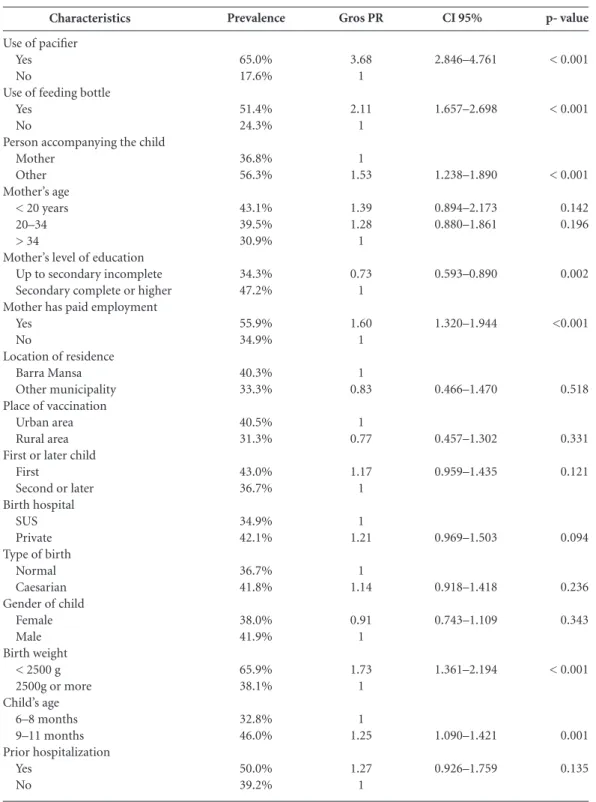
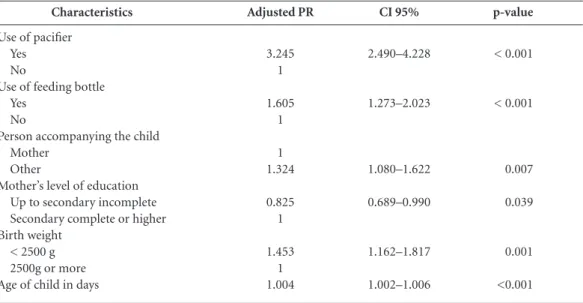
In the bivariate analysis (Table 2), the use of pacifier and bottle, the child not being accompa-nied by the mother, the mother’s age being up to 34 years, the mother working, it being the moth-er’s first child, the child being born in a private hospital, low birth weight, the child being 9–11 months old, and prior hospitalization for some disease were shown to be associated with absence of breastfeeding, while the mother having sec-ondary education incomplete, or a lower educa-tional level, was associated with the presence of breastfeeding. In the multiple model, use of pac-ifier (PR = 3.245), use of bottle (PR = 1.605), the child not being accompanied by the mother (PR = 1.324), lower mother’s schooling (PR = 0.826), low birth weight (PR = 1.488), and increasing age of the child, in days (PR = 1.004) were associated
80%
70%
60%
50%
40%
30%
20%
10%
0%
P
re
v
ale
nc
e o
f b
re
ast
fe
eding
6 ˫ 7 months
7 ˫ 8 months
8 ˫ 9 months
9 ˫ 10 months
10 ˫ 11 months
11 ˫ 12
months Total
67.1% 67.7% 66.3% 65.2%
53.3%
47%
60%
Age in months
aúd e C ole tiv a, 20(4):1235-1244, 2015 Discussion
The patterns of breastfeeding observed in the sec-ond six months of life in Barra Mansa, in 2006, were not yet on a level with those specified by the World Health Organization, since 40% of the children were not being breastfed. The principal factor associated with absence of breastfeeding was use of a pacifier, followed by use of a bottle, both these practices being counter-indicated by
the World Health Organization5. Also, low birth
weight, the child not being accompanied by the mother, higher level of the mother’s schooling and increasing age of the child, in days, were as-sociated with lower occurrence of breastfeeding. In spite of the importance for the child’s health of breastfeeding in the second half-year of
life6-8, the practice of ceasing breastfeeding in this
stage of life, and the factors determining it, have been little investigated. The occurrence found in this study is close to that found in other studies, also made in 2006, in vaccination campaigns in the city of Rio de Janeiro, where 38.2% of chil-dren aged six months to one year had already
stopped breastfeeding12. In the city of Volta
Re-donda, in Rio de Janeiro State, the percentage
was 36.2%15, and in Salvador, Bahia, 42.6%16. In
other scenarios, more adverse results were found. In Campinas, São Paulo State, in the 2001 vacci-nation campaign, 62.0% of children in the sec-ond six months of life were already not
breast-feeding17. In studies made in 2005, in São Paulo,
Recife and Curitiba, 55.4% of children aged 6
to 12 months were not breastfeeding18, a similar
percentage to that found in 16 municipalities of
Paraíba State, where the figure was 54.8%19.
Of the factors investigated, use of the pacifier was the one most strongly associated with absence of breastfeeding in the second six months of life, this outcome being three times more frequent among children using a pacifier – which serves to re-emphasize the importance of discouraging its use. This finding was consistent with those in other Brazilian studies investigating the factors associated with this outcome in children less than
one year old20-24. The use of a pacifier is still a very
widespread cultural habit among Brazilian chil-dren and is prejudicial to breastfeeding because it reduces the frequency of breastfeeding itself, re-ducing the mother’s output of milk, and can lead to failure to identify the nipple. Use of a pacifier can also reflect difficulties for the mother, such as anxiety, insecurity, and problems in handling
breastfeeding25.
Variable
Person accompanying the child Mother
Other Mother’s age
< 20 years 20–34 > 34
Level of education
Up to secondary incomplete Secondary completed or higher Mother has paid employment
Yes No
Municipality of residence Barra Mansa
Other municipality Area of residence
Urban Rural
First or later child First
Second or later Birth hospital: financing
Private Public Type of birth
Normal Caesarian Gender of child
Male Female Birth weight
< 2500 g 2500g or more Child’s age 6–8 months 9–11 months Prior hospitalization Yes No Use of pacifier
Yes No
Use of feeding bottle Yes No % 83.4 16.6 12.4 73.3 11.7 61.0 39.0 25.1 74.9 95.9 4.1 94.5 5.5 52.1 47.9 62.2 37.8 34.4 65.6 51.0 49.0 7.7 92.3 45.7 54.3 7.3 92.7 47.2 52.8 57.3 42.7 n 484 96 72 425 68 341 218 145 433 556 24 548 32 302 278 354 215 199 380 296 284 44 527 265 315 42 531 274 306 331 247
Table 1. Maternal social-demographic and reproductive characteristics and characteristics of birth and care of the child in the second half-year of life – Municipality of Barra Mansa, 2006.
R
ig
ott
The proportion of children not breastfed was 61% higher in children that used a bottle. In the state of Piauí, the probability of not being
cur-rently breastfed was six times higher23, and in São
Leopoldo, in the state of Rio Grande do Sul, the probability was double, for children who used Characteristics
Use of pacifier Yes No
Use of feeding bottle Yes
No
Person accompanying the child Mother
Other Mother’s age
< 20 years 20–34 > 34
Mother’s level of education Up to secondary incomplete Secondary complete or higher Mother has paid employment
Yes No
Location of residence Barra Mansa Other municipality Place of vaccination
Urban area Rural area First or later child
First
Second or later Birth hospital
SUS Private Type of birth
Normal Caesarian Gender of child
Female Male Birth weight
< 2500 g 2500g or more Child’s age 6–8 months 9–11 months Prior hospitalization Yes No
Table 2. Prevalence and prevalence ratio of absence of breastfeeding in the second half-year of life analyzed by: mothers’ social-demographic and reproductive characteristics, and characteristics of child’s birth and healthcare - Municipality of Barra Mansa, 2006.
aúd
e C
ole
tiv
a,
20(4):1235-1244,
2015
a bottle in the first month of life20. However, in
Itapira, São Paulo State, in 1999, the use of the bottle did not show any significant association after adjustment for other factors, such as use of
a pacifier21. Mistaken interpretation of the baby’s
crying can lead to introduction of artificial feed-ing usfeed-ing a bottle, leadfeed-ing to reduced suction at the breast and, consequently, lower production of
mother’s milk26. These are possible explanations
for the association found between the bottle and absence of breastfeeding.
Low birth weight was another factor associat-ed with the outcome in this study, increasing the absence of breastfeeding in the second half-year of life by 45.0%. This was consistent with the re-sult found in Itapira (São Paulo State), where ab-sence of breastfeeding in children under one year old was almost three times higher in children
born with low weight21. A study in Londrina, in
the State of Paraná, with children under one year old, did not show the effect of this variable, but
made and adjustment for birth weight22. This
association between low weight and non-breast-feeding may possibly be due to inefficient suction and the longer period of hospitalization of babies with low weight, which can lead to low produc-tion of mother’s milk and reduce breastfeeding over the child’s first year of life.
A mother’s level of schooling being lower than complete secondary education reduced the oc-currence of breastfeeding by 17%. A nationwide
survey in 2006 found the same pattern: the me-dian duration of breastfeeding was 21 months for mothers with less than four years’ schooling, and
13.1 months for those with nine years or more3.
With each 10 days of the child’s life, the oc-currence of breastfeeding was reduced by 4.0%. Other Brazilian studies of babies less than one year old made an adjustment for the child’s age in days, but did not report the effect of this vari-able10,22. In a study in East Timor with children of less than one year, the probability of being cur-rently breastfed fell by 23% for each month of the
child’s life27.
The fact of the child not coming to be vacci-nated accompanied by her mother was associated with an absence of breastfeeding. It is supposed that the mother who breastfeeds may have more difficulty in allowing another person to accom-pany the child to vaccination, not only because of the attachment, but also because she can offer the breast as a calming factor after vaccination. This variable needs to be better understood, be-cause various Brazilian studies have used surveys
by AMAMUNIC as a database, but the person
ac-companying the child has not been a factor that was investigated.
Surveys taken in vaccination campaigns al-low information to be gathered in a short time and with low cost, but can have limitations. Since it was a questionnaire survey, it was not possible to establish a temporal relation of causality be-Characteristics
Use of pacifier Yes No
Use of feeding bottle Yes
No
Person accompanying the child Mother
Other
Mother’s level of education Up to secondary incomplete Secondary complete or higher Birth weight
< 2500 g 2500g or more Age of child in days
Table 3. Adjusted prevalence ratio of absence of breastfeeding in the second half-year of life analyzed by: mothers’ socio-demographic and reproductive characteristics, and characteristics of child’s birth and healthcare, Municipality of Barra Mansa, 2006.
Adjusted PR
3.245 1
1.605 1
1 1.324
0.825 1
1.453 1 1.004
CI 95%
2.490–4.228
1.273–2.023
1.080–1.622
0.689–0.990
1.162–1.817
1.002–1.006
p-value
< 0.001
< 0.001
0.007
0.039
0.001
R
ig
ott
tween most of the variables investigated and the outcome. There is a possible bias in selection, be-cause children who are ill may have not attended the vaccination campaign, since the campaign’s coverage in Barra Mansa, in 2006, was 96%. An-other limitation would be that in the present study some variables that were shown to be as-sociated with absence of breastfeeding in the first years of life in international studies were unable to be explored, because they were not present in the database of this study, such as the number of
follow-up visits after birth28, marital status, and
mother’s ethnicity29. As a positive point, we
con-sider that the majority of the associations found can be generalized to the Brazilian context, be-cause they are not specificities of Barra Mansa.
The municipality of Barra Mansa has been carrying out actions to promote, protect and sup-port breastfeeding for at least 10 years, both in its Family Health Strategy units and also in its basic healthcare units, where health professionals are trained for these actions by the methodology of the “Pro-Breastfeeding Basic Healthcare Unit
Ini-tiative” (Iniciativa Unidade Básica Amiga da
Ama-mentação)30. Although these actions are achieving
progress in the practice of exclusive
breastfeed-ing31, it can be noted that in 2006 the
recommen-dations of the World Health Organization and of the Brazilian Health Ministry were not yet being fully obeyed. The actions taken in basic health-care need to be complemented by others to be put in place in hospitals, such as the Children’s Friend
Hospital Initiative2, and also in other sectors, such
as education and social protection.
It is, thus, recommended that the public poli-cies currently practiced in promotion, protection and support of breastfeeding, and discourage-ment for the use of artifacts that are potentially prejudicial to breastfeeding, should be inten-sified, and articulated in an inter-sector action, in which the populations identified as being at risk in this present study should be given pri-ority. Since it is a subject that has been little ex-plored, further studies are recommended on the predictive factors for breastfeeding in the second six months of life, so as to contribute to the sci-entific knowledge available in this area, and the improvement of public policies.
Collaborations
aúd
e C
ole
tiv
a,
20(4):1235-1244,
2015
Oliveira LPM, Assis AMO, Gomes GSS, Prado MS, Barreto ML. Duração do aleitamento materno, regime alimentar e fatores associados segundo condições de vida em Salvador, BA. Cad Saude Publica 2005; 21(5):1519-1530.
Cecchetti DFA, Moura EC. Prevalência do aleitamento materno na região noroeste de Campinas, São Paulo, Brasil, 2001. Rev Nutr Campinas 2005; 18(2):201-208. Caetano MC, Ortiz TT, da Silva SG, de Souza FI, Sarni RO. Complementary feeding: inappropriate practices in infants. J Pediatr (Rio J) 2010; 86(3):196-201. Palmeira PA, Santos SMC, Vianna RPT. Prática alimentar entre crianças menores de dois anos de idade residentes em municípios do semiárido do Estado da Paraíba. Rev Nutr Campinas 2011; 24(4):553-563. Feldens CA, Vitolo MR, Rauber F, Cruz LN, Hilgert JB. Risk Factors for Discontinuing Brestfeeding in Southern Brazil: A Survival Analysis. Matern Child Health J 2012; 16(6):1257-1265.
Audi CAF, Correa MAS, Latorre MRDO. Alimentos complementares e fatores associados ao aleitamento materno e ao aleitamento materno exclusivo em lactentes até 12 meses de vida em Itapira, São Paulo.
Rev Bras Saúde Matern Infant 2003; 3(1):85-93. Vannuchi MTO, Thomson Z, Escuder MM, Vezozzo KMK, Castro LMCP, Oliveira MMB, Venâncio SI. Perfil do aleitamento materno em menores de um ano no município de Londrina, Paraná. Rev Bras Matern Infant
2005; 5(2):155-162.
Ramos CV, Almeida JAG, Alberto NSMC, Teles JBM, Saldiva SRDM. Diagnóstico da situação do aleitamento materno no Estado do Piauí, Brasil. Cad Saude Publica
2008; 24(8):1753-1762.
França GVA, Brunken GS, Silva SM, Escuder MM, Venancio SI. Determinantes da amamentação no primeiro ano de vida em Cuiabá, Mato Grosso. Rev Saude Publica 2007; 41(5):711-718.
Jaafar SH, Jahanfar S, Angolkar M, Ho JJ. Effect of restricted pacifier use in breastfeeding term infants for increasing duration of breastfeeding. Cochrane Database Syst Rev 2012; 7:CD007202.
Giugliani ER, Rocha VL, Neves JM, Polanczyk CA, Seffrin CF, Susin LO. Conhecimentos maternos em amamentação e fatores associados. J Pediatr (RJ) 1995; 71(2):77-81.
Senarath U, Dibley MJ, Agho KE. Breastfeeding practices and associated factors among children under 24 months of age in Timor-Leste. European J Clin Nutr
2007; 61(3):387-397.
Senarath U, Siriwardena I, Godakandage SSP, Jaya-wickrama H, Fernando DN, Dibley MJ. Determinants of breastfeeding practices: an analysis of the Sri Lanka Demographic and Health Survey 2006–2007. Matern and Child Nutr 2012; 8(3):315-329.
16.
17.
18.
19.
20.
21.
22.
23.
24.
25.
26.
27.
28. References
Newburg DS. Neonatal protection by an innate immune system of human milk consisting of oligosaccharides and glycans. J Anim Sci 2009; 87(Supl. 13):26-34. Rea MF. Reflexões sobre a amamentação no Brasil: de como passamos a 10 meses de duração. Cad Saude Publica 2003; 19(Supl. 1):537-545.
Brasil. Ministério da Saúde (MS). Centro Brasileiro de Análise e Planejamento. Pesquisa Nacional de Demografia e Saúde da Criança e da Mulher - PNDS 2006: dimensões do processo reprodutivo e da saúde da criança. Brasília: Editora do Ministério da Saúde; 2009. Brasil. Ministério da Saúde (MS). II Pesquisa de Prevalência de Aleitamento Materno nas Capitais Brasileiras e Distrito Federal. Brasília: Editora do Ministério da Saúde; 2009.
World Health Organization (WHO). Dept. of Child and Adolescent Health and Development. Indicators for assessing infant and young child feeding practices: conclusions of a consensus meeting held 6–8 November 2007 in Washington D.C., USA. Geneva: WHO; 2008. Organização Mundial de Saúde (OMS). Evidencias científicas dos dez passos para o sucesso do aleitamento materno. Brasília: Organização Pan-Americana de Saúde (OPAS); 2001.
Boccolini CS, Boccolini PM. Relação entre aleitamento materno e internações por doenças diarreicas nas crianças com menos de um ano de vida nas Capitais Brasileiras e Distrito Federal, 2008. Epidemiol Serv Saúde 2011; 20(1):19-26.
Boccolini CS, Carvalho ML, Oliveira MIC, Boccolini PM. O papel do aleitamento materno na redução das hospitalizações por pneumonia em crianças brasileiras menores de 1 ano. J Pediatr (RJ) 2011; 87(5):399-404. Neiva FCB, Cattoni DM, Ramos JLA, Issler H. Desmame precoce: implicações para o desenvolvimento motor-oral. J Pediatr (RJ) 2003; 79(1):7-12.
Venancio SI, Escuder MML, Kitoko P, Rea MF, Monteiro CA. Frequência e determinantes do aleitamento materno em municípios do Estado de São Paulo. Rev Saude Publica 2002; 36(3):313-318.
Instituto Brasileiro de Geografia e Estatística (IBGE).
IBGE cidades. [acessado 2014 abr 23]. Disponível em: http://www.cidades.ibge.gov.br
Coutinho LMS, Scazufca M, Menezes PR. Métodos para estimar razão de prevalência em estudos de corte transversal. Rev Saude Publica 2008; 42(6):992-998. Brasil. Ministério da Saúde (MS). Conselho Nacional de Saúde. Resolução nº 196 de 10 de outubro de 1996. Diretrizes e Normas Regulamentadoras de Pesquisas Envolvendo Seres Humanos. Diário Oficial da União
1996; 16 out.
Castro IRR, Engstrom EM, Cardoso LO, Damião JJ, Rito RVFV, Gomes MASM. Tendência Temporal da Amamentação na cidade do Rio de Janeiro: 1996 a 2006. Rev Saude Publica 2009; 43(6):1021-1029. Cruz MCC, Almeida JAG, Engstrom EM. Práticas alimentares no primeiro ano de vida de filhos de adolescentes. Rev Nutr Campinas 2010; 23(2):201-210. 1.
2.
3.
4.
5.
6.
7.
8.
9.
10.
11.
12.
13.
14.
R
ig
ott
Kimani-Murage EWK, Madise NJ, Fotso JC, Kyobutungi C, Mutua MK, Gitau TM, Yatich N. Patterns and determinants of breastfeeding and complementary feeding practices in urban informal settlements, Nairobi Kenya. BMC Public Health 2011; 11:396.
Oliveira MIC, Camacho LAB, Souza IEO. Promoção, proteção e apoio à amamentação na atenção primária à saúde no Estado do Rio de Janeiro, Brasil: uma política de saúde pública baseada em evidência. Cad Saude Publica 2005; 21(6):1901-1910.
Alves ALN, Oliveira MIC, Moraes JR. Iniciativa Unidade Básica Amiga da Amamentação e sua relação com o aleitamento materno exclusivo. Rev Saude Publica 2013; 47(6):1130-1140.
Article submitted 03/19/2014 Approved 09/10/2014
Final version submitted 09/23/2014 29.
30.