RESUMO
Helayel PE, Conceição DB, Conceição MJ, Boos GL, Toledo GB, Oli-veira Filho GR - Atitudes de Anestesiologistas e Médicos em Espe-cialização em Anestesiologia dos CET/SBA em Relação aos Bloqueios Nervosos dos Membros Superior e Inferior.
JUSTIFICATIVA E OBJETIVOS: O emprego da anestesia regional, em especial dos bloqueios nervosos periféricos (BNP) tem aumen-tado na prática anestesiológica devido à menor necessidade de instrumentação de vias aéreas, menor custo e excelente analgesia pós-operatória. Entretanto, sua utilização sofre restrições causa-das pela falta de treinamento, maior tempo de realização, temor de complicações neurológicas e toxicidade sistêmica. O objetivo des-se estudo foi medir as atitudes de anestesiologistas e médicos em especialização nos Centros de Ensino e Treinamento (CET/SBA) em relação aos BNP.
MÉTODO: Foi construído um questionário com 25 itens sendo disponibilizado eletronicamente e por correio aos responsáveis de 80 CET, seus instrutores e médicos em especialização.
RESULTADOS: Quarenta e dois CET (52,5%) devolveram 188 ques-tionários, sendo 62 (32%) médicos em especialização (ME) e 126 (68%) anestesiologistas. O coeficiente de confiabilidade de Cron-bach do questionário foi 0,79. A análise fatorial revelou seis fatores, que explicaram 53% da variância dos escores: fator 1 - atitudes po-sitivas, responsável por 18,34 % da variância; fator 2 - treinamento/ aplicação, responsável por 11,73 % da variância; fator 3 -
aspec-tos negativos, responsável por 7,11 % da variância; fator 4 - fatores limitantes, fatoresponsável por 6,39 % da variância; fator 5 -anestesia regional como diferencial de competência, responsável por 5,79% da variância; e fator 6 - respeito pelo paciente, responsável por 5,4 % da variância.
CONCLUSÕES: O questionário mostrou-se uma ferramenta fide-digna para medida de atitudes com relação à anestesia regional. Os anestesiologistas demonstraram maior interesse nos aspectos re-lacionados aos pacientes enquanto os ME tiveram como foco prin-cipal a aquisição de habilidades técnicas.
Unitermos: ANESTESIOLOGIA, Ensino: bloqueios periféricos; METODOLOGIA: pesquisa de opinião; TÉCNICAS ANESTÉSICAS, Re-gional: bloqueio de nervo periférico.
SUMMARY
Helayel PE, Conceição DB, Conceição MJ, Boos GL, Toledo GB, Oli-veira Filho GR – The Attitude of Anesthesiologists and Anesthesio-logy Residents of the CET/SBA Regarding Upper and Lower Limb Nerve Blocks.
BACKGROUND AND OBJECTIVES: The use of regional blocks especially peripheral nerve blocks (PNB) has been increasing in anesthesiology due to the reduced need to manage the airways, lower cost, and excellent postoperative analgesia. However, its use has restrictions due to the lack of training, that it takes longer to be done, fear of neurological complications, and systemic toxicity. The objective of this study was to measure the attitude of anesthesiolo-gists and anesthesiology residents at Teaching and Training Centers (CET/SBA) regarding PNBs.
METHODS: A 25-item questionnaire was developed and it was avai-lable, via the Internet and by mail, to those responsible for the 80 CETs, their instructors and residents.
RESULTS: Forty-two CETs (52.5%) returned 188 questionnaires, 62 (32%) from anesthesiology residents and 126 (68%) from anesthe-siologists. The Cronbach’s alpha coefficient of the questionnaire was 0.79. Factor analysis revealed six factors that explain 53% of scores variance: factor 1 – positive attitude, responsible for 18.34% of the variance; factor 2 – training/use, responsible for 11.73% of the variance; factor 3 – negative aspects, responsible for 7.11% of the variance; factor 4 – limiting factors, responsible for 6.39% of the variance; and factor 5 – regional block as a competence differential, responsible for 5.79% of the variance; and factor 6 – respect for the patient, responsible for 5.4% of the variance.
CONCLUSIONS: The questionnaire proved to be a reliable tool to measure the attitude regarding regional blocks. Anesthesiologists demonstrated greater interest for patient-related aspects, while the main focus of residents was the acquisition of technical abilities.
Keywords: ANESTHESIOLOGY, Teaching: peripheral blocks; ANES-THETIC TECHNIOQUES, Regional: peripheral nerve block; METHODO-LOGY: opinion investigation.
Atitudes de Anestesiologistas e Médicos em Especialização
em Anestesiologia dos CET/SBA em Relação aos Bloqueios
Nervosos dos Membros Superior e Inferior*
The Attitude of Anesthesiologists and Anesthesiology Residents of the
CET/SBA Regarding Upper and Lower Limb Nerve Blocks
Pablo Escovedo Helayel, TSA1, Diogo Brüggemann da Conceição, TSA2, Mario José da Conceição, TSA3, Gustavo Luchi Boos, TSA4, Gustavo Bertoni de Toledo5, Getúlio Rodrigues de Oliveira Filho, TSA6
* Recebido do (Received from) Hospital Governador Celso Ramos - CET/SBA Integrado de Anestesiologia da Secretaria de Estado da Saúde de Santa Catarina (SES-SC), Núcleo de Ensino e Pesquisa em Anestesia Regional (NEPAR) Florianópolis, SC
1. Anestesiologista; Coordenador e Pesquisador do NEPAR; Instrutor Corres-ponsável do CET/SBA Integrado de Anestesiologia da SES-SC
2. Anestesiologista; Pesquisador do NEPAR do CET/SBA Integrado de Aneste-siologia da SES-SC
3. Anestesiologista; Professor de Técnicas Cirúrgicas e Anestésicas - FURB - Blumenau - SC; Membro dos Conselhos Editoriais da Revista Brasileira de Anestesiologia, Pediatric Anesthesia e Regional Anesthesia and Pain Medicine; Corresponsável pelo CET Integrado de Anestesiologia da SES-SC
4. Anestesiologista; Pesquisador do NEPAR do CET/SBA Integrado de Anestesiologia da SES-SC
5. ME em Anestesiologia
6. Anestesiologista; Doutor em Anestesiologia; Responsável do CET e Pes-quisador do NEPAR do CET/SBA Integrado de Anestesiologia da SES-SC
Apresentado (Submitted) em 3 de julho de 2008
Aceito (Accepted) para publicação em 20 de janeiro de 2009
Endereço para correspondência (Correspondence to): Dr. Pablo Escovedo Helayel
Av. Governador Irineu Bornhausen, 3440/204 Agronômica
tivamente a anestesia regional como diferencial de compe-tência. Isto pode refletir possível ansiedade gerada pelo ina-dequado ensino da anestesia regional e pela baixa exposição dos médicos em especialização a estas técnicas durante o programa de residência médica 12.
Desse modo, pode-se sugerir que a indicação do bloqueio periférico pelo ME nem sempre leve em consideração a sa-tisfação do paciente, mas sim seu desejo de se capacitar profissionalmente. Provavelmente, após sua inserção no mercado de trabalho e com o aumento do grau de exigência pela qualidade do atendimento ao paciente (conforto e satis-fação) suas atitudes mudem. Além disso, foi demonstrado que os médicos em especialização submetidos a bloqueios periféricos reformularam seus conceitos, sendo aspectos re-lacionados ao conforto do paciente mais valorizados 13. A frequência de exposição a procedimentos ortopédicos in-fluenciou a atitude de ambos os grupos de médicos parti-cipantes da pesquisa em relação aos bloqueios periféricos. Os médicos em especialização e os instrutores, que reali-zam raramente procedimentos ortopédicos, enfrentam maio-res dificuldades para realização de bloqueios periféricos sendo menos positivos em sua relação.
Entretanto os que praticam bloqueios periféricos frequente-mente foram bastante positivos. Estes, por sua vez, podem ter a atitude influenciada pela opinião dos cirurgiões ortopé-dicos, que ressaltam como fatores positivos dos bloqueios periféricos a excelente analgesia pós-operatória, a menor incidência de náuseas e vômitos e maior segurança. No entanto, consideram negativos os aspectos como tempo de realização dos bloqueios e a imprevisibilidade de sua taxa de sucesso 2. Estas características desfavoráveis poderiam ser contornadas com a utilização de salas de bloqueio e do emprego de novas técnicas de identificação nervosa como a ultrassonografia. Este método de imagem facilita a reali-zação de bloqueios periféricos e tem se mostrado capaz de aumentar a segurança, a taxa de sucesso e diminuído o tempo de latência, possivelmente favorecendo 14-16 a difusão da anestesia regional.
Fatores fundamentais para a prática da anestesia regional, como a disponibilidade de treinamento e de materiais ade-quados, influenciaram a atitude dos médicos que participa-ram da pesquisa em relação aos bloqueios periféricos. Muitos estudos têm sido realizados objetivando identificar fatores relacionados ao treinamento adequado da anestesia regional 17. Kopacz e col. 18,19 mostraram que o índice de su-cesso é proporcional ao número de bloqueios realizados. Além disto, alguns autores destacam a importância da con-fiança individual como fator fundamental para aplicação dos ensinamentos sobre anestesia regional na prática clínica durante e após o período de especialização 19. Esta confiança ou atitude mais predisposta para aprender novas técnicas deveria ser incentivada pelos CET/SBA criando um ambiente de ensino mais propício ao aprendizado da anestesia regi-onal. Um método de ensino adequado e um bom ambien-te de aprendizado são fatores deambien-terminanambien-tes na formação
do aprendiz. As medidas empregadas para construção des-te ambiendes-te favorável envolvem a utilização de salas de blo-queios, aulas virtuais, utilização de modelos e prática em cadáveres. Tais medidas poderiam favorecer o treinamento e incentivar a difusão da anestesia regional. Entretanto, no momento atual, não se dispõe de normativa sobre práticas padronizadas para o ensino da anestesia regional nos CET/ SBA. Desta maneira, através do estabelecimento de está-gios específicos e da promoção de um ambiente adequado para o ensino da anestesia regional seria possível oferecer uma formação anestesiológica mais completa nos progra-mas de residência médica dos CET/SBA.
O questionário mostrou-se ferramenta fidedigna para medi-da de atitudes com relação à anestesia regional. Os aneste-siologistas demonstraram maior interesse nos aspectos relacionados aos pacientes enquanto os ME tiveram como foco principal a aquisição de habilidades técnicas.
The Attitude of Anesthesiologists and
Anesthesiology Residents of the CET/
SBA Regarding Upper and Lower Limb
Nerve Blocks
Pablo Escovedo Helayel, TSA, M.D.; Diogo Brüggemann da Conceição, TSA, M.D.; Mario José da Conceição, TSA, M.D.; Gustavo Luchi Boos, TSA, M.D.; Gustavo Bertoni de Toledo, M.D.; Getúlio Rodrigues de Oliveira Filho, TSA, M.D.
INTRODUCTION
at Teaching and Training Centers regarding upper and lower limb blocks.
METHODS
The study was approved by the Ethics on Research Commi-ttee of the institution. To develop the questionnaire, initially, the authors formulated, independently, questions that might reflect the objectives of the study. Those questions were submitted to the other members in three rounds of a Delphi process to obtain consensus among the investigators 7. In the Delphi process, each investigator attributed independently scores from one to five to each question according to his interpretation of the relevance of the item for the objective of the study. After each round the median of the scores of each question was calculated and given to the members of the group, who reviewed the scores. This process was repeated until the scores of each item of the questionnaire did not show a difference greater than one unit from the median. Ques-tions with scores equal or lower than two were eliminated. Each item of the questionnaire was answered in 5-point Likert scales (0 = strongly disagree, 1 = disagree, 2 = neither agree nor disagree, 3 = agree, 4 = strongly agree). The questionnaire was sent by mail to those responsible for 80 Teaching and Training Centers accredited by the Brazilian Society of Anesthesiology (CET/SBA, from the Portuguese), asking them to stimulate their instructors and residents to answer the questionnaire. An electronic version of the ques-tionnaire was available at a web site in which the questio-nnaire could also be answered. The following parameters were collected: age, gender, geographic region (south, southeast, northeast, north, and center-west), position at the CET (resident or anesthesiologist), practice of Orthopedic Surgeries (frequently or rarely), and predominant surgical population (adult or pediatric). Psychometric analysis of the questionnaire included the Cronbach’s alpha coefficient, that evaluates the internal consistency of the instrument, and prin-cipal component factor analysis with orthogonal factor rotation (varimax) to identify the dimensions measured by the instrument and the amount of score variance explained by each factor through the respective eigenvalues. The scores of each subscale of the questionnaire were compared bet-ween those classes by the Student t test for independent samples. Additional comparisons were undertaken among the subgroups determined by the remaining parameters of the study: gender, geographic region, practice of orthopedic surgeries, and predominant population, by the Student t test for independent samples or unifactorial analysis of variance. An alpha value of 0.05 was established.
RESULTS
The authors identified 36 questions before the Delphi process. After three rounds, 25 items remained, composing the questionnaire (Chart I).
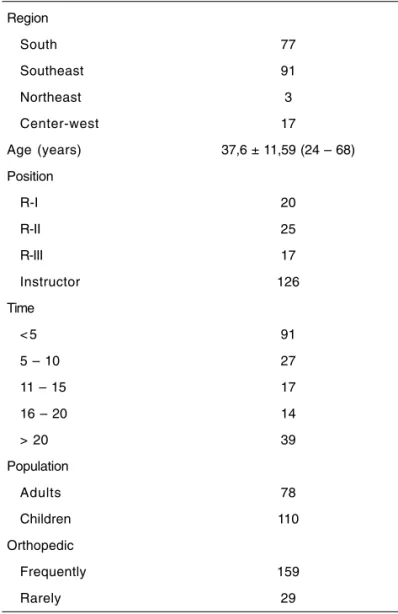
Table I describes the demographic data of the study popu-lation. Forty-two CETs (52.5%) returned 188 questionnaires, of which 62 (32%) were from residents and 126 (68%) from anesthesiologists. Nineteen questionnaires did not have the identification of the CET it came from. The number of answers varied from one and 32 (median = 1; lower quartile = 1; upper quartile = 4). The questionnaire Cronbach’s alpha was 0.79. The adjusted mean correlation coefficient among the items of the questionnaire was 0.13. The mean correla-tion between the items and the total scale was 0.32. Three items were excluded from the original questionnaire due to very low item-total correlation and for contributing negatively for the alpha coefficient. Factor analysis revealed six factors that grouped different questions, as shown in Chart I. Those factors explained 53% of score variance: factor 1 – positive attitudes (eigenvalues = 4.44), composed by six items (1; 6; 10; 15; 21; and 24), was responsible for 18.34% of the variance; factor 2 – training/application (eigenvalues = 2.81), composed of five items (9; 14; 16; 23; and 27), responsible for 11.73% of the variance; factor 3 – negative aspects (eigen-values = 1.76), composed by seven factors (2; 3; 4; 13; 18; 26; and 28), responsible for 7.11% of the variance; factor 4 –
Table I – Demographic Data Region
South 77
Southeast 91
Northeast 3
Center-west 17
Age (years) 37,6 ± 11,59 (24 – 68) Position
R-I 20
R-II 25
R-III 17
Instructor 126
Time
< 5 91
5 – 10 27
11 – 15 17
16 – 20 14
> 20 39
Population
Adults 78
Children 110
Orthopedic
Frequently 159
Chart I – Questionnaire on the Attitudes Regarding Peripheral Nerve Blocks Item Contents
Factor 1 Positive Attitudes
1 I think the benefits of peripheral nerve blocks are greater than the cost of the nerve-stimulation needles. 6 If I need to undergo a surgery on the foot or ankle, I will always prefer sciatic and femoral blocks. 10 I am more relaxed to send a patient to the room with a lower limb nerve block than neuroaxis opioids.
15 I prefer lower limb nerve blocks instead of neuroaxis blocks due to their greater perioperative cardiovascular stability. 21 I think lower limb nerve blocks are indicated in outpatient surgeries.
24 I think peripheral nerve blocks are safer than general anesthesia.
Factor 2 Training/application
9 I was or have been stimulated, during my training, to learn the techniques of brachial plexus block. 14 I was or have been stimulated, during my training, to learn the techniques of lower limb nerve blocks. 16 During my training, I had colleagues who stimulated me to learn the techniques of regional blocks. 23* I do not perform peripheral nerve blocks because it was not taught during my training.
27 I frequently perform peripheral nerve blocks.
Factor 3 Negative aspects
2* The risk of being sued discourages my using peripheral nerve blocks.
3* The surgeons I worked with do not favor peripheral nerve blocks of the lower limbs. 4* I consider the time it takes to perform peripheral nerve blocks when indicating it. 13* I think the costs of peripheral nerve blocks of the lower limbs are high.
18* I think the spinal block is a better technique for lower limb surgeries. 26* I think peripheral nerve blocks are safer in adults than in children. 28* I think caudal block is the Best technique for lower limb surgeries.
Factor 4 Limiting factors
17* I find it difficult to acquire adequate material for peripheral nerve blocks.
20* The incapacity to immobilize the member that was not blocked decreases acceptance of lower limb nerve blocks.
Factor 5 Regional block as a differential of competence
11 I think an anesthesiologist differentiates him/herself when he/she is proficient on lower limb nerve blocks. 12 I think an anesthesiologist differentiates him/herself when he/she is proficient on brachial plexus block.
Factor 6 Respect for the patient
5 I consider patient satisfaction when I indicate peripheral nerve blocks.
22 I think peripheral nerve blocks are recommendable in children to guarantee postoperative analgesia.
25* Since Children do not have the psychological make-up to deal with the sensation of prolonged motor blockade, I avoid peripheral nerve blocks in this population.
* = inverted score (4 = strongly disagree; 0 = strongly agree)
Table II – Comparison of the Scores between Residents and Instructors
Factor Residents Instructors
1 63.9 ± 14.1 62.6 ± 17.4
2 62.3 ± 21.0 65.1 ± 19.9
3 55.4 ± 10.4 61.2 ± 14.5 *
4 51.2 ± 21.7 53.4 ± 22.7
5 78.8 ± 23.9 67.7 ± 27.0 *
6 67.1 ± 15.5 74.5 ± 15.0 *
Total 61.7 ± 8.9 63.8 ± 11.2
Data shown as Mean ± SD * p < 0.05
limiting factors (eigenvalues = 1.54), composed by two items (17 and 20), responsible for 6.39% of the variance; factor 5 – regional block as a differential of competence (eigenvalues = 1.38), containing two items (11 and 12), responsible for 5.79% of the variance; and factor 6 – respect for the patient (eigenvalues = 1.30), containing three items (5; 22; and 25), responsible for 5.4% of the variance.
DISCUSSION
The proposal of this study was to measure the attitudes of instructors (anesthesiologists) and residents at CET/SBA regarding upper and lower limb regional blocks using a questionnaire with reliable psychometric characteristics. The Cronbach’s alpha coefficient (0.79) showed that this tool had adequate confiability and, therefore, could be used as a measure of the attitudes regarding upper and lower limbs nerve blocks 8. The questionnaire also showed clear factorial structure that reflected the objective of the items constructed. Factors that influenced the rate of responses included the sensitive nature of the questions, unwillingness to partici-pate, lack of interest on the objective of the study, lack of trust on the guarantee of confiability of the answers, and difficulty to access the questionnaire. To try to reduce those problems, the target population was limited to a group of individuals with common interests (instructors and residents), and the ques-tionnaire was available both by mail and the Internet 9-11. Residents valued more the negative aspects than anesthe-siologists. The disadvantages emphasized included: the time necessary to perform peripheral nerve blocks, high costs, possibility of neurological complications, and the prac-ticability of spinal blocks for surgeries of the lower limbs. Anesthesiologists showed more interest on patient-related aspects (reduced postoperative pain, greater satisfaction, and promotion of a comfortable surgical experience). The main concern of the residents included the acquisition of technical abilities to perform peripheral blocks since they emphasized positively regional blocks as a differential of competence. This could reflect the anxiety generated for inadequate teaching of regional blocks and low exposure of residents to those techniques during the residency 12. Thus, it can be suggested that the indication of a peripheral block by the resident does not always consider patient sa-tisfaction, but his/her desire to achieve professional
quali-fication. It is possible that, after insertion of residents in the labor market and with an urging for higher quality in patient care (comfort and satisfaction), their attitudes would change. Besides, it was demonstrated that residents exposed to peripheral nerve blocks changed their concepts, valuing more patient-related aspects 13.
The frequency of exposure to orthopedic procedures influen-ced the attitude of both groups regarding peripheral nerve blocks. Residents and instructors who rarely perform ortho-pedic procedures have more difficulties with peripheral nerve blocks, having a less positive attitude.
However, those who frequently perform peripheral nerve blocks were very positive. On their turn, their attitudes can be influenced by the opinion of orthopedic surgeons who em-phasize positive aspects of peripheral nerve blocks, such as excellent postoperative analgesia, reduced incidence of nau-sea and vomiting, and greater safety. However, the time to perform the blocks and the unpredictable success rate were considered negative aspects 2. Those unfavorable characte-ristics could be avoided by using special room for peripheral nerve blocks and new techniques to identify the nerves, such as ultrasound. This imaging method makes peripheral nerve blocks easier to perform and has shown to increase safety and success rate, and to decrease latency time, probably by facilitating 14-16 the spread of the anesthetics.
Fundamental factors for the practice of regional blocks, such as availability of training and adequate material, influenced the attitude of the physicians who participated in the study. Several studies to identify factors related to the adequate training of regional blocks have been undertaken 17. Kopacz et al. 18,19 demonstrated that the rate of success is proportional to the number of blocks performed. Besides, some authors emphasized the importance of individual confidence as funda-mental in the application of what was learned about regional blocks during and after the specialization period 19. This confi-dence or more predisposed attitude to learn new techniques should be stimulated by CETs/SBA by creating a teaching environment more amenable to learn the techniques of regio-nal blocks. An adequate teaching method and a good learning environment are fundamental factors for the development of trainees. Measures to build this favorable environment include the use of rooms for peripheral nerve blocks, virtual classes, use of models, and training in cadavers. Such measures could favor training and stimulate the dissemination of regio-nal blocks. However, norms on standardized practices for the teaching of regional blocks at the CETs/SBA do not exist. Therefore, by establishing specific rotations and promoting an adequate environment to teach regional blocks, it would be possible to offer a more complete anesthesiology formation in the residency programs of the CETs/SBA.
The questionnaire proved to be a reliable tool to measure the attitudes regarding regional blocks. Anesthesiologists de-monstrated more interest in aspects related to patients, while the main focus of residents was the acquisition of tech-nical abilities.
Table III – Comparison of the Scores between Mean Scores of Those Who Answered the Questionnaire and Frequently or Rarely Use Peripheral Nerve Blocks for orthopedic Procedures
Factor Frequently Rarely
1 63.4 ± 17.1 60.6 ± 10.1
2 67 ± 19.3 44.8 ± 15.4 *
3 59.3 ± 13.8 59.2 ± 12.2
4 54 ± 22.3 43.8 ± 21.2 *
5 72.3 ± 25.7 65.1 ± 31.5
6 72.6 ± 14.9 68.1 ± 19
Total 64 ± 10.6 57 ± 7.7
REFERÊNCIAS – REFERENCES
01. Horlocker TT - Peripheral nerve blocks — regional anesthesia for the new millennium. Reg Anesth Pain Med 1998;23:237-240. 02. Oldman M, McCartney CJ, Leung A et al. - A survey of orthopedic
surgeons attitudes and knowledge regarding regional anesthe-sia. Anesth Analg 2004;98:1486-1490.
03. Hadzic A, Vloka JD, Kuroda MM et al. - The practice of peripheral nerve blocks in the United States: a national survey. Reg Anesth Pain Med 1998;23:241-246.
04. Clergue F, Auroy Y, Pequignot F et al. - French survey of anes-thesia in 1996. Anesthesiology 1999;91:1509-1520.
05. Smith MP, Sprung J, Zura A et al. - A survey of exposure to regi-onal anesthesia techniques in American anesthesia residency training programs. Reg Anesth Pain Med 1999;24:11-16. 06. Kopacz DJ, Bridenbaugh LD - Are anesthesia residency
programs failing regional anesthesia? The past, present, and future. Reg Anesth 1993;18:84-87.
07. Hasson F, Keeney S, McKenna HP - Research guidelines for the Delphi survey. J Adv Nurs 2000;32:1008-1015.
08. Cronbach LJ, Warrington WG - Coefficient alpha and the internal structure of tests. Psychometrika 1951;16:297-334.
09. VanDenKerkhof EG, Parlow JL, Goldstein DH et al. - In Canada, anesthesiologists are less likely to respond to an electronic, compared to a paper questionnaire. Can J Anaesth 2004;51:449-454.
10. Braithwaite D, Emery J, De Lusignan S et al. - Using the Internet to conduct surveys of health professionals: a valid alternative? Fam Pract 2003;20:545-551.
11. Nora FS, Aguzzoli M, de Oliveira Filho GR - Atitudes atuais de anestesiologistas e médicos em especialização com relação à anestesia venosa total. Rev Bras Anestesiol 2006;56:362-369. 12. Hadzic A, Vloka JD, Koenigsamen J - Training requirements for
peripheral nerve blocks. Curr Opin Anaesthesiol 2002;15:669-673.
13. Matthey PW, Finegan BA, Finucane BT - The publics fears about and perceptions of regional anesthesia. Reg Anesth Pain Med 2004;29:96-101.
14. Helayel PE, da Conceição DB, Pavei P et al. - Ultrasound-guided obturator nerve block: a preliminary report of a case series. Reg Anesth Pain Med 2007;32:221-226.
15. Koscielniak-Nielsen ZJ - Ultrasound-guided peripheral nerve blocks: what are the benefits? Acta Anaesthesiol 2008;52:727-737.
16. Helayel PE, da Conceição DB, de Oliveira Filho GR - Bloqueios nervosos guiados por ultrassom. Rev Bras Anestesiol 2007;57: 106-123.
17. Hargett MJ, Beckman JD, Liguori GA et al. - Guidelines for regio-nal anesthesia fellowship training. Reg Anesth Pain Med 2005; 30:218-225.
18. Kopacz DJ, Neal JM - Regional anesthesia and pain medicine: residency training — the year 2000. Reg Anesth Pain Med 2002; 27:9-14.
19. Kopacz DJ - Regional anesthesia training: do we have the con-fidence to go on? Reg Anesth Pain Med 1999;24:1-4.
RESUMEN
Helayel PE, Conceição DB, Conceição MJ, Boos GL, Toledo GB, Oli-veira Filho GR - Actitudes de Anestesiólogos y Médicos en Especialización en Anestesiología de los CET/SBA con Relación a los Bloqueos Nerviosos de los Miembros Superior e Inferior.
JUSTIFICATIVA Y OBJETIVOS: El uso de la anestesia regional, en especial de los bloqueos nerviosos periféricos (BNP) ha aumen-tado en la práctica anestesiológica, debido a una menor necesidad de instrumentación de las vías aéreas, a un menor coste y a una excelente analgesia postoperatoria. Sin embargo, su utilización sufre restricciones causadas por la falta de entrenamiento, un mayor tiempo de realización, el temor de las complicaciones neu-rológicas y la toxicidad sistémica. El objetivo de este estudio, fue medir las actitudes de anestesiólogos y médicos en especialización en los Centros de Enseñanza y Entrenamiento (CET/SBA) con relación a los BNP.
MÉTODO: Se constituyó un cuestionario con 25 ítems, quedando a disposición electrónicamente y por correo, para los responsables de 80 CET, sus instructores y médicos en especialización.
RESULTADOS: Cuarenta y dos CET (52,5%) devolvieron 188 cuestionarios, siendo 62 (32%) médicos en especialización (ME) y 126 (68%) anestesiólogos. El coeficiente de confiabilidad de Cronbach del cuestionario fue de 0,79. El análisis factorial reveló seis factores que explicaron un 53% de la variancia de los puntajes: factor 1 - actitudes positivas, responsables de un 18,34 % de la variancia; factor 2 - entrenamiento/aplicación, responsable de un 11,73 % de la variancia; factor 3 - aspectos negativos, responsable de un 7,11 % de la variancia; factor 4 - factores limitantes, res-ponsable de un 6,39 % de la variancia; factor 5 - anestesia regio-nal como diferencial de competencia, responsable de un 5,79 % de la variancia; y factor 6 - respecto del paciente, responsable de un 5,4 % de la variancia.