Received from the Hospital Rio Laranjeiras, Rio de Janeiro, RJ 1. Anesthesiologist
2. Director of the Hospital Rio Laranjeiras
3. Coordinator of the Emergency Service of the Hospital Rio Laranjeiras 4. Surgeon of the Hospital Rio Laranjeiras
5. Professor of the Escola de Medicina - FAMERP São José do Rio Preto, SP Submitted on July 20, 2009
Approved on February 8, 2010 Correspondence to: Dr. Luiz Eduardo Imbelloni Av. Epitácio Pessoa, 2356/203 Lagoa
22471-072 – Rio de Janeiro, RJ, Brasil E-mail: [email protected]
General Anesthesia versus Spinal Anesthesia for Laparoscopic
Cholecystectomy
Luiz Eduardo Imbelloni, TSA
1, Marcos Fornasari
2, José Carlos Fialho
3, Raphael Sant’Anna
4, José Antonio Cordeiro
5Summary: Imbelloni LE, Fornasari M, Fialho JC, Sant’Anna R, Cordeiro JA – General Anesthesia versus Spinal Anesthesia for Laparoscopic Cholecystectomy.
Background and objectives: Laparoscopic cholecystectomy is the treatment of choice for cholelithiasis. The objective of this study was to com-pare the possibility of performing laparoscopic cholecystectomy under spinal anesthesia versus general anesthesia.
Methods: Between July 2007 and September 2008, 68 patients with symptoms of cholelithiasis were included in this study. Patients with physical status ASA I and II were randomly divided to undergo laparoscopic cholecystectomy with low-tension pneumoperitoneum with CO2 under general anesthesia (n = 33) or spinal anesthesia (n = 35). Propofol, fentanyl, rocuronium, sevoflurane, and tracheal intubation were used for general anesthesia. Hyperbaric bupivacaine 15 mg, and fentanyl 20 µg to achieve a sensorial level of T3 were used for the spinal anesthesia. Intraoperative parameters, postoperative pain, complications, recovery, patient satisfaction, and cost were compared between both groups.
Results:All surgical procedures were completed with the chosen method and spinal anesthesia was converted to general anesthesia only in one patient. Pain was significantly lower at 2, 4, and 6 hours after the procedure under spinal anesthesia. The cost of the spinal anesthesia was significantly lower than that of the general anesthesia. All patients were discharged after 24 hours. In the postoperative evaluation, all patients were satisfied with the spinal anesthesia and would recommend this procedure.
Conclusions: Laparoscopic cholecystectomy with low-pressure pneumoperitoneum with CO2 can be safely performed under spinal anesthesia. Spinal anesthesia was associated with an extremely low level of postoperative pain, better recovery, and lower cost than general anesthesia.
Keywords: ANESTHESIA, General; ANESTHETIC TECHNIQUE, Regional: subarachnoid; SURGERY, Abdominal: laparoscopic cholecys-tectomy.
[Rev Bras Anestesiol 2010;60(3): 217-227] ©Elsevier Editora Ltda.
INTRODUCTION
Since the introduction in 1988, laparoscopic cholecystec-tomy is considered the procedure of choice for the
manage-ment of symptomatic cholelithiasis 1,2. The procedure
usua-lly requires general anesthesia with tracheal intubation to avoid aspiration and respiratory complications secondary to the induction of pneumoperitoneum. Regional block such as
low thoracic epidural 3, spinal 4, and combined spinal-epidural 5
blocks have been used in patients with relevant medical proble-ms. The objective of this study was more to avoid general anes-thesia than to promote the benefits of regional blocks, although
some authors 4 consider by reducing the incidence of sequelae
that spinal anesthesia seem better suited for laparoscopic cho-lecystectomy. We designed an almost randomized study to
com-pare the possibility of performing laparoscopic cholecystectomy under spinal anesthesia when compared to the gold standard, general anesthesia, in healthy patients.
METHODS
The protocol was approved by the Ethics Committee of the Hospital Rio Laranjeiras. From July 2007 to September 2008, all patients who presented to the General Surgery Department for elective cholecystectomy were considered eligible for the study as long as they fulfilled the following inclusion criteria:
ASA I or II, between 20 and 65 years, BMI ≤ 32, and
nor-mal coagulation profile. Exclusion criteria were: cholecystitis, pancreatitis, and cholangitis, prior laparotomy for upper abdo-minal surgery, and contra-indication for spinal anesthesia. All patients signed an informed consent.
Patients were chosen at random to undergo spinal anes-thesia or general anesanes-thesia for cholecystectomy through a computer-generated list. Sealed and numbered envelopes were placed in the operating room and opened only after the arrival of the patient, so the patient and the anesthesiologist in charge of the case did not know the group of the patient.
Patients did not receive pre-anesthetic medication. All pa-tients were monitored with non-invasive blood pressure, oxygen
saturation, and expired CO2. An 18F catheter was inserted in
the left hand for hydration and administration of drugs. Initially, 500 mL of Ringer’s lactate were infused for the administration of cephalosporin 2 g, ranitidine 50 mg, omeprazole 40 mg, de-xamethasone 10 mg, ondansetron 8 mg, and metochlopramide 10 mg, before the blockade or general anesthesia. A nasogastric tube was not inserted before induction in neither group.
In the general anesthesia group, anesthesia was induced
with 2.5 mg.kg-1 of propofol, 5 µg.kg-1 of fentanyl, 0.6 mg.kg-1
of rocuronium, and 1.5 mg.kg-1 of lidocaine; all patients were
ventilated with oxygen under a face mask, followed by laryn-goscopy and tracheal intubation. After intubation the
respira-tory rate was adjusted to maintain PETCO2 between 33 and
36 mmHg with a tidal volume of 8 mL.kg-1, and PEEP of 5
cmH2O. Inhalational anesthesia (sevoflurane) was
administe-red with a circular CO2 absorber and O2 flow of 2 l.min-1.
Expi-red concentrations of CO2, O2, and sevoflurane were
monito-red continuously by a gas analyzer. Residual neuromuscular blockade was antagonized with 2 mg of neostigmine and 1 mg of atropine at the end of the surgery.
In patients who underwent spinal anesthesia, fentanyl (1
µg.kg-1) and midazolam (1 mg) were administered before the
puncture. With the patient in left lateral decubitus, after es-tablishing aseptic conditions, the subarachnoid space was
punctured between the L3-L4 apophyses with a 27G cut-bevel
needle. Backflow of CSF confirmed the position of the needle in the subarachnoid space; after the administration of 20 µg of fentanyl, 3 mL of hyperbaric bupivacaine were injected. Af-terwards, patients were placed in the supine position with a 10-degree head-down. The stylet of the needle was used to test the lack of sensitivity of the patient, which should reach
the level of T3. Once the goal was achieved, the surgical table
was paced in the horizontal position and the patient was cle-ared for surgery.
If the mean arterial pressure dropped below 60 mmHg, 2 mg of ethylephrine IV would be administered.
After the second trocar, the subdiaphragmatic surface of the liver received more 100 mg of 1% lidocaine, injected through a catheter inserted through the xiphoid process tro-car. If the patient still complained of shoulder pain after the ad-ministration of lidocaine, 50 µg of fentanyl were administered. The following criteria were established for conversion of the anesthesia: the need of a nasogastric tube, organ damage, difficult to control bleeding, or if the patient was not satisfied with the spinal anesthesia in any phase of the procedure.
Laparoscopic cholecystectomy was performed according to the four-trocar standard technique. The incision was made above the navel and a Veress needle was inserted until the
peritoneum. Pneumoperitoneum was induced with CO2, up to
a maximal pressure of 8 mmHg in all patients in both groups. Subxiphoid, midclavicular, and lateral trocars were inserted.
A clamp was used to traction the fundus of the gallbladder laterally and anteriorly through the lateral subcostal cannula. Dissection, clipping, and electrocauterization were performed through the 10-mm epigastric port. The gallbladder was
dis-sected and exteriorized through the epigastric port, when it was decompressed by suction and the calculi were removed. The aponeurosis of the umbilical port was sutured with ab-sorbable suture and a bupivacaine solution was injected in all surgical wounds before closure of the skin.
The time of surgery, as well as all intraoperative incidents especially those related to the spinal anesthesia such as pain in the right shoulder, headache, nausea, vomiting, and dis-comfort were recorded. In both groups hemodynamic chan-ges, the need of nasogastric tube, time of pneumoperitoneum, time of anesthesia (spinal anesthesia group: from the punc-ture to the dressing; general anesthesia group: from intuba-tion to extubaintuba-tion), and the need to increase intra-abdominal pressure higher than 8 mmHg were evaluated. In the spinal
anesthesia group the time until the blockade reached T3, the
time for regression of the sensorial and motor blockade, and the total dose of midazolam were also evaluated. The costs of each anesthesia were also recorded.
In the postoperative period, all patients received conven-tional intravenous hydration (1.5 L of D5W over the next 24 hours) and intravenous analgesia (100 mg of ketoprofen every 8 hours and 1 g of dipyrone every 6 hours). Postoperative pain was evaluated, in both groups, by the Visual Analogue Scale at 2, 4, 6, and 12 hours after the end of the surgery. Other pos-toperative events related to the surgery or anesthesia, such as discomfort, nausea, vomiting, shoulder pain, urinary reten-tion, pruritus, headache, or any other neurologic complaint, were also recorded. Patients received oral feeding in the follo-wing morning, being discharged 24 hours after the procedure, except in case of complications. Phone follow-up was main-tained with all patients for one week. They were questioned about their degree of satisfaction with the procedure (good, medium, and dissatisfied).
The Student t test was used to compare means, the Mood
test for medians, and percentages by the Pearson’s chi-squa-re test or Fisher exact test. The time of motor and sensorial blockade in the spinal anesthesia group was compared by the
paired t test. Differences were considered significant when
p ≤ 0.05 and the Bonferroni test was used to compare the
medians of pain in the Visual Analogue Scale with correction
applied when considered significant only with p ≤ 0.0125.
RESULTS
Between July 2007 and September 2008, 117 patients un-derwent laparoscopic cholecystectomies. Sixty-eight patients, 49 females and 19 males, who fulfilled the criteria agreed to participate in the study. The demographic distribution was si-milar in both groups (Table I). Patients were randomly assig-ned to undergo laparoscopic cholecystectomy under general anesthesia (n = 33) or spinal anesthesia (n = 35). One spinal anesthesia was converted to general anesthesia due to blee-ding. This patient was excluded from the analysis and, there-fore, 34 patients were included in the analysis.
in the general anesthesia group. In 12 of those cases mean arterial pressure returned to normal with one dose and two patients required two doses, and the surgery was completed without complications. Sixteen (47%) patients in the spinal anesthesia group had some degree of pain in the right shoul-der. Irrigation of the lower surface of the diaphragm relieved the pain in 14 patients. However, the pain was severe enough to require the intravenous administration of fentanyl in 10 pa-tients, which required only one dose.
The mean time (SD) for the blockade to reach T3 was 7.35
(1.05) minutes (Table II). In the spinal anesthesia group, the duration of anesthesia was similar to the duration of the sur-gery, both ended at the same time, while in the general anes-thesia group it lasted 10 minutes more than the time of the sur-gery. The mean duration (SD) of the motor blockade was 3:01 (0:42) (h:min), while that of the sensorial blockade was 4:18 (0:42) (h:min) (Table III). The duration of the motor blockade
was significantly shorter than that of the sensorial blockade (p < 0.0005). Significant differences were not observed in the volume of Ringer’s lactate, time of the pneumoperitoneum, and total time of surgery. None of the patients in the spinal anesthesia group required a nasogastric tube while it was ne-cessary in 14 patients in the general anesthesia group, and this difference was significant. Eight patients in the general anesthesia group, and none in the spinal anesthesia group
had CO2 retention. In the general anesthesia group, it was
necessary to adequate ventilatory parameters while none of the patients in the spinal anesthesia group had any com-plaints, and this difference was significant. It was necessary to increase the pneumoperitoneum pressure to 12 mmHg in 14 patients in the general anesthesia group to maintain surgical conditions, while it was not necessary in any patient in the spinal anesthesia group.
Table III shows surgery/anesthesia-related postoperative
Table I – Characteristics of the Patients Who Underwent Laparoscopic Cholecystectomy
Characteristics General (n = 33) Spinal (n = 34) p
Age (years) * 45.2 ± 12.1 (20 - 64) 41.1 ± 12.4 (21 - 63) 0.18
Weight (kg) * 70.6 ± 10.7 (50 - 98) 66.5 ± 10.4 (51 - 90) 0.12
Height (m) * 1.64 ± 0.07 (1.51 - 1.75) 1.63 ± 0.06 (1.51 - 1.80) 0.51
Gender (F / M) 23 / 10 26 / 9 0.73
*Results expressed as Mean ± Standard Deviation.
Table II – Characteristics in Both Groups
Characteristics General (n = 33) Spinal (n = 34) p
Time until T3 (min.s) * NA 7.35 ± 1.05
Duration of pneumoperitoneum – min (s) 40.6 (14.5) 35.2 (10.0) 0.081
Pneumoperitoneum > 8 mmHg (n) 14 0 < 0.0005
Time of surgery (min) * 66.8 ± 12.5 62.9 ± 11.3 0.19
Perioperative intravenous solutions (mL) 1.076 (120) 1.094 (99) 0.51
Need of nasogastric tube (n) 14 0 < 0.0005
Shoulder pain (n) NA 16
Nausea and vomiting (n) NA 1
CO2 retention 8 0 0.002 #
Hypoxemia 0 0 1.0
Doses of midazolam (mg), median (iqr**) NA 3 (0,0)
Need of fentanyl = 1 dose (n) NA 10
Hypotension (n) 1 14 < 0.0005
Cost of anesthesia (Brazilian reais) 749.17 201.31
*Mean ± Standard Deviation; **iqr – interquartile range; # - Fischer exact test; NA– not available.
Table III – Postoperative Side Effects and Duration of the Blockade
Characteristics General (n = 33) Spinal (n = 34) p
Shoulder pain (n) 8 (24%) 2 (6%) 0.045*
Nausea and vomiting (n) 3 1 0.29
CPR 0 0
Pruritus 0 0
Urinary retention 0 0
Duration of the sensorial blockade (h:min) NA 4:18 (0:42)
< 0.0005
Duration of the motor blockade (h:min) NA 3:01 (0:26)
events such as nausea, vomiting, urinary retention, pain in the right shoulder, and pruritus. Shoulder pain was significantly less frequent in the spinal anesthesia group. None of the pa-tients complained of post-spinal anesthesia headache or neu-rological sequela related to the spinal anesthesia. All patients were discharged from the hospital 24 hours after the surgery and none of the patients was readmitted for any reasons. After one week of follow-up, no late complications were observed. The cost was lower for the spinal anesthesia.
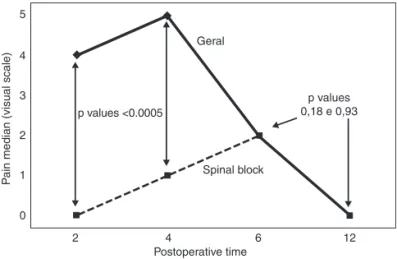
As can be seen in Figure 1, pain evaluated by the Visual Analogue Scale was significantly less severe in the spinal anesthesia group at 2, 4, and 6 hours. At 12 hours both groups had the same evaluation in the Visual Analogue Scale.
All patients in the spinal anesthesia group reported great satisfaction. In the general anesthesia group 26 patients re-ported great satisfaction while three rere-ported being reasona-bly satisfied. This was due to having experienced severe pos-toperative right shoulder pain. All patients would recommend spinal anesthesia for laparoscopic cholecystectomy.
In the spinal anesthesia group all patients recovered six hours after the surgery and were ready to be discharged from the hospital, but they only received permission to leave the institution in the following day to be observed clinically, inclu-ding heart rate, blood pressure, nausea, vomiting, and hea-dache.
DISCUSSION
This study showed that there are some indications for spinal anesthesia in patients undergoing elective laparoscopic cho-lecystectomy. It confirmed the superiority of spinal anesthesia in the control of pain in the immediate postoperative period when compared to general anesthesia, besides having a lower cost. Laparoscopic cholecystectomy, considered a minimally invasive surgery, is usually done under general anesthesia. The advantages of this procedure, including less pain and shorter hospitalization, make spinal anesthesia the procedure
of choice 1,2. Surprisingly, in the era of minimally invasive
me-dicine the use of regional block in laparoscopic
cholecystec-Geral
Spinal block
P
ain median (visual scale)
p values <0.0005
0 1 2
2 3 4
4 6 12
5
Postoperative time
p values 0,18 e 0,93
Figure 1 – Pain in Visual Analogue Scale.
tomy has not become popular. This is due mainly to the notion that laparoscopic cholecystectomy requires tracheal intuba-tion to prevent aspiraintuba-tion and respiratory complicaintuba-tion due to
the introduction of CO2 in the peritoneum 6, which would not
be well tolerated by an awake patient during the procedure 1.
In the present study, spinal anesthesia did not produce any modification in surgical technique except for the reduction in peritoneal pressure to 8 mmHg to avoid vagal reflexes and bradycardia. Comparing spinal block to general anesthesia, conversion of the anesthesia due to technical difficulty or res-piratory problems was not necessary. However, one patient experienced pain after bleeding which indicated the need of conversion to general anesthesia. This patient was excluded from the protocol.
We conclude that spinal anesthesia is associated not only to low mortality indices, but also to a lower incidence of severe com-plications such as deep venous thrombosis, pulmonary embo-lism, pneumonia, respiratory depression, myocardial infarction,
and renal failure when compared to general anesthesia 7. In
another series, spinal anesthesia was associated with a lo-wer incidence of postoperative complaints and treatments as well as shorter observation time when compared to general
anesthesia 8. Consequently, laparoscopic cholecystectomy
under spinal anesthesia should be an appropriate method. In the present study we used a low dose of midazolam (3 mg) for sedation, residual anesthesia (sensorial blockade) lasted 4.18 hours, with a low incidence of nausea and vomiting, and at a lower cost than general anesthesia.
Unlike other authors 9, a nasogastric (NG) tube was not
used routinely in both groups. The determination of its real need was part of the protocol. We believe that the nasogas-tric tube is uncomfortable in awaken patients, and its need would be one of the criteria for conversion of the anesthesia. None of 34 patients in the spinal anesthesia group required a NG tube compared to 14 patients in the general anesthesia group. This confirms that the anesthesiologist by inflating the stomach while ventilating with a face mask during induction and before intubation is the main responsible for the need of a nasogastric tube.
Unlike other studies 9, this is a comparative study and we
believe that the majority of our patients had better experien-ce of postoperative analgesia than those undergoing general anesthesia during this period. This is particularly true during the first six hours after the procedure, most likely due to two factors: absence of a tracheal tube and its discomforts, and presence of an adequate level of analgesia, and analgesia in the first postoperative hours due to the choice of agents used in the subarachnoid space. The use of head-down after the administration of the opioid and hyperbaric anesthetic was responsible for the differential between the sensorial blockade which lasted 4:18 (0:42) hours, and the motor whi-ch lasted 3:01 (0:42) hours. Our data confirms the superiority of the spinal anesthesia' over general anesthesia in the con-trol of postoperative pain.
This study has proven that laparoscopic cholecystectomy can be successful using the classic and well-tested
any discomfort 9,10. Pain in the shoulder related to laparoscopy
is attributed to irritation of the lower surface of the diaphragm
by carbon dioxide during the pneumoperitoneum 3,4,9.
Occa-sionally, this can be severe enough to lead to conversion of
the anesthetic technique 4. After introduction of CO
2, 18 out of
34 patients did not report pain in the shoulder. In the remai-ning 16 patients, local irrigation of the right hemidiaphragm with 100 mg of 1% lidocaine relieved the symptoms. After re-lief of the shoulder pain, the surgery progressed without any problems. The use of midazolam prevents the recall of any event during the immediate postoperative period.
In the immediate postoperative period, eight out of 33 pa-tients in the general anesthesia group, and two out of 34 patients in the spinal anesthesia group developed pain in the right shoulder. We believe that the use of 100 mg of lidocai-ne on the right hemidiaphragm contributed for the reduction in the incidence of shoulder pain. For this reason, lidocaine was adopted as a routine in patients who undergo general anesthesia.
The negative effects of the pneumoperitoneum with CO2
on the respiratory function have been widely investigated 11.
Usually CO2 is used for safety due to its high water
solubili-ty and its high capacisolubili-ty of exchange in the lungs. The
con-centration of CO2 can be easily monitored by capnography
and controlled by ventilation 12. Pneumoperitoneum induces
systemic effects due to the absorption of CO2, and in
ve-nous return due to the increase in intra-abdominal
pressu-re 13. Initially, absorption of CO
2 increases its elimination in
the expired air, in the arterial and venous blood 13,14. This
carboxemia induces metabolic and respiratory acidosis
de-creasing arterial and mixed venous pH and arterial pO2 12,14.
Absorption of CO2 affects negatively the respiratory function
15, which is not observed with inert gases such as helium
and argon. Minute ventilation, peak inspiratory pressure,
pul-monary vascular resistance, alveolar concentration of CO2,
calculated physiological short circuit, central venous pressu-re, diastolic and systolic blood pressupressu-re, systemic vascular
resistance, and cardiac index are all increased 12,13. Those
effects are more pronounced in patients with pulmonary and
cardiac adaptation 12 and in long procedures in endoscopies
and forced head-down. Very high intra-abdominal pressure is associated with a reduction in visceral blood flow and
glome-rular filtration 13. SpO
2 and PETCO2 remained within normal
limits during the procedure confirming that spinal anesthesia
can be safe even without tracheal intubation. Retention of
CO2 and hypoxemia were not observed in the spinal
anes-thesia group during the procedure.
Some surgeons prefer high pressures (14 mmHg) while
others maintain lower pressures (11 mmHg 4 or 10 mmHg
3,6,9). We chose a low pressure of up to 8 mmHg to reduce
dia-phragmatic irritation. This pressure was the same used in the general anesthesia group. Spinal anesthesia offered sensorial and motor blockade up to a level high enough to avoid the use of muscle relaxants, which are usually necessary when gene-ral anesthesia is used. It was not necessary to increase the pressure of the pneumoperitoneum in the spinal anesthesia group while, in the general anesthesia group, it was neces-sary in 14 patients, which could be explained by the pressure necessary to ventilate the patient. Abdominal relaxation was adequate in all 34 patients in the spinal block group.
Intraoperative hypotension is another problem in
laparos-copic cholecystectomy under spinal anesthesia 4,9,10.
Hypo-tension was observed in 17/29 patients 10, in 29/50 patients 16,
while in the present study 14/34 patients in the spinal anes-thesia group developed hypotension. Intravenous ethylephri-ne was successful for the treatment of all cases.
Postoperative nausea and vomiting are relatively common after laparoscopic cholecystectomy under general anesthesia
17. One of our patients developed postoperative nausea and
vomiting, while three patients in the general anesthesia group developed this complication. In another series with laparos-copic cholecystectomy under spinal anesthesia, nausea and
vomiting were not common 4,9,10. The surgical technique was
not different than that of general anesthesia indicating, there-fore, that the low incidence of nausea and vomiting seems to
be related to the spinal anesthesia 10.
Recently, the authors 18 reported the importance of
achie-ving high-quality analgesia in the immediate postoperative period if one intends to maintain effective analgesia related to the regional block. The spinal anesthesia is a vital prere-quisite for this success. In a recent study with 3,492 patients, the spinal block was the technique of choice for
laparosco-pic cholecystectomy 19. To conclude, this is a retrospective,
controlled, randomized study that provided evidence that spinal anesthesia can be an effective technique for elective
laparoscopic cholecystectomy with low pressure CO2, for the