Executive dysfunction and low academic attainment in
adolescent substance abusers with a history of maltreatment
Paulo Jannuzzi CunhaI,II,III, Paula Approbato de OliveiraIV, Mariana CortezziV, Geraldo F. BusattoII,III, Sandra ScivolettoIV
DOI: 10.5935/MedicalExpress.2015.06.06
I Universidade de São Paulo, Faculdade de Medicina, Departamento e Instituto de Psiquiatria, Grupo interdisciplinar de Estudos sobre álcool e drogas (GREA), Sao Paulo, SP, Brazil
II Universidade de São Paulo, Faculdade de Medicina, Departamento e Instituto de Psiquiatria, Laboratório de Neuroimagem Psiquiátrica (LIM 21), Sao Paulo, SP, Brazil III Universidade de São Paulo, Faculdade de Medicina, Nucleo de apoio à pesquisa em neurociência aplicada (NAPNA), USP. Rua Dr Ovídio Pires de Campos, s/n, 05403-010, São Paulo, SP, Brazil
IV Universidade de São Paulo, Faculdade de Medicina, Departamento e Instituto de Psiquiatria, Programa equilibrio, Sao Paulo, SP, Brazil V Universidade Federal de Minas Gerais, Faculdade de Filosoia e Ciências Humanas, Departamento de Psicologia, Belo Horizonte, MG, Brazil
OBJECTIVE: Substance abuse and maltreatment are highly associated with Executive Cognitive Function impairments, but very little is known about how symptoms of a condition known as Dysexecutive Syndrome may impact on real-life activities, especially in adolescents. This study investigated the presence of Executive Cognitive Function deicits in maltreated substance-abusing adolescents relative to healthy control subjects and analyzed the association between executive performance and educational attainment.
METHOD: The sample consisted of 15 maltreated adolescent substance abusers and 15 non-maltreated healthy adolescents (controls). They were assessed by the Frontal Assessment Battery, composed of six subtests: Conceptualization, Mental flexibility, Motor programming, Sensitivity to interference, Inhibitory control, and Environmental autonomy.
RESULTS: Maltreated adolescents did not difer from controls in sociodemographic variables such as age, ethnicity, and handedness. However, they performed signiicantly and importantly below controls in almost all domains of Executive Cognitive Function, including abstract abilities, cognitive lexibility, motor planning, and sensitivity to interference. Maltreated adolescents also completed fewer years of formal education vs. controls. The Frontal Assessment Battery total score correlated with educational attainment throughout the sample (r = 0.511; p < 0.01).
CONCLUSION: Substance-abusing adolescents with a history of maltreatment performed more poorly vs. controls on a variety of measurements of executive functioning, and the results of the Frontal Assessment Battery were associated with educational attainment. Our results evidence a negative impact of dysexecutive symptoms on educational attainment in adolescents. Strategies focusing on neuropsychological rehabilitation may be relevant to help substance-abusing and maltreated adolescents to perform better at school and perhaps in life.
KEYWORDS: Neuropsychology, Adolescents, Addiction, Educational attainment.
Cunha PJ, Oliveira PA, Cortezzi M, Busatto GF, Scivoletto S. Executive dysfunction and low academic attainment in adolescent substance abusers with a history of maltreatment. MedicalExpress (São Paulo, online). 2015;2(5):M150506
Received for Publication on August 27, 2015; First review on September 08, 2015; Accepted for publication on October 07, 2015
E-mail: [email protected]
■
INTRODUCTIONSubstance abuse is strongly associated with
deficits in executive cognitive function which are related to structural and functional abnormalities of the prefrontal cortex.1-6 Studies have shown that individuals
who are early exposed to substances are at a higher risk to develop executive impairments as compared to older individuals.7-9 Also, a history of maltreatment
is a risk factor for later substance abuse.10 It may
prematurely and negatively impact the development of some neural pathways connecting the limbic system with the prefrontal cortex, which could lead to impulsive behaviors and early initiation of substance use.10-11 The
Number 0563/08). Participants and their legal guardians signed the approved consent form before entering in the study. After that, they were assessed by either a clinical psychologist or a psychiatrist. The interview questions covered demographics, drug use, and their consequences on psychosocial functioning. Three trained neuropsychologists (P.J.C., P.A.O. and M.C.) administered the
neuropsychological battery (Frontal Assessment Battery -
FAB) and questionnaires, in one single session, usually in the morning.
Executive measurements
Frontal Assessment Battery (FAB)18 The administration
of the FAB takes approximately 10 minutes; each of the six subtests is scored from 0 (minimum score) to 3 (maximum score) and the total score of the FAB is the sum of the scores in the six subtests (the FAB´s total score ranges from 0 to 18)18. The FAB has been translated and adapted to
Portuguese4-5 and detailed information about instructions
of the FAB are described elsewhere.4,18 The six subtests are:
1. Conceptualization: this is based on the traditional
similarities subtests included in the intelligence scales designed by Wechsler.19 This subtest evaluates the subject’s
ability to generate similarities between: 1) banana-orange, 2) table-chair, 3) tulip-rose-daisy. The examiner asks: “In
what way are they alike?” In the case of total or partial failure in the first item (i.e., “they are not alike”), the examiner may help the subject saying “both a banana and an orange are…” but doesn’t give any credit for him/her. The patient cannot be helped in the other items ( table-chair, tulip-rose-daisy). Full correct responses are fruits,
furniture, and flowers, respectively. Each correct response is associated to one credit (none correct: 0; one correct: 1; two correct: 2; three correct: 3).
2. Mental flexibility: the subject has to recall as many words as he/she can, beginning with the letter “S” in a 1-minute trial. The examiner says: “Say as many words as you can beginning with the letter ‘S,’ any words except surnames or proper nouns”.18 The examiner may help if no
response is given during the first 5 seconds: “for instance, salt”. Each correct word is scored as one point. The score in mental flexibility may be 0 (less than 3 words), 1 (3 to 5 words), 2 (6 to 9 words), and 3 (more than 9 words).
3. Motor programming: the examiner, sitting in front
of the patient, asks him/her to watch carefully the Luria´s fist-palm-edge motor series.18,20 The examiner repeats
three times the Luria´s motor sequences with his left hand. Then, he asks the patient to repeat the movement with his/her right hand, initially accompanying the examiner’s movement, and then alone. The examiner performs the series three times with the patient, and then asks the patient to do it on his/her own. The patient who cannot perform three correct consecutive series even with the examiner receives no point. The subject who is able to perform three physical and mental changes, mainly because this is a crucial
period for brain maturation, especially of the prefrontal cortex and subcortical structures.11-13 However, very little
is known about the additional effect of maltreatment and substance use on the adolescent´s cognitive functioning and how the symptoms of a condition known as Dysexecutive Syndrome may impact on real-life activities, such as at school and family adjustment. Dysexecutive Syndrome is characterized by impairments in cognitive subdomains involving attention and the executive functions that control and regulate other abilities and behaviors.13 In this regard,
addicted adolescents may be at a higher risk for low educational attainment and school dropouts,14-15 but few
studies to date have investigated if cognitive functioning is associated with educational variables. The aim of this study was to investigate the presence of executive cognitive function deficits in maltreated and substance-abusing
adolescents and to analyze the association between
executive performance and educational attainment.
■
METHODSParticipants
Thirty adolescents participated in this study. Fifteen maltreated adolescent substance abusers (MASA) were recruited from The Equilibrium Program (TEP), a multidisciplinary mental health community service specialized in outpatient treatment of children and adolescents with a lifetime history of maltreatment.16 They
met the DSM-IV-TR criteria17for substance abuse at time
of admission to our treatment program. The exclusion criteria were: 1) current major psychiatric disorders (i.e., bipolar disorder, depression, and mania); 2) history of neurological disorders such as head injuries, with loss of consciousness for longer than 30 minutes, strokes, and intracranial hemorrhages; 3) IQ less than 70. The MASA were all adolescents who had been abstinent from drugs for an average of two weeks before evaluation. The abstinence
period was verified by self-report and supervised by the clinical staff. The executive performance of the MASA was compared to the results of a control group, which consisted of 15 non-maltreated healthy adolescents (NMHA), recruited in the city of São Paulo at the “Lar Sirio”, which is a multidisciplinary service that offers a variety of activities including psychosocial interventions for low-income families. The exclusion criteria for the control group were: 1) DSM-IV-TR criteria for any psychoactive substance abuse; 2) the same exclusion criteria of the MASA.
Procedure
correct consecutive series with the examiner, but fails alone, receives 1 point. Two points are given to the patient who performs at least three correct consecutive series alone, and the full score (three points) is given for six correct consecutive series.
4. Sensitivity to interference: this is a subtest
similar to the Stroop Color Word Test (SCWT), which is a traditional neuropsychological task that measures executive functioning.4,18 The examiner requires the patient to tap
twice on a table upon hearing a single tap. The examiner then performs a sequence of three trials (1-1-1) and the patient should respond appropriately. Next, the examiner
asks the patient to tap once on the table upon hearing two
taps. Then, a series of three trials is given: 2-2-2. Finally, the examiner performs the following series: 1-1-2-1-2-2-2-1-1-2. The patient receives 0 points if he taps in imitation of the examiner at least four consecutive times. One point is given when the patient makes more than 2 errors two points are given if the subject makes 1 or 2 errors; the full score (three points) is given when the patient executes without any error.
5. Inhibitory control: this task is based on the
traditional go-no go paradigm. It is similar to the previous subtest, but here the patient should inhibit what he/she had just learned: the subject is required to tap once upon hearing a single tap. A series of three trials is run: 1-1-1. Then, the examiner asks the patient to inhibit his previous learned response upon hearing two taps. The examiner performs three trials (2-2-2). Next, the examiner taps the following sequence: 1-1-2-1-2-2-2-1-1-2. The scoring is identical to the previous subtest.
6. Environmental autonomy: this subtest evaluates
the abnormal spontaneous tendency to adhere to the environment through the apprehension behavior. The examiner sits in front of the patient and the examiner places the patient´s hands palm up on his/her knees. Then, without saying anything, the examiner touches the palms of the patient’s hands. The examiner evaluates if the patient spontaneously takes his/her hands. If the patient takes the examiner´s hands, the examiner will try again saying: “Now, do not take my hands”. If the patient takes the examiner’s hands even after he/she has been told not to do so, he/ she receives zero points. One point is given to the patient who takes the examiner´s hands without hesitation in the first trial, but not in the second. Two points are given to the patient who hesitates and the full score (three points) is obtained when the patient does not take the examiner’s hands.
Data Analyses
The two groups (MASA and NMHA) were compared in all tests applied. Statistical comparisons were carried out using the unpaired Student’s t-test or Mann-Whitney test
for quantitative variables. The Fisher’s Exact Test and Chi-Square were used for categorical variables. The normality
of observations was verified by the Kolmogorov-Smirnov test. The level of statistical significance was α = 0.05 and all statistical tests were two-tailed. Correlations between the FAB scores and educational variables were assessed by the Pearson correlation coefficient (r). Statistical Package
for the Social Sciences (SPSS) for Windows, version 14.0 (SPSS, 2005) was used to perform all statistical analyses.
■
RESULTSThere were no statistically significant differences between the Maltreated Adolescent Substance Abusers (MASA) and the healthy controls (NMHA) in variables
such as age, ethnicity, and handedness as shown in Table
1. Educational attainment of the adolescents in the control group was significantly higher than that of the subjects in the MASA group. These maltreated adolescents had a history of alcohol, crack/cocaine, inhalants and cannabis abuse. Almost all of them (86.7%) were also frequent tobacco smokers.
Table 1 - Sociodemographic variables of the MASA and NMHA
MASA Mean ± SD
(N = 15)
NMHA Mean ± SD
(N = 15)
p
Age 14.47 ± 1.46 13.80 ± 1.15 0.17 Education (in years) 6.20 ± 1.26 8.0 ± 1.07 < 0.01* Ethnicity
White 7 (46.7%) 4 (26.7%) 0.52 African Brazilian 3 (20%) 4 (26.7%)
Mixed 5 (33.3%) 7 (46.7%) Handedness
Right hand 13 (86.7%) 15 (100%) 0.48 Left hand 2 (13.3%) 0
Substance use 15 (100%) 0 Alcohol 7 (46.7%) 0 Tobacco 13 (86.7%) 0 Cannabis 7 (46.7%) 0 Inhalants 6 (40%) 0 Crack/Cocaine 6 (40%) 0
Notes: MASA = adolescent substance abusers; NMHA = non-maltreated healthy adolescents; SD = Standard Deviation; Age and Education (in years) were analyzed with the Student´s t test for independent samples; Ethnicity and Handedness were investigated with Chi-Square and the Fisher’s Exact Test, respectively; mean diferences were considered statistically signiicant if p < 0.05*.
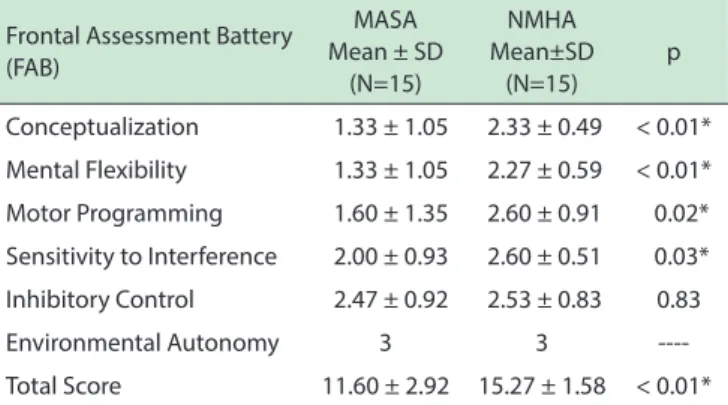
Table 2 - Neurocognitive performance of MASA and NMHA in the six executive domains of the FAB
Frontal Assessment Battery (FAB)
MASA Mean ± SD
(N=15)
NMHA Mean±SD
(N=15)
p
Conceptualization 1.33 ± 1.05 2.33 ± 0.49 < 0.01* Mental Flexibility 1.33 ± 1.05 2.27 ± 0.59 < 0.01* Motor Programming 1.60 ± 1.35 2.60 ± 0.91 0.02* Sensitivity to Interference 2.00 ± 0.93 2.60 ± 0.51 0.03* Inhibitory Control 2.47 ± 0.92 2.53 ± 0.83 0.83 Environmental Autonomy 3 3 ----Total Score 11.60 ± 2.92 15.27 ± 1.58 < 0.01*
Finally, there was a significant positive correlation between executive performance as measured by the
FAB and educational attainment, in number of years of education (r = 0.511; p = 0.004; Figure 1). Correlations
with education and FAB were not found when analyzing within the groups, MASA (r = 0.197; p = 0.48) and NMHA (r = 0.211; p = 0.44).
■
DISCUSSIONSubstance-abusing adolescents with a history of maltreatment evaluated in the present study performed significantly worse than a healthy control group in the Frontal Assessment Battery (FAB). They were cognitively impaired in four of the six cognitive domains assessed by the FAB, including abstract reasoning, cognitive flexibility, motor planning/programming, and sensitivity to interference. In addition, the Maltreated Adolescent Substance Abusers underperformed the Non-Maltreated Healthy Adolescents in educational attainment. Finally, the number of years completed of formal education were correlated with executive cognitive function-related tasks, meaning that the better the executive functioning, the higher the educational attainment among all the
Figure 1 - Correlation between Educational Attainment (completed education years) and Frontal Assessment Battery (Total Scores) and for Healthy (blue) vs. Maltreated Substance Abuser (red) adolescents. Pearson´s coeicient: r = 0.511; p < 0.004*
subjects. To our knowledge, this is the first report showing neurocognitive alterations by different subtests of the FAB among maltreated adolescent drug users.
The FAB subtests in which the MASA were found to have executive cognitive function-related impairments are tasks that have been associated with the functioning of medial, dorsolateral, and posterior areas of the prefrontal cortex.18,21 Our findings may be explained by
the fact that maltreatment in the childhood may impair the initial neural development trajectory of the brain10 and that subsequent substance use during adolescence
will result in an additional disruption in the normative neuro-maturational processes that occur during this
period, particularly synaptic pruning and white matter development.8,9 More specifically, prefrontal cortex
and white matter abnormalities generated by early maltreatment combined with later substance use are associated with executive cognitive function impairments that may limit the adolescent´s ability to deal with the challenges inherent to school success. However, it is possible that not only the prefrontal cortex, but also other regions of the brain may be implicated in these results, such as the uncinate fasciculus and other white matter tracts.11 Indeed, a recent study suggests that
differences in adolescent executive control are not solely attributable to the functioning of any single region or network, but are instead dependent on a dynamic and context-dependent interplay between several brain regions including the prefrontal cortex.22 It is interesting
to note that if we compare the results of this study with a previous investigation of our group carried out in adults,4
maltreated adolescent substance users seem to be more impaired in comparison to adult addicts. For example,
the FAB Sensitivity to Interference subtest was not able to
detect neurocognitive alterations in the sample of adults of our previous study,4 but here this subtest detected
success in subsequent stages of life. Future and prospective neurocognitive studies, combined with neuroscience methods such as neuroimaging techniques and genetic analysis, are required to investigate the pathophysiology and etiology of the combination of childhood maltreatment and substance abuse during adolescence.
■
SUMMARYThe use of a brief battery of executive function tests was relevant to show deficits in maltreated adolescent drug abusers. FAB alterations correlated with educational attainment, indicating the ecological validity of this battery. Our findings suggest that the implementation of rehabilitation strategies may help adolescents to achieve success in educational life.
■
ACKNOWLEDGEMENTSFundação Faculdade de Medicina e Fundação de Amparo a Pesquisa do Estado de São Paulo, FAPESP
(Grant numbers: 2010/15604-0, 2010/15786-1, and
2010/18374-6).
■
AUTHOR CONTRIBUTIONCunha PJ, Cortezzi M, and Scivoletto S designed the study. Cunha PJ and Cortezzi M wrote the protocol. Oliveira PA, Cunha PJ and Cortezzi M oversaw recruitment and assessment of subjects. Cunha PJ and Oliveira PA oversaw the development and maintenance of the database. Cunha PJ undertook the statistical analysis. Cunha PJ and Busatto GF managed the literature searches and wrote the first draft of the manuscript. All authors reviewed the manuscript for scientific content and approved the final manuscript.
■
CONFLICT OF INTERESTAuthors declare no conflict of interest regarding this project.
DISFUNÇÃO EXECUTIVA E BAIXO DESEMPENHO ESCOLAR EM ADOLESCENTES USUÁRIOS DE DROGAS COM HISTÓRIA DE MAUS-TRATOS
OBJETIVO: Abuso de substâncias e maus-tratos
têm sido altamente associados com déficits nas funções executivas, porém pouco se conhece sobre o impacto da disfunção executiva nas atividades da vida real, especialmente em adolescentes. O objetivo deste estudo foi investigar a presença de déficits nas funções executivas em adolescentes abusadores de substâncias com histórico risk factors that may significantly impair the functioning of
multiple brain regions and cognitive performance, namely maltreatment and substance use.
By showing a correlation between cognitive perfor
-mance and the “real-life” measurement of school success, our results also highlight the ecological validity of the FAB. Thus this battery may be used not only as a screening neurocognitive method for the evaluation of executive cognitive function in substance abusers,4 but also as an
indicator of “how-well” the adolescent may achieve success in academic life.
Despite some strengths of our study, some limitations should be considered. First, given the cross-sectional design of the study, it is not possible to determine whether previous dysexecutive symptoms could have lead to drug use and school failures or, instead, whether drug use would have caused the dysexecutive symptoms and the worse academic performance. Our previous findings in adults are consistent with the idea that some premorbid subclinical executive deficits could be associated with a higher vulnerability to
engage in risky substance abuse, which per se could lead to
worsened executive functioning.23 Secondly, we were only
able to compare two samples, and our data are limited to either ascertain the extent to which maltreatment per se
is associated with executive cognitive function deficits24
and poor school attainment, or the degree to which such deficits are amplified by substance use. It is important to note that substance use and abuse is extremely prevalent among maltreated children and adolescents25 and our
sample reflects “real-life” conditions. However, the role of maltreatment and the additional effect of substance use on these variables (i.e., executive cognitive function and school attainment) should be investigated in more controlled studies using prospective designs. Third, as the size of our groups was relatively modest, we were not able to detect significant correlations between FAB and educational attainment in the subgroups (MASA and NMHA), but the absence of correlations in these analysis could be also associated with a low variability in educational attainment considering the two groups separately. Further investigations with more robust samples would be welcome to confirm our data.
In conclusion, our findings indicate that the Frontal Assessment Battery was sensitive to detect executive cognitive function alterations in maltreated adolescents with substance use. Our results also indicate that maltreatment and substance abuse correlate with school performance, showing that executive deficits are associated with real-life problems among adolescents. These findings may have implications for the development of treatment and early prevention interventions. For example, we highlight the potential of using neuro-rehabilitation techniques to help adolescents to achieve better educational attainment levels
de maus-tratos, comparando-os com um grupo de jovens controles saudáveis, assim como analisar a associação entre o desempenho executivo e o nível de escolaridade dos participantes.
MÉTODO: A amostra foi composta por 15 adoles
-centes abusadores de substâncias, vítimas de maus tratos e 15 adolescentes saudáveis, sem história de maus-tratos. Todos os participantes foram avaliados pela Bateria de Avaliação Frontal, composto por seis subtestes:
Concei-tuação, Flexibilidade mental, Programação motora, Sen -sibilidade à interferência, Controle inibitório e Autonomia Ambiental.
RESULTADOS: Os adolescentes abusadores não
diferiram dos controles saudáveis em variáveis sócio-demográficas, tais como idade, etnia e lateralidade. No entanto, apresentaram desempenho significativamente abaixo dos controles em quase todos os domínios das funções executivas, incluindo capacidade de abstração, flexibilidade cognitiva, planejamento motor e sensibilidade à interferência. Os adolescentes vítimas de maus tratos concluíram menos anos de educação formal do que os controles. A pontuação total da Bateria de Avaliação Frontal correlacionou com o nível de escolaridade, na amostra total (r = 0.511; p < 0.01).
CONCLUSÃO: Os adolescentes abusadores de
substâncias com histórico de maus-tratos apresentam prejuízos em várias medidas de Funções Executivas. Os resultados da Bateria de Avaliação Frontal associam-se com os anos completados de escolaridade. Nossos resultados evidenciam o impacto negativo da disfunção executiva no aproveitamento escolar em adolescentes. Estratégias com foco em reabilitação neuropsicológica podem ser relevantes para ajudar adolescentes abusadores de substâncias e vítimas de maus tratos a atingirem melhor aproveitamento na escola e, talvez, na vida como um todo.
PALAVRAS-CHAVE: neuropsicologia, adolescentes,
dependência química, escolaridade.
■
REFERENCES1. Bechara A, Dolan S, Denburg N, Hindes A, Anderson SW, Nathan PE. Decision-making deficits, linked to a dysfunctional ventromedial prefrontal cortex, revealed in alcohol and stimulant abusers. Neurop-sychologia. 2001;39(4):376-89.
2. Bolla KI, Eldreth DA, London ED, Kiehl KA, Mouratidis M, Contoreggi C, et al. Orbitofrontal cortex dysfunction in abstinent cocaine abusers performing a decision-making task. Neuroimage. 2003;19(3):1085-94. 3. Bolla KI, Ernst M, Kiehl K, Mouratidis M, Eldreth D, Contoreggi C, et al. Prefrontal cortical dysfunction in abstinent cocaine abusers. J Neuropsychiatry Clin Neurosci. 2004;16(4):456-64.
4. Cunha PJ, Nicastri S, de Andrade AG, Bolla KI. The frontal assessment battery (FAB) reveals neurocognitive dysfunction in substance-dependent individuals in distinct executive domains: Abstract reasoning, motor pro -gramming, and cognitive flexibility. Addict Behav. 2010;35(10):875-81.
5. Cunha PJ, Novaes MA. Neurocognitive assessment in alcohol abuse and dependence: implications for treatment. Rev Bras Psiquiatr. 2004;26(suppl 1):S23-27.
6. Goldstein RZ, Volkow ND. Drug addiction and its underlying neurobio -logical basis: neuroimaging evidence for the involvement of the frontal cortex. Am J Psychiatry. 2002;159(10):1642-52.
7. Fontes MA, Bolla KI, Cunha PJ, Almeida PP, Jungerman F, Laranjeira RR, et al. Cannabis use before age 15 and subsequent executive functioning. Br J Psychiatry. 2011;198(6):442-7.
8. Lisdahl KM, Gilbart ER, Wright NE, Shollenbarger S. Dare to delay? The impacts of adolescent alcohol and marijuana use onset on cognition, brain structure, and function. Front Psychiatry. 2013;4:53.
9. Lubman DI, Cheetham A, Yücel M. Cannabis and adolescent brain development. Pharmacol Ther. 2015;148:1-16.
10. Edalati H, Krank MD. Childhood Maltreatment and Development of Substance Use Disorders: A Review and a Model of Cognitive Pathways. Trauma Violence Abuse. 2015 May 11. pii: 1524838015584370. [Epub ahead of print]
11. Olson IR, Heide RJ, Alm KH, Vyas G. Development of the uncinate fasciculus: Implications for theory and developmental disorders. Dev Cogn Neurosci. 2015;14:50-61.
12. Giedd JN, Blumenthal J, Jeffries NO, Castellanos FX, Liu H, Zijdenbos A, et al. Brain development during childhood and adolescence: a lon -gitudinal MRI study. Nat Neurosci. 1999;2(10):861-3.
13. Milioni ALV, Rodrigues PA, Cunha PJ. Cognitive Functioning, Decision Making and Prefrontal Cortex Damage: Consequences, Rehabilitation and Neural Plasticity. Cogn Sciences. 2014;9:151-78.
14. Lynskey M, Hall W. The effects of adolescent cannabis use on educa -tional attainment: a review. Addiction. 2000;95(11):1621-30. 15. Grant JD, Scherrer JF, Lynskey MT, Agrawal A, Duncan AE, Haber JR, et
al. Associations of Alcohol, Nicotine, Cannabis, and Drug Use/Depen -dence with Educational Attainment: Evi-dence from Cotwin-Control Analyses. Alcohol Clin Exp Res. 2012;36(8):1414-20.
16. Scivoletto S, da Silva TS, Rosenheck RA. Child psychiatry takes to the streets: a developmental partnership between a university institute and children and adolescents from the streets of Sao Paulo, Brazil. Child Abuse Neglect. 2011;35(2):89-95.
17. American Psychiatric Association (APA). Diagnostic and Statistical Manual of Mental Disorders (4th ed., text revision). Washington, DC:
APA, 2000.
18. Dubois B, Slachevsky A, Litvan I, Pillon B. The FAB: A Frontal Assess -ment Battery at bedside. Neurology. 2000;55(11):1621-26.
19. Wechsler D. Wechsler Intelligence Scale for Adults-Revised (WAIS-R). New York, NY: The Psychological Corporation, 1981.
20. Luria AR. Higher Cortical Functions in Man. New York, NY: Basic Books, 1966.
21. Sarazin M, Pillon B, Giannakopoulos P, Rancurel G, Samson Y, Dubois B. Clinicometabolic dissociation of cognitive functions and social behavior in frontal lobe lesions. Neurology. 1998;51(1):142-8.
22. Dwyer DB, Harrison BJ, Yücel M, Whittle S, Zalesky A, Pantelis C, et al. Large-scale brain network dynamics supporting adolescent cognitive control. J Neurosci. 2014;34(42):14096-107.
23. Cunha PJ, Gonçalves PD, Ometto M, Dos Santos B, Nicastri S, Busatto GF, et al. Executive cognitive dysfunction and ADHD in cocaine depen -dence: searching for a common cognitive endophenotype for addictive disorders. Front Psychiatry. 2013;4:126.
24. Oliveira PA, Scivoletto S, Cunha PJ. Neuropsychological and neuroima -ging studies associated with emotional stress during childhood and adolescence. Rev Psiquiatr Clin. 2010;37(6):260-9.