Cristiano Soares de MouraI Ludmila Santana TavaresI Francisco de Assis AcurcioII
I Núcleo de Epidemiologia e Saúde Coletiva. Instituto Multidisciplinar em Saúde. Universidade Federal da Bahia. Vitória da Conquista, BA, Brasil
II Departamento de Farmácia Social. Faculdade de Farmácia. Universidade Federal de Minas Gerais. Belo Horizonte, MG, Brasil
Correspondence: Cristiano Soares de Moura
15, Boul. Lafayette, apt. 1904, Longueiul Quebec – Canadá – J4K 0B2
E-mail: [email protected] Received: 3/20/2012
Approved: 6/28/2012
Article available from: www.scielo.br/rsp
Hospital readmissions related to
drug interactions: a retrospective
study in a hospital setting
ABSTRACT
OBJECTIVE: To examine the relationship between potential drug interactions
and hospital readmissions.
METHODS: Retrospective study with 1,487 adult patients (> 18 years old)
admitted to a general hospital in the city of Vitória da Conquista, Northeastern Brazil, from January to December 2007. Data were collected from Hospital Admission Authorization (AIH) forms in the Brazilian National Health System Hospital Database (SIH/SUS). Probabilistic linkage was used to combine multiple AIH forms from the same admission into a single record and to identify readmissions. Information on prescriptions was manually added to the SIH/ SUS records. Logistic regression was used to quantitatively assess the impact of drug interactions on hospital readmissions. Cox regression was performed to test the impact of this variable on time to fi rst readmission.
RESULTS: A total of 99 readmissions (7% of all patients) were identifi ed.
Potential drug interactions were found in 35% of all prescriptions evaluated. Patients with potential drug interactions in a prior admission were more likely to be readmitted. The adjusted odds ratio indicated a 2.4-fold increase in odds of being readmitted; and the adjusted hazard ratio showed that this risk was increased by 79% in patients with potential drug interactions (p < 0.01).
CONCLUSIONS: The study results suggest an association between prior drug
interactions and increased risk of readmission. Health professionals should be aware of potential hazard of certain drug combinations and closely monitor high-risk patients such as elderly patients and those with renal impairment.
DESCRIPTORS: Patient Readmission. Drug Interactions.
Hospital readmission (HR) is a measure often used to evaluate the hospital performances1,3,10,14,24 and may refl ect
ineffective patient care, or the occurrence of complica-tions related to the initial admission.1 It is considered to
be a sentinel event in the health care provided.4
There are various definitions of HR. Some authors consider it to be subsequent admissions in which the main diagnosis is the same or directly related to the initial admission,14 whereas others consider them to be
admissions to the same service, irrespective of the read-mission diagnosis.28 There is also a divergence of defi
ni-tions related to the interval of time between admissions, varying between 14 days to one year after discharge.2,4,28
Few studies relate the incidence of adverse events related to medication during the previous admission with hospital readmissions.15,24 We found only one study
on associations with drug interactions.7
Potential drug interaction can be understood as a clinical event in which the effects of one drug are altered by the presence of another. Interactions are a common cause of adverse events related to medication and are particularly critical in a hospital environment, where patients receive various different medications.18
it is diffi cult to document the link between a clinical event and interaction, which means that the majority of studies evaluate potential drug interaction in prescrip-tions, in other words, simultaneously prescribing two drugs which may potentially interact.19
The objective of this study was to analyse the relation-ship between potential drug interaction in prescriptions given on discharge and hospital readmission.
METHODS
Retrospective cohort study with admission data from 2,067 patients over the age of 18, admitted to a general hospital in Vitória da Conquista, BA, between January and December 2007. It is a medium sized institution, caring for patients from the municipality and the surrounding area, as well as the north of Minas Gerais, with mid to high level complexity needs. The hospital has 182 beds, all dedicated to BrazilianUnifi ed Health System (SUS).
Readmission was defi ned as returning to the same institution within one year.
The source of information for the socio-demographic variables and admission data was the Hospital Information System (HIS/SUS), which is used for the purpose of reimbursing the costs of hospital procedures covered by the SUS. The HIS/SUS unit is the Hospital
INTRODUCTION
Admission Authorization (HAA), used as a source of information in epidemiological research.8,16
HAA are generated as a result of authorised procedures and, in some cases, one hospital stay has more than one HAA. The method proposed by Portela et al21 was used
to combine HAA registers with the aim of identifying those belonging to the same admission and those that were from readmissions. This took place in two stages: a) joining HAAs with the same number into one obser-vation, keeping the date of the fi rst admission and the registered discharge date; b) internal probabilistic linkage in the HAA database,12 using the fi elds name
of patient, date of birth and sex; c) applying decision algorithm to the composition of the admission register, in which we considered the admission and discharge dates, the procedure carried out, the main diagnosis, death and the reason for charging. The RecLink III® programme was used at stage “b”. HAAs referring to the same individual, but with a discharge date prior to the admission date of the next record were consid-ered readmissions. The fi rst admission was fl agged as having a readmission. In an extra fi eld on the database the number of days before the fi rst readmission was stored and this number corresponding to the difference between the discharge date from the fi rst and the admis-sion date from the second; if there was no readmisadmis-sion, the fi eld was completed with the difference between the fi nal date of observation (December 31st, 2007) and the
discharge date. We excluded cases in which the fi rst admission resulted in death.
A modifi ed version of the Charlson Comorbidity Index (CCI) was used to control differentiated risk between patients with different diagnoses.5 The CCI classifi es
the seriousness of the illness and is widely used as a method of adjusting studies which compare hospital outcomes.20 The version used in this study is a
modi-fi cation proposed by Ramiarina et al22 (2008), which
calculates CCI based on diagnoses from the CID-10. The records were also classed according to amount of time spent in intensive care (ICU) (yes: spent at least 24 hours in ICU; no: others) and according to whether they had received blood transfusions during their stay in hospital. In the case of blood transfusions, the variable “VAL_SANGUE”, which reports the values for blood transfusions reimbursed at the HAA, was used: when VAL_SANGUE <> 0, the blood transfusion variable is given a value of 1 and, if not, the value is 0.
prescription. HAAs for which it was not possible to identify a discharge prescription were excluded. We collected data on the medications (name and dosage), data of prescription, name of the patient and medical record number.
After applying the exclusion criteria, 2,067 patients were identified, with 2,036 admissions, of which 239 were cases of readmission (147 readmissions of different patients). The sample was made up of the 1487 patients for whom it was possible to assign a discharge prescription. Analysis of the losses indicated that the patients for whom it was not possible to assign a discharge prescription were more elderly (p = 0.01), but there was no signifi cant difference in the distribution of sex in the two groups (p = 0.45).
Drug interaction in the prescriptions were identifi ed using a previously developed computerised database.17
The source of information of this database is the book
Drug Interaction Facts,27 a publication which
special-ises in drug interactions and provides information on clinical signifi cance, manifestation, severity and management of interactions.
The analyses tested the hypothesis that potential inter-actions in the patients’ discharge prescriptions is an indicator of readmission and that patients exposed to drug interactions are readmitted after a shorter interval of time than those who are not. Two sets of models were adjusted to test this hypothesis. Logistic regression was used to determine the chances of correlation between drug interaction and readmission. The adjusted odds ratio was obtained in the multiple regression model that included other variables associated with readmission, chosen based on simple logistic regression analysis. Variables with level of signifi cance p < 0.20 were selected to be included in the multiple model.
Survival curves, estimated using the Kaplan-Meier method, were used to compare the amount of time until the next readmission, censored data being if death occurred or by the end of the observation of the patients with and without potential drug interaction in their discharge prescriptions. The log-rank test was used to compare differences in the two curves. The adjusted hazard ratio was obtained using Cox regression. The variables considered were the patients’ sex and age, CCI, speciality, time and cost of hospital stay, death occurring upon readmission, number of drugs prescribed upon discharge and their potential interaction.
The level of signifi cance adopted for the variables in the models (logistic and Cox) was p < 0.05. The goodness of fi t of the logistical regression model was determined by the Hosmer-Lemeshow test, whereas the assumption of proportional hazards over time in the Cox regres-sion model were estimated by analysis of Schoenfeld residuals. The data were stored in a Microsoft Access®
and analysed using the R for Windows® version 2.6.2
statistical package.
The project was approved by the Committee for Ethical Research of the Universidade Estadual do Sudoeste da Bahia (UESB) (Protocol no 182/2009). The database
was password protected. The researchers who had access to the data signed a confi dentiality agreement.
RESULTS
There was the identifi cation of 1,610 admissions of which 8% were readmissions and 7%, readmissions of different patients. The main diagnoses motivating readmission are listed in Table 1.
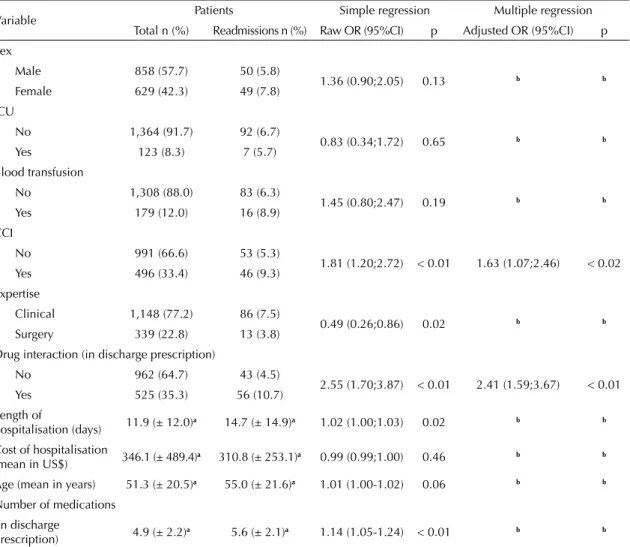
The majority of the admissions (58%) were males and the average age of patients was 51 (standard deviation – sd: 20 years). The patients had an average stay in hospital of 11.9 days (eight days median) at an average cost of R$ 640.60 (US$ 346); 123 patients spent less than 24 hours in ICU, representing 8% of the studied sample. The details of the other characteristics of the patients can be seen in Table 2.
On average, fi ve different drugs were prescribed upon discharge, varying between one and 15 drugs. We found 789 incidences of potential drug interaction in discharge prescriptions; 35% of patients had at least one poten-tial interaction. The most common interactions were between digoxin and furosemide (11.4%), captopril and spironolactone (10.6%), phenytoin and dexamethasone (9.3%) and spironolactone digoxin (8.0%).
There was no signifi cant difference in the proportion of readmissions according to sex, spending at least 24 hours in ICU, hemotherapy during the hospitalisation,
Table 1. Main diagnoses on readmission, according to ICD version 10. Vitória da Conquista, Northeast Brazil, January to December 2007.
ICD Disease Frequency (%)
I509 Heart failure, unspecifi ed 17 (17.1) J128 Other viral pneumonia 10 (10.1)
E86 Volume depletion 8 (8.1)
S060 Brain Concussion 5 (5.0)
K922 Gastrointestinal haemorrhage,
unspecifi ed 4 (4.0)
I219 Acute myocardial infarction,
unspecifi ed 3 (3.0)
C767 Malignant neoplasm of other
ill-defi ned sites 3 (3.0)
J449 Chronic obstructive pulmonary
cost of hospitalisation and age. There were signifi -cant differences regarding potential drug interaction (p < 0.01), length of hospitalisation, number of drugs in the discharge prescription, specialisation and CCI category. The independent variables associated with readmission, after adjusting the multiple model were: CCI and potential drug interaction; the adjusted odds ratio for this model indicates a 2.4 times greater chance of a patient with potential drug interaction in the discharge prescription being readmitted. The Hosmer-Lemeshow test indicated good fi tness to the data model (p = 0.26) (Table 2).
The median time until the next admission was 180 days. It was not possible to estimate the median using the Kaplan-Meier method, as 7% of the patients expe-rienced the event in question. Survival curves were constructed to illustrate the effect of variable inter-action in the discharge prescription in the time until
readmission (Figure). The time until readmission was signifi cantly lower for patients exposed to potential drug interaction (p < 0.01). Multivariate analysis using Cox regression indicated that the variables signifi cantly associated with time until readmission were CCI, death upon readmission, length of hospitalisation and potential drug interaction (Table 3). The hazard ratio, estimated using the admission variable, was 1.79, indicating a 79% greater risk of readmission for those exposed to drug interaction. Analysis of Schoenfeld residuals showed no violation of the proportional hazard over time assumption.
DISCUSSION
The proportion of readmissions found (7%) was lower than that reported by Castro et al3 (2000) (15%), possibly
due to the 5 years duration of that study. The profi le of the population studied may help explain the lower proportion
Table 2. Frequency, raw and adjusted odds ratio for factors associated with hospital readmission according to simple and multiple logistic regression analysis. Vitória da Conquista, Northeast Brazil. January to December 2007.
Variable Patients Simple regression Multiple regression
Total n (%) Readmissions n (%) Raw OR (95%CI) p Adjusted OR (95%CI) p Sex
Male 858 (57.7) 50 (5.8)
1.36 (0.90;2.05) 0.13 b b
Female 629 (42.3) 49 (7.8)
ICU
No 1,364 (91.7) 92 (6.7)
0.83 (0.34;1.72) 0.65 b b
Yes 123 (8.3) 7 (5.7)
Blood transfusion
No 1,308 (88.0) 83 (6.3)
1.45 (0.80;2.47) 0.19 b b
Yes 179 (12.0) 16 (8.9)
CCI
No 991 (66.6) 53 (5.3)
1.81 (1.20;2.72) < 0.01 1.63 (1.07;2.46) < 0.02
Yes 496 (33.4) 46 (9.3)
Expertise
Clinical 1,148 (77.2) 86 (7.5)
0.49 (0.26;0.86) 0.02 b b
Surgery 339 (22.8) 13 (3.8)
Drug interaction (in discharge prescription)
No 962 (64.7) 43 (4.5)
2.55 (1.70;3.87) < 0.01 2.41 (1.59;3.67) < 0.01
Yes 525 (35.3) 56 (10.7)
Length of
hospitalisation (days) 11.9 (± 12.0)
a 14.7 (± 14.9)a 1.02 (1.00;1.03) 0.02 b b
Cost of hospitalisation
(mean in US$) 346.1 (± 489.4)a 310.8 (± 253.1)a 0.99 (0.99;1.00) 0.46 b b
Age (mean in years) 51.3 (± 20.5)a 55.0 (± 21.6)a 1.01 (1.00-1.02) 0.06 b b
Number of medications (in discharge
prescription) 4.9 (± 2.2)
a 5.6 (± 2.1)a 1.14 (1.05-1.24) < 0.01 b b
ICU: Intensive Care Unit; CCI: Charlson Comorbidity Index
of admissions when compared to those reported in studies by other authors.3,11 The rates of readmission are greater
for elderly patients or among the seriously ill. There was a selective loss of older patients, due to the need to exclude patients without a discharge prescription, which may have contributed to underestimating the true proportion of readmissions in the hospital.
This work made use of the HIS/SUS database and as such, it was necessary to link HAA prescription records. The advantages of this type of source of information include the possibility of studying rare events or evalu-ating the effectiveness of measures, its availability and the low cost associated with collecting the data.26 In
some cases, complete information on a patient (clinical data, prescriptions and lab tests) is not available from one single source. The alternative is to use data linking techniques, which consist of combining information
from different, separate databases into one single data-base. This process is simplifi ed if there is one single fi eld which identifi es each record in the databases. On the other hand, if no unique identifi er is available, one needs to turn to probabilistic linkage. In such situations, less specifi c data are used in order to calculate the prob-ability that two records in two separate databases refer to the same individual.12
The technique of probabilistic linkage was used to identify groups of records belonging to the same indi-vidual in one database, in other words, continuation of admissions or readmissions in the period. As in every probabilistic linkage strategy, errors may occur and data lost which may have infl uenced some fi gures, such as the median length of hospitalisation.
The use of administrative databases for studies on medi-cation use is not common in Brazil. There are reports which use the HIS/SUS and the Outpatient Information System in pharmacoepidemiological studies.9,23 Such
studies highlight an important gap in HIS records, complete information on medications prescribed and administered. The lack of this data limits the utility of the HIS/SUS database for studies on medication use and pharmacoepidemiology.23 One way of getting
around this lack of information was using an external source, the records of prescriptions stored in the hospital pharmacy sector. Linking these prescriptions with HAA records by hand enabled the recuperation of the medica-tion history during the hospitalisamedica-tions which met the criteria of this study.
Although admission to hospital due to adverse reactions or exposure to drug interaction has been investigated previ-ously, few studies have concentrated on the incidence of readmission associated with these events. In a case-control study, Ruiz et al24 (2008) analysed the contribution of
adverse reactions to medication to patient readmissions Table 3. Raw and adjusted hazard ratio (HR) of the factors associated with readmission according to simple and multiple Cox regression. Vitória da Conquista, Northeast Brazil. January to December 2007.
Variable Simple regression Multiple regression
Raw HR 95%CI p Adjusted HR 95%CI p
CCI 1.69 1.14;2.50 < 0.01 1.51 1.01;2.25 0.04
Expertise 0.55 0.31;0.99 0.05 a a a
Interaction (discharge prescription) 2.48 1.67;3.69 < 0.01 1.79 1.19;2.70 < 0.01
Sex 1.34 0.90;1.98 0.15 a a a
Age 1.01 1.00;1.02 0.07 a a a
Death (on the next admission) 35.7 22.2;57.5 < 0.01 29.64 18.3;48.1 < 0.01
Length of hospitalisation 1.02 1.01;1.03 < 0.01 1.02 1.00;1.03 0.02
Cost (US$) 1.00 1.00;1.00 0.81 a a a
Number of medication 1.13 1.04;1.22 < 0.01 a a a
R2 fi nal model
a Not included in fi nal model
1.0
0.8
0.6
0.4
0.2
0.0
0 100
Without interaction With interaction
Days
S(t)
200 300
and found associated characteristics, including some medications and types of medication used previous to admission. In a retrospective cohort study, Miller et al15 (2001) found a signifi cant link between unplanned
readmissions of patients with cardiovascular disease and alterations in the pharmacotherapy introduced in the previous admission. Egger et al7 (2003) describe how, of
44 patients with serious DI in their discharge prescriptions, 12 were readmitted within two months.
The results found in this study suggest a link between exposure to potential drug interaction and an increased risk of readmission. These fi ndings should be viewed with caution, especially when trying to establish a causal link between exposure to drug interaction in previous admissions and risk of readmission. It was not possible to confi rm, from the information available, whether the interaction between the drugs manifested itself clinically, nor whether the treatment begun in hospital continued to be effective after discharge.
Actions such as reducing the dose or adding other medi-cations to the patient’s treatment may have reduced the probability of adverse events. The interaction between frusemide and digoxin may predispose patients to arrhythmia, but reducing the dose of digoxin can reduce this risk. The interaction between captopril and spirono-lactone may result in hyperkalemia, but this is only really worrying in elderly patients or those with impaired kidney function.25 In many situations, if the
concentra-tions of medication are monitored and doses adjusted as needed, adverse consequences can be minimised. The results suggest with potential drug interaction may be a marker of the quality of the prescription and, more broadly, of the seriousness of the case. Readmissions may be due to adverse events produced by interactions when being treated as an outpatient.
The need for more rigorous monitoring of pharma-cotherapy on the part of the professionals, above all the pharmacist, and especially at time of discharge, is reinforced. The link between potential drug interaction and readmission should be further explored in future research, which includes following pharmacotherapy after discharge
from hospital, verifying the clinical manifestation of the interactions and analysing factors described in the litera-ture as predictors for hospital readmission.
Some of the main, independent predictors of readmis-sion reported in the literature were covered in this study. Analysing the most frequent readmission diagnoses indicates the predominance of serious illness and suggests a link between the seriousness of the case and the risk of readmission.6 This link is reinforced by the
fact that the CCI was independently associated with readmission. CCI, in the way it was used in this study, gives much more perspective to the seriousness of the reason for admission than the weight of the patient’s comorbidities. The adaptation proposed by Ramiarina et al22 performs satisfactorily in adjusting the
serious-ness in the HIS/SUS database, especially in the analysis of the cost of the hospital stay. However, there were limitations in the use of this index for evaluating some outcomes, mainly because the majority of HAAs did not contain information on secondary diagnoses. This restriction was observed in the records used in this study, and also in other studies.13,22
The main limitations of this study, described above, are related to its retrospective design and the use of secondary databases. Together, these characteristics limit the collection of other important data and may have introduced bias in selection and information. The lack of data on comorbidities, a signifi cant confusing factor in the link between admission and readmission, was partly circumvented by the introduction of the polypharmacy variable. Other variables indicating the seriousness of the case were included in the model, such as being admitted to ICU and blood transfusions during the hospitalisation.
Health professionals should be attentive when prescribing medication with a low therapeutic index or which need specifi c serum levels, above all in more susceptible patients such as the elderly and those with impaired liver or kidney function. Special attention should be given to patients on multiple medications, as this situation predis-poses them to incidence of drug interaction.
1. Benbassat J, Taragin M. Hospital readmissions as a measure of quality of health care: advantages and limitations. Arch Intern Med. 2000;160(8):1074-81. DOI:10.1001/archinte.160.8.1074
2. Billings J, Dixon J, Mijanovich T, Wennberg D. Case fi nding for patients at risk of readmission to hospital: development of algorithm to identify high risk patients. BMJ. 2006;333(7563):327. DOI:10.1136/bmj.38870.657917.AE
3. Castro MS, Carvalho MS, Travassos C. Factors associated with readmission to a general hospital in
Brazil. Cad Saude Publica. 2005;21(4):1186-200. DOI:10.1590/S0102-311X2005000400021
4. Chambers M, Clarke A. Measuring readmission rates. BMJ. 1990;301(6761):1134-6.
DOI:10.1136/bmj.301.6761.1134
5. Charlson ME, Pompei P, Ales KL, MacKenzie CR. A new method of classifying prognostic comorbidity in longitudinal studies: development and validation. J Chronic Dis. 1987;40(5):373-83. DOI:10.1016/0021-9681(87)90171-8
6. Curtis JP, Schreiner G, Wang Y, Chen J, Spertus JA, Rumsfeld JS, et al. All-cause readmission and repeat revascularization after percutaneous coronary intervention in a cohort of medicare patients. J Am Coll Cardiol. 2009;54(10):903-7. DOI:10.1016/j.jacc.2009.04.076
7. Egger SS, Drewe J, Schlienger RG. Potential drug-drug interactions in the medication of medical patients at hospital discharge. Eur J Clin Pharmacol. 2003;58(11):773-8. DOI:10.1007/s00228-002-0557-z
8. Escosteguy CC, Portela MC, Medronho RA, Vasconcellos MT. O Sistema de Informações Hospitalares e a assistência ao infarto agudo do miocárdio. Rev Saude Publica. 2002;36(4):491-9. DOI:10.1590/S0034-89102002000400016
9. Guerra-Junior AA, Acurcio FA, Andrade EI, Cherchiglia ML, Cesar CC, Queiroz OV, et al. Ciclosporina versus Tacrolimus no transplante renal no Brasil: uma comparação de custos.
Cad Saude Publica. 2010;26(1):163-74.
DOI:10.1590/S0102-311X2010000100017
10. Halfon P, Eggli Y, Pretre-Rohrbach I, Meylan D, Marazzi A, Burnand B. Validation of the potentially avoidable hospital readmission rate as a routine indicator of the quality of hospital care. Med Care. 2006;44(11):972-81. DOI:10.1097/01.mlr.0000228002.43688.c2
11. Hasan O, Meltzer DO, Shaykevich SA, Bell CM, Kaboli PJ, Auerbach AD, et al. Hospital readmission in general medicine patients: a prediction
model. J Gen Intern Med. 2010;25(3):211-9. DOI:10.1007/s11606-009-1196-1
12. Machado CJ. A literature review of record linkage procedures focusing on infant health outcomes. Cad Saude Publica. 2004;20(2):362-71. DOI:10.1590/S0102-311X2004000200003
13. Martins M. Uso de medidas de comorbidades para predição de risco de óbito em pacientes Brasileiros hospitalizados. Rev Saude Publica. 2010;44(3):448-456. DOI:10.1590/S0034-89102010005000003
14. Maurer PP, Ballmer PE. Hospital readmissions-are they predictable and avoidable? Swiss Med Wkly. 2004;134(41-42):606-11. DOI:2004/41/smw-10706
15. Miller EFR, McElnay JC, Watt NT, Scott MG, McConnell BJ. Factors affecting the unplanned hospital readmission of elderly patients with cardiovascular disease: a predictive model.
Clinical Drug Investigation. 2001;21(10):705-14.
DOI:10.2165/00044011-200121100-00005
16. Moreira ML, Novaes HMD. Internações no sistema de serviços hospitalares, SUS e não SUS: Brasil, 2006. Rev Bras Epidemiol. 2011;14(3):411-22. DOI:10.1590/S1415-790X2011000300006
17. Moura CS, Ribeiro AQ, Starling SM. Avaliação de interações medicamentosas potenciais em prescrições
médicas do Hospital das clínicas da Universidade Federal de Minas Gerais. Latin American Journal of
Pharmacy. 2007;26(4):596-601.
18. Moura CS, Acurcio FA, Belo NO. Drug-drug interactions associated with length of stay and cost of hospitalization. J Pharm Pharm Sci. 2009;12(3):266-72.
19. Moura C, Prado N, Acurcio F. Potential drug-drug interactions associated with prolonged stays in the intensive care unit: a retrospective cohort study. Clin Drug Investig. 2011;31(5):309-16. DOI:10.2165/11586200-000000000-00000
20. Nuttall M, van der Meulen J, Emberton M. Charlson scores based on ICD-10 administrative data were valid in assessing comorbidity in patients undergoing urological cancer surgery. J Clin Epidemiol. 2006;59(3):265-73. DOI:10.1016/j.jclinepi.2005.07.015
21. Portela MC, Schramm JA, Pepe VE, Noronha MF, Pinto CM, Cianeli MP. Algoritmo para a composição de dados por internação a partir do sistema de informações hospitalares do sistema único de saúde (SIH/SUS) – Composição de dados por internação a partir do SIH/SUS. Cad Saude Publica. 1997;13(4):771-4. DOI:10.1590/S0102-311X1997000400020
22. Ramiarina RA, Ramiarina BL, Almeida RM, Pereira WC. Comorbidity adjustment index for the international classifi cation of diseases, 10th revision. Rev Saude Publica. 2008;42(4):590-7. DOI:10.1590/S0034-89102008000400003
23. Rozenfeld S. Agravos provocados por medicamentos em hospitais do Estado do Rio de Janeiro,
Brasil. Rev Saude Publica. 2007;41(1):108-15. DOI:10.1590/S0034-89102006005000012
24. Ruiz B, Garcia M, Aguirre U, Aguirre C. Factors predicting hospital readmissions related to adverse drug reactions. Eur J Clin Pharmacol. 2008;64(7):715-22. DOI:10.1007/s00228-008-0473-y
25. Schepkens H, Vanholder R, Billiouw JM, Lameire N. Life-threatening hyperkalemia during combined therapy with angiotensin-converting enzyme inhibitors and spironolactone: an analysis of 25 cases. Am J Med. 2001;110(6):438-41.
26. Schneeweiss S, Avorn J. A review of uses of health care utilization databases for epidemiologic research on therapeutics. J Clin Epidemiol. 2005;58(4):323-37. DOI:10.1016/j.jclinepi.2004.10.012
27. Tatro D, Drug Interaction Facts 2008: facts and
comparisons. St. Louis: Wolters Kluwer Health Inc.; 2008.
28. Zamir D. Zamir M, Reitblat T, Zeev W, Polishchuk I. Readmissions to hospital within 30 days of discharge from the internal medicine wards in southern Israel. Eur J Intern Med. 2006;17(1):20-3. DOI:10.1016/j.ejim.2005.10.004