610
Revista da Sociedade Brasileira de Medicina Tropical 48(5):610-613, Sep-Oct, 2015
http://dx.doi.org/10.1590/0037-8682-0049-2015
Short Communication
Larvicidal activity of oils, fatty acids, and methyl esters
from ripe and unripe fruit of
Solanum lycocarpum
(Solanaceae) against the vector
Culex quinquefasciatus
(Diptera: Culicidae)
Viviane de Cássia Bicalho Silva
[1], José Antônio Ribeiro Neto
[1],
Stênio Nunes Alves
[1]and Luciana Alves Rodrigues dos Santos Lima
[1][1]. Campus Centro-Oeste Dona Lindu, Universidade Federal de São João Del-Rei, Divinópolis, Minas Gerais, Brazil.
ABSTRACT
Introduction: The larvicidal activity of oils, fatty acids, and methyl esters of Solanum lycocarpum fruit against Culex quinquefasciatus is unknown. Methods: The larvicidal activity of samples of ripe and unripe fruit from S. lycocarpum was evaluated against third and fourth instar larvae of C. quinquefasciatus. Results: The oils, fatty acids, and methyl esters of
S. lycocarpum showed the greatest larvicidal effect (57.1-95.0%) at a concentration of 100mg/L (LC50 values between 0.70 and 27.54mg/L). Conclusions:Solanum lycocarpum fruit may be a good source of new natural products with larvicidal activity.
Keywords: Bioassay. Mosquito. Pesticide.
Corresponding author: Profa. Luciana Alves Rodrigues dos Santos Lima. Campus Centro-Oeste Dona Lindu/UFSJ. Rua Sebastião Gonçalves Coelho 400, Chanadour, 35501-296 Divinópolis, Minas Gerais, Brasil.
Phone: 55 37 3071-1878; Fax: 55 37 3221-1614 e-mail: [email protected]
Received 25 February 2015 Accepted 30 April 2015
Synthetic insecticides are used to control mosquito vectors of diseases in several parts of the world. However, resistance to synthetic insecticides has recently become problematic in vector control programs. Thus is important the development of new products, with the capacity to prevent or minimize the resistance, to combat insects(1). Biological products represent
alternative approaches for preventing the development of resistance in mosquitoes.
Plants contain bioactive compounds with insecticidal properties that could be suitable for mosquito control applications(2). Several species of the genus Solanum have
demonstrated larvicidal and pupicidal activities against the mosquito Culex quinquefasciatus(3) (4) (5). Solanum lycocarpum A.
St. Hil. (Solanaceae) is popularly known as the fruit of the wolf
and is widely distributed in the Brazilian Cerrado(6). Solanum
lycocarpum is commonly used in traditional medicine as a sedative and a treatment for epilepsy, asthma, diabetes, obesity, abdominal pain, renal pain, and high cholesterol levels(7).
Despite the widespread medicinal usage of S.lycocarpum and the reported insecticidal properties of other Solanum species, no studies have been conducted on the insecticidal activity of oils, fatty acids, and methyl esters obtained from the ripe and unripe fruit of S.lycocarpum.
Fruit of S. lycocarpum A. St. Hil. were collected in São Sebastião do Oeste, Minas Gerais, Brazil in August 2011.
The plant material was identifi ed by Dr. Alexandre Salino. A
voucher specimen (BHCB 159397) was deposited at the Instituto de Ciências Biológicas Herbarium, Universidade Federal de Minas Gerais, Belo Horizonte, Minas Gerais, Brazil. Samples of the dried and powdered unripe (170.01g) and ripe (250.58g)
fruit were subjected to oil extraction using a Soxhlet extractor
with petroleum ether as the solvent (Vetec®, São Paulo, Brazil;
700mL, 6h). The extracted oils were concentrated in a rotary
evaporator at 50°C under reduced pressure to produce 26.95g of oil of unripe fruit (OUF) and 29.09g of oil of ripe fruit (ORF).
Fatty acids and methyl esters were isolated from
S. lycocarpum via transesterifi cation(8). OUF and ORF (2g each)
were refl uxed with 1.0 mol/L methanolic NaOH solution for 30 min and extracted with ethyl ether. The aqueous phases were acidifi ed with 1.0 mol/L HCl solution and extracted with ethyl ether to obtain fatty acids, which were dissolved in hexane and refl uxed with H2SO4 methanolic solution (2% v/v) for 1h to
obtain methyl esters. The resulting samples were concentrated in a rotary evaporator at 35°C under reduced pressure to obtain 0.34g of fatty acids of unripe fruit (FAUF), 0.29g of fatty acids of ripe fruit (FARF), 1.27g of methyl esters of unripe fruit (MEUF), and 0.94g of methyl esters of ripe fruit (MERF).
Gas chromatography-mass spectrometry (GC-MS) of oils was performed on a Shimadzu QP5050A apparatus with electron ionization at 1.2kV and helium as the carrier gas. A DB-5
[(5% phenyl)-methylpolysiloxane] column (30m × 0.25mm,
611
Silva VCB et al. - Larvicidal activity of Solanum lycocarpum fruit
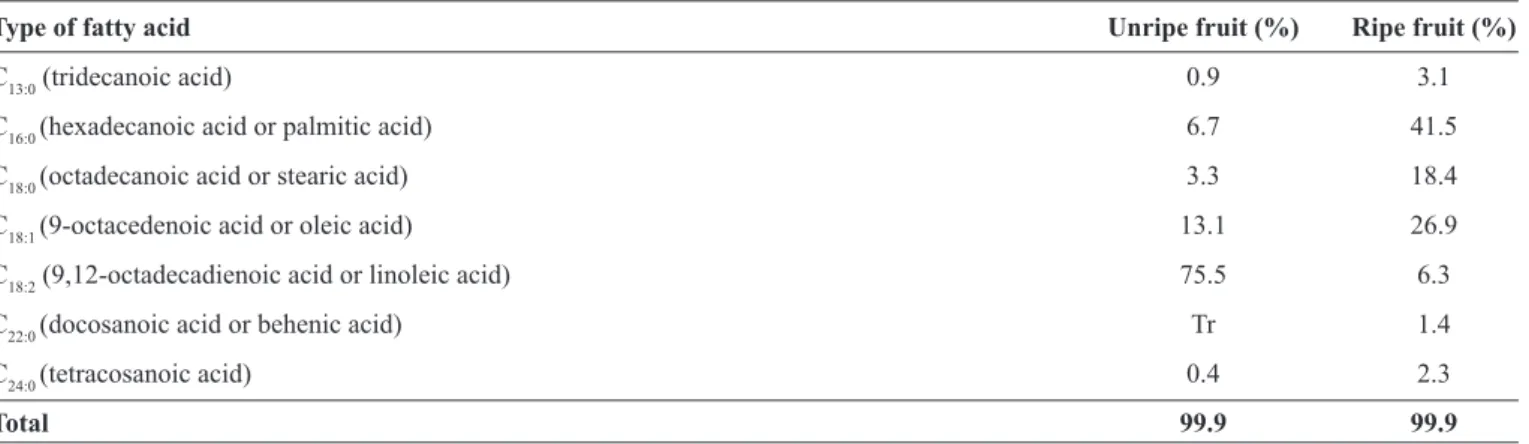
TABLE 1 - Fatty acid composition and oil content of Solanum lycocarpum fruit.
Type of fatty acid Unripe fruit (%) Ripe fruit (%)
C13:0 (tridecanoic acid) 0.9 3.1
C16:0 (hexadecanoic acid or palmitic acid) 6.7 41.5
C18:0 (octadecanoic acid or stearic acid) 3.3 18.4
C18:1 (9-octacedenoic acid or oleic acid) 13.1 26.9
C18:2 (9,12-octadecadienoic acid or linoleic acid) 75.5 6.3
C22:0 (docosanoic acid or behenic acid) Tr 1.4
C24:0 (tetracosanoic acid) 0.4 2.3
Total 99.9 99.9
Tr: trace.
The injection and detector temperature was 250°C. The split
ratio was 1/10. The oven fl ow was 2mL/min and the mass range
was 50-500m/z. Methyl esters were identifi ed by comparison of their retention times with those of standards and by using the National Institute of Standards and Technology (NIST) 2.0 database.
Culex quinquefasciatus larvae were obtained from their biotope as described by Gerberg(9). Third and fourth instar
larvae of C. quinquefasciatus were exposed to different concentrations (0.0011, 0.33, and 100mg/L; dissolved in 1%
dimethyl sulfoxide) of the oils, fatty acids, and methyl esters of S. lycocarpum until the emergence of adults to determine the optimal sub-lethal concentration of the extracted compounds. For each test sample, larvae were divided into test and control groups consisting of 60 specimens each, with 3 replicates
for each treatment. The control group was exposed to 1% dimethyl sulfoxide in water. The temperature was maintained
at 26 ± 1°C throughout all of the tests. The larvicidal bioassay was performed according to the World Health Organization standard protocol(10). Larvae were exposed to the test solutions
and mortality was recorded every 24h over a period of 144h. Three replicates of each treatment were performed. All tested
larvae were of the fi rst generation. Larvae were considered dead
when they did not respond to the stimulus or rise to the surface of the solution. LC50 and LC90 values were calculated by Probit regression (GW Basic 3.22). Differences between the treatment groups were analyzed by Tukey’s test, with results of p < 0.05
considered statistically signifi cant.
In this study, oils obtained from the fruit of S. lycocarpum were analyzed by GC-MS as methyl esters. In S. lycocarpum
fruit, unsaturated fatty acids oleic acid and linoleic acid were detected. Palmitic acid was the most abundant saturated fatty acid, followed by stearic acid (Table 1). Unripe S. lycocarpum fruit exhibited high linoleic acid content (75.5%). Palmitic
acid and oleic acid were the predominant fatty acids in ripe
S. lycocarpum fruit.
The larval mortality rates of each group are shown in
Figure 1. The larvicidal effects in each experiment were
dependent on the particular test solution and concentration that was utilized. The mortality rate was directly proportional to the concentration of oils, fatty acids, or methyl esters to which the
larvae were exposed (Figure 1). FAUF, MERF, OUF, and FARF were most effective at a concentration of 100g/L, with mortality rates of 95%, 93.3%, 90.8%, and 88.9%, respectively, which
were signifi cantly different than the rates produced by the other
treatments (p < 0.05). The lowest tested sample concentrations (0.0011 and 0.33mg/L) showed the lowest mortality rates (Figure 1). There was a complete absence of larval mortality in the dimethyl sulfoxide control group
The LC50 and LC90 values for the tested oils, fatty acids, and methyl esters as estimated by the LC50-LC90 regression equation, as well as the results of chi-square tests, are presented in Table 2. The tested oils, fatty acids, and methyl esters had larvicidal effects against C. quinquefasciatus, with LC50 values between 0.70 and 27.54mg/L, demonstrating more potent larvicidal activity than that of other plant species of the
Solanum genus. Ethanolic extracts of the leaves of Solanum xanthocarpum showed larvicidal activity against third and fourth instar larvae of C. quinquefasciatus(3),with LC
50 values
of 271.12 and 377.40mg/L, respectively. Sakthivadivel and Daniel(4) demonstrated the larvicidal effect of the ethanolic
extract of leaves of Solanum trilobatum on fourth instar larvae of C. quinquefasciatus, with an LC50 value >200mg/L. In a recent study(5), methanolic extract and extract fractions from
unripe S. lycocarpum fruit showed larvicidal effects against
C. quinquefasciatus, with LC50 values of 75.13-207.05mg/L.
In this study, OUF, FAUF, FARF, and MERF showed the
lowest LC90 values (139.47, 93.03, 147.02, and 125.13mg/L,
respectively) and were thus the most toxic of the fractions
against C. quinquefasciatus. Ethanolic extracts of the leaves of S. xanthocarpum also showed activity against third and fourth instar larvae of C. quinquefasciatus(4), with LC
90 values
of 1,011.89 and 1,058.85mg/L, respectively. Changbunjong et al.(11) showed that ethanolic extract of unripe S. xanthocarpum
fruit had larvicidal activity against C. quinquefasciatus, with LC50 and LC90 values of 573.20 and 1,066.93mg/L, respectively,
612
ACKNOWLEDGMENTS Rev Soc Bras Med Trop 48(5):610-613, Sep-Oct, 2015
0 10 20 30 40 50 60 70 80 90 100
OUF ORF FAUF FARF MEUF MERF DMSO
%
M
o
rt
a
li
ty
0.0011mg/L 0.33mg/L 100mg/L
a b
c
b d
e
f g
h
f i
j
k i
l
m n
o
p
FIGURE 1 - Larval mortality rate of Culex quinquefasciatus after exposure to different concentrations of theoils, fatty acids, and methyl esters of unripe and ripe Solanum lycocarpum fruit. Different letters in each column indicate signifi cant differences (p < 0.05)
based on Tukey’s test. OUF: oil of unripe fruit; ORF: oil of ripe fruit; FAUF: fatty acids of unripe fruit; FARF: fatty acids of ripe fruit;
MEUF: methyl esters of unripe fruit; M ERF: methyl esters of ripe fruit; DMSO: dimethyl sulfoxide (control treatment).
Kannathasan et al.(12) evaluated the larvicidal activity of
fatty acid methyl esters (FAMEs) obtained from 3 species of
Vitex against C. quinquefasciatus larvae and reported LC50 values ranging from 9.25 to 18.64mg/L. In this study, MEUF and MERF showed the lowest LC50 values (3.72 and 2.16mg/L, respectively) of the test treatments, indicating more potent larvicidal activity than FAMEs isolated from Vitex species. The difference in the potency of FAMEs isolated from Vitex species and methyl esters from S. lycocarpum may be attributed to differences in methyl ester composition; palmitic and linolenic acid are predominant in Vitex species.
Some experiments show that biological activity against
mosquitoes is mainly due to the presence of long-chain unsaturated fatty acids, rather than of saturated or methylated
forms(13) (14), corroborating the results of this study, in which
fatty acids (FARF and FAUF) had the lowest LC50 values
and were thus the most potent larvicides. Nevertheless, oils
(ORF and OUF) and methyl esters (MERF and MEUF) from ripe and unripe S. lycocarpum fruit also showed larvicidal activity against C. quinquefasciatus. These results form the basis for additional studies aimed at evaluating the potential of oils, fatty acids, and methyl esters isolated from ripe and unripe
S. lycocarpum fruit as natural, plant-based larvicide sources.
The authors are grateful to Prof. Dr. Alexandre Salino for
613
TABLE 2 - Lethal concentrations of oils, fatty acids, and methyl esters of unripe and ripe of Solanum lycocarpum fruit in
Culex quinquefasciatus.
LC50 (95% CI) LC90 (95% CI) Sample
mg/L mg/L Regression equation χ
2 p-value
OUF 2.99 139.47 y = 4.778x + 0.538 5.36 0.25
(1.94-4.63) (35.77-543.82)
ORF 27.54 1,362.42 y = 4.332x + 0.425 8.33 0.21
(13.11-57.88) (126.54-1,467.26)
FAUF 0.70 93.03 y = 5.151x + 0.539 13.33 0.14
(0.44-1.12) (22.61-382.85)
FARF 1.33 147.20 y = 4.942x + 0.538 4.29 0.66
(0.82-2.17) (26.85-806.99)
MEUF 3.72 2,534.55 y = 4.863x + 0.511 8.29 0.08
(0.42-3.92) (156,00-4,178,05)
MERF 2.16 125.13 y = 4.942x + 0.658 13.18 0.38
(1.35-3.45) (30.25-517.46)
LC50: median lethal concentration; 95% CI: 95% confi dence interval; LC90: 90% lethal concentration; χ
2: chi-square. OUF: oil of unripe fruit; ORF: oil of ripe
fruit; FAUF: fatty acids of unripe fruit; FARF: fatty acids of ripe fruit; MEUF: methyl esters of unripe fruit; MERF: methyl esters of ripe fruit; y: probit value; x: log concentration of the sample of the oils, fatty acids, or methyl esters of unripe and ripe fruit.
REFERENCES
The authors declare that there is no confl ict of interest. CONFLICT OF INTEREST
FINANCIAL SUPPORT
The study was supported by the Fundação de Amparo a Pesquisa do Estado de Minas Gerais (FAPEMIG), grant number CEX APQ
01671-12 and the Coordenação de Aperfeiçoamento de Pessoal de Nível Superior (CAPES), via a scholarship to V.C.B. Silva.
1. Alves SN, Tibúrcio JD, Melo AL. Susceptibility of Culex quinquefasciatus larvae to different insecticides. Rev Soc Bras Med Trop 2011; 44:486-489.
2. Prophiro JS, Rossi JCN, Pedroso MF, Kanis LA, Silva OS. Leaf extracts of Melia azedarach Linnaeus (Sapindales: Meliaceae) act as larvicide against Aedes aegypti (Linnaeus, 1762) (Diptera: Culicidae). Rev Soc Bras Med Trop 2008; 41:560-564.
3. Mahesh Kumar P, Murugan K, Kovendan K, Subramaniam J, Amaresan D. Mosquito larvicidal and pupicidal effi cacy of Solanum xanthocarpum (Family: Solanaceae) leaf extract and bacterial insecticide, Bacillus thuringiensis, against Culex quinquefasciatus Say (Diptera: Culicidae). Parasitol Res 2012; 110:2541-2550. 4. Sakthivadivel M, Daniel T. Evaluation of certain insecticidal plants for
the control of vector mosquitos viz. Culex quinquefasciatus, Anopheles stephensi and Aedes aegypti. Appl Entomol Zool 2008; 43:57-63. 5. Pereira TM, Silva VCB, Ribeiro-Neto JA, Alves SN, Lima LARS.
Larvicidal activity of the methanol extract and fractions of the
green fruits of Solanum lycocarpum (Solanaceae) against the vector Culex quinquefasciatus (Diptera: Culicidae). Rev Soc Bras Med Trop 2014; 47:646-648.
6. Vieira Jr G, Ferreira PM, Matos LG, Ferreira EC, Rodovalho W, Ferri PH, et al. Anti-infl ammatory effect of Solanum lycocarpum fruits. Phytother Res2003;17:892-896.
7. Munari CC, Oliveira PF, Lima IMS, Martins SPL, Costa JC, Bastos JK, et al. Evaluation of cytotoxic, genotoxic and antigenotoxic potential of Solanum lycocarpum fruits glicoalkaloid extract in V79 cells. J Food Chem Toxicol 2012; 50:3696-3701.
8. Lima LARS, Johann S, Cisalpino PS, Pimenta LPS, Boaventura MAD. In vitro antifungal activity of fatty acid methyl esters of the seeds of Annona cornifolia A. St. Hil. (Annonaceae) against pathogenic fungus Paracoccidioides brasiliensis.Rev Soc Bras Med Trop 2011; 44:777-780.
9. Gerberg EJ. Manual for mosquito rearing and experimental techniques. Am Mosq Control Assoc 1979; 5:1-124.
10. World Health Organization (WHO). Guidelines for laboratory and fi eld testing of mosquito larvicides; WHO/CDS/WHOPES/ GCDPP/2005.13. WHO; 2005.
11. Changbunjong T, Wongwit W, Leemingsawat S, Tongtokit Y, Deesin V. Effect of Solanum xanthocarpum against snails and mosquito larvae. Southeast Asian J Trop Med Public Health 2010; 41:320-325.
12. Kannathasan K, Senthikumar A, Venkatesalu V, Chandrasekaran M. Larvicidal activity of fatty acid methyl esters of Vitex species against Culex quinquefasciatus. Parasitol Res 2008; 103:999-1001.
13. Bury NR, Codd GA, Wendelaar Bonga SE, Flik G. Fatty acids from the cyanobacterium Microcystis aeruginosa with potent inhibitory effects on fi sh gill Na+/K+-ATPase activity. J Exp Biol 1998; 201:81-89.
14. Morohashi M, Tsuchiya K, Mita T, Kawamura M. Identifi cation of (Na,K)ATPase inhibitor in brine shrimp, Artemia salina, as long-chain fatty acids. J Comp Physiol B 1991; 161:69-72.