INTRODUCTION
Corresponding author: Dra. Keite da Silva Nogueira. Laboratório de Bacteriologia/HC/UFPR. Rua Padre Camargo 280, 80030-400 Curitiba, Paraná, Brasil.
Phone: 55 41 3360-7975; Fax: 55 41 3360-1811 e-mail: [email protected]
Received 12 January 2015 Accepted 1 April 2015
Distribution of extended-spectrum β-lactamase
types in a Brazilian tertiary hospital
Keite da Silva Nogueira
[1], Danieli Conte
[2],
Fernanda Valverde Maia
[3]and Libera Maria Dalla-Costa
[1],[2][1]. Hospital de Clínicas, Universidade Federal do Paraná, Curitiba, Paraná, Brasil. [2]. Faculdades e Instituto de Pesquisa Pelé Pequeno Príncipe, Curitiba, Paraná, Brasil. [3]. Secretaria Municipal de Saúde de Curitiba, Prefeitura Municipal de Curitiba, Curitiba, Paraná, Brasil.
ABSTRACT
Introduction: Epidemiological data on the prevalence of extended-spectrum β-lactamases (ESBLs) are scarce in Brazil despite the fact that these data are essential for empirical treatment and control measures. The objective of this study was to evaluate the
prevalence of different ESBLs by type and distribution in a tertiary hospital in southern Brazil. Methods: We evaluated 1,827
enterobacterial isolates between August 2003 and March 2008 isolated from patients at a tertiary hospital. Samples were identifi ed using a Vitek automated system and were confi rmed by biochemical testing. The identifi ed ESBL strains were characterized by phenotypic methods, polymerase chain reaction (PCR), and sequencing. Genetic similarities were evaluated by pulsed-fi eld gel
electrophoresis. Results: It was 390 (21.3%) ESBL-producing strains, which expressed the ESBLs CTX-M (292), SHV (84), CTX and SHV (10), TEM (2), and PER (2). Conclusions: The prevalence of ESBL-expressing strains was high, especially in Klebsiella pneumoniae and Enterobacter spp. CTX-M was the predominant type of ESBL observed, and its genetic variability indicates a polyclonal distribution.
Keywords: ESBL. CTX-M. Enterobacteriaceae.
Over three decades have passed since the identifi cation of the fi rst extended-spectrum β-lactamase (ESBL)-producing
bacteria. Since then, the prevalence of ESBL-producing strains has increased, and new types and variants have been described.
The fi rst ESBLs were derived from TEM (temoniera) and SHV (sulfhydryl-variable) β-lactamases, which are mainly found in healthcare-associated infections. Cefotaximase (CTX-M)
ESBLs have increased in importance due to the increased frequency of community-acquired infections caused by strains
carrying this enzyme(1) (2).
The frequency and predominant types of ESBL vary from region to region and even between institutions within the same region. The study for monitoring antimicrobial resistance trends
(SMART) surveyed ESBL-producing strains around the world and found that the CTX-M-15 variant predominates(3).
Extended-spectrum β-lactamases are mainly found in Escherichia coli, Klebsiella pneumoniae, and Klebsiella
oxytoca, but have also been described in many other species of Enterobacteriaceae and non-fermenting Gram-negative rodshaped bacteria(1).
According to a study performed in the United States
analyzing data from 2009 to 2011, North America has the lowest
rates of ESBL-producers,with a prevalence of 11.4% to 16.1% in K. pneumoniae and 8.1% in E. coli. In this study, the SHV type of ESBL was most frequently observed, although the authors
reported that CTX-M-14 and CTX-M-15 are increasing in
prevalence and may soon replace SHV-12 as the most common ESBL types(4).
The prevalence of the various ESBL types in Europe varies
from country to country. ESBL has been found in 20.1% of E. coli (0.9%-89.7%) and 45.7% of Klebsiella spp. (2.5-100%), with greater frequencies in Mediterranean countries, Belgium,
and Poland. CTX-M is the predominant type of ESBL found
in Europe, and it is frequently found in community-acquired
infections. Moreover, in some regions, CTX-M is more
commonly found in E. coli than in K. pneumoniae(4) (5) (6).
Extended-spectrum β-lactamase frequencies also vary
among Asian countries. The Antimicrobial Surveillance
Program (SENTRY), conducted from 1998 to 2002, reported
ESBL-producing K. pneumoniae in Singapore (35.6%), China (30.7%), and Japan (10%), and ESBL-producing E. coli in China
(24.5%), Hong Kong (14.3%), and Singapore (11.3%). The most frequent ESBL types in Asia are CTX-M and SHV(6) (7).
METHODS
conducted in the Pacifi c region reported that 10% and 28.1%
of K. pneumoniae in Australia and South Africa, respectively, are ESBL-producers. Additionally, a local study conducted in a Tunisian hospital found E. cloacae ESBL isolates that produce
ESBL types CTX-M and SHV(7) (8).
The highest prevalence of ESBL-producing strains was recorded in South America, although the frequencies vary
among countries; in Guatemala, Mexico, and Peru, ESBLs
are prevalent in E. coli, whereas in Brazil, Cuba, Ecuador, and Venezuela, ESBL prevalence is greater in Klebsiella spp.
(i.e., ≥50%). The most common type of ESBL is CTX-M,
although a few isolates harbor the TEM and SHV ESBL types. The PER-2 type, which is exclusive to South America, is the second most ESBL isolated frequently type in Argentina and has been frequently found in Uruguay, Chile, and Bolivia(9) (10) (11).
A Brazilian survey performed as part of the SENTRY program revealed ESBL frequencies of 10% in E. coli and 50% in K. pneumoniae. Epidemiological data on the prevalence of
ESBL types in Brazil are scarce and suggest that CTX-M is
the predominant ESBL type. Two epidemiological studies conducted in the State of Rio de Janeiro found that the ESBL
CTX-M predominates. One study found a predominance of CTX-M-2, CTX-M-59, and CTX-M-9, but not CTX-M-15(12). In the second study, CTX-M-15was predominant in more than 50%
of K. pneumoniae, E. coli, and E. cloacae isolates(13). A study in
Sao Paulo found 20 CTX-M-2, 14 CTX-M-59, 12 CTX-M-15,
and 13 SHVgenes in ESBL-expressing strains(14). GES (Guiana
Extended Spectrum β-Lactamases), BES (Brazilian Extended Spectrum β-Lactamases), and PER (Pseudomonas Extended
Resistance) types have also been reported in Brazil(10).
Most studies suggest that ESBL-producing strains are polyclonal and that the ESBL features are spread by plasmid transfer; however, during outbreaks, clonal dissemination may occur(14) (15) (16).
The aim of this study was to investigate the prevalence of ESBL types in patients and the genetic similarities between
ESBL strains in a tertiary southern Brazilian hospital.
Sample and control strains
Our survey included 1,827 enterobacterial samples obtained between August 2003 and March 2008 from inpatients at the Clinical Hospital at the Federal University of Paraná. Only one isolate per patient was included in our analysis. The samples
obtained were from urine (856), blood (391), liquor (18), other sterile liquids (138), respiratory samples (336), and abscesses and wounds (88). Identifi cation was performed using a Vitek automated system (bioMérieux, Marcy-l’Etoile, France) and was confi rmed by biochemical testing. Control strains included E. coli RJ-15317 (blaCTX-M-2 positive control), E. coli RJ-694
(blaCTX-M-9 positive control), E. aerogenes RJ-159 (blaCTX-M-8 positive control), K. pneumoniae TEM-3 SP (blaTEM positive
control), K. pneumoniae SHV-5 SP (blaSHV positive control), E. cloacae 532 PR (blaPER-2 positive control), E. coli ATCC
25922 (control for susceptibility testing), and K. pneumoniae ATCC 700603 (positive ESBL phenotype control).
Detection of ESBL producers
The susceptibility disk diffusion test was performed according to Clinical and Laboratory Standards Institute (CLSI) guidelines(17) with the following β-lactam antimicrobials:
ceftazidime, cefotaxime, cefpodoxime, cefepime, aztreonam, cefoxitin, imipenem, meropenem, and ertapenem (Oxoid, Cambridge, UK). Enterobacteriaceae with reduced sensitivity
to one or more β-lactams(18) were tested for the presence of ESBL and the following genes: blaCTX-M,blaTEM, blaSHV, blaPER, blaOXA, blaGES, and blaBES(19). Template deoxyribonucleic acid
(DNA) was obtained using post-boiling- extraction of a heavy suspension of colonies on PCR water. Primers specifi c for
the 16S region were included in all reactions as an internal control. When the internal control was negative, the DNA was extracted again using PureLink® Spin Column-based
DNA extraction kits (Invitrogen, New York, USA). PCR products were purifi ed using the GFX-TM PCR purifi cation kit (Amersham Biosciences, Uppsala, Sweden) and amplifi ed using Dye Terminator GT (Amersham Biosciences). The
product was precipitated with 7.5M ammonium acetate and
95% ethanol, after which the product was sequenced using MegaBACE (Amersham Biosciences) with the following
primers: blaCTX-M (5′-F TGT TAG GAA GTG TGC CGC TG-3’; 5’-R GAC GGC TTT CTG CCT TAG GTT G-3′), blaTEM (5′-F ATG AGT ATT CAA CAT TTC CG3’; 5’-R CCA ATG CTT AAT TCA GTG ACG3′), blaSHV(5′-F TCA GCG AAA AAC ACC TTG; 5’ R TCC CGC AGA TAA ATC ACC A-3′), and blaPER (5′-F CGCTTCTGCTCTGCTGAT3’; 5’R-GGCAGCTTCTTTAACGCC3’). The sequences were compared using basic local alignment search tool (BLAST) analysis based on the GenBank database (http://www.ncbi.nih. gov/BLAST).
Determination of
minimum inhibitory concentration
All ESBL-producing samples were tested for ceftazidime, cefotaxime, cefpodoxime, cefepime, aztreonam, and cefoxitin (Sigma-Aldrich, St Louis, MO, USA); imipenem and ertapenem (Merk Sharp & Dohme Farmacêutica Ltd., Campinas, Brazil); meropenem (AstraZeneca, London, UK); and tigecycline (Wyeth, Philadelphia, USA). Cation-adjusted Mueller Hinton agar (Difco, Franklin Lakes, USA) was used for minimum inhibitory concentration (MIC) analysis, and E. coli strain ATCC 25922 and P. aeruginosa strain ATCC 27853 were used as control strains. The ranges tested were 0.03-256µg/mL for
ceftazidime, cefotaxime, cefpodoxime, cefepime, aztreonam,
and cefoxitin, 0.03-16µg/mL for imipenem, ertapenem, and meropenem, and 0.12-16µg/mL for tigecycline(20).
Analysis of genetic similarity
RESULTS
DISCUSSION
strains using a technique previously described by Kaufmann(21) and adapted by Nogueira(19). PFGE profi les were analyzed in
comparison with the standards in the Gel-Pro Analyzer 4.0 and NTSYS software to calculate the Dice similarity coeffi cient and
to implement Unweighted Pair Group Method with Arithmetic
Mean (UPGMA) to create dendrograms. We used the Tenover(22) criteria to defi ne a clone.
The survey of 1,827 samples yielded 483 (26.4%) strains
with reduced susceptibility to third-generation cephalosporins
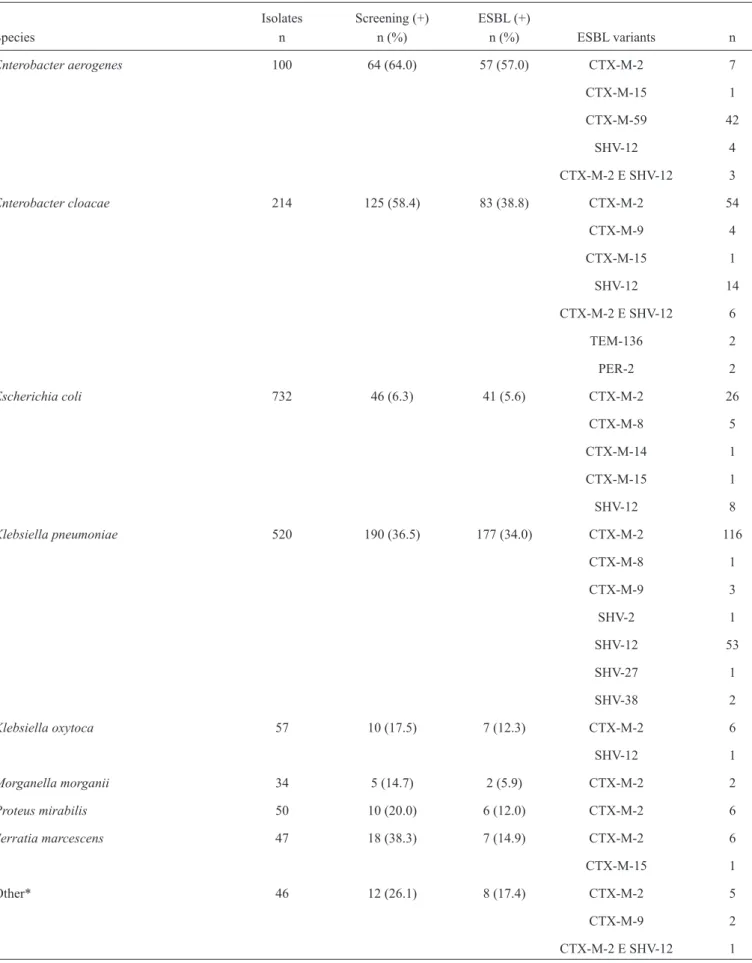
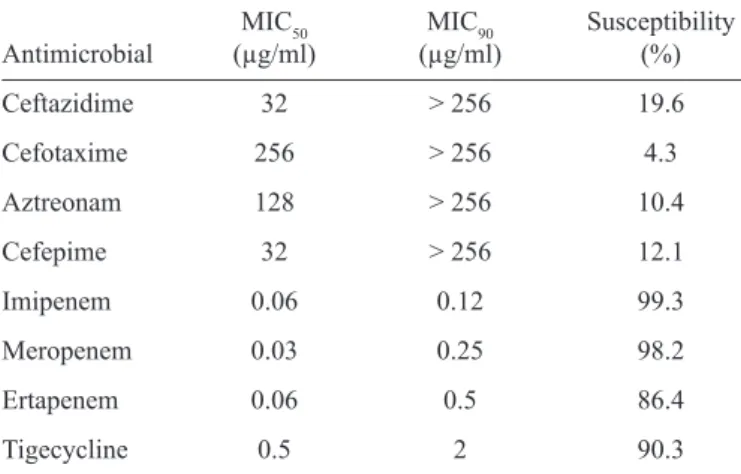
and/or aztreonam, according to CLSI criteria(18). Of these strains, 390 (21.3%) were ESBL-producers, including CTX-M (292), SHV (84), CTX and SHV (10), TEM (2), and PER (2). Table 1 shows the results of the screening and genotype testing for ESBL expression by species. Species with 12 or fewer isolates were grouped as other and included Citrobacter amalonaticus (two non-ESBL), Citrobacter diversus (one non-ESBL), Cronobacter sakazakii (two non-ESBL), Enterobacter gergoviae (three ESBL and seven non-ESBL), Klebsiella ozaenae (six non-ESBL), Pantoea agglomerans (one ESBL and one non-ESBL), Providencia rettgeri (one ESBL), Providencia stuartii (two ESBL and two non-ESBL), Proteus vulgaris (one ESBL and 11 non-ESBL), and Serratia liquefaciens (six non-ESBL). The antimicrobial susceptibility testing of the ESBL strains is presented in Table 2.
A genetic similarity analysis of CTX-M-producing strains
revealed two forms of dissemination: the spread of resistant clones persisting for several years in hospitals and the transmission of resistance-encoding plasmids. This hypothesis is supported by the observation of identical clones, different
types of CTX-M, and unrelated bacterial strains harboring identical ESBL genes. CTX-M-59 was an exception that was
found in a single clone of E. aerogenes. ESBL clones were not restricted to certain hospital areas but were found in intensive
care units (ICU) and other hospital units. They were also present
as causative agents of urinary tract infections, respiratory tract
infections, and bacteremia, among other diseases. Genetic similarities between CTX-M ESBL-producing K. pneumoniae, E. coli, E. cloacae, and E. aerogenes are presented in Figure 1.
The observed prevalence of ESBL-producing strains
(21.3%) was similar to the prevalence reported in another Brazilian study (24.8%) based on phenotype testing.
Notably, previous reports have not been conducted on the prevalence of various ESBL genotypes(23). E. aerogenes, E. cloacae, and K. pneumoniae were the most frequently ESBL-positive species isolated. Epidemiological analysis revealed an unexpectedly high frequency of Enterobacter spp. (i.e., E. aerogenes and E. cloacae) when compared with K. pneumoniae, which is probably due to the spread of a
CTX-M-59-producing E. aerogenes clone throughout the
hospital. In a SENTRY study that included strains from Brazil,
the authors found ESBL rates of 12.8% in Escherichia coli and
49.9% in Klebsiella spp.(11).
The CTX-M ESBL type was present in 74.8% (292/390) of all ESBL-positive strains. CTX-M was fi rst identifi ed in South America and is prevalent in Brazil. It is also the predominant
ESBL type found in other regions of the world and is increasing in frequency, particularly in the context of community-acquired
infections. The CTX-M-2 variant was predominant in our study and was identifi ed in 229 (58.7%) samples. CTX-M-2 was fi rst
described in a strain of Salmonella isolated in Argentina and
was soon reported in Brazil and other South American countries. CTX-M-2 is the predominant ESBL type in Brazil and has been
found in several species of Enterobacteriaceae(11) (24) (25). More
recent studies have reported an increasing number of
CTX-M-15-producing isolates(13) (14) (26).
The CTX-M-59 variant found in isolates of E. aerogenes is an H89 L derivative of CTX-M-2 and was fi rst described
in ESBL-producing K. pneumoniae in Brazil. CTX-M-59 has not been reported outside Brazil or in different species(24). The blaCTX-M-2 and blaCTX-M-59 genes were identifi ed in IncA/C plasmids, reinforcing the possibility of the intraplasmid evolution of blaCTX-M-59 from blaCTX-M-2 and the implication of an effect of IncA/C on blaCTX-M dissemination(12).
CTX-M-15 is predominant in E. coli and K. pneumoniae worldwide but was found in only four of the samples in this study: E. coli (1), E. cloacae (1), E. aerogenes (1), and Serratia marcescens (1). In some countries, outbreaks of E. coli have been driven by a single ESBL-expressing clone that can be
found throughout the world. CTX-M-15 was reported in Brazil for the fi rst time in 2010(24). Moreover, an epidemiological study from Rio de Janeiro identifi ed CTX-M-15 in more than 50% of
ESBL-positive samples(13).
The CTX-M-8 variant was found in fi ve strains of E. coli and one strain of K. pneumonia in our study. CTX-M-8 was fi rst described in Brazil in Citrobacter amalonaticus and E. cloacae; the only other report of this ESBL type was in Spain in 2009(24).
The CTX-M-9 variant was found in nine strains, and CTX-M-14 was found in one strain. CTX-M-9 has been reported in several Brazilian studies and is considered pandemic in Europe similarly to CTX-M-15. CTX-M-14 was fi rst reported in China and was reported in Brazil in 2010(24).
The SHV type was the second most common group of
ESBLs observed in this study, as SHV was found in 94 (24.2%) samples. The SHV-12 variant was found in 90 (23.1%) strains. The SHV enzymes, and SHV-12 in particular, are commonly observed and have been previously reported in Brazil(14). The SHV type is the second most common ESBL group in Brazil
and other countries(16) (24) (27). SHV-2 and SHV-27 were each
found in a single (0.3%) isolate, and SHV-38 was found in two (0.6%) isolates.
The TEM type (TEM-136 variant) was observed in two (0.6%) samples. TEM ESBLs are not common in Brazil, as the only TEM type previously reported in Brazil was TEM-116(25). The TEM type is also less frequently observed than the CTX-M
FIGURE 1 - Electrophoretic profi les of CTX-M ESBL-producing isolates. a: Highlighted cluster A (subtypes A1-A15) and B. b: Highlighted clusters A, B, C (subtypes C1-C3), D, and E. c: Highlighted clusters A (subtype A1), B (subtype B1), C (subtype C1), and D. d: Highlighted cluster A. ESBL: extended spectrum β-lactamase; CTX-M: cefotaximase.
Coeffi cient a) Klebsiella pneumoniae
Coeffi cient b) Enterobacter clocae
Coeffi cient c) Escherichia coli
Coeffi cient d) Enterobacter aerogenes
A
B
A
B
C
D
E
A
B
C
TABLE 1 - Prevalence of ESBL types among Enterobacteriaceae.
Isolates Screening (+) ESBL (+)
Species n n (%) n (%) ESBL variants n
Enterobacter aerogenes 100 64 (64.0) 57 (57.0) CTX-M-2 7
CTX-M-15 1
CTX-M-59 42
SHV-12 4
CTX-M-2 E SHV-12 3
Enterobacter cloacae 214 125 (58.4) 83 (38.8) CTX-M-2 54
CTX-M-9 4
CTX-M-15 1
SHV-12 14
CTX-M-2 E SHV-12 6
TEM-136 2
PER-2 2
Escherichiacoli 732 46 (6.3) 41 (5.6) CTX-M-2 26
CTX-M-8 5
CTX-M-14 1
CTX-M-15 1
SHV-12 8
Klebsiella pneumoniae 520 190 (36.5) 177 (34.0) CTX-M-2 116
CTX-M-8 1
CTX-M-9 3
SHV-2 1
SHV-12 53
SHV-27 1
SHV-38 2
Klebsiella oxytoca 57 10 (17.5) 7 (12.3) CTX-M-2 6
SHV-12 1
Morganella morganii 34 5 (14.7) 2 (5.9) CTX-M-2 2
Proteus mirabilis 50 10 (20.0) 6 (12.0) CTX-M-2 6
Serratia marcescens 47 18 (38.3) 7 (14.9) CTX-M-2 6
CTX-M-15 1
Other* 46 12 (26.1) 8 (17.4) CTX-M-2 5
CTX-M-9 2
CTX-M-2 E SHV-12 1
TABLE 2 - Antimicrobial susceptibility of ESBL-producing strains.
MIC50 MIC90 Susceptibility
Antimicrobial (µg/ml) (µg/ml) (%)
Ceftazidime 32 > 256 19.6
Cefotaxime 256 > 256 4.3
Aztreonam 128 > 256 10.4
Cefepime 32 > 256 12.1
Imipenem 0.06 0.12 99.3
Meropenem 0.03 0.25 98.2
Ertapenem 0.06 0.5 86.4
Tigecycline 0.5 2 90.3
ESBL: extended spectrum β-lactamase; MIC50: minimum inhibitory
concentration 50%;MIC90:minimum inhibitory concentration 90%.
The PER-2 type is restricted to South America and is the second most common group in Argentina(24). PER-2-expressing bacteria
were also described during an outbreak in Uruguay. In Brazil,
the PER-2 type is infrequent and was observed in two isolates previously reported by our group(28).
Ten isolates produced two types of ESBL: SHV-12 and
CTX-M-2. ESBL was also associated with narrow-spectrum β-lactamases (non-ESBL TEM and SHV) in 204 samples. These associations are very common; moreover, different β-lactamases
can be encoded on the same plasmid(29).
The high genetic variability observed among ESBL-producing bacteria indicates polyclonal spread to K. pneumoniae, E. cloacae, and E. coli and a high rate of transfer of ESBL genes between bacteria in healthcare-associated infections. Other
Brazilian studies have found similar results(13) (30). Polyclonal dissemination is also supported by the incidence of identical
clones with different types of CTX-M ESBLs as well as by unrelated isolates expressing identical enzymes. CTX-M-59
did not disseminate and was expressed by a single clone of Enterobacter aerogenes. Other instances of ESBL clonal
dissemination were associated with outbreaks in specifi c hospital
wards(31) (32). By the time of preparation of this manuscript, we have not found an association between the clonal spread of E. aerogenes and an outbreak. ESBL-producing isolates did
not remain restricted to a single ward. Another Brazilian study
found similar results regarding K. pneumonia ESBL(25). The
β-lactamase CTX-M has spread horizontally and vertically,
and clones were not restricted to certain hospital areas but were present in ICUs and other in-patient units. This information is of paramount importance for nosocomial infection control.
Klebsiella pneumoniae isolates consisted of two clonal
groups subdivided into groups A1-A15 (related) and group B. Clonal group A contains CTX-M-2 and CTX-M-9. Clone A K. pneumoniae was found throughout the study period in several clinical isolates, suggesting that Clone A Klebsiella pneumoniae is an endemic microorganism in the hospital. Clone B was
present from 2004 to 2008 in different departments, primarily in intensive care units. The other K. pneumoniae isolates exhibited similarities below the level of highly related or related samples.
The dissemination of ESBLs in E. coli was mostly polyclonal with small highly related clonal groups designated A, B, C, and D. Clone A was found in urine samples of three hematology patients in 2008, with one isolate producing CTX-M-15 and two isolates producing CTX-M-2. Clone B appeared in samples from 2007 and 2008 and included CTX-M-2 and CTX-M-8. Clone C was present in samples from 2004 to 2008; four ICU isolates expressed CTX-M-2, and two ESBL subclones, CTX-M-2 and CTX-M-8, were isolated in other wards. Clone D consisted of thre representative isolates from different wards and different years.
E. aerogenes clones producing CTX-M-59 were isolated from
2004 to 2008, mainly from blood and urine samples obtained from patients in the ICU. Only two isolates showed no clonal relationship with the other isolates.
The spread of E. cloacae was mostly polyclonal, with fi ve
main groups, each including more than three similar strains. Clonal groups were designated A, B, C, D, and E, all of which expressed the ESBL CTX-M-2. Except for clone E, which was mainly isolated from blood samples, the remaining clones were predominantly isolated from urine. Clone A was isolated in 2004-2007, clone B was isolated in 2005-2006, C and E were isolated in 2005-2007, and D was isolated in 2004-2006. All clones were found in different clinics suggesting that they were spread across various hospital departments.
High rates of resistance to cephalosporins and aztreonam were observed; however, a few samples were susceptible according to CLSI criteria(18). Thus, the clinical effi cacy of cephalosporin and aztreonam against ESBL-producing bacteria remains uncertain. Cefepime susceptible-dose dependence (SDD) was found in 12.8% of the ESBL isolates; in cases such as these, higher doses are recommended for infected patients(18).
Carbapenems are considered the drug of choice for treating infections by ESBL-producing microorganisms. This study showed good sensitivity of isolates to carbapenems (99.3% for imipenem, 98.2% for meropenem, and 86.4% for ertapenem), but resistant isolates were also observed (mainly ertapenem). ESBLs do not degrade carbapenems effi ciently but can confer resistance when associated with reduced permeability of the membrane to the drug. Carbapenems displayed good potency and activity, reinforcing the fact that they are an important therapeutic option against these microorganisms. Aminoglycosides have also been associated with high sensitivity rates but are also associated with high toxicity and limited indications. The carbapenems are the most widely used antimicrobial agents to treat infections caused by ESBL-producing strains(9) (10). However, the indications for their use should be clearly defi ned because the indiscriminate use of carbapenems has led to the emergence of resistant strains(30).
Tigecycline has not been approved for the treatment of bacteremia and urinary tract infections; additional studies are
needed to demonstrate its effi cacy(30).
ESBLs are increasing in frequency among several species of enterobacteria. This information is of paramount importance for
nosocomial infection control. CTX-M was the predominant type
observed in our study, which is consistent with other reports from
South America. The ESBL CTX-M has been found in hospitals
and in community, animal, and environmental samples, which illustrates the challenge associated with containing bacteria expressing this ESBL type. The diversity of species in which
CTX-M was found and the great genetic variability observed
among E. coli, K. pneumoniae, and E. cloacae ESBL-producing bacteria indicate a predominantly polyclonal spread and high
transfer effi ciency of ESBL genes between bacteria in the hospital
environment. Moreover, the spread of resistance can occur through the transmission of resistant strains, and resistant clones can be established and remain in hospitals for several years, eventually spreading to other hospitals and causing various types
of infections. One example is the CTX-M-59 gene expressed in
an E. aerogenes strain, which has not been found in other species and has exhibited monoclonal spread. Epidemiological evidence and local studies are important to elucidate the spread of EBSL types, which present a worldwide public health problem.
REFERENCES
The authors declare that there is no confl ict of interest. CONFLICT OF INTEREST
1. Naas T, Poirel L, Nordmann P. Minor extended-spectrum
β-lactamases. Clin Microbiol Infect 2008; 14:42-52.
2. Bush K, Jacoby GA. Updated functional classifi cation of
β-lactamases. Antimicrob Agents Chemother 2010; 54:969-976.
3. Lascols C, Hackel M, Huger AM, Marshall SH, Bouchillon SK, Hoban DJ, et al. Using Nucleic Acid Microarrays to perform Molecular epidemiology and detect novel beta-lactamases: a snapshot of ESBL throughout the world. J Clin Microbiol 2012; 50:1632-1639.
4. Sader HS, Flamm RK, Jones RN. Frequency of occurrence and
antimicrobial susceptibility of Gram-negative bacteremia isolates
in patients with urinary tractc infection: results from United States
and European hospitals (2009-2011). J Chemother 2014; 26:133-138.
5. Cantón R, Novais A, Valverde A, Machado E, Peixe L, Baquero F, et al. Prevalence and spread of extended-spectrum β-lactamase-producing Enterobacteriaceae in Europe. Clin Microbiol Infect 2008; 14:144-153.
6. Jones RN, Flonta M, Gurler N, Cepparulo M, Mendes RE, Castanheira M. Resistance surveillance program report for selected European nations. Diagn Microbiol Infect Dis 2014; 78:429-436.
7. Hirakata Y, Matsuda J, Miyazaki Y, Kamihira S, Kawakami S, Miyazawa Y, et al. Regional variation in the prevalence of
extended-spectrum β-lactamase-producing clinical isolates in the Asia-Pacifi c region (SENTRY 1998-2002). Diagn Microbiol
Infect Dis 2005; 52:323-329.
8. Hammami S, Boutiba-Bem Boubaker I, Saidani M, Lakhal E,
Bem Hassen A, Kamoun A, et al. Characterization and Molecular
epidemiology of extended spectrum beta-lactamases producing Enterobacter cloacae isolated from a Tunisian Hospital. Microb Drug Resist 2012; 18:59-65.
9. Jones RN, Guzman-Blanco M, Gales AC, Gallegos B, Castro AL, Martino MD, et al. Susceptibility rates in Latin American nations:
report from a regional resistance surveillance program. Braz J
Infect Dis 2011; 17:672-681.
10. Villegas MV, Kattan JN, Quinteros MG, Casellas JM. Prevalence of extended-spectrum beta-lactamases in South America. Clin Microbiol Infect 2008; 14:154-158.
11. Gales AC, Castanheira M, Jones RN, Sader HS. Antimicrobial
resistance among Gram-negative bacilli isolated from Latin America: results from SENTRY Antimicrobial Surveillance Program (Latin America, 2008-2010). Diagn Microbiol Infect Dis
2012; 73:354-360.
12. Queiroz ML, Antunes P, Mourão J, Merquior VL, Machado E,
Peixe LV. Characterization of extended-spectrum beta-lactamases,
antimicrobial resistance genes, and plasmid content in Escherichia coli isolates from different sources in Rio de Janeiro. Brazil. Diagn Microbiol Infect Dis 2012; 74:91-94.
13. Seki LM, Pereira PS, de Souza Conceição M, Souza MJ, Marques
EA, Carballido JM, et al. Molecular epidemiology of CTX-M
producing Enterobacteriaceae isolated from bloodstream
infections in Rio de Janeiro, Brazil: emergence of CTX-M-15. Braz J Infect Dis 2013; 7:640-646.
14. Tollentino FM, Polotto M, Nogueira ML, Lincopan N, Neves P,
Mamizuka EM, et al. High prevalence of bla(CTX-M) extended spectrum
beta-lactamase genes in Klebsiella pneumoniae isolates from a tertiary
care hospital: fi rst report of bla(SHV-12), bla(SHV-31), bla(SHV-38), and bla(CTX-M-15) in Brazil. Microb Drug Resist 2011; 17:7-16.
15. Chagas TP, Alves RM, Vallim DC, Seki LM, Campos LC, Asensi
MD. Diversity of genotypes in CTX-M-producing Klebsiella pneumoniae isolated in different hospitals in Brazil. Braz J Infect Dis 2011; 15:420-425.
16. Minarini LA, Clímaco EC, Guimarães DB, Ferreira JC, Palazzo
IC, Martinez R, et al. Clonal transmission of ESBL-producing
Klebsiella spp. at a university hospital in Brazil. Curr Microbiol 2008; 56:587-591.
17. Clinical and Laboratory Standards Institute. Performance Standards for Antimicrobial Disk Susceptibility Testing. Approval Standard-nineth. CLSI document M02-A9; 2008.
18. Clinical and Laboratory Standards Institute. Performance Standards for Antimicrobial Susceptibility Testing. Twenty-Fourth Informational Supplement. CLSI document M100-S24; 2014. 19. Nogueira KS, Paganini MC, Conte A, Cogo LL, Messias Reason IT,
Silva MJ, et al. Emergence of extended-spectrum-lactamase-producing Enterobacter spp. in patients with bacteremia in a tertiary hospital
in southern Brazil. Enferm Infecc Microbiol Clin 2014; 32:67-69.
20. Clinical and Laboratory Standards Institute. Methods for Diluition
Antimicrobial Susceptibility Test for Bacteria that Grow Aerobically.
Approval Standard-seventh. CLSI document M07-A7; 2008. 21. Kaufmann M. Pulsed-fi eld-gel-electrophoresis. In: Woodford
N, Johnson AP, editors. Molecular Bacteriology: protocols and clinical applications. New Jersey: Human Press; 1988. p. 33-51. 22. Tenover FCI, Arbeit RD, Goering RV, Mickelsen PA, Murray BE,
Persing DH, et al. Interpreting chromosomal DNA restriction We would like to thank dr Ana Cristina Gales for proving
control strains for the study.
patterns produced by pulsed-fi eld gel electrophoresis: criteria for
bacterial strain typing. J Clin Microbiol 1995; 33:2233-2339. 23. Lago A, Fuentefria SR, Fuentefria DB. ESBL-producing
enterobacteria in Passo Fundo, state of Rio Grande do Sul, Brazil.
Rev Soc Bras Med Trop 2010; 43:430-434.
24. Cantón R, González-Alba JM, Galán JC.CTX-M enzymes: origin and diffusion. Frontiers in Microbiology 2012; 3:110.
25. Dropa M, Balsalobre LC, Lincopan N, Mamizuka EM, Murakami T, Cassettari VC, et al. Extended-spectrum β-lactamases among Enterobacteriaceae isolated in a public hospital in Brazil. Rev Inst Med Trop Sao Paulo 2009; 51:203-209.
26. Peirano GI, Asensi MD, Pitondo-Silva A, Pitout JD. Molecular
characteristics of extended-spectrum β-lactamase-producing
Escherichia coli from Rio de Janeiro, Brazil. Clin Microbiol Infect 2011; 17:1039-1043.
27. Minarini LA, Gales AC, Palazzo IC, Darini AL. Prevalence of community-occurring extended spectrum beta-lactamase-producing Enterobacteriaceae in Brazil. Curr Microbiol 2007; 54:335-341. 28. Fehlberg LCC, Nogueira KS, Silva RC, Nicoletti AG, Palmeiro
JK, Gales AC, et al. Detection of PER-2-Producing Enterobacter
cloacae in a Brazilian Liver Transplantation Unit. Antimicrobial Agents and Chemotherapy 2014; 58:1831-1832.
29. Carattoli A. Resistance plasmid families in Enterobacteriaceae. Antimicrob Agents Chemother 2009; 53:2227-2238.
30. Wollheim C, Guerra IM, Conte VD, Hoffman SP, Schreiner FJ, Delamare AP, et al. Nosocomial and community infections due
to class A extended-spectrum β-lactamase (ESBLA)-producing
Escherichia coli and Klebsiella spp. in southern Brazil. Braz J Infect Dis 2011; 15:138-143.
31. Feizabadi MM, Mohammadi-Yeganeh S, Mirsalehian A, Azimi
P, Mirafshar SM, Mahboobi M, et al. Genetic characterization of
ESBL-producing strains of Klebsiella pneumoniae from Tehran hospitals. J Infect Dev Ctries 2010; 4:609-615.
32. Biehl LM, Schmidt-Hieber M, Liss B, Cornely OA, Vehreschild MJ.
Colonization and infection with extended spectrum beta-lactamase
producing Enterobacteriaceae in high-risk patients - Review of the literature from a clinical perspective. Crit Rev Microbiol 2014;p. 1-16. Ahead of Print. Available at: http://informahealthcare.com/doi/abs/10.