Systematic review
Lapatinib for treatment of advanced or metastasized breast
cancer: systematic review
Lapatinib no tratamento do câncer de mama avançado ou metastático: revisão sistemática
Rachel Riera
I, Patrícia Coelho de Soárez
II, Maria Eduarda dos Santos Puga
III, Marcos Bosi Ferraz
IVCentro Paulista de Economia da Saúde (CPES), Universidade Federal de São Paulo (Unifesp), São Paulo, Brazil
IMD, MSc. Physician and research assistant at Centro Paulista de Economia da Saúde (CPES), Universidade Federal de São Paulo (Unifesp), São Paulo, Brazil. IIMSc. Dental surgeon, professor and researcher at Centro Paulista de Economia da Saúde (CPES), Universidade Federal de São Paulo (Unifesp), São Paulo, Brazil. IIIMSc. Librarian and research assistant at Centro Paulista de Economia da Saúde (CPES), Universidade Federal de São Paulo (Unifesp), São Paulo, Brazil. IVMD, MSc, PhD. Physician and Director of Centro Paulista de Economia da Saúde (CPES), Universidade Federal de São Paulo (Unifesp), São Paulo, Brazil.
ABSTRACT
CONTEXT AND OBJECTIVE: Around 16% to 20% of women with breast cancer have advanced, metastasized breast cancer. At this stage, the disease is treatable, but not curable. The objective here was to assess the effectiveness of lapatinib for treating patients with advanced or metastasized breast
cancer.
DESIGN AND SETTING: Systematic review of the literature, developed at Centro Paulista de Economia da Saúde (CPES), Universidade Federal de São Paulo (Unifesp).
METHOD: Systematic review with searches in virtual databases (PubMed, Lilacs [Literatura Latino-Americana e do Caribe em Ciências da Saúde], Cochrane Library, Scirus and Web of Science) and manual search.
RESULTS: Only one clinical trial that met the selection criteria was found. This study showed that lapatinib in association with capecitabine reduced the risk of cancer progression by 51% (95% conidence interval, CI: 0.34-0.71; P < 0.001), compared with capecitabine alone, without any increase in severe adverse effects.
CONCLUSION: The combination of lapatinib plus capecitabine was more effective than capecitabine alone for reducing the risk of cancer progression. Further randomized clinical trials need to be carried out with the aim of assessing the effectiveness of lapatinib as monotherapy or in association for
irst-line or second-line treatment of advanced breast cancer.
RESUMO
CONTEXTO E OBJETIVO: Aproximadamente 16% a 20% das mulheres com câncer de mama têm doença avançada com metástases. Neste estágio, a doença é tratável, porém incurável. O objetivo foi avaliar a efetividade do lapatinib no tratamento de pacientes com câncer de mama avançado ou metastático.
TIPO DE ESTUDO E LOCAL: Revisão sistemática da literatura desenvolvida no Centro Paulista de Economia da Saúde (CPES), Universidade Federal de São Paulo (Unifesp).
MÉTODO: Revisão sistemática com busca em bases de dados virtuais (PubMed, Lilacs [Literatura Latino-Americana e do Caribe em Ciências da Saúde], Cochrane Library, Scirus and Web of Science) e busca manual.
RESULTADOS: Foi encontrado apenas um ensaio clínico que preencheu os critérios de seleção. Este estudo mostrou que o lapatinib em associação com a capecitabina reduziu em 51% o risco de progressão da doença (intervalo de coniança, IC 95%: 0,34-0,71; P < 0,001) quando comparado com a
capecitabina isolada, sem aumento de efeitos adversos graves.
CONCLUSÃO: A combinação de lapatinib e capecitabina foi mais efetiva do que a capecitabina isolada na redução do risco de progressão da doença. Ensaios clínicos aleatórios devem ser realizados com o objetivo de avaliar a efetividade do lapatinib como monoterapia ou em associação no tratamento primário ou secundário do câncer de mama avançado.
KEY WORDS: Breast neoplasms.
Review.
Antineoplastic agents.
Antineoplastic protocols. Receptor, erbB-2.
PALAVRAS-CHAVE:
Neoplasias de mama. Revisão.
Antineoplásicos. Protocolos antineoplásicos.
INTRODUCTION
Breast cancer is the most common type of cancer found in women
and is the main cause of cancer deaths among women.
1In 2000, more
than one million new cases of breast cancer were reported, and
approxi-mately 373,000 deaths worldwide were attributed to this.
1While many cases of breast cancer in the early stages are successfully
treated, it is considered incurable when there is recurrence of the disease
with metastasis. Nevertheless, such situations are treatable.
2Advanced or metastasized breast cancer is deined as a clinical stage
that corresponds to phases III and IV of the cancer, based on the tumor
itself, lymph node involvement and metastases.
3Approximately 16% to 20% of women with breast cancer have
ad-vanced, metastasized breast cancer, and 50% of early-stage breast cancer
ultimately develops to metastasized breast cancer.
4Some women with
metastasized breast cancer live for many years, but the average survival
upon diagnosis ranges from 18 to 24 months.
3,5Women with advanced
or metastasized breast cancer that overexpresses epidermal growth factor
receptors (EGFR) have a worse prognosis, with a high risk of recurrence
after the primary treatment and a 50% reduction in mean survival.
4-6he treatment objective in cases of advanced or metastasized breast
cancer is to control the symptoms and prolong life, given that such
cases are considered incurable and that irst-line surgery will have been
inefective.
3-7Although there is no evidence from randomized
stud-ies comparing chemotherapy with observation alone, among women
with this type of breast cancer, it is widely accepted that these patients
should receive some type of systematic treatment at some point
dur-ing the illness.
8In advanced cases, the therapies usually include prescription of
an-thracycline or a combination of cyclophosphamide, methotrexate and
luorouracil.
9,10he guidelines published by the National Institute for
Health and Clinical Excellence (NICE) also include capecitabine,
vi-norelbine,
docetaxel, paclitaxel,
gemcitabine and trastuzumab.
4,11-14Considering that women with breast cancer with overexpression of
EGFR are at greater risk of cancer progression, therapeutic strategies
have been developed to block the activity of these receptors and to
im-prove the response to treatment.
15,16he EGFR family includes four subtypes: HER-1 (human
epi-dermal receptor), HER-2, HER-3 and HER-4.
17-19Overexpression of
HER-1 occurs in approximately 27%-30% of breast cancer cases, while
overexpression of HER-2 is recorded in 20%-25% of the 1.5 million
new breast cancer cases diagnosed annually worldwide.
17,18hese receptors do not stay put in a given spot on the cell
mem-brane, and the extracellular domains of pairs of receptors attach to each
other via a connection that forms a dimer. hese dimers may be
ho-modimers (i.e. two identical receptors, such as HER-1 and HER-1, etc.)
or heterodimers (i.e. diferent receptors, such as HER-1 and HER-2,
etc.).
17-21After dimerization, the intracellular tyrosine kinase domain is
activated, thus stimulating cell proliferation.
17Lapatinib (GW572016/Tykerb; GlaxoSmithKline, Research
Trian-gle Park, North Carolina, United States) is an oral inhibitor of HER-1
and HER-2 receptors that attaches to the intracellular tyrosine kinase
domain, thereby blocking the growth of tumor cells.
17,22It presents
some theoretical advantages over monoclonal antibodies that block the
intracellular domain of the HER-2 receptor (e.g. trastuzumab,
Hercep-tin; Genentech, Inc., South San Francisco, California, United States).
6Inhibition of a single receptor subtype cannot be as efective as
dou-ble inhibition of the heterodimers containing HER-1 and HER-2.
23Moreover, there are truncated receptors that do not have extracellular
domains and that are not recognized by the antibodies that connect to
this domain. In fact, a truncated form of HER-2 known as p95 that
has much more tyrosine kinase activity than other forms of HER-2 has
been documented.
6Lapatinib has been efective in inhibiting p95HER-2
phosphoryla-tion in BT474 cells and in tumor xenografts. On the other hand,
tras-tuzumab does not bind to or inhibit the p95HER-2 receptor, which
suggests that resistance to trastuzumab can be measured through the
overexpression of p95HER-2 receptors during cancer progression.
24Overexpression of p95HER-2 receptors has also been observed as an
independent prognostic factor for breast cancer cases, thus deining a
group of patients with increased expression of HER-2 that demonstrates
a shorter cancer-free survival period.
25In practice, in cases of metastasis,
resistance to trastuzumab occasionally develops,
in addition to
recur-rence after adjuvant therapy.
26-30Given the theoretical beneits of lapatinib, taking into account the
prevalence of this type of cancer and the diiculty in managing it, a
sys-tematic review is necessary in order to map out the evidence available,
prove the efectiveness of this medication and, thus, provide support for
its use in treating advanced or metastasized breast cancer.
OBJECTIVE
To assess the efectiveness of lapatinib as monotherapy or in
associa-tion with another drug during irst-line or second-line treatment of
pa-tients with advanced or metastasized breast cancer.
MATERIAL AND METHODS
1. Search strategy
A systematic review of the literature was conducted from the
fol-lowing sources: a) virtual search: Cochrane Library, PubMed, Embase,
Lilacs (Literatura Latino-Americana e do Caribe em Ciências da Saúde),
Web of Science and Scirus; b) manual search: search of the references
listed in articles and congress abstracts, contacts with authors and
con-tacts with the pharmaceutical industry. he search strategy used for each
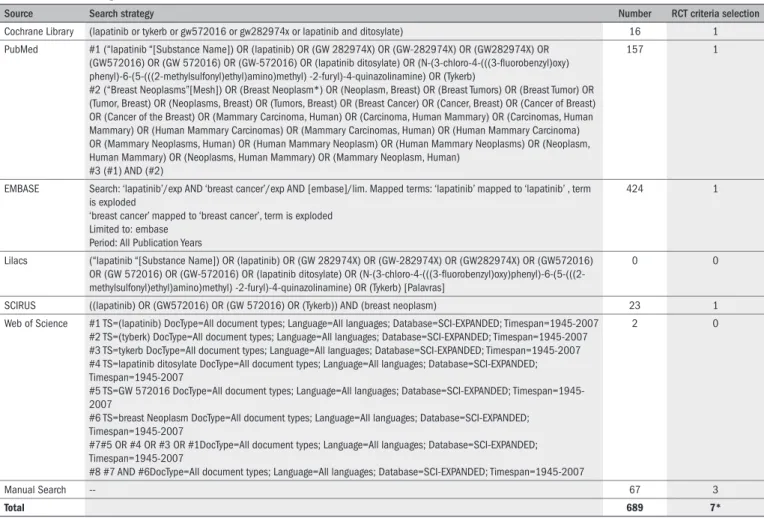
virtual database is available in
Table 1
.
2. Study selection criteria
he criteria for study selection were that they should be
random-ized clinical trials assessing the efectiveness of lapatinib as monotherapy
or in association with another drug, compared with placebo or
anoth-er intanoth-ervention or treatment for women with advanced or metastasized
breast cancer, as a irst-line or second-line treatment.
3. Assessment of study methodological quality
he following evaluation scales were used: a) Jadad, ranging from
0 to 5, in which higher ratings signiied better methodological quality
of implementation of the study; and b) the Cochrane Collaboration
Handbook.
31,32RESULTS
hree papers were selected, which each reported on a single
ran-domized clinical trial that met the selection criteria.
16,33,34he same
pa-pers were found in more than one database as well as in the manual
search. No randomized clinical trials that evaluated the efectiveness of
lapatinib as monotherapy for irst-line or second-line treatment of
ad-vanced or metastasized breast cancer were found. Nor were any
random-ized clinical trials assessing the efectiveness of lapatinib in association
with another drug for irst-line treatment for metastasized breast cancer
found. he search strategy and its results are contained in
Table 1
.
he clinical trial included in the systematic review evaluated 324
women with advanced breast cancer with HER-2 receptors (T4
prima-ry tumor and stage IIIB or IIIC) or with metastasized cancer that had
progressed subsequent to irst-line treatment with anthracycline, taxane
and trastuzumab.
16he cancer was evaluated according to the Response
Evaluation Criteria in Solid Tumors (RECIST), modiied to include
le-Table 1.
Search strategies and results
Source Search strategy Number RCT criteria selection
Cochrane Library (lapatinib or tykerb or gw572016 or gw282974x or lapatinib and ditosylate) 16 1 PubMed #1 (“lapatinib “[Substance Name]) OR (lapatinib) OR (GW 282974X) OR (GW-282974X) OR (GW282974X) OR
(GW572016) OR (GW 572016) OR (GW-572016) OR (lapatinib ditosylate) OR (N-(3-chloro-4-(((3-luorobenzyl)oxy) phenyl)-6-(5-(((2-methylsulfonyl)ethyl)amino)methyl) -2-furyl)-4-quinazolinamine) OR (Tykerb)
#2 (“Breast Neoplasms”[Mesh]) OR (Breast Neoplasm*) OR (Neoplasm, Breast) OR (Breast Tumors) OR (Breast Tumor) OR (Tumor, Breast) OR (Neoplasms, Breast) OR (Tumors, Breast) OR (Breast Cancer) OR (Cancer, Breast) OR (Cancer of Breast) OR (Cancer of the Breast) OR (Mammary Carcinoma, Human) OR (Carcinoma, Human Mammary) OR (Carcinomas, Human Mammary) OR (Human Mammary Carcinomas) OR (Mammary Carcinomas, Human) OR (Human Mammary Carcinoma) OR (Mammary Neoplasms, Human) OR (Human Mammary Neoplasm) OR (Human Mammary Neoplasms) OR (Neoplasm, Human Mammary) OR (Neoplasms, Human Mammary) OR (Mammary Neoplasm, Human)
#3 (#1) AND (#2)
157 1
EMBASE Search: ‘lapatinib’/exp AND ‘breast cancer’/exp AND [embase]/lim. Mapped terms: ‘lapatinib’ mapped to ‘lapatinib’ , term is exploded
‘breast cancer’ mapped to ‘breast cancer’, term is exploded Limited to: embase
Period: All Publication Years
424 1
Lilacs (“lapatinib “[Substance Name]) OR (lapatinib) OR (GW 282974X) OR (GW-282974X) OR (GW282974X) OR (GW572016) OR (GW 572016) OR (GW-572016) OR (lapatinib ditosylate) OR (N-(3-chloro-4-(((3-luorobenzyl)oxy)phenyl)-6-(5-(((2-methylsulfonyl)ethyl)amino)methyl) -2-furyl)-4-quinazolinamine) OR (Tykerb) [Palavras]
0 0
SCIRUS ((lapatinib) OR (GW572016) OR (GW 572016) OR (Tykerb)) AND (breast neoplasm) 23 1 Web of Science #1 TS=(lapatinib) DocType=All document types; Language=All languages; Database=SCI-EXPANDED; Timespan=1945-2007
#2 TS=(tyberk) DocType=All document types; Language=All languages; Database=SCI-EXPANDED; Timespan=1945-2007 #3 TS=tykerb DocType=All document types; Language=All languages; Database=SCI-EXPANDED; Timespan=1945-2007 #4 TS=lapatinib ditosylate DocType=All document types; Language=All languages; Database=SCI-EXPANDED; Timespan=1945-2007
#5 TS=GW 572016 DocType=All document types; Language=All languages; Database=SCI-EXPANDED; Timespan=1945-2007
#6 TS=breast Neoplasm DocType=All document types; Language=All languages; Database=SCI-EXPANDED; Timespan=1945-2007
#7#5 OR #4 OR #3 OR #1DocType=All document types; Language=All languages; Database=SCI-EXPANDED; Timespan=1945-2007
#8 #7 AND #6DocType=All document types; Language=All languages; Database=SCI-EXPANDED; Timespan=1945-2007
2 0
Manual Search -- 67 3
Total 689 7*
* There were overlaps in the references, resulting in a total of three papers, which actually reported the data from the same clinical study. Of these papers, one was an original article, and the others were congress abstracts pub-lished in journal supplements. RCT = randomized clinical trial.
sions measuring 15 to 19 mm, with the ventricular ejection fraction
within normal range as established by the institution and with the renal,
hepatic and hematological systems functioning properly. Women with
previous heart conditions, illnesses that could interrupt gastrointestinal
absorption and patients who had ever received capecitabine as
mono-therapy before the beginning of this study were excluded. One group
(n
=
161) received capecitabine 2500 mg/m
2/day orally on days 1 and
14 in a 21-day cycle and the other group (n = 163) received capecitabine
2000 mg/m
2/day orally on days 1 and 14 every 3 weeks and lapatinib
1250 mg/day orally, continuously. he randomization was
implement-ed in groups of six patients and, for the groups to be homogenous and
comparable, they were stratiied according to the cancer stage and the
presence or absence of visceral disease.
study as having moderate risk of bias.
31,32According to the
level-of-ev-idence classiication established by the Oxford Centre for Evlevel-of-ev-idence-
Evidence-Based Medicine, the results from this clinical study support the use of
lapatinib in association with capecitabine, at the doses prescribed and
for this speciic group of patients with advanced or metastasized breast
cancer, with a level of evidence of 1b and a grade of recommendation of
A.
35he study was inanced and conducted by GlaxoSmithKline.
he published results from this trial correspond to an internal
anal-ysis (n
=
324) on a study that intended to include 528 patients
(statis-tical power
=
90%,
α
=
0.05) and which was conducted after 114
in-stances of cancer progression. Since this analysis demonstrated that the
addition of lapatinib to capecitabine was associated with a reduction in
the risk of disease progression by 51%, the safety monitoring committee
recommended that the study should be closed and that a report
contain-ing this information should be drafted.
Based on updated data from this study, in March 2007 the Swiss
government and the United States (US) Food and Drug Administration
(FDA) approved the use of lapatinib in combination with capecitabine
for treatment of metastasized or advanced breast cancer with HER-2
re-ceptors, for patients who had received anthracycline, taxane and
trastu-zumab as irst-line treatment.
30,36he updated results demonstrated that
there was a signiicant increase in the average length of time until cancer
progression in the combined-treatment group, from 18.6 to 27.1 weeks
(HR
=
0.57; 95% CI 95%: 0.43-0.77; P
=
0.00013).
36he total
re-sponse rate also remained high in the combined-treatment group: 24%
(95% CI: 18%-30.3%) versus 14% (95% CI: 9.5%-19.5%).
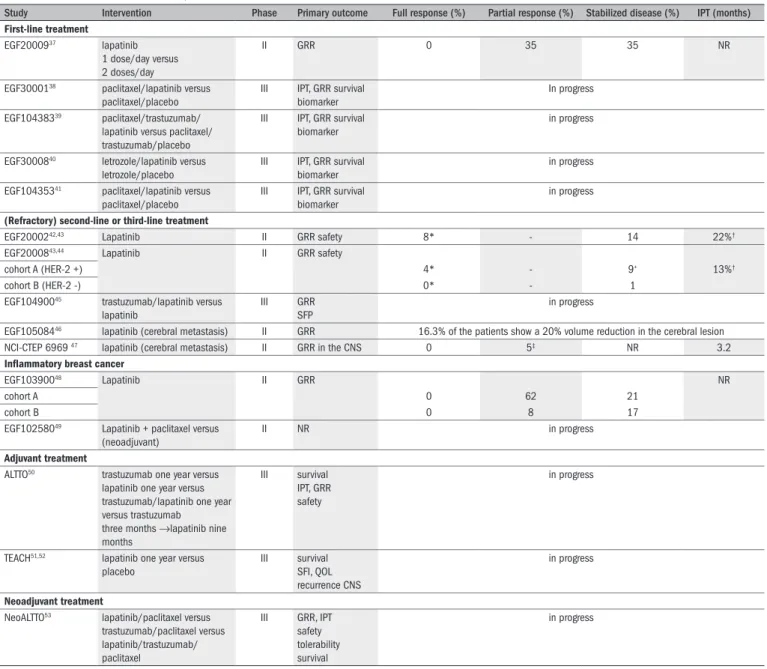
36No randomized clinical trials evaluating the efectiveness of
lapa-tinib in any of the following situations were found: a) as the sole
irst-line or second-irst-line treatment for advanced or metastasized breast
can-cer; b) as part of a combined treatment for the irst-line or
second-line treatment of advanced or metastasized breast cancer; c) as part of a
combined treatment for irst-line treatment of advanced or metastasized
breast cancer; or d) as part of a combined treatment with a drug other
than capecitabine for second-line treatment of advanced or metastasized
breast cancer. herefore,
Table 3
includes data from phase II and III
clinical studies that have already been implemented or are in progress,
with objectives that it within the foregoing list.
37-53CONCLUSIONS
he combination of lapatinib and capecitabine was more efective
than capecitabine alone for reducing the risk of cancer progression in
Table 2.
Outcomes from intention-to-treat (effectiveness) analysis
16Outcomes Lapatinib + capecitabine
(n=163)
Capecitabine alone (n=161)
Risk ratio (95% CI)
P-value
Average length of time until disease progression (months) 8.4 4.4 0.49 (0.34-0.71) < 0.001*
Average length of survival free from disease progression (months) 8.4 4.1 0.47 (0.33-0.67) < 0.001*
Total response rate % (95% CI) 22 (16-29) 14 (9-21) - 0.09†
Full response n (%) 1 (<1) 0 (0) -
-Partial response n (%) 35 (21) 23 (14) -
-Patients with clinical beneit n (%) 44 (27) 29 (18) -
-Deaths n (%) 36 (22) 35 (22) -
-CI = conidence interval. *log-rank test; † Fisher’s exact test.
Compared with capecitabine alone, the association of lapatinib and
capecitabine doubled the average length of time until disease progression,
which was 8.4 months for the latter and 4.4 months for the group
treat-ed solely with capecitabine (hazard ratio
=
0.49; 95% conidence
inter-val, CI: 0.34-0.71; P
<
0.001). In other words, the combined treatment
reduced the risk of breast cancer progression by 50%, in relation to
treat-ment solely with capecitabine. An increase in the length of time until
dis-ease progression was observed for all patients in the group that received
the combined treatment. he secondary outcomes are shown in
Table 2
.
Four patients in the combined therapy group developed cerebral
metastasis as the irst progression site, compared with 11 patients in the
group treated solely with capecitabine (P
=
0.10). he frequency of
ad-verse efects was similar in the two groups, with the exception of
diar-rhea, which occurred more frequently in the combined-treatment group
(P
<
0.001). he treatment discontinuation rate due to side efects was
13% in the combined-therapy group and 12% in the group treated
sole-ly with capecitabine. he most common adverse efects in both groups
were diarrhea, hand-foot syndrome, nausea, vomiting, fatigue and rash.
Asymptomatic reduction of the left ventricular ejection fraction
≥
20%
was observed in four patients in the combined-treatment group and in
one patient in the single-treatment group, but there were no
symptom-atic cardiac events or cases of discontinuation of the treatment due
pri-marily to cardiac function.
DISCUSSION
Considering that only one clinical trial evaluating the
efective-ness of lapatinib for treating advanced or metastasized breast cancer
was found and selected, and considering that this study only dealt with
the use of lapatinib for second-line treatment and in association with
capecitabine, there are limitations on the results from this systematic
re-view, despite their relevance.
With regard to methodological evaluation, the study that was
re-viewed was given a rating of B on the scale set out in the Cochrane
Collaboration Handbook and a rating of 3 on the Jadad scale, since it
demonstrated an adequate randomization technique, was double blind
and described losses and exclusions.
31,32Nevertheless, the study
Table 3.
Phase II and III studies on lapatinib for treatment of advanced or metastasized cancer
Study Intervention Phase Primary outcome Full response (%) Partial response (%) Stabilized disease (%) IPT (months)
First-line treatment
EGF2000937 lapatinib
1 dose/day versus 2 doses/day
II GRR 0 35 35 NR
EGF3000138 paclitaxel/lapatinib versus
paclitaxel/placebo
III IPT, GRR survival biomarker
In progress
EGF10438339 paclitaxel/trastuzumab/
lapatinib versus paclitaxel/ trastuzumab/placebo
III IPT, GRR survival biomarker
in progress
EGF3000840 letrozole/lapatinib versus
letrozole/placebo
III IPT, GRR survival biomarker
in progress
EGF10435341 paclitaxel/lapatinib versus
paclitaxel/placebo
III IPT, GRR survival biomarker
in progress
(Refractory) second-line or third-line treatment
EGF2000242,43 Lapatinib II GRR safety 8* - 14 22%†
EGF2000843,44 Lapatinib II GRR safety
cohort A (HER-2 +) 4* - 9+ 13%†
cohort B (HER-2 -) 0* - 1
EGF10490045 trastuzumab/lapatinib versus
lapatinib
III GRR SFP
in progress
EGF10508446 lapatinib (cerebral metastasis) II GRR 16.3% of the patients show a 20% volume reduction in the cerebral lesion
NCI-CTEP 6969 47 lapatinib (cerebral metastasis) II GRR in the CNS 0 5‡ NR 3.2
Inlammatory breast cancer
EGF10390048 Lapatinib II GRR NR
cohort A 0 62 21
cohort B 0 8 17
EGF10258049 Lapatinib + paclitaxel versus
(neoadjuvant)
II NR in progress
Adjuvant treatment
ALTTO50 trastuzumab one year versus
lapatinib one year versus trastuzumab/lapatinib one year versus trastuzumab
three months →lapatinib nine months
III survival IPT, GRR safety
in progress
TEACH51,52 lapatinib one year versus
placebo
III survival SFI, QOL recurrence CNS
in progress
Neoadjuvant treatment
NeoALTTO53 lapatinib/paclitaxel versus
trastuzumab/paclitaxel versus lapatinib/trastuzumab/ paclitaxel
III GRR, IPT safety tolerability survival
in progress
ALTTO = Adjuvant Lapatinib and/or Trastuzumab Treatment Optimization; NeoALTTO = Neoadjuvant Lapatinib and/or Trastuzumab Treatment Optimization; NR = not reported; QOL = quality of life; SFI = survival free from illness; SFP = survival free from progression; CNS = central nervous system; TEACH = Tykerb Evaluation After Chemotherapy; IPT = illness progression time; GRR = general response rate; EGF = epidermal growth factor.
* general response, including full and partial response; † 16 weeks of survival free from cancer progression; ‡CNS response/cerebral metastases response.
women with metastasized or advanced breast cancer with
overexpres-sion of HER-2 receptors and who had received irst-line treatment with
anthracycline, taxane and trastuzumab.
Lapatinib seems to be an adequate adjuvant treatment for
HER-2-positive breast cancer, since it demonstrates efectiveness in cases of
ad-vanced and metastasized cancer, appears to have few serious side efects
and may be associated with reduction of the incidence of cerebral
metas-tasis, in addition to its easy oral administration once a day.
Randomized clinical trials need to be implemented, with the
objec-tive of assessing the efecobjec-tiveness of lapatinib as monotherapy for
irst-line or second-irst-line treatment of advanced breast cancer, as well the
ef-fectiveness of lapatinib in associations as the primary treatment. An
eco-nomic study with a cost efectiveness evaluation is also necessary, in
or-der to incorporate this new technology into clinical practice.
REFERENCES
1. Parkin DM, Bray FI, Devesa SS. Cancer burden in the year 2000. The global picture. Eur J Cancer. 2001;37(Suppl 8):S4-66.
2. Carrick S, Parker S, Thornton CE, Ghersi D, Simes J, Wilcken N. Single agent versus com-bination chemotherapy for metastatic breast cancer. Cochrane Database Syst Rev. 2009;(2):CD003372.
3. New and Emerging Technology Brieing. National Horizon Scanning Centre. Lapatinib (GW572016) for advanced or metastatic breast cancer. The University of Birmingham; 2005. Available from: http://www.haps.bham.ac.uk/publichealth/horizon/outputs/ documents/2005/Lapatinib.pdf. Accessed in 2009 (Oct 28).
4. National Institute for Clinical Excellence. Guidance on the use of trastuzumab for the treat-ment of advanced breast cancer. London: National Institute for Clinical Excellence; 2002. Available from: http://www.nice.org.uk/nicemedia/pdf/advancedbreastcancerno34PDF. pdf. Accessed in 2009 (Oct 28).
6. Moy B, Goss PE. Lapatinib: current status and future directions in breast cancer. Oncologist. 2006;11(10):1047-57.
7. Johnston S, Stebbing J. Breast cancer: metastatic in clinical evidence, issue 8. London: BMJ Publishing Group; 2002.
8. Wilcken N, Hornbuckle J, Ghersi D. Chemotherapy alone versus endocrine therapy alone for metastatic breast cancer. Cochrane Database Syst Rev. 2003;(2):cd002747.
9. Hortobagyi GN, Piccart-Gebhart MJ. Current management of advanced breast cancer. Semin Oncol. 1996;23(5 Suppl 11):1-5.
10. National Horizon Scanning Centre. New and Emerging Technology Brieing. Lapatinib (GW572016) for advanced or metastatic breast cancer. Available from: http://www.nelm. nhs.uk/en/NeLM-Area/Evidence/Drug-Speciic-Reviews/496451/?query=GW572016&r ank=100. Accessed in 2009 (Oct 28).
11. National Institute for Clinical Excellence. Guidance on the use of capecitabine for the treat-ment of locally advanced or metastatic breast cancer. Technology Appraisal
Available from: http://guidance.nice.org.uk/TA62. Accessed in 2009 (Nov12). 12. National Institute for Clinical Excellence. Guidance on the use of vinorelbine for the treatment
of advanced breast cancer. London: National Institute for Clinical Excellence; 2002. Available from: http://www.burypct.nhs.uk/cg/nicepdf/niceta54.pdf. Accessed in 2009 (Oct 28). 13. National Institute for Clinical Excellence. Taxanes for the treatment of breast cancer. NICE
Technology Appraisal Guidance. Available from: http://www.nice.org.uk/cat.asp?c=1122. Accessed in 2009 (Nov 12).
14. National Institute for Health and Clinical Excellence. Gemcitabine for the treatment of me-tastatic breast cancer. London: National Institute for Health and Clinical Excellence 2007. Available from: http://www.nice.org.uk/nicemedia/pdf/TA116guidance.doc. Accessed in 2009 (Oct 28).
15. Slamon DJ, Clark GM, Wong SG, Levin WJ, Ullrich A, McGuire WL. Human breast cancer: correlation of relapse and survival with ampliication of the HER2/neu oncogene. Science. 1987;235(4785):177-82.
16. Geyer CE, Forster J, Lindquist D, et al. Lapatinib plus capecitabine for HER2-positive advan-ced breast cancer. N Engl J Med. 2006;355(26):2733-43.
17. Atalay G, Cardoso F, Awada A, Piccart MJ. Novel therapeutic strategies targeting the epider-mal growth factor receptor (EGFR) family and its downstream effectors in breast cancer. Ann Oncol. 2003;14(9):1346-63.
18. Chu I, Blackwell K, Chen S, Slingerland J. The dual ErbB1/ErbB2 inhibitor, lapatinib (GW572016), cooperates with tamoxifen to inhibit both cell proliferation- and estro-gen-dependent gene expression in antiestrogen-resistant breast cancer. Cancer Res. 2005;65(1):18-25.
19. Yarden Y. The EGFR family and its ligands in human cancer: signalling mechanisms and therapeutic opportunities. Eur J Cancer. 2000;37(Suppl 4):S3-8.
20. Rini BI. VEGF-targeted therapy in metastatic renal cell carcinoma. Oncologist. 2005;10(3): 191-7.
21. Yarden Y, Sliwkowski MX. Untangling the ErbB signalling network. Nat Rev Mol Cell Biol. 2001;2(2):127-37.
22. Mendelsohn J, Baselga J. Status of epidermal growth factor receptor antagonists in the biology and treatment of cancer. J Clin Oncol. 2003;21(14):2787-99.
23. Rusnak DW, Afleck K, Cockerill SG, et al. The characterization of novel, dual ErbB-2/ EGFR, tyrosine kinase inhibitors: potential therapy for cancer. Cancer Res. 2001;61(19): 7196-203.
24. Xia W, Liu LH, Ho P, Spector NL. Truncated ErbB2 receptor (p95ErbB2) is regulated by he-regulin through heterodimer formation with ErbB3 yet remains sensitive to the dual EGFR/ ErbB2 kinase inhibitor GW572016. Oncogene. 2004;23(3):646-53.
25. Sáez R, Molina MA, Ramsey EE, et al. p95HER-2 predicts worse outcome in patients with HER-2-positive breast cancer. Clin Cancer Res. 2006;12(2):424-31.
26. Tripathy D, Slamon DJ, Cobleigh M, et al. Safety of treatment of metastatic breast cancer with trastuzumab beyond disease progression. J Clin Oncol. 2004;22(6):1063-70.
27. Montemurro F, Donadio M, Clavarezza M, et al. Outcome of patients with HER2-positive advan-ced breast cancer progressing during trastuzumab-based therapy. Oncologist. 2006;11(4): 318-24.
28. Slamon DJ, Leyland-Jones B, Shak S, et al. Use of chemotherapy plus a monoclonal anti-body against HER2 for metastatic breast cancer that overexpresses HER2. N Engl J Med. 2001;344(11):783-92.
29. Vogel CL, Cobleigh MA, Tripathy D, et al. Eficacy and safety of trastuzumab as a single agent in irst-line treatment of HER2-overexpressing metastatic breast cancer. J Clin Oncol. 2002;20(3):719-26.
30. Drugs for breast cancer. Treat Guidel Med Lett. 2005;3(29):1-6.
31. Jadad AR, Moore RA, Carroll D, et al. Assessing the quality of reports of randomized clinical trials: is blinding necessary? Control Clin Trials. 1996;17(1):1-12.
32. Higgins JPT, Green S, editors. Cochrane Handbook for Systematic Reviews of Interventions 4.2.6 [updated September 2006]. In: The Cochrane Library, Issue 4. Chichester: John
Wiley & Sons Ltd; 2006. Available from: http://www.cochrane.org/resources/handbook/ Handbook4.2.6Sep2006.pdf. Accessed in 2009 (Oct 27).
33. Geyer CE, Forster JK, Cameron D, et al. Scientiic Special Session: Lapatinib in Trastuzumab Resistant Breast Cancer. In 42nd Annual Meeting of the American Society of Clinical Oncology. June 2-6, 2006; Atlanta. Available from: http://www.asco.org/ASCOv2/Meetings/Abstracts?&vmview=abst_de-tail_view&confID=40&abstractID=90002. Accessed in 2009 (Nov 16).
34. Cameron D, Casey M, Press M, et al. A phase III randomized comparison of lapatinib plus capecitabine versus capecitabine alone in women with advanced breast cancer that has progressed on trastuzumab: updated eficacy and biomarker analyses. Breast Cancer Res Treat. 2008;112(3):533-43.
35. Phillips B, Ball C, Sackett D, et al. Oxford Centre for Evidence-based Medicine Levels of Evi-dence (May 2001). Available from: http://www.cebm.net/index.aspx?o=1047. Accessed in 2009 (Nov 12).
36. Food and Drug Administration. FDA Approves Tykerb for Advanced Breast Cancer Patients. Available from: http://www.fda.gov/NewsEvents/Newsroom/PressAnnouncements/2007/ ucm108866.htm. Accessed in 2009 (Oct 28).
37. Gomez HL, Chavez MA, Doval DC, et al. A phase II, randomized trial using the small mo-lecule tyrosine kinase inhibitor lapatinib as a irst-line treatment in patients with FISH positive advanced or metastatic breast cancer. Journal of Clinical Oncology. 2005;23(16 Suppl 1). [abstract 3046]. Available from: http://www.cancer.net/ASCOv2/Meetings/ Abstracts?&vmview=abst_detail_view&confID=34&abstractID=31998. Accessed in 2009 (Oct 28).
38. ClinicalTrials.gov. Paclitaxel with/without GW572016 (lapatinib) as irst line therapy for wo-men with advanced or metastatic breast cancer. Available from: http://www.clinicaltrials. gov/ct/show/NCT00075270?order=1. Accessed in 2009 (Oct 28).
39. ClinicalTrials.gov. ErbB2 over-expressing metastatic breast cancer study using paclita-xel, trastuzumab, and lapatinib. Available from: http://www.clinicaltrials.gov/ct/show/ NCT00272987. Accessed in 2009 (Oct 29).
40. ClinicalTrials.gov . Study comparing GW572016 and letrozole versus letrozole in subjects with advanced or metastatic breast cancer. Available from: http://www.clinicaltrials.gov/ct/ show/NCT00073528. Accessed in 2009 (Oct 29).
41. Paoletti P. SVP MDC oncology. Tikerb at ASCO 2006. Available from: http://www.gsk.com/in-vestors/presentations/2006/06072006-roundtable-paole.pdf. Accessed in 2009 (Nov 12). 42. Blackwell KL, Kaplan EH, Franco SX, et al. A phase II, open-label, multicenter study of GW572016 in patients with trastuzumab-refractory metastatic breast cancer. Journal of Cli-nical Oncology. 2004;22(14 Suppl.):196. [abstract 3006]. Available from: http://meeting. ascopubs.org/cgi/content/abstract/22/14_suppl/3006. Accessed in 2009 (Oct 29). 43. Blackwell KL, Burstein H, Pegram M, et al. Determining relevant biomarkers from tissue
and serum that may predict response to single agent lapatinib in trastuzumab refractory metastatic breast cancer. Journal of Clinical Oncology. 2005;23(Suppl 16):S193. [abstract 3004]. Available from: http://meeting.ascopubs.org/cgi/content/abstract/23/16_suppl/ 3004?maxtoshow=&HITS=20&hits=20&RESULTFORMAT=&fulltext=Determining+relevant+ biomarkers+from+tissue+and+serum+that+may+predict+response+to+single+agent+lapa tinib+in+trastuzumab+refractory+metastatic+breast+cancer+&searchid=1&FIRSTINDEX=0 &resourcetype=HWCIT. Accessed in 2009 (Oct 29).
44. Burstein H, Storniolo AM, Franco S, et al. A phase II, open-label, multicenter study of la-patinib in two cohorts of patients with advanced or metastatic breast cancer who have progressed while receiving trastuzumab-containing regimens. Ann Oncol. 2004;15(Suppl 3):iii27 (abstract 1040). Available from: http://annonc.oxfordjournals.org/cgi/reprint/15/ suppl_3/iii27. Accessed in 2009 (Oct 29).
45. Lapatinib in combination with trastuzumab versus lapatinib monotherapy in subjects with metastatic breast cancer. ClinicalTrials.gov [Web site]. Available from: http://www.clinical-trials.gov/ct/show/NCT00320385?order=1. Accessed in 2009 (Apr 16).
46. Lin NU, Dieras V, Paul D, et al. EGF105084, a phase II study of lapatinib for brain metastases in patients (pts) with HER2+ breast cancer following trastuzumab (H) based systemic the-rapy and cranial radiothethe-rapy (RT) [abstract]. Journal of Clinical Oncology. 2007;25(Suppl 18):S1012. Available from: http://meeting.ascopubs.org/cgi/content/abstract/25/18_ suppl/1012. Accessed in 2009 (Oct 28).
47. Lin NU, Carey LA, Liu MC, et al. Phase II trial of lapatinib for brain metastases in patients with HER2+ breast cancer. Journal of Clinical Oncology. 2006;24(Suppl 18):S503. Available from: http://meeting.ascopubs.org/cgi/content/abstract/24/18_suppl/503?maxtoshow =&HITS=20&hits=20&RESULTFORMAT=&fulltext=Phase+II+trial+of+lapatinib+for+brain+ metastases+in+patients+with+HER2_breast+cancer&searchid=1&FIRSTINDEX=0&resourc etype=HWCIT. Accessed in 2009 (Oct 28).
49. Cristofanilli M, Boussen H, Baselga J, et al. A phase II combination study of lapatinib and paclitaxel as a neoadjuvant therapy in patients with newly diagnosed inlammatory breast cancer (IBC) [abstract]. Breast Cancer Research and Treatment. 2006;100(Suppl 1):S5. 50. Piccart-Gebhart MJ, Perez EA, Baselga J. ALTTO (adjuvant lapatinib and/or trastuzumab
tre-atment optimization) study (BIG 2– 06/N063D/EGF106708): A phase III study for HER-2-overexpressing early breast cancer [abstract]. The Breast. 2006;15(Suppl 1):S5. 51. Moy B, Maltzman JD, Goss PE. Phase II study of lapatinib after completion of adjuvant
therapy in trastuzumab-naive women with ErbB2-overexpressing breast cancer. The Breast. 2007;16(Suppl 1):S47.
52. Moy B, Goss PE. TEACH: Tykerb evaluation after chemotherapy. Clin Breast Cancer. 2007;7(6):489-92.
53. ClinicalTrials.gov. Neo ALTTO (Neoadjuvant Lapatinib and/or Trastuzumab Treatment Optimi-zation) Study. Available from: http://www.clinicaltrials.gov/ct2/show/NCT00553358?term =lapatinib&type=Intr&cond=breast+cancer&intr=%22Paclitaxel%22&rank=15. Accessed in 2009 (Oct 29).
Source of funding: This study received inancial support from GlaxoSmithKline
Conlict of interest: None
Date of irst submission: February 6, 2009
Last received: November 17, 2009
Accepted: November 18, 2009
Address for correspondence:
Rachel Riera
Centro Paulista de Economia da Saúde Rua Botucatu, 685
Vila Clementino — São Paulo (SP) — Brazil CEP 04023-062