Review article
Biomechanical parameters of gait among transtibial amputees:
a review
Parâmetros biomecânicos da marcha de amputados transtibiais: revisão
Alex Sandra Oliveira de Cerqueira Soares
I, Edward Yuji Yamaguti
II, Luis Mochizuki
III, Alberto Carlos Amadio
IV, Júlio Cerca Serrão
VBiomechanical Laboratory of the School of Physical Education and Sport, Universidade de São Paulo (USP), São Paulo, Brazil
IMSc. Assistant professor in the Physiotherapy Department, Universidade de Taubaté (Unitau), Taubaté, São Paulo, Brazil. IIGraduate of Physical Education, School of Physical Education and Sport, Universidade de São Paulo (USP), São Paulo, Brazil. IIIPhD. Assistant professor in the School of Arts, Science and Humanities, Universidade de São Paulo (USP), São Paulo, Brazil. IVPhD. Full professor of the School of Physical Education and Sport, Universidade de São Paulo (USP), São Paulo, Brazil. VPhD. Associate professor in the School of Physical Education and Sport, Universidade de São Paulo (USP), São Paulo, Brazil.
ABSTRACT
Rehabilitation for lower-limb amputees needs to focus on restoration of daily functions and independent locomotion. As gait is reestablished, reorganization of the motor pattern takes place in order to optimize the functions of the locomotor system. Biomechanics is a ield of study that enables understanding of this reorganization. From such knowledge, appropriate strategies for recovering the autonomy of the means of locomotion can be established. Thus, this paper had the aim of reviewing the current status of the biomechanics of locomotion among unilateral transtibial amputees. To achieve this aim, papers written in English or Portuguese and published up to 2005 were selected from the Cochrane Library, PubMed, Scientiic Electronic Library Online (SciELO), Literatura Latino-Americana e do Caribe em Ciências da Saúde (Lilacs) and Dedalus databases. In cases of transtibial amputation, the absence of plantar lexors negatively affects locomotion. Increased absorption and energy generation by the muscles that control the hip joint of the amputated leg can be considered to be the main compensatory strategy developed by unilateral transtibial amputees during gait. Factors associated with the characteristics of the amputation, prosthesis and experimental protocol used directly inluence the results.
RESUMO
A reabilitação de amputados de membro inferior deve focar a restauração das funções cotidianas e da locomoção independente. À medida que a marcha é restabelecida, ocorre a reorganização do padrão motor com a inalidade de otimizar as funções do sistema locomotor. A Biomecânica é uma área de estudo que possibilita a compreensão desta reorganização. A partir desse conhecimento, podem-se estabelecer estratégias adequadas para recuperação da autonomia dos meios de locomoção. Assim, este artigo tem por objetivo criar um sumário do atual status do estudo da biomecânica da locomoção de amputados transtibiais unilaterais. Para alcançar tal objetivo foram selecionados artigos nas bases de dados Cochrane Library, PubMed, SciELO (Scientiic Electronic Library Online), Lilacs (Literatura Latino-Americana e do Caribe em Ciências da Saúde) and Dedalus escritos em língua inglesa e portuguesa publicados até o ano de 2005. Na amputação transtibial, a ausência dos lexores plantares repercute de forma negativa na locomoção. O aumento da absorção e geração de energia pelos músculos que controlam a articulação do quadril da perna amputada pode ser considerado a principal estratégia compensatória desenvolvida por amputados transtibiais unilaterais durante a marcha. Fatores ligados às características da amputação, prótese e protocolo experimental estudados inluenciam diretamente os resultados analisados.
KEY WORDS:
Amputation. Biomechanics. Gait. Rehabilitation. Artiicial limbs.
PALAVRAS-CHAVE:
INTRODUCTION
Reestablishment of independent and functional walking is one of the main focuses of rehabilitation for lower-limb amputees.1 In cases of
transtibial amputation, which is the level dealt with in the present study, reorganization of the motor pattern is marked by loss of the plantar lex-ors. his muscle group is responsible for generating about 80% of the mechanical power needed during the gait cycle.2 hrough description,
analysis and synthesis of the knowledge created by biomechanics, the re-percussions of this loss can be understood and appropriate rehabilitation strategies for this amputation level can then be established.
Knowledge of locomotion originates from diferent ields of inves-tigation within biomechanics: kinematics, kinetics and electromyogra-phy (EMG). Studies in the ield of kinematics have mainly emphasized descriptions of space-time parameters in order to analyze the symmetry between limbs.3-7 In addition, they ofer the possibility of evaluating the
success of the rehabilitation process.8,9 Studies on kinetics seek to
elu-cidate the mechanisms for control and management of movement,2,10,11
and to provide ample knowledge of the behavior of the ground reaction force (GRF).5,12-15 hrough electromyography, the main muscle
strat-egies developed can be elucidated.5,11,16,17 In all cases, the inluence of
prosthetic components such as feet,10,15,18-21 factors in experimental
pro-tocols such as speed6,7,17,21 and characteristics of amputation15 are noted
in relation to movement.
hus, this article summarizes the indings from each ield of bio-mechanics and then discusses the strategies developed by the locomotor system at this level of amputation.
METHODS
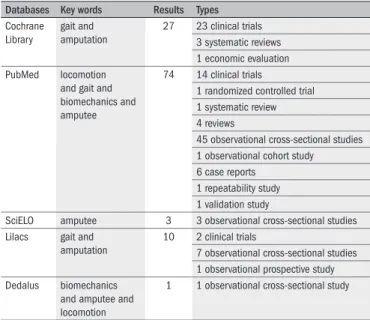
he Cochrane Library, PubMed, Scientiic Electronic Library On-line (SciELO), Literatura Latino-Americana e do Caribe em Ciências da Saúde (Lilacs) and Dedalus databases were consulted in order to carry out this review of the literature (Table 1). he key words used were:
lo-comotion, gait, biomechanics and amputation (amputee). English and Portuguese language articles published up to 2008 that satisied the fol-lowing inclusion criteria were selected: texts analyzing biomechanical gait parameters for unilateral transtibial amputees and samples consist-ing of at least three volunteers.
In this paper, the following abbreviations were used: PL for pros-thetic leg, NAL for non-amputated leg and CG for control group.
RESULTS
Biomechanics of locomotion for transtibial amputees
Kinematics focuses on the measuring of gait among lower-limb am-putees through recording variables such as speed, cadence, stride length and single stance duration. hese were some of the irst variables to be described in this population.3,4 Kinematics can be deined as the ield of
movement description, irrespective of the force caused. With regard to such parameters, we found diferent combinations of results between PL and NAL,3,5-7 marked by individual characteristics and by the
compo-nents of the prostheses used in diferent studies.
Isakov et al.5 analyzed the natural speed of walking (1.25 m/s)
among fourteen volunteers with prostheses composed of patellar ten-don bearing (PTB) sockets and solid ankle cushion heel (SACH) feet. hey found greater stride duration, swing duration and stride length in the PL, whilst the stance duration and single stance duration were shorter. he shorter single stance duration was consequent to the SACH foot, since its rigid ankle speeds up the weight transfer from the heel to the forefoot, thus resulting in shorter stance duration for the PL and the swing phase for the NAL.
Breakey3 found results similar to those of Isakov et al.5 regarding
stance duration for the PL. Soares6 found diferent results from analysis
of gait at a average speed (1.2 m/s) among ive amputee athletes with dy-namic response feet. he duration of the stride and stance were similar for the PL and the NAL, but the swing time was shorter in the PL.
Diferent results were found by Isakov et al.7 from analyzing the
ef-fect of speed on the symmetry between the limbs of fourteen amputees with SACH feet (nine with PTB sockets and ive with a supracondylar tibial prosthesis) at a natural walking speed (0.9 m/s) and a fast speed (1.4 m/s). he stance duration, double-limb stance duration, step dura-tion and step length were symmetrical at the two speeds and in the pairs of legs. Asymmetry was found for the angular variation of the knee. At the time of load response, as expected, there was increased lexing of the knee in the NAL on moving from the natural speed to the fast speed. his did not happen in the PL. Furthermore, at the time of foot release, there was greater lexing of the knee in the PL because of absence of dor-silexion in the prosthetic foot.
Analysis of prosthetic feet while walking is commonly approached through such parameters, as done by Powers et al.18 in analyzing ive
feet (Carbon Copy II, Seattle, Quantum, SACH and Flex foot) among ten volunteers at a natural speed. he speed and cadence, irrespective of the foot, were similar between the legs (NAL and PL) and groups (am-putees and CG), whereas the length of the Flex foot stride (1.5 m) was
Table 1. Description of the databases consulted, key words and
combinations used, results achieved and types of experimental delineation among the papers found
Databases Key words Results Types
Cochrane Library
gait and amputation
27 23 clinical trials 3 systematic reviews 1 economic evaluation PubMed locomotion
and gait and biomechanics and amputee
74 14 clinical trials
1 randomized controlled trial 1 systematic review 4 reviews
45 observational cross-sectional studies 1 observational cohort study 6 case reports
1 repeatability study 1 validation study
SciELO amputee 3 3 observational cross-sectional studies Lilacs gait and
amputation
10 2 clinical trials
7 observational cross-sectional studies 1 observational prospective study Dedalus biomechanics
and amputee and locomotion
greater than the length of the SACH (1.44 m) and Quantum (1.44 m), while all the others were similar (Carbon Copy II 1.46 m, Seattle 1.47 m and CG 1.51 m). Regarding the joint trajectories, only the ankle pre-sented diferences. he Flex foot achieved greater dorsilexion (23.2º) than the others: Quantum 19.5º, Carbon Copy II 12.1º, Seattle 15.1º and SACH 12.0º, and the Quantum dorsilexion was greater than that of the SACH, Seattle and Carbon Copy feet.
hrough kinematic parameters, it is also possible to analyze the progress of rehabilitation among lower-limb amputees. Baker and Hewison8 used speed analysis as a performance index. hey
demonstrat-ed increasdemonstrat-ed spedemonstrat-ed as a result of rehabilitation. It must be stressdemonstrat-ed that the increase was more notable over the irst ifteen days following dis-charge of the initial weight.
To improve the understanding of inter-limb symmetry, Dingwell et al.9 used a combination of kinematic and kinetic parameter
analy-sis. Kinetics is the ield of biomechanics that analyses internal and ex-ternal forces. Inex-ternal forces come from muscle or ligament activity, or from the friction between the muscles and joints. External forces in hu-man locomotion come from the GRF that acts on the huhu-man body and throughout the locomotor system. hus, through using a monitored treadmill, the pressure centre, stance duration and the second peak of the vertical GRF component were recorded. In comparisons between PL and NAL, the variables of stance duration and second peak of the vertical GRF component were asymmetrical. To reduce this asymmetry, training was carried out with visual feedback from the variables ana-lyzed, and the single stance duration was taken as the variable test. he training reduced the asymmetry in the three variables trained, but the variable test either improved or worsened. his result shows that reduc-ing the asymmetry in one variable does not result in improvement of others involved in the same phenomenon.
Prior use of GRF to analyze inter-limb symmetry is an important indicator of mechanical overload imposed on the lower limbs.6,12-14
Chronic abnormalities of gait, as occur in cases of lower-limb amputa-tion, may lead to degenerative problems such as meniscus lesions.22
hrough analysis of the variables relating to the irst peak of the ver-tical GRF component, several studies have found that the mechanical shock in the PL of unilateral transtibial amputees when walking is lower than in the NAL and lower than among non-amputees.6,12-14,17
Soares6 and Tonon and Avila14 reported smaller magnitude and
slower growth in the vertical GRF component in the PL. Lewallen et al.23 found the same in children, which was related to an attempt to
in-crease the inter-limb symmetry. According to these authors, the smaller magnitude and slower growth of the force was a consequence from re-ductions in the speed of gait and length of stride, and increases in the duration of double limb stance and support in the PL, compared with the NAL.
Soares6 analyzed the gait of ive amputee athletes and found
simi-lar results for the growth of the vertical component at natural walking speed (1.2 m/s), comparing PL and NAL. Unlike the abovementioned authors, this author stated that the symmetry was possibly related to the use of lexible feet and the high level of functional capacity in the sam-ple. In the same study, an increase in speed (1.6 m/s) again generated smaller magnitude and slower growth in the vertical component.
Such asymmetry suggests that the NAL experiences higher overload than the PL does. To study this hypothesis, Hurley et al.24 analyzed the
internal forces of joint reactions in the hips, knees and ankles of unilat-eral transtibial amputees, and found similar results for the hips, in com-parisons between PL and NAL. For the knee and ankle, throughout the stance phase and especially in the irst 25% of the cycle, the horizon-tal reaction forces were greater in the NAL. his difered from the CG, which presented inter-limb symmetry.
Barth et al.13 came up with results that indicated the dependence of
the force on the prosthetic foot. In this case, at self-selected speeds, the Carbon Copy II and Quantum feet presented higher force values during the load response in the PL, while the SACH, SAFE, Seattle and Flex feet resulted in symmetry between the supports.
Menard et al.12 analyzed diferent kinds of feet (Flex and Seattle)
and identiied diferences in comparisons between the CG and NAL. In the NAL with the Flex foot, the irst peak of the vertical component (Fy1) was lower and the time taken to achieve it was greater than seen in the CG, whereas in the Seattle foot, Fy1 was greater, with a simi-lar time interval. With regard to the mediolateral and anteroposterior components, the PL presented symmetry. In this case, the mediolateral component presented greater intensity in the PL, whereas the antero-posterior component showed lower values for peaks and impulses for propulsion and braking.
Mizuno et al.15 analyzed the GRF associated with spatial-temporal
parameters to characterize 12 diferent prosthetic feet (three uniaxial, two multiaxial and seven rigid feet). Symmetry indices were calculated: 1- stride length rate; 2- speed rate; 3- eiciency of deceleration and ac-celeration; 4- magnitude of delexing of the vertical GRF component from the irst to the second peak; and 5- patterns presented by the an-teroposterior component of the GRF. his was done from the rates in the PL and NAL to compare them with the rates from the left and right feet of the CG. Greater symmetry was found among the amputees for all variables. In addition to the inluence of the prosthetic foot, these variables were inluenced by the length of the stump, the level of muscle force from the lower limbs and the time interval since the amputation.
Studies on GRF among amputee populations have focused on anal-ysis of the vertical component,6,9,12,14,15,17 while few have explored the
anteroposterior12,15 and mediolateral12 components. Zmitrewicz et al.25
drew attention towards analysis of the anteroposterior component, be-cause this leads to understanding of the speciic parameters relating to the braking and propulsion phases. hese authors analyzed the inluence of the number of axes and the type of foot on the anteroposterior com-ponent and spatial-temporal parameters. With regard to axes, a multi-axial system was incorporated in the SACH and Carbon Copy II feet. Insertion of the axis did not inluence the speed and cadence developed. he same was found for the stance duration, step length, braking im-pulse, ratio between the peaks and force peaks in the braking phase, and the propulsion of both supports. However, the NAL propulsion impulse increased after insertion of the axis in both feet. It can be noted that the number of axes in the prosthetic foot may have an inluence on the be-havior of the NAL.
under-stand the postural adjustments made during speciic gait events, such as gait initiation26 and gait termination27 and the gait initiation
proc-ess when stepping up and stepping down to a new level.28 he strategies
used for gait initiation when the PL is used are marked by reduction or even absence of transference from the COP posteriorly, in conjunction with reduction in the irst force peak for all three GRF components.26
However, in gait termination, there is a reduction in transference from the COP anteriorly and a reduction in the braking force. hus, the tra-jectory of the COP increases mediolaterally.27 Furthermore, through
ki-nematics, it has been shown that the PL is used preferentially for start-ing movement and the NAL for stoppstart-ing it, while in both tasks, there are greater propulsive forces and braking in the NAL.26,27 In an earlier
study,29 the same authors pointed out that to overcome an obstacle
dur-ing the gait trajectory, unilateral transtibial amputees used the PL pref-erentially. hus, increased knee lexion was the main strategy used in the control group to overcome the obstacle, and this was found to be similar among the amputees studied.29
Jones et al.28 stated that, to start the gait process when stepping up
and stepping down to a new level, amputees preferentially used the PL for stepping up and the NAL for stepping down. In these cases, in be-ginning the process with the PL, the COP was directed anteriorly, un-like in the control group, in which it was directed posteriorly. his be-havior reduced the extensor moment generated in the knee joint of the PL and increased the speed of movement during stepping up, in relation to stepping down. his strategy difered from that presented by the con-trol group, for which the speed was greater when stepping down, since the posterior trajectory of the COP was greater. In this way, the ampu-tees minimized the instability generated during stepping down conse-quent to the slope of the terrain and reduced the extensor moment re-quired by the knee of the PL.
To improve the understanding of the strategies developed dur-ing walkdur-ing, consequent to amputation, the moments of mechanical power and joint work need to be analyzed. Winter and Sienko2
ana-lyzed the moment and power of the hip, knee and ankle joints in the sagittal plane among eight amputees (ive SACH, two uniaxial and one Greissinger foot) during walking at a natural speed. hey found that absence of the sural triceps had a direct inluence on the adapta-tion of the joints near to the amputaadapta-tion level. hus, the PL present-ed an initial dorsilexor moment that was three times greater than in the CG, because of the delayed contact of the SACH and Greissing-er feet with the ground. Since these feet wGreissing-ere only deformed slightly, the energy absorbed and returned in the ankle region was small, and therefore the lexor plantar moment generated during propulsion by the PL was about 60-70% of that seen in the CG. During propulsion in the Greissinger foot, 30% of the energy absorbed was returned. In the uniaxial foot, the return was 20%, and in the SACH foot, energy was dissipated through its rigid material. In the knee, the moment and mechanical power were almost zero during the load response and mid-stance. Before propulsion, the lexor moment and negative power were found to be the same as in the CG, but during the swing phase, these values were near to zero. he absence of plantar lexors increased the energy absorption in the hip at the beginning of the stance and conse-quently increased the power generated at the end.
To determine whether dynamic response feet (Flex and Seattle feet) behave in a similar way to rigid feet (SACH), Gitter et al.10 investigated
not only the joint moments and power but also the variation in energy indicated by the work done by the joints in the lower limbs of unilat-eral transtibial amputees. In the ankles of the CG, two power phases were found: the irst related to energy absorption up to midstance (9.96 J) and the second related to generation during propulsion (26.42 J). he amputees presented a irst phase that was similar to that of the CG (7.22, 9.40 and 18.24 J for the SACH, Seattle and Flex feet, respec-tively). However, the second phase was slow and signiicantly smaller (2.80, 6.71 and 16.20 J). he irst and last power phases in the hip joint were signiicantly greater among the amputees. In the CG, the hips pre-sented a positive phase (5.51 J) at the beginning of the stance, followed by a negative phase (13.67 J) and, at the end of the stance, a positive phase (2.93). his triphasic pattern was similar among the amputees, i.e. positive (10.73, 7.34 and 13.63 J for the SACH, Seattle and Flex feet, respectively), negative (4.51, 4.56 and 5.39 J) and positive (5.35, 4.00 and 5.01 J). he knee joint was shown to be capable of energy ab-sorption in the CG (8.49 J). his was not found among the amputees (SACH 0.39 J, Seattle 1.59 J and Flex 2.13 J), who presented greater energy absorption in the hips.
In the same study, the authors also calculated an index to repre-sent mechanical eiciency, from the results relating to energy absorbed and generated by each foot. his variable was deined as the proportion of energy generated during release of the foot that came from the en-ergy absorbed during the irst half of the stance. he proportion for the SACH foot was 39%, Seattle foot 71%, Flex foot 89% and CG 264%. Prince et al.20 had aims similar to those of Gitter et al.10 in analyzing
the mechanical eiciency of diferent prosthetic feet. In their study, the Golden-Ankle foot achieved the best results (40.9%), followed by the Seattle (38.7%) and SACH (36.6%). In analyzing the results from these two studies, it can be noted that there is a discrepancy in the results from the Seattle foot, and this deserves further study.
With regard to the behavior of the knee joint moment, Sanderson and Tokuno11 found that one of the factors responsible for values of
practically zero related to abnormalities of muscle activation. hese au-thors found that the knee extensor moment in the PL was 50% small-er than that seen in the NAL, from analysis on amputees’ walk. In the same study, through EMG, the correlation found between the vastus lateralis muscle and semitendinosus muscles in the PL was less than the correlation in the CG.
EMG records the electrical energy associated with muscle con-traction stemming from the power of the motor units.30 One of the
irst studies that analyzed the electromyographic activity relating to the locomotion of amputees was done by Winter and Sienko.2 he
Focusing on the muscles that control the knee joint, Isakov et al.5
analyzed scores relating to the ratio between the biceps femoris and vas-tus medialis muscles for the intervals from 0 to 50% and 50 to 100% of the stance and swing phases of amputees’ walk. he prostheses used were the PTB socket and SACH foot. he score for the PL (3.8) over the 0 to 50% stance interval was signiicantly greater than that of the NAL (2.0). his was because the activity of the biceps femoris muscle in the PL (26.85) during the irst half of the stance was twice as great as in the NAL (15.19). he values for the vastus medialis in the PL and NAL (8.45 and 9.75, respectively) were similar. For the remaining time inter-vals, the scores were similar. According to these authors, the increased activation of the biceps femoris stabilizes the knee joint during the ini-tial instants of the stance.
Isakov et al.16 described new results from EMG on the vastus
me-dialis and biceps femoris muscles of amputees with prostheses similar to those described previously. In this study, peak muscle action was as-sessed. In the vastus medialis in the NAL, this occurred after 6.06% of the walking cycle (WC), which was earlier than in the PL (8.84% of the WC) but without any signiicant diference. In the biceps femoris muscle of the NAL, the peak was at the end of the swing (92.43% of the WC), unlike in the PL, in which it occurred at the beginning of the stance (9.81 ± 4.8% of the WC). his diference related to the lower muscle force found in the remaining muscles. In other words, for ade-quate control over the lower limb during load response, the biceps fem-oris muscle was activated vigorously in conjunction with the quadriceps at the beginning of the stance phase.
Soares et al.17 found diferent results regarding the peak action of the
biceps femoris muscle, in analyzing the walk of three amputee athletes at natural walking speed (1.5 m/s) and fast walking speed (1.8 m/s). he peak of the stride in the PL occurred at 97% and 98% of the WC, and in the NAL at 91% and 90% of the WC, at the end of the swing phase. he physical capacity of these athletes may have led to these results. In the same study, it was found that at the beginning of the stance phase, the vastus lateralis muscle in the PL remained active for up to 40% of the WC, whereas in the NAL, its action was until reaching 30%. he bi-ceps femoris muscle followed the same tendency, i.e. in the PL, its action occurred until reaching 20% of the WC and in the NAL until reaching 5%. It can be noted that, in both cases, there is greater coactivation of these muscles in the PL, as pointed out by Winter and Sienko.2
Analysis of electromyographic activity is also a tool used to investi-gate the efect of diferent prosthetic feet on locomotion. Culham et al.31
analyzed EMG proiles from the vastus lateralis muscle and hamstrings of amputees with prostheses composed of PTB sockets and two difer-ent feet: SACH and uniaxial. For each foot, the subjects were given a period for adaptation, and the interval between data collections was 24 days. he foot used inluenced the hamstrings. With the SACH foot, the peak muscle activity occurred at 30% of the WC, whereas for the uniaxial foot, two peaks were observed: the irst at 10% of the WC and the second at the transition from stance to swing.
Torburn et al.19 used EMG associated with kinematic parameters
to analyze diferent prosthetic feet (SACH, Flex, Carbon Copy II, Se-attle and Sten). he vastus lateralis, gluteus maximus and biceps femoris muscles were analyzed by means of wire electrodes. No diferences were
found in comparing the muscle linear envelope with diferent kinds of feet. However, the EMG results from this study were greater than those described for normal subjects.32 With regard to angular variation, the
Flex foot presented greater dorsilexion in the preswing than the others did. Upon asking the subjects for their preferences, they chose the feet with dynamic response: the model most cited was the Seattle, which dif-fered from the other regarding speed.
To investigate the strategies used by elderly subjects who had un-dergone amputation for vascular reasons, during climbing and descend-ing ramps usdescend-ing the SACH foot, Vickers et al.33 analyzed the
electro-myographic activity of the vastus lateralis, lateral hamstring and glu-teus maximus muscles in conjunction with spatial-temporal parameters, GRF and kinetic and kinematic variables. All the results were compared with a CG of similar age. In the PL, the muscles analyzed (gluteus maxi-mus, vastus lateralis and lateral hamstring) presented greater magnitude of EMG activity and, during periods of activation, factors that contrib-uted directly towards reducing the speed of movement and the verti-cal component of the GRF. In conjunction, there were reductions in cadence, stride length, angular variation of the knee and hip and mo-ment in the hip joint in the PL. his study drew attention to the behav-ior of the contralateral leg because the reduction in this leg was found to be in the unilateral stance phase, along with reductions in the moment and power of all three lower-limb joints. hese results for the contralat-eral, non-amputated leg demonstrate that walking on an inclined sur-face increases the demands on the locomotor system among this popula-tion. his is directly related to the absence of distal muscles, particularly the sural triceps, and the absence of mobility in the prosthetic ankle.
To minimize the asymmetries while walking in situations that re-quire greater skill, focusing on going down stairs, and to optimize the control over the impact and the generation of power, Au et al.34
devel-oped a motorized prosthetic foot controlled by sensorial impulses from the muscles in the stump in conjunction with data picked up by ex-ternal sensors. he exex-ternal sensors measured the ankle joint position, the contact of the heel and toes with the ground and the joint torque. hrough the myoelectrical signals, amputees were able to control the movement of the prosthetic foot. In other words, when they wanted to walk on a lat surface, they activated the anterior tibial muscle, thereby causing dorsilexion in the prosthetic foot. To go down stairs, they ac-tivated the plantar lexors, from which the prosthetic ankle performed plantar lexion to begin the descent. In initial evaluations, these authors found that the foot they developed was capable of simulating human movement, through generating energy during the propulsion phase of the stride and increasing the shock absorption in going down stairs.
DISCUSSION
he complexity of human locomotion is approached in this popu-lation through combined analysis of diferent parameters in each of the ields of biomechanics.35-42 Only in this way is it possible to extrapolate
from subjective analysis of the movement, to reach an understanding of the factors that could be of use for rehabilitation of amputees.
he increased absorption and generation of energy in the hip joint of the PL can be considered to be the main compensatory strategy devel-oped by unilateral transtibial amputees during gait. his conclusion can be reached through analysis of the joint moment, power and work, with conirmation through EMG. hus, the hip joint and the muscles that control it need to receive special attention during the rehabilitation of transtibial amputees.
With regard to the biomechanical tools used for analyzing human movement, it needs to be made clear that the results relating to joint moment, power and work, as well as the EMG, explain the indings de-scribed by the kinematic parameters and the GRF.
From analysis on spatial-temporal parameters, it is seen that the sample characteristics and the prosthetic components analyzed have an inluence on the results presented in various studies. Rigid feet lead to a fast step from foot strike to toe of, which causes changes in the behav-ior of the PL during the stance phase and in the NAL during the swing phase. Dynamic feet produce diferent behavior, with increased symme-try between the PL and NAL during the stance and swing phases. his relates to the elasticity of these feet, which gives rise to a more harmonic transition between foot strike and toe-of during the stance phase, since they provide greater range of motion for the prosthetic ankle.
With regard to the GRF, it can be noted that the behavior of the vertical component is linked to the smaller magnitude and slower growth at the beginning of the stance phase. It can be seen that dynam-ic response feet may make the behavior of the PL similar to the NAL. Smaller magnitude and slower growth of the vertical component point towards mechanical overload in the PL, and the GRF is lower in the ini-tial instants of stance. Moreover, it has been shown that greater speed of movement is not accompanied by higher GRF values, especially with regard to the variables relating to the acceleration phase of the center of mass during propulsion.
he trajectory of the COP indicates that the postural adjustments made during the diferent phases (gait initiation and termination) and speciic tasks (stepping up and stepping down to a new level) minimize body oscillation in the anteroposterior direction. his strategy com-pounds the reduced external force and joint angle changes, thereby in-creasing the balance control in tasks that require greater skill to perform. Hence, such activities must be included in the rehabilitation process for this population.
With regard to electromyographic activity, it can be noted that walk-ing gives rise to increases in the number and duration of muscle action pulses. his leads to an increase in co-contraction moments between ag-onistic and antagag-onistic muscles. Co-contraction of the quadriceps and hamstrings, for example, explains the joint moment in the knee, which is practically zero at the beginning of the stance phase. Periods of coacti-vation may occur because of attempts to prevent the collapse of the low-er limb during the initial instants of stance. Some muscles responsible for such a task, such as the tibialis anterior and the extensor digitorum longus, are absent at this level of amputation and therefore coactivation develops in order to increase joint rigidity.
Irrespective of the analytical tool used, it has been noted that the diferent characteristics of amputation and prostheses, and the diferent experimental protocols adopted hinder the production of a synthesis of
this subject from the literature. Hence, strict inclusion and exclusion criteria were not established, as these might have restricted the knowl-edge that could be gained regarding this subject. he present text has thus been signiicantly inluenced by these characteristics.
Among the experimental protocols, there has been notable variation in the speed of movement taken as the natural speed. Gait speeds over the ground ranging from 0.9 m/s to 1.4 m/s7 and 1.5 m/s6 on the
tread-mill has been used in diferent analyses. his indicates that if a standard speed for analyses on this population were to be imposed, erroneous in-terpretations of the movement could arise.
With regard to the prosthesis, special interest in analysis on the in-luence of the prosthetic foot on the movement has been shown in the literature. In a recent meta-analysis,35 it was sought to develop suitable
criteria for prescribing prosthetic feet, based on functional characteris-tics. From a survey of the literature, 23 articles were selected. he meta-analysis was performed by analyzing the following parameters: speed, stride length, cadence, energy cost, step eiciency and Borg scale. hese authors pointed out that there was no evidence to support surveying of speciic criteria for prosthesis prescription. In addition, the Flex foot was shown to be superior to the SACH foot in only one study that ana-lyzed ascending and descending gait. his indicates that although sev-eral studies in the literature describe the inluence of prosthetic compo-nents on gait among this population, new studies need to be carried out with proper methodological control, so that in the future it will be pos-sible to determine objective criteria for prosthesis prescription. More-over, such studies may also be of help in issues relating to the rehabilita-tion process for amputees.
With regard to inter-limb symmetry, Dingwell et al.9 presented an
important discussion on this subject. here have been several studies on symmetry as a measurement index for the eiciency of walk among amputees.7,8 According to Winter and Sienko,2 structural asymmetry in
amputees creates adaptations to the musculoskeletal and nervous sys-tems that consequently lead to an asymmetric pattern. hese authors therefore rejected the presumption that eiciency of walk among unilat-eral transtibial amputees is linked to symmetry.
As the understanding of locomotion among these individuals im-proves through knowledge of their biomechanical parameters, ampu-tees’ subjective perceptions regarding their movement could perhaps be better explored through concomitant studies. It may then be possible to arrive at a single conclusion regarding the importance of symmetry in locomotion among this population. his concern needs to be given due regard in rehabilitation and restoration of locomotion for this popula-tion, since it has been raised through analysis of the literature.
CONCLUSION
he present analysis showed that the strategy developed by unilat-eral transtibial amputees during gait is inluenced by the speed of move-ment, laterality and prosthetic foot.
activity level in the experimental protocol, the speed of movement and the prosthetic components (such as the foot) have a direct impact on movement and can increase or decrease the asymmetries.
Attenuation of the GRF occurs in the PL, and this is seen mainly through slower growth and smaller magnitude of the vertical compo-nent and lower braking and propulsion impulses in the anteroposterior component.
Reductions in the lexor plantar moment and in the mechanical force of the ankle joint in the PL are direct results from the absence of the sural triceps. Dynamic response feet optimize the energy return dur-ing propulsion, but the values achieved are still below those seen among non-amputees.
With regard to joint moment, one characteristic is of interest in the knee joint: values that are practically zero at the beginning of the stance phase.
he absence of plantar lexors increases the energy absorption in the hip at the beginning of the stance and consequently increases the power generated at the end of this phase.
Electromyography enables comprehension of various aspects of the other variables analyzed. In relation to the physical activity of the mus-cles, there is an increase in quadriceps activity in conjunction with ham-string activity during the initial instants of the stance phase, which leads to a prolonged period of co-contraction. he descriptions of the behavior of the femoral biceps in the PL in relation to the intensity of activation and the peak moment of the action are marked by diferent indings.
Based on the studies presented, it can be noted that the analyses on walking among transtibial amputees present consistent results that make it possible to understand the strategies developed during this movement. However, the inluence of the diferent characteristics of the amputation, prosthesis and experimental protocols creates a need for new studies that consider all the speciic features relating to amputees’ situations.
REFERENCES
1. Kottke FJ, Lehmann JF, editors. Krusen’s handbook of physical medicine and rehabilitation. 4th ed. Philadelphia: WB Saunders Company; 1990.
2. Winter DA, Sienko SE. Biomechanics of below-knee amputee gait. J Biomech. 1988;21(5):361-7. 3. Breakey JM. Gait unilateral below-knee amputees. Orthot Prosthet. 1976;30:17-24. 4. Robinson JL, Smidt GL, Arora JS. Accelerographic, temporal, and distance gait factors in
below-knee amputees. Phys Ther. 1977;57(8):898-904.
5. Isakov E, Keren O, Benjuya N. Trans-tibial amputee gait: time-distance parameters and EMG activity. Prosthet Orthot Int. 2000;24(3):216-20.
6. Soares ASOC. Análise de parâmetros biomecânicos da locomoção de atletas amputados transtibiais [Biomechanics analysis of locomotion in transtibial amputee athletes]. [disser-tation]. Escola de Educação Física e Esporte da Universidade de São Paulo; 2005. 7. Isakov E, Burger H, Krajnik J, Gregoric M, Marincek C. Inluence of speed on gait parameters
and symmetry in trans-tibial amputees. Prosthet Orthot Int. 1996;20(3):153-8. 8. Baker PA, Hewison SR. Gait recovery pattern of unilateral lower limb amputees during
reha-bilitation. Prosthet Orthot Int. 1990;14(2):80-4.
9. Dingwell JB, Davis BL, Frazier DM. Use of an instrumented treadmill for real-time gait sym-metry evaluation and feedback in normal and trans-tibial amputee subjects. Prosthet Orthot Int. 1996;20(2):101-10.
10. Gitter A, Czerniecki JM, DeGroot DM. Biomechanical analysis of the inluence of prosthetic feet on below-knee amputee walking. Am J Phys Med Rehabil. 1991;70(3):142-8. 11. Sanderson DJ, Tokuno CD. Electromyography of knee-joint muscles in unilateral below-knee
amputees during walking and running. In: Proceedings of the 4th World Congress of
Biome-chanics; 2002 Aug 4-9; Calgary (CA). Calgary: Omnipress; 2002.
12. Menard MR, McBride ME, Sanderson DJ, Murray DD. Comparative biomechanical analysis of energy-storing prosthetic feet. Arch Phys Med Rehabil. 1992;73(5):451-8.
13. Barth DG, Schumacher L, Thomas SS. Gait analysis and energy cost of below-knee ampute-es wearing six different prosthetic feet. J Prosthet Orthot 1992;4(2):63-75. Available from: http://www.oandp.org/jpo/library/1992_02_063.asp. Accessed in 2009 (Oct 20). 14. Tonon SC, Avila AOV. Gait analysis in amputees with different levels of amputation. Rev Bras
Biomec = Braz J Biomech. 2000;1(1):27-31.
15. Mizuno N, Aoyama T, Nakajima A, Kasahara T, Takami K. Functional evaluation by gait analysis of various ankle-foot assemblies used below-knee amputees. Prosthet Orthot Int. 1992;16(3):174-82.
16. Isakov E, Burger H, Krajnik J, Gregoric M, Marincek C. Knee muscle activity during ambulation of trans-tibial amputees. J Rehabil Med. 2001;33(5):196-9.
17. Soares ASOC, Serrão JC, Amadio AC. Características eletromiográicas e dinâmicas da mar-cha de amputados transtibiais com a utilização de calçados esportivos. Braz J Biomech 2003;4(Suppl 1):55-61.
18. Powers CM, Torburn L, Perry J, Ayyappa E. Inluence of prosthetic foot design on sound limb loading in adults with unilateral below-knee amputations. Arch Phys Med Rehabil. 1994;75(7):825-9. 19. Torburn L, Perry J, Ayyappa E, Shanield SL. Below-knee amputee gait with dynamic elastic
response prosthetic feet: a pilot study. J Rehabil Res Dev. 1990;27(4):369-84. 20. Prince F, Winter DA, Sjonnensen G, Powell C, Wheeldon RK. Mechanical eficiency during
gait of adults with transtibial amputation: a pilot study comparing the SACH, Seattle, and Golden-Ankle prosthetic feet. J Rehabil Res Dev. 1998;35(2):177-85.
21. Hsu MJ, Nielsen DH, Lin-Chan SJ, Shurr D. The effects of prosthetic foot design on phy-siologic measurements, self-selected walking velocity, and physical activity in people with transtibial amputation. Arch Phys Med Rehabil. 2006;87(1):123-9.
22. Andersen-Ranberg F, Jørgensen U. Meniscal tear in a below-knee amputee. Acta Orthop Belg. 1987;53(4):514-6.
23. Lewallen R, Dyck G, Quanbury A, Ross K, Letts M. Gait kinematics in below-knee child amputees: a force plate analysis. J Pediatr Orthop. 1986;6(3):291-8.
24. Hurley GR, McKenney R, Robinson M, Zadravec M, Pierrynowski MR. The role of the contra-lateral limb in below-knee amputee gait. Prosthet Orthot Int. 1990;14(1):33-42. 25. Zmitrewicz RJ, Neptune RR, Walden JG, Rogers WE, Bosker GW. The effect of foot and ankle
prosthetic components on braking and propulsive impulses during transtibial amputee gait. Arch Phys Med Rehabil. 2006;87(10):1334-9.
26. Vrieling AH, van Keeken HG, Schoppen T, et al. Gait initiation in lower limb amputees. Gait Posture. 2008;27(3):423-30.
27. Vrieling AH, van Keeken HG, Schoppen T, et al. Gait termination in lower limb amputees. Gait Posture. 2008;27(1):82-90.
28. Jones SF, Twigg PC, Scally AJ, Buckley JG. The gait initiation process in unilateral lower-limb amputees when stepping up and stepping down to a new level. Clin Biomech (Bristol, Avon). 2005;20(4):405-13.
29. Vrieling AH, van Keeken HG, Schoppen T, et al. Obstacle crossing in lower limb amputees. Gait Posture. 2007;26(4):587-94.
30. Winter DA. The locomotion laboratory as a clinical assessment system. Med Prog Technol. 1976;4(3):95-106.
31. Culham EG, Peat M, Newell E. Below-knee amputation: a comparison of the effect of the SACH foot and single axis foot on electromyographic patterns during locomotion. Prosthet Orthot Int. 1986;10(1):15-22.
32. RAB GT. Músculos. In: Rose J, Gamble JG, editors. Marcha humana. 2a ed. São Paulo:
Pre-mier; 1998. p.107-28.
33. Vickers DR, Palk C, McIntosh AS, Beatty KT. Elderly unilateral transtibial amputee gait on an inclined walkway: a biomechanical analysis. Gait Posture. 2008;27(3):518-29. 34. Au S, Berniker M, Herr H. Powered ankle-foot prosthesis to assist level-ground and
stair-descent gaits. Neural Netw. 2008;21(4)654-66.
35. Hofstad C, Van der Linde H, Van Limbeek J, Postema K. Prescripción de mecanismos pro-tésicos para tobillo y pie después de la amputación de miembros inferiores (Revisión Cochrane traducida). La Biblioteca Cochrane Plus. 2008;3. Available from: http://www. update-software.com/AbstractsES/ab003978-ES.htm. Accessed in 2009 (Oct 20). 36. Hughes J, Jacobs N. Normal human locomotion. Prosthet Orthot Int. 1979;3(1):4-12. 37. Saleh M, Murdoch G. In defence of gait analysis. Observation and measurement in gait
assessment. J Bone Joint Surg Br. 1985;67(2):237-41.
38. Skinner HB, Effeney DJ. Gait analysis in amputees. Am J Phys Med. 1985;64(2):82-9. 39. Lemaire ED, Fisher FR, Robertson DG. Gait patterns of elderly men with trans-tibial
amputa-tions. Prosthet Orthot Int. 1993;17(1):27-37.
40. Czerniecki JM. Rehabilitation in limb deiciency. 1. Gait and motion analysis. Arch Phys Med Rehabil. 1996;77(3 Suppl):S3-8.
42. Rietman JS, Postema K, Geertzen JH. Gait analysis in prosthetics: opinions, ideas and con-clusions. Prosthet Orthot Int. 2002;26(1):50-7.
Sources of funding: Not declared
Conlict of interest: None
Date of irst submission: July 7, 2008
Last received: October 29, 2009
Accepted: October 30, 2009
Address for correspondence:
Alex Sandra Oliveira de Cerqueira Soares
Laboratório de Biomecânica — Escola de Educação Física e Esporte Universidade de São Paulo (USP)
Av. Professor Mello Moraes, 65 São Paulo (SP) — Brasil CEP 05508-900