Sterilization with ozone in health care:
an integrative literature review
*C
RITICAL
R
EVIEW
OZÔNIO NA ESTERILIZAÇÃO DE PRODUTOS PARA ASSISTÊNCIA À SAÚDE: REVISÃO INTEGRATIVA DA LITERATURA
OZONO EN LA ESTERILIZACIÓN DE PRODUCTOS PARA ATENCIÓN DE SALUD: REVISIÓN INTEGRADORA DE LA LITERATURA
RESUMO
Estudo de revisão integrai va da literatura com o objei vo de buscar evidências que subsidiem a incorporação do ozônio como agente esterilizante de produtos para saú-de. A busca foi realizada nas bases MEDLI-NE, SCOPUS, COCHRAMEDLI-NE, COMPENDEX, INSPEC E ENGINEERING RESEARCH DATA-BASE, ui lizando-se os descritores ozone e sterilizai on. Foram obi das cinco publica-ções, entre 1990 e 2008, que testaram o ozônio como esterilizante. Todas ui lizaram o mesmo i po de invesi gação (experimen-tal laboratorial) e alcançaram esterilização pelo ozônio, porém com variados escopos e produtos testados, além de diversos pro-cedimentos metodológicos. Tendo em vista a incessante tecnologia de novos produtos, com ampla variedade de conformações e matéria-prima, os achados denotam o ozônio um método promissor, porém ainda em fase inicial de invesi gação. Mais estu-dos experimentais ainda são necessários, de maneira a subsidiar evidências mais am-plas sobre suas possibilidades e limitações.
DESCRITORES Ozônio
Esterilização Enfermagem ABSTRACT
The objeci ve of this integrai ve literature review was to fi nd evidence to support us-ing ozone as a sterilizus-ing agent for health products. The search was performed on the following bases: MEDLINE, SCOPUS, COCHRANE, COMPENDEX, INSPEC and EN-GINEERING RESEARCH DATABASE; using ozone and sterilizai on as descriptors. Five ari cles were found between 1990 and 2008, which tested ozone as a sterilizer. All stud-ies used the same type of invesi gai on (ex-perimental laboratory study) and achieved sterilizai on with ozone, but with diff erent scopes and products, besides using diff erent methodological procedures. Considering the ever-growing technology for new products, with the vast range of forms and materials, the fi ndings point at ozone sterilizai on as a promising method, but si ll in an inii al phase of invesi gai on. Further experimental stud-ies are needed to provide broader evidence regarding the possibilii es and limitai ons of ozone sterilizai on.
DESCRIPTORS Ozone
Sterilizai on Nursing
RESUMEN
Estudio de revisión integradora de literatu-ra objei vando buscar evidencias que res-palden la incorporación del ozono como agente esterilizante de productos para la salud. La búsqueda se realizó en las bases MEDLINE, SCOPUS, COCHRANE, COMPEN-DEX, INSPEC y ENGINEERING RESEARCH DA-TABASE, ui lizándose los descriptores ozone y sterilizai on. Se rescataron cinco publica-ciones entre 1990 y 2008 que testearon al ozono como esterilizante. Todas ui lizaron el mismo i po de invesi gación (experimen-tal laboratorial) y consiguieron la esteriliza-ción mediante el ozono; sin embargo, con variados objei vos y productos probados, además de diversidad de procedimientos metodológicos. Teniendo en cuenta la alta tecnología de nuevos productos, con amplia diversidad de conformaciones y materias primas, los hallazgos determinan al ozono como método promisorio, no obstante que aún esté en fase inicial de invesi gación. Se necesitan más estudios experimentales, para respaldar con evidencias ampliadas sus posibilidades y limitaciones.
DESCRIPTORES Ozono
Esterilización Enfermería
Cristina Silva Sousa1, Lilian Machado Torres2, Marcela Padilha Facetto Azevedo3, Tamara Carolina de Camargo4, Kazuko Uchikawa Graziano5, Rúbia Aparecida Lacerda6, Ruth Natalia Teresa Turrini7
INTRODUCTION
Choosing the appropriate method to process prod-ucts used in health care delivery is esseni al to ensuring that poteni al pathogens that cause infeci ons are not transmit ed to pai ents(1-2). The quality of processing is
the foundai on of preveni ng infeci ons associated with certain procedures through the microbial reduci on or de-struci on in products used, as well as the maintenance of a product’s funci onality and integrity(3).
Sterilizing refers to the processing stage that destroys or eliminates all forms of microbial life from the surface of ari cles, which may be performed through physical or chemical processes(4). The coni nuous search for low
tem-perature sterilizai on technologies is due to the need for adequate sterilizing agents related to the physical-chem-ical characterisi cs of products launched in the market, seeking the convenience of greater speed in processing, in addii on to environmental issues in comparison to the methods normally used(1,4). The
low-tem-perature sterilizai on processes currently available include: ethylene oxide, hydrogen peroxide plasma, low-temperature steam and formaldehyde (LTSF), gamma radiai on, electron beam technology, liquid chemical sterilizing (LCS) and, more recently, ozone (O3)(1,5).
A Canadian company (TSO3. Inc®) de-veloped a process in 2003 using O3 as the single sterilizing agent(6). Such a process was
approved by both Health Canada and the Food Drug Administrai on (FDA) in the Unit-ed States because it was considerUnit-ed safe and fast, and also an economical alternai ve to low-temperature sterilizai on(6). The
ef-fi ciency of this process is established when
it achieves the Sterility Assurance Level (SAL) of 10-6 (7).
O
3 is present in the environment and is naturally via
oxygen in the stratosphere through the absorpi on of the sun’s ultraviolet radiai on(8). It can also be mechanically
produced, such as in photocopy machines(9). When O 3 is
obtained through electrochemical technology, it is an al-ternai ve for breaking down resistant organic compounds, such as dyes from texi le effl uents, pesi cides, and waste from the paper industry(7).
Even though not legally recognized in many countries, including Brazil, O3 has been used as a therapeui c
alterna-i ve to care for various types of diseases under diff erent forms of applicai ons, topical and systemic, since the be-ginning of the 20th century(10). Many other uses are known:
ani microbial in the treatment, storage and processing of food genders(11), purifi cai on or treatment of water and
sewage, sterilizai on of water bot les(6), and
decontamina-i on of environments such as hotel and hospital rooms(12).
O3 is easily soluble in water and highly oxidai ve when in a gaseous state. This characterisi c, combined with its solubility, makes it an excellent candidate to be used as a sterilizing. Its oxidai ve capacity is greater than that of hydrogen peroxide and peracei c acid, which makes its stronger and more effi cient as a sterilizing(6).
The guarantee that O3 sterilizes is not suffi cient, how-ever, for its broad applicai on in products used in health care. It is currently a challenge to always assess new tech-nologies based on scienifi c evidence in order to ensure a bet er cost-benefi t relai onship, especially in relai on to the absence of adverse eff ects for pai ents and pro-fessionals(13). This integrai ve literature review evaluates
whether there is suffi cient data in the scienifi c literature to support the use of O3 as a physical-chemical-sterilizing agent for health products.
METHOD
An integrai ve literature review is one of the methods used in evidence-based
prac-i ce that includes the analysis of studies relevant for decision-making and improving care praci ces(14). It enables the synthesis of
knowledge acquired on a given subject and indicates gaps that need to be fi lled in with further research.
The literature search was conducted through July 2010 without restrici ons con-cerning language or period of publicai on in the following databases: MEDLINE, SCOPUS, COCHRANE, COMPENDEX, ENGINEERING RESEARCH DATABASE and INSPEC using the descriptors ozone and sterilizai on from the Medical Subject Headings Seci on (MeSH). Only primary studies addressing the use of O3 as a sterilizing agent for health products were included. These were selected by the i tle and abstract and only those that met the inclusion criteria were fully read. Papers idenifi ed in more than one database were analyzed only once. Figure 1 presents the search results.
The included studies were classifi ed according to the idenifi cai on of the publicai on (author(s), i tle, periodical, year, country of origin, language) and data from the experi-ment concerning: scope, type of study, methodological pro-cedures, results, considerai ons of this review, confl icts of in-terest, and score concerning quality of methodological rigor.
In order to assess methodological rigor we took as a reference point the best quality to be expected concern-ing studies of this nature15-16), which implies: a)
labora-tory experimental design; b) informai on concerning the process of sterilizai on with O3 (concentrai on, humidity,
i me, temperature, vacuum and veni lai on), descripi on of methodological procedures as evidence of: direct in-oculai on of resistant microorganisms (spores) on the
Even though not legally recognized in many countries,
including Brazil, O3
has been used as a therapeutic alternative
to care for various types of diseases under different forms of applications, topical
and systemic, since the beginning of the
products, culture and reading of material of experimen-tal groups (which were sterilized by O
3), posii ve control
(without sterilizai on) and negai ve control (sterilizai on with approved equipment, preferably a steam autoclave);
c) confl icts of interest (studies conducted by manufactur-ers). We considered 10 the maximum score, which was reduced, as the studies did not meet the criteria or incom-pletely met criteria previously described.
Databases
Medline
Scopus
Cochrane
Compendex
Engineering Research Database
Inspec
Found 35
Found 88
Found 05
Found 135
Found 71 Found
161
Excluded 35
Excluded 86
Excluded 05
Excluded 132
Excluded 71 Excluded
161
Included 02
Included 03
Figure 1 – Diagram of the selection process of papers in the databases
RESULTS
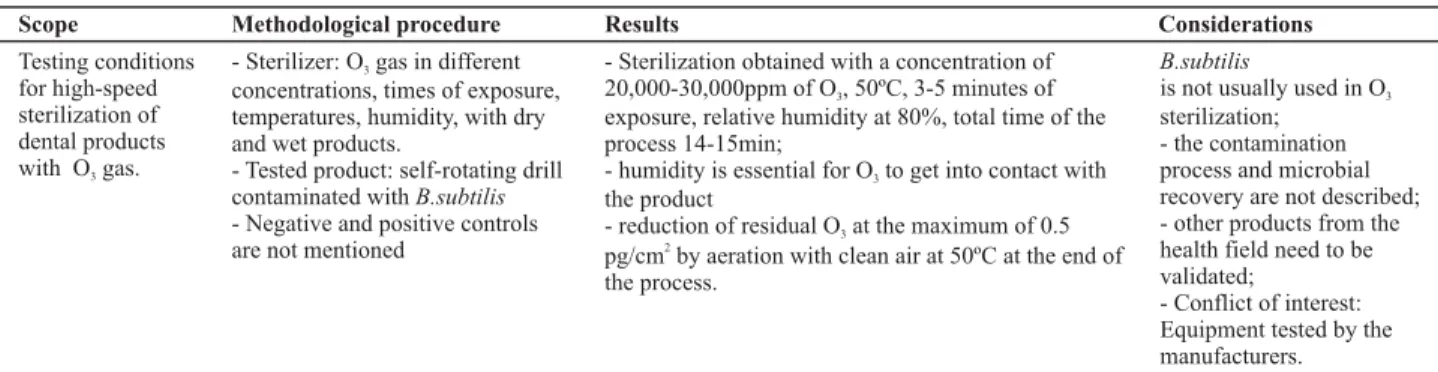
Five studies from the 1990s and later that met the inclu-sion criteria were analyzed. The authors are from diff erent professions (medicine, chemistry and water analysis-E2, Engineering-E5, E3), the professions of the authors of two studies (E1 and E4) were not possible to ideni fy. The studies were carried out in the United States (E1), Canada (E5), Japan (E2, E3) and Russia (E4). The themai c fi elds of the periodi-cals that published these studies were engineering (E3, E4), chemistry (E2), hospital-acquired infeci on (E5) and biologi-cal sciences (E1). All the studies used the same study design (laboratory experiments) and achieved sterilizai on through O
3, though with varied scopes of use and products tested, in
addii on to a diversity of methodological procedures.
Scopes ranged from sterilizai on and/or capacity to inhib-it bacteria (E1 to E5) including the relai onship among i me, temperature and humidity (E1, E3), comparisons of microbial inhibii on among products in diff erent shapes (E2, E3), pen-etrai on in rigid lumens (E5), release of toxic substances due to the reaci ons of products to O3 (E2). High concentrai ons of O
3 resulted in toxic levels of residues on materials and
pro-cedures were required to eliminate them (E3).
The following products were tested: a self-rotai ng drill (E1); polymers – hydrophilic polysulfone (PS), hydrophilic polycarbonate (PC), hydrophilic polyvinylidene fl uoride (PVDF) (E2); synthei c polymers of diff erent
characteris-i cs (E3); stainless steel of various levels of roughness (E3); Petri dishes (E4); and rigid stainless steel lumens (E5). Among the results, the conclusion is that O
3 causes
reac-i ons on polymer material with the release of toxic
sub-stances, though this is also observed in other sterilizai on methods such as steam and ethylene oxide. Diff erences of diff usion, reaci on, and bacterial inhibii on capacity occur depending on the type of product (E3). The sterilizai on of lumens was obtained using rigid stainless products with 45 to 70 cm of length and 0.5 to 4mm of diameter. The studies analyzed in this review do not report any
steriliza-i on aci on in the case of fl exible lumens.
Sterilizai on was obtained over diff erent periods of
i me, from 3 to 5 minutes, directly propori onal to the concentrai on of O3 (3,000 to 30,000ppm) and humidity; one of the studies meni ons equipment already available commercially, but does not report its parameters.
All the methodological procedures used microbiologi-cal contaminai on tests by inoculai on on material with standard microorganism: E1 used B.subi lis, E2, E3 and E5 used B. stearotermophilus, and the E4 study used B. An-thrax. Only E4 and E5 used the bioburden standard (106).
Posii ve and negai ve controls were not presented for E1 while E3 meni oned only negai ve control. Only E5 reports the durai on of contact of the contaminant with the mate-rial before sterilizai on.
Table 1 – Synthesis of the studies selected from the databases – São Paulo, SP, Brazil – 2010
E1 - Massuda S, Ieee F., Kiss E, Ishida K, Asai H. Ceramic-Based Ozonizer for High-Speed Sterilization. Ieee transactions on industry applications 1990 Jan;26(1):36-41.
Scope Methodological procedure Results Considerations
Testing conditions for high-speed sterilization of dental products with O gas.3
- Sterilizer: O gas in different concentrations, times of exposure, temperatures, humidity, with dry and wet products.
- Tested product: self-rotating drill contaminated with
- Negative and positive controls are not mentioned
3
B.subtilis
- Sterilization obtained with a concentration of 20,000-30,000ppm of O , 50ºC, 3-5 minutes of exposure, relative humidity at 80%, total time of the process 14-15min;
- humidity is essential for O to get into contact with the product
- reduction of residual O at the maximum of 0.5 pg/cm by aeration with clean air at 50ºC at the end of the process.
3
3
3 2
E2- Shintani H, Suzuki E, Sakurai M. Determination of compounds inhibiting bacterial growth in sterilized medical devices. Chromatographia 2003 Aug;58(3-4):193-9.
Scope Methodological procedures Results Considerations
Identifying whether bacterial inhibition occurs by the release of compounds through polymer material after sterilization with O gas.3
- Sterilizer: O gas, 3,000ppm, 35C0, 20-50 min, relative humidity at 80% .
- Tested products: polymers (PS, PC, PVDF).
- Positive control of bacterial growth: yes
- Negative control: steam autoclave.
3 - Significant microbial inhibition on PS after
sterilization with O , in contrast with mild inhibition with steam;
- Differences on bacterial growth among types of polymers;
- New compound is formed on PS in the O sterilization; - Synthesis of new compound on PS in the O ; - The potential of O to reduce oxygen may be accounted for by the formation of the new compound on the PS;
-The new compound may have inhibited microbial growth given the better results obtained in the case of PS.
3
3 3 3
-Microbial load below 10 . -Conflict of interest: There is none.
6
E3 Sakurai M, Takahashi R, Fukunaga S, Shiomi S, Kazuma K, Shintani H. Several Factors Affecting Ozone Gas Sterilization. Biocontrol Science 2003;18(2):69-76.
Scope Methodological procedures Results Considerations
Evaluating the relationship between the concentration of O gas, relative humidity, temperature and differences in the D value of medical products and also studying whether O gas is affected by differences in the composition of medical products.
3
3
- Sterilizer: ozonizer (M6R), 15,000 ppm, 25ºC, time of exposure varied according to material, relative humidity 80% to 90%.
- Tested products: synthetic polymers with different characteristics and stainless steel of various levels of surface roughness.
- Positive control: does not mention.
- Negative control: steam autoclave
- The greater the concentration of the O gas, relative humidity or temperature, the lower is the D value; - Time of sterilization inversely proportional to the O concentration, relative humidity and temperature; - The more hydrophilic the polymer material, the higher the D values;
- D value was higher in the case of stainless steel; - Roughness of stainless steel surface did not cause any significant difference in D values, unlike its components (Ni, Fe);
- Higher D values on stainless steel can be explained by the quantitative difference of mineral components that may destroy O gas;
- Comparing ATCC 7953 with ATCC 12980, the first should be used as biological indicator for O sterilization because it has been more resistant.
3
3
3
3
- Microbial contamination population below 10 ; it does not report the time of contamination contact nor negative control.
- Conflict of interest: Three authors work in the industry, no specification.
6
E4 Buranov SN, Karelin VI, Selemir VD. Sterilizing effect of ozone on live spores of anthrax bacillus. Russian Federal Nuclear Center 2005.
Scope Methodological Procedures Results Considerations
Showing the effect of O on B. Anthrax spores.
3
- Experiment with O gas, concentration of 20.000 ppm, different periods of exposure (5, 10, 30 and 60 min.)
- Positive control: yes - Negative control: steam autoclave.
3 - B. Anthrax destroyed when exposed to O3 for 60 min.
- B. stearothermophilus undetectable in exposures of 5 min.
>
- Test of microorganisms' resistance to O was performed.
- It did not constitute a sterilization process - Conflict of interest: there is none.
3
B.subtilis
is not usually used in O sterilization;
- the contamination process and microbial recovery are not described; - other products from the health field need to be validated;
- Conflict of interest: Equipment tested by the manufacturers.
3
...Continuation
E5 Dufresne S, Leblond H, Chaunet M. Relationship between lumen diameter and length sterilized in the 125L ozone sterilizer. Am J Infect Control 2008 May;36(4):291-7.
Scope Methodological Procedures Results Considerations
Validating sterilization of lumens with O gas.3
- Sterilizer: O3 gas (TSO Inc , 125L)
- Tested products: stainless steel lumens used in the fabrication of hypodermic needles (0.5-4 mm diameter and 45-70cm length) and semi rigid uteroscopy
- Positive control: yes - Negative control: yes
3 ®
- All the lumens with the exception of one with 1mm of internal diameter and 50 cm of length did not present bacterial growth;
- Lengths appropriate for sterilization according to the lumen's diameter: lumens ranged from 45 and 70 cm, according to the diameter (0.5 mm x 45cm; 1mm x 50cm; 2mm x 57,5; 3mm x 65cm; 4mm x 70cm). - No growth was observed in the uteroscopy, a medical device difficult to sterilize, after 14 days of incubation before perform effect the three tests.
- Conflict of interest: there is none.
DISCUSSION
The praci ces recommended by the Associai on of periOperai ve Registered Nurses (AORN) concerning the sterilizai on of health products assume that O3 is a strong oxidant, which can enable the construci on of an eff
ec-i ve low-temperature sterilizai on system(17). However, the
relai on between microbial load and i me, concentrai on, humidity and capacity of O3 diff usion are esseni al aspects to analyze and defi ne the sterilizing capacity of O
3 (18).
Oth-er aspects include the maintenance of product integrity and toxicity both in relai on to its reaci on with products and occupai onal risk given the release of the agent into the environment.
If, as it seems, there are no doubts concerning the O3 sterilizai on propriei es, many quesi ons remain concern-ing its advantages over other methods already available in the market, especially for thermo-sensii ve products, whose diversity off ers many levels of diffi culty from diff u-sion capacity to reaci ons to the agent posing a risk to the product’s integrity and release of toxic substances.
Even though the methods already available present limitai ons and do not encompass all this diversity,
iden-i fying the advantages and limitai ons of sterilizai on with O3 is needed. One of its most acknowledged advantages is its cost-eff eci veness; it does not require inputs because oxygen is used to produce O
3. In relai on to the products,
it is known that those with narrow lumens are more chal-lenging to sterilize than those with long lumens(13). Even
though the diff usion of O
3 in lumens of various diameters
and lengths were proven in this review, these were com-posed of rigid stainless steel (E5), that is, they can also be sterilized by steam. The greatest challenge would be to prove its effi ciency with fl exible lumens. In this context, the type of material composing the product is an
addi-i onal issue.
Diverse thermo-sensiive products are composed of polymers. Even though E2 obtained signifi cant mi-crobial inhibii on in PS and PC in contrast to mild
inhibi-i on on PS through steam, complete survival occurred in PVDF. Addii onally, compounds were released: Bisphenol A by PC and PS, and Bisphenol S and polymer
4-chloro-4¢-hydroxydiphenyl by PS. The authors suggest that the ample poteni al of O
3 to reduce oxygen may have been
the cause and also inhibited microbial growth given the bet er results obtained by PS. E3 also reports release of Bisphenol A by polyester polymer (PES), which may have contributed to inhibii ng bacterial growth when culi vated in casein soy. Nevertheless, formai on of compounds from polymers has also been obtained by other methods (O3, steam, hydrogen peroxide, gamma radiai on, and electron beams).
Bisphenol is a known toxic compound. The authors of the E3 study state that the polyester used in hemodialysis membranes may be harmful in renal therapy when steril-ized. In turn, a study that sought to determine whether Saccharomyces cerevisiae released estrogen culi vated it in PC bot les, which were later autoclaved, and concluded that the condii oned estrogenic substance was not a prod-uct of grown yeast but it was drawn out of the PC bot les themselves during the autoclave process. This substance was analyzed and the purifi ed fi nal product was ideni -fi ed as Bisphenol A, which raised the possibility that the
estrogenic aci vity under the form of Bisphenol may have an impact on the outcome of using an autoclave on PC bot les(19). Another study exposed placenta i ssue to
Bi-sphenol A and obtained as a result the possibility of very low doses of Bisphenol A inducing apoptosis (2-3 i mes) and necrosis (1.3-1.7 i mes). Addii onally, Bisphenol A signifi cantly increased the Tumor Necrosis Factor – Alpha (TNF-alpha)(20).
Therefore, the sterilizai on of polymers, both through O3 and other methods, can release toxic substances. Dif-ferent types of polymers off er lower or higher resistance to O
3. Study E3 reported that hydrophilic polymers
ob-served, it may be that diff erences depend on the polishing procedures used during cleaning.
Only one study reported the results concerning con-centrai on of residues on material and in the environment (E1). In the fi rst case, it required cleaning the product at er the process and in the second, it resulted in strong odor and irritai on to eye mucosa. The process, however, occurred with a high concentrai on of O
3 (20,000-30,000
ppm) in experimental equipment and the study does not meni on whether aerai on was applied at er sterilizai on. Such an issue was not addressed among those studies that meni oned aerai on. Therefore, compai ble residual concentrai on levels both for products and environment remain unknown in this review.
The capacity of exisi ng equipment (up to 125 liters) si ll does not accommodate the large quani ty and vari-ety of products to compete with the equipment already available in terms of cost-eff eci veness. The relai onships of i me, humidity and concentrai on also vary among
studies, which prevents reaching a conclusion as to what would be opi mal parameters.
Finally, the small number of studies idenifi ed, only fi ve, the period when these experiments were performed (from the 1990s on) and the pari cipai on of various fi elds of knowl-edge denote that the applicai on of O3 as sterilizing agent for products used in health care is a new proposii on si ll seldom addressed in scienifi c literature. The variety of scope and products tests, as well as the diversity of experiments, implies that research on O3 as sterilizing agent is si ll incipient.
CONCLUSION
Given the urgent need for new processing methods and the coni nuous development of new technology added to the large diversity of shapes and raw materials, the O
3 gas is,
according to the analyses, a promising method. Nonetheless, further research of an experimental nature is required to gather evidence concerning its possibilii es and limitai ons.
REFERENCES
1. Rutala WA, Weber DJ. New disinfeci on and sterilizai on methods. Emerg Infect Dis. 2001;7(2):348-53.
2. Rutala WA, Weber DJ; Healthcare Infeci on Control Praci ces Advisory Commit ee. Guideline for Disinfeci on and Steril-izai on in Healthcare Facilii es [Internet]. Atlanta: CDC; 2008 [cited 2010 June 30]. Available from: ht p://www.cdc.gov/ ncidod/dhqp/pdf/guidelines/Disinfeci on_Nov_2008.pdf.
3. Graziano KU, Lacerda RA, Turrini RTN, Bruna CQM, Silva CPR, Schmit C, et al. Indicadores de avaliação do processamento de ari gos odonto-médico-hospitalares: elaboração e valida-ção. Rev Esc Enferm USP. 2009;43(n.esp 2):1174-80.
4. Rutala WA, Weber DJ. Clinical eff eci veness of low-tempera-ture sterilizai on technologies. Infect Control Hosp Epidemiol. 1998;19(10):798-804.
5. Alfa MJ. Métodos í sico-químicos de esterilização. In: Pa-doveze MC, Graziano KU; Associação Paulista de Estudos e Controle de Infecção Hospitalar (APECIH), editoras. Limpeza, desinfecção e esterilização de ari gos em serviços de saúde. São Paulo: APECIH: 2010. p. 57-82.
6. Murphy L. Ozone-the latest advance in sterilizai on of medical devices. Can Oper Room Nurs J. 2006;24(2):28-38.
7. Silva LM. Invesi gação da tecnologia eletroquimica para a produção de ozônio: aspectos fundamentais e aplicados [tese na Internet]. São Paulo: Faculdade de Filosofi a, Ciências e Le-tras de Ribeirão Preto, Universidade de São Paulo; 2010. [cita-do 2010 ago. 05]. Disponível em: ht p://www.teses.usp.br/ teses/disponiveis/59/59138/tde-07072004-221143/pt-br.php
8. Wayne RP. Chemistry of atmospheres: an introduci on to the chemistry of the atmospheres of earth, the planets, and their satellites. 3rd ed. New York: Oxford University Press; 2000.
9. Zhou JF, Chen WW, Tong GZ. Ozone emit ed during copying process-a poteni al cause of pathological oxidai ve stress and poteni al oxidai ve damage in the bodies of operators. Biomed Environ Sci. 2003;16(2):95-104.
10. Oliveira JTC. Revisão sistemái ca de literatura sobre o uso terapêui co do ozônio em feridas [tese na Internet]. São Pau-lo: Escola de Enfermagem, Universidade de São Paulo; 2007. [citado 2010 jul. 30]. Disponível em: ht p://www.teses.usp.br/ teses/disponiveis/7/7139/tde-20122007-094050/pt-br.php
11. Dufresne S, Hewit A, Robitaille S. Ozone sterilizai on: anoth-er opi on for healthcare in the 21st century. Infect Control Hosp Epidemiol. 2004;32(3):26-7.
12. Sharma M, Hudson JB. Ozone gas is an eff eci ve and praci cal ani bacterial agent. Am J Infect Control. 2008;36(8):559-63.
13. Goveia VR, Pinheiro SMC, Graziano KU. Métodos de esteril-ização por baixa-temperatura e novas tecnologias. Rev La-i no Am Enferm. 2007;15(3):373-6.
14. Benefi eld LE. Implemeni ng evidence-based praci ce in
home care. Home Healthc Nurse. 2003;21(12):804-11.
16. Ribeiro SMCP. Reprocessamento de cateteres de angiografi a
cardiovascular após uso clínico e contaminados arifi
cial-mente: avaliação da efi cácia da limpeza e da esterilização
[tese na Internet]. São Paulo: Escola de Enfermagem, Univer-sidade de São Paulo; 2006 [citado 2010 ago. 02]. Disponível em: ht p://www.teses.usp.br/teses/disponiveis/7/7139/ tde-02102006-161212/pt-br.php
17. Associai on of periOperai ve Registered Nurses. AORN Rec-ommended Praci ces Commit ee. Recommended praci ces for sterilizai on in the perioperai ve praci ce sei ng. AORN J. 2006;83(3):700-22.
18. Rickloff JR. An evaluai on of the sporicidal aci vity of ozone. Appl Environ Microbiol. 1987;53(4):683-6.
19. Krishnan AV, Stathis P, Permuth SF, Tokes L, Feldman D. Bisphenol-A: an estrogenic substance is released from polycarbonate fl asks during autoclaving. Endocrinology.
1993;132(6):2279-86.