Original Article 959
-NURSES AND THE WORKING PROCESS AT A TEACHING HOSPITAL:
IMPLEMENTATION OF THE UNIFIED HEALTH SYSTEM
1Daiane Siqueira de Luccas2, Liliana Müller Larocca3, Maria Marta Nolasco Chaves4, Elizabeth Bernardino5
1 This study is part of the thesis - Nurses’ work process at a public teaching hospital: changes after the implementation of the Uniied Public Health System, presented to the Programa de Pós-Graduação em Enfermagem, Universidade Federal do Paraná
(UFPR), in 2013.
2 Master’s student in the Graduate Program in Nursing of UFPR. Curitiba, Paraná, Brazil. E-mail: [email protected] 3 Ph.D. in Education. Professor at the Nursing Department and the Graduate Program in Nursing of UFPR. Curitiba, Paraná,
Brazil E-mail: [email protected]
4 Ph.D. in Nursing. Professor at the Nursing Department and the Graduate Program in Nursing of UFPR. Curitiba, Paraná, Brazil E-mail: [email protected]
5 Ph.D. in Nursing. Professor at the Nursing Department and the Graduate Program in Nursing of UFPR. Curitiba, Paraná, Brazil E-mail: [email protected]
ABSTRACT: Study guided by Norberto Elias’s theoretical, methodological background, which objectiied to analyze the changes in nurses’ work process at a Teaching Hospital since the implementation of the Uniied Health System. Data were gathered by means of an interview applied to 12 nurses working in the studied setting since 1990, with further discourse analysis. Eight themes emerged as results (integrality, decentralization, hierarchization, regionalization, work process, health funding and social control), and 35 thematic statements, categorized from concepts of iguration, interdependence and tension balance, which enabled discussions on relational dynamics between society and individuals in order to apply Uniied Health System principles, and tension production to carry out the work process. We concluded that Uniied Health System implementation-ridden changes relected on such professionals’ work process even indirectly. DESCRIPTORS: Nursing. Health public policy. Uniied Health System.
ENFERMEIROS E O PROCESSO DE TRABALHO DE UM HOSPITAL DE
ENSINO: IMPLANTAÇÃO DO SISTEMA ÚNICO DE SAÚDE
RESUMO: Estudo guiado pelo referencial teórico-metodológico de Norbert Elias cujo objetivo foi analisar as transformações no processo de trabalho dos enfermeiros de um Hospital de Ensino a partir da implantação do Sistema Único de Saúde. Os dados foram obtidos por meio de entrevista aplicada a 12 enfermeiros atuantes no cenário do estudo desde 1990, com posterior análise dos discursos. Como resultados emergiram oito temas (universalidade, integralidade, descentralização, hierarquização, regionalização, processo de trabalho, inanciamento da saúde e controle social) e 35 frases temáticas, categorizadas a partir dos conceitos de iguração, interdependência e equilíbrio de tensões, o que permitiu discussões sobre a dinâmica relacional entre sociedade e indivíduos para aplicabilidade dos princípios do Sistema Único de Saúde e produção de tensões na realização do processo de trabalho. Concluímos que as transformações induzidas pela implantação do Sistema Único de Saúde reletiram no processo de trabalho destes proissionais, ainda que indiretamente. DESCRITORES: Enfermagem. Políticas públicas de saúde. Sistema único de saúde.
LOS ENFERMEROS Y EL PROCESO DE TRABAJO DE UN HOSPITAL DE
ENSEÑANZA: IMPLANTACIÓN DEL SISTEMA ÚNICO DE SALUD
RESUMEN: Estudio guiado por el referencial teórico-metodológico de Norbert Elias, cuyo objetivo ha sido analizar las transformaciones en el proceso laboral de los enfermeros de un Hospital de Enseñanza, a partir de la implantación del Sistema único de salud. Los datos fueron obtenidos por medio de uma entrevista realizada con 12 enfermeros actuantes, desde 1990, en el escenario del estudio y por un posterior análisis de los discursos. En cuanto a los resultados, surgieron ocho temas: universalidad, integralidad, descentralización, jerarquización, regionalización, proceso de trabajo, inanciación de la salud y control social) y 35 frases temáticas, categorizadas a partir de los conceptos de iguración, interdependencia y equilibrio de tensiones, lo que permitió discusiones sobre la dinámica relacional entre la sociedad y los individuos para la aplicabilidad de los principios del Sistema único de salud y la producción de tensiones en la realización del proceso de trabajo. Concluimosque las transformaciones inducidas por la implantación del Sistema único de salud se relejaran en el proceso de trabajo de estos profesionales, aunque indirectamente.
INTRODUCTION
The establishment of societies does not in-volve only a sum of individuals, since individual
and collective identities are subjected to context
and structural changes taking place in a given society. Therefore, individuals in society develop interdependent functions with structures and
standards that provide speciicity to some social
groups.
In Brazil, the implementation of the Uniied Health System (SUS - Sistema Único de Saúde) in 1990 can be understood as one of the model cases for social changes, with direct and remarkable impacts on the training and work of nurses. The so-ciologist Norbert Elias refers to this kind of change as a civilizing process and brings elements to un-derstand the changes caused on human behavior in society which, in this paper, is represented by
the implementation of the Uniied Health System in a public teaching hospital in the state of Paraná.1
It is widely known that subjects are respon -sible for social transformations in the space they
live, through their working process. Likewise, the environment modiies the subjectivity of indi -viduals and, as such, discovering the network of interdependencies between them is crucial, which could interfere on the nurses’ habitus – the way individuals behave in their interdependence net, generated from two phenomena: social control and self-control.²
To understand the changes in the nursing working process and highlight the importance of public teaching hospitals to the professional cat-egory as a setting of work, training and knowledge production, this study uses the historical excerpt
of the Brazilian Health System enactment as legal
ground and the theoretical approach proposed by Elias to understand this duty.
This excerpt was selected due to the
discus-sions held 25 years after the SUS implementation.
Although some studies emphasize the progress in
the Brazilian health sector related to the implemen
-tation of the SUS and extinction of the National Institute of the Social Security Medical Care (In -amps - Instituto Nacional de Assistência Médica da Previdência Social), to the expansion of the Family
Health Program (PSF - Programa Saúde da Família) and the growth of production and productivity in health care, the broken promises are also
high-lighted and exempliied by the underfunding of
the program and the struggle for universal and fair coverage.3-4
The social formation conigured in the SUS
implementation process brings variable dimen-sions that are categorized by a given institution, territory, city, nation, among other aspects. All these formations clearly show the networks of interdependence between different social players, which generate a historical production in societies.
In face of the aforementioned, the aim of this
study was to analyze the changes in the working process of nurses in a public teaching hospital since the implementation of the Uniied Health System.
METHODOLOGY
An exploratory qualitative study was devel -oped, with a theoretical-methodological approach based on the studies by sociologist Norbert Elias, notably on the construction of individual and
col-lective identities and the idea of society as a igura
-tion of interdependent func-tions (conigura-tion,
interdependence and balance of tensions) which is intertwined with the history of the individuals that make it up.1
The concept of coniguration stands for the
relational dynamics between society and individu-als, or even between society and nurses, unveiling the routines, rules, laws and implicitly the invisible
work links. In this study, the teaching hospital was
the dimension that permeates the social formation
of subjects.¹
The coniguration exposed by the sociologist
assumes the existence of a network, based on the concept of interdependence, which represents the connection of individuals through a phenomenon of mutual dependence.1 Here, the relationships of de
-pendence established between professional nurses, the team of workers in the institution and the users
of the Uniied Health System are considered.
Twelve nurses (11 women and 1 man) participated in this study and met the following inclusion criterion: being active nurses in 1990 at the teaching hospital located in the municipality of Curitiba, regardless their sex and age.
The nurses formalized their voluntary
par-ticipation by signing a Free and Informed Consent Form (FICF), and their anonymity was ensured by replacing their names with the acronym NUR
followed by Arabic numerals in ascending order, following the order of interviews, ranging from
NUR01 to NUR12.
Data were collected by means of semi-structured interviews carried out from May to
and a script designed according to the analytical categories established by the theoretical approach
of Norbert Elias – coniguration, interdependence
and balance of tensions.
The three-stage analysis of discourse was em-ployed, as it enables a broader understanding of the context exposed by the social actors, and because it includes social, historical, and ideological aspects.5
Each ideology referred to corresponded to a discursive formation with a set of topics and
igures. The igures were related to an element of
the natural world, perceived in the discourse as a simulation of this world – for example, concrete nouns or verbs that indicate physical activities. The topic, in turn, is part of the discursive semantic and cannot be considered as something belonging to the natural world, as it is part of the categories that rule reality, like solidarity, honor and exploration.6
The discourses were decomposed by a thor-ough reading of the text to identify topics and
igures, which allowed unveiling the meaning of
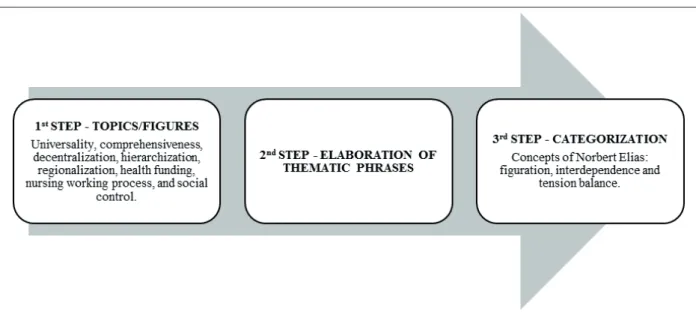
the statements, as shown in Figure 1.6
Figure 1 - Stages of the discourse analysis used in the study. Curitiba, 2013
In the second step of analysis, the topics and igures were concatenated/coordinated to
identify their coherences and divergences in the participants’ discourses. The result was the
elabo-ration of thematic phrases that deined the topics and sub-topics of the discourse as a whole. In the
third step, the thematic phrases were grouped to categorize the empirical material. Depending on
the topics identiied, the following categories have
emerged from this study: coniguration, interde
-pendence and balance of tensions.6
The research proposal for this study was
approved by the Human Research Ethics Com
-mittee of the HC/UFPR, according to the protocol 249407/2013.
RESULTS AND DISCUSSION
The existing tensions in the everyday of individuals lead to changes in the balance of power (balance of tensions) and result in
struc-tural changes in society.¹ The changes caused by
the SUS implementation on the working process
of nurses are originated by tensions and can be observed in this study.
The discourse analysis brought about eight topics: universality, comprehensiveness, decentralization, hierarchization, regionaliza-tion, working process, health funding and social
control. Thirty-ive phrases were built in the step of Elaboration of Thematic Phrases. In the last
step, Categorization, the thematic phrases were
classiied following the three concepts of Elias (coniguration, interdependence and balance of tensions). In this study, we will present only 14
thematic phrases, in addition to their links with the concepts of the theoretical approach found in the discussions of the topics elected.
Topic: comprehensiveness
The high number of phrases in this topic,
speciically regarding the concept of coniguration,
be-tween society and individuals, which refers to the
Brazilian health system that proposes the existence
of interconnections among care complexity de-grees through the principle of comprehensiveness. This study considered the presentation of
comprehensiveness proposed by Law 8080/90 which, in Article 7, deines it as a coordinated
and continuous set of actions and preventive and
healing services required to each case, at all levels
of the system complexity.7
The discourses brought about this principle
when the subjects referred to the changes after the SUS implementation.
In the past, patients sought the HC for simple diagnosis, but today the most critically ill patients come
here (NUR01, NUR02, NUR08, NUR12).
The noticeable change refers to family care, the
humanization program, children care and women’s health (NUR10, NUR05).
Health care systems should be connected by
the users’ health needs. This form of organizing
services is called Health Care Network, and is de
-ined as an integration of health care units linked by a unique mission that culminates in the delivery
of continuous and comprehensive care, with com-munication between the different levels of service.8
Primary Health Care (PHC) is referred to
as the insertion of users in this network, and the strategies mentioned by the nurses are part of the
PHC and evidence its impact on high-complexity
care institutions.
Up to these days, users don’t have a clear under
-standing about the role of the ‘Network’, as they believe
that higher complexity care [hospital] brings better
results than the health unit (NUR05).
The building of Health Care Networks is consistently questioned due to its hierarchical or -ganization anchored in primary care, followed by
medium and high complexity care. This deinition allows understanding the wrong view that Basic Health Care is a low-complexity activity. This
biased view makes the population, politicians, managers and health professionals overestimate the secondary and tertiary health care levels.9
Health care networks organized as polyar
-chy should replace this pyramidal model, mainly considering the epidemiological condition of chronic diseases hegemony. Thus, the technologi-cal densities rather than the complexity degrees will be valuated, in a way to break vertical rela-tionships and to implement horizontal polycentric networks.9
However, despite the dificulty in organiz
-ing the Primary Care Networks, there are concrete
causes that could have a direct impact on the
PHC non-effectiveness and that are implicit in
the nurses’ discourse. For example, poor physical structure of services, working process and man-agement, training of professionals and shortage of resources to diagnosis support and referral to specialized care.10
The failures found in the principle of com-prehensiveness implementation bring about ten-sions in society and have been mentioned in the discourses of the participants.
The counter-referral system still shows failures (NUR02).
This statement corroborates the study carried
out in the state of Paraíba in 2012 and in irst half of 2013. The study aimed at describing the character -istics of the organization, of articulation and care, about the referral and counter-referral system, and gathered data from the evaluation of profession-als in 624 health units. The conclusion was that in
Paraíba the referral and counter-referral system is
weak, what is clearly shown in the study through the lack of knowledge among professionals about the workflow, vagueness regarding flows, or fragmented referral and counter-referral system in that state.11
The ineficacy of the referral and counter-referral system entails several problems. The relex of this weakness is exempliied by the long time
users have to wait to access some services, thus impairing the continuity of treatment.12
Topic: funding
Historically, teaching hospitals have gone
through several changes in an attempt to
over-come inancial and managerial crises, aiming at improving the quality of health care services. The
hospital where we carried out this study has also participated in these changes, which were men-tioned by the study participants.
The changes that directly interfere with the relational dynamics between society and indi-viduals, considered here as the voice of society through the normative rules established regard-ing the nurses of the teachregard-ing hospital, have been
classiied under the concept of coniguration. The ive subjects that have incorporated this topic in
Nurses and the working process at a teaching hospital... 963 -The participants referred to several events
of changes: in the past, there were beds for non-con-tributors, FUNRURAL and INPS (NUR02, NUR12). The budget to fund procedures that used to be
transferred by the Ministry of Education is now trans
-ferred by the Ministry of Health (NUR01, NUR02).
The changes referred to by nurses in their discourses came about in the 1980s, and teaching
hospitals started being ruled by the Hospitaliza
-tion Authoriza-tion (AIH - Autorização de Inter
-nação Hospitalar).13
The transition away from the former
fund-ing models to the new approaches in the SUS
implementation was a must. Early in the 1990s, eleven state hospitals were closed and others drastically reduced the services provided because of the impossibility of funding health with the amounts paid through the agreements with the
Social Security.13
After the management agreement was
signed with the Municipal Health Secretariat in 2004, the inancial resources spent in the hospital
object of this study became ixed and were pro
-vided by the Ministry of Health.13
Despite the many changes that followed the
Sanitary Reform until the SUS implementation, participants pointed out dificulties regarding health funding in Brazil. These deicits generate
tensions in the society’s power balance.
The SUS funding does not cope with the hos-pital expenses and the referral price table is outdated
(NUR05).
After the SUS implementation, a tripartite
organization of federalist funding in health was
promoted. In that organization, the federal govern -ment, states and municipalities would be co-respon-sible for funding the new health system, supported
by the Social Security Budget (OSS - Orçamento da Seguridade Social). Although being innovative, this budgetary option reduced resources because of the
irregular inancial contributions and the fragmenta
-tion of health resources. Therefore, the Provisional Contribution on Transactions or Remittance of Values and Credits and Right of Financial Nature (CPMF) tax and the Constitutional Amendment #
29 (EC 29/2000) emerged as a temporary solution.14
The enactment of that Amendment was
considered to be a huge progress of the Brazilian
health system funding, as it ensured minimum
resources to the Brazilian health. However, there were conlicts that posed a barrier to compliance.
For example, there were no definitions about
which expenses should be considered as health
ac-tions and services. There are also conlicts regard -ing the calculations to use the Federal Government resources.15-16
The great problems related to health funding
remain up to these days. In 2012, the percentage of
the federal government expenditures with health actions and services virtually remained the same as in 1995, when it was only 1.75% of the gross domestic product.15 These data are even more
concerning when we observe the total expenses
with health in Brazil, as 47% correspond to public expenditure. This shows the dificulty faced by the SUS public managers, as the system must provide
services to 75% of the population, who have no private health insurance, and this care is provided with less than half of the resources devoted to
health in Brazil.17-18
The SUS underfunding is not a current prob -lem: the situation was historically generated by the
policies of macroeconomic adjustment, which allot
half of the public expenditure to pay expenses with
interest, charges and amortization of the Brazilian debt. In addition to that there is the political inter -est game, lack of governance and irregularities of
the political system that relect in the poor health
care provided to citizens, and notably the lack of funding, as disclosed in the discourses of the study participants.14
Topic: working process
This study found some contradictions in the participating nurses’ experiences regarding
the Brazilian public policies, notably about the SUS, its guidelines, principles, organization and
intentionality.
The phrases related to the nurses’ working process could be categorized into two concepts of Norbert Elias: interdependence and balance of
ten-sions. Regarding the irst concept, some statements
refer to mutual dependence, i.e., the nurses’ work and the public health policies. The second concept, in turn, evidences the tensions of carrying out the nursing work related to the downs caused by the
SUS implementation.
The SUS is correlated with the free health care
(NUR03).
There was no difference in the Brazilian health
system after the SUS implementation (NUR03,
NUR06, NUR07, NUR10, NUR11).
participa-tion in the Sanitary Reform. Since 1986, there
are evidences that this class was not numerically expressive in the period – the higher-education
professionals accounted for 30% of the total health
workers and, of these, 17% were physicians and only 2% were nurses.19 The percentage of nurses in
that period did not exceed 8.5% of the total work
power in nursing, with only 25,863 professionals.
According to the Federal Nursing Council, in 2010, there were 287,119 nurses.20
The lack of engagement with health
policy-related issues in Brazil may have contributed to the perception of the SUS nurses that it is a system that comprises only free health care. Law 8080/90
describes the complementarity with the services provided by the private initiative when resources are not enough to ensure the care coverage, cor-roborating with the participation of private
institu-tions in the SUS.7
Another fact to be analyzed concerns the academic training of nurses. The historical path of undergraduate courses in this area is marked by countless changes related to the social, political and economical situation in the period.
Today, education in nursing is very close to the needs of health and comprehensive care. The
major focus on hospital care was redirected after
the insertion of collective health practices in the
education process. The intention of adjusting the
training process to the new health policies based
on the Sanitary Reform and the SUS principles
and guidelines was evidenced in a survey carried
out in Paraná with political-pedagogical projects
of nine nursing undergraduate schools.21
Most of the working process-related the-matic phrases were categorized based on the con-cepts interdependence and balance of tensions by
Norbert Elias. Some participants do not recognize
the changes in their working process induced by
the SUS implementation, like in the following
statement: There was no difference in nursing care
throughout these years (NUR01).
A study developed in 1995 at the Clinics
Hospital of Rio Preto, state of São Paulo, cor
-roborated the idea of non-recognition of changes
in the nursing working process. However, of the 31 nurses interviewed only 17 nurses (54.84%)
deny changes in their daily actions after the
in-stitution adhered to the SUS. The 14 subjects that
referred to changes said the work, by that time, was closer to the patient. During the study, care became demanding, and a stronger focus of this
professional category on critically ill patients was needed.22
Topic: universality
The relational dynamics, or the conigura
-tion, existing in the Brazilian health system is evi -denced in the statements for the topic of universal-ity. The representation of thematic phrases in this category allows observing the correlation between comprehensiveness and universality, which will only be fully provided to the population at large
when it is in line with the SUS funding.
The participants’ statements reflect that dependence.
The number of hospital beds – just like human resources - was reduced due to the adjustments to the new laws (NUR01, NUR03, NUR05, NUR07,
NUR10, NUR12).
Data show that access to health services in
Brazil has improved. Prior to the implementation of SUS, 8% of the population stated to have used the health service in the last 30 days. In 2008, in
turn, that index increased 174%: 14.2% of the popu-lation had used health services in the last 15 days.3 An analysis about funding with a direct impact on universality showed several
hospi-talizations funded by the public sector. In 1982, the social security system inanced 13.1 million hospitalizations/year, whereas in 2009 the SUS
funded 11.1 million hospitalizations/year. The
reduction on access to hospital care can be justi
-ied by the restriction of hospital expenditures by
state (according to the population size) that limited the payment of hospitalizations by the Ministry of
Health, and by the reduction in potentially avoid -able hospitalizations after the creation of some
services, such as the Family Health Strategy.3
Topic: social control
In this study, phrases in the category of in
-terdependence were conirmed when participants
reinforced the links between users to implement social control. Another category emerges when nurses refer to the existing tensions like the
dif-iculty in putting into practice that principle due
to the inexistence of an active local health council in the scenario studied.
Implemented through Law 8142/90 and further amended by Resolution 333/03, the
of public health policies takes place through the
health council participation. It is currently deined
as a collegiate, deliberative and permanent body
of the SUS which, in principle, is part of the basic structure of the Ministry of Health, and of the Health Secretariats of states, the Federal District
and municipalities.23
The objective of the health councils is to work
on the formulation and proposition of strategies and on the monitoring of the health policies
en-forcement, including in its economic and inancial
aspects.23
Thus, according to the nurses interviewed
the debates brought knowledge and beneits to SUS users, enabling stronger participation and the consequent demand for their rights.
Users exercise social control when they challenge the investment in the ield of health and know their
rights (NUR04, NUR05).
However, despite the democratization pro
-cess permeated by social participation, there is still a long path towards legitimacy, collectivity of decisions and the strengthening of decision-making spaces.24
The SUS principle of social control is not put into practice, as there is no active local health council
(NUR06).
A study performed in Minas Gerais to as-sess the effective participation of citizens in the
Health Municipal Council found that participatory
management has not yet been consolidated in the
SUS. The incompliance with the parity principles and the political inluence as criterion to select the
Council members hinder the important process of
managing health public policies in Brazil.25
Topics: decentralization and regionalization
Both topics – decentralization and region
-alization – are approached together since their concepts are complementary to one another.
The phrases for the topic approached
re-main in the category of coniguration because they represent the dynamics between subjects in the health system. Some current examples are the
intergovernmental relationships.
Since the SUS implementation, the state reduced
its responsibility in the ield of health. On the other hand, the municipality work has been strengthened (NUR06, NUR02).
The idea of decentralization with one single leadership in each governmental level comes about
in an attempt to change concepts related to health management, with emphasis on municipalization of care. Management at municipal level would be
explained by the continental dimensions of Brazil,
where quality care would demand essential ser
-vices in all corners of the country.26-27
The 1988 National Constitution was a
hall-mark in the process, as it deined the role to be
played by the federal government, states and municipalities in the health system, focusing on
decentralization. It would provide for the formula
-tion and implementa-tion of health policy, inancial
resources and health services and actions in the states and municipalities.26
The enactment of the 1988 Constitution granted autonomy to municipalities, converting them into federal entities. The model brought some
consequences that were not necessarily beneicial:
more competitiveness between state and munici-palities for increasingly scarce resources and the
historical dificulties of the model centered in
healing and high-cost practice, and weak focus on health promotion.26
FINAL CONSIDERATIONS
In the working process developed by nurses
in the setting under study, the tensions and rela-tions – analyzed in the light of implementation,
in the 1990s, of the Brazilian Sanitary Reform as
-sumptions – led us to conclude that the Uniied Health System principles are part of the routine
of the nurses interviewed and permeate the rela-tionships established by professionals, regardless if nurse-nurse, nurse-user or nurse-health system.
The concept of coniguration was the most frequently used to classify the phrases. This cor -roborates the assertion that relationships estab-lished between nurses and the health system are
frequently used in their routine. The impositions
of the system, the facilities implemented and
the resulting dificulties are often quoted in the
discourses, unveiling the relational dynamics between them.
Likewise, there are frequent references to the tensions generated. Since these are perceived as
barriers to the achievement of the nurses’ working
object, regardless if care, management, education
or research, tensions lead to changes in the society power balance and, as such, are of great relevance.
These subjects have not identiied the SUS
working process. It is argued that the short par
-ticipation of this professional class in the Sanitary Reform and, still today, in the political
decision-making spaces, added to the academic training
of these professionals, cause a deicit of in-depth knowledge about the health public policies in Brazil
and result in impact on the health working process.
However, nurses recognize that Law
8080/90, through its principles and guidelines, has changed the setting studied, notably regarding the topics of comprehensiveness and universality and
the uniqueness of health actions funding. Hence, we believe the changes induced by the SUS imple
-mentation have inluenced the working processes
of these professionals, even if indirectly perceived.
REFERENCES
1. Elias N. On the process of civilisation: revised edition: collected works of Norbert Elias. Dublin
(IE): University College Dublin Press; 2012.
2. Veiga CG. Cuestiones teóricas y conceptuales para la investigación de la psicogénesis y sociogénesis de
los procesos escolarizadores. Univ Humaníst. 2011
Ene-Jun; 71: 85-100.
3. Paim J, Travassos C, Almeida C, Bahia L, Macinko J. The Brazilian health system: history, advances, and challenges. Lancet. 2011; 377(9779):1778-97.
4. Macinko J, Oliveira VB, Turci MA, Guanais FC,
Bonolo PF, Lima-Costa MF. The influence of
primary care and hospital supply on ambulatory care-sensitive hospitalizations among adults in
Brazil, 1999-2007. Am J Public Health. 2011 Oct; 101(10):1963-70.
5. Minayo MCS. O desaio do conhecimento: pesquisa
qualitativa em saúde. 12ª edição. São Paulo (SP): Hucite; 2010.
6. Fiorin JL, Savioli FP. Para entender o texto: leitura
e redação. 17ª edição. São Paulo (SP): Ática, 2007.
7. Brasil. Lei nº 8.080, de 19 de setembro de 1990.
Dispõe sobre as condições para a promoção, proteção e recuperação da saúde, a organização e o funcionamento dos serviços correspondentes e dá outras providências. Diário Oicial [da] República Federativa do Brasil, 20 Set. 1990.
8. Mendes EV. As redes de atenção à saúde. Ciênc
Saúde Coletiva. 2010 Aug; 15(5):2297-305.
9. Mendes EV. As redes de atenção à saúde. Organização
Pan-Americana da Saúde. Brasília (DF): OPAS; 2011.
10. Spedo SM, Pinto NRS, Tanaka OY. O difícil acesso a
serviços de média complexidade do SUS: o caso da cidade de São Paulo, Brasil. Physis. 2010; 20(3):953-72.
11. Protasio APL, Silva PB, Lima EC, Gomes LB,
Machado LS, Valença AMG. Avaliação do sistema de referência e contrarreferência do estado da
Paraíba segundo os proissionais da Atenção Básica no contexto do 1º ciclo de Avaliação Externa do PMAQ-AB. Saúde Debate. 2014 Out; 38(esp):209-20.
12. Brito-Silva K, Bezerra AFB, Tanaka OY. Direito
à saúde e integralidade: uma discussão sobre os desaios e caminhos para sua efetivação. Interface.
2012 Abr; 16(40):249-60.
13. Coser C, Machado-da-Silva CL. Práticas de Assistência no HC-UFPR: a Dinâmica do Processo no Período 1961-2008. In: Anais do Encontro da ANPAD, XXXIV, 2010, p.1-17, Rio de Janeiro, Brasil. Rio de Janeiro (RJ). 2010 [acesso 2013 Out 01]. Disponível em: http://www.anpad.org.br/ diversos/trabalhos/EnANPAD/enanpad_2010/ EOR/2010_EOR2489.pdf
14. Silva C.L da, Rotta CV. O dilema da universalidade
e inanciamento público do Sistema Único de Saúde no Brasil. Textos & Contextos. 2012 Ago-Dez; 11(2):333-345.
15. Mendes A. A longa batalha pelo inanciamento do
SUS. Saúde Soc. 2013; 22(4):987-93.
16. Esteves RJ. The quest for equity in Latin America:
a comparative analysis of the health care reforms
in Brazil and Colombia. Int J Equity Health. 2012
Feb 2;11:6.
17. Mendes JDV, Bittar OJNV. Perspectivas e desaios
da gestão pública no SUS. Rev Fac Cienc Med Sorocaba [online]. 2014 [acesso 2015 abr 27]; 16(1):35-9. Disponível em http://pesquisa.bvs.br/brasil/
resource/pt/ses-27426.
18. Montekio VB, Medina G, Aquino R. Sistema de salud
de Brasil. Salud Pública Méx. 2011 Jan; 53(Suppl 2):120-31.
19. Almeida MCP. A formação do enfermeiro frente à
reforma sanitária. Cad Saúde Pública. 1986 Out-Dez;
2(4):505-10.
20. Barreto IS, Krempel MC, Humerez DC. O Cofen
e a Enfermagem na América Latina. Enferm Foco
2011; 2(4):251-4.
21. Silva RPG, Rodrigues RM. Sistema Único de Saúde
e a graduação em enfermagem no Paraná. Rev Bras Enferm. 2010; 63(1):66-72.
22. Melo MRAC, Fávero N, Évora YDM, Nakao JRS.
Modificações no atendimento de enfermagem hospitalar decorrentes do Sistema Único de Saúde (SUS). Rev Latino-Am Enfermagem. 1998 Out;
6(4):5-14.
23. Brasil. Resolução n. 333, de 04 de novembro de 2003: aprova as diretrizes para criação, reformulação, estruturação e funcionamento dos Conselhos de Saúde. Diário Oicial [da] República Federativa do Brasil, 4 Dez. 2003.
24. Soratto J, Witt RR. Participação e controle social:
scielo.br/scielo.php?script=sci_arttext&pid=S0104-07072013000100011&lng=en
25. Cotta RMM, Martins PC, Batista RS, Franceschinni
SCC, Priore SE, Mendes FF. O controle social em cena: reletindo sobre a participação popular no
contexto dos Conselhos de Saúde. Physis. 2011;
21(3):1121-37.
26. Organização Pan-Americana da Saúde. Redes e
regionalização em saúde no Brasil e na Itália: lições aprendidas e contribuições para o debate. Brasília
(DF); 2011.
27. Fleury S. Brazil’s health-care reform: social
movements and civil society. Lancet. 2011 May; 377(9779):1724-25.
Correspondence: Daiane Siqueira de Luccas Rua Gastão Câmara, 628. ap. 408
80730-300 - Bigorrilho, Curitiba, PR, Brasil E-mail: [email protected]