2014 Sept.-Oct.;22(5):772-7 DOI: 10.1590/0104-1169.3612.2479 www.eerp.usp.br/rlae
Copyright © 2014 Revista Latino-Americana de Enfermagem This is an Open Access article distributed under the terms of the Creative Commons Attribution Non-Commercial License (CC BY-NC).
This license lets others distribute, remix, tweak, and build upon your work non-commercially, and although their new works must also acknowledge you and be non-commercial, they don’t have to license their derivative works on the same terms.
Corresponding Author: Joseba Xabier Huitzi-Egilegor
Universidad del País Vasco. Departamento de Enfermería II Paseo Doctor Beguiristain, 105
20014, Donostia - San Sebastián, España E-mail: [email protected]
1 PhD, Full Professor, Departamento de Enfermería II, Universidad del País Vasco, Donostia - San Sebastián, Spain.
2 PhD, Full Professor, Departamento de Física Teórica e Historia de la Ciencia, Universidad del País Vasco, Donostia - San Sebastián, Spain. 3 PhD, Professor Colaborador, Departamento de Enfermería II, Universidad del País Vasco, Donostia - San Sebastián, Spain.
Implementation of the nursing process in a health area: models and
assessment structures used
Joseba Xabier Huitzi-Egilegor
1Maria Isabel Elorza-Puyadena
1Jose Maria Urkia-Etxabe
2Carmen Asurabarrena-Iraola
3Objective: to analyze what nursing models and nursing assessment structures have been used in the
implementation of the nursing process at the public and private centers in the health area Gipuzkoa
(Basque Country). Method: a retrospective study was undertaken, based on the analysis of the nursing
records used at the 158 centers studied. Results: the Henderson model, Carpenito’s bifocal structure,
Gordon’s assessment structure and the Resident Assessment Instrument Nursing Home 2.0 have been
used as nursing models and assessment structures to implement the nursing process. At some centers,
the selected model or assessment structure has varied over time. Conclusion: Henderson’s model
has been the most used to implement the nursing process. Furthermore, the trend is observed to
complement or replace Henderson’s model by nursing assessment structures.
Descriptors: Models, Nursing; Nursing Theory; Nursing Process; Nursing Assessment; History of
Introduction
The nursing process is the work method used
in nursing and permits, through research, logical
analysis and analytic reasoning, the development and
application of technical, interpersonal or relational and communication care. It involves ive steps: assessment, diagnosis, planning, execution and, inally, evaluation(1).
Its creation dates back to the 1950-1960’s in
the United States of America and Canada(2). In the
initial years, it is mainly discussed and developed in
teaching. In the 1970’s, it is extended to clinical practice
(professional practice) in those countries and continues
developing. The establishment of the nursing diagnoses
and NIC-NOC terminologies are steps that stand out
in this development. Nowadays, the nursing process is
used at health centers all over the world(3-4).
In the same decades as the creation and the
implementation of the nursing process, models and
theories are established that serve as a guide for
professional nursing practice(5). While the nursing process
is a method to organize professional practice, the nursing
models and theories are a framework to understand
and give meaning to this professional practice, which
guarantees a strict practice based on personal experience and on the scientiic and philosophical premises each theorist contributes. Therefore, one should depart from general philosophical and scientiic elements that will transform into concrete and unique elements, which will serve to deine the empirical and operative elements of each conceptual model. In that sense, the nursing
guides or models used condition the practice, which rests
on the theoretical foundations each model contains and
which the nurses identify with, accepting that the clients
and their own reality are conditioned by the underlying
theoretical base(6).
In general, one might say that the nursing models
and theories help to identify the objectives and practice
means each person is provided with(7). To give an
example, when adopting the Henderson model, the
nurses accept the proposal to satisfy the patients’ needs
and aim to generate the independence of each person.
If they prefer Orem’s model, they will aim to maximize
the clients’ self-care skills(6).
Later, without reaching the point of being models
or theories, different nursing assessment structures
are published, including Carpenito’s bifocal structure(8)
and Gordon’s conceptual structure(9). The bifocal
structure Carpenito introduced in 1983 is a model in which the clinical situations are identiied in which the
nurse intervenes, making reference to independent
nursing work and interdependent or collaborative work.
Gordon’s conceptual structure serves as a general
reference framework to assess each person through the
proposed Functional Health Patterns. After obtaining Gordon’s permission and after being modiied by NANDA International’s taxonomy committee, the NANDA
accepted this structure in April 1998(10).
Few studies(11-12) have been found in the Spanish
context that contribute with numerical data about the
nursing models and structures used in the application of
the nursing method. These studies are not monographs
about the theme and do not indicate concrete start dates.
The objective in this research is to study what
nursing models and structures have been used to
implement the nursing process at the public and private
centers in the health area Gipuzkoa (Basque Country).
The results will reveal the evolution in the nursing work
mode in Gipuzkoa and the past and current presence of
the nursing models and structures in the nursing method.
Method
A retrospective study was undertaken about the
nursing records used at the public and private centers in
the health area Gipuzkoa, one of the three health areas
in the Basque Country.
In total, 158 centers were studied: 137 public
(all public centers) and 21 private (all centers with a
staff of 10 or more nursing professionals). At these 158
centers, 2667 nursing professionals work (2103 at the
public centers and 564 at the private centers), which
correspond to 90% of all professionals working in clinical
practice in Gipuzkoa.
The nursing records were obtained or visualized
after getting authorization from the management of the
involved centers, and after interviewing the professionals
responsible for these records. The anonymity of the
centers was preserved in the publication of the data.
The Research Ethics Committee at the Universidad
del País Vasco – Euskal Herriko Unibertsitatea (UPV-EHU)
started its activities in 2010. The data for this study were
collected between January and December 2009, which is
why the assessment of this committee was not possible.
The following data were collected for each center:
-The number of nursing professionals working at the
center.
-The date of the oldest nursing assessment records
existing at the center. The existence of records
criterion followed to consider that the nursing process is
applied, as the rest of the nursing process phases rest on the irst(1,13).
-The shape of the nursing assessment records used
at the center over time. To determine what nursing
model and/or what assessment structure were used, it was veriied that the shape of the records corresponds to the guidelines that mark one or another model or
structure. To give an example, it was considered that
Henderson’s model was used if the assessment records
address at least 75% of the basic needs presented in
that model(14). In another example, it was considered
that Gordon’s assessment structure was used if at least
75% of the functional patterns this structure rests on
were assessed.
Quantitative analysis was applied to the data, using
descriptive statistics.
Results
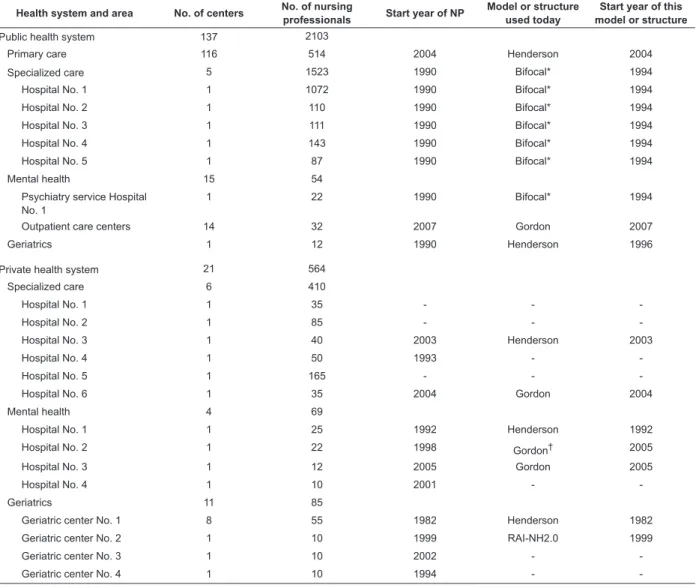
In Table 1, the centers studied are shown, as
well as the number of nursing professionals, the year
the application of the nursing process (NP) started,
the nursing model or assessment structure used in
the application of the nursing process and the year
this nursing model or assessment structure started to
be used. When the cell is empty, this means that the
above are not used at the center. The number of nursing
professionals working at each center reveals its size.
Table 1 – Centers studied, number of nursing professionals working there, start year of application of the nursing
process (NP), nursing model or assessment structured used at the time of the research in the application of the
nursing process and start year of this nursing model or assessment structure. Gipuzkoa, Basque Country, Spain, 2009
Health system and area No. of centers No. of nursing
professionals Start year of NP
Model or structure used today
Start year of this model or structure
Public health system 137 2103
Primary care 116 514 2004 Henderson 2004
Specialized care 5 1523 1990 Bifocal* 1994
Hospital No. 1 1 1072 1990 Bifocal* 1994
Hospital No. 2 1 110 1990 Bifocal* 1994
Hospital No. 3 1 111 1990 Bifocal* 1994
Hospital No. 4 1 143 1990 Bifocal* 1994
Hospital No. 5 1 87 1990 Bifocal* 1994
Mental health 15 54
Psychiatry service Hospital No. 1
1 22 1990 Bifocal* 1994
Outpatient care centers 14 32 2007 Gordon 2007
Geriatrics 1 12 1990 Henderson 1996
Private health system 21 564
Specialized care 6 410
Hospital No. 1 1 35 - -
-Hospital No. 2 1 85 - -
-Hospital No. 3 1 40 2003 Henderson 2003
Hospital No. 4 1 50 1993 -
-Hospital No. 5 1 165 - -
-Hospital No. 6 1 35 2004 Gordon 2004
Mental health 4 69
Hospital No. 1 1 25 1992 Henderson 1992
Hospital No. 2 1 22 1998 Gordon† 2005
Hospital No. 3 1 12 2005 Gordon 2005
Hospital No. 4 1 10 2001 -
-Geriatrics 11 85
Geriatric center No. 1 8 55 1982 Henderson 1982
Geriatric center No. 2 1 10 1999 RAI-NH2.0 1999
Geriatric center No. 3 1 10 2002 -
-Geriatric center No. 4 1 10 1994 -
-*At these centers, between 1990 and 1994, Henderson’s nursing model was used. In 1994, Carpenito’s bifocal structure started to be used.
According to the igures in Table 1, besides some exception, the use of the nursing process starts in 1990 and is generalized in the irst decade of the 21st
century. Nowadays, at 155 (98%) out of the 158 centers
studied, the nursing process is applied. It is applied
at all public centers and 18 out of 21 private centers.
The details of this start are available for one public
center and 18 out of 21 private centers. These details
are available in a previously published retrospective
study(15), and the details of the current use (the use of
the nursing diagnoses, the NIC-NOC terminologies and
the standardized care plans) in an also published
cross-sectional study(12).
At 127 (82%) out of the 155 centers that apply
the nursing process, Henderson’s model is used; at six
(4%) Carpenito’s bifocal structure is used; at 17 (11%)
Gordon’s conceptual structure and, at one, the RAI-NH
2.0 structure (Resident Assessment Instrument Nursing
Home 2.0). At the remaining four centers, the nursing
process is applied without the support of any model or
assessment structure, with records being elaborated
according to the particular criterion of the nursing
professionals at each center.
Carpenito’s bifocal structure, also known as the
bifocal model of clinical practice, is an assessment
structure that proposes the use of a nursing model to
recollect that data that permit obtaining the client’s
nursing diagnoses and the use of the body system
assessment structure to collect the data that permit
obtaining the interdependent problems or the client’s
cooperation. At the public specialized care centers
and the psychiatry service of hospital No. 1 studied,
Carpenito’s bifocal structure has been implemented as
follows: Henderson’s model has been used to collect the
data that permit reaching the client’s nursing diagnoses,
and the body system assessment structure has been
used to collect the data that permit reaching the client’s
interdependent problems. Therefore, keeping in mind
that the centers that use Carpenito’s bifocal structure
are applying Henderson’s model, when adding up the
127 centers where Henderson’s model is used and the
six centers where Carpenito’s bifocal structure is applied,
today, among the 155 centers that apply the nursing
process, at 133 (86%), Henderson’s model is used.
In terms of the number of nursing professionals,
at the centers where the nursing process is applied with
the sole use of Henderson’s model, 578 professionals
are active (24% of all professionals who work at the
155 centers where the nursing process is applied); at
the centers where Carpenito’s bifocal structure is used,
1545 (65%); at the centers where Gordon’s conceptual
structure is used, 101 (4%) and, at the center where
the RAI-NH 2.0 structure is used, 10 (0.4%). When
adding up the 578 nursing professionals who work at
the centers where the nursing process is applied using
Henderson’s model and the 1545 professionals who
work at the centers where the nursing process is applied
using Carpenito’s bifocal structure, today, 2123 (89%) of
the professionals work at centers that use Henderson’s
model.
Concerning the start year of the model or structure,
it should be highlighted that, at some centers, the
selected model or structure has varied over time: at the
public specialized care center or at the psychiatry service
of public hospital No. 1, in 1990-1994, Henderson’s
nursing model was used and, as from 1994, Carpenito’s
bifocal structure; at private mental health hospital No.
2, in 1998-2005, Henderson’s nursing model was used
and, as from 2005, Gordon’s conceptual structure.
When considering the activity area, it is observed
that Henderson’s nursing model is used in all areas; the
bifocal structure is mainly used in the specialized care
area; Gordon’s conceptual structure is mainly used in
the mental health area and the RAI-NH 2.0 structure in
geriatrics.
Discussion
The results show that, in Gipuzkoa, Henderson’s
model has been the most used in the implementation
of the nursing process. That is in accordance with the
authors who refer that Henderson’s model is one of the
most well-known and globally used models(5,16).
The usage igures obtained in this study, superior to 80% in the case of Henderson’s model, is higher than the igures obtained in other similar studies. In a study undertaken in Spain, it is afirmed that, in primary care, 35% of the centers use Henderson’s model, which is the
only one used(11). In a study undertaken in Canada, it
was found that only 25.5% of the centers use a nursing
model to apply the nursing process(17). The study does
not specify what nursing models are used. In another
study developed in Poland, it is concluded that, in that
country’s clinical practice, the ideas and theories of
Nightingale, Orem and Henderson are used, but the
study does not quantify this use per centers(18).
In general, in Gipuzkoa, the nursing process is applied under the inluence of a nursing model or theory. Exceptions are the centers that apply the nursing process
structure or with records made in line with the center
professionals’ private criterion. It should be kept in mind
that Gordon’s conceptual structure and the RAI-NH 2.0
structure are not actually nursing models, but nursing
assessment structures.
In view of the above, those centers should be
focused on which, over time, have varied their choice
of the model or assessment structure. These variations
have affected 1567 nursing professionals (66% of all
professionals who work at the 155 centers who apply
the nursing process), and are related either to replacing
Henderson’s model by an assessment structure or to
complementing Henderson’s model with Carpenito’s
bifocal structure. It seems that, at these centers, Henderson’s model alone was not suficient for the correct assessment of the patient-client, and that
something more or something different was required.
Therefore, in Gipuzkoa, the trend is observed to
complement or replace Henderson’s model by nursing
assessment structures.
This trend appears to conirm those authors who alert to the problems that can emerge if the selected model is not used correctly or who indicate dificulties when combining the nursing model with the incorporation
of novelties (the nursing diagnoses, the NIC-NOC
terminologies) related to the nursing process(20-21).
Concerning the activity area, as mentioned,
Gordon’s conceptual structure is mainly used in the
mental sector. This can be due to the fact that the
school in the Basque Country that offers the programs
to obtain the degree of mental health nursing specialist
has selected this structure.
As regards the geriatric area, it should be observed
that, at the public as well as the private centers, in the
nursing assessment records, a paragraph was found in
which the patients’ ability to accomplish the activities
of daily living is assessed. This term “activities of daily
living” reminds of the term “activities of living” in the
nursing model by Roper-Logan-Tierney(22) but, in the
records studied, the 12 activities of living this model
proposes are not assessed, but only those activities
that propose the indices used to measure the autonomy
in the accomplishment of the activities of daily living
(Katz, Barthel and Lawton indices). That is the reason
why it was not considered that this nursing model is
applied.
Finally, it is noteworthy that, at almost all public
centers in the same area, the selected assessment
model or structure coincides and is simultaneous over
time. At the private centers, on the other hand, there
are differences in the choice of the model or assessment
structure as well as in the start date. That is so because,
at the public centers, the management of each area, which drives the changes, is uniied. The management at the private centers, on the other hand, is independent,
without any connections among them.
Conclusions
These study results show that, in Gipuzkoa,
Henderson’s model has been the most used in the
implementation of the nursing process.
Over time, a trend is observed to complement
or replace Henderson’s model by nursing assessment
structures.
Finally, this study reveals that, at the public centers
in the same area, the nursing model or assessment
structure almost always coincides, which is not the case
at the private centers.
References
1. Alfaro-Lefevre R. Applying nursing process:
the foundation for clinical reasoning. Philadelphia:
Lippincott; 2014. 3 p.
2. De la Cuesta C. The Nursing Process: from development
to implementation. J Adv Nurs. 1983;8(5):365-71.
3. Müller-Staub M, Lavin MA, Needham I, Van Achterberg
T. Nursing diagnoses, interventions and outcomes –
application and impact on nursing practice: systematic
review. J Adv Nurs. 2006;56(5):514-31.
4. Lunney M. Critical thinking and accuracy of nurses
diagnosis. Int J Nurs Terminol Classif.
2003;14(3):96-107.
5. Raile M, Marriner A. Nursing theorists and their work.
7th. ed. New York: Mosby/Elsevier; 2010. 3-15 p.
6. Durán de Villalobos M. Marco epistemológico de la
enfermería. Aquichan. [Internet]. 2009 [acesso 16
maio 2014]; 2(1). Disponivel em: <http://aquichan.
u n i s a b a n a . e d u . c o / i n d e x . p h p / a q u i c h a n / a r t i c l e /
view/17/34>.
7. Meleis A. Theoretical nursing development and
progress. 5th. ed. Philadelphia: Lippincott-Willians &
Wilkins; 2012. 10 p.
8. Carpenito LJ. Nursing diagnosis: Application to clinical
practice. 14th. ed. Philadelphia: Lippincott-Willians &
Wilkins; 2013.
9. Gordon M. Manual of nursing diagnosis. 12th. ed.
London: Jones and Bartlett Publishers International;
10. NANDA-International. Diagnósticos enfermeros.
Definiciones y clasificación 2012-2014. Barcelona:
Elsevier; 2013. 49 p.
11. Izquierdo JM, Pérez MB, Ramírez FJ, Serrano I, Torres
MD, Conde G. Implantación del proceso enfermero. Rol
Enferm. 2002;25(7-8):488-93.
12. Huitzi-Egilegor JX, Elorza-Puyadena MI, Urkia-Etxabe
JM, Zubero-Linaza J, Zupiria-Gorostidi X. Use of the
nursing process at public and private centers in a health
area. Rev. Latino-Am. Enfermagem. 2012;20(5):903-8.
13. Giménez AM, Serrano P. Imprecisiones del proceso
diagnóstico enfermero. Metas Enferm. dic 2008/ene
2009;11(10):57-62.
14. De Henderson VA. The nature of nursing: Reflections
after 25 years. New York: National League for Nursing
Press; 1991.
15. Huitzi-Egilegor JX, Elorza-Puyadena MI,
Urkia-Etxabe JM, Esnaola-Herrero MV, Asurabarrena-Iraola C.
Retrospective study of the implementation of the nursing
process in a health area. Rev. Latino-Am. Enfermagem.
2013;21(5):1049-53.
16. Luis MT, Navarro MV, Fernández C. De la teoría a
la práctica: el pensamiento de Virginia Henderson en el
Siglo XXI. 3th. ed. Barcelona: Masson; 2005. 46 p.
17. Simpson J, Taylor D. Reality check. Do conceptual
models of nursing work today? Can Nurse. 2002
Feb;98(2):24-6.
18. Zarzycka D, Dobrowolska B, Slusarska B, Wronska I,
Cuber T, Pajnkihar M. Theoretical foundations of nursing
practice in Poland. Nurs Sci Q. 2013;26(1):80-4.
19. Morris JN, Hawes C, Fries BE, Phillips CD, Mor V, Katz
S, et al. Designing the national resident assessment
instrument for nursing homes. Gerontologist.
1990;30(3):293-307.
20. Kalisch BJ, Landstrom GL, Hinshaw AS. Missed nursing
care: a concept analysis. J Adv Nurs.
2009;65(7):1509-17.
21. Reyes J, Jara P, Merino JM. Adherencia de
las enfermeras/os a utilizar un modelo teórico
como base de la valoración de enfermería. Cienc
Enferm. [Internet]. jun 2007 [acesso 16 maio
2014]; 13(1):45-57. Disponivel em: http://www.
scielo.cl/scielo.php?script=sci_arttext&pid=S0717-95532007000100006&lng=es. http://dx.doi.
org/10.4067/S0717-95532007000100006.
22. Roper N, Logan WW, Tierney AJ. The
Roper-Logan-Tierney model of nursing: based on activities of living.
3th. ed. Edinburgh: Churchill Livingstone; 2009.