R E S E A R C H
Open Access
Analyzing competing demands in
organizations: a systematic comparison
Medhanie Gaim
1*, Nils Wåhlin
1, Miguel Pina e Cunha
2and Stewart Clegg
2,3* Correspondence:
1Umeå School of Business, Economics and Statistics, Umeå University, Umeå, Sweden Full list of author information is available at the end of the article
Abstract
Organizational scholars have shown increasing interest in the ways in which managers
enact and respond to competing demands and the tensions they prompt asconstitutive
elements of their organizations. There is now a proliferation of conceptualizations of such competing demands that can be somewhat confusing. We will enhance conceptual clarity by identifying seven constitutive empirical characteristics of competing demands: these consist of the existence of dyadic relations, contradiction, interrelatedness, complementarity, compatibility, simultaneity, and the existence of push-pull forces. We construct a comparative classification of competing demands using these characteristics as our distinguishing features. The result is a more nuanced understanding of how managers approach competing demands that can help scholars to minimize arbitrariness, interpret results, and compare contributions in the area in a much-needed step toward understanding and designing organizations.
Keywords: Competing demands, Organizational contradictions, Organizational design, Organizational tensions, Paradox theory
Introduction
Being subject to competing demands is a pervasive and inherent feature of managerial life (Beech et al.2004; Jarzabkowski et al.2013; Lewis and Kelemen2002). Competing demands occur when management, depending on the use of limited resources or at-tention, requires more to be done than available resources suggest it is possible to do. Where competing demands are deemed to be of comparable importance for managers and decision-makers, tensions arise over resource allocation and prioritization (see Andriopoulos and Lewis 2010; DeFillippi et al. 2007; Jarzabkowski et al. 2013). For competing demands to be sensed as contradictory, it is not sufficient that demands be competing as there must also be managerial “perceptions of [their] opposing and interwoven elements” (Lewis2000, p. 397). How they are dealt with depends on“how much time, energy, and effort go into one demand versus the other” (Putnam et al.
2014, p. 416). The struggle to meet competing demands has spurred many dichotom-ous abstractions in organization studies that require balancing such as exploration and exploitation (March 1991), efficiency and flexibility (Adler et al. 1999), empowerment (power to) and power over (Clegg et al. 2006), the management of order and chaos (Eisenhardt and Brown 1998), efficiency and flexibility (Adler et al. 1999), and managing evolutionary and revolutionary change (Tushman and O’Reilly 1996). For organization members, attending to both demands simultaneously does not necessarily
© The Author(s). 2018 Open Access This article is distributed under the terms of the Creative Commons Attribution 4.0 International License (http://creativecommons.org/licenses/by/4.0/), which permits unrestricted use, distribution, and reproduction in any medium, provided you give appropriate credit to the original author(s) and the source, provide a link to the Creative Commons license, and indicate if changes were made.
mean engaging both demands to their full strength or with equal vigor (Burton et al.
2015; Clegg et al. 2002) or situating them in a new relationship as a novel approach (Putnam et al. 2016). There are subtle differences between conceptualizations of com-peting demands when they are addressed separately or engaged simultaneously (see Chen 2017). Managers perceiving tensions between competing demands may be torn between two poles of action when they attempt to attend to both demands at the same time (Carroll 2012). The risk is that one side of the competing demands requires the most immediate attention; an organization exclusively dedicated to exploration of new frontiers, for example, will expire in relatively short order if it fails to manage exploit-ation of what it already knows well. Similarly, an organizexploit-ation that creates value through exploitation will exhaust its stocks of knowledge in due course, as it is “out-flanked” (Clegg 1989) by more exploratory rivals (see Martin 2004). Achieving both poles simultaneously is the managerial ideal promised by ambidextrous designs that enable organizations to accommodate competing demands in order to gain higher performance (Bøe-Lillegraven 2014; O’Reilly and Tushman2013), despite the ideal be-ing difficult to achieve, costly to maintain, and unstable in action (Burton et al. 2015; Gibson and Birkinshaw2004).
In reviews of the recent literature, the effects of competing poles have been conceptu-alized as dilemmas, trade-offs, dualities, dialectics, and paradoxes, to mention only a few of the treatments of the theme (Achtenhagen and Melin 2003; Ashforth et al.2014; Smith and Lewis2011). These conceptualizations of competing demands, while becom-ing more detailed and varied, are also increasbecom-ingly inconsistent (Denis et al. 2007; Fairhurst et al. 2016; Pache and Santos 2010). In this paper, we increase conceptual clarity by identifying core features and then constructing a system for comparative clas-sification and outline how different conceptualizations result in different understandings and design options.
The paper is structured as follows. We start by discussing the prevalence of compet-ing demands in organizations, and their associated effects in different contexts and at different levels, stressing the need for conceptual clarity. Next, we discuss the most prominent theoretical conceptualizations. Using key references, we present the salient features and show how these can be used to re-conceptualize the contradictory effects of competing demands. Distilling these features provides a more nuanced conceptualization of the effects of competing demands and the resulting tensions. In concluding, we discuss the implications of having provided increased conceptual clarity, along with the theoretical and practical implications for organizational design.
A plethora of competing demands
The essence of organization design is that it be able to deal with contingencies. The management of competing demands is a contingency that frames organizational design (Jarzabkowski et al. (2013). How competing demands, such as exploration and exploit-ation, are accommodated can be conceptualized in various ways, often with overlapping features, introducing a degree of analytical ambiguity and confusion. It is important to be able to distinguish between different types of competing demands. Cameron and Quinn (1988) distinguish a situation that is one presenting paradox from other related concepts, such as those that pose dilemmas, prompt irony, generate inconsistency,
foster dialectics, create ambivalence, or produce conflict. Others, such as Achtenhagen and Melin (2003) identify distinctions among dualities, paradoxes, trade-offs, and di-lemmas. More recent researchers on paradoxes, such as Smith and Lewis (2011), distin-guish paradox from duality, dilemma, and dialectic. Putnam et al. (2016) emphasize that discriminating among these distinctions generates a “conceptual malaise” which they seek to resolve by offering definitions of various concepts such as tension, duality, dualism, contradiction, dialectics, and paradox. However, the precise conceptualization of these different demands remains elusive, as the distinctiveness of different conceptu-alizations cannot be easily delineated.
The way in which competing demands may be conceptualized—for example, as a di-lemma or a paradox—implies the presence or absence of specific features. On the one hand, irrespective of representations, some aspects of the world may be experienced as paradoxical (Clegg2002, p. 2) while, on the other hand, paradoxes that exist in reality might be obliterated by the label and conceptualization chosen to represent them (Clegg 2002, p. 2). In studying competing demands, organization members might be seen by some observers to be dealing with duality or paradox while others might see them as dealing with something different but equally distinctive (see, for example, Ashforth and Reingen2014; Luscher and Lewis2008). The conceptual vocabulary used to address competing demands remains somewhat prolix and ill disciplined. Such rep-resentational confusion means that in practice, when faced with such demands, organization members have no clear guidance as to whether to attend to them either separately—across time and space—or simultaneously. How competing demands are conceptualized and dealt with in practice challenges various design options. In the next sections we will briefly present the existing conceptualizations of competing demands that are commonly used in the literature and then outline their inherent, and to some extent overlapping, features.
Conceptualizations of competing demands
Conceptualizations of competing demands imply assumptions about the relationships between these demands—for example, whether they are oppositional or interdependent (Chen 2008). Moreover, different conceptualizations represent diverse options for ways in which organization members’ sensemaking might respond. For example, in classical studies in which it is assumed that there is one best way of doing things, these demands will be dealt with in terms of a decision as to which pole is the best one to prioritize at the expense of the other. However, given the increased complexity and nature of the environment, the“one-best-way” approach has given way to one in which organizations deal with multiple demands simultaneously or across time and space (Poole and Van de Ven1989).
Various options present themselves. Using an either/or or both/and framing (Martin
2007; Putnam et al. 2016) or regarding responses as either defensive or active (Jarzabkowski et al.2013) defines a specific situation differently, making different sense. When competing demands are conceptualized as dilemmas, they are framed as problem-atic, as problems to be solved (Li2016, p. 47). An either/or situation presents itself, as one in which alternative must be selected at the expense of the other in a win-lose situation (Ashforth et al. 2014; Quinn and Cameron 1988). Dilemmas pose an incompatibility
between competing demands that necessitates choice as a response (Janssens and Steyaert
1999; Westenholz 1993). Conceptualizing competing demands as trade-offs implies that achieving more of one demand means achieving less of the other (Gaim and Wåhlin
2016). In this view, responses must partially attend to one demand at the expense of the other, in the form of a compromise, with a moderate focus on either demand (Achtenhagen and Melin2003; Ashforth et al.2014; Eisenhardt2000; Pache and Santos2010). When com-peting demands are conceptualized in dialectical terms, a pattern is assumed that begins with a thesis, followed by its antithesis; the dialectic is then resolved through their synthesis1 (Poole and Van de Ven1989; Smith and Lewis2011). The synthetic response resolves the tension temporarily or permanently. Synthesis consequently stresses similarities between demands while putting less emphasis on their differences. In a synthesis, according to Smith and Lewis (2011), actors will ultimately favor one demand at the expense of the other. Conceptualizing competing demands as dualities means that their opposites exist within a unified whole (Smith and Lewis2011). Duality can also refer to two essential elements that are interdependent and in which one enables the other (Farjoun 2010). The conceptualization of competing demands as paradoxes envisages the simultaneous and per-sistent coexistence of competing demands that are contradictory, yet interrelated (Schad et al.2016; Smith and Lewis2011).
Table 1 summarizes the various conceptualizations of tensions with key associated sources and definitions. In this table, the movement from dilemma to paradox indicates the change in theoretical perspective used to understand the nature and implication of organizational ways of dealing with competing demands.
In the literature on competing demands, it is typical for researchers to stress different conceptualizations chosen from those represented in Table 1 (see Putnam et al. 2016; Smith and Lewis2011). Despite their respective merits, the distinctiveness of such con-ceptualizations does not explicitly show similarities and differences across the various sources, although they do indicate why sharp distinctions among varying conceptualiza-tions matter. Moreover, given the variety of conceptualizaconceptualiza-tions (for more, see Ashforth et al. 2014; Janssens and Steyaert 1999), analytical distinctions among various ways of coping with competing demands need to be closely related to distinctions made at a practical level. Consequently, current explanations lack an overarching systematic framework. Such a framework would combine features characterizing responses to competing demands that show their similarities, differences, and implications.
In the following section, we distil the core features that can be used to show similarities and differences among diverse conceptualizations of competing demands. Using these features, we discuss how various conceptualizations of the effects of these competing de-mands can be understood and interpreted, indicating which features are present (and ab-sent) in each conceptualization. The intention is not to impose a single definition but to contribute to the field of research by showing how to delimit the consideration of compet-ing demands—meancompet-ing how to define their boundaries in a manner that is useful for ad-vancing our understanding of them and enables us to separate and compare them.
Features of competing demands in organizations
Although various conceptualizations and definitions exist, as we have discussed, the dif-ferences among them are not always clear. As shown in Table1, existing and somewhat
overlapping definitions are insufficient for understanding and researching competing demands and the resulting tensions. Hence, systematic comparison is required to en-hance clarity. To make a systematic comparison, it is important to differentiate features unique to a particular conceptualization from overlapping features that co-exist with other conceptualizations. These features could then serve as distinguishing or shared traits or qualities. Using the identified features, it is possible to describe the uniqueness of any conceptualization and to make systematic comparisons among these. Doing so makes it possible to show if a particular concept is used as an overarching category or is treated as a feature of a categorical conceptualization. For example, Putnam et al. (2016) use contradiction as a concept in itself, while others (see Achtenhagen and Melin 2003; Schad et al. 2016; Smith and Lewis 2011) use the same term as a feature characterizing a concept.2
Based on a review of key references distinguishing competing demands and their as-sociated effects (such as Achtenhagen and Melin 2003; Ashforth et al. 2014; Cameron and Quinn 1988; Janssens and Steyaert 1999; Putnam et al. 2016; Smith and Lewis
2011), we were able to identify seven core features: the existence of a dyad, Table 1 Various types of competing demands in organizations
Competing demand Definition Implications for organizational design
Representative work Dilemma An either/or situation
where one alternative is preferred relative to the other.
Designers need to know how to select and be aware of potential for polarization and rigidity. Choice of one pole, for example, A, leads to failure to engage in action that supports the other pole, for example, B.
(Achtenhagen and Melin
2003; Janssens and Steyaert1999; Jarzabkowski et al.2013; Westenholz1993)
Trade-off A gradual exchange between two demands where more of one means less of the other.
Designers need to be aware that the relief that comes as a result of a compromise is short-lived and it might reduce or neutralize the energy of the tension. In addition, the compromise might mute opposition although it might resurface later.
(Achtenhagen and Melin
2003; Jarzabkowski et al.2013)
Dialectic A pattern that always begins with a thesis, followed by an antithesis, which is then resolved by their synthesis.
Designers need to be aware of the separation that dialectics imply as it might delay learning of the intersection and the opportunity to thrive through the tension. This also might marginalize the less powerful pole.
(Jarzabkowski et al.2013; Putnam et al.2016; Smith and Lewis2011; Westenholz1993)
Duality The twofold nature of an object of study without separation; they are seemingly opposite but are interdependent and complementary.
This implies that the designer’s focus is on complementarity and reducing power difference. This might also imply neutralizing the opposition in the long term.
(Farjoun2010; Janssens and Steyaert1999; Jarzabkowski et al.2013; Smith and Lewis2011)
Paradox Contradictory, yet interrelated elements exist simultaneously and the tension persists over time.
This implies that designer’s aim for accommodating tensions. For the designer that means critically examining assumptions about tensions and developing a complicated range of understanding tensions and new organizational practices to accommodate them.
(Janssens and Steyaert
1999; Jarzabkowski et al.
2013; Quinn and Cameron
1988; Smith and Lewis
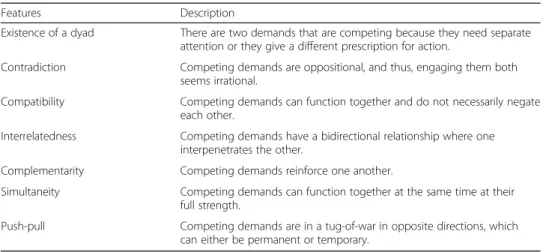
contradiction, interrelatedness, complementarity, compatibility, simultaneity, and push-pull forces. Using these features, we advance a nuanced understanding of those features that are common and those used to define each particular categorization. What these features refer to and how they are used is further discussed below.
The existence of a dyadic choice implies that there are two competing demands, such as the pressure to explore and to exploit (March1991). The demands are competing because they require separate attention, entail the allocation of mutually incompatible resources, and point to different guidelines for action (Chen2017). Although most organizations will always anticipate meeting more than two demands at any time, the basic idea behind the notion of competing demands, as the literature has articulated it, is that problems often present themselves as twofold—as a potential contradiction. A potential contradiction im-plies that the competing demands are in opposition to one another (Smith and Lewis
2011) and hence engaging both might seem irrational or illogical. For example, to explore and to exploit entails different lines of action that might be considered contradictory. Exploration is characterized by search, experiment, and discovery while exploitation is characterized by refinement, efficiency, and execution (March1991).
If competing demands are incompatible, it means that they cannot function together and negate each other (Chen 2008; Putnam et al.2016), while compatibility signifies that the competing demands do not necessarily negate each other but can operate together. Inter-relatedness signifies the presence of a bidirectional relationship (Clegg et al.2002), which also implies a potential for synergy. When competing demands are interrelated, the perception of one demand is in some way, if not entirely, shaped by that of the other (Chen2008); in other words, one demand defines the other (Putnam et al.2016). Compatibility and interrelated-ness can be exemplified by improvisation where planning and action function together. Ac-cording to Clegg et al. (2002, p. 494), improvisation necessarily engages planning and ad hoc reaction (see also Kamoche and Cunha2001). Complementarity denotes that competing de-mands support and reinforce one another (Andriopoulos and Lewis2009a,2010), that each is necessary but not sufficient for the well-being of the organization (Ashforth and Reingen
2014). The social and commercial needs of social enterprises exemplify complementarity in that one reinforces the other (Porter and Kramer2006; Smith et al.2013).
Simultaneity implies that competing demands are apparent at the same time, exemplified by the co-presence of art and technology as a source of novelty in the case of Pixar (Harvey
2014). Pixar’s success depends on meeting both demands at the same time with equal vigor
(Birkinshaw and Gibson2004; Burton et al. 2015). Finally, push-pull points to the tug-of-war that pulls competing but inseparable demands in opposite directions. The push-pull can be exemplified by the need to attend to the idealist and pragmatic missions of a natural food cooperative, as explained by Ashforth and Reingen (2014). The push-pull or the sense of being pulled in the opposite direction (Schad et al.2016) can be continuous or tempor-ary. If the push-pull is continuous, the more organization members move towards one pole, the more they will feel pulled towards its opposite (Smith and Lewis2011). If the push-pull is punctuated, it implies a resolution of the tension, i.e., favoring one over the other, either temporarily or permanently. Table2summarizes the features.
By juxtaposing features of competing demands, as shown in Table 3, it is possible to explore how different ways of dealing with competing demands invoke different re-sponses. By adding an element of conceptual grounding to the analysis of competing demands, researchers have a more focused conceptual lens, delineating innovation and
significance, moving beyond blurred explanations. The classification depicted in Table3
clarifies the relations among the different conceptualizations of competing demands. Compared to Table 1—which is a more typical way of differentiating concepts related
to competing demands—the conceptualization of Table3indicates systematically which features are present (and absent) when describing a specific competing demand. Table3
complements the prior conceptualization and indicates how, for example, trade-offs can be understood and how they differ from other conceptualizations. The theoretical implication of constructing Table 3is that it delineates content validity—that is to the extent to which a conceptualization represents all facets of a given construct—in re-search into different processes that are often conceptually amalgamated. Having out-lined the features and provided an overview of the similarities and differences among different tensions, we now offer a more nuanced discussion, based on Table3.
In the table, the “√” sign indicates what features are present within each conceptualization, while the absence of a particular feature is indicated by the“×” sign. If the cell contains both symbols, this means the feature is present in a limited way, ei-ther temporally, spatially, or as a minimal presence.
Dilemmas
If a competing demand is conceptualized as a dilemma, these demands may be attended to separately because they are merely competing for attention. None of the other features characterize a dilemma; for example, there is no assumption that the two “horns of a di-lemma” are contradictory, interrelated, complementary, and compatible. Moreover, the prescription for action is different if one is more likely to be selected at the expense of the other. As Smith (2014) indicates, there is a clear decision, one way or the other, meaning that one alternative must be preferred. The treatment of competing demands that is most closely related to regarding them as a dilemma would be a trade-off.
Trade-offs
If a tension is conceptualized as a trade-off, it comprises two demands that are compat-ible but oppositional and that require separate attention. Moreover, although they can function together in a constant tug-of-war, they are not present at their full strength. Table 2 Features of competing demands
Features Description
Existence of a dyad There are two demands that are competing because they need separate attention or they give a different prescription for action.
Contradiction Competing demands are oppositional, and thus, engaging them both seems irrational.
Compatibility Competing demands can function together and do not necessarily negate each other.
Interrelatedness Competing demands have a bidirectional relationship where one interpenetrates the other.
Complementarity Competing demands reinforce one another.
Simultaneity Competing demands can function together at the same time at their full strength.
Push-pull Competing demands are in a tug-of-war in opposite directions, which can either be permanent or temporary.
Table 3 A reconceptualization of competing de mands Vario us types of com peting de mands Feat ures of compe ting demand s Exist ence of dy ad Contr adiction Interrelatedne ss Comple menta rity Compat ibility Simultan eity Pu sh-pull Dilem mas √ ×× × × × × Tra de-offs √√ ×× √ × √ Dial ectics √√ √ ×× × √ /× Dual ities √ × √√ √ √ √ /× Para doxes √√ √ √ √ √ √
Since the demands are neither interrelated nor complementary, it means that more of one demand means less of the other (for example, work/life balance). In other words, although they are compatible and hence can be active at the same time, the two de-mands are not present at their full strength. They represent, as Eisenhardt (2000) put it, a bland, halfway.
Dialectics
When tensions are conceptualized as dialectics, the two demands are contradictory and interrelated. In a dialectic, the two demands are antagonistic: one emerges due to the dominance of the other; hence, they are not compatible. As Hargrave and Van de Ven (2017) pointed out, actors try either to maintain or change existing conditions, seeking to defeat their dialectical other (implying resolution) rather than accepting coexistence. Because there is a resolution involved, push-pull is not present (Li 2016). As Schad et al. (2016) put it, the synthesis renders push-pull obsolete.3In dialectics, considering the current conceptualization, one demand follows the other (i.e., thesis is followed by anti-thesis) and the two do not exist simultaneously but rather across time and space (they are separated).
Dualities
Tensions conceptualized as dualities consist of two demands that are interrelated, com-plementary, compatible, and simultaneous. Because the two are not necessarily contra-dictory, the tug-of-war between them (for example, protection of self-interest while nurturing the collective good) is not as pronounced as in a trade-off. Accordingly, dual-ities imply a “twofold character of an object of study without separation” (Farjoun
2010). They are neither necessarily antagonistic (Putnam et al. 2016) nor separate (Farjoun2010), and because they are inseparable, one cannot be understood in the ab-sence of the other, so there is less focus on the contradiction (Schad et al.2016, p. 12). Paradoxes
Finally, paradoxes are contradictory dyads, with complementary and interrelated poles. They exist simultaneously and reinforce one another, such that the push-pull of the opposites persists over time. The push-pull or presence of a tug-of-war has different implications in paradoxes compared to trade-offs, for example. In a paradox, the push-pull is embraced and used as a source of energy while in a trade-off the push-push-pull is minimized and settled by reaching a compromise middle-ground solution. Paradox checks off all features and is defined in terms of “contradictory, yet interrelated organizational elements that exist simultaneously,” with the tensions between them expressing persistence or stubbornness (Cunha and Clegg2018; Smith and Lewis2011, p. 382). Tensions are used as a source of energy.
The framework provided by this innovative conceptualization renders the similarities and differences of various ways of classifying competing demands clearer by revealing their underlying assumptions. Moreover, it clarifies which features are present and which are absent when using a specific conceptual lens to frame and subsequently approach competing demands. Doing so also shows whether the situation is to be con-sidered as a problem to be solved (for example, a dilemma) or as an opportunity to be creative (for example, a paradox) (see Andriopoulos and Lewis2010).
Distinctions for conceptual clarity
Competing demands can be understood on the basis of how their inherent features are con-stituted in practice. Commonly, two forms of constitution are in play: one negative, the other positive. First, competing demands (and their associated tensions) may be treated as a source of anxiety and discomfort, and organization designers and members will thus attempt to avoid, suppress, or resolve them (Smith and Berg 1987). Second, they may be approached as a source of energy thus calling for creativity (Beech et al. 2004; Smith and Lewis2011). These different approaches are reflected in the ways that researchers differenti-ate between competing demands at the theoretical and empirical levels. These distinctions are of great importance because of the subtleties involved, but they are not always apparent in specific expressions of scholarship (Gaim2017b). For example, researchers such as Smith (2014) use paradox to conceptualize tensions but state that being consistently inconsis-tent—through differentiation and integration—is a decision pattern that informs leaders’ practice. Similarly, in their study of tensions in cooperatives, Ashforth and Reingen (2014) report that organization members engage in a zigzag pattern over time to deal with the ten-sion; the authors conceptualize this as duality. Although on a conceptual level these studies claim to look at paradox and duality, respectively, they are in fact looking at various ways of dealing with competing demands. In this formulation of being“consistently inconsistent,” as soon as the competing demands are separated, paradox ceases to exist because paradox (see Table3) involves unceasing push-pull. Similarly, if organizational members engage in a zigzag pattern favoring idealistic over pragmatist demands at one point and the opposite on a later occasion, then they are not dealing with dualities but with dilemmas (see Table3).
Although our central focus has been on the importance of conceptual clarity to make a significant research contribution, the paper also has practical implications. In research terms, insofar as the constitutive features identified help researchers in their studies of competing demands, practically an awareness of similarities and differences can also aid organizational design that makes sense of competing demands (see the action research done by Luscher and Lewis2008). Similarly, it is possible to show whether the responses suggested conceptually (e.g., based on avoidance, choice, compromise, or ac-ceptance and engaging (Jarzabkowski et al. 2013; Lewis 2000; Smith and Berg 1987) were targeted to different categories of competing demands.
Apart from responses based on avoidance (which are conceptually irrelevant), choice-related responses align with the category of a dilemma (see Table3). Compromise-related responses imply recognizing and attempting to accommodate competing demands but not at their full strength; this would entail finding a middle ground in the form of settle-ment or balance (Jay2013; Smith and Lewis 2011). In these cases, there is a tendency to reconcile and sacrifice some of one’s own needs: one party’s gain is another party’s loss. Following Table3, this compromise aligns with the notion of a trade-off. Responses based on accepting and engaging tensions inherent in competing demands imply understanding contradiction, tension, and ambiguity as natural conditions of work (Lewis 2000). Doing so involves conceptualizing paradox in theory and accepting paradox in practice as a stimulus to the imagination of creative responses (Carlson et al.2017).
Discussion
We sought to increase conceptual clarity by identifying relevant features in different ways of conceptualizing and responding to competing demands. Doing so complements those
previous studies providing isolated definitions without systematically juxtaposing their simi-larities and differences. For instance, increased conceptual clarity demonstrates that treating competing demands as either a duality or a paradox requires particular substantive features. In this case, conceptual confusion among the terms might hinder the development of the-ory, since it affects what Clegg (2002) calls“representing” the tension: what is paradoxical in reality might be conceptualized as something else depending on the features employed.
Conceptual clarity contributes to the body of scholarship by explaining how compet-ing demands and their associated tensions can be interpreted. Chen (2008) argues that unless a field achieves conceptual clarity, research will be limited; it may even culmin-ate in what has been termed conceptual “malaise” (Putnam et al. (2016). Moreover, conceptual clarity makes the connection between responses and specific problematics clearer and hence enables the field to grow by focusing on developing creative ways of dealing with these different tensions using a consistent and shared vocabulary, thus reducing definitional equivocality.
Conceptual clarity can also explain gaps between conceptualization in theory and the context of practice. With enhanced clarity, the gap between conceptual and practical treatments narrows, allowing practitioners to recognize the consequences of shifts in their practical consciousness when iterating between dilemma and paradox or between di-lemma and duality, for instance. Understanding of both practical and theoretical situations is enhanced through the appreciation of multiple approaches for dealing with competing demands. Hence, envisaging multiple conceptualizations and implications liberates both researchers and designers of organizations from self-imposed conceptual captivity. Using the conceptualization provided, organization researchers as well as designers will be able to recognize different tensions and their implications. Clear delinea-tion and understanding of occasions of contradicdelinea-tion, interrelatedness, or complementar-ity aids both theoretical and practical recognition of the diverscomplementar-ity of problems encountered. Organizations need to express a requisite variety (Ashby1956) in their rep-ertoire of responses that are at least as nuanced as the problems they face. In other words, one can examine transitions or iterations among different ways of categorizing competing demands and how these take place, as well as the reasons behind the different treatments (see Chen (2017) for a closer approach regarding ambidexterity).
Escaping from conceptual blinkers also means researchers and practitioners can see that different ways of framing and dealing with competing demands might be operating at the same time. Such differences in accounting for action imply distinct orientations that make investigating the transition or intersection between certain problematizations (e.g., trade-off and paradox) and approaches (e.g., compromise and synergy) worth-while. Examining patterns between problematizations and responses and changes in these patterns, as well as why and how such changes occur, frames a future research agenda. Questions of relevance might include the following: at what point do members shift their approach to problematization? Why do they change their approach? What happens when different problematizations suggest contradictory responses, in the man-ner of the garbage can (Cohen et al.1972)? Process-oriented longitudinal studies in dif-ferent contexts would enable researchers to address such issues. Hence, with enhanced conceptual clarity, it will be possible to study how organizations and their members change in regard to the ways in which they problematize competing demands: if, for ex-ample, choice becomes replaced by synergy as the modus operandi.
The contemporary literature assumes that different problematizations of com-peting demands are equally valid or important (Schad et al. 2016). However, power relations and their dynamics play a major role in organizations (Clegg
1989; Clegg et al. 2006). Hargrave and Van de Ven (2017) introduce the notion of power distribution as a contingency and examine how it affects outcomes. More significant is the power of categorization in the first place: whose definition of a given situation or event as one or other problematization prevails (Deroy and Clegg 2011)? Neither competing demands nor the ways of representing them will be seen as equally valid. In practical contexts where one demand dominates over the other, or one way of seeing the situation overwhelms other possibilities, those in charge will define not only whether but also how problematizations are framed. Given the relevance of conceptual clarity in general, the implications for organization design are discussed below.
Implications for organization action and design
If organization actors frame competing demands as a dilemma, these demands will be approached in terms of their “either/or” quality (Cameron and Quinn 1988). If we take the example of strategy, it could mean that exploitation might be priori-tized over exploration in what Miles and Snow (1978) call a defender strategy. In this case, there is a risk of not being able to change quickly, which makes a firm vulnerable in the long term. Similarly, if exploration is prioritized over exploitation, the firm might exhaust its resources (Burton et al. 2015). From a structurational point of view, this would mean prioritizing an organic structure at the expense of one that is more mechanistic (Burns and Stalker 1961), something that was evident in Oticon when it adopted the design of a “spaghetti organization” (Gould 1994). Oticon gradually abandoned this design to adopt matrix organizing (Foss 2003). In the Oticon case, engaging with “the precarious nature of extremes” (Gaim and Wåhlin 2016, p. 39) meant that too much organic structure led to chaos and ran-domness (Clegg et al. 2002, p. 496). Organization design needs to be heedful of the potential for polarization and its associated risks.
As discussed above, framing of competing demands as trade-offs implies seeking a balance in which more of one implies less of the other. For organization design, how such balance is achieved and the nature of the balance is of high importance. For example, is the balance one that allows a minimal, sufficient, or full-strength presence of both demands? For example, with respect to coordination and control systems, the challenge of organization design entails making decision on flexibility and control (Cameron 1986) and centralization and decentralization (Alonso et al.
2008). In attempts to balance organization design, compromise might be sought, despite that this can sometimes be a bland halfway or mediocre split (Andriopou-los and Lewis 2009b; Eisenhardt 2000). The implication of compromise is that it might provide short-lived relief (Jarzabkowski et al. 2013) but it might also reduce or neutralize tension (Cunha and Putnam 2017). From an organization design viewpoint, in the case of either a perceived dilemma or a trade-off, the assumption is that the problem is to be solved, respectively, by choosing one alternative or bal-ancing—in a form of error-correction—the two alternatives.
Framing competing demands as dialectics implies separation of these demands in time and space (Poole and Van de Ven1989). For example, organization designers deal with issues of efficiency and effectiveness. If seen as dialectics, the issue that poses a challenge would be whether these demands are assigned to different units or divisions in an organization. Separation might imply an organization design in which these de-mands are met sequentially where one demand is met followed by the other in a process of ambidextrous sequentiality that deals first with the matter considered on the one hand followed by the matter considered in terms of the other hand. Sequential ambidexterity prompts“organizational vacillation” (Boumgarden et al. 2012) as organi-zations focus their attention on different demands at different periods (Chen 2017). The risk of doing so is the missed opportunity of learning at the point of intersection of these demands. The opportunity for“ideas to bump into and build upon each other” (Johansson 2004, p. 16) is lost. Similarly, framing competing demands as dualities im-plies that not recognizing the contradictory nature of competing demands ultimately reduces the power of difference. Moreover, such framing runs the risk of neutralizing the potential value that learning from these contradictory oppositions might afford in the long term (Cunha and Putnam2017).
It has been argued that securing superior performance in the short run while simultan-eously forging the conditions for long-term success can be achieved by framing competing demands as a paradox (Smith and Lewis 2011). Moreover, it has further been proposed that an organization that effectively embraces paradox is more likely to be successful in dy-namic environments (Tushman et al.2010). Doing so consistently, however, is a challenge that involves attention to a support system, strategy, and context (Gibson and Birkinshaw
2004; Raisch and Birkinshaw2008) as well as specific organizational arrangements (Gaim
2017a) and particular attention from the leaders (Burton et al.2015).
As stressed, regarding competing demands in terms of paradox might be an “ideal” but it is one that entails complex organizational design (Burton et al. 2015). Moreover, it requires critically examining fundamental assumptions about tensions as something to be avoided. Instead, enduring and persistent tensions have to be apprehended in terms of their potential stimulus for designing new organizational practices with which to accommodate them (Bartunek 1988; Lewis2000). For example, if a firm successfully accommodates both exploration and exploitation, we can safely assume that the tension between them was problematized as a paradox and appropriate organizational practices innovated (Burton et al.2015, p. 39).
Conclusions
The paper started from the premise that the conceptual confusion regarding the problematization and treatment of competing demands that exists in the manage-ment and organization literature was inimical to further theory building and con-ceptual clarification. Instead of concon-ceptual clarity there was a concon-ceptual malaise. Based on an extensive literature review of key sources, we identified seven dis-tinctive features that reveal underlying assumptions regarding problematization and treatment. Using these features, we have reconceptualized five common ap-proaches to illustrate similarity and distinctiveness. By juxtaposing apap-proaches, we complement previous definitions and make the assumptions behind each much clearer.
Problematization is important. Seeing a competing demand as a dilemma when it might best be seen as a paradox not only makes the existing design of an organization that makes such a mis-categorization seem inadequate but it can also derail an organization. Depending on how events are problematized (Deroy and Clegg 2011), especially in situations where elite problematizations are able to assert their domination over all interpretive repertoires, certain consequences tend to follow. Interpretive reper-toires are narrowed, forgotten, or vetoed where they do not align with those of the elites. Smart organizations, rather than be subordinated to singular problematizations of possible competing demands and the implications for action that might follow, can use the categorical distinctions that have been developed here to organize a reflexive conversation about the nature of the problems they face. Problems never announce themselves as such; they must be problematized and their problematization depends on being able to read the signs correctly. Our schema presented herein should provide dir-ection to the semiotics of problematizing and responding to competing demands.
Endnotes
1
In the literature dealing with tension, thesis, antithesis, and synthesis are associated with Hegelian dialectics although, as indicated by Hargrave and Van de Ven (2017), Hegel did not use these terms. Nielsen (1996, p. 288) noted that Hegel used affirmation, negation, and transformation. In the Hegelian dialectic change process, some aspects of an alternative are affirmed, some aspects of the alternative are negated, and a trans-formed alternative emerges that includes some of the affirmed aspects without some of the negated aspects. Both the idea alternative and the social tradition within which the idea is embedded are transformed. The transformation is neither necessarily an im-provement nor a progress (Nielsen1996, p. 288).
2
Contradiction is a bipolar opposite that is mutually exclusive and interdependent such that the opposites define and potentially negate each other (Putnam et al.
2016, p. 6). Paradox is a persistent contradiction between interdependent elements (Schad et al. 2016).
3
Unless taken as a process or from the view of a permanent dialectic where there is an implied circularity in that the synthesis becomes a new thesis, followed by another antithesis, etc. (see Clegg et al. (2002) and Cunha et al. (2002)).
Acknowledgements
The authors are grateful to Professor Linda Putnam, Dr. Mattias Jacobsson, and Professor Devi Gnyawali for their feedback to earlier versions of the paper. We would also like to thank the Associate Editor, Samina Karim, and two anonymous reviewers for their constructive feedback during the review process.
Authors’ contributions
The paper was written collaboratively. The coauthors read and approved the final manuscript. Competing interests
The authors declare that they have no competing interests.
Publisher’s Note
Springer Nature remains neutral with regard to jurisdictional claims in published maps and institutional affiliations. Author details
1Umeå School of Business, Economics and Statistics, Umeå University, Umeå, Sweden.2Nova School of Business and Economics, Universidade Nova de Lisboa, Lisbon, Portugal.3Management Discipline Group, University of Technology Sydney, Sydney, Australia.
Received: 25 August 2017 Accepted: 20 February 2018
References
Achtenhagen L, Melin L (2003) Managing the homogeneity-heterogeneity duality. In: Pettigrew A, Whittington R, Melin L, Sanchez-Runde CJ, Van den Bosch F, Ruigrok W, Numagami T (eds) Innovative forms of organizing. SAGE,
London, pp 301–327
Adler PS, Goldoftas B, Levine DI (1999) Flexibility versus efficiency? A case study of model changeovers in the Toyota
production system. Organ Sci 10(1):43–68
Alonso R, Dessein W, Matouschek N (2008) When does coordination require centralization? Am Econ Rev 98(1):145–179
Andriopoulos C, Lewis MW (2009a) Exploitation-exploration tensions and organizational ambidexterity: managing
paradoxes of innovation. Organ Sci 20(4):696–717
Andriopoulos C, Lewis MW (2009b) Exploitation-exploration tensions and organizational ambidexterity: managing
paradoxes of innovation. Organ Sci 20(4):696–717
Andriopoulos C, Lewis MW (2010) Managing innovation paradoxes: ambidexterity lessons from leading product design
companies. Long Range Plan 43(1):104–122
Ashby WR (1956) An introduction to cybernetics. Chapman & Hall, London
Ashforth BE, Reingen PH (2014) Functions of dysfunction. Adm Sci Q 59(3):474–516
Ashforth BE, Rogers KM, Pratt MG, Pradies C (2014). Ambivalence in organizations: a multilevel approach. Organ Sci
25(5):1453–1478
Bartunek JM (1988) The dynamics of personal and organizational reframing. In: Quinn R, Cameron K (eds) Paradox and
transformation: towards a theory of change in organization and management. Ballinger, Cambridge, MA, pp 137–162
Beech N, Burns H, Caestecker LD, MacIntosh R, MacLean D (2004) Paradox as invitation to act in problematic change
situations. Human Relations 57(10):1313–1332
Birkinshaw J, Gibson C (2004) Building ambidexterity into an organization. MIT Sloan Manag Rev 45(4):47–55
Bøe-Lillegraven T (2014) Untangling the ambidexterity dilemma through big data analytics. Journal of Organisation
Design 3(3):27–37
Boumgarden P, Nickerson J, Zenger TR (2012) Sailing into the wind: exploring the relationships among ambidexterity,
vacillation, and organizational performance. Strateg Manag J 33(6):587–610
Burns T, Stalker GM (1961) The management of innovation. Tavistock, London
Burton RM, Obel B, Håkonsson DD (2015) Organizational design: a step-by-step approach (third ed.). Cambridge University Press, Cambridge
Cameron KS (1986) Effectiveness as paradox: consensus and conflict in conceptions of organizational effectiveness.
Manag Sci 32(5):539–553
Cameron KS, Quinn RE (1988) Organizational paradox and transformation. Ballinger, Cambridge, MA Carlson EJ, Poole MS, Lambert NJ, Lammers JC (2017) A study of organizational responses to dilemmas in
interorganizational emergency management. Commun Res 44(2):287–315
Carroll TN (2012) Designing organizations for exploration and exploitation. J Organ Des 1(2):64–68
Chen MJ (2008) Reconceptualizing the competition–cooperation relationship: a transparadox perspective. J Manag Inq
17(4):288–304
Chen Y (2017) Dynamic ambidexterity: how innovators manage exploration and exploitation. Bus Horiz 60(3):385–394
Clegg S (2002) General introduction. In: Clegg S (ed) Management and organization paradoxes. John Benjamins,
Philadelphia, PA, pp 1–10
Clegg S, Cunha JV, Cunha MP (2002) Management paradoxes: a relational view. Hum Relat 55(5):483–503
Clegg SR (1989) Frameworks of power. Sage, London
Clegg SR, Courpasson D, Phillips N (2006) Power and organizations. Sage, London
Cohen MD, March JG, Olsen JP (1972) A garbage can model of organizational choice. Adm Sci Q 17(1):1–25
Cunha JV, Clegg S, Cunha MP (2002) Management, paradox, and permanent dialectics. In: Clegg S (ed) Management
and organization paradoxes. John Benjamins, Philadelphia, PA, pp 11–40
Cunha M, Putnam LL (2017) Paradox theory and the paradox of success. Strategic organization 1-12 (in press) Cunha MP, Clegg S (2018). Persistence in paradox. In Farjoun M, Smith WK, Langley A & Tsoukas H (Eds.) Perspectives
on process organization studies: Dualities, dialectics and paradoxes in organizational life (vol.8). Oxford: Oxford University Press. (in press).
DeFillippi R, Grabher G, Jones C (2007) Introduction to paradoxes of creativity: managerial and organizational
challenges in the cultural economy. J Organ Behav 28(5):511–521
Denis JL, Langley A, Rouleau L (2007) Strategizing in pluralistic contexts: rethinking theoretical frames. Hum Relat 60(1):
179–215
Deroy X, Clegg S (2011) When events interact with business ethics. Organization 18(5):637–653
Eisenhardt KM (2000) Paradox, spirals, ambivalence: the new language of change and pluralism. Acad Manag Rev 25(4):
703–705
Eisenhardt KM, Brown SL (1998) Competing on the edge: strategy as structured chaos. Long Range Plan 31(5):786–789
Fairhurst GT, Smith WK, Banghart SG, Lewis MW, Putnam LL, Raisch S, Schad J (2016) Diverging and converging:
integrative insights on a paradox meta-perspective. Acad Manag Ann 10(1):173–182
Farjoun M (2010) Beyond dualism: stability and change as a duality. Acad Manag Rev 35(2):202–225
Foss NJ (2003) Selective intervention and internal hybrids: interpreting and learning from the rise and decline of the
Oticon spaghetti organization. Organ Sci 14(3):331–349
Gaim M (2017a). On the emergence and management of paradoxical tensions: The case of architectural firms. Eur
Manag J 1–22 (in press)
Gaim M (2017b). Paradox as the new normal: essays on framing, managing and sustaining organizational tensions. Dissertation, Umeå University
Gaim M, Wåhlin N (2016) In search of a creative space: a conceptual framework of synthesizing paradoxical tensions.
Scand J Manag 32(1):33–44
Gibson CB, Birkinshaw J (2004) The antecedents, consequences, and mediating role of organizational ambidexterity.
Acad Manag J 47(2):209–226
Gould RM (1994) Revolution at Oticon A/S: the spaghetti organization. In: Dutta S, Manzoni J-F (eds) Process
re-engineering, organizational change and performance improvement. McGraw-Hill, London, pp 1–16
Hargrave TJ, Van de Ven AH (2017) Integrating dialectical and paradox perspectives on managing contradictions in
organizations. Organ Stud 38(3–4):319–339
Harvey S (2014) Creative synthesis: exploring the process of extraordinary group creativity. Acad Manag Rev 39(3):324–343
Janssens M, Steyaert C (1999) The world in two and a third way out? The concept of duality in organization theory and
practice. Scand J Manag 15(2):121–139
Jarzabkowski P, Lê JK, Van de Ven AH (2013) Responding to competing strategic demands: how organizing, belonging,
and performing paradoxes coevolve. Strateg Organ 11(3):245–280
Jay J (2013) Navigating paradox as a mechanism of change and innovation in hybrid organizations. Acad Manag J 56(1):137
Johansson F (2004) The medici effect. Harvard Business School Press, Boston, MA
Kamoche K, Cunha MP (2001) Minimal structures: from jazz improvisation to product innovation. Organ Stud 22(5):733–764
Lewis M (2000) Exploring paradox: toward a more comprehensive guide. Acad Manag Rev 25(4):760–776
Lewis MW, Kelemen ML (2002) Multiparadigm inquiry: exploring organizational pluralism and paradox. Hum Relat 55(2):
251–275
Li PP (2016) Global implications of the indigenous epistemological system from the east: how to apply Yin-Yang
balancing to paradox management. Cross Cult Strateg Manag 23(1):42–77
Luscher LS, Lewis MW (2008) Organizational change and managerial sensemaking: working through paradox. Acad
Manag J 51(2):221–240
March JG (1991) Exploration and exploitation in organizational learning. Organ Sci 26(3):327–342
Martin, R. (2004). The design of business. Rotman Management, Business Design
Martin R (2007) The opposable mind: how successful leaders win through integrative thinking. Harvard Business School Press, Boston, MA
Miles RE, Snow CC (1978) Organizational strategy, structure, and process. McGraw-Hill, New York
Nielsen RP (1996) Varieties of dialectic change processes. J Manag Inq 5(3):276–292
O’Reilly C, Tushman M (2013) Organizational ambidexterity: past, present and future. Acad Manag Perspect 27(4):324–338
Pache AC, Santos F (2010) When worlds collide: the internal dynamics of organizational responses to conflicting
institutional demands. Acad Manag Rev 35(3):455–476
Poole MS, Van de Ven AH (1989) Using paradox to build management and organization theories. Acad Manag Rev
14(4):562–578
Porter ME, Kramer MR (2006) Strategy and society: the link between competitive advantage and corporate social responsibility. Harv Bus Rev 84(12):78
Putnam LL, Fairhurst GT, Banghart S (2016) Contradictions, dialectics, and paradoxes in organizations: a constitutive
approach. Acad Manag Ann 10(1):65–171
Putnam LL, Myers KK, Gailliard BM (2014) Examining the tensions in workplace flexibility and exploring options for new
directions. Human Relations 67(4):413–440
Quinn RE, Cameron KS (1988) Organizational paradox and transformation paradox and transformation. toward a theory
of change in organization and management. Ballinger, Cambridge, MA, pp 1–19
Raisch S, Birkinshaw J (2008) Organizational ambidexterity: antecedents, outcomes, and moderators. J Manag 34(3):375–409
Schad J, Lewis M, Raisch S, Smith W (2016) Paradoxical research in management science: looking backward to move
forward. Acad Manag Ann 10(1):5–64
Smith K, Berg D (1987) Paradoxes of group life. Jossey—Bass, San Francisco
Smith W (2014) Dynamic decision making: a model of senior leaders managing strategic paradoxes. Acad Manag J
57(6):1592–1623
Smith W, Gonin M, Besharov M (2013) Managing social- business tensions: a review and research agenda for social
enterprise. Bus Ethics Q 23(3):407–442
Smith W, Lewis M (2011) Towards a theory of paradox: a dynamic equilibrium model of organizing. Acad Manag Rev
36(2):381–403
Tushman M, O’Reilly C (1996) Ambidextrous organizations: managing evolutionary and revolutionary change. Calif
Manag Rev 38(4):8–20
Tushman M, Smith WK, Wood RC, Westerman G, O'Reilly C (2010) Organizational designs and innovation streams. Ind
Corp Chang 19(5):1331–1366