Rev Bras Ter Intensiva. 2017;29(2):124-127
Lactate is THE target for early resuscitation in sepsis
COMMENTARYINTRODUCTION
he resuscitation of patients in sepsis is a challenge for many reasons. One of the important questions is: Who needs what kind of resuscitation? In the present guidelines, resuscitation is mostly directed at patients with a high risk of mortality. In this review, I will discuss the value of using lactate levels to identify patients who might beneit from treatment and how to use sequential lactate levels in the process.
THE CLINICAL SCENARIO
Although lactate has been advocated as a marker of tissue hypoperfusion by the Surviving Sepsis Campaign guidelines when it rises above 1.0mmol/L,(1) aggressive luid resuscitation is only recommended for patients with a lactate level above 4.0mmol/L, due to its association with high mortality.(2) However, the origin of hyperlactatemia and its treatment might be more complex. First, it is important to realize that tissue hypoperfusion does not cause a rise in lactate until the decrease in oxygen delivery to the tissues (as an efect of hypoperfusion) reaches a critical point, where it is insuicient to meet the oxygen demand of the tissues, causing cellular dysoxia to occur and lactate levels to increase.(3) Second, as the clearance capacity of the liver almost disappears in sepsis,(4) persistently increased lactate levels may not be related to tissue dysoxia. Finally, other factors in sepsis might contribute to increased lactate levels in the presence of adequate tissue oxygen delivery.(5) Nevertheless, lactate is an important marker of the patient’s response to the initiated therapy. In ALL forms of acute circulatory failure, a decrease in lactate levels is associated with a more favorable outcome.(6) hus, from this we can form our irst conclusion: If lactate levels DO NOT decrease following the initiation of treatment, something is wrong.
Although there are many reasons why patients with sepsis might have increased lactate levels, in the early presentation of these patients, inadequate oxygen delivery is the most likely cause. It is also the only cause we can efectively treat when we exclude intoxications, inborn errors of metabolism and other metabolic causes of increased lactate levels.(5) he initial treatment of hyperlactatemia in patients with sepsis should be directed at improving tissue oxygen delivery. his is most efectively accomplished by improving global blood low, which aims to improve microcirculatory perfusion. Other measures Jan Bakker1,2,3,4
1. Department of Intensive Care Adults, Erasmus MC University Medical Center - Rotterdam, Netherlands.
2. Division of Pulmonary, Allergy, and Critical Care Medicine, Columbia University Medical Center - New York, United States. 3. Division of Pulmonary, Sleep Medicine and Critical Care, New York University - Langone Medical Center - New York, United States. 4. Department of Intensive Care, Pontificia Universidad Catolica de Chile, Santiago, Chile.
Conflicts of interest: None.
Submitted on October 14, 2016 Accepted on January 5, 2017
Corresponding author:
Jan Bakker
Department of Intensive Care Adults, Erasmus MC University Medical Center
PO Box 2040, Room H625 Rotterdam 3000 CA, Netherlands E-mail: [email protected]
Responsible editor: Jorge Ibrain Figueira Salluh
Lactato é O alvo para ressuscitação precoce na sepse
Lactate is the target for early resuscitation in sepsis 125
Rev Bras Ter Intensiva. 2017;29(2):124-127
that could be used simultaneously are improving arterial oxygen saturation, improving hemoglobin levels and decreasing oxygen demand. When started immediately upon admission to the ICU, this package will not only efectively decrease lactate levels; it will also improve survival by 20%.(7) Although patients in afore mentioned study(7) had a lactate concentration at or above 3.0mmol/L, it is conceivable that patients with lower concentration levels might also beneit, as lactate levels between 2.0 - 3.9mmol/L in patients with suspected infection are associated with signiicant mortality, even in the absence of hypotension.(8) he concept of using the treatment package from the study by Jansen et al.(7) only in the early resuscitation period (irst 8 hours of ICU admission) was recently conirmed in a study on septic shock survivors. Hernandez et al.(9) assessed the normalization ratio of lactate and showed that a biphasic curve existed. In the early hours (irst 6 hours), lactate levels normalized rapidly following the initiation of therapy. In the second phase (up to 24 hours), the normalization was much slower. In the end, 50% of the patients (all survivors) had increased lactate levels at 24 hours after the initiation of treatment. he authors speculated that, early in the course of sepsis, the increased lactate levels quickly responded to improvements in tissue oxygen delivery (the main efect of increasing cardiac output by luid resuscitation and improving perfusion pressure by using vasopressors). his phase might thus represent a low-dependent phase of hyperlactatemia whereas, in the later phase, the increased lactate levels are probably more related to other factors. his allows a second conclusion on the use of lactate levels in patients with sepsis: Increased lactate levels should be seen as the consequence of inadequate tissue oxygenation for only a limited time in the early course of sepsis. In addition, driving the patient to normal lactate levels with the continued resuscitation of tissue perfusion/ oxygenation might not be efective any longer.
he ultimate goal of resuscitation is to restore microcirculatory perfusion, not macro hemodynamics.(10) However, current guidelines/protocols are still mostly directed towards macrocirculatory parameters, such as blood pressure, using aggressive luid resuscitation. Although recent trials on the use of early goal directed therapy (EGDT) have shown no beneit over usual care,(11) we should recognize that the resuscitation of sepsis
patients has already changed signiicantly. In the recent EGDT studies, luid resuscitation was already done in the majority of patients. Even in the lactate study by Jansen et al.,(7) lactate levels had the exact same trajectory in the control group patients compared to the protocol patients, despite the fact that the treatment team was unaware of the actual levels. his brings up a relevant question: If the lactate levels were not diferent between the two groups, why did the patients in the lactate oriented group have better survival? here were few diferences in the variables collected in the study that could explain this efect. On average, the patients in the protocol group were treated with approximately 500mL more luids in the treatment period and over 1L less luids in the observation period (8 - 72 hours after initiation of treatment). In addition, the use of nitroglycerin to improve microcirculatory perfusion (as demanded by protocol in the protocol group) was more present in the protocol group than the control group (43% versus 20% of the patients, respectively). Although this did not result in diferences in lactate levels, this adjustment in therapy might have had a signiicant efect in the patients who really needed the extra luids and vasodilators when their lactate levels did not decrease as projected (20% decrease per 2 hours in the protocol group). Second, the use of less luids in the observation period might have resulted in less morbidity associated with luid overload.(12-14)
One aspect, related to a comment made earlier, was not captured in the study. he goal in the protocol group was to decrease lactate by at least 20% per 2 hours; upon failure to meet this goal, a reassessment of the current treatment was initiated and, in some patients, additional diagnostic procedures (CT-scan, echo, etc.) were initiated and therapy was adjusted (laparotomy, change of antibiotic regimen, etc.).
126 Bakker J
Rev Bras Ter Intensiva. 2017;29(2):124-127
REFERENCES
1. Dellinger RP, Levy MM, Rhodes A, Annane D, Gerlach H, Opal SM, Sevransky JE, Sprung CL, Douglas IS, Jaeschke R, Osborn TM, Nunnally ME, Townsend SR, Reinhart K, Kleinpell RM, Angus DC, Deutschman CS, Machado FR, Rubenfeld GD, Webb SA, Beale RJ, Vincent JL, Moreno R; Surviving Sepsis Campaign Guidelines Committee including the Pediatric Subgroup. Surviving sepsis campaign: international guidelines for management of severe sepsis and septic shock: 2012. Crit Care Med. 2013;41(2):580-637.
2. Casserly B, Phillips GS, Schorr C, Dellinger RP, Townsend SR, Osborn TM, et al. Lactate measurements in sepsis-induced tissue hypoperfusion: results from the Surviving Sepsis Campaign database. Crit Care Med. 2015;43(3):567-73. 3. Cecconi M, De Backer D, Antonelli M, Beale R, Bakker J, Hofer C, et al.
Consensus on circulatory shock and hemodynamic monitoring. Task force of the European Society of Intensive Care Medicine. Intensive Care Med. 2014;40(12):1795-815.
4. Tapia P, Soto D, Bruhn A, Alegría L, Jarufe N, Luengo C, et al. Impairment of exogenous lactate clearance in experimental hyperdynamic septic shock is not related to total liver hypoperfusion. Crit Care. 2015;19(1):188. suggest that this regimen might be efective in all sepsis
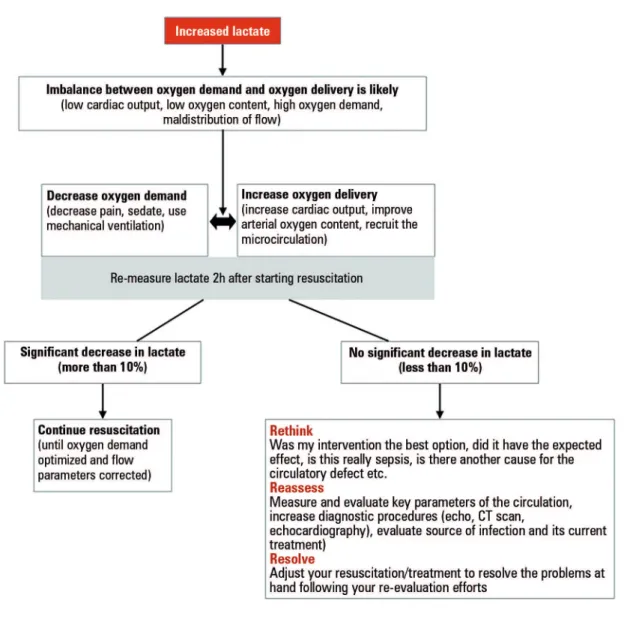
patients with increased lactate levels (above 2.0mmol/L). Following the start of resuscitation, lactate levels should decrease rapidly if the balance between oxygen demand
and oxygen delivery indeed improves (Figure 1). herefore, frequent measurements (at least every 2 hours) should be part of the resuscitation protocol. If the therapeutic measures do not result in a rapid decrease in lactate levels, then RETHINK, REASSESS and RESOLVE.
Lactate is the target for early resuscitation in sepsis 127
Rev Bras Ter Intensiva. 2017;29(2):124-127
5. Bakker J, Nijsten MW, Jansen TC. Clinical use of lactate monitoring in critically ill patients. Ann Intensive Care. 2013;3(1):12.
6. Vincent JL, Quintairos E Silva A, Couto L Jr, Taccone FS. The value of blood lactate kinetics in critically ill patients: a systematic review. Crit Care. 2016;20(1):257.
7. Jansen TC, van Bommel J, Schoonderbeek FJ, Sleeswijk Visser SJ, van der Klooster JM, Lima AP, Willemsen SP, Bakker J; LACTATE study group. Early lactate-guided therapy in intensive care unit patients: a multicenter, open-label, randomized controlled trial. Am J Respir Crit Care Med. 2010;182(6):752-61.
8. Puskarich MA, Illich BM, Jones AE. Prognosis of emergency department patients with suspected infection and intermediate lactate levels: a systematic review. J Crit Care. 2014;29(3):334-9.
9. Hernandez G, Luengo C, Bruhn A, Kattan E, Friedman G, Ospina-Tascon GA, et al. When to stop septic shock resuscitation: clues from a dynamic perfusion monitoring. Ann Intensive Care. 2014;4:30.
10. Dünser MW, Takala J, Brunauer A, Bakker J. Re-thinking resuscitation: leaving blood pressure cosmetics behind and moving forward to permissive hypotension and a tissue perfusion-based approach. Crit Care. 2013;17(5):326. 11. Angus DC, Barnato AE, Bell D, Bellomo R, Chong CR, Coats TJ, et al. A
systematic review and meta-analysis of early goal-directed therapy for septic shock: the ARISE, ProCESS and ProMISe Investigators. Intensive Care Med. 2015;41(9):1549-60.
12. Legrand M, Dupuis C, Simon C, Gayat E, Mateo J, Lukaszewicz AC, et al. Association between systemic hemodynamics and septic acute kidney injury in critically ill patients: a retrospective observational study. Crit Care. 2013;17(6):R278.
13. Vellinga NA, Ince C, Boerma EC. Elevated central venous pressure is associated with impairment of microcirculatory blood flow in sepsis: a hypothesis generating post hoc analysis. BMC Anesthesiol. 2013;13:17. 14. Kelm DJ, Perrin JT, Cartin-Ceba R, Gajic O, Schenck L, Kennedy CC. Fluid