International Journal for Quality Research 10(2) 355–372 ISSN 1800-6450
Jacek Karcz 1 Beata Ślusarczyk
Article info: Received 20.01.2015 Accepted 04.02.2016
UDC – 54.0612 DOI – 10.18421/IJQR10.02-08
IMPROVEMENTS IN THE QUALITY OF
COURIER DELIVERY
Abstract: The functioning of courier companies is a vital
component of modern trade. E-commerce services are changing the way of shopping. Along with them, also courier services change and become more advance. Customers of courier companies become more aware of quality, which they should expect from supplier of these services. The article presents the result of the research of the effectiveness and the timelines of deliveries realized by one of the terminals of a leading courier operator in Poland. The survey involved 55 courier routes over the course of 10 business days. The author analyses weak points of the supply chain and presents two solutions, which may improve quality of delivery processes. Keywords: courier transport, quality of logistics processes, quality of transport, improvement of quality of logistics processes
1.
Introduction
1Logistics is present in the operational activity of almost every enterprise. Originally it is defined only as the flow of raw materials and products, but currently it provides more and more functions. The customer (either internal or external) wants the needed product to be delivered in the right place, time and in the right quantity. For this purpose, broadly defined area of logistics focuses on transport (Coyle et al., 2010).
As the field of science, logistics develops very intensively. Especially in the context of technology. In areas such as telecommunications and informatics, there is very rapid progress and they are strongly connected with each other. Logistics competences are currently the most highly regulated both in terms of substantive and
1Corresponding authorŚ Jacek Karcz
emailŚ [email protected]
practical. It is believed that thanks to them, companies can gain a competitive advantage, not only in the local but also in the global economy (Gołembska, 2009).
the new reality. It was caused by many unknowns, but the owners and managers did not try to find clarifications for them, although all information was available in the local government units (Kowalska, 2004). Currently, the Ministry of Transport focuses its efforts on helping companies from TSL sector, for example through the creation of coherent policy for this sector of the economy. Strategy of Transport Development until 2020 (with outlook until 2030) developed by the Ministry, contains information on how Polish transport market should shape in the coming years but also presents how the changes will be introduced. Policy of Ministry of Transport focuses its activities onŚ
Alternative means of propulsion and the use of alternative energy sources,
Infrastructure improvement, which is equipped with nodes integrating transport processes (eg. bus rail - road),
Exploitation of modes of transport based on new materials and technologies.
Widespread use of intelligent control systems and its management Highly flexible and adaptive capacity of transport and logistics operatorsś
Minimization of nuisance to the environment sector (Ministry of Transport, 2013).
This flexibility and adaptability of transport and logistics operators, requires them to keep self-improvement of internal processes, in order to meet requirements. Operators can not confine themselves on continuous development of the transport departments. It requires them to present a strategy that will be compatible with the principles of sustainable development of all provided services. The strategy must also contribute to the overall development of other parts of the economy. Such actions are visible only in the form of externalities, i.e. effects that economic activity of producers will bring. In
this case, logistics providers and recipients of these services, and which interact with the other members of the community - eg. the satisfaction of online shopping through the efficient realization of delivery (Szczepaniak, 2002).
Quality of services is now a very important part of the proper functioning of many transport, forwarding and logistics companies.
logistics processes. Logistics processes, at the design stage must take into account quality standards. It is easier to implement them from the beginning, than to change the procedures during operational activity or to adapt them to the standards they use. Linking of logistics concepts with elements of quality management work very well in practice and it results in improvement of efficiency of the entire company (Ciesielski, 2009). Operators in the production sectors efficiently implemented quality management standards, such asŚ EFQM, Kaizen, ISO, Lean Six Sigma or TQM. Quality requirements used in production process have also been transposed to suppliers. Very often they have to get the status of verified suppliers to collaborate with other entities. These quality standards are not always possible to implement in individual companies. Thus referring to well-know quality methods we can cite definition of 7R parameters that can be used regardless of implementationŚ
Right product Right quantity Right condition Right place Right time Right customer
Right price (Coyle et al., 2010) These seven rules determine how each of logistics operators (each, from the producer to the final seller is referred as the logistics operator) should manage the flow of goods or services in one's activity. Implementation of all rules gives a kind of guarantee for efficient, reliable and secure goods and services turnover. In order to control the flow of goods and services, it is necessary to carry out series of studies. Based on their results and mathematical calculations, model of logistic task is created. Then this model is analyzed at an angle of usefulness of information contained in it and the aim of it use. Data developed in this way is used to prepare many variants of situations that can occur or not during logistics operations.
The concept of quality in logistics is not easy to define. The literature review allows to define the notion of quality in logistics aspect. T. Olejnik puts his attention on the fact that quality does not function/exist itself. It can be seen only in combination with effect, which it is expected to bring (Olejnik and Wieczorek, 1982). On the basis of the definition presented by M. Brzeziński, we describe quality as a set of characteristics of product or services deciding if it can satisfy customers' needs (Brzeziński, 1997).
To summarize theoretical consideration in term of quality processes in transport, forwarding and logistics companies, it should be remembered that qualitative elements are implemented for client. Only fulfillment of his needs gives us an opportunity to gain another (Wasilewski, 1998). The result of all these activities should be loyal customer, who feels that his requirements were fulfilled at the highest level. Among them areŚ
Access to information,
Timeliness and reliability of delivery,
Correctness of orders execution, Level of after-sale services
(Łunarski, 2009).
Shaping the future of transport services depend on actions, which should be made now. However, it is necessary to remember to keep a balance of development. Strong emphasis should be placed on the quality of supply chain processes. Studies just begin to allow for advancement of the knowledge in this field. Especially in terms of connection of quality parameters with environmental protection, we should pay our attention on growing interest in these issues by people responsible for operational and strategic management (Carter and Easton, 2011).The quality of transport services can be defined as a set of characteristics of service, which affect its final form and as a value, which it has for final customer. The customer (understood in most cases as the recipient or sender of consignment) expects that courier meets his needs and will be able to perform service at the highest level. Also availability and easiness to use the service influence the assessment of its quality. Currently, process of placing a service must contain the features of simplicity. Customers do not want to fill complex printed order forms, print them, sign and send back. They expect service accessible via mobile devices, for which they also pay in this form. Popularization of e-services influenced also courier industry (Rucioska, 2001).
The issues of quality management in terms of logistics, relate specifically to customer service processes, which can include, among others, execution of orders or return services. It can be generally defined as the ability to meet customers’ expectations in provision of services of appropriate quality, which is determined by final customer (Ciesielski and Długosz, 2010). In this area of activity, the emphasis is put on physical distribution and all ancillary processes such asŚ acceptance, preparation, delivery and exchange of data, for example in the EDI system. These parameters are measured in terms of quality of supply, taking into accountŚ punctuality, reliability, security and communication. At the preparation stage of distribution, parameters such as the degree of product availability, or percentage of correctly completed orders are measured. The fulfillment of these parameters makes it possible to define itself as a logistics operator that meets the quality standards in customer service at the highest level (Coyle et al., 2010).
2.
Theoretical aspects of courier
services
Significant function of most courier services is very similar. Its core is based on organization of logistics process, in such a way that shipment is received from any place of shipment and delivered to any destination. In practice, it means that neither sender nor recipient do not have to move from their permanent place of residence to exchange goods (Kawa, 2008).
Currently, range of additional services developed extremely wide. Playing the role of the sender, you should expectŚ
Delivery to a particular person, Deliver before the indicated time,
usually around 9Ś00 or 10Ś00, and 12Ś00 am (currently the most popular additional service)
Insurance of content of our consignment.
The services are usually extra paid. As a "free package" you can apply forŚ
Confirmation of delivery via e-mail, phone or text message,
Copies of list with the signature of the person receiving.
From January 1996, all courier companies are required to apply for licenses to perform services. Concessions are paid and issued by the Minister of Transport usually for ten years with the possibility of extension. The Minister may refuse to grant licenses if it finds that the activity of the entity can threaten the interests of the national economy, national defense or national security. The obligation of licensing courier services was introduced in 1995 on the occasion of the amendment to the Communications Act.
The process of courier transport is carried out in a systematic and consistent way. When we want to send a shipment we inform courier company about it. There is a possibility to use any form of information exchange. We can do it by telephone notification, text message, e-mail, website or even by applications dedicated for mobile devices (smartphone, tablet) (Ramana et al., 2013).
Courier company check in an automated way if in a given day, place of shipment is within the courier extent, who service a given area. If not it will be assigned in a next day. In a large agglomeration, possible pick up hours are much later due to the larger number of couriers servicing these areas. Through smaller cities, couriers usually pass through once a day and they are not able to get back. Thus, if in a given day they have passed place of shipment they will be able to pick up shipment next day. This system is based on the flowchart of satellites that go around planet, as couriers go around terminals (warehouses). Shipment is taken with other shipments in a given day and later afternoon or early evening it goes to the terminal,
which service the area. There, it is properly tagged (bar code system) and loaded to the night collective transport to distribution center.
Around the world, courier companies operate in a similar way, regardless what means of transport they offer. The basis of their operation is night shuttle service. Every day, cars or airplanes from furthest company agencies go to destination, which is central sorting office. In a sort office there is transshipment of goods and then transport moves in opposite direction. In a distribution center - as in the middle of the circle - all express connections converge. Also international networks of courier companies (allowing over-night services) are based on such distribution centers and system of connections between them. Distribution centers task is to sort shipments and sent them to their destination. Within a few hours of the night, collective transports from terminals are unloaded and after automatic sorting of shipments according to their destination they are re-loaded. Then, also at night, they return to the terminals from they came from with shipments to be distributed next day. Freight distribution begins around midnight.
from this model, because overnight shipment is transported from sender to recipient (Karcz et al., 2013).
The history of courier companies in Poland began approx. in 1982 (establishment of the Servisco company). In the following years, more companies were established. In Warsaw, at the Chopin Airport, representatives of international transport companies rented first offices and on the principles of cooperation started fast import and export of goods by air. The market in Poland is extremely receptive to this kind of services. After the opening of the borders, an expansion of foreign companies on the Polish market has started. It resulted in the rapid development of transport, including courier companies. At that time, the most popular was delivery of documents. A lack of developed communication by fax and e-mail was compensated by fast courier delivery.
3.
Role and development of
courier industry
Courier services have grown in popularity with the development of Internet commerce. In Poland, online shopping is gaining popularity. According to the study, currently 30% of Internet users make purchase via the Internet. Native e-commerce sector develops like its western counterparts. Courier companies can not leave their customers without proposal of additional services. Plans include (in addition to the standard delivery services) also multi-channel distributions, logistics of returns, as well as the implementation of affordable forms of cashless payments for ordered goods directly to courier ( liwa, 2014).
Competing with each other, courier companies pursue to minimize cost. So they try to offer lower and lower prices for delivery. Opportunities to optimize cost are limited. They are determined by profit threshold of courier company as well as all its subcontractors (Grabara et al., 2013).
Customers simultaneously want to meet their needs and to find high quality of services. The quality is related to just-in-time supplies and other customers' requirements. For the courier industry, the most important quality parameters areŚ
Timeliness of delivery (delayed delivery),
Effectiveness of delivery (the number of returns form sender and refusals to receipt goods),
Loss ratio (the number of damaged shipments and complains) (Miskiewicz, 2009).
Article examines two first parameters. In the analyzed case, loss ratio is at a very low level. Company uses regression policy of any damages to its subcontractors and it results in a significant decrease in the number of complains. Policy in term of effectiveness and timeliness is not consistent. These parameters are difficult to improve in terms of large supply network. Couriers in most cases do not have problems during shipment reception. In case of mentioned e-commerce sector, from one place of shipment couriers pick up shipments for many recipients. Therefore business-to-consumer (B2C) service is implemented (Gazeta Prawna, 2009). The biggest downside of shipments delivery to private customers is their frequent absence at home. Couriers deliver shipments usually between 10-18. Previously, standard courier routes serve mainly institutional customers, whose require guarantee that they shipments will be deliver in the morning. Study and improvement process concern sphere of undelivered shipments during business day (the next day after receipt). It is one of the main indicators of quality in courier companies. Customers, especially large companies operating in e-commerce sector, require effectiveness of supply at 98-99% (Kroll, 2013).
There may be a few reasons of undelivered shipmentsŚ
Change in delivery address, Incorrect address.
In recent years a decrease in profit margins for these services dominated on the market of courier services. It was caused to a large extent by the worldwide economic crisis. However a constant growth of companies operating in the industry of the courier transport is expected. Managerial staffs cannot base their strategies only on the forecast condition of the market. Considering the entirety of the operations of these companies, as well as outside conditions, main error committed by people managing the industry, is false pricing policy and wrong decisions associated with it. Particularly, that it is possible to avoid recalled mistakes in quite simple way. Courier companies are notoriously contending with the same problemsŚ
Fuel prices growth,
Higher costs of maintaining of non-courier staff,
Nad road infrastructure, Crowded streeta,
Growth of the level of services directed from companies to individuals (B2C – business to client).
At present in many courier companies effects of mistakes of the managed pricing policy, made during recent years turn up. These companies constantly incorrectly lowered prices of their services, instead of trying to keep them, taking into consideration even the level of the market inflation. The should do it uninterruptedly, hand in hand with a steady increase of the quality of provided services. Within 10 recent years the price level reduced for about 15 - 20%, what for this branch of transport is really enough perceptible. The managers responsible for the sale tried to get more and more new clients, overlooking in fact the direct profit, which those customers generated. Raising the level of the sales revenue of services became the most important aspect of the functioning of sales departments, although growths in this area
trying to declare the largest monthly, or annual volume of letters being sent, to get the biggest discount. In practice however it turns out that the customer hands for the delivery only a part of parcels from the created volume. In fact he can have a potential, which he declared, however "divides" parcels to a few service providers, in order to satisfy each of them. This way he can always use the argument that he tries to send the established number of parcels, however is not achieving the anticipated effect or still is able to negotiate the rate by making a condition about handing all parcels over to the competition. Of course the courier company is not able to enforce the precitbale parcels from the customer. Making discounts is not acting backwards as a rule, so such a practice remains without negative consequences for the customer. Differently the situation looks at ex post making discountst, where the customer gets a discount only after entering a specific amount of parcels into the courier network. However, main conclusion coming from establishing the pricing policy is a fact that in many cases it should be established in a rational manner, considering all aspects, mainly as for the amount of sent parcels, which a customer declares. Such action next requires precise analyses and the possibility of fast optimizations in the operating context. If recalled action is not taking place in the sector of the courier transport, perhaps it can cause a bankruptcy for some companies operating on the market.
4.
Research methodology and
results
4.1.Influence of the most important quality factors on development of KEP (courier, express and parcel shipments) industry
Currently, during lowering the pace of the development of the economy what even the PMI indicator of the industry of Chinese, which is lowest for 3 years, points out
(Stasiuk, 2015), the marketplace of the courier service is characterized by very expressive features of the "consumer market", where the severe competition within struggle for the customer leads to extreme erosion of prices and profit margins of the processed profit, mainly in standard products, are being measured with fractions of the per cent. The competition between great suppliers of the courier service on the technological as well as on the price plain increases rapidly. All courier companies offer similar services, in order to attract clients, which containŚ
• NCN parcels (No Consignment Note) shortening the time of preparing the parcel to taping it in the head office of sending company by a directional label containing main data connected to the parcel – sender, receiver as well as the number of the parcel and barcode, • Tracking the parcel from the sender
to the receiver by Internet network, • Return of signed documents like the
invoice, SN,
• Delivering of very urgent parcels on specific areas up to „9” or „12”. In relation to the fact of the uniformity of services on the courier market amongst various suppliers of this service a charge of the service becomes the most crucial tender element. At very strong emphasis on the part of the customer and competing companies for leaving prices on the current level or straight for lowering it, a question about the profitability of the business is becoming most material. The part of companies from the CEP sector notice a reduction of so-called Gross Profit, i.e. the EBITDA - profit on business activities not yet taxed. It is possible to describe Gross Profit value as the difference between the sale and direct costs incurred by the company for the handling of these sales. The decrease in the average price is caused byŚ
Competition’s pressure on prices, Faster growth of parcels from large
determined during separate out-of-price list agreements,
Lowering share of charges for extra services of medium price,
Not-fulfilling volumes declared by clients defining their transport expectations during signing exaggerated agreements.
Than, causes of direct costs growth areŚ Investments into new objects
(terminals, sub-sorting departments),
Investments into new technologies (new technological systems, sorters development, new scanners), Enlarging parcels dimensions
(filling Linear Transports on the Terminal – Hub way),
Growing costs of courier services on the part of subcontractors. In case of the persistence of the adverse tendency of the equalization of lines meaning the sales revenue and growing direct costs, a real danger of the contact of lines appointing mentioned values exists. It can cause the total unprofitability of business. Assessing situations from the side of the terminal performing the service it is possible to prevent the contact of these lines throughŚ
Enlargement of selling extra services, which do not cause costs increase,
Profit from selling standard service, Extra profit coming from the
parcel’s insurance,
Delivering non-standard parcels (round, atypical dimensions, increased shipping risk i.e.Ś glass, electronics etc.),
Services of delivering on a specific time up to „9.00” or „12.00”, However additional services generate increased charges and are not being favorably accepted by the customer on the market of a strong price pressure. So, concentration on the cost cutting remains. Unfortunately the process of making savings
is most often conducted on the principle of "Recommendation of the management board of the reduction of courier costs of x% towards the last accounting period". The question is, what base such purposes were adopted on - as a rule remains unanswered. Here it appears, not from the rational attempt at searching for savings, but the reduction of costs as a result of replacing more expensive stores with cheaper at keeping their full utility value and with the elimination of unnecessary costs or reducing costs exaggerated from the final effect point of view. Unfortunately very often it causes the change of the way of noticing the company on the market of services, lowering the quality of service and making the volume of the amount of parcels smaller. In the current situation, finding such "excessive costs" is unusually difficult, if possible at all on the level of the Terminal. So, the way of optimization remains, which is the change of the structure and the method of executing actions, operations and processes through an analysis being made.
especially considering human factor, which occurs in this context. The operator, after the study, estimates the level of customer satisfaction at nearly 99%. In this case, human factor has negative context. However, transferring it into a positive factor, we can
notice benefits, which come from the fact that routes are serve by human instead of machine (such pilot project is implemented by Amazon company, which testing deliveries by innovative flying drones).
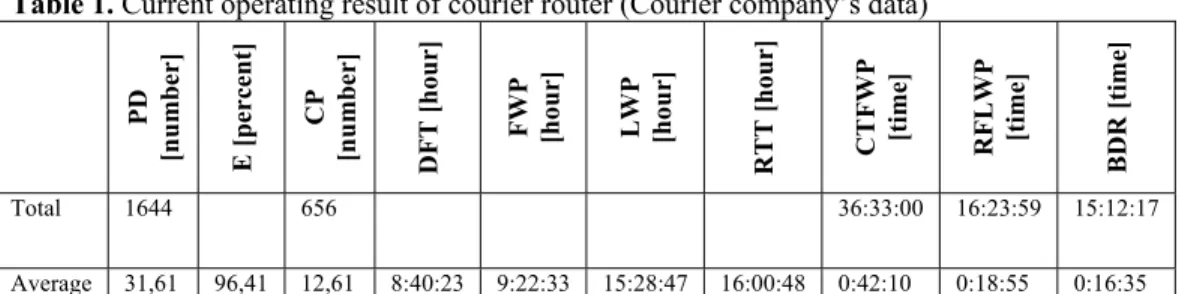
Table 1. Current operating result of courier router (Courier company’s data)
PD
[numbe
r]
E [p
erc
en
t]
CP
[numbe
r]
DFT [hour] FWP [hour] LWP [hour] RTT [hour] CTFWP [time] RFLWP [time] BDR [time]
Total 1644 656 36Ś33Ś00 16Ś23Ś59 15Ś12Ś17
Average 31,61 96,41 12,61 8Ś40Ś23 9Ś22Ś33 15Ś28Ś47 16Ś00Ś48 0Ś42Ś10 0Ś18Ś55 0Ś16Ś35
PD - Places of Deliveryś E- Effectivenessś CP - Collection Pointsś DFT - Departure From Terminalś FWP- First Way Pointś LWP- Last Way Pointś RTT - Return To Terminalś CTFWP- Commute To First Way Pointś RFLWP - Return
From Last Way Pointś BDR Break During Route
The study was conducted in the period of two weeks, at the end of the summer months (April-May). Thus, the data come from the period not involving so called peek-period, which takes place from October to the end of the year. During this period, the number of shipments increases significantly. Therefore, it is necessary to take such actions to encumber couriers as little as possible. Proposed amendments is to change of way of overnight deliveries from distribution centers to terminals - current times of night transports and percent of truckload capacity
utilized presents Table 2. During peek-period, in general two full transports and third additional leave distribution center. During other months one standard and one additional transport serve increased number of shipments. Transports leave distribution center according to rule, the last comes - the first leaves. It means that if transport is in distribution center about 11 pm., it leaves it, as the first about 1 am. This action is associated with the distance from terminal to distribution center and traffic on a given route.
Table 2. Current time of night transports from distribution center to terminal (Own work based on data from Courier company)
First departure
LH from DC Last departure LH from DC First arrival LH to DC Last arrival LH to DC departure from Couriers terminal
Time 01Ś00Ś00 02Ś00Ś00 06Ś30Ś00 07Ś30Ś00 08Ś40Ś00
Percent of truckload capacity
utilized
100% 30-50% - - -
The distance, which line-haul has to cover is 350 kilometers. Delivery van cover it within 5 and a half of hour, driving about 55-60 kilometers per hour. Percentage utilization of the last transport is about 30-50% of
cars are sufficient instead of one, which is not completely full. Delivery van driving at the speed of 75-80 km/h covers the distance
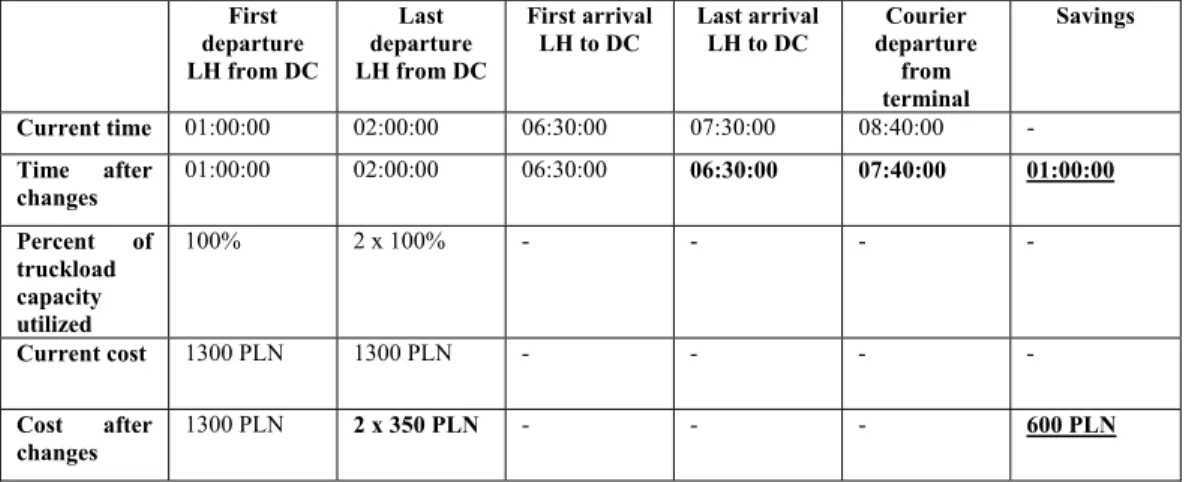
of 350 km within 4 and a half of hour. Comparison of transport costs and time in both proposed cases presents table 3.
Table 3. Comparison of costs and time before and after the changes. (Own work based on data from courier company)
First departure LH from DC
Last departure LH from DC
First arrival
LH to DC Last arrival LH to DC departure Courier from terminal
Savings
Current time 01Ś00Ś00 02Ś00Ś00 06Ś30Ś00 07Ś30Ś00 08Ś40Ś00 -
Time after
changes 01Ś00Ś00 02Ś00Ś00 06Ś30Ś00 06:30:00 07:40:00 01:00:00
Percent of truckload capacity utilized
100% 2 x 100% - - - -
Current cost 1300 PLN 1300 PLN - - - -
Cost after
changes 1300 PLN 2 x 350 PLN - - - 600 PLN
Table 4. Operating results of courier routes after implementation of process of quality improvement. (Data from Courier company)
PD [
number
]
E [perc
ent]
CP [
number
]
DFT [
hour]
FWP
[ho
ur]
LWP [hour] RTT [hour] CTFWP [time] RFLWP [time] BDR [
time]
Total 1726 643 41Ś17Ś28 03Ś32Ś43 13Ś17Ś36
Average 32,78 98,74 11,64 07Ś50Ś41 08Ś36Ś37 15Ś17Ś28 15Ś47Ś37 00Ś45Ś56 00Ś30Ś09 00Ś14Ś53
PD - Places of Deliveryś E- Effectivenessś CP - Collection Pointsś DFT - Departure From Terminalś FWP- First Way Pointś LWP- Last Way Pointś RTT - Return To Terminalś CTFWP- Commute To First Way Pointś RFLWP - Return
From Last Way Pointś BDR Break During Route
In the case of this study cost savings are a positive effect, which was discovered during the study. All the more reason, the proposed amendment of process is profitable.
Time saving, which was achieved allows for significant increase in productivity and also directly influences parameters of effectiveness and timelines of delivery (Table 3). In addition, if it will be necessary, smaller cars can be used to distribute shipments within the terminal. Haulage contractor may rent them to other couriers or after shift change from night on day he can provide services on his own in an ad-hoc courier option. Use of smaller cars also
contribute to reduction of CO2 emission by reducing fuel consumption, and reduce GHG emission by better organization of routes (Boskovic et al., 2013).
Duty of prior proactive contact with customer is realized only after reaching a place or shortly before it. The proposed form of verification is occasional checking telephone billing and comparing them with the amount of supply in a given day. Implementation of one of two proposal is independent. Analyzed terminal implemented both solutions. Implementation of the first proposal will not be able in all terminals. The limitation is the amount of available loading ramps for smaller cars from distribution center. Changes brought time benefits and increased in efficiency of delivery. Table 4 presents this data.
5.
Conclusions and direction for
future research
Analyzed factor of delivery effectiveness increased to 98.74% after implementation of both solutions. Delivery effectiveness at this level is more acceptable for customers. It also results in cost savings. If couriers spent more time on preparation to delivery they do not have to perform another attempt of its delivery in the next day. Also customer service department is relieved in several paramtersŚ
Number of inquiries from recipients regarding planned delivery time Number of inquiries from senders
in terms of reasons for undelivered shipments
Number of cases to explain in the issue of address changes
Couriers have more time to prepare for route due to time saving in commute of linear transport from distribution center to terminal. As a result, they are able to prepare a list of contacts for customers. Contact numbers should appear automatically on the basis of data transmission from sender. However, there are some cases, where number is not transmitted or sender did not gave it. In this case number is only on waybill. That is the reason, why couriers contact with customer just before delivery.
The current solutions allowed to generate time to find the missing number on waybill or even to determine them with the sender. Implemented process of quality improvement of courier deliveries may be associated with other solutions in the future. These are as followŚ
The solution in case of courier’s lack of willingness to proactive contact with recipient is a possibility to reward them for effective delivered shipments. Currently, some routes are remunerated at a flat rate per day. Payment system redesigned in such a way should be an effective tool to enforce effectiveness of courier’s deliveries. The proactive contact is also valid from the customer point of view, who when being earlier informed is able to prepare better for the receipt of the parcel. The considerable part of courier companies does not want to provide couriers direct phone numbers. It is caused by the fact that customers will stop reporting orders through the Internet or over the phone to the customer service department and will start phoning couriers up directly. In such case the courier will not often be able to take the decision on the possibility of the receipt of the parcel well, and consequently, wanting to satisfy customer’s desire, will be trying to change the route. It will be transferred into the lack of the optimization. If the company does not want to aspire to the direct phone contact on the line courier - customer (the sender or the recipient), should start proactive call center or to encourage customers to set the hour best suiting them for delivering a parcel by the Internet. At present it is possible to come across solutions with the SMS application, where in the morning the customer gets a message containing information about the planned hour period for the delivery of his parcel. He is possible to change the data of the delivery or the hour period by an answer with an appropriate order. He can also not respond the message if planned hours does not suited him and wait for the courier.
Implementation of additional courier routes for afternoon and evening deliveries. An average time to return from terminal is 15Ś47. An
implementation of additional routes, which may deliver undelivered shipments from previous day between 5-9 pm or later will give an opportunity to demonstrate even greater efficiency. These deliveries concern especially those recipients, who are available only in the evening hours and redirection between routes that can not be done during the day after courier’s departure. However, this change involves additional costs and should be implemented only in conjunction with rewarding only for effectively delivered shipments.
Companies as a rule are deciding to employ couriers on the basis of their own business activity, on the partner, although subcontracting principle. It causes great impediments in enforcing expected results. Drivers are additionally employed by subcontractors which are serving a few different routes. Therefore, not always, in spite of exerting influence on the subcontractor, it is transferred directly into the driver, which carries the delivery out. All the more it is hard to manage such a team from the position of the courier company. In such a perceptions the level of costs develops very favorably. However couriers are not entirely identifying themselves with the name of the company they represent. No courier company is able to achieve the perfection in the effectiveness of supplies. So customer, deciding on the cooperation, must accept the level of efficiency within 95 % maximum in the next day after giving shipments. It is worth to know about the periods of increased shipments like Christmas and at that time expecting the efficiency of 85-90 %. However, supplies carried out within Just-In-Time even through dedicated drivers is being realized totally different. In such cases logistic operators are able to guarantee 100% of timely supplies, however ruling extrinsic factors out (war, cataclysm). The breakdown of the car, or the traffic jam - for arising of such situations the company must be prepared (they cannot be a surprise), because if the customer really requires it, dispatches of the same components are being organized on two different cars, across two other routes. Unfortunately the working practice of couriers is not able to assure such solutions. Quality parameters presented in the article meet the standards, which final customers require. SMART method is frequently used in a general goals setting. Each letter represents one of the most important parameters in goals setting. Widely understood logistics has its own parameters. Among them, the most important areŚ completeness, integration, flexibility,
comprehensiveness, accuracy, transparency, integration and ease of implementation (Arsovski et al., 2012).
courier operator also have to enforce changes in quality of services provided by its subcontractors. After implementation of proposed changes, the study showed an increase of a key indicator - effectiveness of shipments delivery. The proposed changes not only improve quality of offered services but they are also able to reduce their costs. They do not need to incur large expenses. Due to it, management board’s approval is not necessary. Local manager can prove that in an effective way manages his terminal and knows all processes occurring in it.
However, exploiting other innovations in this matter is a future of the optimization of courier supplies. Using drones (UAV) to the accomplishment of straight shipments becomes more and more common - e.g. not requiring the recipient's signature. At least in this matter companies focusing on research-developmental activity have great spectrum of possibilities, even through using photographs as a confirmation of shipments. At present distribution concerns or courier companies are testing the solutions based on the delivery directly to the recipient from the HUB or the Terminal (Warehouse), as well as consisting in the delivery within the small area. Then the flying machine is being loaded from the courier car and carries the delivery out without the participation of the courier. The solution is being modeled on ancient racing pigeons, however under the angle of ecology is certainly of the future. It limits the movement of the vehicle only for the departure to the place close enough, where it is possible to deliver all parcels
possible for the delivery in such a way. Supplies carried out directly from the warehouse are at present much more complicated for instance due to the short capacity of drone’s battery. Also the lack regulations about the altitude and the routes does not support these way of supplies. At present however, the section of services and the commercialization of flying machines is oriented on the constant development, so in the next few years such supplies will become possible. Other well-known innovation in the delivery and receipts of courier parcels is using machines. So-called "Paczkomaty" produced and sold by the Polish company InPost, are valued worldwide. Courier similarly, like in the example of the drone, arrives only at the place, where the "Paczkomat" is situated and there sorts parcels to individual pigeonholes. Currently, it is not possible to optimize this process for more - the man is still needed. However, it is possible to much greater optimize of the exploitation of the means of transport. For the recipient a possibility of the receipt of the packet at any time is a convenience, moreover he stays anonymous for the courier company, because in this case nobody is able to associate a surname with the face. Further to the more and more popular protection of personal data such a solution appears to be very favorable. So, the technology must still cope with requirements, which the optimization of delivering parcels demands. The practice confirms that every new solutions in this matter are being willingly accepted by the market.
References
:Arsovski, Z., Rejman Petrovic, D., Milanovic, I., Rankovic, V., & Kalinic, Z. (2012). Measuring the data model quality in the e-supply chains, International Journal for Quality research,6(1), 47-53.
Blikle, A. (2013). Doktryna jako ci – rzecz o skutecznym zarządzaniu, Warszawa.
Boskovic G., Jovicic N., Milasinovic M., Jovicic G., & Milovanovic D. (2013). Methodology for reduction of GHG emissions from municipal solid waste collection and transport, International Journal for Quality Research, 7(4), 641–652.
Carter, C., & Easton, P.L. (2011). Sustainable supply chain managementŚ evolution and future directions, International Journal of Physical Distribution and Logistics Management, 41(1), 46–62.
Ciesielski, M. (2009). Instrumenty zarządzania łańcuchem dostaw, PWE, Warszawa, 23. Ciesielski, M., & Długosz, J. (2010). Strategie łańcucha dostaw, PWE, Warszawa, 68.
Coyle, J.J., Bardi, E.J., & Langley, C.J. (2010). Zarządzanie logistyczne, PWE, Warszawa, 30.
Gazeta Prawna Nr 177/2007 from 2009.09.12
Gołembska, E. (2009). Logistyka w gospodarce wiatowej, C. H. Beck, Warszawa, 7.
Grabara, J., Man, M., & Kot, S. (2013). Costs Incurred by Designing and Implementing the Logistical Projects in the Activity of Companies, Applied Mechanics and Materials, 309, 221-228.
Guillaume, J.P. (1993). La performance logistique, Nathan, Paris.
Kadłubek, M. (2014), Measurement of the Logistic Customer Service Level in Commercial Cargo Motor Transport Companies, InŚ The 11th International Conference on Logistics & Sustainable Transport. 19-21 June 2014, Celje, Slovenia. University of Maribor, Faculty of Logistics, Celje
Karcz, J., Brzeziński, S., & Kot, S. (2013). Optimization the costs of courier deliveries, Recent Researches in Applied Economics & Management, Business Administration and Financial Management – Volume 1 Proceedings of the 5th International Conference on Applied
Economics, Business and Development (AEBD ’13), Chania, Crete Island, Greece, August
27-29.
Kawa, A. (2008). Branża kurierska - barometr i motor rozwoju gospodarki, STL 2/2008. Kearrneya, T. (1992). Pojęcie logistycznej doskonało ci zostało użyte po raz pierwszy przez
Amerykańskie Biuro
Kowalska, G., (2004). Europejskie wyzwanie dla przewoźników drogowych, Prawo Przedsiębiorcy, 6.
Kroll, T. (2013). Retrived fromŚ httpŚ//mojafirma.infor.pl/moto/logistyka/uslugi-kurierskie/ 670074,Jak-podwyzszyc-jakosc-uslug-kurierskich.html
Lock, D. (2002). Podręcznik zarządzania jako cią, PWN, Warszawa.
Łunarski, J. (2009). Zarządzanie jako cią w logistyce, Oficyna Wydawnicza Politechniki Rzeszowskiej, Rzeszów.
Ministerstwo Transportu, Budownictwa i Gospodarki Morskiej (2013) Strategia Rozwoju Transportu do 2020 roku (z perspektywą do 2030 roku), Warszawa, dnia 22 stycznia 2013 r. httpsŚ//www.transport.gov.pl/files/0/1795904/130122SRTnaRM.pdf, odczyt z dnia 04.07.2015 r. s. 39-45
Miskiewicz, M., Dwornik, B., & Ciszak, P. (2009). Retrieved fromŚ httpŚ//www.money.pl/ ranking-firm-kurierskich/
Olejnik, T., & Wieczorek, E. (1982). Kontrola i sterowanie jako cią, PWN, Warszawa – Poznań.
Ramana, V.D., Rao, N.K., Kumar S.J., & Venkatasubbaiah, K. (2013), Identification of measurment items of design requirements for lean and agile supply chain – confirmatory factor analysis, International Journal for Quality Research 7(2), 258.
Sharma, A., Garg, D., & Agarwal, A. (2012). Quality management in supply chainsŚ The literature review, International Journal for Quality research, 6(3), 193-206.
liwa, J. (2014). Retrieved fromŚ httpŚ//www.dziennik.pl/artykuly/464119,rynek-uslug-kurierskich-e-commerce-nowym-polem-dzialania.html
Stasiuk T., (2015) ChinyŚ PMI dla przemysłu najniżej od 3 lat, Puls Biznesu, httpŚ//www.pb.pl/4272945,66880,chiny-pmi-dla-przemyslu-najnizej-od-3-lat, odczyt z dnia 01.09.2015
Szczepaniak, T. (2002). Transport i spedycja w handlu zagranicznym, PWE, Warszawa, 82. Ulewicz, R. (2003) Quality Control System in Production of the Castings from Spheroid Cast
Iron, Metalurgija, 42(1), 61-64.
Wasilewski, L. (1998). Rozważania o jako ci, PWE, Warszawa.
Zimon, D. (2012). Znaczenie jako ci w zrównoważonej logistyce, Logistyka,Nr 2.
Jacek Karcz
Czestochowa University of Technology,
Faculty of Management Armii Krajowej 19 B 42-200 Czestochowa Poland
Beata Ślusarczyk Czestochowa University of Technology,
Faculty of Management Armii Krajowej 19 B 42-200 Czestochowa Poland