Reintubation of patients submitted to cardiac
surgery: a retrospective analysis
INTRODUCTION
Since the advent of cardiac surgery in the 1950s, the number of cardiac
procedures has grown worldwide.(1) herefore, it is important to know the
factors that can cause complications in the postoperative period and the clinical outcomes of patients undergoing such surgery.(2) he reintubation in this group
of patients is related to undesirable consequences because it is associated with higher rates of morbidity and mortality, duration of stay in the intensive care unit (ICU) and hospital costs and resources.(3,4)
hus, we aim to analyze the sample of patients after cardiac surgery, which
required reintubation during their stay in the adult ICU of the Hospital de
Clínicas of Universidade Estadual de Campinas (UNICAMP). Additionally, we Cíntia Yukie Shoji1, Luciana Castilho de
Figuereido1, Eveline Maria Calixtre1, Cristiane Delgado Alves Rodrigues1, Antonio Luis Eiras Falcão1, Pedro Paulo Martins1, Ana Paula Ragonete dos Anjos1, Desanka Dragosavac1
1. Department of Surgery, Universidade Estadual de Campinas - Campinas (SP), Brazil.
Objectives: To analyze patients after cardiac surgery that needed endotracheal reintubation and identify factors associated with death and its relation with the severity scores.
Methods: Retrospective analysis of information of 1,640 patients in the postoperative period of cardiac surgery between 2007 and 2015.
Results: he reintubation rate was
7.26%. Of those who were reintubated, 36 (30.3%) underwent coronary artery bypass surgery, 27 (22.7%) underwent valve replacement, 25 (21.0%) underwent correction of an aneurysm, and 8 (6.7%) underwent a heart transplant. Among those with comorbidities, 54 (51.9%) were hypertensive, 22 (21.2%) were diabetic, and 10 (9.6%) had lung diseases. Among those who had complications, 61 (52.6%) had pneumonia, 50 (42.4%)
Conflicts of interest: None.
Submitted on March 23, 2016 Accepted on February 11, 2017
Corresponding author:
Ana Paula Ragonete dos Anjos Universidade Estadual de Campinas
Cidade Universitária Zeferino Vaz - Barão Geraldo Zip code: 13083-970 - Campinas (SP), Brasil E-mail: [email protected]
Responsible editor: Alexandre Biasi Cavalcanti
Reintubação de pacientes submetidos à cirurgia cardíaca: uma
análise retrospectiva
ABSTRACT
Keywords: Noninvasive ventilation; Cardiac surgery; Intubation; Mortality; Respiratory insuiciency
developed renal failure, and 49 (51.0%) had a moderate form of the transient disturbance of gas exchange. Noninvasive ventilation was performed in 53 (44.5%) patients. he death rate was 40.3%, and mortality was higher in the group that did not receive noninvasive ventilation before reintubation (53.5%). Within the reintubated patients who died, the SOFA and APACHE II values were 7.9 ± 3.0 and 16.9 ± 4.5, respectively. Most of the reintubated patients (47.5%) belonged to the high-risk group, EuroSCORE (> 6 points).
Conclusion: he reintubation rate
was high, and it was related to worse SOFA, APACHE II and EuroSCORE scores. Mortality was higher in the group that did not receive noninvasive ventilation before reintubation.
intend to identify factors associated with death and its relationship with the severity scores of Acute Physiology and Chronic Health Evaluation (APACHE II) in the irst 24 hours after ICU admission, Sequential Organ Failure Assessment (SOFA) and European System for Cardiac Operative Risk Evaluation (EuroESCORE).
METHODS
his is a retrospective and descriptive study based on an analysis of information contained in postoperative databases of the ICU of the Hospital de Clínicas of the UNICAMP. he postoperative ICU has 17 beds serving the specialties of cardiac surgery, vascular surgery, and neurosurgery. he professional staf was selected based on the Brazil decree 07, which is speciic for ICUs since
2010.(5) he staf was composed of medical residency
students in intensive care and students of physical therapy performing continuing education in adult ICUs. he multidisciplinary team care was performed within 24 hours. A single nurse performed the data collection on a daily basis during medical visits using medical records and multidisciplinary team record notes. he scores were calculated daily through applications that are integrated within the database program. All the information was extracted from the database for statistical analysis in a conidential manner to maintain the integrity and privacy of the patients. he research was submitted to the Ethics Committee of the institution and approved under the number 48898915.4.00005404 and registered by Brazilian Registry of Clinical Trials (REBEC) number RBR 6j6fcx.
Data from 1,640 patients undergoing surgery or cardiac procedures were analyzed; these patients had been referred to the postoperative ICU of the speciic specialty and required the use of invasive mechanical ventilation by endotracheal tube between May 2007 and April 2015. he study excluded patients under 14 years old, those who were extubated in the operating room, and those who had incomplete data in the database.
All subjects underwent the weaning and extubation protocol developed by the multidisciplinary team of the ICU, which is available in the “Clinics Hospital UNICAMP Adult ICU Procedures Manual.” he subjects were considered able to perform a spontaneous breathing trial according to the following criteria: resolution or
improvement of the causes of respiratory failure, minute volume ≤ 10 - 15L/min, positive end-expiratory pressure (PEEP) ≤ 5 - 8cmH2O, fraction of inspired oxygen (FiO2) ≤ 0.4 partial pressure of oxygen/fraction of inspired oxygen (PaO2/FiO2) > 150mmHg, pH > 7.25, intact respiratory mechanics and hemodynamically stable with low doses of vasoactive drugs. he spontaneous breathing trial was performed in the pressure support mode with a value of
7cmH2O and PEEP between 5 and 8cmH2O, between 30
minutes and 1 hour. Weaning and extubation failure was indicated by returning to mechanical ventilation in less than 48 hours.(6)
For data analysis, subjects were divided into two groups: a group of patients who required reintubation one or more times in the ICU and the other group of patients who were not reintubated during the ICU stay. To analyze the data, reintubated patients in the ICU were divided into 2 groups, namely, the group who died, and those who did not die. he variables related to the regression method that were considered death prognostic predictors were the following: use of non-invasive mechanical ventilation, APACHE II calculation in the irst 24 hours after ICU admission, SOFA and EuroSCORE, chronic obstructive pulmonary disease (COPD), age and endocarditis.
We determined the number of individuals who required endotracheal reintubation during the ICU stay and evaluated the demographic characteristics, type of surgery (emergency or elective), indication for surgery (valve replacement, coronary artery bypass, aneurysm repair, heart transplantation), comorbidities (hypertension, diabetes mellitus, arrhythmias, chronic obstructive pulmonary disease), postoperative complications, presence of transient disturbance of gas exchange (TDGE), use of non-invasive ventilation (NIV), mortality and scores APACHE II, SOFA and EuroSCORE of gravity.
he EuroSCORE provides information on risk factors and mortality.(7) he factors related to the patient are
Statistical analyses
A descriptive analysis is presented with tables of frequencies for categorical variables and position and dispersion measures for numeric variables. To compare proportions, we used the chi-square test or Fisher’s exact test if necessary. For comparison of numerical measurements between two groups, we used the Mann-Whitney test. To evaluate the factors related to death, we used a logistic regression analysis and univariate and multiple models with Stepwise selection criteria variables. To analyze the relationship between the numerical variables, we Spearman’s correlation coeicient. he signiicance level was set at 5%.
RESULTS
Of the total 1,640 patients eligible for the study, 119 individuals - 7.3% (95% conidence interval - 95%CI, 6.1 to 8.7) required endotracheal reintubation during their ICU stay. Of this population, 69 (58%) were male, and 50 patients (42%) were female, with a mean age of 59.6 ± 14.4 years. he most common indication for surgery was myocardial revascularization (30.6%), followed by valve replacement (22.7%) and thoracic aortic aneurysm repair (21%). Regarding the severity scores, the average APACHE II and mortality predicted by APACHE II were 15% ± 4.4 and 24.2% ± 11.7 points, respectively. he mean total of SOFA, calculated from the data collected on the irst day of ICU admission (SOFA day 1) was 6.9 ± 2.6 points. he average EuroSCORE used for risk stratiication in cardiac surgery was 10.4 ± 13.0 points, whichever was the high-risk group (47.5%). he descriptive analysis of the study population is listed in tables 1 and 2.
Of the intubated patients, 48 (40.3%) died. Only Apache, the mortality predicted by APACHE II, the SOFA and the use of NIV were signiicantly diferent among the population that eventually died and the people who survived. he other analyzed variables included TDGE, pneumonia, ventilator-associated pneumonia (VAP), arterial hypertension, chronic renal failure, smoking and reintubation in less than 48 hours, and these variables were homogeneous among the populations. he comparative analysis between the patients who died and those who survived is shown in table 3.
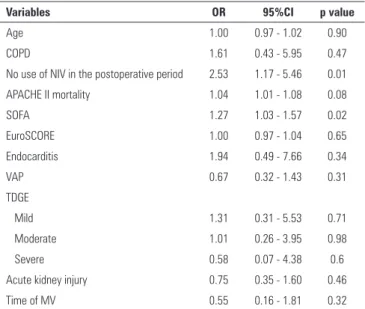
Death risk factors were calculated using a univariate logistic regression analysis using the following variables: age, COPD, APACHE, SOFA, NIV and EuroSCORE, endocarditis, VAP and TDGE. hese are shown in table 4.
Table 1 - Baseline characteristics of patients submitted to cardiac surgery that needed tracheal reintubation (n = 119/1640)
Variables Total
Sex
Female (N = 50) 42
Male (N = 69) 58
Age (years) 59.6 ± 14.4
Surgery type
Elective (N = 86) 72.3
Urgent (N = 33) 27.7
Cause
Myocardial revascularization (N = 36) 30.3
Valve replacement (N = 27) 22.7
Aneurysm (N = 25) 21.0
Heart transplant (N = 8) 6.7
Myocardial revascularization + valve replacement (N = 12) 10.1
Others* (N = 11) 9.2
Comorbidities
Arterial hypertension (N = 54) 51.9
Diabetes Mellitus (N = 22) 21.2
Cardiac insufficiency (N = 17) 16.3
Active smoking (N = 20) 19.2
COPD (N = 10) 9.6
Cardiac arrhythmia (N = 10) 9.6
COPD - chronic obstructive pulmonary disease. * Atrial/ventricular septal defect correction; ventricle aneurysmectomy. Values are expressed as percentage or mean ± standard deviation.
Table 2 - Clinical outcomes of patients submitted to cardiac surgery that needed tracheal reintubation
Variables Total
Postoperative complications
Pneumonia/VAP (N = 61) 52.6
Kidney dysfunction (N = 50) 42.4
AMI (N = 3) 2.5
Endotracheal reintubation in ≤ 48 hours (N = 38) 49.4 Use of NIV in the postoperative period (N = 53) 44.5
Deaths (N = 48) 40.3
APACHE (N = 118) 15.0 ± 4.4
APACHE mortality (N = 118) 24.2 ± 11.7
EuroSCORE (N = 80) 10.4 ± 13.0
SOFA (N = 67) 6.9 ± 2.6
TDGE
Absent (PaO2/FiO2 > 300) (N = 11) 11.5
Mild (PaO2/FiO2: 200 - 300) (N = 28) 29.2
Table 3 - Characteristics of reintubated patients according to survival status
Variables Death No death Total p value
APACHE 16.9 ± 4.5 (N=47) 14.6 ± 4.2 (N=71) 15.5 ± 4.4 (N=118) 0.01*
APACHE mortality 27.9 ± 12.9 (N=47) 21.7 ± 10.3 (N=71) 24.2 ± 11.7 (N=118) 0.01*
SOFA 7.9 ±3.0 (N=24) 6.3 ± 2.2 (N= 43) 6.9 ± 2.6 (N=67) 0.03*
Use of NIV 31.3 (N=15) 53.5 (N=38) 44.5 (N=53) 0.01†
TDGE
Absent 11.1 (N=4) 11.7 (N=7) 11.5 (N=11) 0.86‡
Mild 33.3 (N=12) 26.7 (N=16) 29.2 (N=28)
Moderate 50.0 (N=18) 51.7 (N=31) 51.0 (N=49)
Severe 5.6 (N=2) 10.0 (N=6) 8.3 (N=8)
Arterial hypertension 43.9 (N=18) 57.1 (N=36) 51.9 (N=54) 0.19†
Smoking 19.5 (N=8) 19.0 (N=12) 19.2 (N=20) 0.95†
Pneumonia 46.7 (N=21) 56.3 (N=40) 52.6 (N=61) 0.31†
VAP 21.4 (N=9) 26.5 (N=18) 24.5 (N=27) 0.55†
CKF 14.6 (N=6) 7.9 (N=5) 10.6 (N=11) 0.33‡
Reintubation < 48 hours 58.6 (N=17) 43.8 (N=21) 49.4 (N=38) 0.21†
Endocarditis 40.34 (N= 4) 59.66 (N=5) 7.56 (N=9) 0.44
APACHE - Acute Physiology and Chronic Health Evaluation; SOFA - Sequential Organ Failure Assessment score; NIV - noninvasive ventilation; TDGE - transient gas exchange disturbance; VAP - ventilator-associated pneumonia; CKF - chronic kidney failure. * Mann-Whitney’ test; † Chi-square test; ‡ Fisher’s exact test. Values are expressed as the mean ± standard deviation or
percentage.
Table 4 - Univariate logistic regression analysis of risk factors for death
Variables OR 95%CI p value
Age 1.00 0.97 - 1.02 0.90
COPD 1.61 0.43 - 5.95 0.47
No use of NIV in the postoperative period 2.53 1.17 - 5.46 0.01
APACHE II mortality 1.04 1.01 - 1.08 0.08
SOFA 1.27 1.03 - 1.57 0.02
EuroSCORE 1.00 0.97 - 1.04 0.65
Endocarditis 1.94 0.49 - 7.66 0.34
VAP 0.67 0.32 - 1.43 0.31
TDGE
Mild 1.31 0.31 - 5.53 0.71
Moderate 1.01 0.26 - 3.95 0.98
Severe 0.58 0.07 - 4.38 0.6
Acute kidney injury 0.75 0.35 - 1.60 0.46
Time of MV 0.55 0.16 - 1.81 0.32
OR - odds ratio; 95%CI - 95% confidence interval; COPD - chronic obstructive pulmonary disease; NIV - noninvasive ventilation; APACHE - Acute Physiology and Chronic Health Evaluation; SOFA - Sequential Organ Failure Assessment score; EuroSCORE - European System for Cardiac Operative Risk Evaluation; VAP - ventilator-associated pneumonia; TDGE - transient gas exchange disturbance; MV - mechanical ventilation.
Table 5 - Multivariate analysis of the risk factor for death in the use of noninvasive ventilation and mortality calculated by Acute Physiology and Chronic Health Evaluation
Variables OR 95%CI p value
No use of NIV in the postoperative period 3.07 1.10 - 8.54 0.03
APACHE II mortality 1.05 1.01 - 1.1 0.01
OR: odds ratio; 95%CI - 95% confidence interval; NIV - noninvasive ventilation; APACHE - Acute Physiology and Chronic Health Evaluation.
he variables that are collectively associated with death are the following: NIV (not using it increases the chance of death 3-fold), and mortality measured by APACHE II (each increased unit in the probability increases the chance of death by 5.7%). hese variables are shown in table 5.
DISCUSSION
he reintubation rate in this study was 7.26%. It is superior to the rates found in other studies, which range
from 3.8% to 6.6%(8,9), and also disagrees with the
suggestion that university hospitals tend to have lower rates of reintubation.(10) his result shows that at least
in this service, factors other than the presence of trained professionals and protocols for extubation may inluence outcomes in this context.
According to Zahoor and Azlina,(11) individuals
blood volume of the lungs after correction of the valve defect. In this study, however, the highest reintubation rate was found in patients with coronary artery bypass surgery (30.3%), possibly because this procedure is the most prevalent surgery service.
Smoking and hypertension are risk factors for extubation failure, which consequently leads to prolonged use of invasive mechanical ventilation, need for reintubation and mortality in postoperative cardiac surgery patients.(10,11) In this study, the percentage of
smokers and hypertensive subjects showed no signiicant diferences between the death group and the surviving group. Similarly, it was observed that there was no correlation between smoking, chronic obstructive pulmonary disease and reintubation.(2,12,13)
Cardiovascular, pulmonary and renal complications are also reported in the literature as factors related to reintubation and greater mechanical ventilation.(9) In the
studied population, 2.5% had acute myocardial infarction and more than half (52.6%) of patients had nosocomial pneumonia or VAP. he latter igure is consistent with other authors, who observed a higher incidence of pneumonia in reintubated patients and longer duration of mechanical ventilation. hus, preventive measures and treatments must be developed and improved to shorten the duration of mechanical ventilation and increase the chances of survival.(14,15)
Regarding renal complications, 42.4% developed some degree of renal dysfunction, deined here as serum creatinine > 1.2mg/dL (value from which the SOFA considers renal failure), regardless of whether renal replacement therapy was needed during hospitalization. In the study by Piotto et al., despite the use of serum creatinine value, renal failure was the strongest predictor
of the need for prolonged mechanical ventilation.(16)
Exarchopoulos et al. noted that SOFA score is one of the most signiicant predictors of mortality and in-hospital postoperative comorbidities in cardiac surgery patients.(17)
Prolonged mechanical ventilation is deined in the literature as the use of invasive mechanical ventilation for more than 48 hours(16) and is closely related to endotracheal
reintubation because the factors or complications that led the patient to need new ventilatory support are rarely resolved in less than two days. hus, the length of stay in the ICU can exceed 2 to 3 weeks,(18) mortality increases
by 40% and the efective cost of patients on mechanical ventilation for more than 4 days rises up to 18 times, leading to substantial economic impact.(19) In this work,
we have chosen to only study the population submitted to reintubation and therefore subject to all the complications that can prolong the ICU stay; the mean hospital stay was 22.7 ± 19.1 days. Cohen et al. deined reintubation as the increase in postoperative complications and extension in the intensive care unit and hospitalization.(20)
Practically all patients who are in the postoperative period of cardiac surgery have some degree of pulmonary dysfunction.(21,22) Factors related to the surgical procedure
are involved in the pathogenesis of this problem: the pain caused by drains and the surgical incision creates a restrictive phenomenon that compromises respiratory dynamics, hindering gas exchange and favoring the appearance of atelectasis. he need for blood product transfusions and extracorporeal circulation also afect lung function by delagrating important inlammatory response.(23)
Regarding the transient disturbance of gas exchange, most reintubated patients presented mild (29.2%) and moderate (51.0%) forms. he pathophysiology behind this disorder is summarized in the presence of pro-inlammatory cytokines released by activated leukocytes after getting in contact with non-endothelial surfaces of extracorporeal circulation. Under the inluence of these interleukins, a release of oxygen-derived free radicals and proteases that damage the pulmonary microvasculature
modify the gas exchange.(24) Rodrigues et al. found
similar values with respect to mild (27.7%) and moderate (56.1%) forms of TDGE in patients undergoing cardiac surgery.(22) In the same study, the researchers correlated the
APACHE II (12.8 ± 4.2 points) and mortality predicted by APACHE II (17.9 ± 9.5 points) with the presence of severe TDGE (p = 0.0001), suggesting that the APACHE II can also be a predictor of severe TDGE.
he APACHE II is an index used to classify critical patients according to the severity of their condition.(23) he
mean APACHE II in this study was 15 ± 4.4 points, and the predicted mortality was 24.2 ± 11.7 points. Similar values were seen in the work by Feijó et al., in which the
average APACHE II was 16.5 ± 7.7 points.(24) However,
he overall analysis of the gravity of this study scores (APACHE II, SOFA and EuroSCORE) shows that the studied population is composed predominantly of critically ill patients, which may explain the high rate of reintubation and mortality. Of the patients who were reintubated, 48 (40.3%) died.
In the comparative analysis between the death group and no deaths, the APACHE II variables, mortality predicted by APACHE II and SOFA scores were higher in the group who died. here was a signiicant relationship between mortality predicted by Apache and risk of death (p = 0.0105), showing that this score can also be used to predict mortality in reintubated patients. Tsaousi et al. found that EuroSCORE appears to confer remarkable prognostic value, almost equivalent to the SOFA score and higher than APACHE II, which are the main risk stratiication scores for morbidity and mortality prediction in the cardiac surgery population.(26)
he use of noninvasive ventilation (NIV) preceding reintubation was associated with a lower mortality according to our multivariate model adjusted for baseline APACHE II. However, although these results at irst suggest a beneicial efect of NIV, alternative explanations are very reasonable, and a causal relationship cannot be established. Unadjusted confounders may be involved. For example, NIV is contraindicated for very sick patients in a coma or with severe shock.
If NIV is indeed beneicial in post-extubation respiratory failure, possible mechanisms might be the fact that the NIV prophylactic in patients undergoing cardiac surgery improves oxygenation rates and reduces the risk of pulmonary complications in the postoperative period.(27,28) In a prospective study of patients after cardiac
surgery, Zhu et al. concluded that the use of NIV is associated with a lower reintubation rate (18.8% versus
80.9%), lower incidence of VAP (0 versus 17%) and the
lowest mortality rate (18.8% versus 38.3%) compared
to conventional treatment.(29) In a meta-analysis study,
Olper et al. demonstrated efectiveness of the use of NIV in reducing reintubation in fourteen clinical trials that evaluated the beneits after cardiac surgery.(30) Other studies
of respiratory dysfunction in the postoperative period of major surgery, such as solid organ transplantation and lung resections, also suggest that NIV reduces the need for reintubation and mortality.(31,32) According to Jaber
et al., NIV prevented reintubation in 67% of patients undergoing abdominal surgery.(33)
his is a cohort type study composed of a population that experiences an event that occurred at the same time. he analysis of this study was performed with postoperative cardiac surgery patients who underwent various procedures; however, all had similar APACHE II scores. Additionally, the available data storage system is obsolete for the data analysis, which is a common situation in Brazilian public hospitals.
he study’s strengths include the large sample size and correlated variables. If the results were analyzed by a clinical trial, it would have required more time and higher costs.
Due to the large sample in this study, some data could not be captured by the database to record the variables of ventricular function, pulmonary hypertension and extracardiac arteriopathy isolated from EuroSCORE. herefore, further studies should examine these variables independently to evaluate reintubation and mortality of postoperative cardiac surgery patients.
CONCLUSION
he reintubation rate in patients undergoing cardiac surgery in our hospital was high. Of the reintubated patients, many died, and this outcome is associated with high APACHE II and SOFA scores. he use of non-invasive ventilation was associated with reduced mortality in reintubated patients. Its use for prophylaxis in patients after cardiac surgery should be considered and enhanced to avoid reintubation and increase the chances of survival.
ACKNOWLEDGEMENT
Objetivo: Analisar pacientes em pós-operatório de cirurgia cardíaca que necessitaram de reintubação endotraqueal, e iden-tiicar os fatores associados com óbito e seu relacionamento com escores de severidade.
Métodos: Análise retrospectiva de informações referentes a 1.640 pacientes em pós-operatório de cirurgia cardíaca no perí-odo entre 2007 e 2015.
Resultados: A taxa de reintubação foi de 7,26%. Dentre os pacientes reintubados, 36 (30,3%) foram submetidos à cirur-gia de revascularização miocárdica, 27 (22,7%) à substituição valvar, 25 (21,0%) à correção de um aneurisma e oito (6,7%) a um transplante cardíaco. Dentre os pacientes com comorbida-des, 54 (51,9%) eram hipertensos, 22 (21,2%) diabéticos e 10 (9,6%) tinham doença pulmonar. Dentre os pacientes que tive-ram complicações, 61 (52,6%) tivetive-ram pneumonia, 50 (42,4%)
desenvolveram insuiciência renal e 49 (51,0%) tiveram uma forma moderada de distúrbio transitório da troca gasosa. Foi realizada ventilação não invasiva em 53 (44,5%) pacientes. A taxa de óbitos foi de 40,3%, e a mortalidade foi mais elevada no grupo que não recebeu ventilação não invasiva antes da reintu-bação (53,5%). Dentre os pacientes reintubados que morreram, os valores do SOFA e do APACHE II foram, respectivamente, de 7,9 ± 3,0 e 16,9 ± 4,5. A maior parte dos pacientes reintuba-dos (47,5%) pertencia ao grupo de risco mais elevado (EuroS-CORE > 6 pontos).
Conclusão: A taxa de reintubação foi elevada e se relacionou com o SOFA e o APACHE II mais graves. A mortalidade foi mais elevada no grupo que não recebeu ventilação não invasiva antes da reintubação.
RESUMO
Descritores: Ventilação não invasiva; Cirurgia torácica; In-tubação; Mortalidade; Insuiciência respiratória
REFERENCES
1. Wynne R, Botti M. Postoperative pulmonary dysfunction in adults after cardiac surgery with cardiopulmonary bypass: clinical significance and implications for practice. Am J Crit Care. 2004;13(5):384-93.
2. Yazdanian F, Azarfarin R, Aghdaii N, Faritous SZ, Motlagh SD, Panahipour A. Cardiac variables as main predictors of endotracheal reintubation rate after cardiac surgery. J Tehran Heart Cent. 2013;8(1):42-7.
3. Beckmann U, Gillies DM. Factors associated with reintubation in intensive care: an analysis of causes and outcomes. Chest. 2001;120(2):538-42. 4. Epstein SK. Extubation failure: an outcome to be avoided. Crit Care.
2004;8(5):310-2.
5. Brasil. Ministério da Saúde. Agência Nacional de Vigilância Sanitária. Resolução-RDC Nº 7, de 24 de Fevereiro de 2010. Dispõe sobre os requisitos mínimos para funcionamento de Unidades de Terapia Intensiva e dá outras providências. Disponível em http://www.saude.mg.gov.br/ images/documentos/RDC-7_ANVISA%20240210.pdf
6. Wynne R, Botti M. Postoperative pulmonary dysfunction in adults after cardiac surgery with cardiopulmonary bypass: clinical significance and implications for practice. Am J Crit Care. 2004;13(5):384-93.
7. ARDS Definition Task Force, Ranieri VM, Rubenfeld GD, Thompson BT, Ferguson ND, Caldwell E, Fan E, et al. Acute respiratory distress syndrome: the Berlin Definition. JAMA. 2012;307(23):2526-33.
8. Rodrigues CD, Oliveira RA, Soares SM, Figueiredo LC, Araújo S, Dragosavac D. Lesão pulmonar e ventilação mecânica em cirurgia cardíaca: revisão. Rev Bras Ter Intensiva. 2010;22(4):375-83.
9. Rady MY, Ryan T. Perioperative predictors of extubation failure and the effect on clinical outcome after cardiac surgery. Crit Care Med. 1999;27(2):340-7.
10. Kulkarni AP, Agarwal V. Extubation failure in intensive care unit: predictors and management. Indian J Crit Care Med. 2008;12(1):1-9.
11. Zahoor A, Azlina N. Endotracheal reintubation in post-operative cardiac surgical patients. Anaesth Pain Intensive Care. 2011;15(1):25-9.
12. Smeili LA, Lotufo PA. Incidência e preditores de complicações cardiovasculares e óbito após cirurgia vascular arterial. Arq Bras Cardiol. 2015;105(5):510-8.
13. Spivack SD, Shinozaki T, Albertini JJ, Deane R. Preoperative prediction of postoperative respiratory outcome. Coronary artery bypass grafting. Chest. 1996;109(5):1222-30.
14. Branca P, McGaw P, Light R. Factors associated with prolonged mechanical ventilation following coronary artery bypass surgery. Chest. 2001;119(2):537-46.
15. Sheng W, Xing QS, Hou WM, Sun L, Niu ZZ, Lin MS, et al. Independent risk factors for ventilator-associated pneumonia after cardiac surgery. J Invest Surg. 2014;27(5):256-61.
16. Piotto RF, Ferreira FB, Colósimo FC, Silva GS, Sousa AG, Braile DM. Fatores preditores independentes de ventilação mecânica prolongada em pacientes submetidos à cirurgia de revascularização miocárdica. Rev Bras Cir Cardiovasc. 2012;27(4):520-8.
17. Exarchopoulos T, Charitidou E, Dedeilias P, Charitos C, Routsi C. Scoring systems for outcome prediction in a cardiac surgical intensive care unit: a comparative study. Am J Crit Care. 2015;24(4):327-34; quiz 335. 18. Trouillet JL, Combes A, Vaissier E, Luyt CE, Ouattara A, Pavie A, et al.
Prolonged mechanical ventilation after cardiac surgery: outcome and predictors. J Thorac Cardiovasc Surg. 2009;138(4):948-53.
19. Kern H, Redlich U, Hotz H, von Heymann C, Grosse J, Konertz W, et al. Risk factors for prolonged ventilation after cardiac surgery using APACHE II, SAPS II, and TISS: comparison of three different models. Intensive Care Med. 2001;27(2):407-15.
20. Cohen AJ, Katz MG, Frenkel G, Medalion B, Geva D, Schachner A. Morbid results of prolonged intubation after coronary artery bypass surgery. Chest. 2000;118(6):1724-31.
21. Moura HV, Pomerantzeff PM, Gomes WJ. Síndrome da resposta inflamatória sistêmica na circulação extracorpórea: papel das interleucinas. Rev Bras Cir Cardiovasc. 2001;16(4):376-87.
22. Rodrigues CD, Moreira MM, Lima NM, Figueiredo LC, Falcão AL, Petrucci Junior O, et al. Risk factors for transient dysfunction of gas exchange after cardiac surgery. Rev Bras Cir Cardiovasc. 2015;30(1):24-32.
23. Costa JI, Gomes do Amaral JL, Munechika M, Juliano Y, Bezerra Filho JG. Severity and prognosis in intensive care: prospective application of the APACHE II index. Sao Paulo Med J. 1999;117(5):205-14.
24. Feijó CA, Leite Júnior FO, Martins AC, Furtado Júnior AH, Cruz LL, Meneses FA. Gravidade dos pacientes admitidos à unidade de terapia intensiva de um hospital universitário brasileiro. Rev Bras Ter Intensiva. 2006;18(1):18-21.
26. Tsaousi GG, Pitsis AA, Ioannidis GD, Pourzitaki CK, Yannacou-Peftoulidou MN, Vasilakos DG. Implementation of EuroSCORE II as an adjunct to APACHE II model and SOFA score, for refining the prognostic accuracy in cardiac surgical patients. J Cardiovasc Surg (Torino). 2015;56(6):919-27. 27. Al Jaaly E, Fiorentino F, Reeves BC, Ind PW, Angelini GD, Kemp S, et al.
Effect of adding postoperative noninvasive ventilation to usual care to prevent pulmonary complications in patients undergoing coronary artery bypass grafting: a randomized controlled trial. J Thorac Cardiovasc Surg. 2013;146(4):912-8.
28. Ferreira FR, Moreira FB, Parreira VF. Ventilação não invasiva no pós-operatório de cirurgias abdominais e cardíacas - revisão de literatura. Rev Bras Fisioter. 2002;6(2):47-54.
29. Zhu GF, Wang DJ, Liu S, Jia M, Jia SJ. Efficacy and safety of noninvasive positive pressure ventilation in the treatment of acute respiratory failure after cardiac surgery. Chin Med J (Engl). 2013;126(23):4463-9.
30. Olper L, Corbetta D, Cabrini L, Landoni G, Zangrillo A. Effects of non-invasive ventilation on reintubation rate: a systematic review and meta-analysis of randomised studies of patients undergoing cardiothoracic surgery. Crit Care Resusc. 2013;15(3):220-7.
31. Antonelli M, Conti G, Bufi M, Costa MG, Lappa A, Rocco M, et al. Noninvasive ventilation for treatment of acute respiratory failure in patients undergoing solid organ transplantation: a randomized trial. JAMA. 2000;283(2);235-41.
32. Auriant I, Jallot A, Hervé P, Cerrina J, Le Roy Ladurie F, Fournier JL, et al. Noninvasive ventilation reduces mortality in acute respiratory failure following lung resection. Am J Respir Crit Care Med. 2001;164(7):1231-5. 33. Jaber S, Delay JM, Chanques G, Sebbane M, Jacquet E, Souche B, et