Physical inactivity in the leisure-time in young people from Feira de
Santana, Bahia, Brazil
Inatividade física no lazer em jovens de Feira de Santana, Bahia
Inactividad física en el ocio en jóvenes de Feira de Santana, Bahia, Brasil
Luzana Cirqueira Rios1, Saulo Vasconcelos Rocha2, Maura Maria G. de Almeida3, Tânia Maria Araújo4
Instituição: Universidade Estadual de Feira de Santana (UEFS), Feira de Santana, BA, Brasil
1Bacharel em Enfermagem UEFS, Feira de Santana, BA, Brasil
2Mestre em Saúde Coletiva pela Universidade Estadual do Sudoeste da Bahia (UESB); Professor Assistente da UESB, Jequié, BA, Brasil 3Doutora em Enfermagem pela UEFS; Professora Titular da UEFS, Feira de Santana, BA, Brasil
4Doutora em Epidemiologia pela UEFS; Professora Titular da Universidade UEFS, Feira de Santana,BA, Brasil
Endereço para correspondência: Saulo Vasconcelos Rocha
Avenida José Moreira Sobrinho, s/n – Jequiezinho CEP 45200-000 – Jequié/BA
E-mail: [email protected]
Fonte financiadora: Ministério da Saúde (Convênio 1532/2005) e Fundação de Amparo à Pesquisa do Estado da Bahia (FAPESB), Processo nº 71/2004 Conflito de interesse: nada a declarar
Recebido em: 16/8/2011 Aprovado em: 13/12/2011 ABStrAct
Objective: To evaluate the prevalence of physical inactivity during leisure-time among adolescents and young adults.
Methods: A cross-sectional epidemiological study was conducted among 1,400 young people aged 15–29 years liv-ing in the urban area of Feira de Santana, Northeast, Brazil. Physical activities and entertainment were assessed using a structured questionnaire, which addressed the frequency, type, reason, and effort involved.
Results: Among interviewed individuals 63.3% (n=795) were considered physically inactive concerning leisure activi-ties. Prevalence was higher among women (p<0.001) and among those 10 to 24 years old (p<0.001).
Conclusions: The young population of Feira de Santana city, Brazil, presented an elevated rate of physical inactivity during leisure. Public policies directed to health promotion among adolescents and young adults should include speciic programs to encourage women and 18–24years old individu-als to engage in physical activities.
Key-words: motor activity; sedentary lifestyle; adoles-cent; young adult.
reSumo
Objetivo: Estimar a prevalência de inatividade física no lazer entre os jovens.
Métodos: Estudo epidemiológico de corte transversal com amostra constituída de 1.400 jovens entre 15 e 29 anos, residentes na zona urbana de Feira de Santana, Bahia. As atividades físicas e de lazer foram avaliadas por meio de um questionário estruturado, que abordou frequência, tipo, motivo e esforço envolvido.
Resultados: Dos entrevistados, 63,3% (n=795) eram inativos isicamente no seu tempo de lazer, sendo que a prevalência foi maior entre as mulheres (p<0,001) e entre os indivíduos na faixa etária de 18–24 anos (p<0,001).
Conclusões: A população de jovens residentes no muni-cípio de Feira de Santana, Bahia, apresentou uma prevalência elevada de inatividade física no lazer. As políticas públicas direcionadas à promoção de saúde de adolescentes e jovens adultos devem priorizar ações que facilitem às mulheres e aos indivíduos de 18 a 24 anos engajarem-se em práticas de atividades físicas.
Palavras-chave: atividade motora; estilo de vida seden-tário; adolescente; adulto jovem.
reSumen
Objetivo: Estimar la prevalencia de inactividad física en el ocio entre los jóvenes.
(Brasil). Las actividades físicas y de ocio fueron evaluadas por medio de un cuestionario estructurado, que abordó frecuen-cia, tipo, motivo y esfuerzo implicado.
Resultados: De los entrevistados, el 63,3% (n=795) eran inactivos físicamente en su tiempo de ocio, siendo que la prevalencia fue mayor entre las mujeres (p<0,001) y entre los individuos en la franja de edad de 18–24 años (p<0,001).
Conclusiones: La población de jóvenes residentes en el municipio de Feira de Santana, Bahia (Brasil), presentó una prevalencia elevada de inactividad física en el ocio. Las políticas públicas destinadas a la promoción de salud de adolescentes y jóvenes adultos deben priorizar acciones que faciliten que las mujeres y a los individuos de 18 a 24 años se comprometan en prácticas de actividades físicas.
Palabras clave: actividad motora; estilo de vida seden-tario; adolescente; adulto joven.
Introduction
Physical activity is deined as any bodily movement performed by skeletal muscles, resulting in a substantial increase in energy expenditure(1). It can be understood as
an essential quality of human beings, and it is an interdis-ciplinary topic which arouses the interest of investigators from several ields of knowledge, of the media and of public health. Hallal et al(2) highlight the fact that at no other time
in history the practice of physical activities was so present in the public health agenda and in academic debate as in these last years.
The regular practice of physical activities is a protective behavior against the development of obesity, cardiovascu-lar diseases, type II diabetes, cervical cancer(3), and arterial
hypertension(4), also contributing to an improvement in the
sense of wellbeing(5).
In the last years, however, a substantial decrease in the population’s level of physical activity can be noticed, espe-cially during adolescence(6). The decrease in the time the
young population spends in physical activities is a conse-quence of the increase of the time spent in sedentary activities such as watching TV and using the computer(7). The increase
of the time spent in intellectual activities, such as school activities, language and computer courses, work (either paid or not), and the ease in waving physical education at school are factors that contribute to a sedentary behavior(8).
The regular practice of physical activities during adoles-cence can promote physical growth, increase self-esteem,
and contribute to the development of social skills. Literature evidence shows that the practice of physical activities dur-ing adolescence may be associated to the level of physical activities during adulthood(9).
Since population-based studies with adolescents and adults in Northeastern Brazil are rare, this study aimed to estimate the prevalence of physical inactivity during leisure-time in young people from Feira de Santana, state of Bahia. We hope our results can foster the introduction of measures to promote and stimulate physical activities, which in its turn, as literature shows, can be an important element in the prevention of the major injuries and non-communicable chronic diseases of modernity.
method
An epidemiological cross-sectional study was performed in a representative sample of the urban population over 15 years old in Feira de Santana. The areas were selected through a stratiied sample by subdistrict with random criteria, using census data from the Brazilian Institute of Geography and Statistics (Instituto Brasileiro de Geograia e Estatística, IBGE)(10).
The analyzed data included 3,597 subjects of 15 years or older. However, for this study, the target population selected was of 1,400 young people from 15 to 29 years, according to the age classiication of the National Youth Council (Conselho Nacional da Juventude)(11) for adolescents
(from 15 to 17), youths (from 18 to 24), and young adults (from 25 to 29).
The following procedures were adopted to select the sample: percent representation of the population per urban area subdis-ctrict; deinition of the percentage in each subdisctrict’s sample, made from the resident population data from each subdisctrict; list of the census sectors in each subdistrict; random selection of census sections included in the sample; random selection of streets; selection of houses.
The houses in the selected streets were visited and inhabit-ants aged 15 years or more were considered eligible for this study. To reduce the loss percentage, up to three visits per house were made, excluding those that refused to participate in the study and the individuals that were not found in their houses after three visits.
To evaluate physical inactivity during leisure-time, sub-jects were asked if they regularly participated in physical activities during their leisure moments, of what kind were these activities, and how they classiied their intensity: light, moderate, or heavy.
Subjects who classiied their physical effort in leisure as moderate – at least two hours per week of activities such as walking, biking, dancing classes, – or heavy – at least four hours per week of activities such as jogging, gymnastics, swimming, ball games – were considered active in their leisure. Those who did not participate in physical activi-ties or just described sedentary behaviors in their leisure-time (activities such as reading, listening to the radio, or watching TV) were considered inactive. The adopted procedure was similar to that used in other studies found in the literature(12-15).
The database was built and analyzed using the statisti-cal program Statististatisti-cal Package for Social Sciences (SPSS), version 9.0 for Windows. In the analysis, the global preva-lence of physical inactivity of the studied population was estimated. The prevalence of inactivity according to sex and age were also evaluated. The chi-square test was calculated to analyze the association of the investigated variables, adopting a signiicance level of p<0.05. Info about some of the characteristics researched in this study were lost due to questionnaires illed incorrectly or absence of an answer by the respondent.
The study was submitted to and approved by the Human Being’s Research Ethics Committee of Universidade Estadual de Feira de Santana, under the Opinion n. 042/2006. The adopted procedures followed the recommendations estab-lished by the Resolution n. 196/96 of the Brazilian National Health Council (Conselho Nacional de Saúde).
results
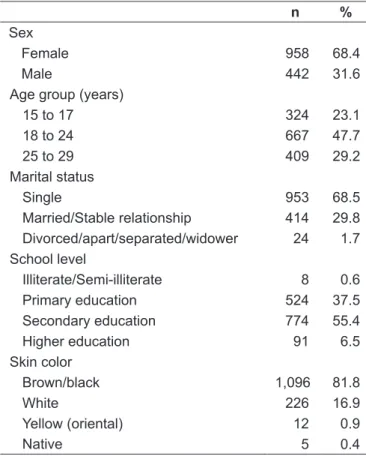
Of the selected population, 47.7% were aged 18 to 24 years; 68.4% were female; 68.5% were single; 81.8% were black (self-reported as brown or black); and 55.4% were finishing or still attending secondary education (Table 1).
Soccer/volleyball (23.2%) and walking (12.2%) were the physical activities most practiced during leisure-time (Table 2). Global physical inactivity in leisure was of 63.3%. Analyzing physical inactivity according to sex, physical inactivity in men was less prevalent than in women (Table 3).
table 1 - Distribution of young people from 15 to 29, according to sociodemographic characteristics
n %
Sex
Female 958 68.4
Male 442 31.6
Age group (years)
15 to 17 324 23.1
18 to 24 667 47.7
25 to 29 409 29.2
Marital status
Single 953 68.5
Married/Stable relationship 414 29.8
Divorced/apart/separated/widower 24 1.7
School level
Illiterate/Semi-illiterate 8 0.6
Primary education 524 37.5
Secondary education 774 55.4
Higher education 91 6.5
Skin color
Brown/black 1,096 81.8
White 226 16.9
Yellow (oriental) 12 0.9
Native 5 0.4
Lost information: nine for marital status, three for school level, and 61 for skin color
table 2 - Percentage of the major leisure physical activities reported by the studied population
n %
Soccer/volleyball 292 23.2
Walking 154 12.2
Gymnastics 84 6.6
Swimming/biking 62 4.9
Yoga/dancing 34 2.6
Hidrogymnastics 5 0.3
Others* 42 3.4
*Bodybuilding, stretching, basketball, boxing, capoeira, physical educa-tion, indoor soccer, handball, karate, skateboarding, tennis
Sex
p-value Female male
Inativo 80.6 53.2
<0,0001
Ativo 19.4 46.8
table 3 - Percentage of (active and inactive) levels of physical activity in leisure, according to sex
Physical inactivity in leisure changes with age: from the 15–17 to the 18–24 group the prevalence of physical inactivity increased. However, from 25 onwards a decrease occurred in the percentage of subjects classiied as physically inactive in leisure (Table 4). The intensity of physical activ-ity according to age group showed that only 7.7% of youths and 9.4% of young adults take part in leisure-time physical activities considered heavy, a percentage much smaller than the 17.7% of adolescents. The presented proile of leisure activity practices is characterized by the high prevalence of physical inactivity in leisure among young people.
Discussion
Regular physical activity is an important behavior in people’s lives and presents a signiicant impact in the prevention and control of non-communicable chronic diseases, also helping the control of stress, anxiety and depressive symptoms.
The physical activities most practiced by young people during their free time were walking, soccer and volleyball, while hydrogymnastics was the least attended physical activity. Two categories may inluence physical activities’ patterns: individual characteristics, including motivations, self-eficacy, motor skills, and other health behaviors; and environmental characteristics, such as access to work or leisure spaces, costs, time availability barriers, and socio-cultural support(16). The prevalence of soccer and volleyball
as the major preferences of adolescents and young adults has been indicated in several studies(17) and, as noted above,
may be caused by cultural aspects, such as the extensive dis-semination of soccer in Brazilian society, especially among men. These activities, besides, do not have a high cost, which can help their practice in our social contexts.
The frequency of physical inactivity among young people from Feira de Santana was high (72.8%). More than half of the respondents was considered inactive in leisure, that is, they reported they did not participate in physical activities or par-ticipated only in light physical activities during their free time. Lopes et al(13), in a study performed with 2,022 adults from 20
to 59 years old from the city of Lages, state of Santa Catarina, Brazil, detected a smaller prevalence of physical inactivity (only 29.6%) than the one detected in this study. Burton e Turrel(15)
described results close to the ones found in Feira de Santana, with a 67.7% prevalence of physical inactivity in adults living in Australia. Tenório et al(9), detected that 65.1% of adolescents
attending secondary education were insuficiently active. Obtained results show physical inactivity is higher among women, conirming results from the literature(17) and
showing the need for actions to promote physical activities among women.
During the classiication of physical activity effort, it was found that a low percentage of subjects reported practicing high intensity physical activities. Besides, the intensity of physical activity was considerably reduced with age.
For Tenório et al(9), participation in physical education
classes is a factor associated both to the level of physical activ-ities’ practice and to the exposure to non-sedentary behavior in secondary school students. Schools must be attentive to the planning of this subject in the school environment, so that young people be encouraged to take part in physical activi-ties. Since this is a phase in life in which group activities are very motivating, the organization of teams, championships and extra activities in school can be improved so that spaces of social exchange be enlarged, increasing the possibility of adolescents and youths participating in these activities. The beneits of these programs and actions can be even greater, since physical activity habits in adolescence are associated with physical activity during adulthood(17).
Other aspect that can be highlighted is that the prob-ability of overweight is larger among sedentary young people, what increases exposure to cardiovascular diseases. In a research with adolescents, Silva et al(16) claim that the
probability of overweight is 74% larger in not very active boys than in active ones.
Data from the Risk and Protection Factors for Chronic Disease Watch by Phone Interview System (Sistema de Vigilância de Fatores de Risco e Proteção Para Doenças Crônicas por Inquérito Telefônico, VIGITEL), in a 2006 survey that covered the 26 Brazilian state capitals and the Federal District, showed a high percentage of physically Age group (years)
p-value 15 to 17 18 to 24 25 to 29
Inactive 52.5 69.2 62.1
<0.0001
Active 46.5 30.8 37.9
Spent physical effort
Light 52.5 69.2 62.1
<0.0001
Moderate 29.8 23.1 28.5
Heavy 17.7 7.7 9.4
table 4 - Percentage of (active and inactive) levels of physical activity in leisure and spent effort in leisure physical activities according to age group
inactive adults (≥18 years). Among the state capitals of the Northeast region, the city of Salvador, state of Bahia, pre-sented the smaller percentage of people physically inactive in leisure (29%), while the city of Recife, state of Pernambuco, presented the larger percentage (32.8%)(18).
Sedentariness is acknowledged as a risk factor for non-communicable chronic diseases and presents a high preva-lence in several countries(19). Studies show that a large part
of the population does not meet the current recommenda-tions on the practice of physical activities. When evaluat-ing only physical activities performed durevaluat-ing leisure-time, investigators have been detecting an even higher prevalence of sedentariness(20-22). The high number of young people
physically inactive in leisure is, thus, worrying. Keeping this sedentary behavior throughout life may lead to health dam-ages, especially those related to non-communicable chronic diseases, thus compromising these individual’s life quality and overloading the city’s Public Health system.
The design of this study can be pointed out among its possible limitations, since a cross-sectional study prevents us to secure implicit causal relations between the studied variables. The instrument used to analyze physical activity in leisure was not especially built to investigate physical ac-tivity, but to perform a population survey with the primary purpose of studying the mental health conditions of the city’s urban area residents. This can be a relevant limitation to this study, since it hindered the development of more speciic aspects of physical activity in the studied popula-tion. The analysis of physical activity in leisure was set after the data collection. There was no validation nor was the test-retest agreement of the questionnaire checked for this purpose. However, a pilot study was performed to evalu-ate and better adequevalu-ate the questions of the instrument. It is worth noticing, however, that this is a
population-based study with a randomly selected sample, involving a signiicant number of subjects, what allowed us to obtain estimates for the event of interest (physical inactivity in leisure), adopting sample procedures to minimize potential biases in selection.
Results allow us to conclude that the young people popu-lation from Feira de Santana, state of Bahia, presents a high prevalence of physical inactivity in leisure, which is further shortened in its physical effort intensity with age. In view of the fact that 55.4% of these young people were inishing or still attending secondary education, actions to promote physical activities and the adoption of an active lifestyle may be developed in the school environment, especially in Physical Education classes. The construction of leisure equipments in public spaces (courts, walk lanes, soccer ields, pools), connected to the development of public policies ori-ented towards changes in behavior and the promotion of the adoption of an active lifestyle may contribute to the increase of the population’s level of physical activity.
Acknowledgements
To the Coordination for the Improvement of Higher-Education Personnel (Coordenação de Aperfeiçoamento de Pessoal de Ensino Superior, CAPES), for the Masters fellow-ship granted to Saulo Vasconcelos Rocha, to the Scientiic Initiation Grant Program (Programa de Bolsa de Iniciação Cientíica) of Universidade Estadual de Feira de Santana (PROBIC/UEFS), for the undergraduate research fellowship granted to Cirqueira Rios, to the Brazilian Ministry of Health (Ministério da Saúde) (Agreement 1532/2005) and to the Foundation for Research of the State of Bahia (Fundação de Amparo à Pesquisa do Estado da Bahia, FAPESB), Process n. 71/2004, for the inancial help in performing this study.
references
1. Carpersen CJ, Powell KE, Christenson GM. Physical activity, exercise, and physical itness: deinitions and distinctions for health-related research. Public Health Rep 1985;100:126-31.
2. Hallal PC, Dumith SC, Bastos JP, Reichert FF, Siqueira FV, Azevedo MR. Evolution of the epidemiological research on physical activity in Brazil: a systematic review. Rev Saude Publica 2007;41:453-60.
3. Guthold RW, Ono T, Strong KL, Chatterji S, Morabia A. Worldwide variability in physical inactivity a 51-country survey. Am J Prev Med 2008;34:486-94. 4. Barroso WK, Jardim PC, Vitorino PV, Bittencourt A, Miquetichuc F.
The influence of programmed physical activity on blood pressure of hypertensive elderly patients on non-pharmacological. Rev Assoc Med Bras 2008;54:328-33.
5. Reijneveld SA, Westhoff MH, Hopman-Rock M. Promotion of health and physical activity improves the mental health of elderly immigrants: results of a group randomised controlled trial among Turkish immigrants in the Netherlands aged 45 and over. J Epidemiol Community Health 2003;57:405-11. 6. Koezuka N, Koo M, Allison KR, Adlaf EM, Dwyer JJ, Faulkner G et al. The
relationship between sedentary activities and physical inactivity among adolescents: results from the Canadian Community Health Survey. J Adolesc Health 2006;39:515-22.
7. French SA, Story M, Jeffery RW. Environmental inluences on eating and physical activity. Annu Rev Public Health 2001;22:309-35.
9. Tenório MC, Barros MV, Tassitano RM, Bezerra J, Tenório JM, Hallal PC. Physical activity and sedentary behavior among adolescent high school students. Rev Bras Epidemiol 2010;13:105-17.
10. Brasil. Instituto Brasileiro de Geograia e Estatística [homepage on the Internet]. Síntese dos indicadores sociais [cited 2008 Aug 18]. Rio de Janeiro: IBGE; 2005. Available from: http://biblioteca.ibge.gov.br/visualizacao/monograias/ GEBIS%20-%20RJ/sintese_indic/indic_sociais2004.pdf
11. Brasil. Conselho Nacional de Juventude. Política Nacional de Juventude: diretrizes e perspectivas. São Paulo: Fundação Friedrich Ebert; 2006. 12. Pitanga FJ, Lessa I. Prevalence and variables associated with leisure-time
sedentary lifestyle in adults. Cad Saude Publica 2005;21:870-7.
13. Lopes JA, Longo GZ, Peres KG, Boing AF, Arruda MP. Factors associated with insuficient physical activity: a population-based study in southern Brazil. Rev Bras Epidemiol 2010;13:689-98.
14. Pitanga FJ, Lessa I. Association between leisure-time physical inactivity and hospital care in adult in the city of Salvador-Brasil. Rev Bras Cineantropom Desempenho Hum 2008;10:347-53.
15. Burton NW, Turrell G. Occupation, hours worked, and leisure-time physical activity. Prev Med 2000;31:673-81.
16. Silva KS, Nahas MV, Hoefelmann LP, Oliveira ES.Associations between
physical activity, body mass index, and sedentary behaviors in adolescents. Rev Bras Epidemiol 2008;11:159-68.
17. Azevedo MR, Araújo CL, Cozzensa da Silva M, Hallal PC. Tracking of physical activity from adolescence to adulthood: a population-based study.Rev Saude Publica 2007;41:69-75.
18. Brasil. Ministério da Saúde [homepage on the Internet]. VIGITEL BRASIL 2007 - Vigilância de fatores de risco e proteção para doenças crônicas por inquérito telefônico [cited 2011 Feb 28]. Brasília: Ministério da Saúde, 2008. Available from: http://portal.saude.gov.br/portal/arquivos/pdf/vigitel2007_inal_web.pdf 19. Guthold R, Ono T, Strong KL, Chatterji S, Morabia A. Worldwide variability in
physical inactivity: a 51-country survey. Am J Prev Med 2008;34:486-94. 20. Monteiro CA, Conde WL, Matsudo SM, Matsudo VR, Bonseñor IM, Lotufo PA.
A descriptive epidemiology of leisure-time physical activity in Brazil, 1996-1997. Rev Panam Salud Publica 2003;14:246-54.
21. Barros MV, Nahas MV. Health risk behaviors, health status self-assessment and stress perception among industrial works. Rev Saude Publica 2001;35:554-63.
22. Dias-da-Costa JS, Hallal PC, Wells JC, Daltoé T, Fuchs SC, Menezes AM