Low serum testosterone is a predictor of high-grade disease in
patients with prostate cancer
GEORGE A. M. LINSDE ALBUQUERQUE1*, GIULIANO B. GUGLIELMETTI2, JOÃO ARTHUR B. A. BARBOSA3, JOSÉ PONTES JR.2,
ARNALDO J. C. FAZOLI2, MAURÍCIO D. CORDEIRO2, RAFAEL F. COELHO2, PAULO AFONSODE CARVALHO2, FÁBIO P. GALLUCCI2,
GUILHERME P. PADOVANI2, RUBENS PARK2, JOSÉ CURY4, HENRIQUE NONEMACHER5, MIGUEL SROUGI6, WILLIAM C. NAHAS7
1Assistant Physician, Urology Service, Hospital Universitário Getúlio Vargas/Universidade Federal do Amazonas (HUGV/UFAM), and Assistant Physician, Urology Service, Fundação Centro de Controle em Oncologia do Estado do Amazonas (FCECON), Manaus, AM, Brazil
2Assistant Physician, Urology Service, Instituto do Câncer do Estado de São Paulo (Icesp), Hospital das Clínicas, Faculdade de Medicina da Universidade de São Paulo (HC-FMUSP), São Paulo, SP, Brazil 3Urology Resident Physcian, HC-FMUSP, São Paulo, SP, Brazil
4MD Urologist, HC-FMUSP. Head of the Sexual Medicine Group, São Paulo, SP, Brazil 5Fellow in Urologic Oncology, Icesp, HC-FMUSP, São Paulo, SP, Brazil
6Full Professor of Urology, FMUSP, São Paulo, SP, Brazil
7Full Professor of Urology, FMUSP, and Head of the Urologic Oncology Group at Icesp, São Paulo, SP, Brazil
S
UMMARYStudy conducted at Division of Urology, Instituto do Câncer do Estado de São Paulo, Faculdade de Medicina, Universidade de São Paulo (Icesp/
HC-FMUSP), São Paulo, SP, Brazil Article received: 7/3/2017 Accepted for publication: 7/21/2017
*Correspondence: Address: Av. Dr. Arnaldo, 251,
Cerqueira César São Paulo, SP – Brazil Postal code: 01246-000 [email protected]
http://dx.doi.org/10.1590/1806-9282.63.08.704
Objective: To evaluate the relation between serum total testosterone (TT) and prostate cancer (PCa) grade and the effect of race and demographic characteristics on such association.
Method: We analyzed 695 patients undergoing radical prostatectomy (RP), of whom 423 had serum TT collected. Patients were classiied as having hypogonadism or eugonadism based on two thresholds of testosterone: threshold 1 (300 ng/dL) and threshold 2 (250 ng/dL). We evaluated the relation between TT levels and a Gleason score (GS) ≥ 7 in RP specimens. Outcomes were evaluated using univariate and multivariate analyses, accounting for race and other demographic predictors.
Results: Out of 423 patients, 37.8% had hypogonadism based on the threshold 1 and 23.9% based on the threshold 2. Patients with hypogonadism, in both thresholds, had a higher chance of GS ≥ 7 (OR 1.79, p=0.02 and OR 2.08, p=0.012, respectively). In the multivariate analysis, adjusted for age, TT, body mass index (BMI) and race, low TT (p=0.023) and age (p=0.002) were found to be independent risk factors for GS ≥ 7. Among Black individuals, low serum TT was a stronger predictor of high-grade disease compared to White men (p=0.02).
Conclusion: Hypogonadism is independently associated to higher GS in localized PCa. The effect of this association is signiicantly more pronounced among Black men and could partly explain aggressive characteristics of PCa found in this race.
Keywords: prostate cancer, hypogonadism, testosterone.
INTRODUCTION
Prostate cancer (PCa) is the second most common cancer in males in western countries1 and the known risk factors are age, diet, race and family history.2 The relationship between PCa and testosterone was irst described by Hug-gins over 70 years ago3 and has become controversial as accumulated evidence demonstrating potentially oppos-ing effects of androgens on cancer.4-6 Testosterone is vital for normal development and growth of the prostate and, conversely, androgen deprivation therapy in metastatic PCa signiicantly decreases symptoms and disease
progres-sion. On these grounds, high levels of testosterone are believed to increase the risk of developing PCa. However, epidemiological investigations failed to demonstrate such association.7 Morgentaler et al.8 reported a high prevalence of PCa among asymptomatic men with low levels of total and free testosterone. This was the irst study to show that low testosterone levels do not provide protection to the development of PCa.
testoster-one (TT) may be associated with higher-grade disease. Park et al.9 retrospectively evaluated 681 patients under-going prostate biopsy and found an independent asso-ciation between laboratorial hypogonadism, deined as TT below 300 ng/dL, and high-grade PCa at biopsy. Stud-ies performed in patients presenting PCa with clinically localized disease treated with radical prostatectomy (RP) also demonstrated that low levels of TT preoperatively were associated with more aggressive disease based on higher pathological stage, positive surgical margins and Gleason score (GS).10,11 However, an independent asso-ciation has not been uniformly demonstrated in all in-vestigations.12,13 Most studies have been performed in Caucasian and Asian populations, yet without specifying the effect of demographic characteristics on the asso-ciation between TT and higher-grade PCa. Possible ex-planations for the inconsistency between existing stud-ies include demographic variability, variable cutoffs for hypogonadism and biased samples.
The purpose of our study was to evaluate if serum TT levels are associated with higher-grade PCa and to evalu-ate the effect of race and other demographic predictors in this association in a multiethnic population.
METHOD
Institutional Review Board approval was obtained prior to the beginning of investigations. We retrospectively reviewed charts of 695 patients undergoing RP from January 2010 to December 2011 at a single tertiary care center. Patients who had TT levels measured from 6 months to 1 day before the surgery totalized 423 and were included for analysis. If more than one TT measurement was performed, levels obtained the closest to the surgery were used. TT measurement was performed at the discre-tion of the attending physician; TT results obtained more than 6 months prior to surgery were not included, which caused a number of subjects to be excluded from analysis. We studied the association between preoperative serum TT levels and the pathological outcomes of the surgical specimens. Only patients with clinically local-ized disease who underwent RP as treatment were in-cluded. Salvage radical prostatectomies were excluded from analysis.
Statistical analysis
Patients were divided into groups of normal and low testosterone based on 2 threshold levels for TT: threshold 1 (< 300 ng/dL vs. ≥ 300 ng/dL) and threshold 2 (< 250 ng/dL vs. ≥ 250 ng/dL). High-grade PCa was considered as a Gleason score ≥ 7.
Fisher’s exact test was used to evaluate associations between binomial variables. To compare means between groups, we used the t-Student test for independent sam-ples with normal distribution or the nonparametric Kruskal-Wallis when appropriate. We evaluated the rela-tion between TT and pathological indings such as: path-ological stage, GS and positive lymph nodes. Multivariate analysis considering age, body mass index (BMI), TT and race was performed for the outcomes of interest. A linear regression model was used to evaluate the relationship between PSA and testosterone levels. All statistical analy-ses were performed using SPSS 20.0 (IBM Software).
RESULTS
Table 1 shows the clinical preoperative data for age, BMI, testosterone levels and PSA. Table 2 depicts the patho-logical characteristics of patients according to race, age--adjusted Charlson comorbidity index, prostate-speciic antigen (PSA), TT levels (threshold 1 and threshold 2) and pathologic evaluation of RP specimens. Of 423 pa-tients, 37.8% had hypogonadism based on threshold 1 and 23.9% based on threshold 2.
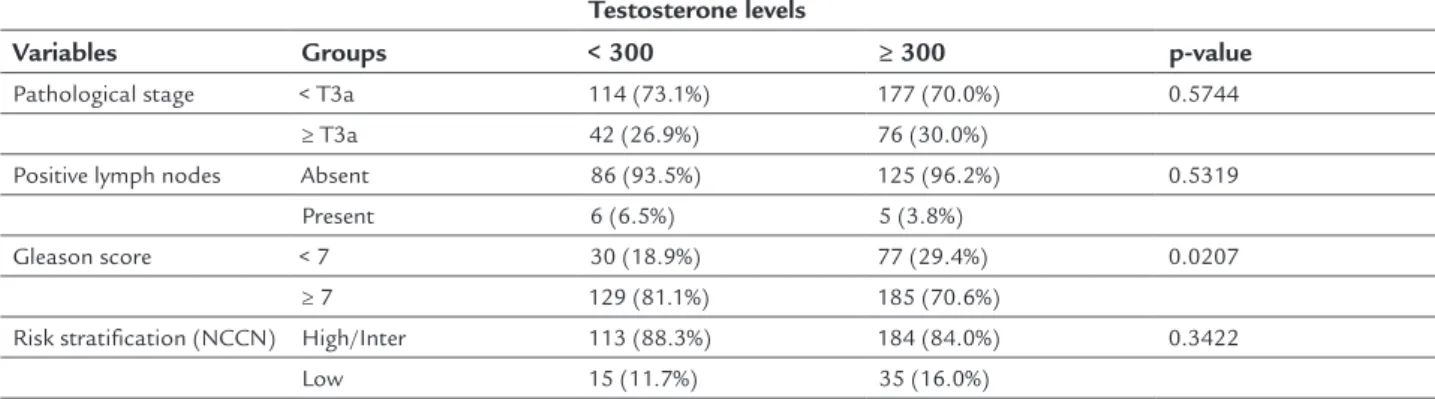
On univariate analysis, patients with hypogonadism had higher prevalence of GS ≥ 7 in RP specimens for both thresholds. There was no difference between groups in terms of rates of lymph node metastases and pathological stage (Table 3 and Table 4). Considering the levels of TT as a continuous variable, we observed that decreasing TT levels were associated with a progressive increase in the risk of having GS ≥ 7 (p-value = 0.0157). Levels of TT did not correlate with levels of PSA on a linear regression fashion (R square goodness-of-it 0.0002; p=0.77).
On multivariate analysis, adjusted for age, TT levels, BMI and race, only low TT levels (p-value = 0.0231) and advanced age (p-value = 0.0018) were independent risk factors for high-grade disease (Gleason ≥ 7).
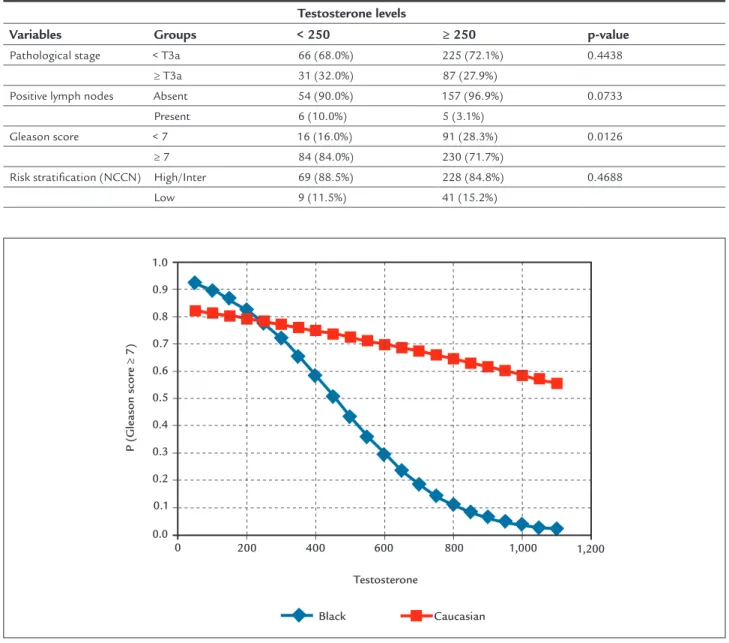
In our data, Black men had a higher incidence of hy-pogonadism compared to Caucasians (p-value = 0.0103). Variations of TT levels had a higher impact on predicting high-grade disease (GS ≥ 7) among Black men compared to White men (p=0.02) (Figure 1). We also observed that obese patients had a higher prevalence of hypogonadism compared to men with normal BMI (p-value < 0.001).
DISCUSSION
signii-TABLE 1 Characteristics of patients.
Variable Results
BMI (Mean ± SD) 26.8±4.3
Age (Mean ± SD) 63.6±6.6
Testosterone (Mean ± SD) 380.0±183.2
PSA (Median, IQR) 13.0 (6.1-14.7)
BMI: body mass index; PSA: prostate-speciic antigen; IQR: interquartile range; SD: standard deviation.
TABLE 2 Clinicopathological characteristics of the 423 patients included in the study.
Variables Groups N (%)
Race Asian 3 (0.7%)
Caucasian 360 (86.3%)
Black 20 (4.8%)
Pardo (Brown multiracial) 34 (8.2%)
Pathological stage < T3a 291 (71.1%)
≥ T3a 118 (28.9%)
Positive lymph nodes Absent 211 (95.0%)
Present 11 (5.0%)
Gleason score < 7 107 (25.4%)
≥ 7 314 (74.6%)
Age-adjusted Charlson comorbidity score 0 15 (3.7%)
1 90 (22.2%)
2 204 (50.4%)
≥ 3 96 (23.7%)
PSA < 10 197 (53.4%)
≥ 10 172 (46.6%)
Testosterone levels (threshold 1) < 300 160 (37.8%)
≥ 300 263 (62.2%)
Testosterone levels (threshold 2) < 250 101 (23.9%)
≥ 250 322 (76.1%)
Risk stratiication (NCCN) Low 50 (14.4%)
Intermediate 213 (61.4%)
High 84 (24.2%)
PSA: prostate-speciic antigen.
TABLE 3 Comparison of pathological characteristics of patients with hypogonadism vs. eugonadism (classiied using the
300 ng/dL threshold).
Testosterone levels
Variables Groups < 300 ≥ 300 p-value
Pathological stage < T3a 114 (73.1%) 177 (70.0%) 0.5744
≥ T3a 42 (26.9%) 76 (30.0%)
Positive lymph nodes Absent 86 (93.5%) 125 (96.2%) 0.5319
Present 6 (6.5%) 5 (3.8%)
Gleason score < 7 30 (18.9%) 77 (29.4%) 0.0207
≥ 7 129 (81.1%) 185 (70.6%)
Risk stratiication (NCCN) High/Inter 113 (88.3%) 184 (84.0%) 0.3422
TABLE 4 Comparison of characteristics of patients with hypogonadism vs. eugonadism (classiied using the 250 ng/dL threshold).
Testosterone levels
Variables Groups < 250 ≥ 250 p-value
Pathological stage < T3a 66 (68.0%) 225 (72.1%) 0.4438
≥ T3a 31 (32.0%) 87 (27.9%)
Positive lymph nodes Absent 54 (90.0%) 157 (96.9%) 0.0733
Present 6 (10.0%) 5 (3.1%)
Gleason score < 7 16 (16.0%) 91 (28.3%) 0.0126
≥ 7 84 (84.0%) 230 (71.7%)
Risk stratiication (NCCN) High/Inter 69 (88.5%) 228 (84.8%) 0.4688
Low 9 (11.5%) 41 (15.2%)
Caucasian Black
1.0
0.9
0.8
0.7
0.6
0.5
0.4
0.3
0.2
0.1
0.0
0 200 400 600 800 1,000 1,200
Testosterone
P (Gleason scor
e ≥ 7)
FIGURE 1 Interaction between TT levels and race in predicting the risk of high-grade PCa. Among Black individuals, hypogonadism had a
stronger effect in predicting high-grade disease (p=0.038), although there was a similar trend among Caucasians (p=0.06). Both groups differed signiicantly in this behavior (p=0.02).
cantly more pronounced among Black men, who also had higher incidence of hypogonadism. These results may reveal an underlying mechanism for higher-grade PCa found in Black race, and may also partly explain incon-sistencies between previous investigations regarding the association between TT and PCa grade.
Although the response of metastatic PCa to androgen deprivation therapy is well established, it is still controver-sial whether androgens are responsible for the initiation of PCa. Age, one of the strongest risk factors for PCa, is knowingly associated with a gradual decline in testosterone
levels. However, that does not preclude a pathogenic role for androgens, given the long preclinical phase of PCa. Yet, multiple population-based studies have failed to show an association of circulating testosterone, dihydrotestosterone (DHT) or other sex steroids with PCa risk.14,15
(TRT) promotes limited changes in PSA levels when men with hypogonadism are treated to normalize testosterone. Morgentaler and Traish proposed a saturation mod-el theory of testosterone and the prostate.16 According to this theory, PCa is testosterone-sensitive at low testoster-one levels, but after androgen receptors are fully occupied, further testosterone increments have modest or no effect on the prostate or PCa dynamics. This hypothesis is sup-ported by studies in men on TRT showing modest or no PSA increase after initiating testosterone injections, as well as no increased risk for cancer.17,18
There are many reports on the role of testosterone in predicting high-risk disease, although with contrast-ing results and employcontrast-ing different methodological standards and outcomes. Schatzl et al. reported on a higher risk for high-grade Gleason scores in men with low serum testosterone among patients diagnosed with PCA.19 Similarly, Pichon et al. showed, among subjects undergoing RP for PCa, that lower testosterone levels were associated with higher-grade PCa and with increased risk of GS upgrading from prostate biopsy to specimens from surgery.20 Park et al.9 demonstrated a correlation between hypogonadism and unfavorable outcomes in prostatic biopsies, such as increased incidence of GS ≥ 8. Several studies, despite adopting different thresholds for the deinition of hypogonadism, have conirmed an association between low testosterone levels and adverse characteristics and outcomes for PCa, including higher Gleason score,21,22 higher pathological stage10,22 and in-creased risk for disease progression.23
However, a number of investigations failed to show an association between low serum testosterone levels and high-risk characteristics of PCa specimens. Salonia et al.12 found an association between androgens and higher risk PCa that was not proven to be independent on multi-variate analysis. Other studies showed no association,12,24 while Porcaro et al. suggest a direct relation between tes-tosterone levels and Gleason score, a result that opposes the indings described previously.25
In our study, we evaluated 423 patients and tested two thresholds, 250 and 300 ng/dL, for the deinition of hypogonadism. We used pathological indings from RP specimens in order to most accurately relect tumor char-acteristics. In keeping with other reports, we found a signiicant and independent correlation between low TT levels (threshold 1 and threshold 2) and high-grade disease (GS ≥ 7). We also analyzed the correlation between pre-operative hypogonadism and pathological stage and the presence of lymph nodes involved by the disease. This relationship proved to be non-signiicant, although there
was a trend towards higher stage (≥ T3a) on threshold 2 and positive lymph nodes in both thresholds.
In our cohort, low TT levels were also signiicantly associated with race and BMI characteristics. This re-sulted in a signiicant interaction between these variables and the outcome of higher grade PCa. We hypothesize that inconsistencies between previous studies on this subject may be due to demographic variability between cohorts, owing to the effect that interaction with race may produce. We also hypothesize that low serum testos-terone may be one of the mechanisms mediating previ-ously reported associations between demographic groups and increased risk for high-grade PCa.
Nunzio et al., in a prospective multicenter study, evaluated the association between abdominal obesity, PCa diagnosis and grade in 668 patients undergoing prostate biopsy. PCa was detected in 246 patients (38%), of whom 110 had a higher-grade cancer (GS ≥ 7). Logistic regression showed that BMI and waist circumference were signiicant predictors of high-grade PCa. Furthermore, obesity with central adiposity was signiicantly associated with high--grade disease.26
Black men have a 67% higher incidence of PCa com-pared to Caucasians.27 While population-level studies have consistently shown that the incidence and mortal-ity burden is highest among Black men, it remained un-clear whether this can be explained by inadequate access to medical care.28 Gaines et al., in a population-based study involving 887 men, evaluated the association be-tween race and low- and high-grade PCa in men undergo-ing initial prostate biopsy in an equal access medical center. Of the 887 men, 499 had PCa on biopsy (56.3%). Black men were signiicantly more likely to have PCa on biopsy than White men 61,9% vs. 50.9% (p≤0.001). In multivariate analyses, Black race was signiicantly predic-tive of high-grade.29
In our study, on multivariate analysis adjusted for BMI and race, only low levels of TT and advanced age had a signiicant impact in predicting GS ≥ 7. Low TT was associated with increased BMI, and hypogonadism was a stronger predictor of high-grade PCa among Black in-dividuals. Based on these observations, we hypothesize that low serum testosterone may be an underlying mech-anism involved in higher-grade PCa found in both obese and Black men in previous reports. These results should be further conirmed in larger populations and tested on molecular level.
association between low TT and high-grade PCa. How-ever, our indings confront this hypothesis, as changes in serum testosterone did not correlate with changes in PSA. This is in consonance with previous investigations.9 Fur-thermore, low TT predicted high-grade PCa indepen-dently of age at diagnosis, which also opposes this con-jecture. Rather, we believe that, according to the Saturation Model, patients with hypogonadism do not reach levels of testosterone necessary for physiological proliferation of the epithelium, leading to a greater risk of abnormal proliferation and differentiation, resulting in greater risk for high-grade cancer.
Our results should be interpreted in the context of a number of limitations. The retrospective nature of the study, the lack of a standardized protocol for testosterone measurement and the selection of patients from a high--volume cancer center imply biases for epidemiological observations. Many patients were not included in the study because their TT measurement had been performed prior to 6 months from surgery, introducing a bias that excluded patients who waited longer until radical pros-tatectomy. Furthermore, our observations on the effect of low TT in Black men are based on a limited sample. However, we believe that our study provides meaningful insight into associations between testosterone levels, pros-tate cancer grade and race interactions, and should war-rant further prospective investigations.
CONCLUSION
According to our indings, hypogonadism is an independent risk factor for developing higher GS in localized PCa. Low levels of TT might be related to the carcinogenesis of high-er grade canchigh-er and is a potential markhigh-er of prognosis in PCa. In our sample, low TT level was a stronger predictor of high-grade PCa in Black men compared to White men, which could partly explain the behavior of the disease in this ethnic group and should warrant further investigation.
RESUMO
Baixa testosterona sérica é prognóstica de doença de alto grau em pacientes com câncer de próstata
Objetivo: Avaliar a relação entre testosterona sérica total (TT) e grau do câncer de próstata (CP) e o efeito da raça e de características demográicas sobre essa associação.
Método: Foram analisados 695 pacientes submetidos a prostatectomia radical (PR), dos quais 423 tinham medidas dos níveis séricos de TT. Os pacientes foram classiicados como portadores de hipogonadismo ou
eugonadismo com base em dois limites de testosterona: limite 1 (300 ng/dL) e limite 2 (250 ng/dL). Avaliou-se a relação entre nível de TT e escore Gleason (GS) ≥ 7 em amostras de PR. Os resultados foram avaliados por aná-lises univariada e multivariada, com ajuste para raça e outros fatores prognósticos demográicos.
Resultados: Do total de 423 pacientes, 37,8% apresentavam hipogonadismo com base no limite 1, e 23,9% com base no limite 2. Os pacientes com hipogonadismo, indepen-dentemente do limite de referência, tiveram uma chance maior de GS ≥ 7 (OR 1,79, p=0,02 e OR 2,08, p=0,012, respectivamente). Na análise multivariada, após ajuste para idade, TT, índice de massa corporal (IMC) e raça, baixo TT (p=0,023) e idade (p=0,002) foram considerados fatores de risco independentes para GS ≥ 7. Entre os indi-víduos negros, baixo TT sérico foi mais preditivo de doen-ça de alto grau em comparação com os brancos (p=0,02).
Conclusão: O hipogonadismo é independentemente associado a escores mais altos de GS no CP localizado. O efeito dessa associação é signiicativamente mais pronun-ciado entre homens negros, o que poderia explicar, em parte, as características agressivas do CP observadas nes-sa população.
Palavras-chave: câncer de próstata, hipogonadismo, testosterona.
REFERENCES
1. Ferlay J, Bray F, Pisani P, Parkin DM. GLOBOCAN 2002. Cancer Incidence, Mortality and Prevalence Worldwide, Version 2.0. Lyon: IARC Press; 2004. 2. Bostwick DG, Burke HB, Djakiew D, Euling S, Ho SM, Landolph J, et al.
Human prostate cancer risk factors. Cancer. 2004; 101(10 Suppl):2371-490. 3. Huggins C, Stevens RE Jr, Hodges CV. Studies on prostate cancer. II. The effect of castration on advanced carcinoma of the prostate gland. Arch Surg. 1941; 43(2):209-23.
4. Morgentaler A. Testosterone replacement therapy and prostate cancer. Urol Clin N Am. 2007; 34(4):555-63, vii.
5. Endogenous Hormones and Prostate Cancer Collaborative Group, Roddam AW, Allen NE, Appleby P, Key TJ. Endogenous sex hormones and prostate cancer: a collaborative analysis of 18 prospective studies. J Natl Cancer Inst. 2008; 100(3):170-83.
6. Isbarn H, Pinthus JH, Marks LS, Montorsi F, Morales A, Morgentaler A, et al. Testosterone and prostate cancer: revisiting old paradigms. Eur Urol. 2009; 56(1):48-56.
7. Morgentaler A. Turning conventional wisdom upside-down: low serum testosterone and high-risk prostate cancer. Cancer. 2011; 117(17):3885-8. 8. Morgentaler A, Bruning CO 3rd, DeWolf WC. Occult prostate cancer in
men with low serum testosterone levels. JAMA. 1996; 276(23):1904-6. 9. Park J, Cho SY, Jeong S, Lee SB, Son H, Jeong H. Low testosterone level is
an independent risk factor for high-grade prostate cancer detection at biopsy. BJU Int. 2016; 118(2):230-5.
10. Isom-Batz G, Bianco FJ, Kattan MW, Mulhall JP, Lilja H, Eastham JA. Testosterone as a predictor of pathological stage in clinically localized prostate cancer. J Urol. 2005; 173(6):1935-7.
12. Salonia A, Gallina A, Briganti A, Abdollah F, Suardi N, Capitanio U, et al. Preoperative hypogonadism is not an independent predictor of high-risk disease in patients undergoing radical prostatectomy. Cancer. 2011; 117(17):3953-62.
13. Shin BS, Hwang EC, Im CM, Kim SO, Jung SI, Kang TW, et al. Is a decreased serum testosterone level a risk factor for prostate cancer? A cohort study of Korean men. Korean J Urol. 2010; 51(12):819-23.
14. Grossmann M, Cheung AS, Zajac JD. Androgens and prostate cancer; pathogenesis and deprivation therapy. Best Pract Res Clin Endocrinol Metab. 2013; 27(4):603-16.
15. Grossman M, Wittert G. Androgens, diabetes and prostate cancer. Endocr Relat Cancer. 2012; 19(5):F47-62.
16. Morgentaler A, Traish AM. Shifting the paradigm of testosterone and prostate cancer: the saturation model and the limits of androgen-dependent growth. Eur Urol. 2009; 55(2):310-20.
17. Coward RM, Simhan J, Carson CC 3rd. Prostate-speciic antigen changes and prostate cancer in hypogonadal men treated with testosterone replacement therapy. BJU Int. 2009, 103(9):1179-83.
18. Rhoden EL, Morgentaler A. Testosterone replacement therapy in hypogonadal men at high risk for prostate cancer: results of 1 year of treatment in men with prostatic intraepithelial neoplasia. J Urol. 2003; 170(6 Pt 1):2348-51. 19. Schatzl G, Madersbacher S, Thurridl T, Waldmüller J, Kramer G, Haitel A,
et al. High-grade prostate cancer is associated with low serum testosterone levels. Prostate. 2001; 47(1):52-8.
20. Pichon A, Neuzillet Y, Botto H, Raynaud JP, Radulescu C, Molinié V, et al. Preoperative low serum testosterone is associated with high-grade prostate cancer and an increased Gleason score upgrading. Prostate Cancer Prostatic Dis. 2015; 18(4):382-7.
21. Dai B, Qu Y, Kong Y, Ye D, Yao X, Zhang S, et al. Low pretreatment serum total testosterone is associated with a high incidence of Gleason score 8-10
disease in prostatectomy specimens: data from ethnic Chinese patients with localized prostate cancer. BJU Int. 2012; 110(11 Pt B):E667-72.
22. Xylinas E, Ploussard G, Durand X, Fabre A, Salomon L, Allory Y, et al. Low pretreatment total testosterone (< 3 ng/mL) predicts extraprostatic disease in prostatectomy specimens from patients with preoperative localized prostate cancer. BJU Int. 2011; 107(9):1400-3.
23. García-Cruz E, Piqueras M, Huguet J, Peri L, Izquierdo L, Musquera M, et al. Low testosterone levels are related to poor prognosis factors in men with prostate cancer prior to treatment. BJU Int. 2012; 110(11 Pt B):E541-6. 24. Morote J, Ramirez C, Gómez E, Planas J, Raventós CX, de Torres IM, et
al. The relationship between total and free serum testosterone and the risk of prostate cancer and tumour aggressiveness. BJU Int. 2009; 104(4):486-9.
25. Porcaro AB, Petrozziello A, Ghimenton C, Migliorini F, Sava T, Caruso B, et al. Associations of pretreatment serum total testosterone measurements with pathology-detected Gleason score cancer. Urol Int. 2014; 93(3):269-78.
26. De Nunzio C, Albisinni S, Freedland SJ, Miano L, Cindolo L, Finazzi Agrò E, et al. Abdominal obesity as risk factor for prostate cancer diagnosis and high grade disease: a prospective multicenter Italian cohort study. Urol Oncol. 2013; 31(7):997-1002.
27. Howlader N, Noone AM, Krapcho M, Garshell J, Neyman N, Altekruse SF, et al., editors. SEER Cancer Statistics Review, 1975-2010. National Cancer Institute. Bethesda. 2013.
28. Powell IJ. Epidemiology and pathophysiology of prostate cancer in African-American men. J Urol. 2007; 177(2):444-9.