Lycopene and ß-carotene protect
in vivo
iron-induced oxidative stress damage in
rat prostate
1Departamento de Bioquímica, Instituto de Química,
2Departamento de Clínica Médica-Nefrologia, Faculdade de Medicina,
Universidade de São Paulo, São Paulo, SP, Brasil
3Departamento de Fisiologia, Universidade Federal de Sergipe, São Cristóvão,
SE, Brasil H.R. Matos3, S.A. Marques1,
O.F. Gomes1, A.A. Silva2, J.C. Heimann2, P. Di Mascio1 and M.H.G. Medeiros1
Abstract
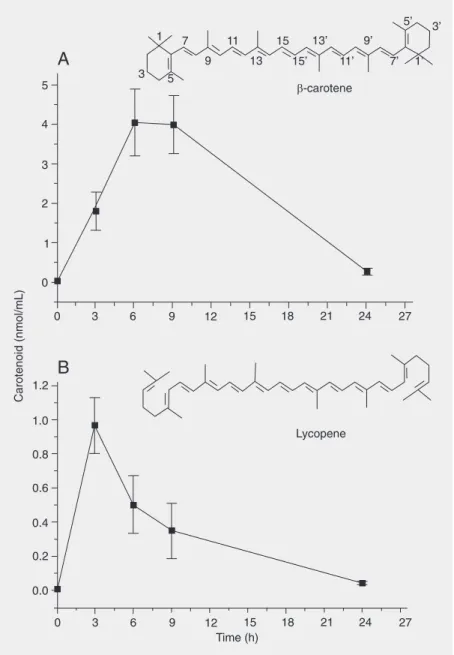
It has been suggested that iron overload may be carcinogenic. In the present study, we evaluated the effect of plasma and prostate caro-tenoid concentration on oxidative DNA damage in 12-week-old Wistar ratstreated with intraperitoneal (ip) ferric nitrilotriacetate (Fe-NTA) (10 mg Fe/kg). Plasma ß-carotene and lycopene concentrations were measured as a function of time after ip injection of carotenoids (10 mg kg-1 day-1 ß-carotene or lycopene) in rats. The highest total plasma
concentration was reached 3 and 6 h after ip injection of lycopene or ß-carotene, respectively. After 5 days of carotenoid treatment, lyco-pene and ß-carotene were present in the 0.10-0.51 nmol/g wet tissue range in the prostate. Using a sensitive method to detected 8-oxo-7,8-dihydro-2'-deoxyguanosine (8-oxodGuo) by HPLC/EC, the level of 8-oxodGuo in rat prostate DNA was significantly higher (6.3 ± 0.6 residues/106 dGuo) 3 h after Fe-NTA injection compared with control
rats (1.7 ± 0.3 residues/106 dGuo). Rats supplemented with lycopene
or ß-carotene for 5 days prior to Fe-NTA treatment showed a reduction of about 70% in 8-oxodGuo levels to almost control levels. Compared with control rats, the prostate of Fe-NTA-treated animals showed a 78% increase in malondialdehyde accumulation. Lycopene or ß-carotene pre-treatment almost completely prevented lipid damage. Epidemiological studies have suggested a lower risk of prostate cancer in men reporting a higher consumption of tomato products. However, before associating this effect with tomato sauce constitu-ents, more information is required. The results described here may contribute to the understanding of the protective effects of carotenoids against iron-induced oxidative stress.
Correspondence
M.H.G. Medeiros
Departamento de Bioquímica Instituto de Química, USP Av. Prof. Lineu Prestes, 748 05508-900 São Paulo, SP Brasil
Fax: +55-11-3815-5579 E-mail: [email protected]
Research supported by FAPESP, CNPq, and PRONEX/FINEP. P. Di Mascio is the recipient of a fellowship from the John Simon Memorial Guggenheim Foundation.
Received January 31, 2005 Accepted October 27, 2005
Key words
•Lycopene •ß-carotene •DNA damage •
8-oxo-7,8-dihydro-2'-deoxyguanosine •Ferric nitrilotriacetate •Prostate cancer
Introduction
Epidemiological studies have suggested that consumption of fruits and vegetables can help cancer prevention. This effect can
much interest has been focused on elucidat-ing the molecular mechanisms responsible for their biological effects. In addition to the well-known pro-vitamin A activity of some carotenoids, part of their beneficial effects has been attributed to their antioxidant prop-erties (3,4). Their ability to scavenge free radicals (5-7) and to physically quench sin-glet molecular oxygen (8) has been well described. Carotenoids have also been asso-ciated with other biological mechanisms such as modulation of intercellular gap junctional communication, immune system and meta-bolic pathways (9,10).
On the other hand, iron has been exten-sively reported to mediate oxidative stress (11-14). In fact, a high production of free radicals occurs in animal models of iron overload (15). Liver iron deposits are fre-quent in cirrhotic patients with hepatitis C and seem to contribute to the development of hepatocellular carcinoma (16). It has been demonstrated that the iron chelate, ferric nitrilotriacetate (Fe-NTA), is a potent in-ducer of lipid peroxidation in cells and in animal models (17). It has also been reported that rats intraperitoneally (ip) injected with Fe-NTA show an increase in the level of thiobarbituric acid-reactive substances in liver and an elevation of the plasma levels of aspartate aminotransferase and alanine ami-notransferase indicative of hepatic injury (18). Fe-NTA causes renal carcinomas in rats (19) and induces the formation of 8-oxo-7,8-dihydro-2'-deoxyguanosine (8-oxodGuo) in DNA from isolated rat kidney cells (20-23). In previous studies, we have shown that lycopene can protect cultured mammalian cells against damage to biomolecules in-duced by Fe-NTA/ascorbate treatment (24). Furthermore, we showed a significant pro-tective effect of lycopene against DNA oxi-dation, membrane damage and histopatho-logic changes observed in the liver of Fe-NTA-treated rats (25).
One of the cancers which benefit from a diet rich in tomatoes and tomato products is
prostate cancer (2). Recently, Boileau et al. (26) investigated the effect of tomato prod-ucts or lycopene in a rat model of prostate carcinogenesis. They observed that tomato powder but not lycopene inhibited prostate carcinogenesis, suggesting that tomato prod-ucts contain compounds in addition to lyco-pene that reduce the risk of prostate cancer. In contrast, a stimulatory effect of a lyco-pene oxidation product on gap junctional communication between cells was observed in rat liver epithelial WB-F344 cells, indi-cating a potential role of lycopene degrada-tion products in cell signaling (27). There-fore, more information is required to eluci-date the biochemical mechanisms respon-sible for the protective effects of lycopene. The purpose of the present study was to determine if lycopene or ß-carotene or both can protect against iron-induced oxidative DNA damage in the rat prostate.
Material and Methods
Chemicals
Nitrilotriacetic acid (NTA), tetrahydro-furan (THF), nuclease P1, alkaline phos-phatase, ribonuclease A and T1, proteinase K, acetonitrile, ß-carotene, methanol, and isopropyl alcohol were from Sigma (St. Louis, MO, USA). All other solvents and chemicals used were of analytical grade and were supplied by Merck (Darmstadt, Ger-many). Water was purified with a Milli-Q system (Millipore, Bedford, MA, USA). Lycopene was donated by Dr. Zohar Nir, LycoRed Natural Products Industries Ltd. (Beer-Sheva, Israel). Fresh stock solutions of lycopene were kept in the dark and used immediately. The Fe-NTA solution was pre-pared just before use as described by Bates and Schlabach (28). Briefly, aqueous solu-tions of FeCl3 and NTA were mixed at a
molar ratio of 1:4 FeCl3/NTA. The pH of
Lycopene or ß-carotene stock solutions
Lycopene or ß-carotene (100 mg) was mixed in 2 mL Tween-80 at room tempera-ture until a homogenous paste was obtained. Physiologic saline at room temperature was added dropwise and with vigorous stirring to a final concentration of 10 mg lycopene or ß-carotene per mL of suspension (29).
Animal treatments
Male Wistar rats (12 weeks old) were taken from the colony of the Instituto de Química, Universidade de São Paulo. All animals were allowed one week of in-house acclimatization with ad libitum access to standard laboratory food and water. The ani-mals were divided into six groups of five or 10 individuals each: a) control with animals receiving ip Tween-80 in saline (vehicle); b) animals receiving ip lycopene (10 mg kg-1
day-1) in vehicle, for 5 days; c) animals
receiving ip ß-carotene in vehicle (10 mg kg-1
day-1) for 5 days; d) animals receiving ip
lycopene in vehicle (10 mg kg-1 day-1) for 5
days, and after an ip Fe-NTA injection (10 mg Fe/kg); e) animals receiving ip ß-caro-tene in vehicle (10 mg kg-1 day-1 for 5 days)
and after an ip Fe-NTA injection (10 mg Fe/ kg). Animals were sacrificed 3 h after Fe-NTA administration and the prostate was removed, snap frozen in liquid nitrogen and stored at -80ºC.
Plasma concentration of lycopene and ß-carotene
All rats, except the control groups, re-ceived a 1-mL ip injection of a 10-mg/mL solution containing ß-carotene or lycopene. Blood was collected from the rat tail 3, 6, 9, and 24 h after the injection and centrifuged to obtain plasma. Lycopene and ß-carotene were analyzed by HPLC. Lycopene and ß-carotene in plasma were measured accord-ing to a previously described method (30,31).
Plasma (100 µL) was extracted with 100 µL ethanol and 200 µL hexane and samples were vortexed for 1 min and centrifuged for 5 min at 2500 rpm and 4ºC. The upper organic phase was removed and dried in the dark under a stream of nitrogen at 30ºC. Samples were redissolved in HPLC solvent, after which 10 µL of a 5-mM solution of ß-ionone was added as internal standard. The amounts of lycopene and ß-carotene were measured by HPLC using a Shimadzu HPLC system (Kyoto, Japan) equipped with two LC-10AD pumps, a Rheodyne injector and an SPD-M10AV photodiode array detector, controlled by a CBM-10A communication bus module and the CLASS LC-10AWS software. The following conditions were employed for HPLC: a reverse phase C-18 column (Spherex, 250 x 4.6 mm, 5 µm) eluted with an isocratic solvent system con-sisting of acetonitrile:THF:methanol (68:22: 10, v/v/v), with 0.025% (w/v) ammonium acetate at 1 mL/min. Lycopene and ß-caro-tene were detected at 445 nm. The detection limit of the assay was 5 pmol/injection, based on a signal-to-noise ratio of 3:1. The quanti-fication limit of the assay was determined as the concentration equal to six times the value of the signal-to-noise ratio and was 7.5 pmol/ injection.
Lycopene and ß-carotene determination in the prostate
Carotenoids were measured in the pros-tate according to the method described by Zhao et al. (32). THF was added to tissue slices and the mixture was sonicated. After five extractions the extracts were dried un-der N2 and the residue was treated with
methanolic KOH (10%) under N2for 1 h at
lycopene and ß-carotene were measured by HPLC as described above.
DNA extraction and enzymatic hydrolysis
DNA was isolated by the chaotropic NaI method (33). Tissue (300 mg) was suspended in 2 mL of a lysis solution (1% (w/v) Triton X-100, 0.32 M sucrose, 5 mM EDTA, 10 mM Tris-HCl, pH 7.5). After centrifugation at 1500 g for 10 min, the pellets were sus-pended in 600 µL 10 mM Tris-HCl buffer, pH 8.0, containing 5 mM EDTA, 10% SDS and 0.15 mM desferrioxamine. The enzymes RNase A (30 µL, 1 mg/mL) and RNase T1 (8 µL, 1000 U/mL) in 10 mM Tris-HCl buffer, pH 7.4, containing 1 mM EDTA and 2.5 mM desferrioxamine, were added and the reac-tion mixture was incubated at 50oC. After 15
min, 30 µL proteinase K (20 mg/mL) was added followed by additional incubation at 37oC for 1 h. After centrifugation at 5000 g
for 15 min, the liquid phase was collected and 1.2 mL 7.6 M NaI was added to it, followed by the addition of 1 mL isopro-panol. The content in the tube was mixed well by inversion until a whitish precipitate appeared. The precipitate was collected by centrifugation at 5000 g for 15 min and washed with 1 mL 40% isopropanol (w/v), followed by 1 mL 70% ethanol (w/v). After additional centrifugation at 5000 g for 15 min, the DNA pellet was suspended in 100 µL 0.1 mM desferrioxamine. The DNA con-centration was measured spectrophotometri-cally at 260 nm and was considered to be homogeneous, A260/A280 >1.75. DNA (100
µg) was diluted in 200 µL of deionized wa-ter, followed by the addition of 4 µL 1 M sodium acetate buffer, pH 5.0, containing 5 units of nuclease P1 and incubated at 37ºC for
30 min. Twelve microliters of 1 M Tris-HCl buffer, pH 7.4, 12 µL phosphatase buffer, and 6 units of alkaline phosphatase were then added for an additional 1-h incubation at 37°C. The sample was centrifuged and the aqueous layer was collected and analyzed by HPLC.
Analysis of
8-oxo-7,8-dihydro-2'-deoxyguanosine by HPLC-electrochemical detection
Samples (100 µg) of digested DNA were injected into the HPLC/electrochemical de-tection system consisting of a Shimadzu model LC-10AD pump connected to a Luna C18 (Phenomenex, Torrance, CA, USA)
re-verse-phase column (250 x 4.6 mm ID, par-ticle size 5 µm). The flow rate of the isocratic eluent (50 mM potassium phosphate buffer, pH 5.5, and 8% methanol) was 1 mL/min. Coulometric detection was obtained with a Coulochem II detector (ESA, Chemsford, MA, USA). The potentials of the two elec-trodes were set at 120 and 280 mV. Elution of unmodified nucleosides was monitored simultaneously with a Shimadzu SPD-10A UV detector set at 254 nm. A Shimadzu Class-LC10 1.6 software was used to calcu-late the peak areas. The molar ratio of 8-oxodGuo to dGuo in each DNA sample was determined based on coulometric detection at 280 mV for 8-oxodGuo and on absorb-ance at 254 nm for dGuo in each injection.
Malondialdehyde determination
Malondialdehyde (MDA) was measured as described (34). Briefly, an aqueous sample containing MDA at pH 6.5-8.0 was separated by HPLC using an aminophase column (S-5 Spherisorb-NH2) with acetonitrile 30 mM Tris
buffer, pH 7.4 (1:9, v/v), as the mobile phase at 1 mL/min. The effluent was monitored at 267 nm, the molar absorptivity (ε) of the enolate
anion form of free MDA, was taken to be 31,500 at pH 7.4. To deproteinize the sample, 300 mg of the tissue was mixed with an equal volume of acetonitrile followed by centrifuga-tion. A 20-µL aliquot of the supernatant was injected into the HPLC apparatus.
Statistical analysis
were analyzed by two-way ANOVA fol-lowed by the post hoc Bonferroni test per-formed using GraphPad Prism version 4.02 for Windows (GraphPad Software, San Di-ego, CA, USA) to compare groups or by the Student t-test when two groups were com-pared. Differences were considered signifi-cant at P < 0.05.
Results and Discussion
Oxidative damage to biomolecules has been postulated to be involved in several chronic diseases (35). Iron is a well-known inducer of oxidative stress. The administra-tion of Fe-NTA to rats and mice causes in vivo oxidative DNA damage. It has been reported that all four DNA bases are modi-fied in the renal chromatin of rats within 24 h of Fe-NTA administration (22). Prostate tissue is vulnerable to oxidative stress (36) and whether carotenoids can protect against DNA damage and lipoperoxidation associ-ated with this process is of particular inter-est.
Plasma ß-carotene and lycopene concen-trations, measured as a function of time after 10 mg of ip injection of the carotenoid in rats, are shown in Figure 1. The highest concentration of ß-carotene in plasma, 4.05 ± 0.84 nmol/mL, was reached after 6 h, remaining at this level for another 3 h (Fig-ure 1A). Rats injected with the same amount of lycopene displayed a four-fold lower plasma carotenoid concentration peak (0.97 ± 0.16 nmol/mL blood) than those injected with ß-carotene (Figure 1B). The maximum plasma lycopene level was observed 3 h after administration. The control animals, which did not receive carotenoid treatment, displayed no detectable plasma lycopene or ß-carotene. Therefore, the carotenoid con-centration used in this study for the treat-ment of rats effectively raised plasma con-centrations.
To provide additional support for the hypothesis that increased carotenoid
con-centration protects in vivo against oxidative damage, membrane and DNA damage was evaluated in prostate tissue. Carotenoid lev-els in the prostate of rats treated for 5 con-secutive days with ip injections of 10 mg/kg body weight lycopene or ß-carotene were: 0.51 ± 0.04 nmol lycopene/g wet tissue and 0.13 ± 0.01 nmol ß-carotene/g wet tissue for the lycopene and ß-carotene treatments,
spectively. Lycopene or ß-carotene were not detected in prostate tissue of control rats (data not shown).
Treatment with Fe-NTA caused substan-tial lipid peroxidation in rat prostate tissue as indicated by MDA formation (Table 1). MDA levels were 817 ± 122nmol/g tissue 3 h after Fe-NTA administration. Carotenoid-supple-mented rats showed inhibition of MDA for-mation to control levels (364 ± 17 nmol/g) 3
h after Fe-NTA treatment for rats pre-treated with lycopene and with ß-carotene (377 ± 36 nmol/g). ß-Carotene pre-treatment almost completely prevented Fe-NTA-induced membrane damage, as indicated by MDA formation.
The steady state level of 8-oxodGuo was quantified using a sensitive HPLC-electro-chemical detection method. The level of 8-oxodGuo in rat prostate DNA was signifi-cantly higher (6.3 ± 0.6 residues/106 dGuo)
3 h after Fe-NTA administration compared with control rats (1.7 ± 0.3 residues/106
dGuo). Rats supplemented with lycopene or ß-carotene for 5 days prior to Fe-NTA treat-ment showed a reduction of approximately 70% in the 8-oxodGuo levels to almost con-trol levels (Table 2). In fact, a large body of other evidence points to the role of oxidative DNA damage in carcinogenesis (1). Induc-tion of G:C to T:A transversion by 8-oxodGuo can activate the ras oncogene by point muta-tion (37). The measurement of 8-oxodGuo in DNA has been indicated as a feasible marker to investigate the antioxidant proper-ties of food constituents in vivo (38).
Using statistical analyses of Fourier trans-form-IR spectra, Malins et al. (39) reported that DNA of histologically normal human prostates undergo structural changes in the bases and backbone with increasing age. Of the older men, 42% exhibited a DNA pheno-type mimicking that of primary prostate tu-mors. Significantly higher levels of 8-oxodGuo were found in prostate DNA of older men (ages 55-80 years) compared with younger men (age 16-36 years). The authors suggested that hydroxyl radicals contributed to the structural changes that characterize the cancer-like phenotype (39).
The effect of consumption of tomato sauce-based pasta dishes on lycopene up-take, oxidative DNA damage, and prostate-specific antigen was reported by Chen et al. (36) in patients diagnosed with prostate can-cer. The levels of 8-oxodGuo were signifi-cantly lower in the group consuming tomato Table 1.Lycopene and ß-carotene
supplementa-tion block the increase of MDA content of rat prostate tissue after Fe-NTA treatment.
MDA (nmol/g protein)
Control 359 ± 32b
Lycopene (5 days) 363 ± 30
ß-carotene (5 days) 367 ± 13
Fe-NTA (3 h) 817 ± 122a,b
Lycopene + Fe-NTA (3 h) 364 ± 17a
ß-carotene + Fe-NTA (3 h) 377 ± 36a
Each value represents the mean ± SEM of 5 ani-mals. Saline-treated animals served as control. Lycopene or ß-carotene (10 mg/kg body weight) was administered for 5 consecutive days before Fe-NTA (10 mg/kg body weight) treatment. MDA = malondialdehyde; Fe-NTA = ferric nitrilotriacetate.
aP < 0.001 compared to the Fe-NTA group; bP <
0.005compared to control (Student t-test).
Table 2.Lycopene and ß-carotene supplementa-tion block the increase in 8-oxodGuo content of prostate DNA of rats after Fe-NTA treatment.
8-oxodGuo (residues/106 dGuo)
Control 1.7 ± 0.3b
Lycopene 2.1 ± 0.4b
ß-carotene 2.3 ± 0.5
Fe-NTA 6.3 ± 0.6a,b
Lycopene + Fe-NTA 1.8 ± 0.3a
ß-carotene + Fe-NTA 1.9 ± 0.2a
Each value represents the mean ± SEM of 5 ani-mals. Lycopene or ß-carotene (10 mg/kg body weight, ip) was administered for 5 days prior to Fe-NTA (10 mg Fe/kg body weight, ip). 8-oxodGuo = 8-oxo-7,8-dihydro-2'-deoxyguanosine; FE-NTA = ferric nitrilotriacetate.
aP < 0.001 compared to the Fe-NTA group; bP <
dishes for 3 weeks than in randomly selected patients, and serum prostate-specific anti-gen also decreased after this dietary inter-vention. These data indicate the possible application of tomato sauce constituent, pos-sibly lycopene, in the treatment of prostate cancer.
Although epidemiological data show the association between carotenoids and health protection, the antioxidant properties of these compounds are still debatable. The data
re-ported here, using iron as a model of oxida-tive stress generation in vivo, indicate clearly that ß-carotene or lycopene provides strong protection against membrane and DNA oxi-dation in the prostate induced by iron treat-ment. The present results support the in vivo antioxidant effect of carotenoids and pro-vide epro-vidence to explain part of the benefi-cial effects of tomato products reported in epidemiological trials.
References
1. Ames BN, Gold LS & Willett WC (1995). The causes and prevention of cancer. Proceedings of the National Academy of Sciences, USA, 995: 5258-5265.
2. Giovannucci E (1999). Tomatoes, tomato-based products, lyco-pene, and cancer: Review of the epidemiologic literature. Journal of
the National Cancer Institute, 91: 317-331.
3. Stahl W & Sies H (1996). Lycopene: A biologically important caro-tenoid for humans? Archives of Biochemistry and Biophysics, 336: 1-9.
4. Kiokias S & Gordon MH (2004). Antioxidant properties of caro-tenoids in vitro and in vivo. Food Reviews International, 20: 99-121. 5. Kennedy TA & Lieber DC (1992). Peroxyl radical scavenging by beta-carotene in lipid bilayers - effect of oxygen partial-pressure.
Journal of Biological Chemistry, 267: 4658-4663.
6. Palozza P, Moualla S & Krinsky NI (1992). Effects of beta-carotene and alpha-tocopherol on radical-initiated peroxidation of micro-somes. Free Radical Biology and Medicine, 13: 127-136.
7. Terao J (1989). Antioxidant activity of beta-carotene-related caro-tenoids in solution. Lipids, 24: 659-661.
8. Di Mascio P, Kaiser S & Sies H (1989). Lycopene as the most efficient biological carotenoid singlet oxygen quencher. Archives of
Biochemistry and Biophysics, 274: 532-538.
9. Rao AV & Agarwal S (2000). Role of antioxidant lycopene in cancer and heart disease.Journal of the American College of Nutrition, 19: 563-569.
10. Stahl W, von Laar J, Martin H-D et al. (2000). Stimulation of gap junctional communication: Comparison of acyclo-retinoic acid and lycopene. Archives of Biochemistry and Biophysics, 373: 271-274. 11. Meneghini R (1997). Iron homeostasis, oxidative stress, and DNA
damage. Free Radical Biology and Medicine, 23: 783-792. 12. Dreher D & Junod AF (1996). Role of oxygen free radicals in cancer
development. European Journal of Cancer, 32: 30-38.
13. Ames BN (1983). Dietary carcinogens and anticarcinogens-oxygen radicals and degenerative diseases. Science, 221: 1256-1264. 14. Valko M, Morris H & Cronin MTD (2005). Metals, toxicity and
oxida-tivestress. Current Medicinal Chemistry, 12: 1161-1208.
15. Stohs SJ & Bagchi D (1995). Oxidative mechanisms in the toxicity of metal ions. Free Radical Biology and Medicine, 18: 321-336. 16. Chapoutot C, Esslimani M, Joomaye Z et al. (2000). Liver iron
excess in patients with hepatocellular carcinoma developed on viral C cirrhosis. Gut, 46: 711-714.
17. Toyokuni S (1996). Iron-induced carcinogenesis: The role of redox regulation. Free Radical Biology and Medicine, 20: 553-556. 18. Suzumura K, Hashimura Y, Kubota H et al. (2000). Antioxidative
property of T-0970, a new ureidophenol derivative. Free Radical
Biology and Medicine, 32: 255-264.
19. Ebina Y, Okada S, Hamazaki S et al. (1986). Nephrotoxicity and renal cell carcinoma after use of iron- and aluminum-nitrilotriacetate complexes in rats. Journal of the National Cancer Institute, 76: 107-113.
20. Umemura T, Sai K, Takagi A et al. (1990). Formation of 8-hydroxy-deoxyguanosine (8-OH-dG) in rat kidney DNA after intraperitoneal administration of ferric nitrilotriacetate (Fe-NTA). Carcinogenesis, 11: 345-347.
21. Yamaguchi R, Hirano T, Asami S et al. (1996). Increased 8-hydroxyguanine levels in DNA and its repair activity in rat kidney after administration of a renal carcinogen, ferric nitrilotriacetate.
Carcinogenesis,17: 2419-2422.
22. Toyokuni S, Mori T & Dizdaroglu M (1994). DNA base modifications in renal chromatin of Wistar rats treated with a renal carcinogen, ferric nitrilotriacetate. International Journal of Cancer, 57: 123-128. 23. Kawanishi S, Hiraku Y, Murata M et al. (2002). The role of metals in
site-specific DNA damage with reference to carcinogenesis. Free
Radical Biology and Medicine, 32: 822-832.
24. Matos HR, Di Mascio P & Medeiros MHG (2000). Protective effect of lycopene on lipid peroxidation and oxidative DNA damage in cell culture. Archives of Biochemistry and Biophysics, 383: 56-59. 25. Matos HR, Capelozzi VL, Gomes OF et al. (2001). Lycopene inhibits
DNA damage and liver necrosis in rats treated with ferric nitrilotri-acetate. Archives of Biochemistry and Biophysics,396: 171-177. 26. Boileau TWM, Liao ZM, Kim S et al. (2003). Prostate carcinogenesis
in N-methyl-N-nitrosourea (NMU)-testosterone-treated rats fed to-mato powder, lycopene, or energy-restricted diets. Journal of the
National Cancer Institute, 95: 1578-1586.
27. Aust O, Ale-Agha N, Zhang L et al. (2003). Lycopene oxidation product enhances gap junctional communication. Food and
Chemi-cal Toxicology, 41: 1399-1407.
28. Bates GW & Schlabach MR (1973). The reaction of ferric salts with transferrin. Journal of Biological Chemistry, 248: 3228-3232. 29. Forssberg A, Lingen C, Ernst L et al. (1959). Modification of the
30. Riso P, Pinder A, Santangelo A et al. (1999). Does tomato consump-tion effectively increase the resistance of lymphocyte DNA to oxida-tive damage? American Journal of Clinical Nutrition, 69: 712-718. 31. Lowe GM, Booth LA, Young AJ et al. (1999). Lycopene and
ß-carotene protect against oxidative damage in HT29 cells at low concentrations but rapidly lose this capacity at higher doses. Free
Radical Research, 30: 141-151.
32. Zhao Z, Khachik F, Richie JP et al. (1998). Lycopene uptake and tissue disposition in male and female rats. Proceedings of the
Socie-ty for Experimental Biology and Medicine, 218: 109-114.
33. Wang L, Hirayasu K, Ishizawa M et al. (1994). Purification of genom-ic DNA from human whole blood by isopropanol-fractionation with concentrated NaI and SDS. Nucleic Acids Research, 22: 1774-1775.
34. Esterbauer H & Cheeseman KH (1990). Determination of aldehydic lipid peroxidation products: malondialdehyde and 4-hydroxynonenal.
Methods in Enzymology, 186: 407-421.
35. Willkox JK, Ash SL & Catignani GL (2004). Antioxidants and preven-tion ofchronicdisease. Critical Reviews in Food Science and
Nutri-tion, 44: 275-295.
36. Chen L, Stacewicz-Sapuntzakis M, Duncan C et al. (2001). Oxida-tive DNA damage in prostate cancer patients consuming tomato sauce-based entrees as a whole-food intervention. Journal of the
National Cancer Institute, 93: 1872-1879.
37. Higinbotham KG, Rice JM, Diwan BA et al. (1992). GGT to GTT transversions in codon 12 of the K-ras oncogene in rat renal sarco-mas induced with nickel subsulfide or nickel subsulfide/iron are consistent with oxidative damage to DNA. Cancer Research, 52: 4747-4751.
38. Halliwell B (1999). Oxygen and nitrogen are pro-carcinogens, dam-age to DNA by reactive oxygen, chlorine and nitrogen species: measurement, mechanism and the effects of nutrition. Mutation
Research - Genetic Toxicology and Environmental Mutagenesis,
443: 37-52.
39. Malins DC, Johnson PM, Barker EA et al. (2003). Cancer-related changes in prostate DNA as men age and early identification of metastasis in primary prostate tumors. Proceedings of the National