Fascicle VI – Food Technology (2016), 40(1), 9-22
ORIGINAL RESEARCH PAPER
DEVELOPMENT OF THE METHOD OF PEANUTS DETOXIFICATION AND IMPROVEMENT OF ITS DIGESTION
ANTONINA DUBININA, SVITLANA LENERT, OLGA KHOMENKO*,
TETYANA SHCHERBAKOVA, LUDMILA MALUK
Kharkiv State University of Food Technology and Trade, 333 Klochkivska Street, 61051 Kharkiv, Ukraine
*Corresponding author: [email protected]
Received on 6th April 2016 Revised on 30th June 2016
Heat treatment, namely hydrothermal treatment, followed by roasting was chosen in order to reduce the content of toxicants and antinutritional substances. Rational duration of hydrothermal processing is the temperature of 100º C at which the content of oxalic acid and its salts is reduced by 67.2...76.0%, and copper salts – by 28.8...38.0%, duration of 30...40 min being chosen. The duration for peanut kernels roasting (t = 120º C) was determined by the change of its color. It was determined that rational colour-parametric characteristics of peanut kernels (dominant wavelength 581.3 - 582.5 nm, color purity 35.9 - 36.0%, brightness 37.1 - 38.1%) are achieved during roasting for 30 - 35 min. The digestibility of peanut protein increased by 20 mg of tyrosine per 1 g of protein indicating the improvement of enzymatic hydrolysis of protein.
Keywords: peanuts, oxalic acid, copper salts, hydrothermal treatment, roasting, digestibility
Introduction
active substances that makes it an essential product for an adequate and healthy diet (Arya et al., 2016; Salesa et al., 2014; Hasan et al., 2012; Talcott et al., 2005). However, peanuts also contain harmful substances that can have antinutrient and toxic effects. These are such substances as oxalic acid and its salts (Chai et al., 2005; Judprasong et al., 2006; Chicago Dietetic Association, 2000; Sasaki et al., 2008), allergens (Burks et al., 1997; Shreffler et al., 2004; Barre et al., 2005), proteolytic enzyme inhibitors (Shherbakov et al., 2003), heavy metals salts (Rahbar et al., 2004; Radjabi et al., 2010; Tinggi, 1998; Angelova et al., 2006; Ching, 2008; Ching et al., 2008), radionuclides (Akkurt et al., 2012), mycotoxins (Park, 2006; Oliveira et al., 2009; Bakhiet et al., 2010; Kamika et al., 2011; Abbas et al., 2012; Stojanovska-Dimzoska et al., 2013).
The high content of oxalic acid and its salts, copper salts as well as poor digestibility and allergenicity does not allow safe use of domestic peanut in healthy diet products and requires searching the ways of its detoxification.
Scientists from many countries of the world are involved in the study of toxic and antinutrient substances in peanuts and the ways of reducing them.
The emergence of new peanut varieties and their genotypes as well as of new technologies that are actively implemented in agriculture requires determining peculiarities of the chemical composition of precisely those varieties that are adapted to the specific soil and climatic conditions of Ukraine. The results of our research showed that peanuts adapted to growing in Ukraine contain a rather high amount of oxalic acid and copper salts in its composition (Dubinina et al., 2013a; Dubinina et al., 2013b). To create peanut-based products of high quality it is necessary to minimize the content of these toxic substances and antinutrients in peanuts.
For some types of natural toxicants and pollutants, post-harvest processing and some technological methods of cooking can contribute to the destruction of endogenous and exogenous toxic substances or to the reduction of their toxicity. To reduce toxicity in the products of plant origin, a lot of ways are applied including washing, cleaning, soaking, blanching, boiling, canning, etc. Due to these operations, it is possible to reduce the content of toxicants up to 90% (Chernenok, 1993; Seljutina, 2001; Shaporova, 2002; Frolova, 2007; Olhovska, 2009; Lenert, 2010; Dubinina, 2014).
The best way to reduce the level of heavy metals in plant raw material is hydrothermal processing (boiling, blanching, poaching). As a result, the loss of these substances can reach 60% (Díaz et al., 2004; Lisiewska et al., 2007; Perello et al., 2008; Dubinina, 2014; Hajeb et al., 2014).
Judprasong et al. (2006) studied the effect of roasting on the change of oxalic acid content in peanuts. It is proved that this type of processing reduces insignificantly its content (up to 7%). This is due to the partial removal of the shell that contains a small amount of this toxicant.
Peanut is one of the most common food allergens. It is included in the list of products listed in the Supplement III of the European Commission legislation as an allergenic ingredient the presence of which must be indicated on the label (Pele, 2010). At present, 13 allergens of peanut (Ara h 1 – Ara h 13) originating from 7 families of proteins are identified. It is determined that the peanut allergens Ara h 1, Ara h 2 and Ara h 3 are the greatest threat (Burks et al., 1997; Shreffler et al., 2004; Barre et al., 2005).
Scientists work successfully at development of the ways of reducing allergenicity of peanuts. It was determined that it is possible reduce its allergenic effects by using heat processing (boiling, frying). Increasing allergenic properties of peanuts during high-temperature heat processing due to the flowing of Mayer reaction was found in the works of Kopper et al. (2005), Maleki et al. (2001). In vivo research on mice proved that peanuts of dry roasting are probably more allergenic than raw ones (dry roasting causes chemical modification of peanuts proteins that activate the immune system) (Moghaddam et al., 2014). However, Vissers et al. (2011a) determined that, after heating for 20 min at 145°C, Ara h allergen 2/6 degranulated.
Oil legumes to which peanuts belong are characterized by high content of trypsin and chymotrypsin inhibitors. In general, inhibitors of enzymes account for about 6% of the proteins content. Peanuts contain both high molecular (Kunits inhibitor with the weight of 21.5 kDa) and low molecular inhibitors (Bauman-Birk inhibitors, S-P, D-P, E-1 with the molecular weight of 12...14 kDa) (Shherbakov et al., 2003). Bauman-Birk inhibitors and D-P form triple complex with trypsin and chymotrypsin: chymotrypsin-inhibitor-trypsin. Kunits inhibitor forms a double complex with trypsin: inhibitor-trypsin. Proteolytic enzymes being part of these complexes are completely devoid of catalytic activity because peanut proteins digestion by the body is significantly reduced. Inactivation is usually carried out by thermal denaturation of protein inhibitors.
Carrying out various types of peanuts kernels processing (boiling, microwave cooking, autoclaving and roasting) is described and their effectiveness is compared in the research of Embaby (2011). It was determined that all types of heat processing allow reducing phytic acid content by 3.8...24.7%, tannins by 6.7...68.5%, lectins by 75...100% and improving protein digestibility by 21.4...100%. Autoclaving, boiling, roasting-salting and oil-roasting proved to be the most effective.
In this regard, it was necessary to develop a more universal method of processing peanuts that would be suitable for detoxification of many toxicants and appropriate for use in the existing technologies of its processing.
The objective of this work is to develop a method of processing peanut kernels that will allow reducing the content of toxic and antinutrient substances and increasing digestibility.
Materials and methods
Raw material
Peanuts sort of Pale Pink-2 Collection of the Institute of oilseed of the National Academy of Agrarian Sciences of Ukraine adapted to growing in Ukraine were selected for conducting this research. The specimen is grown in the South Ukraine steppe arid zone on the neutral soils.
Research of the oxalic acid content
The method of quantitative determination is based on the removal and sedimentation of oxalic acid in the form of calcium oxalate that is almost insoluble in cold water. An extract derived from raw material was used to determine free and bound oxalic acid in the form of calcium salt. Sample material in the amount of 5 g was crushed and transferred to a volumetric flask and topped up with water to 250-500 ml, shaken and left for several hours or overnight. Free oxalic acid was determined in aqueous extracts without acidification.
To sediment oxalic acid, a volume of 50 ml extract was taken in the flask, added to the alkaline reaction ammonia and 1-2 g of boric acid (the latter was added for making difficult the sedimentation of tartaric acid salts and its optical isomers). Then a volume of 10 ml of reagent for the sedimentation of oxalic acid was added and left for 48 hours at a temperature below 7ºC. To prepare the reagent for sedimentation, 25 g of calcium chloride were dissolved in a small amount of water and 50% acetic acid was then added up to 500 ml; 330 g of crystalline sodium acetate were dissolved in 300 ml of water; both solutions were mixed well. The reagent was then allowed to stand for 48 hours at the temperature of 3-7ºC and was finally filtered. Calcium oxalate sediment together with filter is transferred into the flask, dissolved in a precise volume of volumetric solution of H2SO4 and the excess of acid is titrated with 0.1 N alkaline solution (1 ml 0.1 N H2SO4 equals 4.5 mg of oxalic acid) (Kovalchuk et al., 2004).
Copper salts content
Copper salts content was determined by atomic-absorption method according to GOST 30178-96 (1997) that was based on the product mineralization by the method of dry or wet ashing, while the element concentration in the mineralizing solution was determined by method of flame atomic absorption on the atomic absorption spectrophotometer of Perkin Elmer 2380.
with glass cork and heated on the electric hot plate, thus boiling down the contents of the flask up to 3-5 cm3 of volume. Afterwards it was cooled. This procedure was repeated 2-4 times. Nitric acid in the amount of 10 cm3, 5 cm3 of sulfuric acid, 4 cm3 of perchloric acid per every 5 g of the product were placed into a flask. The contents of the flask was boiled down to a volume of about 5 cm3. The flask was cooled to room temperature, 5 cm3 of nitric acid and 2 cm3 of perchloric acid were added and then heated until white fumes of sulfur trioxide appeared.
Aliquot of tested solution (different volumes volumes ranging from 10 to 50 cm3, depending on the requirements for the degree of concentration) was placed into one cup, while the second cup was filled with the same volume of control solution. The content of both cups was brought to a final volume of 50 cm3 using zero standard. Standard solutions were prepared for a device calibration. Settings, standardization and procedure of determination were performed according to the instruction manual of the atomic absorption spectrophotometer for analytical methods.
Determining color characteristics
The method of the International Commission on Illumination (ICI) based on determining integral coordinates of color X, Y, Z by which chromaticity coordinates x, y are calculated with the help of the diffuse reflection coefficients was used. They allow determining the chromatic parameters such as color purity, brightness, dominant wavelength (dominant tone).
Spectral characteristics were obtained in the range of 380-780 nm, with a pitch of 10 nm and the number of accumulation cycles being 20 (Kozlov et al., 2004).
Determining protein digestibility
Analysis of the protein ability to be digested using proteolytic enzymes in vitro
system was conducted by the method of gradual action on the protein substances of the studied object by the proteinases system consisting of crystalline pepsin and trypsin (Antipova et al., 2001).
Fermentation was conducted in two stages, the duration of each was 60 min. The first stage of fermentation by pepsin was conducted at pH environment of 2.0, the second by trypsin at pH environment of 8.0.
pH level was checked with the help of Laboratory pH meter inoLab pH Level 1. General chemical composition of the peanuts test sample was determined in the previous works of the authors (Dubinina et al., 2012).
products of protein pepsinolysis was determined by Lowry method (Lowry et al., 1951) and the degree of protein cleavage under the action of pepsin is calculated. To conduct trypsinolysis, the content of the experimental and control tubes was
neutralized with alkali (рН=7.0), namely 15 сm³ of 0.08 N of NaHCO3 solution was
added. In particular, 30 mg of trypsin were added to the sample into the experimental test tube. Trypsinolysis was conducted for 60 min at a temperature of 38°C with constant stirring of the tubes contents.
To determine the total digestibility (the amount of soluble products of protein hydrolysis based on sequential action of pepsin and trypsin), a volume of 0.2 cm³ hydrolysate was collected from the test tubes, and was mixed with 2 cm³ of 10% solution of trichloracetic acid, exposed for 20 min at room temperature, and finally centrifuged for 10 min at 6000 rpm/min. In the supernatant the amount of soluble products of protein pepsinolysis was determined by Lowry method and the total digestibility of protein and the degree of protein cleavage under the action of trypsin were calculated.
Statistical analysis
The statistical analysis of the results was performed by means of Excel Program, Microsoft Office 2007. Differences were considered significant at P < 0.05. All results were presented as mean value ± standard error.
Results and discussion
Determining optimal parameters of hydrothermal treatment for peanut kernels detoxification
In order to reduce the content of toxicants and antinutrient substances we have chosen the physical method – hydrothermal processing that involves boiling followed by roasting. Hydrothermal treatment simultaneously affects the reduction of oxalic acid and its salts, heavy metals salts due to the diffusion into the solution. In addition, hydrothermal treatment leads to inactivation of trypsin and chymotrypsin inhibitors, thereby peanut protein is easier to digest. At the same time, roasting affects the improvement of organoleptic indicators of peanut quality. To establish the optimal duration of hydrothermal processing, the interval duration of processing of 10...60 min was selected by us. The content of toxic substances was recorded every 10 min.
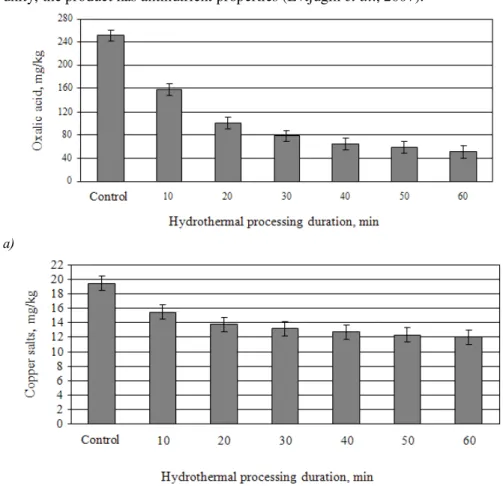
Peanut kernels together with seed coat were boiled in distilled water (ratio of peanuts:distilled water was 1:3). To evaluate the effectiveness of the proposed methods, changes in the contents of oxalic acid and copper salts after hydrothermal processing of samples were studied. Peanuts without hydrothermal processing were selected as a control sample. The results of the conducted experiment are presented in Figure 1.
consideration the ratio of oxalate / calcium (oxalate index). If it is greater than the unity, the product has antinutrient properties (Evtjugin et al., 2007).
а)
b)
Figure 1. Evolution of oxalic acid and oxalates (a) and of copper salts (b) during the hydrothermal processing
oxalate index of ≤1 was achieved in 30 min. But this duration of processing may not be enough to eliminate antinutrient impact for peanut varieties with high contents of oxalic acid and low contents of calcium. Therefore, rational duration of hydrothermal processing is 30...40 min, during which the content of oxalic acid and its salts is reduced by 67.2...76.0% and copper salts by 28.8...38.0%. Duration of hydrothermal processing over more than 40 min is inappropriate as it is energy-intensive and contributes to the loss of biologically active substances contained in peanuts.
One of the most important technological operations during peanuts products cooking is roasting. During this operation peanut seed coat is removed, favoring the improvement of the organoleptic indices and the decrease of the threat of microbial spoilage development.
We have selected roasting in the oven with air convection at a temperature of 120ºC. Such temperature of roasting is conditioned by the previous studies of the authors who determined that roasting at temperature of 120...145ºC contributes to the improvement of the hypoallergenic properties of peanuts, and, on the contrary, roasting at higher temperatures (150...170°C) increases the allergenicity of peanuts due to the course of Maillard reaction (Beyer et al., 2001; Vissers et al., 2011). Duration of peanuts roasting was controlled visually and according to the quantitative characteristics of samples color.
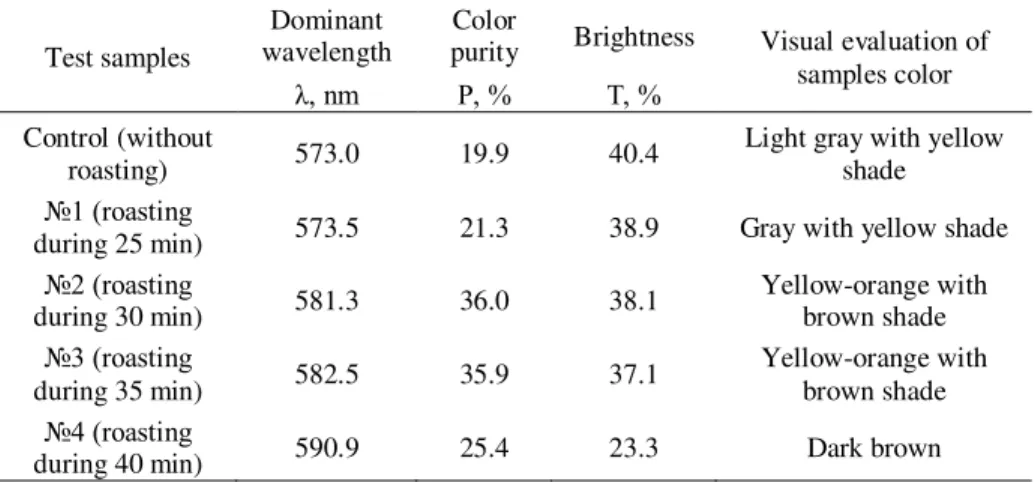
Color characteristics of test samples in CIE XYZ systems were determined with the help of firmware SFScan. The spectral tristimulus values x and y were obtained with the help of chromaticity diagram in the form of a unit area (x+y+z=1). The 3D color space allowed determining the following indicators: dominant tone (dominant
wavelength λ); color purity P, %; brightness T, % (Table 1).
During investigation of the impact of roasting duration on color parametric characteristics of peanut (Table 1) it was determined that "dominant wavelength", "color purity" and "brightness" parameters of the test sample, the roasting period of which is 25 min, does not affect significantly the change of color compared to the control sample (without roasting).
Increase in the period of processing up to 30...35 min is characterized by a shift of
the parameter (λ, nm) to the red spectrum region of 573.0 nm for control to 581.3
nm and 582.5 nm for samples №2 and №3 respectively, the color of which is visually
characterized as yellow-orange with brown shade.
Further increase in the period of processing leads to significant darkening of the
sample №4 that will adversely affect the color formation of the finished product.
were identified in samples №2 and №3 (roasting during 30 and 35 min): a pleasant flavor of roasted nuts was obtained.
Table 1. Effect of peanuts roasting on color parametric characteristics of peanuts
Test samples
Dominant wavelength
Color
purity Brightness Visual evaluation of samples color
λ, nm Р, % Т, %
Control (without
roasting) 573.0 19.9 40.4
Light gray with yellow shade
№1 (roasting
during 25 min) 573.5 21.3 38.9 Gray with yellow shade
№2 (roasting
during 30 min) 581.3 36.0 38.1
Yellow-orange with brown shade
№3 (roasting
during 35 min) 582.5 35.9 37.1
Yellow-orange with brown shade
№4 (roasting
during 40 min) 590.9 25.4 23.3 Dark brown
Thus, the data obtained allowed determining a rational mode of peanuts roasting – at a temperature of 120ºC during 30...35 min. This color parametric characteristics of roasted peanut kernels had the following meanings: dominant wavelength – 581.3...582.5 nm, color purity – 35.9...36.0%, brightness – 37.1...38.1%.
The impact of peanuts processing on protein digestibility
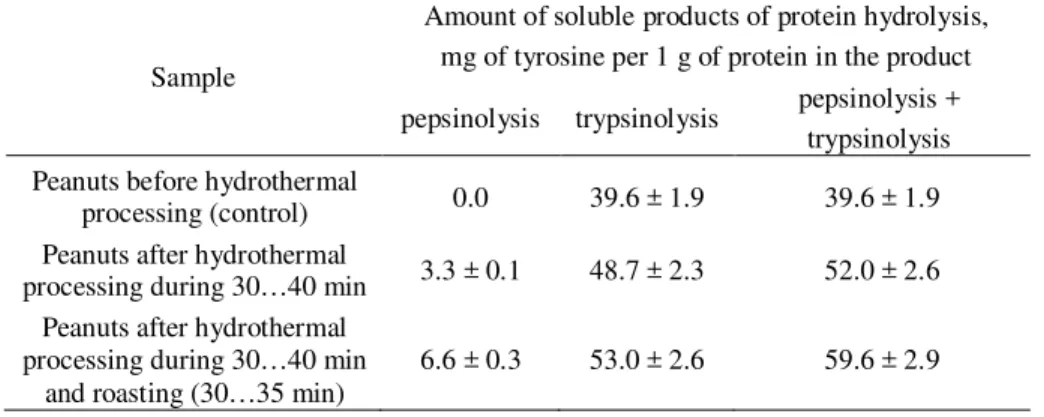
Thermal processing also improves significantly digestibility of peanut proteins by digestive enzymes due to inactivation of trypsin and chymotrypsin inhibitors. That is why we studied the impact of hydrothermal processing on digestibility of peanut proteins. The results of the research are presented in Table 2.
Digestibility of peanut protein that was subjected to hydrothermal processing during 30...40 min, increased by 12.4 mg of tyrosine, and during extra roasting for 30...35 min, increased by 20 mg of tyrosine per 1 g of protein (Table 2). All this proves the improvement of enzymatic hydrolysis of proteins and digestibility of nutrients.
Table 2. Digestibility of proteins in vitro of the control and test samples of peanuts
Sample
Amount of soluble products of protein hydrolysis, mg of tyrosine per 1 g of protein in the product
pepsinolysis trypsinolysis pepsinolysis + trypsinolysis Peanuts before hydrothermal
processing (control) 0.0 39.6 ± 1.9 39.6 ± 1.9 Peanuts after hydrothermal
processing during 30…40 min 3.3 ± 0.1 48.7 ± 2.3 52.0 ± 2.6 Peanuts after hydrothermal
processing during 30…40 min and roasting (30…35 min)
6.6 ± 0.3 53.0 ± 2.6 59.6 ± 2.9
Conclusions
In order to reduce the content of toxic and antinutrient substances, the method of thermal processing of peanuts with further roasting (hydrothermal processing during 30...40 min followed by roasting at a temperature of 120ºC during 30...35 min) was used. It was determined that this process favors the reduction of the content of oxalic acid and its salts by 67.2...76.0%, and copper salts by 28.8...38.0%, and the increase of protein digestibility by 20.0 mg of tyrosine per 1 g of protein. This results on peanuts processing encourage their use for obtaining high quality traditional products suitable to be used in healthy diets.
Acknowledgments
Conducting this research took place within the main areas of scientific research of the Kharkiv State University of Food Technology and Trade and it was approved by the Ministry of Education and Science of Ukraine, in particular, within the plan of scientific research of the Department of Commodity Science and Merchandise Expertise. It was partially financed within the frames of the economic-contractual
topic №23-13-14D (0113U006394).
References
Abbas, M., Khan, A. M., Asi, M. R., Akhtar, J. 2012. Pervasiveness of Aflatoxin in Peanuts Growing in the Area of Pothohar, Pakistan. World Academy of Science, Engineering and Technology, 69, 624–627.
Akkurt, İ., Günoğlu, K., Mavi, B., Kara, A. 2012. Natural radioactivity concentration of peanuts in Osmaniye-Turkey. American Institute of Physics, 1476(1), 245–248.
Angelova, V., Ivanov, K. 2006. Effect of chemical forms of lead, cadmium and zinc in polluted soils on their uptake by peanuts. Geophysical Research Abstracts, 8, 1509–1510.
Arya, S. S., Salve, A. R., Chauhan S. 2016. Peanuts as functional food: a review. Journal of Food Science and Technology. 53(1), 31–41.
Bakhiet, S. E. A., Musa, A. A. A. 2010. Survey and determination of aflatoxin levels in stored peanut in Sudan. Jordan Journal of Biological Sciences, 4(1), 13–20.
Barre, A., Borges, J., Culerrier, R., Rougé, P. 2005. Homology modelling of the major peanut allergen Ara h 2 and surface mapping of IgE-binding epitopes. Immunology Letters, 100(2), 153–158.
Beyer, K., Morrow, E., Li, X.-M., Bardina, L., Bannon, G. A., Burks, A. W., Sampson, H. A. 2001. Effects of cooking methods on peanut allergenicity. J Allergy Clin. Immunol.,
107(6), 1077–1081.
Blanc, F., Vissers, Y. M., Adel-Patient, K., Rigby, N. M., Mackie, A. R., Gunning, A. P., Wellner, N. K., Skov, P. S., Przybylski-Nicaise, L., Ballmer-Weber, B., Zuidmeer-Jongejan, L., Szépfalusi, Z., Ruinemans-Koerts, J., Jansen, A. P., Bernard, H., Wal, J. M., Savelkoul, H. F., Wichers, H. J., Mills, E. N. 2011. Boiling peanut Ara h 1 results in the formation of aggregates with reduced allergenicity. Molecular Nutrition and Food Research, 55(12), 1887–1894.
Burks, A. W., Shin, D., Cockrell, G., Stanley, J. S., Helm, R. M., Bannon, G. A. 1997. Mapping and mutational analysis of the IgE-binding epitopes on Ara h 1, a legume vicilin protein and a major allergen in peanut hypersensitivity. European Journal of Biochemistry, 245(2), 334–339.
Chai, W., Liebman M. 2005. Oxalate content of legumes, nuts, and grain-based flours.
Journal of Food Composition and Analysis, 18, 723–729.
Chernenok, L. I. 1993. The content of heavy metals in vegetables and methods of its reduction, Ph.D. dissertation, 128. Moscow.
Chicago Dietetic Association. 2000. Manual of Clinical Dietetics. 475. American Dietetic Association, Chicago.
Ching, J. A. 2008. Phytoremediation and Biomarker Potentials of Arachis hypogaea L. (Peanut) to Heavy Metals in Soils. Ph.D. dissertation, 149, Manila.
Ching, J. A. Binag, C. A., Alejandro, G. J. D. 2008. Uptake and distribution of some heavy metals in peanut (Arachis hypogaea L.) grown in artificially contaminated soils.
Philippine Agricultural Scientist, 91(2), 134–142.
Díaz, O. P., Leyton, I., Muñoz, O., Núñez N, Devesa V, Súñer, M. A., Vélez, D., Montoro, R. 2004. Contribution of water, bread, and vegetables (raw and cooked) to dietary intake of inorganic arsenic in a rural village of Northern Chile. J Agri Food Chem., 52(6), 1773– 1779.
Dubіnіna, A. A., Kolesnik, V. V., Kruglova, O. S., Olhovska, V. S. 2008. Reserarch of the oxalates content in botanical varieties of tomatoes realeased in the South Ukraine. In Innovative machinery and technology of food production enterprises of restaurant business and trade – Volume 2(8), Ed. Cherevko, O. I., 334–338. Kharkiv State University of Food Technology and Trade,Published in Kharkiv.
Dubіnіna, A. A., Lenert, S. O., Khomenko, O. O. 2012. Research of the general chemical
Dubіnіna, A. A., Lenert, S. O., Khomenko, O. O. 2013a. Accumulation of heavy metals in the varieties of peanuts prevailing in Ukraine, Products & Markets, 1, 87–93.
Dubіnіna, A. A., Lenert, S. O., Khomenko, O. O. 2013b. Research of oxalic acid content in
different varieties of peanuts prevailing in Ukraine. In Innovative machinery and technology of food production enterprises of restaurant business and trade. Economic strategy and perspectives for development of the trade and services sphere – Volume 1, Ed. Cherevko, O. I., 289–290. Kharkiv State University of Food Technology and Trade, Published in Kharkiv.
Dubіnіna, A. A. 2014. Scientific substantiation of the formation of consumer properties of
fortified pastes from fruits and vegetables, 395. Ph.D. dissertation, Kharkiv.
Embaby, H. E. 2011. Effect of Heat Treatments on Certain Antinutrients and in vitro Protein Digestibility of Peanut and Sesame Seeds. Food Sci. Technol. Res.,17(1), 31–38.
Evtjugin, G. A., Budnikov, G. K., Stojkova, E. E. 2007. Problems of human environment safety, 62. 2. V.I. Ulyanov-Lenin Kazan State University, Kazan.
Foreign Agricultural Service/USDA, Office of Global Analysis 2016. Available Online: apps.fas.usda.gov/psdonline/circulars/production.pdf.
Frolova, N. V. 2007. Ecological evaluatioin of nitrates and nitrites content in food products of vegetable and animal origin and methods of its reduction, 151. Ph.D. dissertation, Brjansk.
GOST 30178−96. 1997. Raw material and food-stuffs. Atomic absorption method for determination of toxic elements. Interstate Council for Standardization, Metrology and Certification, Minsk.
Hajeb, P., Sloth, J. J., Shakibazadeh, Sh., Mahyudin, N. A., Afsah-Hejri, L. 2014. Toxic Elements in Food: Occurrence, Binding, and Reduction Approaches. Comprehensive Reviews in Food Science and Food Safety, 13(4), 457–472.
Hasan, M. M., Cha, M., Bajpai, V. K., Baek, K.-H. 2012. Production of a major stilbene phytoalexin, resveratrol in peanut (Arachis hypogaea) and peanut products: a mini review. Reviews in Environmental Science and Biotechnology, 12(3), 209–221.
Jaworska, G. 2005. Nitrates, nitrites, аnd oxalates in products of spinach and New Zealand
spinach: Effect of technological measures and storage time on the level of nitrates, nitrites, and oxalates in frozen and canned products of spinach and New Zealand spinach.
Food Chemistry,93(3), 395–401.
Judprasong, K., Charoenkiakul, S., Sungpuag, P., Vasanachitt, K., Nakjamanong, Y. 2006. Total and soluble Oxalate Content in Thai Vegetables, Cereal Grains and Legume Seeds and their Changes after Cooking. Journal of Food Composition and Analysis, 19(4), 340−347.
Kamika, I. and Takoy, L. L. 2011. Natural occurrence of Aflatoxin B1 in peanut collected from Kinshasa, Democratic Republic of Congo. Food Control, 22(11), 1760–1764.
Kmiecik, W., Lisiewska, Z., Supski, J. 2004. Effects of freezing and storing of frozen products on the content of nitrates, nitrites, and oxalates in dill (Anethum graveolens L).
Food Chemistry,86(1), 105–111.
Kopper, R. A., Odum, N. J., Sen, M., Helm, R. M., Stanley, J. S., Burks, A. W. 2005. Peanut protein allergens: the effect of roasting on solubility and allergenicity. International Archives of Allergy and Immunology, 136(1), 16–22.
Kovalchuk, V. P., Vasylev, V. H., Boiko, L. V., Zosymov V. D. 2010. Collection of methods of soils and plants research, 52. Trud-HryPol-ХХI vik, Kyiv.
Kozlov, M. G., Tomskij, K. A. 2004. Light measurement, 320. St. Petersburg institute of press,St. Petersburg.
Lenert, S. O. 2010. Efficiency estimation of methods of white root crops pre-processing.
Eastern-European Journal of Enterprise Technologies, 6/10 (48), 19-23.
Lisiewska, Z., Gębczyński, P., Kmiecik, W., Skoczeń-Słupska, R. 2007. Effect of Vegetable Freezing and Preparation of Frozen Products for Consumption on the Content of Lead and Cadmium. Polish J. of Environ. Stud., 16(4), 579–585.
Lowry, O. H., Rosebrough, N. J., Farr, A. L., Randall, R. J. 1951. Protein measurement with Folin phenol reagent. Journalof Biological Chemistry,193(1), 265-275.
Maleki, S. J., Chung, S. Y., Champagne, E. T., Raufman, J. P. 2001. Allergic and biophysical properties of peanut proteins before and after roasting. Food Allergy Tolerance, 2(3), 211–221.
Moghaddam, A. E., Hillson, W. R., Noti, M., Gartlan, K. H., Johnson, S., Thomas, B., Artis, D., Sattentau, Q. J. 2014. Dry roasting enhances peanut-induced allergic sensitization across mucosal and cutaneous routes in mice. Journal of Allergy and Clinical Immunology, 134(6), 1453–1456.
Olhovska, V. S. 2009. Вдосконалення якості концентрованих томатопродуктів в процесі їх виробництва, 170. Ph.D. dissertation, Kharkiv.
Oliveira, C. A. F., Gonçalves, N. B., Rosim, R. E., Fernandes A. M. 2009. Determination of aflatoxins in peanut products in the northeast region of São Paulo, Brazil. International Journal of Molecular Sciences, 10, 174–183.
Park, J. W. 2006. Analysis of peanut and peanut butter retailed in Korea for aflatoxin B1.
Korean Journal of Food Science and Technology, 38(2), 309–312.
Pele, M. 2010. Peanut allergens: review. Romanian Biotechnological Letters, 15(2), 5204– 5212.
Perello, G., Marti-Cid, R., Liobet, J. M., Domingo, J. E. L. 2008. Effects of various cooking processes on the concentrations of arsenic, cadmium, mercury, and lead in foods. J Agric Food Chemistry, 56(23), 11262–11269.
Radjabi, R., Niyaki, S. A. N. 2010. Monitoring of Cd and Pb in local and imported peanut specimens of Iran market. Research Journal of Biological Sciences, 5(8), 517–520.
Rahbar, N., Nazari, Z. 2004. Level of lead and cadmium in peanut. KAUMSJ (FEYZ), 7(4), 71–77.
Salesa, J. M. and Resurreccion, A. V. 2014. Resveratrol in Peanuts. Food Science and Nutrition, 54(6), 734–770.
Sayers, R., Marsh, J., Semic-Jusufgic, A., Custovic, A., Simpson, A., Brown, H., Mills, E. 2015. The effect of thermal processing on the allergenic activity of peanuts. Clinical and Translational Allergy,5(3), 113.
Seljutіna, G. A. 2001. Merchandising estimation of rhubarb and gooseberry and pastes on
their basis, 142. Ph.D. dissertation, Kharkiv.
Shaporova, T. M. 2002. Forming consumer properties of pastes made from pumpkin and carrot, 154. Ph.D. dissertation, Kharkiv.
Shherbakov, V. G., Lobanov, V. G. 2003. Biochemestry and commodity science of oily raw material − 5th edition, revised and enlarged, 360. Kolos, Moscow.
Shreffler, W. G., Beyer, K., Chu, T. T.,Burks, A. W., Sampson, H. A. 2004. Microarray immunoassay: association of clinical history, in vitro IgE function, and heterogeneity of allergenic peanut epitopes. Journal of Allergy and Clinical Immunology, 113(4), 776– 782.
Stojanovska-Dimzoska, B., Hajrulai-Musliu, Z., Dimitrieska-Stojković, E., Uzunov, R., Sekulovski, P. 2013. Occurrence of aflatoxins in peanuts and peanut products determined by liquid chromatography with fluorescence detection. Journal of Natural Sciences, Matica Srpska Novi Sad, 124, 27–35.
Talcott, S. T., Duncan, C. E., Del Pozo-Insfran, D., Gorbet, D. W. 2005. Polyphenolic and antioxidant changes during storage of normal, mid, and high oleic acid peanuts. Food Chemistry, 89(1), 77–84.
Tinggi, U. 1998. Cadmium levels in peanut products. Food Additives and Contaminants, 15(7), 789–792.
Turner, P. J., Sayers, R., Wong, M., Shamji, M. H., Campbell, D. E., Mills E. N. 2014. Loss of allergenic proteins during boiling explains tolerance to boiled peanut in peanut allergy.
Journal of Allergy and Clinical Immunology, 134(3), 751–753.
Vissers, Y. M., Iwan, M., Adel-Patient, K., Stahl Skov, P, Rigby, N. M., Johnson, P. E., Mandrup Müller P., Przybylski-Nicaise, L., Schaap, M., Ruinemans-Koerts, J., Jansen, A. P., Mills, E. N., Savelkoul, H. F., Wichers, H. J. 2011a. Effect of roasting on the allergenicity of major peanut allergens Ara h 1 and Ara h 2/6: the necessity of degranulation assays. Clinical and Experimental Allergy, 41(11), 1631–1642.