AR
TICLE
1 Departamento de Enfermagem, Universidade Estadual da Paraíba. R. Manoel Alves de Oliveira 159, Catolé. 58410-575 Campina Grande PB Brasil. jamilly_aragao@
hotmail.com 2 Departamento de Enfermagem, Universidade Federal do Rio Grande do Norte. Natal RN Brasil.
Vulnerability associated with sexually transmitted infections
in physically disabled people
Abstract Objective: to analyze the conditions that enhance the dimensions of individual, so-cial and programmatic vulnerability associated with sexually transmitted infections in physically disabled people. Methods: this transversal study, with a quantitative approach, was conducted in 2015 in conjunction with an association for dis-abled people in Campina Grande, PB, Brazil. Ninety-eight individuals participated in the study and answered a questionnaire regarding the di-mensions of vulnerability in relation to sexually transmitted infections. The chi-square test, Fish-er’s test, contingency coefficient test and preva-lence ratio test were all performed. Results: an as-sociation was identified between the occurrence of sexually transmitted infections with the number of partners (p = 0.020); the belief that having few partners was a form of prevention (p = 0.044); the belief that poor hygiene was a risk factor; age (p = 0.007); the type of disability (p = 0.007); and hav-ing a consultation with a urologist (p = 0.030). Conclusion: physically disabled people have con-ditions that enhance their vulnerability to sexu-ally transmitted infections, which are linked to individual, social and programmatic dimensions. By characterizing the conditions of vulnerability it is possible to devise specific prevention linked to the reality of the social and health conditions of individuals.
Key words Disabled people, Sexuality, Sexually transmitted infections, Health vulnerability
Jamilly da Silva Aragão 1
Inacia Sátiro Xavier de França 1
Alexsandro Silva Coura 1
Carla Campos Muniz Medeiros 1
A
ragão JS
Introduction
Despite changes that have occurred in the epi-demiological profile worldwide, such as the rise of chronic non-communicable diseases (NCDs) and a decrease in infectious diseases, the latter still constitute a serious public health problem. In terms of sexually transmitted infections (STIs), it is known that the control of the incidence and prevalence of HIV/AIDS is still incomplete and initiatives for prevention and treatment have
only been partially successful1.
With respect to reducing the incidence of STIs, which still constitute a global epidemic, health practices are required which involve not only individual aspects but also actions that can influence the social, economic and cultural as-pects of individuals who are infected, those who have an infection and/or disease, and those who
are in vulnerable situations2
.
According to the World Health Organization (WHO), each year, 340 million people worldwide
are affected by some kind of STI3. Because of the
complications caused by STIs, and particularly because of the risk of facilitating the transmis-sion of HIV, increased attention is required re-garding prevention in order to avoid the develop-ment of new cases, or that existing cases become more acute. In order that levels of prevention can be effective it is necessary to know more about the vulnerable conditions that contribute to the
onset of diseases and other health problems4.
Vulnerability and risk can often be linked to notions of deprivation and exclusion. Some peo-ple, families and communities are vulnerable be-cause they lack the necessary resources to face the risks that are undergoing or the capacity to adopt actions and strategies that afford them an
appro-priate range of personal and collective safety5.
The concept of vulnerability refers to the susceptibility of an individual who is exposed to illness. It incorporates aspects of what are termed “dimensions of individual vulnerability”, which comprise the following: the biological and cog-nitive aspects of individuals; the attitudes of in-dividuals; social vulnerability, including social, cultural and economic factors; and programmat-ic vulnerability, whprogrammat-ich refers to the resources that are necessary for the protection and quality of life
of individuals6.
Disabled people constantly live in situations
that can expose them to increased vulnerability7.
According to the WHO, about one billion people worldwide have some kind of disability. These people face difficulties related to accessibility due
to inadequate buildings and transport without appropriate adaptations, which reflects attitudes that are rooted in prejudice and discrimination, as well as problems in terms of healthcare. Fail-ures to provide skilled care for this sector of the
community have been highlighted8.
In Brazil, 45.6 million have reported some form of disability; of this total there were 13,265,599 cases of physical disability. The state of Paraíba is second in the ranking of the num-ber of disabled people among the federal states in Brazil. Thus, this reflects a demand that needs
to be targeted by public health policies9. In terms
of data regarding physically disabled people with STIs it is known that in Brazil, 38% of women
and 35% of men have had some form of STI10.
Concerning the sexuality of physically dis-abled people, they usually suffer from social prejudices that consider they do not date, don’t have sex, do not marry, cannot have children and
that they are not raped11. This misrepresentation
about the sexuality of physically disabled people not only contributes to the discrimination pro-cess but also increases their vulnerability in
rela-tion to situarela-tions related to STIs12.
Studies have shown that physically disabled people face difficulties in accessing health ser-vices due to architectural problems, as well as dif-ficulties in using public transport, and the lack of materials and equipment to facilitate their par-ticipation in educational, professional, cultural
and social environments11,13. Furthermore, these
individuals frequently have a low income, poor education, and little professional training; conse-quently, most are unemployed, and all these fac-tors undermine their human and social
develop-ment, as well as increasing their vulnerability14,15.
The present study can help to contribute to preventing STIs in physically disabled people; by characterizing their vulnerability it is possible to trace a specific form of prevention that is linked to the reality of the social and health conditions of individuals. In addition, this study can help to define new actions and programs that can be developed to focus on the health of physically disabled people. This study can also help health professionals in terms of guidance regarding planning related to preventive actions and the quality of healthcare of these people. Moreover, in Brazil the issue of physically disabled people forms part of the National Agenda for Research Priorities in Health.
aúd
e C
ole
tiv
a,
21(10):3143-3152,
2016
dimensions of individual, social and program-matic vulnerability that are associated with sexu-ally transmitted infections in physicsexu-ally disabled people.
Method
This analytical study, with a transversal design and quantitative approach, took place from April 2014 to November 2015 under the auspices of the Borborema Association of Disabled People (AS-DECB) in Campina Grande, PB, Brazil.
The ASDECB was founded in 2003 and is a non-governmental, civil, non-profit organization with its own legal definition. It is intended to be a representative, campaigning, educational and so-cial organization. It has 335 members in the city of Campina Grande, who are of different ages and all of whom have some form of disability.
The study participants consisted of 130 peo-ple with physical disabilities, who were duly reg-istered and attending activities adminreg-istered by the ASDECB. To estimate the sample size, so that it should be representative of the aforementioned population, the following formula was used: n =
N. Z2. P(1-P) / (N-1). e2 + Z2. P(1-P), where: n =
sample value; N = population value; Z = confi-dence interval = 1.96; P = prevalence = 50%; e = tolerated error = 0.05. Thus, using a probabilistic sampling process with a simple random tech-nique to select participants, the sample consist-ed of 98 physically disablconsist-ed people. The people who participated in the study were aged 18-59, had a physical disability, and attended activities organized by the ASDECB. People were excluded from the study if they had another type of dis-ability that was not physical in nature.
The data was collected through an interview with a structured questionnaire. To collect the data for the questionnaire a home visit was con-ducted. The first contact was arranged through the ASDECB, who signed the institutional agree-ment term. After the participants were selected at random, a home visit was conducted in order to present the informed consent form and to ensure that the individual agreed to participate in the study. The form was duly completed.
The variables regarding the dimensions of vulnerability were in accordance with a study
by Ayres6 and were as follows: 1. Individual
di-mension of vulnerability - a) Cognitive - access to information; knowledge about risk factors; knowledge about attitudes regarding the preven-tion of STIs; thinking about the risk of
contract-ing an STI; b) Behavioral – history of drug use; history of sexual relations; age of onset of sexual relations; number of partners in life; frequency of condom use; blood transfusion; STI history;
sharing of intimate objects. 2. Social dimension
of vulnerability - age; gender; income; education; religion, marital status, type of work and type of
disability. 3. Programmatic dimension of
vulnera-bility - access to healthcare services; type of ser-vice used most frequently; frequency of medical appointments (gynecologist/urologist); guidance by health professionals guidance regarding the prevention of STIs.
The collected data were entered in an elec-tronic database and analyzed using the Statistical Package for Social Sciences (SPSS), version 22.0 for Windows, and then presented in tables. De-scriptive statistics were used for the analysis of the socio-demographic data, and the absolute and relative frequency, mean and standard
de-viation were calculated. The chi-square test (X2)
was used to verify the associations between the variables, except when the statistical requirement of no less than five cases was not met; in that case Fisher’s exact test was performed. The prevalence ratio and the respective confidence interval were calculated. The level of significance for the study was 5%.
To check the magnitude of the association be-tween the variables, the contingency coefficient
test was used with the following parameters: r ≥
0.750 = strong association; 0.500-0.749 =
mod-erate association; ≤ 0.499 = weak association)16.
All the criteria established by Resolution 466/2012 of the National Health Council were respected. Thus, the study participants were in-formed about the research and they signed an informed consent form that ensured their rights of privacy, confidentiality and the right to decline to participate in the study. The project was sub-mitted to the Research Ethics Committee (REC) of the State University of Paraíba (UEPB) and it was approved by CAAE.
Results
Socio-demographic profile
A
ragão JS
(59.2%). The largest percentage received welfare assistance (50%), which was mainly granted in respect of their acquired deficiency (83.7%). The
average age was 42.28 (± 9.25; Xmin = 20; Xmax =
59).
Variables
Gender Male Female Age
18 - 31 32 - 45 46 - 59 Religion
Catholic Evangelical Other Kardecist No religion Education
Illiterate
Did not complete primary education Completed primary education Did not complete secondary education Completed secondary education Did not complete higher education Completed higher education Married status
Single Married
Common-law marriage Divorced
Widower Renda per capita
< 1 minimum wage* 1 minimum wage 2-5 minimum wages Working
Yes No
Type of link/benefit State benefit
Registered employment Self-employed Retired
Temporary contract Type of disability
Congenital Acquired
n
57 41
15 44 39
61 32 3 1 1
4 37 7 16 26 4 4
43 30 12 11 2
16 70 12
40 58
45 30 9 4 1
16 82
Table 1. Socio-demographic aspects of physically
disabled people, Borborema Association of Disabled People (ASDECB), Campina Grande, PB, Brazil, 2015.
%
58.2 41.8
15.3 44.9 39.8
62.1 32.6 3.1 1.1 1.1
4.1 37.8 7.1 16.3 26.5 4.1 4.1
43.9 30.6 12.2 11.2 2.1
16.3 71.4 12.3
40.8 59.2
45.9 30.6 9.2 4.1 1.1
16.3 83.7
Source: research data. n = 98; * minimum wage = R$: 788.00 per month.
Frequency of sexual relations and STIs
Table 2 shows the data regarding sexual prac-tices, the occurrence of STIs and the type of dis-ease.
Associations with the individual dimension of vulnerability
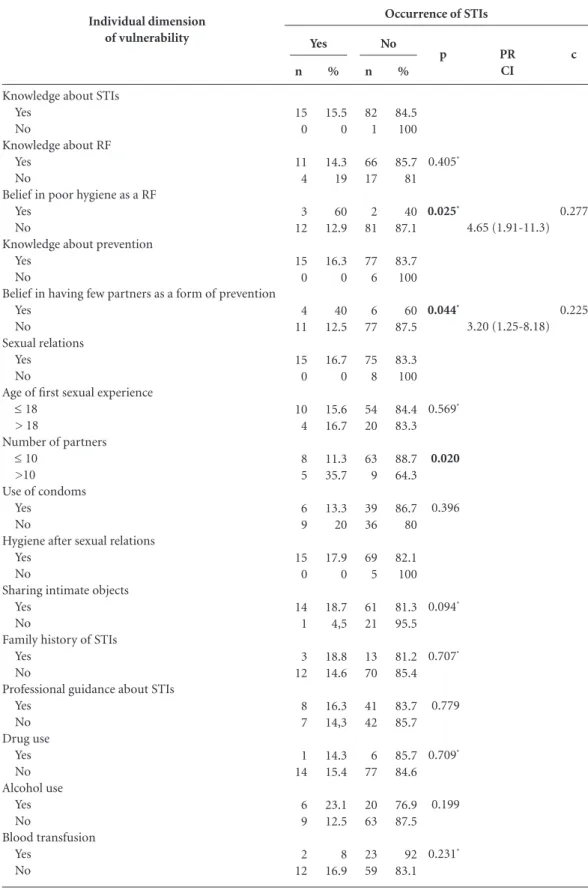
Table 3 shows the association between the occurrence of STIs with the number of sexual partners (p = 0.020), the belief that having few partners was a form of prevention (p = 0.044), and the belief that poor hygiene was a risk factor. A number less than 10 partners was set as a pro-tective factor.
Associations with the social dimension of vulnerability
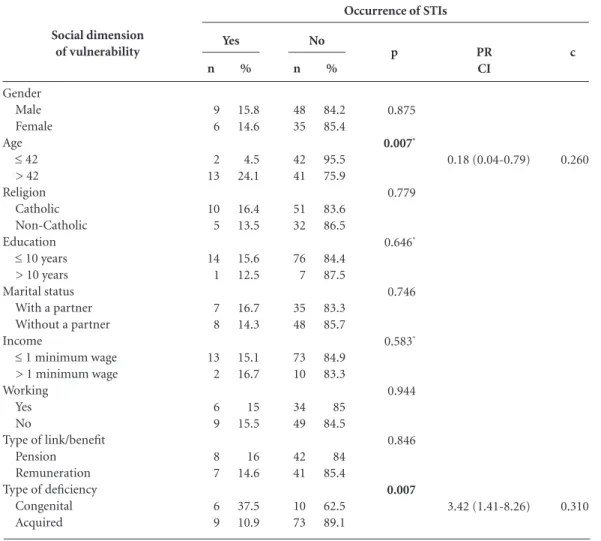
There were associations between the occur-rence of STIs and age (p = 0.007) as well as the type of deficiency (p = 0.007). Participants with a congenital deficiency were 3.42 times more likely to have had an STI compared to individuals who had acquired a disability during their lifetime (Table 4).
Associations with the programmatic dimension of vulnerability
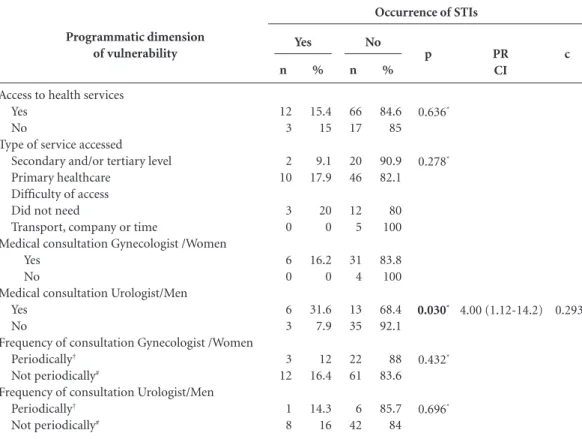
Table 5 shows that there was an association between the occurrence of STIs and having had a consultation with an urologist (p = 0.030).
Discussion
Research about socio-demographic aspects and the identification of most males aged 32-45 in Brazil diverges regarding physical disability be-cause the IBGE estimates indicate that the
major-ity are female and aged over 459. It is believed that
this fact is linked with the main objective of the ASDECB, which is the defense of social rights, especially in relation to labor, demonstrating that in Latin American societies, young adult males are, in general, still considered to be the financial breadwinner and the family member who is most
likely to work outside the home17
. The majority
of those seek to join this type of institution are young males.
par-aúd
e C
ole
tiv
a,
21(10):3143-3152,
2016
ticipants, which was conducted in the city of João Pessoa, PB, Brazil, found that 62.4% of partici-pants lived without a partner and 63.3% did not
complete primary school18. Another study, which
involved young men from all over Brazil, high-lighted the link between low levels of education and a lack of knowledge about STIs; it indicated the need for educational activities aimed at
re-ducing this situation of vulnerability19.
With regard to religious belief, the fact that most respondents in the present study reported that they attended some form of religious orga-nization was significant because values and be-liefs, including religion, form elements that can interfere with the perception of vulnerability to STIs, particularly in relation to the adoption of safe sex methods, such as the use of condoms, as well as values related to marriage and the number
of sexual partners20.
Concerning the occupational characteristics in relation to labor that were identified in the present study, it was noted that even though there exists legislation designed to ensure the right of inclusion of physically disabled people in the la-bor market, this social segment still does not enjoy equality of opportunity in this respect. There are still difficulties regarding the social inclusion of
physically disabled people in the labor market21.
Moreover, the challenge remains to ensure that,
in addition to entering the labor market, physical-ly disabled people have the correct conditions to perform their functions within their abilities and skills at their disposal. Therefore, it is important to emphasize that, over and beyond material and logistical factors, it is necessary to confront atti-tudes towards physically disabled people that are
shaped by prejudice and discrimination11.
The notable evidence of sexual relations identified in this study shows that it is important that there is a re-thinking of the erroneous no-tion in Brazilian society that assigns or restricts sexuality to merely able-bodied physical aspects. From this perspective, the myth that physically disabled people do not exercise their sexuali-ty generates a lack of information and this is a
conditional factor of vulnerability19 because the
degree of quality of information that individuals possess can increase or decrease their vulnerabili-ty to STIs, which can translate into unsatisfactory
practices or attitudes22.
According to Ayres, the conditions that en-hance the vulnerability of individuals are com-prised of a triad of behavior, consciousness and vulnerability; the degree of consciousness of the individual influences their behavior, which in
turn influences their vulnerability6
. In the
pres-ent study, this was evidenced by the associations between cognitive and behavioral characteristics and the occurrence of STIs. The belief that poor hygiene is a risk factor (which is correct) occurred more frequently in people who had had an STI, which indicates that individuals have received the relevant information but that their actions are not always consistent with their knowledge. A study that was conducted with physically disabled
people in the Brazilian state ofCeará, identified
their limitations in performing daily activities
such as taking care of personal hygiene23. Thus,
regarding people with some kind of physical dis-ability, a care plan is necessary to link the family to identify the most effective practices in terms of
assisting in the development of self-care24.
Another situation similar to that which was previously mentioned is the fact that in the pres-ent study, people who believed that having few sexual partners was a form of prevention had mainly had more than one sexual partner; factors that were associated with the occurrence of STIs. Since this was a transversal study, with no moni-toring of individuals, knowledge about the risk of multiple factors may have occurred subsequently. A study of young people with disabilities in Ethi-opia found high levels of sexual activity among young people with physical disabilities and risky
%
91.8 8.2
15.3 84.7
26.6 13.3 6.7 6.7 6.7 6.7 33.3
Frequency
Sexual Relations Present Absent STI
Yes No Type of STI
Gonorrhea HPV
Trichomoniasis Vaginal herpes Candidiasis Syphilis Unidentified
n
90 8
15 83
4 2 1 1 1 1 5
Table 2. Frequency of sexual relations and sexually
transmitted infections in physically disabled people. Borborema Association of Disabled People (ASDECB), Campina Grande, PB, Brazil, 2015.
A
ragão JS
Individual dimension of vulnerability
Knowledge about STIs Yes
No
Knowledge about RF Yes
No
Belief in poor hygiene as a RF Yes
No
Knowledge about prevention Yes
No
Belief in having few partners as a form of prevention Yes
No
Sexual relations Yes
No
Age of first sexual experience
≤ 18 > 18
Number of partners
≤ 10 >10 Use of condoms
Yes No
Hygiene after sexual relations Yes
No
Sharing intimate objects Yes
No
Family history of STIs Yes
No
Professional guidance about STIs Yes No Drug use Yes No Alcohol use Yes No Blood transfusion Yes No
Table 3. Associations between the individual dimension of vulnerability and the occurrence of STIs in physically
disabled people. Borborema Association of Disabled People (ASDECB), Campina Grande, PB, Brazil, 2015.
Source: research data; PR = prevalence ratio; CI = confidence interval (95%); c = contingency coefficient; RF = risk factor. *using Fisher’s exact test.
Occurrence of STIs
aúd
e C
ole
tiv
a,
21(10):3143-3152,
2016
sexual behavior; 59% of those who were sexually active had had multiple sexual partners during
their lives25.
A study that was performed in a service spe-cializing in infectious diseases in obstetrics and gynecology in the state of São Paulo, with 824 women with HPV, identified a greater likelihood of being seropositive, which was due to factors such as having multiple partners and prostitu-tion. Women who had five to 10 partners were more likely to have HIV compared to women who had five partners; those with more than 10 partners were 3,487 times more likely to have the
infection26.
In relation to the physically disabled people in the present study, the conditions that increase
social vulnerability, which are related to access to goods and services, such as housing, consumer goods and the freedom to express thought and
attitudes6
, were identified by the associations
be-tween social, economic and demographic factors and the occurrence of STIs. The results demon-strated an association between STIs and an age that was greater than or equal to 42, which cor-roborated a study of the socio-demographic pro-file of people with HIV/AIDS in an outpatient AIDS/STI control clinic, which found an average
age of 4327. However, it is important to note that
the highest proportion of physically disabled people who had an STI reported that they were under the age of 18 years at the time of their first sexual experience. Loving experiences in
adoles-Social dimension of vulnerability
Gender Male Female Age
≤ 42 > 42 Religion
Catholic Non-Catholic Education
≤ 10 years
> 10 years Marital status
With a partner Without a partner Income
≤ 1 minimum wage
> 1 minimum wage Working
Yes No
Type of link/benefit Pension Remuneration Type of deficiency
Congenital Acquired
Table 4. Associations between the social dimension of vulnerability and the occurrence of STIs in physically
disabled people. Borborema Association of Disabled People (ASDECB), Campina Grande, PB, Brazil, 2015.
Source: research data; PR = prevalence ratio; CI = confidence interval (95%); c = contingency coefficient; * using Fisher’s exact test.
Occurrence of STIs
Yes
n
9 6
2 13
10 5
14 1
7 8
13 2
6 9
8 7
6 9
%
15.8 14.6
4.5 24.1
16.4 13.5
15.6 12.5
16.7 14.3
15.1 16.7
15 15.5
16 14.6
37.5 10.9
No
n
48 35
42 41
51 32
76 7
35 48
73 10
34 49
42 41
10 73
%
84.2 85.4
95.5 75.9
83.6 86.5
84.4 87.5
83.3 85.7
84.9 83.3
85 84.5
84 85.4
62.5 89.1
p
0.875
0.007*
0.779
0.646*
0.746
0.583*
0.944
0.846
0.007
PR CI
0.18 (0.04-0.79)
3.42 (1.41-8.26)
c
0.260
A
ragão JS
cence are characterized by the early onset of sex-ual activity, as well as multiple sexsex-ual partners, which provide a greater chance of being affected
by infections and even unplanned pregnancies28.
The type of disability was also associated with the occurrence of STIs; the proportion of people with congenital physical disabilities who devel-oped a disease was greater than for those with an acquired disability. The existence of a physical disability results in an individual having reduced physical capacity and also having to face barri-ers imposed by society. Limitations and barribarri-ers, such as lack of access to transport, prejudice and the fear of other people can reduce the power to take decisions and result in individuals contact-ing the health services, as well as reportcontact-ing their
sex life, which makes them more vulnerable12,13-29.
An exploratory study that was conducted in São Paulo, SP, Brazil indicated that in addition to the architectural barriers that people with physical
disabilities face, specialized services are not able
to receive them29.
Ayres considers that the conditions that en-hance programmatic vulnerability are the way that the health system is organized, health pre-vention and protection actions, relationships with professionals, as well as the resources that
are available in the area of health6
. In the present
study, the results demonstrated an association between the variables of access to health services and the occurrence of STIs. The association that was identified between having more frequent consultations with an urologist and the occur-rence of STIs seems contradictory; however, it may be related to reverse causality, which is typ-ical of transversal studies. Moreover, many men only seek healthcare when they already have signs and symptoms of a disease, at the expense of health promotion and preventive practices. Oth-er factors that contribute to the lack of contact
Programmatic dimension of vulnerability
Access to health services Yes
No
Type of service accessed Secondary and/or tertiary level Primary healthcare
Difficulty of access Did not need
Transport, company or time
Medical consultation Gynecologist /Women Yes
No
Medical consultation Urologist/Men Yes
No
Frequency of consultation Gynecologist /Women
Periodically†
Not periodically#
Frequency of consultation Urologist/Men
Periodically†
Not periodically#
Table 5. Associations between the programmatic dimension of vulnerability and the occurrence of STIs in
physically disabled people Borborema Association of Disabled People (ASDECB), Campina Grande, PB, Brazil, 2015.
Source: research data; PR = prevalence ratio; CI = confidence interval (95%); c = contingency coefficient; *using Fisher’s exact test. † One or more consultation in the same year. # More than one year without a consultation.
Occurrence of STIs
Yes
n
12 3
2 10
3 0
6 0
6 3
3 12
1 8
%
15.4 15
9.1 17.9
20 0
16.2 0
31.6 7.9
12 16.4
14.3 16
No
n
66 17
20 46
12 5
31 4
13 35
22 61
6 42
%
84.6 85
90.9 82.1
80 100
83.8 100
68.4 92.1
88 83.6
85.7 84
p
0.636*
0.278*
0.030*
0.432*
0.696*
PR CI
4.00 (1.12-14.2)
c
aúd
e C
ole
tiv
a,
21(10):3143-3152,
2016
with health services are the difficulty individuals have in recognizing that they are sick and the fear
of discovery of some serious disease30.
People with physical disabilities face a lack of access to health services and rehabilitation due to the deprivation of material resources, which prevents them from obtaining the equipment to ensure greater autonomy, a lack of investment in their education and professional
habilitation/re-habilitation7. Even in this context, there were no
other associations in the group of programmatic vulnerability conditions; however, it is believed that with a sample containing a larger number of people who have had STIs that might occur, tak-ing into consideration the strong influence of so-cial determination on the health-disease process.
Conclusion
Physically disabled people have conditions that enhance their vulnerability to STIs which are linked to individual, social and programmatic di-mensions. The individual dimension is enhanced by the risk factor of having multiple partners. The more sexual partners an individual has, the greater their risk of exposure to STIs. The social dimension is enhanced by the factors of age and congenital disabilities. Older individuals and people with congenital disabilities showed lim-itations that may restrict their coping capacity in relation to vulnerability. The programmatic dimension is enhanced by specialized consulta-tions. Seeking health services only for the
pur-pose of treatment may affect the levels of preven-tion.
Conditions of vulnerability can be mini-mized in relation to the occurrence of STIs. This requires that health professionals and the health sector adopt specific preventative actions that are linked to the reality of the social and health conditions of physically disabled people, as well as advancing policies related to the social inclu-sion of physically disabled people, minimizing their difficulties, improving their participation and integrating them into families and society. Despite the limitations of this study it provided useful information, which can be tested by future research.
This study contributed to the programs and support networks that focus on the health of physically disabled people. Further research is required that emphasizes health promotion and prevention factors that are aimed at strategies de-signed to control and eradicate STIs in Brazil and worldwide. Furthermore, these data can be of use to health service managers and regional basic health units in determining priorities and atten-tion to the health of physically disabled people.
The limitations of this study were related to its sample size and the fact that it did not assess all conditions of vulnerability or the level of vul-nerability. The literature in this area is still hardly developed and it is suggested that future research addresses the vulnerability indices applied to physically disabled people, as well as longitudinal studies to understand the relationship between the different domains of vulnerability over time.
Collaborations
A
ragão JS
Holanda CMA, Andrade FLJP, Bezerra MA, Nascimen-to JPS, Neves RF, Alves SB, Ribeiro KSQS. Support net-works and people with physical disabilities: social in-clusion and access to health services. Cien Saude Colet 2015; 20(1):175-184.
Miranda AE, Ribeiro D, Rezende EF, Pereira GFM, Pin-to VM, Saraceni VA. Associação de conhecimenPin-to sobre DST e grau de escolaridade entre conscritos em alista-mento ao Exército Brasileiro. Brasil, 2007. Cien Saude Colet 2013; 18(2):489-497.
Hoga LAK, Tiburcio CA, Borges ALV, Zoboli ELCP, Chavez-Alvarez RE. Counseling Regarding Sexual and Reproductive Behavior: Principles and Practices of Catholic Priests. Rev. Latino-Am enfermagem 2010; 18(6):1237-1245.
Maia ACB, Ribeiro PRM. Desfazendo mitos para mini-mizar o preconceito sobre a sexualidade de pessoas com deficiências. Rev. bras. educ. espec. 2010; 16(2):159-176. Andrade SSC, Zaccara AAL, Leite KNS, Brito KKG, Soares MJG, Costa MML. Knowledge, attitude and practice of condom use by women of an impoverished urban area. Rev. Esc. Enferm. USP 2015; 49(3):364-372. Moura GN, Nascimento JC, Lima MA, Frota NM, Cris-tino VM, Caetano JA. Atividade de vida de pessoas com deficiência segundo modelo de enfermagem de Roper-Logan-Tierney. Rev. RENE. 2015; 16 (3):317-326. Vasconcelos AS, França ISX, Coura AS, Sousa FS, Souto RQ, Cartaxo HGO. Nursing interventions on the needs of people with spinal cord injury: an inte-grative review. Online Braz J Nurs [Internet]. 2010 [cited 2012 Sept 16];9(2). Available from: http:// www.objnursing.uff.br/index.php/nursing/article/ view/j.1676-285.2010.3000/674
Kassa TA, Priv-Doz TL, Birru SK, Riedel-Heller SG. Sexuality and Sexual Reproductive Health of Dis-abled Young People in Ethiopia. Sex Transm Dis 2014; 41(10):583-588.
Gaspar J, Quintana SM, Reis RK, Gir EL. Sociodemo-graphic and clinical factors of women with HPV and their association with HIV. Rev. latinoam. enferm. 2015; 23(1):74-81.
Bertoni RF, Bunn K, Silva J, Traebert J. Socioeconomic and demographic profile of patients with HIV/ aids of Ambulatory de DST/aids of São José, SC. ACM arq. ca-tarin. med. 2010; 39(4):75-79.
Cruzeiro ALS, Souza LDM, Silva RA, Pinheiro RT, Ro-cha CLA, Horta BL. Comportamento sexual de risco: fatores associados ao número de parceiros sexuais e ao uso de preservativo em adolescentes. Cien Saude Colet 2010; 15(Supl. 1):1149-1158.
Paula AR, Sodelli FG, Farias G, Gil M, Regen M, Me-resman S. Pessoas com deficiência: pesquisa sobre sexualidade e vulnerabilidade. Temas desenvolv 2010; 17(98):51-65.
Vieira KLD, Gomes VLO, Borba MR, Costa CFS. Aten-dimento da população masculina em unidade básica saúde da família: motivos para a (não) procura. Esc. Anna Nery Rev. Enferm. 2013; 17(1):120-127.
Article submitted 25/02/2016 Approved 19/07/2016
Final version submitted 21/07/2016 18.
19.
20.
21.
22.
23.
24.
25.
26.
27.
28.
29.
30. References
Barreto ML, Teixeira MG, Bastos FI, Ximenes RAA, Barata RB, Rodrigues LC. Sucessos e fracassos no con-trole de doenças infecciosas no Brasil: o contexto social e ambiental, políticas, intervenções e necessidades de pesquisa. Saúde no Brasil 2011; 3:47-60.
Brasil. Ministério da Saúde (MS). Brasil reafirma com-promisso pelo fim de epidemias até 2030. Brasília: MS; 2015.
World Health Organization (WHO). Global Strategy for the Preventions and Control of Sexually Transmitted Infections: 2006-2015. Genebra: WHO; 2007.
Guanilo MCTU, Takahashi RF, Bertolozzi MR. Assess-ing the vulnerability of women to sexually transmitted diseases STDS/ HIV: construction and validation of markers. Rev Esc Enferm USP 2014; 48(spe):152-159. Carneiro CBL, Veiga L. O conceito de inclusão, dimen-sões e indicadores. Belo Horizonte: Secretaria Municipal de Coordenação da Política Social (Pensar BH/Política Social, 2); 2004.
Ayres J, Calazans GJ, Saletti Filho HC, França Jr I. Ris-co, vulnerabilidade e práticas de prevenção e promoção da saúde. In: Campos G, Minayo MCS, Akerman M, Drumond Jr M, Carvalho YM, organizadores. Tratado de Saúde Coletiva. São Paulo: Editora Fiocruz; 2006. p. 375-417.
Nicolau SM, Schraiber LB, Ayres JRCM. Mulheres com deficiência e sua dupla vulnerabilidade: contribuições para a construção da integralidade em saúde. Cien Saude Colet 2013; 18(3):863-872.
World Health Organization (WHO). Desability and Health. Genebra: WHO; 2011.
Brasil. Secretaria de Direitos Humanos da Presidência da República (SDH-PR), Secretaria Nacional de Pro-moção dos Direitos da Pessoa com Deficiência (SNPD). Cartilha do Censo 2010. Brasília: SDH-PR/SNPD; 2012. Brasil. Ministério da Saúde (MS). Pessoas com Deficiên-cia e DST/aids. Brasília: MS; 2012.
Ferreira WB. Vulnerabilidade à Violência Sexual no Contexto da escola Inclusiva: Reflexão sobre a Invisi-bilidade da Pessoa com Deficiência. Revista Iberoame-ricana sobre Calidad, Eficacia y Cambio en Educación 2008; 6(2):120-136.
França ISX, Pagluica LMF, França EG, Coura AS, Souza JA. Violência simbólica no acesso das pessoas com de-ficiência às unidades básicas de saúde. Rev Bras Enferm 2010; 63(6):964-970.
Castro SS, Lefèvre F, Lefèvre AMC, Cesar CLG. Accessi-bility to health services by persons with disabilities. Rev Saude Publica 2011; 45(1):99-105.
França ISX, Pagliuca LMF. Social inclusion of disable people: achievements, challenges and implications for the nursing area. Rev Esc Enferm USP 2009; 43(1):178-185.
Coura AS, França ISX, Enders BC, Barbosa ML, Sou-za JRS. Functional disability of adult individuals with spinal cord injury and its association with socio-de-mographic characteristics. Rev Latino-Am Enfermagem 2012; 20(1):84-92.
Field A. Descobrindo a Estatística usando o SPSS. 2ª ed. Porto Alegre: Artmed; 2009.
Pedrero Nieto M. Uso del tiempo e inequidades de gé-nero. Algunas evidencias en tres países latinoamerica-nos. Acta colomb. Psicol 2013; 16(2):55-62.
1.
2.
3.
4.
5.
6.
7.
8. 9.
10. 11.
12.
13.
14.
15.