AR
TICLE
1 Instituto de Saúde
Coletiva, Universidade Federal da Bahia. R. Basílio da Gama s/n, Canela. 40110-040 - Salvador, BA - Brasil. [email protected]
Intersectorality in the ‘Health in Schools’ Program: an evaluation
of the political-management process and working practices
Abstract This study analyzed inter-sectoral ac-tivities between the health and education sectors in implementing the Health in Schools program in a city within a metropolitan region in north-east Brazil. Analysis of the political-management process looked at the following dimensions: profes-sional practices and subject understanding of in-tersectorality. The results show that subjects define intersectorality as partnership and joint efforts. Regarding decision making and resource mobili-zation, during program implementation we no-ticed that healthcare leads, and education tends to play a more peripheral role. Health activities in the schools use a biomedical approach and pri-marily consist of lectures. We believe that the pro-gram strengthened the relationship between these two sectors. However, intersectoral coordination in the political-management process and practices show weaknesses and limitations.
Key words Intersectorality, Health in schools,
Program implementation Marta Caires de Sousa 1
Monique Azevedo Esperidião 1
Sousa MC Introduction
Intersectorality has been defended as an initiative in opposition to the fragmentation of social pol-icies, and essential for overcoming the iniquities in health and to improve the quality of life of the population, especially in countries with low to medium per capita income1.
Discussions around its meanings and scope are vast and simultaneously generic. Among the various concepts of intersectorality, there is a de-gree of convergence that may be understood as the coordination of different sectors and players, and shared power and knowledge in order to take integrated action on problems and demands, aiming to improve quality of life2,3.
The international debate on intersectorality in the field of healthcare has stressed interven-tions on the social determinants of health4-6, and creating partnerships and alliances for imple-mentation7,8. They also point out that local inter-ventions are more likely to produce sustainable and satisfactory results9,10.
In Brazil, intersectorality is valued in numer-ous public policies, such as those regarding Edu-cation, Healthcare and Social Services. In Educa-tion, intersectorality is associated with the con-cept of partnerships and collaboration between government institutions, NGOs and society as an alternative to improve education11
. In Health-care, it is a considered a fundamental element for changing the care model and reorganizing the system12, and is mentioned in numerous works in Health Promotion as a strategy for action that impacts the social determinants of health3,12. The partnership between the health and education sectors has existed since the beginning of the 20th Century, particularly in relation to the im-plementation of healthcare programs for school pupils13,14. Studies show that these policies and actions have revealed numerous weaknesses and challenges when it comes to implementing inter-sectoral actions, such as uneven sector commit-ment, fragmented actions and a predominance of sector and biomedical approaches15-17. Prom-ising experiences such as the Health Promotion Schools18 have introduced new approaches, pri-oritizing health promotion and intersectorali-ty. However, in practice progress was timid and fraught by the inability to create integrating ac-tions14.
In 2007, the HSP (Health in Schools Program) was created19 as a strategy for permanent integra-tion and coordinaintegra-tion between healthcare and
education policies. The goal is to expand health-care actions focused on public school students, articulating the public primary care and educa-tion networks, and contributing to comprehen-sive student education, with health prevention, promotion and care activities. In addition to ed-ucation and health, the HSP calls for the involve-ment of other sectors and players, depending on the organization in each territory. Comprehen-siveness, territoriality and intersectorality are the underlying principles for this Program.
Few cities in Brazil subscribed to the program in its initial phases. At the time, city eligibility cri-teria were 100% coverage by the Family Health Strategy (FHS), and low IDEB (Basic Education Development Index) (2.69), or include schools that participate in the Mais Educação (More Ed-ucation) program.
In Bahia, 65 (63%) of the cities meeting the criteria subscribed to the program. In 2011, the program was expanded and the criteria changed; FHS coverage was lowered to 70%, and the IDEB increased to 3.1. Consequently, the number of cities in the program increased from 65 to 282. Later, in 2013, all eligibility criteria were elimi-nated and all cities became eligible20. Further-more, day-care and pre-school were included, and tracking indicators and performance targets were set. Currently 297 (05%) of the cities in the program are enrolled in the HSP21.
It is worth mentioning the HSP is the main program focused on healthcare for students en-rolled in public schools. Given that in 2015 85% of all primary students in Brazil were enrolled in public schools22, its importance and potential reach are evident.
Studies about the HSP are still scant, with only a handful published14,23-25, three of them discussing intersectoral management23-25. Results show possible difficulties to implement the Pro-gram, and diverse concepts of intersectorality among local managers making up the working groups23,24, and the predominance of Healthcare in the decisions23, 24 and definition of rules and standards25. It is also worth pointing out that none of the studies looked at coordination be-tween healthcare and education practices.
aúd
e C
ole
tiv
a,
22(6):1781-1790,
2017
Methodological strategy
This an evaluation study conducted in a city in a metropolitan region in Brazil’s northeast, which successfully (according to key references in state management) adopted the HSP in 2008.
To understand the political-management, this study is anchored on the contributions of Teixei-ra26 and Junqueira2 regarding decision-making and resource mobilization. Decision-making here is understood as the process consisting of making a shared choice based on different looks, knowledge and experience2,26. Resource mobi-lization involves a set of planned activities and financial, material, institutional and people re-sources2,26.
To understand the practices we used, as the theoretical basis, the contributions of Mendes-Gonçalves27 on the working process for health-care and the elements it consists of: a) the sub-ject - the agent performing interventions on the object and interacting with other subjects; b) the object, or the target of a given activity; c) the in-strument: material and non-material technology used for the intervention on the object; d) the activity, or the work itself; c) technical and social relationships, the relationships between agents and their activity on the object.
In this study, we adopted the concept of in-tersectorality as the coordination of different sec-tors, players and knowledge regarding planning, performance and assessment of measures to act on problems and demands in an integrated man-ner, searching for improved quality of life2,3.
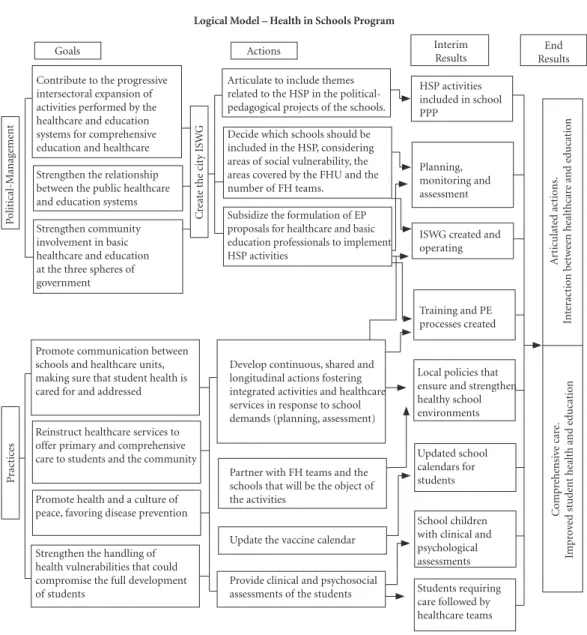
We designed a logical program for the Health in Schools Program, listing the goals, actions and results expected (Figure 1), based on its policy framework19,28 .
We considered two components for the logical model. The first is related to the polit-ical-management process, where intersectoral coordination is a program innovation, strength-ening local healthcare and education networks. The Intersectoral Working Group (ISWG) is an essential component of the healthcare-education coordination process. Integrated measures, train-ing and the inclusion of HSP in the political ped-agogical projects of the schools are the expected outcome, with a view to network coordination and interaction.
The second component is related to practices, and here we find coordinated healthcare activity and addressing vulnerabilities. Among the activ-ities included, we point to clinical assessments, updating the vaccine calendar and defining
inte-grated measures as per the needs found in each area to provide comprehensive care and improve the indicators related to health and education.
Study data was produced from document analysis, systematic observations and semi-struc-tured interviews with city education and health secretaries, members of the municipal ISWG, professionals from three public schools (two city and one state), and professionals from two Pri-mary Family Care Units. In all, 23 subjects partic-ipated in this study, five of them managers from the two city departments, and 18 employees of the schools and healthcare units.
For the analysis of the political-management we considered indicative criteria, such as:
a) Decision making processes: which deci-sions are made, how they are made and by whom; how planning, monitoring and assessment are carried out; sector representation on the ISWG and its responsibilities.
b) Resource mobilization: how financial and material resources are appropriated and allocat-ed to the program, and how other sectors are mo-bilized and involved.
The following criteria were used to analyze the practices:
a) Subjects: FHU and school professionals, students, parents and the community.
b) Objects: the diseases, risks and social determinants of health.
c) Activities: activities to promote health, prevention and care.
d) Instruments: coordination between the different areas of technical, scientific and meth-odological knowledge; development of strategies and materials used to perform the activities.
a) Technical and social relationships: co-ordination between FHU professionals and the schools in planning, scheduling and performing activities; relationships of power and conflicts revealed.
The information obtained from data analy-sis, interviews and observations was triangulated and analyzed. This study was approved by the ethics committee of the Institute for Collective Health, Universidade Federal da Bahia, Opinion Number 391,683.
Results and discussion
Concepts of intersectorality
Sousa MC
(all under the age of 50) and predominantly fe-male. Almost all had university degrees.
When asked about their understanding of intersectorality, the interviewees did not have a structured or accurate definition, but all shared the concept that it involves joint effort. The term intersectorality is clearly more widely under-stood among those in healthcare. Among those in education the term is considered to be slight-ly strange, but is associated with the concept of partnership.
Among the documents analyzed, such as the City Healthcare Plan, the Political-Pedagogical Projects of the Schools, and the Management Re-ports, we find that the concept of intersectorality is also not clear. Documents from the education sector make no mention to the expression, howev-er they do stress partnhowev-erships. We believe that these documents state the importance of joint action and the need for collaborative efforts, although without any conceptual definition of intersectoral-ity and how it should be made operational.
Figure 1. Logical Model – Health in Schools Program.
Source: Study data. Prepared by the authors from the Decree19 and the instruction 201328. Logical Model – Health in Schools Program
Goals Actions Interim
Results
End Results Contribute to the progressive
intersectoral expansion of activities performed by the healthcare and education systems for comprehensive education and healthcare Strengthen the relationship between the public healthcare and education systems Strengthen community involvement in basic healthcare and education at the three spheres of government P olit ical-M anag eme nt C reat
e the cit
y ISW
G
Articulate to include themes related to the HSP in the political-pedagogical projects of the schools. Decide which schools should be included in the HSP, considering areas of social vulnerability, the areas covered by the FHU and the number of FH teams.
Subsidize the formulation of EP proposals for healthcare and basic education professionals to implement
HSP activities Articulat
ed a ct io ns. Int er ac tio n b etw ee n healthcar
e and e
d
ucat
io
n
HSP activities included in school PPP
Planning, monitoring and assessment
ISWG created and operating
Training and PE processes created C o mp re he nsi ve car e. Imp ro ve d st ud
ent health and e
d ucat io n P ra ct ic es
Promote communication between schools and healthcare units, making sure that student health is cared for and addressed
Reinstruct healthcare services to offer primary and comprehensive care to students and the community
Promote health and a culture of peace, favoring disease prevention
Strengthen the handling of health vulnerabilities that could compromise the full development of students
Develop continuous, shared and longitudinal actions fostering integrated activities and healthcare services in response to school demands (planning, assessment)
Partner with FH teams and the schools that will be the object of the activities
Update the vaccine calendar
Provide clinical and psychosocial assessments of the students
aúd
e C
ole
tiv
a,
22(6):1781-1790,
2017
An understanding that intersectorality means joint effort was uniform across all managers and workers, with no significant differences based on years of schooling. The interviewees point to a need for more/closer partnerships among institutions, given the complexity of the social problems and also as a means to optimize the outcome.
In today’s context, especially in education, it is impossible to work without partnerships as we fully need one another. We cannot work without information about health, and health cannot work without information about education and public
safety. [...] In these turbulent and violent times,
without this support and orientation, this approx-imation, there can be no prevention, thus joint
ac-tion is important. (Education Manager)
Among the various reports one finds an un-derstanding, especially among the education professionals, that it is important to involve the
family and community in these partnerships. “Partnerships with the family and community” are considered important to improve the inter-sectoral activities of the HSP program. These partnerships may overcome numerous challeng-es, such as bringing schools closer to the com-munities they are part of29. When considering family and community involvement as import-ant dimensions of intersectoral policies, one should give more visibility to the factors that place health at risk, while at the same time devel-oping joint strategies to overcome the problems and adversities identified and experienced by the community within and outside the schools.
Interviewee concepts approximate the con-cept of intersectorality adopted in this study when they mention “joint efforts”, “collaborative” and “partnerships” among the institutions and the different subjects. However, shared power, di-alog, horizontal decisions and integrated actions
Chart 1. Profile of the interviewees working in the Health in Schools Program.
Int
er
vie
w
ees:
P
olit
ical-manag
eme
nt P
ro
ces and P
ro
cesses
Identification Age Gender Years of
schooling
Sector Position Time in
position (years)
Employment bond
E1 41 F UG Education Secretary < 1 CP
E2 33 F UG Health Secretary 02 CP
E3 34 F UG Education HSP Coordinator (ISWG) 02 CP
E4 31 M UG Health HSP Coordinator (ISWG) 03 CP
E5 23 F UG Health AB Coordinator (ISWG) <1 CP
E6 35 M UG Education Teacher (ISWG) 01 Statutory
E7 30 F UG Health Dentist 04 TSA
E8 30 F UG Health Physician 05 TSA
E9 47 F UG Health Nurse 08 TSA
E10 39 F SC Health ACS 03 Statutory
E11 27 F UG Health Dentist 02 TSA
E12 38 F UG Health Nurse 03 TSA
E13 29 M UG Health Physician 04 TSA
E14 34 F SC Health Nursing Technician 10 TSA
E15 31 M UG Education Vice-Principal 02 CP
E16 49 F UG Education Pedagogical Coordinator 01 Statutory
E17 32 F UG Education Teacher 02 Statutory
E18 32 F UG Education Principal 03 CP
E19 44 M UG Education Teacher 10 Statutory
E20 40 F UG Education Teacher 12 Statutory
E21 28 F UG Education Principal 01 CP
E22 47 F UG Education Pedagogical Coordinator 03 Statutory
E23 48 F SC Education Teacher 04 TSA
Legend: M = Male; F = Female; UG = University Graduate; SS = Secondary School; ISWG = Intersectoral Working Group; HSP = Health in Schools Program; PC = Primary Care; CP = Commissioned position; TSA = Temporary Service Agreement.
Sousa MC do not emerge as the dimensions of intersectoral
practices. The absence of these issues in how they view intersectorality may factor sector and hier-archical practices, compromising collective deci-sions and the effectiveness of actions. Silva30 as-sumes that one of the challenges in making inter-sectorality operational is precisely the separation of institutional hierarchies and the relationships of power among different sectors and profession-al segments.
According to Akerman et al.31, intersectorality is a polysemic theme, which creates problems for electing it as a research and assessment category. This polysemic nature makes the definition un-clear, both from a theoretical point of view and for those players responsible for the management of intersectoral actions.
Intersectoral political-management processes
In this study we found that, although there was an ISWG, its activities were informal as there was no directive to create it or appoint its mem-bers. The WG had no formal planning processes, nor any formal monitoring or assessment pro-cedures. Monitoring consisted merely of com-pleting the information systems: the Ministry of Health e-SUS and the Ministry of Education SIMEC (Integrated Monitoring and Control Sys-tem); systematic information was not used for making program decisions.
Vilasbôas and Paim32 point out that planning may be understood as one way to instruct human activities, focused on achieving a certain purpose, constituting a social action. According to these same authors, planning practices are considered structured when they use formal procedures and situation analyses based on the consistency, suf-ficiency and feasibility of the proposals, while informal planning is considered non-structured as it lacks any defined methodological structure. Given these prerogatives, ISWG planning is in-formal, and thus not structured.
Analysis of the ISWG revealed that it was not responsible for managing HSP financial resourc-es. Funding for the Program was limited to the funds provided by the MoH minimum amount provided for variable basic care, which the man-agers consider insufficient. According to those we spoke to, the city did not receive any of the clinical or educational materials provided by the MoEd. The lack of financial and material re-sources makes it hard to undertake some of the program activities.
Regarding participation in the ISWG, only the Departments of Health and Education par-ticipate, each one with three representatives. There is no evidence of any strategy to involve other management representatives in the HSP program. The vision of the interviewees differed regarding the importance of organized involve-ment of civil society, but converged around the need for involvement of representatives of the Department of Social Services.
Social mobilization, integration across insti-tutions and community involvement in decisions are all elements that strengthen intersectoral ac-tiviteis5,8,10,33. However, even though these con-cepts permeate the opinions of some members, we found no action that contemplated these ele-ments. It is worth pointing out that the program’s logical model includes community involvement in the ISWG.
In decision processes, immediate program actions such as creating a calendar of activities, defining the themes to address and feeding the information systems are the responsibility of the HSP coordinators in the different city depart-ments. More complex and political decisions, such as managing the allocation of financial re-sources, appointments to participate in external events, the make-up of the ISWG, selection of the healthcare and school units that will participate in the Program are the responsibility of city sec-retaries of education and health. According to the interviewees, other decisions are made collective-ly by the ISWG, as per the following report.
There is an ISWG, made up of representatives from both departments. HSP activities are ad-dressed by the group. We decide what to work on
based on needs [...] we decide what to do with the
teachers and unit professionals. The decision is al-ways joint, we talk about what is needed and set the
priorities. (Healthcare Manager)
There are indications that decisions are cen-tralized by the health sector. For example, one of the managers said that “financial resources are entered into the healthcare account, so this area as more of a focus on what needs to be done”, and “mobilization is greater in health”.
re-aúd
e C
ole
tiv
a,
22(6):1781-1790,
2017
quiring actions that extrapolate this sector. The greater involvement of a given sector in an inter-sectoral program may lead to that program ac-quiring sector character. Furthermore, increased responsibility of the health area for leading HSP activities may be an indication that there is al-ready a biased and fragmented view of healthcare practices in schools.
Program operation
In terms the Program’s practical activities, results show that by and large, these were formu-lated and performed by healthcare subjects, with the target public (subjects) being the students, sometimes involving parents or guardians.
School professionals were only occasionally involved in these activities, and even then, their role was limited to helping with the activities per-formed by the health teams. We find that, even though unstructured, FHU professionals orga-nized themselves to deliver the activities proposed by the Program, as revealed in the interviews.
Every year we schedule our dates so as not to interfere in the student’s school year. We always vis-it the school as vis-it’s quvis-ite close, and instruct them about oral health and brushing. There is a date for every school. We go there, hand out tooth brushes, apply fluoride and now we are doing even more. I go to every classroom and evaluate the children’s
oral health, encouraging them to keep it healthy.
(Dentist)
There was no formal mention of the HSP pro-gram in the school political-pedagogical projects. Thus, we understand that the Program was not part of the pedagogical actions of the different school units. Most of the Program activities fol-lowed a theme calendar prepared by the ISWG. Analysis of the themes in the calendar and activ-ity reports provided by the FHU show that most of these focused on disease intervention, with lectures on “scabies”, “pediculosis”, “STDs”, “obe-sity” and “violence”. We also found themes such as “oral health”, “healthy nutrition” and “exercise”.
Mendes-Gonçalves27, looking at the object of one of the elements of the working process, states that achieving this object consists of iden-tifying the characteristics that enable visualizing the end product. The object is a “biased look that discriminates the potential of the product”. In the analysis, the activities performed by the different school units focused on disease prevention and identification, organized in the form of clinical evaluations and lectures. The following tran-script shows the focus:
The focus of the HSP program is disease pre-vention, we talk to the students and implement nu-merous health assessment and education measures
[...]. The HSP is a ready-to-go program, but even so, if we have to focus on a given activity that is part of our reality we do that. The student here present with numerous diseases, from the common cold to
serious diseases. (Nurse)
In adopting disease rather than health as the main object of the activities, the HSP is unable to overcome the challenges of innovating healthcare practices focused on school-age children.
Even though the healthcare and school units in this study were located in different territories, with differing epidemiological and social condi-tions as stated by the managers and shown in the observations, we found no differentiation of ac-tivities to fight problems and inequalities accord-ing to the local demands of each territory.
These findings suggest that the profession-als were not using epidemiological knowledge as a tool to identify risk and propose interven-tions. Paim36 points out that by reducing health-care needs to health problems, epidemiological knowledge rather than clinical knowledge would be the more consistent way to act on the object.
In short, instruments such as health and edu-cation indicators were not used to plan activities, and educational resources were limited to leaflets and posters on disease prevention. Lectures were the methodology of choice.
HSP actions were prioritized by the city schools. At the state schools, measures were spo-radic and what caught our attention was the lim-ited involvement of school teams, at the teach-er or management level. Thteach-ere was no evidence of active involvement in any coordination and/ or mobilization measure. We also found that, at times, school management suggested that the healthcare team “take” some sort of action, when we would have expected this to be taken jointly, showing that the education professionals have distanced themselves from co-responsibility for the Program. We see that “healthcare goes to the school”, rather than “the schools promote health”.
Sousa MC Thus, an analysis of the knowledge involved
in HSP activities showed a predominance of knowledge from the healthcare sector. This is concentrated on learnings transferred to the students, and the means chosen to mediate this knowledge. When activities are carried out in the schools, knowledge is not built, problematized or reflexive. Teachers have limited involvement and often merely reproduce the teachings and instructions received from the healthcare system. This section illustrates this:
The (healthcare) team talks to the students bout healthy nutrition, lice and other diseases, they update vaccination cards, they are always around here doing something, providing support and
in-formation [...] however, in my view, this support
could be more constant. Perhaps the issue is the size of the community and the small number and
lim-ited availability of physicians [...] when they come
the children welcome them. (Teacher)
I spoke to the principal about what we really needed to talk to students and teachers about. She asked us to prepare a plan, to address sexuality and
based on that we organized the activity [...] we took
some gifts to encourage student engagement. If we
don’t do that, nothing happens. (Nurse)
Given the reports and observations we find that healthcare practices in the schools still have a strong preventive, fragmented and biomedi-cal bias. They focus on clinibiomedi-cal assessments and lectures on disease prevention. However, based on our observations, we infer that students have multiple healthcare needs, and that HSP mea-sures, even if not very transforming, contribut-ed to better health and consequently contribut-education. This is confirmed in the following statement by a school manager:
Here at the school we have a high prevalence of STD. Pregnancies and abortions are a constant, and sometimes school is the only place these
stu-dents are free to talk about these topics [...] for one
reason or another they don’t even discuss them with their parents, so activities in the school like
lectures and tests help a lot. (Principal)
The HSP program is important for health promotion activities, according to the directive that created it and the reference documents, it was conceived as a health public policy19,28,29. However, this study revealed few health promo-tion activities. According to the program’s logical model, comprehensive care is one of the out-comes expected, and even though (healthcare) professionals claim it is of the utmost impor-tance, it is still incipient and under construction.
The HSP proposal as an intersectoral pro-gram remains strongly rooted in sector activities. Dialog, the exchange of knowledge and experi-ence, joint efforts and coordination with other social structures in the territory are important strategies to connect different initiatives, en-abling synergy across actions taken to address any problems identified. It is understood that developing local actions involving the subjects that are directly impacted have a greater chance of delivering positive and long-lasting results7,9,10. Regarding the factors that make the devel-opment of the HSP program difficult in the city selected, the interviewees pointed to the large number of families the FHS must follow, com-promising the frequency and quality of school visits. Furthermore, many students live in other territories, making it harder to follow them as if any healthcare problem is found, another team is responsible for care, with no efficient communi-cation between the different teams.
Another difficulty mentioned was the short-age of financial and material resources, and the limited time of the professionals involved to plan activates jointly. In light of these findings, the ab-sence of structured and shared planning in the ISWG could be a factor limiting HSP implemen-tation and intersectorality.
Everyone involved in the HSP program men-tioned that, since the Program was implemented, the teams in both sectors are closer and there is more dialog. This greater integration is men-tioned as a facilitating factor that enabled the de-velopment of several activities. They also consid-er physical proximity between the healthcare and school units to be a facilitator, as well as schools that offer all-day programs.
The absence of procedures to train all of the professionals for intersectoral activities and to work in the HSP program are factors we found that are hurdles for making intersectorality op-erational. On the other hand, the willingness of many professionals to consolidate HSP is a factor that could enhance the Program’s effectiveness.
Final considerations
aúd
e C
ole
tiv
a,
22(6):1781-1790,
2017
recognized as a means to achieve a better out-come from public policies. These findings allow us to consider that although the HSP program innovates the proposal of intersectorality, the measures actually developed remained strongly within the healthcare sector only. Involvement of the education sector is peripheral, which cer-tainly limits the Program’s potential, especially regarding the outlook for health promotion and citizenship development among school children.
As a limitation of this study we mention the limited number of HSP related activities in the period, thus limiting our on-site observation,
and the failure to include students as interview subjects.
As a suggestion for improving the Program at the city level, we recommend creating an ISWG, greater involvement of the education sector in the political-management processes and prac-tices, and training for intersectoral work for all of the players involved. Finally, we suggest new assessment studies to complement the current study, focusing on aspects related to the outcome of the HSP program and its impact on the school children, their families and the community.
Collaborators
Sousa MC References
1. Public Health Agency of Canada (PHAC). Health Eq-uity Through Intersectoral Action: An Analysis of 18 Country Case Studies. 2008. [site da internet]. [aces-sado 2016 ago 14]. Disponível em: http://www.who. int/social_determinants/resources/health_equity_ isa_2008_en.pdf
2. Junqueira LAP. A gestão intersetorial das políticas so-ciais e o terceiro setor. Saúde Soc. 2004; 13(1):25-36. 3. Buss PM. Promoção da Saúde e Qualidade de Vida.
Cien Saude Colet2000; 5(1):163-177.
4. Jackson SF, Perkins F, Cordwell L, Hamann S, Buasai S. Integrated health promotion strategies: a contribution to tackling current and future health challenges. Health
Promotion International 2007; 21(1):75-83.
5. Lawless A, Williams C, Hurley C, Wildgoose D, Sawford A, Kickbusch I. Health in All Policies: Evaluating the South Australian Approach to Intersectoral Action for Health. Can J Public Health 2012; 103 (Supl. 1):15-19. 6. EvciKiraz ED, Filiz E, Orhan O, Gulnur S, Erdal B. Local
decision makers’ awareness of the social determinants of health in Turkey: across-sectional study. BMC Public
Health 2012; 12(1).
7. O’neill M, Lemieux V, Le Groleau G, Fortin JP, La-marche P. Coalition theory as a framework for under-standing and implementing intersectoral health-relat-ed interventions. Health Promotion International 1997; 12(1):79-87.
8. Gillies P. Effectiveness of alliances and partnerships for health promotion. Health Promotion International
1998; 13(2):99-120.
9. Spiegel J, Alegret M, Clair V, Pagliccia N, Martinez B, Bonet M, Yassi A. Intersectoral action for health at a municipal level in Cuba. Int J Public Health 2012; 57(1):15-23.
10. Panader AT, Agudelo CNA, Bolívar SY,Cárdenas CLM. Tobacco control: an intersectorial experience in Tunja (Colombia). Gac Sanit 2014; 28(6):508-510.
11. Brasil. Ministério da Educação. Plano Nacional da
Edu-cação – PNE 2014-2024. Brasília, DF; 2014. [site da
in-ternet]. [acessado 2016 mar 10]. Disponível em: http:// pne.mec.gov.br
12. Andrade LOM. A saúde e o dilema da intersetorialidade. São Paulo: Editora Hucitec; 2006.
13. Figueiredo TAM, Machado VLT, Abreu MMS. A Saúde na Escola: Um breve resgate histórico. Cien Saude Colet
2010; 15(2):397-402.
14. Silva CS, Bodstein RCA. Referencial teórico sobre prá-ticas intersetoriais em Promoção da Saúde na Escola.
Cien Saude Colet 2016; 21(6):1777-1788.
15. Santos DS. Ações Intersetoriais de Educação e Saúde:
Entre Teoria e Prática [dissertação]. Campinas:
Univer-sidade Estadual de Campinas; 2005.
16. Villardi ML. A Equipe da Saúde da Família e a atenção à saúde da criança em idade escolar: um desafio social
[dissertação]. Botucatu: Faculdade de Medicina de Bo-tucatu; 2011.
17. Sousa MC. Saúde na escola: analisando os caminhos da
intersetorialidade [dissertação]. Salvador: Universidade
Federal da Bahia; 2014.
18. Brasil. Ministério da Saúde (MS). Escolas Promotoras
de Saúde: experiências no Brasil. Brasília: OPAS; 2007.
19. Brasil. Decreto Presidencial nº 6.286, 5 de dezembro de 2007. Institui o Programa Saúde na Escola - PSE, e dá outras providências. Diário Oficial da União 2007; 6 dez.
20. Brasil. Ministério da Saúde (ME). Ministério da Edu-cação. Portaria Interministerial nº 1.413, de 10 de julho de 2013. Diário Oficial da União 2013; 11 jul. 21. Bahia. Secretaria Estadual da Saúde. Diretoria da
Aten-ção Básica. [site da internet]. [acessado 2016 jul 15]. Disponível em: http://www.saude.ba.gov.br/dab 22. Brasil. Instituto Nacional de Estudos e Pesquisas
Edu-cacionais Anísio Teixeira. Censo escolar da Educação
Básica 2015. Brasília; 2013. [site da internet]. [acessado
2015 jul 16]. Disponível em: http://download.inep.gov. br/educacao_basica/censo_escolar/resumos_tecnicos/ resumo_tecnico_censo_educacao_basica_2012.pdf 23. Vieira MEM. Programa Saúde na Escola: A
Intersetoria-lidade em Movimento [dissertação]. Brasília:
Universi-dade de Brasília; 2013.
24. Ferreira IRC, Moysés SJ, França BHS, Carvalho ML, Moysés ST. Percepções de gestores locais sobre a in-tersetorialidade no Programa Saúde na Escola. Revista
Brasileira de Educação 2014; 19(56):60-76.
25. Ferreira IRC, Vosgerau DSR, Moyses SJ, Moyses ST. Diplomas Normativos do Programa Saúde na Escola: análise de conteúdo associada à ferramenta ATLAS TI.
Cien Saude Colet 2012; 17(12):3385-3398.
26. Teixeira CF, organizadora. Planejamento em Saúde:
conceitos, métodos e experiências. Salvador: Editora
EDUFBA; 2010.
27. Mendes-Gonçalves RB. Tecnologia e Organização So-cial das Práticas de Saúde: Características tecnológicas do processo de trabalho na rede estadual de centros de
saúde em São Paulo. São Paulo, Rio de Janeiro: Hucitec,
Abrasco; 1994.
28. Brasil. Ministério da Saúde (MS). Ministério da Edu-cação. Manual Instrutivo. Programa Saúde na Escola. Brasília: MS; 2013.
29. Brasil. Ministério da Saúde (MS). Programa Saúde na Escola. Cadernos da Atenção Básica. Brasília: MS; 2009. 30. Silva KL, Rodrigues AT. Ações intersetoriais para pro-moção da saúde na Estratégia Saúde da Família: experi-ências, desafios e possibilidades. Rev Bras Enferm 2010; 63(5):762-769.
31. Akerman M, Franco de Sá R, Moyses S, Rezende R, Ro-cha D. Intersectoriality? IntersectorialitieS!. Cien Saude
Colet 2014; 19(11):4291-4300.
32. Vilasbôas ALQ, Paim JS. Práticas de planejamento e implementação de políticas no âmbito municipal. Cad
Saude Publica 2008; 24(6):1239-1250.
33. Magalhães R, Bodstein R. Avaliação de iniciativas e pro-gramas intersetoriais em saúde: desafios e aprendiza-dos. Cien Saude Colet 2009; 14(3):861-868.
34. Carvalho MF, Barbosa MI, Silva ET, Rocha DG. Inter-setorialidade: diálogo da política nacional da promo-ção da saúde com a visão dos trabalhadores da atenpromo-ção básica em Goiânia. Tempus - Actas de Saúde Coletiva
2009; 3(3):44-55.
35. Lima EC, Vilasbôas ALQ. Implantação das ações in-tersetoriais de mobilização social para o controle da dengue na Bahia, Brasil. Cad Saude Publica 2011; 27(8):1507-1519.
36. Paim JS. Desafios para a Saúde Coletiva no século XXI. Salvador: EDUFBA; 2006.
Article submitted 29/08/2016 Approved 23/11/2016