Original Article
Artigo Original
Samantha Pereira1 Juliana Nunes Santos2 Maria Aparecida Nunes3 Moisés Gonçalves Oliveira4 Tâmara Simone Santos3 Vanessa de Oliveira Martins-Reis2
Keywords
Speech, Language and Hearing Sciences Family Child Health School Learning
Descritores
Fonoaudiologia Família Criança Saúde Escola Aprendizagem
Correspondence address: Juliana Nunes Santos
Departamento de Fonoaudiologia da Faculdade de Medicina da UFMG Avenida Alfredo Balena, 190, sala 249, Santa Eigênia, Belo Horizonte (MG), Brasil, CEP: 30130-100.
E-mail: [email protected] Received: 04/08/2014
Accepted: 10/29/2014
Study carried out at the Speech Language Pathology and Audiology Department, Universidade Federal de Minas Gerais – UFMG – Belo Horizonte (MG), Brazil.
(1) Family Health Support Group and Program Health in School, Municipal Secretariat of Health of Campo Belo – Campo Belo (MG), Brazil.
(2) Speech Language Pathology and Audiology Department, Universidade Federal de Minas Gerais – UFMG – Belo Horizonte (MG), Brazil.
(3) Municipal School Secretário Humberto Almeida – Belo Horizonte (MG), Brazil.
(4) Health Center MG-20, Municipal Secretariat of Health of Belo Horizonte – Belo Horizonte (MG), Brazil. Conlict of interests: nothing to declare.
Health and education: a partnership
required for school success
Saúde e educação: uma parceria
necessária para o sucesso escolar
ABSTRACT
Purpose: To investigate the association between home environment resources and the school performance of children from a public school in Belo Horizonte, Brazil, enrolled in the fourth year of the second cycle of Elementary School. Methods: This is a cross-sectional descriptive study in which 48 children aged between 8 and 12 years old participated. It included 28 boys, 20 girls, and their respective guardians. The children were evaluated in hearing and school performance regarding reading, writing, and arithmetic. In the home environment, the resources that promote proximal processes, activities that indicate stability in family life, parent’s practices that promote a family-school connection, the resources that may contribute to the development of academic learning, the child’s health, the presence of altered communication, family literacy, and socioeconomic data were assessed. Results: There is a relationship between the home environment resources and the academic performance in reading and writing (for all categories of the Home Environment Resources Scale, HERS). The statistical relationship between performances in arithmetics was found in two of HERS’ categories: home environment resources and family-school connection. Conclusion: The home environment inluenced the learning development of the assessed children.
RESUMO
INTRODUCTION
The progress in the constitution of a universal, equanimous, and whole health system requires the consolidation of health actions that promote intersectorality(1). Therefore, to ensure the
right to health, some tactics that aim at contemplating the basic and strategic principles of the Uniied Health System (SUS) have been structured.
Basic care is deined in Brazil by the National Basic Care Policy as a set of individual and collective actions involving health promotion and protection, prevention of problems, diag-nosis, treatment, rehabilitation, damage reduction, and health maintenance, with the objective of developing full care that can inluence the situation of health and autonomy of people as well as determinant conditions of health in groups(2).
The point of entry of SUS users to primary care has been represented, since 1994, by the Family Health Strategy (ESF) because it indicates mechanisms that are favorable to inte-grality(3). ESF aims at reorganizing basic care in the country
according to the principles of SUS; its essential attributes are continuity, integrality, and coordination of care inside SUS(2).
From the effective work of ESF, it was possible to observe the need for interdisciplinary programs involving professionals from several ields of knowledge in health to meet the demands of the community in the territory. Then, the Family Health Support Group (NASF) was created, aiming at amplifying the scope of basic care, working on the health project of the terri-tory with multiprofessional actions of prevention, promotion, habilitation, and rehabilitation of individuals and the family(2).
In this context, the speech language pathologist has rel-evance as a communication professional who is able to work in basic care, with the possibility of working with users when they irst come to the health services(4) because Basic Health
Units are the point of entrance for the population when it comes to health services(2).
Basic care assists the subject as an individual and regarding sociocultural insertion, aiming at full care(2); therefore, school
is a privileged space for the work of NASFs, since health and education promotion are interconnected strategies, essential for any health project(1).
From the perspective of amplifying speciic health ac-tions addressed to students in the public network (Elementary School, High School, Federal Network of Professional and Technological Education, Education for Adolescents and Adults), the Program Health in School (PSE) was estab-lished, by the Presidential Decree n. 6,286, on December 5, 2007, resulting from an articulation between the Ministry of Health and the Ministry of Education and Culture(1).
One of PSE’s objectives was to articulate the actions in the public health network with the actions in the elementary education public network, to increase the reach and the impact of actions regarding students and their families, thus optimizing the use of available spaces, equipment, and resources(1).
As a health and education promoter, school helps to build the subject. In the school environment, each one of these
subjects carries the culture and the education from the envi-ronment where they lived in. While the child develops, the resources that inluence school performance change naturally; therefore, it is possible to observe the inluence of the family environment from early childhood education until university. The knowledge acquired by the children is formed by the en-vironment where he or she lives in; therefore, it is impossible to dissociate the development of learning, family microsystem and family-school mesosystem(5).
Components of the family environment that favor the learning process and the formation of neural networks, such as pedagogical materials, books, magazines, miniatures of ani-mals, objects in different shapes and sizes, the family–school connection, the child’s routine, and family structure, have a di-rect impact on the increasing learning process of the students(5).
Literature points out to a narrow relationship between the family context and the learning process of the child(6).
The bioecological model of development, which investi-gates the process of reciprocal interaction between an active developing human body and people, objects, and symbols (proximal processes), is the theoretical base for the Home Environment Resources Scale (HERS). Proximal processes cannot function in places that are unstable and unpredictable in space and time. The microsystems of family and school have the proximal processes, constituting a mesosystem of connections and processes between both systems, affecting the development of the child(5).
This study uses the existing social equipment: the health center in which community health agents (ACS) work, inside the ESF; NASF, in which the speech-language pathologist and other health professionals work; and the school inserted in the PSE, with the objective of investigating the association between the resources of the family environment and the school perfor-mance of children in a public school of Belo Horizonte, Brazil.
METHODS
This is a descriptive cross-sectional study conducted with students in elementary school and their family members, living in a region of Belo Horizonte presenting high rates of vulner-ability to health(7). The project was approved by the Research
Ethics Committee (COEP) of the institution, protocol n. 0686/11. All of the children who were regularly enrolled in the fourth year of the second cycle of elementary school were eligible to participate in the study. However, those with history of changes in neuropsychomotor development, uncorrected hearing, and/or visual impairment were excluded from the study, or in cases when the family or the child refused to participate, or if the fam-ily was not located for the interview. Parents were enlightened as to the voluntary aspects of their participation, its goals and repercussion, and then signed the informed consent.
All participants performed pure tone audiometry at the school library, in an acoustic cabin, properly calibrated, to rule out the possibility of hearing loss. The normal standard for tone audiometry was considered as the presence of thresholds of up to 25 dB in the frequencies of 250, 500, 1,000, 2,000, 4,000, 6,000, and 8,000 Hz(8).
Children underwent the School Performance Test (SPT)(9),
which consists of a reading task (individual), and a written test and an arithmetic test (both in groups). The written test assesses the writing of the person’s name and isolated words after a dictation, the reading task assesses the recognition of isolated words from the context, and the arithmetic analysis evaluates simple mathematic operations.
The SPT lasted 40 minutes in the classroom, in average, for the group part, and 5 minutes for the individual part. The results were compared to the standard score of the test for the children enrolled in the fourth year of the second cycle of elementary school. Reference values of the test were considered to classify the performance as superior, medium, and inferior for each subtest.
HERS(5) was performed in household visits, combined
with anamnesis. The school provided a list of addresses of the students who were part of the study. To conduct the household visits, managers of seven health centers in the area correspond-ing to the address of most students were contacted (ive students were not inside the area of the health centers). According to the child’s address, the managers informed the agent in charge of the area to accompany the researchers in household visits.
In household visits, using HERS, the resources in the family environment that could contribute to the school learn-ing process durlearn-ing elementary school were investigated, and three domains were obtained: resources promoting proximal processes, activities indicating a stable family life, and pa-rental practices that promote the family-school connection. The survey was applied with a semi-structured interview, and each topic was presented to the mother/informer orally. The examiner was free to paraphrase the content of the ques-tion in case the interviewee had dificulties to understand it(5). In each topic, the interviewer began by asking an open
question. Then, the items mentioned by the interviewee in the free answer were signed; afterwards, the interviewer presented the other items, one at a time. If the answer to the initial question included an item that was not on the list, it was marked and described in the item “other”.
Besides, the interview with the parents investigated ques-tions about the child’s health, the beginning of speech, pres-ence of changes in communication, literacy of the family, and socioeconomic data.
For the descriptive analysis, frequency distribution was performed for the categorical variables in the evaluation. The statistical analysis used the Student’s t-test to relate the results from the reading, writing, and arithmetic tests to the availability of resources in the family environment. A 5% signiicance level was adopted. Statistically signiicant results were marked with an asterisk.
RESULTS
Of the 65 assessed children, 17 were excluded from the study for the following reasons: living in an area of urban oc-cupation that was not located by the researchers (6), not having an address in the data from the health center and school (1), lack of parent’s availability for an interview with the research-ers (2), having changed address without informing the school and the health service (1), household not being located by the researchers (4), altered thresholds of hearing (2), and presence of neurological changes (1). Therefore, the analyses refer to 48 children.
Of the 48 analyzed children, 28 (58.3%) were boys, aged between 8 and 12 years old, mean age of 9.3 years (±0.76).
From the total, 19 (39.6%) attended full-time school from the program “Integrated School”.
The SPT results can be observed in Figure 1. As shown, more than 70% of the assessed children present worse per-formance in the three evaluated domains (writing, reading, and arithmetic).
Figure 1. Performance of fourth graders of elementary school in the School Performance Test (reference values are standardized
according to Stein(9))
SPT-Writing
P
er
cent
age of students
SPT-Reading SPT-Arithmetic
72.9%
79.2%
18.8%
16.7%
77.1%
18.8%
4.2% 4.2%
8.3%
Inferior Medium Superior
After analyzing the resources in the family environment, absolute values were observed ranging from 16 to 58 points, with an average of 38 (±10.2). In the category of predictable
activi-ties that indicate some level of stability in family life, the mean was 19.1 points (±5.8), ranging from 4 to 29. In the category
of parental practices promoting the family-school connection, scores ranged between 5 and 18 points, with mean of 11.1 (±3.2).
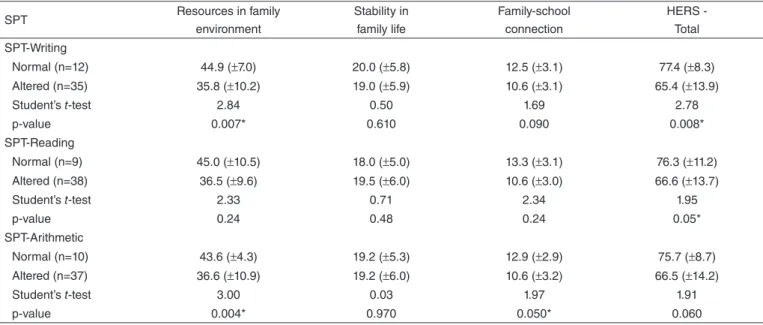
It was possible to observe relationships between the total HERS scores and writing and reading tests in the SPT. Besides, there was a relationship between the performance of students in the arithmetic test and two HERS categories: resources from the family environment and family-school connection.
The results indicate that girls performed better in reading than boys (Table 2). No relationship was observed between gender and the other SPT tests.
As to the effect of the participation in the Integrated School regarding the performance of children in the SPT, no statisti-cally signiicant relations were observed (Table 3).
DISCUSSION
This study was performed by the partnership between health and education services, by considering the principles of work from the ESF and the health planning of the terri-tory. The analyzed students entered the PSE(1) and families
were visited by the researchers accompanied by the health agents, who represent the connection between the commu-nity and health services(10).
Partnerships between the school and seven health centers located in the area where the children lived were established.
Table 3. Relationship between performance in the School Performance Test and in the Integrated School
SPT
Participates in the Integrated School
Does not participate in the Integrated School
χ2 p-value
Normal n (%)
Altered n (%)
Normal n (%)
Altered n (%)
Arithmetic 3 (16.7) 15 (83.3) 7 (24.0) 22 (76.0) 0.37 0.71
Reading 2 (11.0) 16 (89.0) 7 (24.0) 22 (76.0) 1.21 0.44
Writing 2 (11.0) 16 (89.0) 10 (34.0) 19 (66.0) 3.10 0.09
Caption: SPT = School Performance Test
Table 2. Relationship between performance in the School Performance Test and gender
SPT
Female Male
χ2 p-value
Normal n (%)
Altered n (%)
Normal n (%)
Altered n (%)
Arithmetic 4 (20) 16 (80) 6 (22) 21(78) 0.34 1.00
Reading 7 (35) 13 (65) 2 (7) 25 (93) 5.65 0.02*
Writing 6 (30) 14 (70) 6 (22) 21 (78) 0.36 0.73
*p<0.05
Caption: SPT = School Performance Test
Table 1. Analysis of the score in the three domains of the Home Environment Resource Inventory and performance in the three tests of the School Performance Test
SPT Resources in family
environment
Stability in family life
Family-school connection
HERS - Total
SPT-Writing
Normal (n=12) 44.9 (±7.0) 20.0 (±5.8) 12.5 (±3.1) 77.4 (±8.3)
Altered (n=35) 35.8 (±10.2) 19.0 (±5.9) 10.6 (±3.1) 65.4 (±13.9)
Student’s t-test 2.84 0.50 1.69 2.78
p-value 0.007* 0.610 0.090 0.008*
SPT-Reading
Normal (n=9) 45.0 (±10.5) 18.0 (±5.0) 13.3 (±3.1) 76.3 (±11.2)
Altered (n=38) 36.5 (±9.6) 19.5 (±6.0) 10.6 (±3.0) 66.6 (±13.7)
Student’s t-test 2.33 0.71 2.34 1.95
p-value 0.24 0.48 0.24 0.05*
SPT-Arithmetic
Normal (n=10) 43.6 (±4.3) 19.2 (±5.3) 12.9 (±2.9) 75.7 (±8.7)
Altered (n=37) 36.6 (±10.9) 19.2 (±6.0) 10.6 (±3.2) 66.5 (±14.2)
Student’s t-test 3.00 0.03 1.97 1.91
p-value 0.004* 0.970 0.050* 0.060
*p<0.05
The health centers were located in neighborhoods close to school; in areas of low, medium, and high risk, with high levels of vulnerability to health in terms of sanitation and socioeconomics, with the following indicators: percentage of households with inadequate or absent water supply, sewer system, and garbage collection; percentage of inhabitants per household; percentage of illiterate people; percentage of private households whose income is up to half a minimum wage; and percentage of black/brown and indigenous people(7).
Some houses were located in areas of urban occupation, and there were no community health agents in charge of the family, no pavement on the streets, and the area was dificult to access. It was possible to observe that the family context of the children was similar due to the lack of resources and similar unconventional family organization(11).
The investigated children mostly presented lower perfor-mance for the three categories in the SPT: reading, writing, and arithmetic. A study that compared the performance of reading and writing among students in a public school and those in a private school from Belo Horizonte showed that most poor readers and poor writers attended public schools(12).
About 40% of the assessed children participated in the project Integrated School, and spent two shifts in the institu-tion attending oriented activities. Integrated School was cre-ated in 2006 by the City Hall of Belo Horizonte to increase the learning possibilities of the student attending public schools, thus increasing the time they stay in school from four and a half hours to nine hours. The idea is to increase the activities conducted in school to ields such as music, sports, culture, basic computer notions, and leisure(13). A study conducted in
Massachusetts proved that only one year after increasing the time children stay in school, the students presented better results in local evaluation tests. The longer permanence of children in school allows the performance of more tasks and enables the contact with other ields of knowledge, such as music, informatics, and other languages(14).
However, the fact that children participated in Integrated School did not interfere in their performance regarding read-ing, writread-ing, and arithmetic tasks. There are two hypotheses: the time since the project has been established, which is recently, so it is not possible that the inluence of this inser-tion in the learning development is shown. Another possible justiication is that children were assessed in the beginning of the school year, so they had just entered school; therefore, there was no previous information about their attendance to Integrated School. Another hypothesis about the results is the situation of social vulnerability to which children are exposed, which can require them to spend more than in the program to show improvements in school learning. This happens because a poor school performance must be seen as a symptom that is related to multiple etiologies. Two major groups of causes to be considered are the following: matters of pedagogical dificulties and associated pathologies and disorders. Inside the group of causes related to pedagogical dificulties, unfa-vorable or little encouraging sociocultural conditions have a direct inluence on poor school performance(15), which can be
observed in the studied population.
The assessed children had more dificulties in reading tasks. Reading is a complex and interactive process that requires two cognitive routes: the lexical and the phonological routes(16).
Two-route models help to understand the process of reading and writing acquisition, which is mutually inluenced by the school and the family environment, due to the form of reading acquisition and exposure to several stimuli, which have a direct impact on the access to the phonological and lexical routes(6,16).
International studies have been showing that only the fact of reading out loud to a child leads to considerable gain in the development of oral and written language(17), which does not
seem to be true among children who are in high-risk situations. In the analysis between the resources of the family envi-ronment and school performance, it was observed that most children do not perform regular activities other than attending school. When they are not at school, they play outside or in the house, watch television, but only a few read books or maga-zines at home. A lack of pedagogical resources, such as books, newspapers, magazines, and toys, was observed, as well as a family environment that would be less supportive of the low performance of their children at school(18).
There was a relationship between the resources in the family environment and the performance of children in arithmetic and writing tests. Such indings were also found in an investigation involving the families of 100 children with school-related complaints attending the three irst grades of Elementary School(19). By comparing two subgroups that were
respectively constituted of children who only had the intention of writing, and the other group with children who elaborated articulated phrases, the author observed that those with more elaborate writing lived in places with more availability of toys and books, similar to the indings in this study.
Language starts to develop together with the baby’s life; therefore, actions in ESF are required, starting with pueri-culture, to promote language stimulation for the child. The program “Reach Out and Read”, conducted in Washington, is based on evidence and prepares children to be successful at school by establishing partnerships with health servers. Health professionals work by indicating books and guiding families with regard to the importance of reading out loud to the children since early childhood(20). In this program, it has
been observed that parents who participate in are more prone to reading out loud to their children, and that the children pres-ent better performance in terms of receptive and expressive language, besides increasing the vocabulary(21).
School performance was not related to predictable activities that indicate some level of stability in family life and that was also observed by other authors(11,22) who investigated the
rela-tionship between school performance and family constitution. It is worth mentioning that even though no direct relationship has been found in some studies, family is decisive for the emotional adjustment of the children; family stability is an essential factor for the child to be able to focus on learning activities(23). National and international literature(23,24) show that
The family–school connection in HERS was related to the better performance of the children in writing and arithmetic tests, thus showing that the participation of the family together with the school is a successful strategy and that parents con-tribute largely to the children’s learning process. Therefore, one of the main objectives of PSE should be to promote the approximation between parents and school.
It is believed that the children who own more books and dictionaries, the ones who play with more pedagogical re-sources, and share more activities with their parents develop better writing skills(19), which suggests better language
devel-opment for the children, which is indispensable for learning reading, writing, and arithmetic skills. Preventing pathologies and promoting health is up to the professionals who work in the health centers, the entry point for SUS. The speech language pathologist has important contribution to the ield of school development because this professional works with human com-munication and is skilled to improve the development of reading and writing among students, as well as to prevent changes and develop health promotion strategies(25).
Education is a process that contributes with the development of the subject, and health guides the vitality and the quality of life for the individuals. Health and education are two processes that need to be side by side due to their mutual contribution for the individual and the society toward life in citizenship. In this sense, it is clear that school and community are spaces where ESP works in.
ESF uses tools based on sciences such as sociology and psychology. To ensure the promotion of quality of life and to prevent factors that can jeopardize the health of the family, education in health is an important step for the use of such tools(26). Literature shows the eficiency of a program including
household visits to mothers with the objective of promoting their children’s development, besides the positive aspects of integrating practices of stimulation and intervention of children in actions involving basic health(27).
It is known that the partnership between education and health is necessary for the promising development of an individual. Therefore, it is necessary to mention the impor-tance of the collective construction of these two sectors, as well as the articulation of combined actions in their agen-das. In this study, it was possible to experience directly the integrated work between school and ESF, mediated by the university, which conducted this articulation. For managers and professionals of the participating institutions, the need to maintain this partnership became clear, as well as the lack of skilled professionals to work on the subjects related to school performance.
This analysis could map the resources in the family environment, once the study was conducted in loco by the researcher, based on HOME(28). This instrument was
interna-tionally used for household investigations. It is important to consider that the inancial cost of the study becomes higher due to household visits; however, the beneit of the fact that the researcher goes, in person, to know the family environment
where the child lives is immeasurable, once the subjective, clinical, and diagnostic impressions were personally veriied by the researchers. By narrowing the gap between health and education, this study showed that combined actions in primary care can strengthen the school performance of students by intervening in the family and in the community; the school was seen as a space of health promotion. The development of intersectoral actions of health promotion allows health and education professionals to increase their potential in terms of work and relection, extrapolating the actions in quality and magnitude, without, however, losing its speciicity.
CONCLUSION
It was observed that family environment has inluence on school performance among the assessed children in the fourth year of Elementary School, and that the lack of resources, such as toys, books, and reasoning games, as well as the lack of activities performed outside of school, are related to learning dificulties among children. Therefore, these items must be approached in health promotion actions from the PSE teams, together with ESF initiatives.
ACKNOWLEDGMENT
We thank the managers and health community agents from the health centers in the North Region of Belo Horizonte for the support in data collection.
*SP participated in the study planning, data collection and analysis, and the elaboration of the article. JNS and VOMR are the coordinators of this study and oriented SP in the inal assignment, having participated in all of the stages of the research. The other authors participated in the study planning and the elaboration of the manuscript.
REFERENCES
1. Brasil. Ministério da Saúde. Secretaria de Atenção à Saúde. Departamento de Atenção Básica. Saúde na Escola. Cadernos de Atenção Básica n. 24; Série B. Textos Básicos de Saúde. Brasília: Ministério da Saúde; 2009. 2. Brasil. Ministério da Saúde. Portaria nº 2.488, de 21 de outubro de 2011.
Brasília: Ministério da Saúde; 2011.
3. Castanheira ERL, Nemes MIB, Almeida MAS, Puttini RF, Soares ID, Patrício KP, et al. QualiAB: desenvolvimento e validação de uma metodologia de avaliação de serviços de atenção básica. Saúde Soc. 2011;20(4):935-47.
4. Lipay MS, Almeida EC. A fonoaudiologia e sua inserção na saúde pública. Rev Ciênc Méd. 2007;1(1):31-41.
5. Marturano EM. O Inventário de Recursos do Ambiente Familiar. Psicol Relex Crít. 2006;19(3):498-506.
6. Oliveira CBE, Araújo CMM. A relação família-escola: intersecções e desaios. Estud Psicol. 2010;27(1):99-108.
7. Belo Horizonte. Prefeitura Municipal. Índice de Vulnerabilidade à Saúde (IVS); 2012.
8. Northen JL, Dows MP. Hearing in children. Third edition. Baltimore: Williams & Wilkins; 1984.
10. Santos JN, Lemos SMA, Rates SPM, Lamounier JA. Habilidades auditivas e desenvolvimento de linguagem em crianças. Pró-Fono. 2008;20(4):255-60.
11. Ferreira SHA, Barrera, SD. Ambiente familiar e educação escolar em alunos da educação infantil. Psico (Porto Alegre). 2010;41(4):462-72. 12. Pontes VA, Diniz NLF, Martins-Reis VO. Parâmetros e estratégias de
leitura e escrita utilizados por crianças de escola pública e privada. Rev CEFAC. 2013;15(4):827-36.
13. Coelho JS, Oliveira DA, Duarte AMC, Vieira LMF. Escola integrada. Belo Horizonte: Faculdade de Educação da UFMG; 2010. CD-ROM. 14. Gabrieli C, Goldstein W. Time to learn: how a new school schedule is
making smarter kids, happier parents & safer neighborhoods. New Jersey: John Wiley & Sons; 2008.
15. Siqueira CM, Giannetti JG. Mau desempenho escolar: uma visão atual. Rev Assoc Med Bras. 2011;57(1):78-87.
16. Salles JF, Parente MAMP. Avaliação da leitura e escrita de palavras em crianças de 2ª série: abordagem neuropsicológica cognitiva. Psicol Relex Crít. 2007;20(2):220-8.
17. Duursma E, Augustyn M, Zuckerman B. Reading aloud to children: the evidence. Arch Dis Chil. 2008;93(7):554-7.
18. D’Avila-Bacarji KMG, Marturano EM, Elias LCS. Suporte parental: um estudo sobre crianças com queixas escolares. Psicol Estud. 2005;1(1):107-15.
19. Marturano EM. Recursos no ambiente familiar e dificuldades de aprendizagem na escola. Psicol Teor Pesqui. 1999;15(2):135-42.
20. Mendelsohn AL, Mogilner LN, Dreyer BP, Forman JA, Weinstein SC, Broderick M, et al. The impact of a clinic-based literacy intervention on language development in inner-city preschool children. Pediatrics. 2001;107(1):130-4. 21. High PC, Lagasse L, Becker S, Algren I, Gadner A. Clinical care for
children literacy promotion in primary care pediatrics: can we make a difference? Pediatrics. 2000;105(4 Pt 2):927-34.
22. Dessen MA, Polonia AC. A família e a escola como contextos de desenvolvimento humano. Paidéia. 2007;17(36):21-32.
23. Alves RA. Interação família e escola: contribuições [monografia]. Linhares (ES): Faculdade de Ciências Aplicadas Sagrado Coração; 2008. 24. Grolnick WS, Slowiaczek ML. Parents’ involvement in children’s
schooling: a multidimensional conceptualization and motivational model. Child Dev. 1994;65(1):237-52.
25. Silva TOF, Calheta PP. Relexões sobre assessoria fonoaudiológica na escola. Distúrb Comun. 2005;17(2):225-32.
26. Ditterich RG, Gabardo MCL, Moysés SJ. As ferramentas de trabalho com famílias utilizadas pelas Equipes de Saúde da Família de Curitiba, PR. Saúde Soc. 2009;18(3):515-24.
27. Walker SP, Chang SM, Powell CA, Baker-Henningham H. Building human capacity through early childhood intervention: the Child Development Research Programme at the Tropical Medicine Research Institute, the University of the West Indies, Kingston, Jamaica. West Indian Med J. 2012;61(4):316-22.