Maria Cecília de Souza Minayo Liana Wernersbach Pinto Simone Gonçalves de Assis Fátima Gonçalves Cavalcante Raimunda Matilde do Nascimento Mangas
Centro Latino- Americano de Estudos sobre Violência e Saúde. Escola Nacional de Saúde Pública. Fundação Oswaldo Cruz. Rio de Janeiro, RJ, Brasil
Correspondence:
Maria Cecília de Souza Minayo Fundação Oswaldo Cruz Av. Brasil, 4036, 7º andar Manguinhos
21040-210 Rio de Janeiro, RJ, Brasil E-mail: [email protected] ocruz.br Received: 3/18/2011
Approved: 11/12/2011
Article available from: www.scielo.br/rsp
Trends in suicide mortality
among Brazilian adults and
elderly, 1980 – 2006
ABSTRACT
OBJECTIVE: To describe mortality from suicide in Brazil, with emphasis on the older adult population.
METHODS: Temporal analysis and trend analysis by polynomial regression were conducted on suicide in the population above 10 years old in Brazil and the State of Rio de Janeiro (Southeastern Brazil) from 1980-2006. The data were extracted from the Mortality Information System, and the rates calculated by gender and age per 100,000 inhabitants, considering the resident population provided by DATASUS. For the period between 1980 and 1995,
the ninth revision of International Statistical Classifi cation of Diseases and
Related Health Problems was used, and for 1996 to 2006, the tenth revision.
RESULTS: Suicide rates signifi cantly increased in Brazil and in Rio de Janeiro (respectively reaching 5.7 and 3.1 deaths per 100,000 inhabitants in 2006). The change was caused by the increase in suicides among the male population at all ages. The increase occurred especially among men over 60 years. In Rio de
Janeiro, the increase was not statistically signifi cant among men, while there
was a decrease among women. The principal means utilized for suicide by men
were hanging, suffocation, strangulation and fi rearms. For women, death by
hanging also ranks fi rst, followed by ingestion of solids or liquids, smoke or
fi re, and jumping from heights. The high rate of suicide by unspecifi ed means
reveals problems with data quality.
CONCLUSIONS: Suicides are important events in the male population, especially among older men over time. In Rio de Janeiro, the suicide rate is also higher in men, although the difference is not statistically signifi cant. According to the World Health Organization and the Ministry of Health, suicide is preventable, and established interventions exist for each age group.
DESCRIPTORS: Aged. Suicide, trends. Mortality.
INTRODUCTION
Having intent to die is a key element directly linked with violence and aggres-sion. Therefore, suicide is categorized as an “external cause” by the International
Classifi cation of Diseases (ICD), a rubric that includes forms of violence and
injuries. The World Health Organization (WHO)aclassifi es suicide rates in four
levels: low (less than fi ve per 100,000 inhabitants); medium (from 5 to 15); high (from 15 to 30); and very high (above 30 per 100,000). The main risk factors
for suicide are: mental illnesses and conditions; use of specifi c medications,
2 Suicide among older adults Minayo MCS et al
b Minayo MCS, Assis SG, Souza ERS, Correia BSC, Pacheco ML, Godinho PGD. Suicídios no Brasil: mortalidade, tentativas, ideação, comportamento autopunitivo e prevenção. Brasília (DF): RIPSA/OPAS/MS; 2010.
drugs, alcohol and intoxication; having a degenerative and terminal illness, social problems and infl uence from media.1-3,6-8,11,12,16,22,23
According to information from WHO,25 an estimated
815,000 people committed suicide in 2000, which represents a mortality rate of approximately 14.5 per 100,000 people or “one person every 40 seconds”, when considering the statistics of countries that report this event. Worldwide rates of suicide increased 60% in the last 45 years, and in some countries it is among the top three causes of death for age 15 to 44 years.
Suicide rates are unequally distributed across the world, across countries and between sexes, age groups and method used. The highest rates concentrate in Eastern
Europe.25 Suicide accounts for more deaths globally
than homicide and war combined. In Latin America, suicide rates are relatively low compared to homicide rates.25 In Brazil, suicide accounts for a small portion
(0.6%) of total deaths and corresponds to 5.6% of deaths from external causes. Brazil recorded 4.9 deaths by suicide per 100,000 inhabitants in 2008, placing it in 73rd position globally and in the group with low although increasing rates (in comparison to the medium level). The State of Rio de Janeiro has the lowest rate among all of Brazil’s federal entities (2.2 deaths per
100,000 inhabitants in 2008).b
Age is an important factor in the profi le of suicides.
Data from the WHO25 show indices from 0.9/100,000
inhabitants among age fi ve to 14 years and 66.9/100,000 among people above 75 years in 1995. Since the popu-lation above age 60 years is increasing as a proportion in Brazil, it is justifi ed to study the rates of suicide in people at this life stage.
Likewise, there are important differences by sex; rates are higher among men than women in innumerable countries, varying from 1:1 to 10.4:1.25 In Brazil, the
ratio was 4:1 in 2006.
Improved understanding of the topic may contribute to a prevention agenda that transcends epidemiologic studies, since as Cassorla affi rms4 the phenomenon of
suicide includes complex factors that interact through
infi nite ways and cannot be understood through only
one approach. Therefore, as recommended, comprehen-sive approaches are also performed through psycholo-gical autopsies.7,12,18,22,23
The objective of this article was to describe mortality by suicide in Brazil and the State of Rio de Janeiro among people age 10 years or older, with emphasis on people age 60 years or older.
METHODS
Temporal analysis was performed of suicide mortality among people age over 10 years, with emphasis on the population age 60 years or older from 1980 to 2006, in Brazil and the State of Rio de Janeiro. The state was chosen due to its unique characteristic of having the highest proportion of its population in this age group and the lowest (and decreasing) suicide rates among the federal entities.
The data on suicides used to populate the historical
series were extracted from the Sistema de Informações
sobre Mortalidade (Mortality Information System of the Ministry of Health – SIM/MS). The population estimates by sex and age group were obtained from the
Instituto Brasileiro de Geografi a e Estatística (IBGE – Brazilian Institute of Geography and Statistics). The rates for Brazil and Rio de Janeiro were calculated according to sex and age group and presented per 100,000 inhabitants. To calculate the mortality rate, the number of suicide deaths per year was the nume-rator and the population the denominator. Information on mortality from 1980 to 1995, followed the 9th revision of the ICD (ICD-9, E950-E959) and from 1996 to 2006, the 10th revision (ICD-10, X60-X84 and Y87).15
Proportional mortality was calculated to analyze the suicide method used (ICD category). The ratio between the male and female rates was calculated for each year, in order to evaluate changes over time.
Trend analysis was performed by polynomial regres-sion, which describes the curve that best fi ts the data in order to reveal the relationship between the dependent and independent variables. The suicide mortality rates were the dependent variable and the calendar year the independent variable. The variable year was trans-formed to avoid self-correlation between the terms of the equation, and a centralized version was utilized (year minus the midpoint of the study period). Model selection utilized dispersion diagrams, the coeffi cient of determination (R2) and analysis of residuals (verifi
-cation of homeodasticity). The simple linear regression models were tested at the second and third orders and with exponential functions. The trend was considered signifi cant when p < 0.05.
SPSS for Windows® (version 19.0) was used to calcu-late suicide mortality rates and for trends analysis. The
fi gures for the historical series were constructed with
RESULTS
There were small and continual increases in suicide mortality rates among all age groups (4.4/100,000 in 1980 to 5.8 in 2006). Over the period, 158,952 people died in Brazil and 8,353 in Rio de Janeiro, with an annual average of 5,887.1 and 309.4, respectively (among people above age 10 years) (Figure 1).
Throughout the 1980s, 43,131 deaths occurred by suicide among all age groups in Brazil (mean of 4,313.1 deaths/year), increasing to 60,543 in the 1990s (mean of 6,054.3 deaths/year). From 2000 to 2006, 55,278 suicides occurred in the total population (mean of 7,896.9 deaths/year), indicating a continued increase in these events. A similar situation was observed in Rio de Janeiro, although at lower levels: 2,503 deaths by suicide (mean of 250.3 deaths/year) in the 1980s; 2,956 (mean of 295.6 deaths/year) in the 1990s; and 2,894 (mean of 413.3 deaths/year) between 2000 and 2006.
The profi le of suicide in Brazil was more stable than
in Rio de Janeiro over the same period (Figure 1). The
rate in the state fl uctuated due to the small number
of cases: 3/100,000 over the period, lower than the national average.
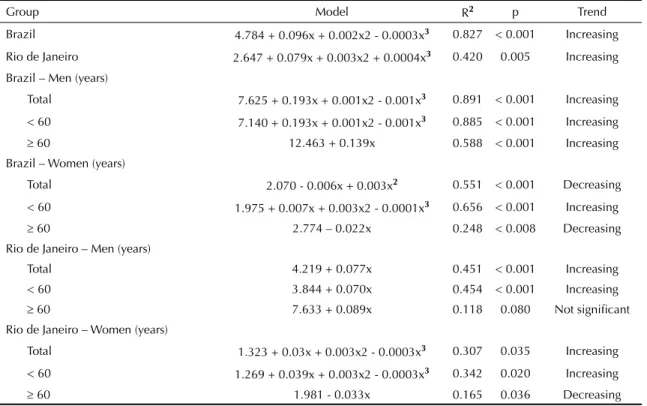
The trend analysis (Table 1) indicated increased suicide rates: the curve for Brazil highlighted the increase (R2
= 0.827; p < 0.001) in comparison to the curve for Rio de Janeiro (R2 = 0.420; p = 0.005).
A progressive increase in deaths occurred among males of all ages in Brazil, from 6.2/100,000 in 1980 to 9.3/100,000 in 2006. The rates for Brazilian women
fl uctuated slightly and presented a small decrease:
2.6/100,000 in 1980 and 2.3/100,000 in 2006 (Figure 2).
Large variations in the suicide rates were observed among males in Rio de Janeiro, with the highest rate in 2001 (5.7/100,000) and the lowest in 1992 (2.7/100,000). The highest rate in females occurred in 1980 (2.3/100,000). The rate remained around 1.6/100,000 from 2000 to 2006. Data on suicides among
women in Rio de Janeiro also fl uctuated.
The trend analysis (Table 1) showed increases among
men across Brazil and in Rio de Janeiro (R2 = 0.891
and 0.451, respectively; p < 0.001). The profi le was distinct for women: a decreasing trend nationally and increasing in Rio de Janeiro (R2 = 0.551; p < 0.001 e
R2 = 0.307; p < 0.035, respectively).
In 1980, the death ratio was 2.4 men to women in Brazil and 1.7 in Rio de Janeiro. The ratio increased to four nationally and 2.9 in the state in 2006.
Deaths from self-infl ected injuries signifi cantly
incre-ased among older adults: 5,953 suicides among older Figur
e 1.
Suicide mortality r
ate in Br
azil and Rio de J
aneiro State. 1980-2006.
Sour ce: SIM/D A TASUS, 2009 80 81 82 83 84 85 86 87 88 89 90 91 92 93 94 95 96 97 98 99 00 01 02 03 04 05 06 Brasil 4.4 4.5 4.2 4.8 4.5 4.3 4.2 4.5 4.2 4.1 4.3 4.6 4.5 4.7 5.0 5.5 5.4 5.5 5.4 5.0 5.0 5.6 5.5 5.6 5.6 5.8 5.8
Rio de Janeiro
3.1 2.2 2.1 3.0 2.9 2.3 2.2 3.0 2.6 2.5 2.8 1.9 1.7 2.3 2.2 2.9 3.4 3.3 3.3 2.7 3.3 3.7 3.7 2.9 3.1 3.4 3.1 0.0 1.0 2.0 3.0 4.0 5.0 6.0 7.0 Rate Brazil
Rio de Janeiro
4 Suicide among older adults Minayo MCS et al
Table 1. Trends analysis of suicide mortality rates. Brazil and Rio de Janeiro State, 1980-2006.
Group Model R2 p Trend
Brazil 4.784 + 0.096x + 0.002x2 - 0.0003x3 0.827 < 0.001 Increasing
Rio de Janeiro 2.647 + 0.079x + 0.003x2 + 0.0004x3 0.420 0.005 Increasing
Brazil – Men (years)
Total 7.625 + 0.193x + 0.001x2 - 0.001x3 0.891 < 0.001 Increasing
< 60 7.140 + 0.193x + 0.001x2 - 0.001x3 0.885 < 0.001 Increasing 60 12.463 + 0.139x 0.588 < 0.001 Increasing Brazil – Women (years)
Total 2.070 - 0.006x + 0.003x2 0.551 < 0.001 Decreasing
< 60 1.975 + 0.007x + 0.003x2 - 0.0001x3 0.656 < 0.001 Increasing
60 2.774 – 0.022x 0.248 < 0.008 Decreasing Rio de Janeiro – Men (years)
Total 4.219 + 0.077x 0.451 < 0.001 Increasing < 60 3.844 + 0.070x 0.454 < 0.001 Increasing
60 7.633 + 0.089x 0.118 0.080 Not signifi cant Rio de Janeiro – Women (years)
Total 1.323 + 0.03x + 0.003x2 - 0.0003x3 0.307 0.035 Increasing
< 60 1.269 + 0.039x + 0.003x2 - 0.0003x3 0.342 0.020 Increasing
60 1.981 - 0.033x 0.165 0.036 Decreasing
adults in Brazil (average of 595.3 deaths/year) in the 1980s; 8,547 (average of 854.7 deaths/year in the 1990s); and 7,994 from 2000 to 2006, corresponding to an annual average of 1,142 deaths.
In Rio de Janeiro 427 older adults committed suicide during the 1980s, 522 in the 1990s and 517 between 2000 and 2006 (annual incidence increased from 42 deaths during the 1980s to 74 deaths from 2000 and 2006).
Suicides among younger men fluctuated between 5.7/100,000 and 8.8/100,000. Among older men, the rate reached 12.1/100,000 in 1980. The rates relative to the older male population increased beginning in 1995, and the peak of the increase occurred in 2005, with a rate of 15.4/100,000 inhabitants (Figure 3).
The patterns for men and women had substantial differences, and rates were smaller among females,
fl uctuating between 2.5/100,000 and 3/100,000 among
all age groups during the study period.
The increase in suicide rates among men was refl ected
in the increased rates among the total population, contrary to the rates among females which were more or less constant with a small decreasing trend. The death ratio was four men to women in 1980 and 5.4:1 in 2006.
The trends analysis showed a signifi cant increase in
suicides among older Brazilian men (R2 = 0.588; p <
0.001) and men less than 60 years (R2 = 0.885; p < 0.001)
(Table 1). Older women experienced decreased rates (R2
= 0.248; p = 0.008), although among younger women there was an increasing trend (R2 = 0.656; p = 0.001).
Suicide rates fl uctuated in Rio de Janeiro among people both younger and older than age 60 years (Figure 4). The rates in men age less than 60 years presented a slightly increased curve in the series after 1995, with peaks in 1987, 12.1/100,000; in 1998, 11.2/100,000; and in 2005, 11.0/100,000. The rates went from 7.4/100,000 in 1980 to 11/100,000 in 2005 and returned to 7.1/100,000 in 2006, demonstrating the oscillation. The data for women of all age groups in Rio de Janeiro also oscillated, and there were 1.9 suicides among men for each woman in 1980, increasing to 3.4:1 in 2006.
The trend analysis showed increased suicide among
men younger than 60 years (R2 = 0.454; p < 0.001)
and among women of the same age group (R2 = 0.342;
p = 0.020) in Rio de Janeiro (Table 2). Among older women, there was a signifi cant decrease (R2 = 0.165; p
= 0.036), which was not observed in men.
Deaths by hanging and by fi rearm, according to the
ICD categorization, were the fi rst and second most
common methods used among older men from 1980 to 1995 (Table 2). Among older men in Rio de Janeiro, hanging was more frequent, followed by other unspe-cifi ed means and then suicide by fi rearms.
The most common means of suicide among men were hanging; smoke, fi re and fl ames; fi rearms; and other
5
80 81 82 83 84 85 86 87 88 89 90 91 92 93 94 95 96 97 98 99 00 01 02 03 04 05 06
Male < 60 years 5.7 6.2 5.9 6.6 6.4 6.0 5.7 6.3 6.0 5.9 6.1 6.7 6.7 7.2 7.5 8.3 8.3 8.3 8.2 7.8 7.6 8.6 8.4 8.6 8.5 8.7 8.8 Male ≥ 60 years 12.1 9.4 9.9 12.3 11.8 11.3 11.7 12.6 10.8 11.2 11.7 12.1 11.1 11.3 13.1 14.1 12.3 14.1 14.6 13.1 12.8 14.1 12.8 13.0 13.8 15.4 14.0 Female < 60 years 2.6 2.6 2.3 2.6 2.3 2.0 2.1 2.1 2.0 1.8 2.1 1.9 2.0 1.9 2.1 2.2 2.1 2.1 2.2 1.8 1.9 2.2 2.3 2.2 2.3 2.4 2.3 Female ≥ 60 years 3.0 3.1 2.3 3.5 2.7 2.8 3.0 3.1 3.2 2.9 3.1 3.6 2.3 2.7 2.5 3.1 2.8 2.6 2.6 2.3 2.4 2.3 2.6 2.5 2.7 2.6 2.6
0.0 2.0 4.0 6.0 8.0 10.0 12.0 14.0 16.0 18.0
Rate
Male < 60 years Male ≥ 60 years Female < 60 years Female ≥ 60 years
per 100 mil
Figure 3. Suicide mortality rate in Brazil according to sex and age group. 1980-2006. Source: SIM/DATASUS, 2009
80 81 82 83 84 85 86 87 88 89 90 91 92 93 94 95 96 97 98 99 00 01 02 03 04 05 06
BR_Male 6.2 6.4 6.2 7.0 6.8 6.5 6.2 6.9 6.4 6.4 6.6 7.2 7.1 7.6 8.0 8.8 8.7 8.9 8.7 8.3 8.1 9.2 8.8 9.0 9.0 9.4 9.3
BR_Female 2.6 2.6 2.3 2.7 2.3 2.1 2.2 2.2 2.1 1.9 2.2 2.1 2.0 2.0 2.1 2.3 2.2 2.2 2.2 1.9 2.0 2.2 2.4 2.2 2.3 2.4 2.3
RJ_Male 4.0 2.9 2.9 4.2 4.3 3.2 3.2 4.6 3.9 3.8 4.1 2.9 2.7 3.6 3.3 4.2 5.3 5.1 5.3 4.7 5.4 5.7 5.3 4.3 4.9 5.4 4.7
RJ_Female 2.3 1.5 1.3 1.8 1.7 1.4 1.3 1.5 1.4 1.3 1.5 1.0 0.8 1.2 1.2 1.8 1.6 1.7 1.5 1.0 1.3 1.9 2.2 1.5 1.5 1.5 1.6
0.0 1.0 2.0 3.0 4.0 5.0 6.0 7.0 8.0 9.0
Rate
BR_Male BR_Female RJ_Male RJ_Female
6 Suicide among older adults Minayo MCS et al
Table 2. Cause of death as a percentage of suicides, according to the categories of the International Statistical Classifi cation of Diseases and Related Health Problems. Brazil and Rio de Janeiro State, 1980-2006.
Category Brazil (%) Rio de Janeiro (%)
Total Male Female Total Male Female
ICD-9 1980-1995a
E953 Hanging, strangulation and suffocation 51.7 52.3 49.8 29.3 34.8 16.1
E958 Other and unspecifi ed means 17.9 16.2 23.9 32.9 26.8 47.3 E955 Firearms and explosives 16.6 19.6 6.1 16.2 20.1 6.8 E950 Ingestion of solids or liquids 7.5 6.7 10.2 6.1 5.9 6.3 E957 Jumping from high place 1.7 1.3 3.2 10.7 8.8 15.1
ICD-10 1996-2006b
X70 Hanging, strangulation and suffocation 56.2 57.8 49.4 34.0 38.4 17.6 X74 Other and unspecifi ed fi rearm discharge 13.4 15.4 4.4 15.6 18.9 3.1 X84 Unspecifi ed means 5.0 4.8 5.9 12.8 12.9 12.6
X68 Intentional self-poisoning by and exposure to
pesticides 4.8 4.7 5.3 7.0 5.7 11.9
X72 Handgun discharge 3.1 3.5 1.3 3.2 3.5 1.9
X69 Exposure to other and unspecifi ed chemicals
and noxious substances 3.0 2.8 4.0 3.3 2.7 5.7 X80 Jumping from a high place 2.8 2.0 6.4 8.6 5.5 20.1 X76 Smoke, fi re and fl ames 2.6 1.2 9.2 4.2 3.0 8.8
ICD: International Statistical Classifi cation of Diseases and Related Health Problems
a Period 1980-1995: Brazil - N_Total = 10671; N_Male = 8276; N_Female = 2396; Rio de Janeiro - N_Total = 693; N_Male
= 488; N_Female = 205
b Period 1996-2006: Brazil - N_Total = 11591; N_Male = 9502; N_Female = 2087; Rio de Janeiro - N_Total = 758; N_Male
= 599; N_Female = 159
means was hanging followed by smoke, fi re and fl ames. Jumping from a high place was the principal means among older women in Rio de Janeiro, followed by hanging, strangling and suffocation.
DISCUSSION
The profi le of suicide over time differs in Brazil and
Rio de Janeiro State, and there are differences by age group, sex and means of perpetration. Nonetheless
these differences refl ect reality, as emphasized by
Durkheim’s research,10 in which he defends the
structural character of violence in general and suicide in particular. According to Durkheim, variations are explained by particular social processes and not only demographics, and these variations suggest sociocul-tural changes and profound crises in contemporary society, in this case in regards to older adults. The WHO considers the increase in deaths among older adults as notable in comparison to 50 years ago, when there was little variation by age.25
The present study agrees with international studies and shows an increased suicide rate in the Brazilian population (4.4 to 5.8 per 100,000 inhabitants during the period), which places Brazil in the second level
as defi ned by WHO (between fi ve and 15 per 100,000
inhabitants). This increase affects men of all ages and younger women. For the overall population in Rio de Janeiro, the increase is more considerable in the younger population. The increase in the rates among older Brazilian males was marked, in contrast to the rates of older women which remained structurally low (between two or three per 100,000 inhabitants) with a decreasing trend in Rio de Janeiro and the nation. The principal mean utilized in suicide in Brazil is strangulation, which also occurs globally. In the United States, though, the
most common method used by older men is fi rearms and
in China, poisoning by pesticides. Around the world,
older women tend to utilize less traumatic means.25
The prominence of suicide among men and the decre-asing trend among women occurred both in Rio de Janeiro and Brazil. Nonetheless, there were differences in the magnitude of the overall rates and the rate in men, when comparing Brazil to Rio de Janeiro. In males the national rates are almost twice the rates in Rio de Janeiro, and the rates among women in Rio de Janeiro are slightly less than the rates for females across Brazil.
The methods utilized by women in Rio de Janeiro (jumping from a high place, strangulation and drug poisoning) differ from those utilized by men
(strangu-lation and fi rearms). The means among men also differ
followed by smoke, fi re and fl ames). In contrast, the most common means among older adults in Rio de
Janeiro are frequently reported by WHO25 in men and
women of this age group globally, although several differences exist between countries.
The lower occurrence of suicide among women – in Rio de Janeiro and nationally – is attributed to the
low prevalence of alcoholism, fl exible attitudes in
regards to social abilities, religion and the perfor-mance of their culturally distinct roles. Women also have greater facility to recognize signs of depression, seeking help and social support in moments of crises with greater frequency.11,17,18,23 The results observed in
males involve macho and aggressive behaviors such as competition, impulsiveness and an affi nity for fi rearms. In older age adults, when professional life ends, many men associate the new moment in life as a failure of their traditional role as the economic provider and as a reference for the family, and they retract socially, which increases risk of isolation, sadness, stress and desire to end life.11,16,17,19,23
The low rates of self-infl icted deaths among older
adults in Rio de Janeiro is a positive social occur-rence, especially because the highest proportion of older adults live in this state, when compared to other federal entities. Data from this study do not provide an understanding of the signifi cance of the state context, which is in a way privileged. There is a trend to attribute low rates of suicide to climate and the weather. In his
study, Durkheim10 showed that these two elements did
not infl uence suicide in France. Researchers such as
Chesnais5 also analyzed the relationship between these
two elements and self-infl icted deaths, but did not fi nd a signifi cant association. A social environment that is happy, open and welcoming, though, appears to have a consistent protective association.6,7,19,21-23 The culturally
diverse surroundings, the multiple possibilities for recreation and the outdoor lifestyle in Rio de Janeiro may be factors protective of suicide. Nonetheless this hypothesis should be cautiously examined, since the quality of death records in the state is considered unsa-tisfactory, with 10.4% of deaths from unspecifi ed cause
among men and 11.9% among women.20 Diffi culties
were also encountered with the high level of suicides by
unspecifi ed causes in the state, indicating weaknesses
in detecting this mode of death.
The use of two classifi cations (ICD-9 and ICD-10)
complicated simple comparison. The most recent system (ICD-10) expanded the number of categories in regards to the previous one, improving the description and providing more detail on the circumstances of the event. Nonetheless, when considering suicide, the problem is not only greater precision in classifi cation.
According to Cassorla,4 more than 50% of suicides
with a high degree of intentionality are classifi ed as
Male < 60 years Male
≥
60 years
Female < 60 years Female
≥ 60 years 80 81 82 83 84 85 86 87 88 89 90 91 92 93 94 95 96 97 98 99 00 01 02 03 04 05 06 3.7 2.7 2.8 3.7 4.0 3.1 2.7 3.9 3.6 3.5 3.7 2.5 2.4 3.3 3.0 4.0 4.9 4.6 4.6 4.5 4.9 5.2 5.0 4.0 4.4 4.7 4.4 7.4 5.2 4.5 9.7 7.4 5.0 8.3 12.1 6.7 5.9 8.0 6.2 4.6 6.3 5.6 6.4 8.6 9.5 11.2 6.4 9.1 9.6 8.0 7.1 9.2 11.0 7.1 2.1 1.5 1.3 1.8 1.7 1.3 1.2 1.4 1.3 1.2 1.3 0.9 0.8 1.1 1.2 1.7 1.6 1.7 1.4 1.0 1.3 2.1 2.2 1.5 1.4 1.4 1.6 3.9 1.7 1.6 2.3 2.0 2.3 2.6 2.8 1.9 2.0 3.0 1.8 1.3 1.6 1.3 2.4 2.1 1.8 2.2 0.8 1.4 0.9 2.0 1.6 2.0 2.1 2.1 0.0 2.0 4.0 6.0 8.0 10.0 12.0 14.0 Rate
Male < 60 years
Male
≥
60 years
Female < 60 years
Female
≥
60 years
per 100 mil
Figur
e 4.
Suicide mortality r
ate in Rio de J
aneiro State, according to sex and age group. 1980-2006.
Sour
ce: SIM/D
A
8 Suicide among older adults Minayo MCS et al
causes are innumerable and can be found in genetic, biologic or psychological factors and in social and
environmental circumstances.2,9,13,23 Minor depression
leads to isolation, which is associated with suicide in extreme cases.13,14 In the older population, the in
fl uence of these factors is stronger, not because they are
natu-rally depressive due to age, as recalled by Beeston,2
but because profound changes tend to occur in the way people live and face their lives
It is necessary to provide specialized attention to this critical social group so that older adults receive guidance and motivation to live and not die.3 A strategy
to approach aging in a comprehensive and systematic way is necessary, in order to improve quality of life and the delivery of careful and effective care that works to improve life and prevent suicide.
Research about suicide in older Brazilian adults is inci-pient and should supplement epidemiologic, clinical, environmental and psychological studies.
accidents. Family, friends and health professionals tend to misclassify due to social disapproval.
It is necessary to understand the situation of older men – the most vulnerable group – and to treat the post-professional moment and retirement time as opportunities for new realizations. The creation of friendships, relationships, human contact and interge-nerational dialogue should be cultivated as protective of depression and self-destruction among older adults. This recommendation was reinforced by the research
of Duberstein et al9 and Beeston,2 who argue that a
social support network for these people should be established as a priority (p.39).2
In addition to investment in primary care and in secon-dary health prevention, it is important to equip mental health units to work with older adults and against
depression in daily life, as recommended by WHO.a
Depression is considered the principal contributory factor for suicide2,3,6,11,12,20,21,23,24 and as an illness that
1. Beautrais AL. A case control study of suicide and attempted suicide in older adults. Suicide Life Threat
Behav. 2002;32(1):1-9.
2. Beeston D. Older people and suicide. Sttafordshire (UK): Sttafordshire University, Centre for Ageing and Mental Health; 2006.
3. Bruce ML, Ten Have TR, Reynolds CF 3rd, Katz II, Schulberg HC, Mulsant BH, et al. Reducing suicidal ideation and depressive symptoms in depressed older primary care patients: a randomized controlled trial. JAMA. 2004;291(9):1081-91. DOI:10.1001/ jama.291.9.1081
4. Cassorla RMS. Debate sobre o artigo de Everardo Duarte Nunes. Cad Saude Publica. 1998;14(1):28-30. DOI:10.1590/S0102-311X1998000100009
5. Chesnais JC. Histoire de la violence en Occident de 1800 à nos jours. Paris: Robert Laffont Editeur; 1981.
6. Cole MG, Bellavence F, Mansour A. Prognosis of depression in elderly community and primary care populations: a systematic review and meta-analysis.
Am J Psychiatry. 1999;156(8):1182-9.
7. Conwell Y, Duberstein PR, Cox C, Herrmann JH, Forbes NT, Caine ED. Relationships of age and axis I diagnoses in victims of completed suicide: a psychological autopsy study. Am J Psychiatry. 1996;53(8):1001-8.
8. De Leo D, Padoani W, Scocco P, Bille-Brahe U, Arensman E, Hjelmeland H, et al. Attempted and completed suicide in older subjects: results from the WHO/EURO Multicentre Study of Suicidal Behaviour.
Int J Geriatr Psychiatr. 2001:16(3):300-10.
9. Duberstein PR, Conwell Y, Conner KR, Eberly S, Caine ED. Suicide at 50 years of age and older: perceived physical illness, family discord and fi nancial strain.
Psychol Med. 2004:34(1):137-46.
10. Durkheim E. O suicídio: estudo sociológico. Rio de Janeiro: Zahar; 1982.
11. Forsell Y, Jorm AF, Winblad B. Suicidal thoughts and associated factors in an elderly population. Acta
Psychiatr Scand. 1997;95(2):108-11.
12. Hawton K, Appleby L, Platt S, Foster T, Cooper J, Malmberg A, et al. The psychological autopsy approach to studying suicide: a review of methodological issues. J
Affect Dis. 1998;50(2-3):269-76.
13. Jorm AF, Henderson AS, Scott R, Korten AE, Christensen H, Mackinnon AJ. Factors associated with the wish to die in elderly people. Age Ageing.
1995;24(5):389-92.
14. Kalache A. O mundo envelhece: é imperativo criar um pacto de solidariedade social. Cienc Saude
Coletiva. 2008;13(4):1107-11.
DOI:10.1590/S1413-81232008000400002
15. Laurenti R. Acidentes e violências/lesões e envenenamentos e a 10ª revisão da Classifi cação Internacional de Doenças. Rev Saude Publica. 1997;31(4):55-8. DOI:10.1590/S0034-89101997000500007
16. Marshall JR. Changes in aged white male suicide: 1948-1972. J Gerontol. 1978;33(5):763-8.
17. Meneghel SN, Victora CG, Faria NMX, Carvalho LA, Falk JW. Características epidemiológicas do suicídio no Rio Grande do Sul. Rev Saude
Publica. 2004;38(6):804-10.
DOI:10.1590/S0034-89102004000600008
18. Minayo MCS, Cavalcante FG, Souza ER. Methodological proposal for studying suicide as a complex phenomenon. Cad Saude Publica. 2006;22(8):1587-96. DOI:10.1590/S0102-311X2006000800007
19. Minayo MCS, Cavalcante FG. Suicídio entre pessoas idosas: revisão de literatura. Rev Saude
Publica. 2010;44(4):750-7.
DOI:10.1590/S0034-89102010000400020
20. Paes NA. Qualidade das estatísticas de óbitos por causas desconhecidas dos Estados brasileiros. Rev
Saude Publica. 2007;41(3):436-45. DOI:10.1590/
S0034-89102007000300016
21. Saz R, Dewey ME. Depression, depressive symptoms and mortality in persons aged 65 and over living in the community: a systematic review of the literature. Int J
Geriatr Psychiatry. 2001;16(6):622-30.
22. Shneidman ES. Comprehending suicide: landmarks in 20th century suicidology. Washington (DC): American Psychological Association; 2001.
23. Stack S. Suicide: a 15-year review of the sociological literature. Part I: cultural and economic factors. Suicide
Life Threat Behav. 2000;30(2):145-62.
24. Vannoy SD, Duberstein P, Cukrowicz K, Lin E, Fan MY, Unützer J. The relationship between suicide ideation and late-life depression. Am J Geriatr
Psychiatry. 2007;15(12):1024-33. DOI:10.1097/
JGP.0b013e3180cc2bf1
25. World Health Organization. World report on violence and health. Geneva; 2002.
REFERENCES