Preoperative serum albumin as a prognostic factor in
patients with upper urinary tract urothelial carcinoma
_______________________________________________
Ja Hyeon Ku
1, Myong Kim
1, Woo Suk Choi
1, Cheol Kwak
1,Hyeon Hoe Kim
11Department of Urology, Seoul National University College of Medicine, Seoul, Korea
ABSTRACT
ARTICLE
INFO
______________________________________________________________ ______________________
Purpose: The study evaluated whether preoperative measures of the C-reactive protein--based systemic inflammatory response may predict cancer survival independent of tumor stage in patients with upper urinary tract urothelial carcinoma (UTUC).
Materials and Methods: Between September 1999 and October 2010, 181 patients submitted to radical nephroureterectomy were available for evaluation. Multivariate survival analyses were performed using Cox’s proportional hazards model and the coefficient for each factor was divided by the highest coefficient, multiplied by 4, and rounded to the nearest integer.
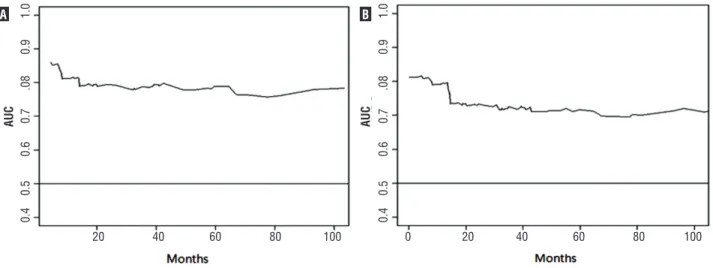
Results: Multivariate analyses showed that tumor location, pathologic T stage, lym-phovascular invasion, margin status, and albumin level were independent contributors. The bootstrap-corrected C statistics of the model were 0.813 for disease-specific survi-val and 0.755 for overall survisurvi-val, respectively. For time to disease-specific and overall mortality for patients, integrated area under the curve values were 0.792 and 0.739, respectively. When patients were clustered into three groups according to their model--predicted survival, the 5-year disease-specific survival in the low-, intermediate- and high-risk group was 95.4%, 76.2%, and 36.9%, respectively (p<0.001), and were 87.8%, 54.4%, and 31.8%, respectively, for overall survival (p<0.001). Decision curve analysis revealed that the use of model was associated with net benefit gains relative to the treat-all strategy.
Conclusions: Pretreatment albumin is a simple biomarker based on routinely available well-standardized measures, and is not an expensive and time-consuming process. Hypoalbuminemia is an independent marker of poor prognosis in patients with upper urinary tract urothelial carcinoma.
Key words:
Carcinoma, Transitional Cell; Urinary Tract; Ureter; C-Reactive Protein; Inflammation
Int Braz J Urol. 2014; 40: 753-62
_____________________
Submitted for publication: December 02, 2013
_____________________
Accepted after revision: April 06, 2014
INTRODUCTION
Upper urinary tract urothelial carcinoma (UTUC) is a relatively rare malignancy, accoun-ting for 5% of all urothelial carcinomas (1). Since these tumors often behave aggressively and local failure rates are high, even after radical surgical treatment, the outcome of patients with UTUC is still generally poor (1). Although tumor stage and histologic grade are the most significant
prognos-tic factors for UTUC, the significance of other re-levant factors, such as lymphovascular invasion, tumor necrosis, tumor architecture, and concomi-tant carcinoma in situ, are unclear (2).
IBJU| PREOPERATIVE SERUM ALBUMIN AS A PROGNOSTIC FACTOR IN PATIENTS
754
(4), host SIR may be an important tumor stage-in-dependent predictor of outcome in cancer. Previous studies have established the prognostic importance of the SIR in patients with localized tumor under-going curative surgery (5) as well as advanced tu-mors (6). Based on a previous study, C-reactive pro-tein (CRP) level >10 mg/l (7), albumin level <35 g/l (7), and white cell count >11 x 109/l (8) were
consi-dered to indicate the presence of a SIR. In particular, CRP-based SIR have been explored and these prog-nostic scores have been associated with survival in patients with cancer: the combination of serum CRP and albumin as the original Glasgow prognos-tic score (9) and modified Glasgow prognosprognos-tic score (10), and a combination of CRP and white cell count in the prognostic index (11).
To our knowledge, a few studies have eva-luated the prognostic value of CRP-based SIR in pa-tients with UTUC (12). The aim of this study was to evaluate whether preoperative measures of CRP-ba-sed SIR may predict cancer survival, independent of tumor stage, in patients with UTUC.
MATERIALS AND METHODS
Patient selection and data collection
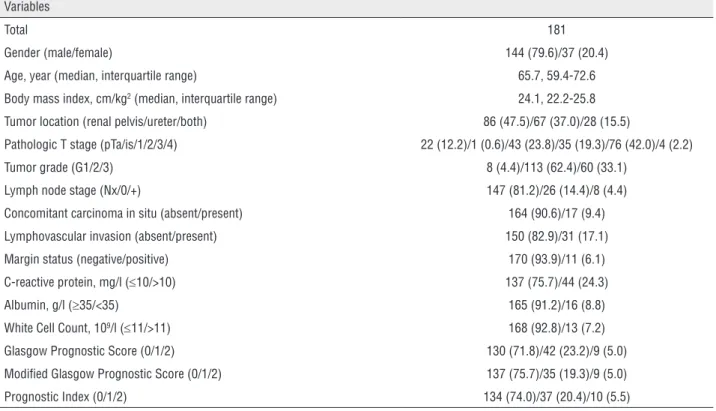
The study protocol was approved by our Institutional Review Board. We retrospectively re-viewed our database of the 303 patients who un-derwent radical nephroureterectomy for primary UTUC between September 1999 and October 2010. Exclusion criteria were: 1) no available laboratory data for inflammation, such as CRP, albumin, and white cell count; 2) clinical evidence of infection or inflammatory conditions, such as pneumonia, in-flammatory bowel disease, or rheumatoid arthritis; 3) history of bladder tumor at a higher stage than the upper tract disease; 4) preoperative chemothe-rapy or irradiation; and 5) distant metastatic disease at the time of surgery. In total, 181 patients (median age 65.7 years, range 34.2-90.0 years) were availa-ble for evaluation. Median follow-up period of those patients was 56.4 months (range 0.1 to 158.0). The clinical and histologic criteria for these 181 patients are shown in Table-1.
Table 1 - Patient characteristics.
Variables
Total 181
Gender (male/female) 144 (79.6)/37 (20.4)
Age, year (median, interquartile range) 65.7, 59.4-72.6
Body mass index, cm/kg2 (median, interquartile range) 24.1, 22.2-25.8
Tumor location (renal pelvis/ureter/both) 86 (47.5)/67 (37.0)/28 (15.5)
Pathologic T stage (pTa/is/1/2/3/4) 22 (12.2)/1 (0.6)/43 (23.8)/35 (19.3)/76 (42.0)/4 (2.2)
Tumor grade (G1/2/3) 8 (4.4)/113 (62.4)/60 (33.1)
Lymph node stage (Nx/0/+) 147 (81.2)/26 (14.4)/8 (4.4)
Concomitant carcinoma in situ (absent/present) 164 (90.6)/17 (9.4)
Lymphovascular invasion (absent/present) 150 (82.9)/31 (17.1)
Margin status (negative/positive) 170 (93.9)/11 (6.1) C-reactive protein, mg/l (≤10/>10) 137 (75.7)/44 (24.3)
Albumin, g/l (≥35/<35) 165 (91.2)/16 (8.8)
White Cell Count, 109/l (≤11/>11) 168 (92.8)/13 (7.2)
Glasgow Prognostic Score (0/1/2) 130 (71.8)/42 (23.2)/9 (5.0)
Modified Glasgow Prognostic Score (0/1/2) 137 (75.7)/35 (19.3)/9 (5.0)
Prognostic Index (0/1/2) 134 (74.0)/37 (20.4)/10 (5.5)
The kidney, ureter, and bladder cuff were ex-cised en bloc. A regional lymphadenectomy was per-formed when nodal involvement was suspected from the preoperative workup or was discovered during the procedure. Adjuvant cisplatin-based combination chemotherapy was administered in most patients with disease pT3 or pT4, and/or nodal involvement, but the decision for conducting adjuvant chemothe-rapy was left to the treating urologists.
Laboratory measurements
CRP, albumin, and white cell count were me-asured a few days prior to surgery as part of the rou-tine examination. Rourou-tine laboratory measurements including the serum level of CRP, albumin, and white cell count were performed preoperatively. The coeffi-cient of variation for these methods over the range of measurement was <5% as established by routine quality control procedures. The prognostic subdivi-sions used for each described prognostic score are consistent with the previously published literature (Table-2) (7-11).
Pathologic analysis
All surgical specimens were examined by a dedicated genitourinary pathologist and pro-cessed according to standardized procedures. The TNM stage was determined according to the Union Internationale Contre le Cancer/American Joint Cancer Committee 2004 classification. The tumor grade was determined according to the World Health Organization 1973 and 2004 clas-sifications (13). Lymphovascular invasion was defined as the presence of tumor cells in an en-dothelium-lined space but not in the underlying muscular walls. Tumor multifocality was defined as the synchronous presence of two or more pa-thologically confirmed tumors in any upper uri-nary tract location. Positive margin status was defined as tumor presence at linked areas of soft tissue on the surgical specimen.
Postoperative follow-up
Patients were generally followed every 3-4 months for the first 2 years, every 6 months in years 3 and 4, and annually thereafter. Follow--up examinations included a history, physical examination, blood laboratory tests, urine
cyto-Table 2 - Systemic inflammation-based prognostic scores.
Prognostic scores Score
C-reactive protein7
≤10 mg/l 0
>10 mg/l 1
Albumin7
≥35 g/l 0
<35 g/l 1
White cell count8
≤11 (109/l) 0
>11 (109/l) 1
Glasgow Prognostic Score9
C-reactive protein ≤10 mg/l and albumin ≥35 g/l 0
C-reactive protein ≤10 mg/l and albumin <35 g/l 1
C-reactive protein >10 mg/l 1
C-reactive protein >10 mg/l and albumin <35 g/l 2
Modified Glasgow Prognostic Score10
C-reactive protein ≤10 mg/l and albumin ≥35 g/l 0
C-reactive protein ≤10 mg/l and albumin <35 g/l 0
C-reactive protein >10 mg/l 1
C-reactive protein >10 mg/l and albumin <35 g/l 2
Prognostic Index11
C-reactive protein ≤10 mg/l and white cell count
≤11 (109/l)
0
C-reactive protein ≤10 mg/l and white cell count >11 (109/l)
1
C-reactive protein >10 mg/l and white cell count
≤11 (109/l)
1
C-reactive protein >10 mg/l and white cell count >11 (109/l)
2
IBJU| PREOPERATIVE SERUM ALBUMIN AS A PROGNOSTIC FACTOR IN PATIENTS
756
the last follow-up or death if the event of inte-rest had not been attained. All patients who were identified as having died of UTUC had progressive and widely disseminated metastases at the time of death. Patients who died in the perioperative period within 30 days of surgery were censored at time of death for DSS analyses.
Statistical analysis
Data are presented as median and inter-quartile range. Several variables were chosen, including gender, patient age, body mass index, pathologic T stage, tumor grade, lymph node sta-ge, concomitant carcinoma in situ, lymphovascu-lar invasion, margin status, CRP, albumin, white cell count, Glasgow prognostic score, modified Glasgow prognostic score, and prognostic index. Multivariate survival analysis with calculation of hazard ratio (HR) with 95% confidence interval (CI) was performed using the Cox proportional hazards model including all covariates that were significant on univariate analysis. We applied a weighting method to each variable (14); the coe-fficient for each factor was divided by the highest coefficient, multiplied by 4, and rounded to the nearest integer (15). Precision of the reported coe-fficients was assessed by creating 1,000 bootstrap samples from the entire data set and replicating the estimation process. CIs were obtained using this bootstrap method of the corresponding sam-pling distributions.
To evaluate the performance of the models, we assessed these models in terms of both discri-mination and calibration (16). The discriminative ability of the model was measured quantitatively using the C statistic (17) and time-dependent re-ceiver operating characteristics curve (18). A score was calculated for each patient by adding toge-ther the points corresponding to his or her factors, and the patients were divided into three groups on the basis of the score. The survival stratified by risk groups was calculated using the Kaplan--Meier method. Calibration was also assessed by the calibration plot. To determine the net benefit, we relied on decision curve analysis (19).
For all statistical analyses, two-sided p<0.05 was regarded as significant. Analysis was
performed using SPSS software (SPSS, Chicago, IL) and R 2.13.0 (R Development Core Team, Vien-na, Austria, http://www.R-project.org).
RESULTS
Table-3 shows the results of the multiva-riate Cox regression analyses in the cohort rela-ted to survival. Univariate analysis revealed that tumor location, pathologic T stage, tumor grade, lymph node stage, lymphovascular invasion, mar-gin status, and albumin level were significant pre-dictors of disease-specific survival. Multivariate analysis with these variables as covariates showed that tumor location, pathologic T stage, lympho-vascular invasion, margin status, and albumin le-vel were independent contributors. The score for DSS was calculated as 2 (if tumors located in both renal pelvis and ureter) + 3 (if pT2) or 4 (if ≥pT3) + 3 (if lymphovascular invasion) + 4 (if positive margin) + 2 (if albumin <35 g/l) and 0 (otherwi-se). In univariate analysis, tumor location, pa-thologic T stage, tumor grade, lymph node stage, lymphovascular invasion, margin status, CRP, and albumin level were significantly associated with overall survival (OS). Tumor location, pathologic T stage, lymphovascular invasion, margin status, and albumin level were independent contributors in the Cox regression model for OS. The score for OS was calculated as 2 (if tumors located in both renal pelvis and ureter) + 3 (if ≥pT3) + 3 (if lym-phovascular invasion) + 4 (if positive margin) + 3 (if albumin <35 g/l) and 0 (otherwise) (Table-3).
model-IBJU
|
PREOPERA
TIVE SERUM ALBUMIN AS A PROGNOSTIC F
A
CT
OR IN P
A
TIENTS
757
p HR (95% CI) Coefficient (95% CI)* Score† p HR (95% CI) Coefficient (95% CI)* Score†
Tumor location
renal pelvis reference reference
ureter 0.163 1.66 (0.82-3.36) 0.317 1.34 (0.75-2.39)
both 0.006 3.06 (1.38-6.79) 1.12 (0.16-2.63) 2 0.009 2.29 (1.23-4.25) 0.83 (0.12-1.90) 2
Pathologic T stage
pTa/is/1 reference reference
pT2 0.008 4.37 (1.47-13.02) 1.48 (0.49-3.32) 3 0.114 1.92 (0.86-4.31)
pT3/4 <0.001 6.21 (2.38-16.21) 1.83 (1.07-3.39) 4 <0.001 3.27 (1.72-6.24) 1.19 (0.62-2.03) 3
Grade
G1/2 reference reference
G3 0.239 1.44 (0.79-2.68) 0.515 1.18 (0.71-1.97)
Lymph node stage
Nx/0 reference reference
N+ 0.790 0.85 (0.27-2.75) 0.668 0.79 (0.26-2.37)
LVI
Absent reference reference
Present <0.001 4.68 (2.41-9.10) 1.54 (0.88-2.46) 3 <0.001 3.46 (1.96-6.11) 1.24 (0.74-2.04) 3
Margin status
negative reference reference
positive <0.001 5.24 (2.09-13.14) 1.66 (0.39-2.92) 4 <0.001 4.25 (1.98-9.09) 1.45 (0.56-2.35) 4
CRP, mg/l
≤10 reference
>10 0.470 1.24 (0.69-2.22)
Albumin, g/l
≥35 reference reference
<35 0.013 2.97 (1.25-7.03) 1.09 (-0.08-2.34) 2 0.016 2.48 (1.18-5.21) 0.91 (-0.09-1.89) 3
IBJU| PREOPERATIVE SERUM ALBUMIN AS A PROGNOSTIC FACTOR IN PATIENTS
758
-predicted survival (first quartile, <33%; second quartile, 33% to 66%; third quartile, >66%). As depicted, models discriminated well and log-rank test were all highly significant (p<0.001). Accor-ding to the models, the 5-year DSS in the low-, intermediate-, and high-risk group was 95.4%, 76.2%, and 36.9%, respectively (Figure-2A), and 87.8%, 54.4%, and 31.8%, respectively, for OS (Figure-2B). To assess the agreement between the predicted and actual outcomes, we generated ca-libration curves. The dashed line represents the performance of an ideal model, where the
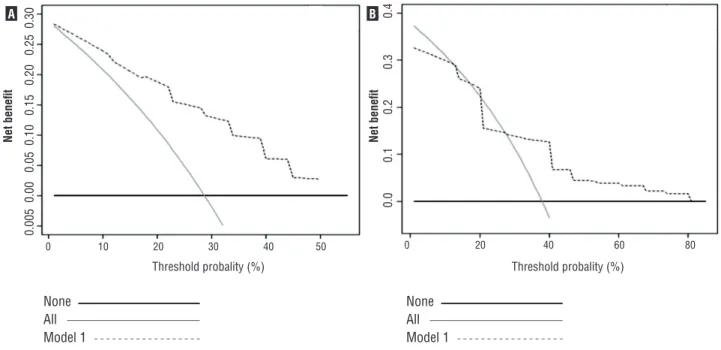
pre-dicted outcome would correspond perfectly with the actual outcome. The performance of model is plotted as the solid line. The models were reaso-nably calibrated (Figure-3). Figure-4 presents the results of the decision curve analysis at 5 years. In our cohort, the predictions resulted in good net benefit across the range of risk thresholds. Decision curve analysis revealed that the use of model was associated with net benefit gains rela-tive to the treat-all strategy. The models perfor-med well across a wide range of threshold proba-bilities using decision curve analysis.
Figure 1 - Time-dependent receiver operating characteristics curve analysis of the Cox regression model. Curve plots the area under the curve over time. (A) Disease-specific survival. Integrated AUC value was 0.792. (B) Overall survival. Integrated AUC value was 0.739.
Figure 2 - (A) Kaplan-Meier plots of disease-specific survival of the Cox regression mode (p <0.0001). (B) Kaplan-Meier plots of overall survival of the Cox regression mode (p <0.0001).
0 20 40 60 80 100
0 12 24 36 48 60 72 81 96 108 120 132 144 156 168 1.0
0.8
0.6
0.4
0.2
0.0 1.0
0.8
0.6
0.4
0.2
0.0
0 12 24 36 48 60 72 81 96 108 120 132 144 156 168
0.4 0.5 0.6 0.7 .08 0.9 1.0
0.4 0.5 0.6 0.7 .08 0.9 1.0
AUC
Disease-specific sur
vival
Months Months
Overall sur
vival
AUC
A
A
B
B
DISCUSSION
The prognosis of patients with UTUC re-mains unsatisfactory because it is one of the most aggressive carcinomas. Knowledge about progno-sis is essential for patients and clinicians whenever
multimodal treatment is considered. At present, no biomarker has been applicable for predicting the outcomes in patients with UTUC. There is in-creasing evidence that the presence of SIR is asso-ciated with poor outcome in patients undergoing resection for a variety of common solid tumors. Figure 3 - (A) Calibration curves for 5-year disease-specific survival predictions. (B)
Figure 4 - Decision curve analysis for 5-year survival predictions. (A) Disease-specific survival. (B) Overall survival. In decision curve analysis, the y-axis measures net benefit, calculated by summing the benefits (true positives) and subtracting the harms (false positives). The straight line represents the assumption that all patients will die and the horizontal line represents the assumption that no patients will die. The dotted line indicates the net benefit of using the new model.
None All Model 1
None All Model 1
0 20 40 60 80 100 0 20 40 60 80 100
Threshold probality (%)
Net benefit Net benefit
Threshold probality (%)
0 10 20 30 40 50 0 20 40 60 80
0.0 0.2 0.4 0.6 0.8 1.0
0.005 0.00 0.05 0.10 0.15 0.20 0.25 0.30
0.0 0.1 0.2 0.3 0.4
0.0 0.2 0.4 0.6 0.8 1.0
Fraction sur
viving 5 years
Fraction sur
viving 5 years
Predicted 5 years survival Predicted 5 years survival
A
A
B
IBJU| PREOPERATIVE SERUM ALBUMIN AS A PROGNOSTIC FACTOR IN PATIENTS
760
It has been proposed that there are intrin-sic pathways involved in cancer-related inflam-mation, such as the induction of genetic instabi-lity by inflammatory mediators. A recent review proposed that cancer-related inflammation is the seventh hallmark of cancer (3). Inflammation in the tumor microenvironment plays an important role in tumor proliferation and the survival of ma-lignant cells, and promotes tumor angiogenesis, invasion, and metastasis (4).
Recent definitions of cancer cachexia in-clude elevation of CRP and hypoalbuminemia (20). CRP is an acute phase reactant that acts as a surveillance molecule for the activation of the adaptive immune system. It is considered a nons-pecific but sensitive marker of systemic inflam-mation and has been related to most of the signs of nutritional depletion (21). Albumin represents a negative acute phase protein and its level de-creases as CRP rises (22). Albumin is no longer considered as a nutritional marker, but rather is considered an inflammatory response marker (23). Increased catabolism, chronic malnutrition, and a chronic inflammatory reaction due to cancer eventually lead to hypoalbuminemia. Hypoalbu-minemia may be due to the production of cytoki-nes, such as interleukin-6, which modulates the production of albumin by hepatocytes (24). Alter-natively, tumor necrosis factor may increase the permeability of the microvasculature, allowing an increased transcapillary passage of albumin (25). Also, the presence of micrometastatic tumor cells in liver may induce Kuppfer cells to produce a va-riety of cytokines, which may modulate albumin synthesis by hepatocytes (24,26).
Hypoalbuminemia provides additional prognostic information for patients with cancer in various organs. Hypoalbuminemia is predictive of increased 90-day mortality and poor overall sur-vival after radical cystectomy in patients with bla-dder cancer (27). In patients with hepatocellular carcinoma, hypoalbuminemia is an independent poor prognostic factor (28). Separate studies re-ported that preoperative hypoalbuminemia is as-sociated with earlier tumor recurrence and death following potentially curative resection for colon and rectal cancer (24,29). Hypoalbuminemia as a marker of the SIR and not CRP is a significant and
independent predictor of survival in patients with primary operable breast cancer (30).
It is not yet established if any specific component of SIR is a better predictor of cancer survival. This study is the first to show hypoalbu-minemia to be superior to other CRP-based SIR prognostic scores for the prediction of progno-sis in patients with UTUC. Presently, among the inflammation-based prognostic scores, only al-bumin was significantly associated with disease--specific survival and had prognostic value inde-pendent of TNM stage. This would suggest that albumin has superior prognostic value than other scores based on CRP (Glasgow prognostic score, modified Glasgow prognostic score, and prognos-tic index) in terms of outcome and should be used in preference to cellular markers of the SIR. There-fore, any further development of prognostic scores based on the SIR should include albumin. Howe-ver, since the basis of the relationship between the SIR and poorer DSS in patients with UTUC is not clear, the cause-effect relationship between a SIR and DSS is questionable.
We used a wide array of tools to evaluate our multivariate Cox regression model including discrimination as well as calibration analyses. In addition, we used decision curve analysis to show the clinical net benefit. Our study results support the view that hypoalbuminemia has significant prognostic value. We observed a good prediction of clinical outcome by the model. The accuracy of the model for DSS and OS disease-specific and overall survival was 81.3% and 75.5%, respec-tively. The Kaplan-Meier curve was within the boundaries of predictions for each of the three strata. Using decision curve analysis, the model demonstrated net benefit gains for predictions of the examined end points at 5 years after radical nephroureterectomy.
The present cohort has a number of limita-tions. Despite the retrospective nature of the data col-lection, not all patients in our database had preope-rative data on CRP-based SIR. Therefore, the patients were not necessarily representative of all patients with UTUC in general. A large-scale prospective vali-dation study is needed to confirm the results.
pa-tients in a single center, a homogeneous patient population was sufficient to indicate the signi-ficance of hypoalbuminemia as a postoperative prognostication of patients with UTUC.
CONCLUSIONS
In the present study, hypoalbuminemia predicted DSS as well as OS independent of stage in patients with UTUC. Pretreatment albumin is a simple biomarker based on routinely available well-standardized measures, is not expensive, and does not involve a time-consuming process. Our study demonstrates that hypoalbuminemia is an independent marker of poor prognosis in patients with UTUC and is superior to other CRP-based SIR protocols in terms of prognostic ability.
ABBREVIATIONS
CI = confidence interval CRP = C-reactive protein CT = computed tomography DSS = disease-specific survival HR = hazard ratio
OS =overall survival
SIR = systemic inflammatory response
UTUC = upper urinary tract urothelial carcinoma
REFERENCES
1. Jemal A, Siegel R, Ward E, Hao Y, Xu J, Thun MJ: Cancer statistics, 2009. CA Cancer J Clin. 2009; 59: 225-49. 2. Rouprêt M, Zigeuner R, Palou J, Boehle A, Kaasinen E,
Sylvester R, et al.: European guidelines for the diagnosis and management of upper urinary tract urothelial cell carcinomas: 2011 update. Eur Urol. 2011; 59: 584-94. 3. Colotta F, Allavena P, Sica A, Garlanda C, Mantovani A:
Cancer-related inflammation, the seventh hallmark of cancer: links to genetic instability. Carcinogenesis. 2009; 30: 1073-81. 4. Mantovani A, Allavena P, Sica A, Balkwill F: Cancer-related
inflammation. Nature. 2008; 454: 436-44.
5. Lamb GW, Aitchison M, Ramsey S, Housley SL, McMillan DC: Clinical utility of the Glasgow Prognostic Score in patients undergoing curative nephrectomy for renal clear cell cancer: basis of new prognostic scoring systems. Br J Cancer. 2012; 106: 279-83.
6. Sharma R, Hook J, Kumar M, Gabra H: Evaluation of an inflammation-based prognostic score in patients with advanced ovarian cancer. Eur J Cancer. 2008; 44: 251-6. 7. Glen P, Jamieson NB, McMillan DC, Carter R, Imrie CW,
McKay CJ: Evaluation of an inflammation-based prognostic score in patients with inoperable pancreatic cancer. Pancreatology. 2006; 6: 450-3.
8. Proctor MJ, Morrison DS, Talwar D, Balmer SM, Fletcher CD, O’Reilly DS, et al.: A comparison of inflammation-based prognostic scores in patients with cancer. A Glasgow Inflammation Outcome Study. Eur J Cancer. 2011; 47: 2633-41.
9. Forrest LM, McMillan DC, McArdle CS, Angerson WJ, Dunlop DJ: Evaluation of cumulative prognostic scores based on the systemic inflammatory response in patients with inoperable non-small-cell lung cancer. Br J Cancer. 2003; 89: 1028-30. 10. McMillan DC: An inflammation-based prognostic score and
its role in the nutrition-based management of patients with cancer. Proc Nutr Soc. 2008; 67: 257-62.
11. Kasymjanova G, MacDonald N, Agulnik JS, Cohen V, Pepe C, Kreisman H, et al.: The predictive value of pre-treatment inflammatory markers in advanced non-small-cell lung cancer. Curr Oncol. 2010; 17: 52-8.
12. Saito K, Kawakami S, Ohtsuka Y, Fujii Y, Masuda H, Kumagai J, et al.: The impact of preoperative serum C-reactive protein on the prognosis of patients with upper urinary tract urothelial carcinoma treated surgically. BJU Int. 2007; 100: 269-73.
13. Lopez-Beltran A, Sauter G, Gasser T: Tumors of the urinary system: infiltrating urothelial carcinoma. In: Eble JN, Sauter G, Epstein JI (ed.), World Health Organization Classification of Tumours-Tumours of the Urinary System and Male Genital Organs. Lyon, IARC Press. 2004; vol 1, pp. 93-109. 14. Rassi A Jr, Rassi A, Little WC, Xavier SS, Rassi SG, Rassi
AG, et al.: Development and validation of a risk score for predicting death in Chagas’ heart disease. N Engl J Med. 2006; 355: 799-808.
15. Iimura Y, Saito K, Fujii Y, Kumagai J, Kawakami S, Komai Y, et al.: Development and external validation of a new outcome prediction model for patients with clear cell renal cell carcinoma treated with nephrectomy based on preoperative serum C-reactive protein and TNM classification: the TNM-C score. J Urol. 2009; 181: 1004-12; discussion 1012. 16. Altman DG, Royston P: What do we mean by validating a
prognostic model? Stat Med. 2000 Feb 29; 19: 453-73. 17. Harrell FE Jr, Lee KL, Mark DB: Multivariable prognostic
models: issues in developing models, evaluating assumptions and adequacy, and measuring and reducing errors. Stat Med. 1996; 15: 361-87.
IBJU| PREOPERATIVE SERUM ALBUMIN AS A PROGNOSTIC FACTOR IN PATIENTS
762
19. Vickers AJ, Elkin EB: Decision curve analysis: a novel method for evaluating prediction models. Med Decis Making. 2006; 26: 565-74.
20. Fearon KC, Voss AC, Hustead DS; Cancer Cachexia Study Group: Definition of cancer cachexia: effect of weight loss, reduced food intake, and systemic inflammation on functional status and prognosis. Am J Clin Nutr. 2006; 83: 1345-50.
21. Mahmoud FA, Rivera NI: The role of C-reactive protein as a prognostic indicator in advanced cancer. Curr Oncol Rep. 2002; 4: 250-5.
22. McMillan DC: Systemic inflammation, nutritional status and survival in patients with cancer. Curr Opin Clin Nutr Metab Care. 2009; 12: 223-6.
23. Barbosa-Silva MC: Subjective and objective nutritional assessment methods: what do they really assess? Curr Opin Clin Nutr Metab Care. 2008; 11: 248-54.
24. Heys SD, Walker LG, Deehan DJ, Eremin OE: Serum albumin: a prognostic indicator in patients with colorectal cancer. J R Coll Surg Edinb. 1998; 43: 163-8.
25. Deehan DJ, Heys SD, Simpson WG, Broom J, Franks C, Eremin O: In vivo cytokine production and recombinant interleukin 2 immunotherapy: an insight into the possible mechanisms underlying clinical responses. Br J Cancer. 1994; 69: 1130-5.
26. Fearon KC, Falconer JS, Slater C, McMillan DC, Ross JA, Preston T: Albumin synthesis rates are not decreased in hypoalbuminemic cachectic cancer patients with an ongoing acute-phase protein response. Ann Surg. 1998;227:249-54.
27. Gregg JR, Cookson MS, Phillips S, Salem S, Chang SS, Clark PE, et al.: Effect of preoperative nutritional deficiency on mortality after radical cystectomy for bladder cancer. J Urol. 2011; 185: 90-6.
28. Cho YK, Chung JW, Kim JK, Ahn YS, Kim MY, Park YO, et al.: Comparison of 7 staging systems for patients with hepatocellular carcinoma undergoing transarterial chemoembolization. Cancer. 2008; 112: 352-61.
29. Cengiz O, Kocer B, Sürmeli S, Santicky MJ, Soran A: Are pretreatment serum albumin and cholesterol levels prognostic tools in patients with colorectal carcinoma? Med Sci Monit. 2006; 12: CR240-7.
30. Al Murri AM, Doughty JC, Lannigan A, Wilson C, McArdle CS, et al.: The relationship between deprivation, tumour stage and the systemic inflammatory response in patients with primary operable breast cancer. Br J Cancer. 2004; 91: 1063-5.
_______________________ Correspondence address: