Histological changes caused by meclofenamic acid in
androgen-independent prostate cancer tumors: evaluation
in a mouse model
_______________________________________________
Iván Delgado-Enciso
1,2, Alejandro D. Soriano-Hernández
1, Alejandrina Rodriguez-Hernandez
1, Héctor R.
Galvan-Salazar
1,2, Daniel A. Montes-Galindo
1, Rafael Martinez-Martinez
1, Laura L. Valdez-Velazquez
4, Rafael
Gonzalez-Alvarez
1, Francisco Espinoza-Gómez
1, Oscar A. Newton-Sanchez
1, Agustín Lara-Esqueda
5, Jose
Guzman-Esquivel
1,31 School of Medicine, University of Colima, Colima, México; 2 Instituto Estatal de Cancerología, Servicios
de Salud del Estado de Colima, Colima, México; 3 Hospital General de Zona Nº1 del IMSS, Colima, México; 4 Chemical Sciences School, University of Colima, Colima, México; 5 Servicios de Salud del Estado de Colima, Colima, México
ABSTRACT
ARTICLE
INFO
______________________________________________________________ ______________________
Meclofenamic acid is a nonsteroidal anti-inflammatory drug that has shown therapeu-tic potential for different types of cancers, including androgen-independent prostate neoplasms. The antitumor effect of diverse nonsteroidal anti-inflammatory drugs has been shown to be accompanied by histological and molecular changes that are res-ponsible for this beneficial effect. The objective of the present work was to analyze the histological changes caused by meclofenamic acid in androgen-independent prostate cancer. Tumors were created in a nude mouse model using PC3 cancerous human cells. Meclofenamic acid (10 mg/kg/day; experimental group, n=5) or saline solution (control group, n=5) was administered intraperitoneally for twenty days. Histological analysis was then carried out on the tumors, describing changes in the cellular architecture, fibrosis, and quantification of cellular proliferation and tumor vasculature. Meclofe-namic acid causes histological changes that indicate less tumor aggression (less hyper-cellularity, fewer atypical mitoses, and fewer nuclear polymorphisms), an increase in fibrosis, and reduced cellular proliferation and tumor vascularity. Further studies are needed to evaluate the molecular changes that cause the beneficial and therapeutic effects of meclofenamic acid in androgen-independent prostate cancer.
Key words:
Prostatic Neoplasms; Meclofenamic Acid;
Therapeutics; Anti-Inflammatory Agents
Int Braz J Urol. 2015; 41:1002-7 _____________________
Submitted for publication: October 19, 2013
_____________________
Accepted after revision: June 06, 2014
INTRODUCTION
Prostate cancer (PCa) is a worldwide pu-blic health problem and is the first cause of death by cancer in men over fifty years of age (1). The growth of this neoplasia is generally dependent on androgen stimulation, although at a given mo-ment it can proliferate in a hormone-independent
manner. Androgen-independent prostate cancers are the most aggressive and difficult tumors to control, causing the majority of deaths by this neoplasia (2-5). For these reasons new treatments that can help PCa patients, especially those with androgen-independent tumor, are necessary.
dissemination of different cancers, including PCa (6, 7), and thus the effect of anti-inflammatory drugs, particularly nonsteroidal anti-inflamma-tory drugs (NSAIDs), has been studied with great interest. Fenamates are a group of NSAIDs that stand out for their strong anti-inflammatory pro-perties upon COX enzyme inhibition. At the same time they are very effective inhibitors of aldo-keto reductases (AKR), especially the AKR1C subfamily members. The inhibition processes of both COX and AKR1C are involved in the NSAID antitumor effect, and thus fenamates show great potential in the treatment of cancer (8, 9).
Of the fenamates studied in PCa, meclo-fenamic acid is the one with the greatest thera-peutic effect (10). It has shown a high degree of cytotoxicity for both androgen-dependent and androgen-independent PCa. In addition, it has been confirmed in a nude-mouse model of hu-man androgen-independent prostate cancer that meclofenamic acid at non-toxic doses (10 mg/ kg/day/25days) significantly reduces tumor gro-wth, prolongs survival, and is even capable of generating total tumor regression in up to 25% of mice treated (10).
Therefore, it is of interest to study the mechanisms by which meclofenamic acid produ-ces therapeutic effects in PCa. The objective of the present work was to analyze the histological changes caused by meclofenamic acid on PCa tumors (nude-mouse model) as a possible first step towards understanding the drug’s antineo-plastic effects.
MATERIALS AND METHODS
Prostate cancer cell line PC3 was employed in this study. PC3 does not respond to androgens, glucocorticoids, epidermal growth factor (EGF), or fibroblastic growth factor (FGF) (11). Cell lines were maintained in DMEM medium (Sigma, St.
Nude-Mouse model of human prostate cancer
A xenotransplanted murine model harbo-ring prostate tumors was created by subcutaneous injection of 1X10⁶ prostate PC3 cells at the
dor-sum. The mouse strain used in these experiments was Foxn1nu (6-to 8-week-old males from Harlan Mexico, Mexico City). Once tumors reached an ap-proximate diameter of 4 mm, mice were divided into two groups. For 20 days, a single applica-tion per day of meclofenamic acid at a volume of 100 µL was intraperitoneally administered to one group of mice at doses of 10 mg/kg/day (n=5) and a second group received saline solution (PBS) (n=5). Mice were euthanized one day after the end of treatment (day 21) and tumors were extracted and histologically processed and analyzed. It has previously been reported that treatment with me-clofenamic acid for 25 days significantly reduced tumor growth and on occasion produced complete tumor regression (10). The purpose of the present study was not to evaluate treatment effectiveness, and so treatment was given for only 20 days in or-der to avoid any total tumor regression and con-sequent tumor histological analysis loss. Animals were handled according to institutional guidelines and to the Mexican Official Norm regulating labo-ratory animal use (11, 12).
Tumor histological analysis
Neutral buffered formalin-fixed tumor tis-sue was embedded in paraffin. Tistis-sue sections (5 µm) were prepared using a microtome and moun-ted on slides. Proliferation and angiogenesis ma-rkers were evaluated by immunostaining for Ki-67 (clone MIB-1) and CD34 (clone QBEnd 10), res-pectively, as previously described (13). DAKO (CA, USA) brand antibodies were used.
statistical analysis, fifteen tumor data per group were obtained by analyzing three representative regions of each of five tumors per group.
Since it has previously been demonstrated that there can be an increase in fibrosis in prostate tumors after different treatments (14, 15), Masson’s trichrome stain was also carried out to detect collagen. A commercial Dakocytomation (Arti-san) Kit was used according to the manufacturer’s instructions (16). Fibrosis was considered to be 1) focal, when it covered less than 10% of the tumor area and presented as isolated bands, 2) moderate, when it covered 10-75% of the tumor area and presented as localized fibrotic zones, and 3) exten-sive, if it presented in generalized form covering more than 75% of the tumor area.
Statistical analysis
After further normal data distribution corroboration (by Kolmogorov-Smirnov test), Student t test was used to compare microvessel density and Ki-67 marker of tumors treated with meclofenamic acid and saline solution. Statistical
significance was interpreted at values of P<0.05 using the MedCalc program (version 8.1.0.0 for Windows; Mariakerke, Belgium).
RESULTS
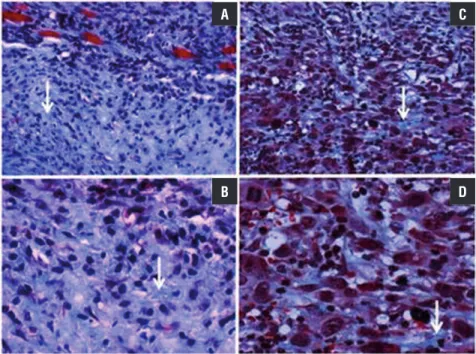
At day 21 from beginning of treatment, proliferation and angiogenesis markers (Ki-67 and CD34) and degrees of fibrosis were analyzed in five tumors from the PBS group (control) and from the 10 mg/kg/day meclofenamic acid group. Initially, general histological tumor characteristics were qua-litatively analyzed. Tumors treated with PBS had greater hypercellularity, greater nuclear polymor-phism, and a greater number of atypical mitoses than the tumors treated with meclofenamic acid (Figure-1). In regard to quantitative analyses sup-ported by immunohistochemical techniques, there was significant reduction in proliferation (Ki-67) and vascularization (CD34) markers (Table-1) in tumors of mice treated with meclofenamic acid.
In addition, Masson’s trichrome stain sho-wed differences among the groups in regard to degree of fibrosis. Fibrosis was focal in control
Figure 1 - Histological slices representative of PC-3 prostatic tumors stained with Masson´s trichrome. Collagen fibers are blue, as signaled by arrows. Tumors treated with meclofenamic acid (A: X200 and B: X400) present with fibrosis (blue color) clearly covering a large portion of the tumor, whereas tumors treated with PBS (controls) only present with isolated collagen fibers (C: X200 and D: X400). Clear differences in cellularity and nuclear polymorphism are also observed.
A
B
C
tumors and was moderate in tumors treated with meclofenamic acid. This result was constant in all five tumors analyzed in each group (Figure-1).
DISCUSSION
Treatment with meclofenamic acid pro-duces significant histological changes that can be considered beneficial and they are concordant with antitumor effects previously reported for this drug. In an androgen-independent PCa mouse mo-del, Soriano-Hernandez et al. (2011) showed that 25 days of treatment with meclofenamic acid at 10 mg/kg/day significantly reduced tumor growth, prolonged survival and was even able to generate total tumor regression (10). However, the histolo-gical mechanisms or changes associated with this beneficial therapeutic effect were not established.
The present study showed that meclofena-mic acid caused histological changes denoting less tumor aggression (less hypercellularity, fewer aty-pical mitoses, and fewer nuclear polymorphisms). It quantitatively confirmed that treatment increa-sed fibrosis, reduced cellular proliferation (Ki-67 reduction) and possibly reduced angiogenesis sin-ce it significantly redusin-ced tumor vascularity.
There is evidence in clinical or preclinical trials that NSAIDs can reduce cellular prolifera-tion (determined by means of the Ki-67 marker)
its reduction, through iRNA, causes a decrease in cell proliferation (26, 27). Meclofenamic acid is a potent simultaneous inhibitor of the COX-2 and AKR1C enzymes, which can explain the signifi-cant reduction in cellular proliferation in tumors in the mice treated in the present study.
There are different reports regarding the influence of NSAIDs on tumor vasculature. A stu-dy in a human breast cancer model showed that COX-2 inhibition by means of celecoxib adnistration for 7 days significantly reduced mi-crovessel density (28% reduction on average), confirming that angiogenesis had been inhibi-ted (28). Various NSAIDs can inhibit tumor gro-wth by drastically reducing their vascularization (29). This effect is generated when endothelial cell apoptosis is induced (30), or through the reduc-tion of vascular endothelial growth factor (VEGF) levels - one of the principal angiogenesis indu-cers (31-33). In addition it has been reported that AKR1C3 overexpression promotes angiogenesis and aggressiveness of PCa cells (PC3), suggesting that AKR1C3-inhibition would reduce angiogene-sis. This concurs with the significant decrease in vascularity (21% reduction on average) caused by meclofenamic acid (COX-2 and ARK1C inhibitor) in the PCa (PC3 tumors) model in the present stu-dy, even though the molecular mechanism respon-sible for it was not determined.
Table 1 - Immunohistochemical markers detected in tumors in the nude-mouse model of human prostate cancer.
Marker Control Meclofenamate* P
Ki-67** 22.0±4 13.9±6.6 0.002
CD34*** 10.8±2.4 8.5±2.1 0.006
*10 mg/kg/day dose
**Positive cell percentage (mean±standard deviation)
been detected in nonmalignant residual prostatic tissue after hormone treatment in humans (35).
In conclusion, meclofenamic acid caused histological changes that indicated decreased tu-mor aggression, increased fibrosis, and cellular proliferation and vascularity reduction in andro-gen-independent prostate tumors, lending support to its great therapeutic potential in regard to this neoplasia. Further studies are needed to evaluate the molecular changes that produce meclofenamic acid’s histological and therapeutic effects in PCa.
ACKNOWLEDGEMENTS
This study was funded by the Fondo Mixto CONACYT- Gobierno de Colima, 2008-C01-83189 and the Fondo Ramon Alvarez Buylla de Aldana (Universidad de Colima).
CONFLICT OF INTEREST
None declared.
REFERENCES
1. Jemal A, Siegel R, Xu J, Ward E. Cancer statistics, 2010. CA Cancer J Clin. 2010;60:277-300.
2. Lassi K, Dawson NA. Emerging therapies in castrate-resistant prostate cancer. Curr Opin Oncol. 2009;21:260-5. 3. Gomella LG, Johannes J, Trabulsi EJ. Current prostate cancer
treatments: effect on quality of life. Urology. 2009;73:S28-35. 4. Festuccia C, Guerra F, D’Ascenzo S, Giunciuglio D, Albini A,
Bologna M. In vitro regulation of pericellular proteolysis in prostatic tumor cells treated with bombesin. Int J Cancer. 1998;75:418-31.
5. Stearns ME, Rhim J, Wang M. Interleukin 10 (IL-10) inhibition of primary human prostate cell-induced angiogenesis: IL-10 stimulation of tissue inhibitor of metalloproteinase-1 and inhibition of matrix metalloproteinase (MMP)-2/MMP-9 secretion. Clin Cancer Res. 1999;5:189-96.
6. Dobrovolskaia MA, Kozlov SV. Inflammation and cancer: when NF-kappaB amalgamates the perilous partnership. Curr Cancer Drug Targets. 2005;5:325-44.
7. Sugar LM. Inflammation and prostate cancer. Can J Urol. 2006;13(Suppl 1):46-7.
8. Skarydová L, Zivná L, Xiong G, Maser E, Wsól V. AKR1C3 as a potential target for the inhibitory effect of dietary flavonoids. Chem Biol Interact. 2009;178:138-44.
9. Kovala-Demertzi D, Dokorou V, Primikiri A, Vargas R, Silvestru C, Russo U, et al. Organotin meclofenamic complexes: Synthesis, crystal structures and antiproliferative activity of the first complexes of meclofenamic acid – novel anti-tuberculosis agents. J Inorg Biochem. 2009;103:738-44. 10. Soriano-Hernández AD, Galvan-Salazar HR, Montes-Galindo
DA, Rodriguez-Hernandez A, Martinez-Martinez R, Guzman-Esquivel J, et al. Antitumor effect of meclofenamic acid on human androgen-independent prostate cancer: a preclinical evaluation. Int Urol Nephrol. 2012;44:471-7.
11. Nakamoto T, Chang CS, Li AK, Chodak GW. Basic fibroblast growth factor in human prostate cancer cells. Cancer Res. 1992;52:571-7.
12. Norma Oficial Mexicana NOM-062-ZOO-1999: Especificaciones Técnicas para la Producción, Cuidado y Uso de loa animales de Laboratorio. Diario Oficial de la Federación de los Estados Unidos Mexicanos, AFIA 6 de Diciembre 1999.
13. Patel MI, Subbaramaiah K, Du B, Chang M, Yang P, Newman RA, et al. Celecoxib inhibits prostate cancer growth: evidence of a cyclooxygenase-2-independent mechanism. Clin Cancer Res. 2005;11:1999-2007.
14. Biermann K, Montironi R, Lopez-Beltran A, Zhang S, Cheng L. Histopathological findings after treatment of prostate cancer using high-intensity focused ultrasound (HIFU). Prostate. 2010;70:1196-200.
15. Saito S, Momma T, Dokiya T, Murai M. Brachytherapy for prostate cancer in Japan. Int J Urol. 2001;8:S22-7.
16. Luna LG. Histopathological Methods and Color Atlas of Special Stains and Tíssue Artifacts, 1st ed. Gaíthersburg, MD: American Histolabs, Inc; 1992.
17. Martin LA, Davies GL, Weigel MT, Betambeau N, Hills MJ, Salter J, et al. Pre-surgical study of the biological effects of the selective cyclo-oxygenase-2 inhibitor celecoxib in patients with primary breast cancer. Breast Cancer Res Treat. 2010;123:829-36. 18. Sohrabi M, Kalati FA, Vatansever S, Abbasi MM, Roshangar
L, Khaki AA, et al. Effect of dietary and topical Celecoxib on expression of bcl-2, bax, c-erb-B2 and Ki67 in carcinogen-induced tongue carcinoma in rat. Pak J Biol Sci. 2009;12:750-7.
19. Ferrandina G, Ranelletti FO, Legge F, Lauriola L, Salutari V, Gessi M, et al. Celecoxib modulates the expression of cyclooxygenase-2, ki67, apoptosis-related marker, and microvessel density in human cervical cancer: a pilot study. Clin Cancer Res.2003;9:4324-31.
20. Quidville V, Segond N, Tebbi A, Cohen R, Jullienne A, Lepoivre M, et al. Anti-tumoral effect of a celecoxib low dose on a model of human medullary thyroid cancer in nude mice. Thyroid. 2009;19:613-21.
22. Wang X, Colby JK, Rengel RC, Fischer SM, Clinton SK, Klein RD. Overexpression of cyclooxygenase-2 (COX-2) in the mouse urinary bladder induces the expression. of immune- and cell proliferation-related genes. Mol Carcinog. 2009;48:1-13.
23. Yashiro M, Nakazawa K, Tendo M, Kosaka K, Shinto O, Hirakawa K. Selective cyclooxygenase-2 inhibitor downregulates the paracrine epithelial-mesenchymal interactions of growth in scirrhous gastric carcinoma. Int J Cancer. 2007;120:686-93.
24. Richardsen E, Uglehus RD, Due J, Busch C, Busund LT. COX-2 is overexpressed in primary prostate cancer with metastatic potential and may predict survival. A comparison study between COX-2, TGF-beta, IL-10 and Ki67. Cancer Epidemiol. 2010;34:316-22.
25. Schmitz KJ, Lang H, Wohlschlaeger J, Reis H, Sotiropoulos GC, Schmid KW, et al. Elevated expression of cyclooxygenase-2 is a negative prognostic factor for overall survival in intrahepatic cholangiocarcinoma. Virchows Arch. 2007;450:135-41.
26. Penning TM, Steckelbroeck S, Bauman DR, Miller MW, Jin Y, Peehl DM, Fung KM, et al. Aldo-keto reductase (AKR) 1C3: role in prostate disease and the development of specific inhibitors. Mol Cell Endocrinol. 2006;248:182-91.
27. Downs TM, Burton DW, Araiza FL, Hastings RH, Deftos LJ. PTHrP stimulates prostate cancer cell growth and upregulates aldo-keto reductase 1C3. Cancer Lett.2011;306:52-9. 28. Fournier LS, Novikov V, Lucidi V, Fu Y, Miller T, Floyd E,
et al. MR monitoring of cyclooxygenase-2 inhibition of angiogenesis in a human breast cancer model in rats. Radiology. 2007;243:105-11.
29. Mayorek N, Naftali-Shani N, Grunewald M. Diclofenac inhibits tumor growth in a murine model of pancreatic cancer by modulation of VEGF levels and arginase activity. PLoS One. 2010;5:e12715.
30. Raut CP, Nawrocki S, Lashinger LM, Davis DW, Khanbolooki S, Xiong H, et al. Celecoxib inhibits angiogenesis by inducing endothelial cell apoptosis in human pancreatic tumor xenografts. Cancer Biol Ther. 2004;3:1217-24.
31. Robich MP, Chu LM, Burgess TA, Feng J, Bianchi C, Sellke FW. Effects of selective cyclooxygenase-2 and nonselective cyclooxygenase inhibition on myocardial function and perfusion. J Cardiovasc Pharmacol. 2011;57:122-30. 32. Kaur J, Sanyal SN. Diclofenac, a selective COX-2 inhibitor,
inhibits DMH-induced colon tumorigenesis through suppression of MCP-1, MIP-1α and VEGF. Mol Carcinog. 2011;50:707-18.
33. Yoshinaga N, Arimura N, Otsuka H, Kawahara K, Hashiguchi T, Maruyama I, et al. NSAIDs inhibit neovascularization of choroid through HO-1-dependent pathway. Lab Invest. 2011;91:1277-90.
34. Larson BT, Bostwick DG, Corica AG, Larson TR. Histological changes of minimally invasive procedures for the treatment of benign prostatic hyperplasia and prostate cancer: clinical implications. J Urol. 2003;170:12-9.
35. Roznovanu SL, Rădulescu D, Novac C, Stolnicu S. The morphologic changes induced by hormone and radiation therapy on prostate carcinoma. Rev Med Chir Soc Med Nat Iasi. 2005;109:337-42.
_______________________ Correspondence address: Jose Guzman-Esquivel, MD Hospital General de Zona Nº1 del IMSS, Av. De los Maestros 149, colonia Centro,