PESQUIS
A
ORIGINAL
Endereço para correspondência: Sandra Aliberti – Rua Cipotânea, 51 – Cidade Universitária – CEP: 05360-160 – São Paulo (SP), Brasil – E-mail: [email protected]
Apresentação: out. 2010 – Aceito para publicação: out. 2010 – Fonte de financiamento: Fundação de Amparo à Pesquisa do Estado de São Paulo (FAPESP) –2005/03803-0 – Conflito de interesse: nada a declarar – Aprovado pela Comissão de Ética para Análise de Projetos de Pesquisa da Diretoria Clínica do Hospital das Clínicas da Faculdade Medicina da Universidade de São Paulo (protocolo no 1.237/05)
RESUMO | O objetivo deste estudo foi investigar se exis-te associação entre a síndrome da dor paexis-telofemoral e as medidas clínicas estáticas: os ângulos do retropé e Q. Foi realizado um estudo observacional, transversal, caso-con-trole, no qual foram avaliados 77 adultos (ambos os sexos), 30 participantes com síndrome da dor patelofemoral e 47 controles. Foram medidos os ângulos do retropé e Q, por meio da fotogrametria. Testes t para amostras
indepen-dentes foram usados para comparações dos resultados das variáveis contínuas entre os grupos. Os resultados das variáveis contínuas foram transformados em classifica-ções clínicas categóricas, para verificar a associação es-tatística com a disfunção, e o teste do χ2 para respostas
múltiplas também foi utilizado. Não houve diferença entre os grupos para o ângulo do retropé [média da di-ferença: 0,2º (IC95% -1,4–1,8)] e ângulo Q [média da diferen-ça: -0,3º (IC95%-3,0–2,4). Não houve associação entre o ân-gulo do retropé [Odds Ratio: 1,29 (IC95% 0,51–3,25)], assim
como entre o ângulo Q [Odds Ratio: 0.77 (IC95% 0,31–1,93)] e a ocorrência da síndrome da dor patelofemoral. Apesar de serem teoricamente justificadas e amplamente utili-zadas na prática clínica fisioterapêutica, não pode-se afir-mar que as medidas dos ângulos do retropé e Q, quando ABSTRACT | The aim of the present study was to
inves-tigate the association between the patellofemoral pain syndrome and the clinical static measurements: the rear-foot and the Q angles. The design was a cross-sectional, observational, case-control study. We evaluated 77 adults (both genders), 30 participants with patellofemoral pain syndrome, and 47 controls. We measured the rearfoot and Q angles by photogrammetry. Independent t-tests
were used to compare outcome continuous measures between groups. Outcome continuous data were also transformed into categorical clinical classifications, in or-der to verify their statistical association with the dysfunc-tion, and χ2 tests for multiple responses were used. There
were no differences between groups for rearfoot angle [mean differences: 0.2º (95%CI -1.4–1.8)] and Q angle [mean differences: -0.3º (95%CI -3.0–2.4). No associations were found between increased rearfoot valgus [Odds Ratio: 1.29 (95%CI 0.51–3.25)], as well as increased Q angle [Odds Ratio: 0.77 (95%CI 0.31–1.93)] and the patellofemoral pain syndrome occurrence. Although widely used in clinical practice and theoretically thought, it cannot be affirmed that increased rearfoot valgus and increased Q angle, when statically measured in relaxed stance, are associated
Clinical rearfoot and knee static alignment
measurements are not associated
with patellofemoral pain syndrome
Medidas clínicas estáticas do retropé e joelho não estão associadas à
síndrome da dor patelofemoral
Sandra Aliberti1, Mariana Souza Xavier Costa2, Sílvia Maria Amado João3,
Anice de Campos Pássaro4, Antonio Carlos Arnone5, Isabel de Camargo Neves Sacco6
Estudo desenvolvido no Laboratório de Biomecânica do Movimento e Postura Humana (LaBiMPH) do Departamento de Fisioterapia, Fonoaudiologia e Terapia Ocupacional da Faculdade de Medicina da Universidade de São Paulo (USP) – São Paulo (SP), Brasil.
1Fisioterapeuta; Mestre em Ciências da Reabilitação pelo Departamento de Fisioterapia, Fonoaudiologia e Terapia Ocupacional da
Faculdade de Medicina da Universidade de São Paulo (USP) – São Paulo (SP), Brasil.
2Fisioterapeuta graduada na USP – São Paulo (SP), Brasil.
3Professora Doutora do Departamento de Fisioterapia, Fonoaudiologia e Terapia Ocupacional da Faculdade de Medicina da USP – São
Paulo (SP), Brasil.
4Fisioterapeuta; Mestre em Ciências da Reabilitação pelo Departamento de Fisioterapia, Fonoaudiologia e Terapia Ocupacional da
Faculdade de Medicina da USP – São Paulo (SP), Brasil.
5Médico do Hospital Universitário da USP – São Paulo (SP), Brasil.
6Professora Livre-Docente do Departamento de Fisioterapia, Fonoaudiologia e Terapia Ocupacional da Faculdade de Medicina da USP
INTRODUCTION
Patellofemoral pain syndrome (PFPS) is one of the most common knee joint dysfunctions, afecting 25% of the general population and, most commonly, young
physically active adult females1,2. Despite its high
inci-dence, there is a lack of consensus on its multifactorial
etiology1,3,4.
According to Fredericson and Yoon, there is no gol-den standard test or clinical method for PFPS diag-nosis, but there is a set of clinical measurements that
conirm the diagnosis of this dysfunction5.Although
patellofemoral symptoms occur during dynamic con-ditions, quantitative dynamic evaluation is not always available in daily clinical practice, besides its higher cost. herefore, static clinical measurements are widely used in PFPS physical examination as this syndrome is supposedly related to lower extremity static
misalig-nment5-7. he static postural alignment of the rearfoot
and the Q angle are examples of clinical static measure-ments, which are frequently employed to evaluate
indi-viduals during PFPS rehabilitation5,7-9.
heoretically, the static postural alignment of the rearfoot is related to the Q angle, in such a way that excessive and/or prolonged subtalar pronation could in-duce medial rotation of the tibia and, therefore, greater
femoral medial rotation in a closed kinetic chain10. he
increased femoral medial rotation would enlarge the Q angle and, consequently, the force vector that pulls the patella laterally would increase the contact forces and pressures on the patellofemoral joint. he higher the Q angle, the greater the lateral force vector acting to increase the retropatellar pressure, and the greater
the risk for developing PFPS6,10,11.Some studies did
not show a relationship between a higher Q angle and PFPS12,13, however a study demonstrated a diference
between patients with this knee disorder and
asympto-matic individuals14.
he static postural alignment of the rearfoot is commonly used to decide whether anti-pronation ta-ping/ortheses should be employed to deal with PFPS
individuals that show excessive pronation during the
lo-comotion15,16. An increased rearfoot valgus17 and
incre-ased calcaneal angle7 were found during relaxed
stan-ce posture in subjects with PFPS, while other authors found no association between rearfoot static posture
and incidence of PFPS13,18. A systematic review, which
evaluated risk factors associated with PFPS, stated that the actual knowledge is still insuicient to con-irm the relationship between rearfoot alignment and this dysfunction, therefore, more evidences need to be
established19.
Although widely recommended in clinical practice
and in theoretical thought1,5-7, the scientiic basis for the
association of rearfoot and Q angles with PFPS is still
controversial8,9,19. Studies with a sample size large
enou-gh to allow inferences from the results are necessary to investigate the association between clinical static mea-sures and PFPS. Appropriate meamea-sures are important to assist treatment decisions and to help to construct an evidenced-based treatment for the dysfunction.
herefore, the aim of the present study was to in-vestigate the association between the PFPS and clinical static measurements: the rearfoot and the Q angles.
METHODS
Participants
Seventy-seven adults of both genders (from 18 to 45 years-old) volunteered for this study. Groups were statistically similar (at mean values) for age (p=0.70), height (p=0.93), and body mass (p=0.73). Baseline char-acteristics of both groups are presented in Table 1. PFPS participants presented median of 68 (Inter-quartile in-terval 57 to 74) points in the Lysholm Functional Knee Scale, while the control ones showed median of 98 (Inter-quartile interval 98 to 100) points.
A cross-sectional, observational, case-control study was undertaken. All participants signed an informed
with patellofemoral pain syndrome (PFPS). These measures may have limited applicability in screening of the PFPS development.
Keywords | patellofemoral pain syndrome; lower extremity;
posture.
mensuradas em posição ortostática, estão associadas com a ocorrência da síndrome da dor patelofemoral. Essas medidas po-dem ter aplicabilidade limitada na triagem desta disfunção.
Descritores | síndrome da dor patelofemoral; extremidade
consent term approved by the Local Ethics Committee (Protocol nº 1237/05). PFPS patients were included if they had pain in the patellofemoral joint area, which arose in at least one of the following situations: resist-ed contraction of the femoral quadriceps, squatting,
prolonged sitting, or descending or ascending stairs4.
A criterion for inclusion was pain during at least two
months4. Current pain intensity was individually
eval-uated using the Visual Analogue Scale; knee function
was rated with the Lysholm Functional Knee Scale20,21.
he intensity of the current pain in the knee region and the functional knee score were evaluated to bet-ter characbet-terize the PFPS sample and to ensure that the control group was asymptomatic and function-ally healthy. he exclusion criteria for the PFPS group were patellar tendinitis, meniscus and knee ligament injuries, and patellar instability. Exclusion criteria for both groups were: history of knee ligament, tendon or cartilage injury; patellar luxation trauma; previous knee surgery; or lower limb discrepancy equals to or
greater than 1 cm22.
As the PFPS is common in physically active in-dividuals, a questionnaire was administered to both groups concerning the frequency, duration, and num-ber of years they had been involved in physical activ-ity. “Physically active” was deined as participation in a minimum of three 30-minute sessions per week of activity requiring a moderate efort, in keeping with
es-tablished guidelines for physical itness23.
Outcome measures
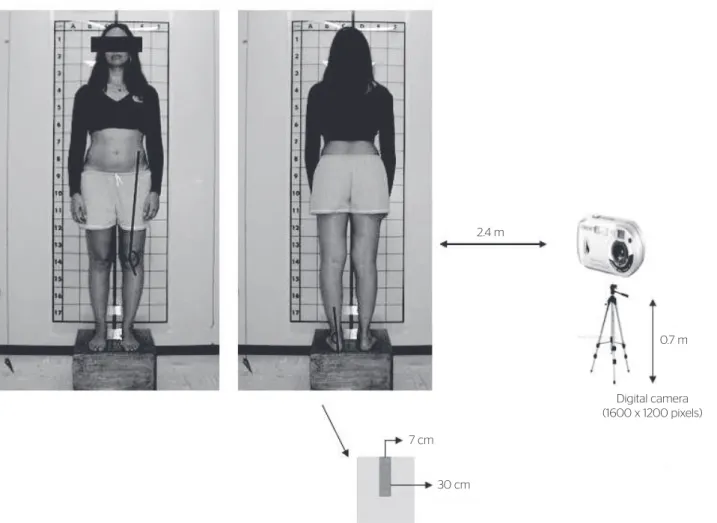
Rearfoot and Q angles were measured by digital
pho-togrammetry24, and the participants were photographed
on the anterior and posterior frontal plane using a digi-tal camera (Sony; 1600x1200 pixels) positioned at knee
height (~0.7 m) on a tripod 2.4 m from the platform,
parallel to the loor24.
he participants were positioned in a relaxed stance position on a wooden platform (40 cm long x 40 cm wide x 20 cm high), which was placed 15 cm away from the wall with a prumo wire hanging from the ceiling down to the side of the platform to beyond the platform height. To maintain uniform inter-subject positioning, they were told to maintain their feet parallel and an eth-ylene vinyl acetate rectangle (7 cm wide x 30 cm long)
was placed between each subject’s feet24.
he photometric calculation of the angles was made using a software for postural evaluation (SAPO, version
0.67)25. Anatomical landmarks were marked with 0.9 cm
self-adhesive tags (Pimaco). Rearfoot angle landmarks were: the midpoint of the posterior lower third of the leg, and the ones of the upper and the lower portion of the calcaneus were marked. Rearfoot angle was formed by the line that comes from the posterior lower third of the leg with that of the lower portion of the calcaneus.
he intersection was on the upper portion of calcaneous26.
Q angle anatomical landmarks were: anterior supe-rior iliac spine, center of patella, and tibia tuberosity. Q angle was formed by the line that comes from the anterior superior iliac spine and of the tibia tuberosity as they intersect at the center of patella (Figure 1).
All measurements were performed by an experienced physical therapist and, in order to evaluate the intra-rater reliability of the outcome measures, a test-retest was
per-formed with a week of interval and compared by t test for
repeated measures and intraclass correlation coeicient.
Paired t test did not show diferences between the irst
and second assessments (p>0.05) for rearfoot and Q an-gles. Intraclass correlation coeicient showed excellent reliability for the rearfoot angle (ICC=0.896) and very
good for the Q angle (ICC=0.870)21.
Table 1. Mean, n (%) characteristics of each group and mean diference or Odds Ratios and the 95% confidence interval (95%CI) between groups: control
and patellofemoral pain syndrome
Characteristics Groups Diference between groups
PFPS (n=30) Control (n=47) PFPS relative to Control (95%CI)
Gender, n female (%) 26 (87) 42 (89) OR=0.7 (0.1–3.1) Age (year), mean (SD) 30 (7) 29 (7) MD=1.0 (-2.2–4.2) Height (cm), mean (SD) 165 (9) 164 (8) MD=1.0 (-2.8–4.8) Body mass (kg), mean (SD) 63 (11) 59 (9) MD=4.0 (-0.4–8.4) Physically active, n (%) 12 (41) 23 (51) OR=0.6 (0.2–1.7) Frequency (days/week), mean (SD) 3 (1) 3 (1) MD=0.0 (-0.4–0.4) Duration (minutes), mean (SD) 67 (22) 85 (38) MD=-18.0 (-33.0–2.9) Time since physically active (year), mean (SD) 3 (4) 5 (5) MD=-2.0 (-4.1–0.1) VAS (cm), mean (SD) 1.6 (2.3) 0.0 (0.0) MD=1.6 (0.9–2.2)
Data analysis
he sample size for both groups was calculated based on a proportion of 30% PFPS development, 80% of
sta-tistical power, and a 5% signiicance level2,27.
In the PFPS, the leg evaluated was the painful one (unilateral dysfunctions) and the one presenting the greatest pain (bilateral dysfunctions). In the control group, the leg evaluated was randomly selected by lot.
After conirming the normal distribution of all con-tinuous measures (Shapiro-Wilk test), the rearfoot and Q angles data were compared between groups using
independent t-tests (p<0.05). In order to investigate
the association between the clinical static measure-ments and PFPS, we transformed the quantitative con-tinuous measures into qualitative categorical variables using classiications, which are frequently used in clini-cal practice. he participants from both groups were distributed into clinical categories. Male participants were classiied as normal if showed Q angles between 11º to 15º, diminished lower than 11º and increased
above 15º8,28. Female participants were classiied as
normal if presented Q angles between 13º to 17º,
di-minished lower than 13º and increased above 17º8,28.
he participants were classiied as varus rearfoot when rearfoot angle was lower than 0º; valgus rearfoot be-tween 0º to 6º, and increased valgus rearfoot when
greater than 6º16.
he qualitative categorical variables were compared
between groups using the χ2 test for Multiple Responses
to verify association between the clinical variables and PFPS. We adopted a statistical signiicance level of 0.05.
RESULTS
No statistical diference was found between groups for rearfoot (p=0.30) and Q angles (p=0.62), when they were compared as continuous measures (Table 2). When the outcome measures were transformed in categori-cal data, no association was found between increased rearfoot valgus (p=0.67) as well as excessive Q angle (p=0.49) and PFPS occurrence.
Figure 1. Data collection setup for rearfoot and Q angles
2.4 m
7 cm
30 cm
0.7 m
Table 3 shows the number and percentage of par-ticipants in each group for each outcome measure and
Odds Ratios (95%CI) between groups. Participants with
PFPS presented 8% more very valgus and 4% less rear-foot varus than their similar controls. PFPS presented 8% less increased Q angles and 11% more diminished Q angles than their similar controls.
DISCUSSION
Despite the greater frequency of increased rearfoot val-gus among participants with PFPS, there was no sig-niicant association between increased rearfoot valgus and excessive Q angle to the occurrence of PFPS.
Although PFPS showed a greater percentage of in-creased rearfoot valgus qualitatively, no diference was found between the means of the rearfoot angle pre-sented by both groups, suggesting that there is no rela-tion between rearfoot posture in relaxed stance and the occurrence of PFPS. his inding is in agreement with other studies, which found no diference between
rear-foot posture in stance and the occurrence of PFPS9,13,18.
Although the reliability of the rearfoot angle found in the present study was excellent, previous reports of
reliability have been poor for this measure29. his poor
general reliability combined with the lack of signiicance between groups suggests that rearfoot angle may not be the most adequate measure for foot posture determi-nation. Other assessment techniques, like foot posture
index, are beginning to be clinically used and may be a more valid alternative method for foot and ankle
as-sessment7. he foot posture index involves triplanar
evalu-ation of the foot, instead of rearfoot angle biplanar mea-surement and this may be an explanation for the better reliability of the former. In addition, further studies that evaluate foot posture in more challenging positions, like unipodal stance or with diferent knee lexion angles, may provide more information about foot posture and be more speciic to predict dynamic function of the foot
and ankle complex than relaxed stance evaluation30.
here was no diference between the Q angle means presented by both groups. Emami et al. have found a re-lation between an increased Q angle and the incidence of PFPS. his study evaluated the Q angle with a
uni-versal goniometer14. For this angle, anatomical reference
points are distant from each other and the muscle mass and arrangement is such that may hinders the position-ing of the goniometer. On the other hand, evaluatposition-ing the Q angle using digital photogrammetry improves the reliability of the measure as the anatomical landmarks are marked and the angle is really formed by the inter-section of the distant landmarks. his methodological diference may contribute to explain the distinct results between Emami’s study results in relation to ours.
he feet of the participants in the present study were positioned parallel at a standardized distance. Although the same inter-participant positioning may have pro-duced some change to the individuals habitual stance and, consequently in our alignment results, our option to position the feet parallel to each other guaranteed
Table 2. Outcome means for each group and mean diference, 95% confidence interval (95%CI) between groups: control and patellofemoral pain syndrome
Outcome Measures Control (n=47) PFPS (n=30) Diference between groups
PFPS relative to Control (95%CI)
Rearfoot angle (degrees) 5.3 (4) 5.5 (3) 0.2 (-1.4–1.8) Q angle (degrees) 17.9 (6) 17.6 (6) -0.3 (-3.0–2.4)
PFPS: patellofemoral pain syndrome; CI: confidence interval
Table 3. Number (%) of participants in each group for each outcome measure and Odds Ratios 95% confidence interval (95%CI) between groups: control
and patellofemoral pain syndrome
Outcome measures Groups Diference between groups
PFPS (n=30) Control (n=47) PFPS relative to Control (95%CI)
Rearfoot angle
Varus 1 (3) 3 (7) 0.51 (0.05–5.10)
Valgus 15 (50) 25 (54) 0.88 (0.35–2.20)
Very valgus 14 (47) 19 (39) 1.29 (0.51–3.25)
Q angle
Diminished 9 (31) 9 (20) 1.81 (0.62–5.26)
Normal 7 (24) 13 (27) 0.79 (0.28–2.30)
Increased 14 (45) 25 (53) 0.77 (0.31–1.93)
the standardization of the feet static position and lower variability among participants.
he systematic review organized by Livingston8
highlighted that there is still no scientiic evidence to support the claim that a greater Q angle, by itself, can determine the incidence of PFPS. hese results have showed that individuals with PFPS presented a sur-prisingly greater percentage of Q angles classiied as diminished, and a lower percentage of normal Q angles, however these indings were not statistically signiicant. hus, the results found in this study do not support the issue of an association between Q angle and PFPS.
he present study contributes to actual knowledge in PFPS research, since evaluated static measurements that are commonly used in clinical practice in a large sample, using very similar groups, enrich the discussion of the relation-ship between these measures and the occurrence of PFPS. One of the limitations of this study was that the retrospec-tive design could not diferentiate cause and efect results, and consequently conclusions about risk factors could not be airmed. Besides, categories used to distinguish, when normal alignment ends and misalignment begins, although clinically recognized, do not have their validity established. Nevertheless, the continuous measures did not show dif-ferences between groups either, conirming the lack of as-sociation between measures and the dysfunction.
Given the multifactorial origin of PFPS, many fac-tors tend to contribute to the development of this dys-function, consequently it may be diicult to separate and isolate these contributions. Besides that, although this study was not prospective, the lack of association between measures and the occurrence of the dysfunc-tion suggests that they may have limited applicability in screening for risk of PFPS development. It does not mean that these measures cannot assist the categoriza-tion of patients into appropriate subgroups, therefore, assisting treatment decisions.
he indings for postural alignment evaluated in this study did not conirm the theory that increased rear-foot valgus and increased Q angle are associated with PFPS in relaxed stance. As this study did not evaluate dynamic alignment, it was not possible to make any as-sociation between static and dynamic alignment in this PFPS group. Future studies could attempt to verify this association in PFPS patients.
In clinical practice, performing an inspection of PFPS patients only in relaxed stance may have limited applicability in screening for risk of PFPS development. Future prospective studies may conirm these indings.
Studies that verify the postural alignment in more chal-lenging situations, such as unipodal support or with diferent knee lexion angles, would contribute to the discussion of the association of postural alignment of the lower limbs and the incidence of PFPS.
CONCLUSIONS
Although widely used in clinical practice and theoreti-cally thought, it cannot be airmed that increased rear-foot valgus and increased Q angle when statically mea-sured in relaxed stance are associated with PFPS. hese measures may have limited applicability in screening of the development of this syndrome.
ACKNOWLEDGMENTS
he authors thanks the Fundação de Amparo à Pesquisa
do Estado de São Paulo FAPESP (2005/03803-0) for the
inancial support.
REFERENCES
1. LaBella C. Patellofemoral pain syndrome: evaluation and treatment. Prim Care. 2004;31:977-1003.
2. Tauton JE, Ryan MB, Clement DB, McKenzie, Lloyd-Smith DR, Zumbo BD. A retrospective case-control analysis of 2002 running injuries. Brit J Sports Med. 2002;36:95.
3. La Botz M. Patellofemoral Syndrome. Phys Sportsmedice. 2004;32:22-9.
4. Davis IR, Powers CM. Patellofemoral pain syndrome: Proximal, Distal e Local Factors. An International Research Retreat. J Orthop Sports Phys Ther. 2010;40:A1-48.
5. Fredericson M, Yoon K. Physical examination and patellofemoral pain syndrome. Am J Phys Med Rehabil. 2006;85:234-43.
6. Powers CM. The influence of altered lower-extremity kinematics on patellofemoral joint dysfunction: a theoretical perspective. J Orthop Sports Phys Ther. 2003;33:639-46.
7. Barton CJ, Bonanno D, Levinger P, Menz HB. Foot and ankle characteristics in patellofemoral pain syndrome: a case-control and reliability study. J Orthop Sports Phys Ther. 2010;40:286-96.
8. Livingston LA. The quadriceps angle: a review of the literature. J Orthop Sports Phys Ther. 1998;28:105-9.
10. Tibério D. The efect of excessive subtalar joint pronation on patellofemoral mechanics:a theoretical model. J Orthop Sports Phys Ther. 1987;9:160-5.
11. Smith TO, Hunt NJ, Donell ST. The reliability and validity of the Q angle: a systematic review. Knee Surg Sports Traumatol Arthrosc. 2008;16:1068-79.
12. Caylor D, Fites R, Worrell TW. The relationship between quadriceps angle and anterior knee pain syndrome. J Orthop Sports Phys Ther. 1993;17:11-6. 13. Thomee R, Renstrom P, Karlsson J, Grimby G. Patellofemoral pain
syndrome in young women. I. A clinical analysis of alignment, pain parameters, common symptoms and functional activity level. Scand J Med Sci Sports. 1995;5:237-44.
14. Emami MJ, Ghahramani MH, Abdinejad F, Namazi H. Q angle: an invaluable parameter for evaluation of anterior knee pain. Arch Iran Med. 2007;10:24-6.
15. Cheung RT, Ng GY, Chen BF. Association of footwear with patellofemoral pain syndrome in runners. Sports Med. 2006;36:199-205.
16. Eng JJ, Pierrynowski MR. Evaluation of soft foot orthotics in the treatment of patellofemoral pain syndrome. Phys Ther. 1993;73:62-8. 17. Levinger P, Gilleard W. An evaluation of the Rearfoot Posture in individuals
with patellofemoral pain syndrome. J Sports Sci Med. 2004;3:8-14. 18. Messier SP, Davis SE, Curl WW, Lowery RB, Pack RJ. Etiologic factors
associated with patellofemoral pain in runners. Med Sci Sports Exerc. 1991;23:1008-15.
19. Waryasz GR, McDermott AY. Patellofemoral pain syndrome (PFPS): a systematic review of anatomy and potential risk factors. Dyn Med. 2008;7:9.
20. Lysholm J, Gillquist J. Evaluation of knee ligament surgery results with special emphasis on use of a scoring scale. Am J Sports Med. 1982;10:150-4.
21. Wahlund K, List T, Dworkin SF. Temporomandibular disorders in children and adolescents: reliability of a questionnaire, clinical examination, and diagnosis. J Orofac Pain. 1998;12:42-51.
22. Aliberti S, Costa MXS, Passaro AC, Arnone AC, Sacco ICN. Medial contact and smaller plantar loads characterize individuals with patellofemoral pain syndrome during stair descent. Phys Ther in Sport. 2010;11:30-4.
23. Shephard RJ. Limits to the measurement of habitual physical activity by questionnaires. Br J Sports Med. 2003;37:197-206.
24. Sacco I, Aliberti S, Queiroz B, Pripas D, Kieling I, Kimura A, et al. Reliability of photogrammetry in relation to goniometry for postural lower limb assessment. Rev Bras Fisioter. 2007;11:411-7.
25. Ferreira EAG, Duarte M, Burke TN, Maldonado EP, Marques AP. Postural Assessment Software: Validation and Reliability. Clinics. 2010;65:675-81.
26. Kernozek T W, Gerr NL. Quadriceps Angle and Rearfoot Motion: Relationships in Walking. Arch Phys Med Rehabil. 1993;74:407-10. 27. Breslow NE, Day NE. Statistical methods in cancer research. The
analysis of case-control studies. Lyon: IARC Scientific Publications; 1980. 28. Livingston LA, Mandigo JL. Bilateral within-subject Q angle
asymmetry in young adult females and males. Biomed Sci Instrum. 1997;33:112-7.
29. Iunes DH, Castro FA, Salgado HS, Moura IC, Oliveira AS, Bevilaqua-Grossi D. Intra and inter-examiner reliability and method repeatability of postural evaluation via photogrammetry. Braz J Physical Ther. 2005;9:327-34.