A Summary Evaluation of the Top-Five Brazilian Psychology
Journals by Native English-Language Scholars
1Uma Avaliação do Sumário das Top-Cinco Revistas Brasileiras de Psicologia por
Professores de Língua Nativa Inglesa
Chris Fradkin
*Centro Universitário La Salle, Canoas, RS, Brazil
Abstract
In the current century, English is the language for the research and dissemination of scientiic indings. But for many scholars, English is a foreign language. This is especially true among the emerging
and developing nations (EDNs), such as the BRICS nations, encompassing Brazil, Russia, India,
China, and South Africa. The present study conducted a survey examining the translational integrity and overall impression of translated summary materials (abstracts and titles) from the ive highest ranking (SCImago Journal Rank) Brazilian journals in the ield of psychology. Analysis proceeded with two models. In the irst model, translated summary materials from 12 randomly-selected articles from four of the ive journals were evaluated by a panel of three native English-language scholars.
Findings indicated an inverse relationship between the overall impression of the materials and their: abstract errors, r(34) = -0.61, p < .001; and total errors, r(34) = -0.62, p < .001; suggesting a direct
relationship between the translational integrity of these EDN materials and the overall impression
they leave with native English-language scholars. A second model added 3 additional articles from the ifth journal (English-language only) to the materials described. The indings from this second
model suggested that for EDN journals, an investment in language resources may substantially improve the impression they leave with native English-language scholars, and thus promote wider
dissemination of their indings.
Keywords: English, translation, Brazil, lost science, lingua franca
Resumo
No século atual, o inglês tem sido a língua usada preferencialmente para pesquisa e a divulgação
cientíica. Mas para muitos pesquisadores, o inglês é uma língua estrangeira. Essa constatação é
muito verdadeira, especialmente, para nações emergentes e em desenvolvimento, (EDNs – Emerging and Developing Nations) tais como as nações do BRICS, abrangendo Brasil, Rússia, Índia, China,
e África do Sul. O presente estudo é um levantamento da integridade translacional e a compreensão
geral de sumários (resumos e títulos) das revistas brasileiras que ocupam os cinco primeiros lugares
da classiicação do SCImago Journal Rank, no campo da psicologia. A análise foi organizada em dois modelos. No primeiro, três professores de língua nativa inglesa avaliaram a tradução dos sumários de 12 artigos escolhidos aleatoriamente de quatro das cinco revistas. Os achados indicaram uma
relação inversa entre a impressão geral e seus respectivos: erros no resumo r(34) = -0.61, p < .001;
e erros totais r(34) = -0.62, p < .001; sugerindo uma relação direta entre a integridade translacional
e a impressão geral que os artigos deixaram em professores de língua nativa inglesa. Um segundo
modelo acrescentou 3 artigos de uma quinta revista, toda ela escrita em língua inglesa, aos materiais
descritos. Os achados deste segundo modelo sugeriram que para as revistas EDNs, um investimento em recursos de linguagem poderão aumentar, substancialmente, a impressão que elas estão deixando em professores de língua nativa inglesa, e incrementar a divulgação dos seus achados.
Palavras-chave: inglês, tradução, Brasil, ciência perdida, língua franca
* Corresponding author: Chris Fradkin, Programa de Estudos em Educação,
Centro Universitário La Salle, UNILASALLE, Av. Victor Barreto, 2288, Canoas, Rio Grande do Sul, 92010-000, Brasil. Email: [email protected] Acknowledgements: Funded by a pós-doc through Coordenação de Aperfeiçoamento de Pessoal de Nivel Superior (CAPES), Ministério da Educação, Brasil.
1 Consulting editors for this article: Claudio Hutz & Gustavo Gauer (UFR
The enterprise of scholarship consists largely of writing
manuscripts. It is a process of construction, in which loor-by-loor, level-by-level, an argument is presented (the hypothesis), the argument is tested, and the indings are interpreted and posited for value in the future. This
level-by-level process involves a literature search, in which
foundational material is gathered. In the 21st century, this
search is conducted primarily on computers, with the
scholar typing key words into worldwide databases (e.g., PubMed, PsycINFO, JSTOR, Google Scholar), which return published articles related to the search. From these
published articles, the scholar gleans background and theory that will serve as the foundation—for the manuscript
that he or she will write.
With worldwide databases, the scholar now has access
to published science from all corners of the globe. While
the diversity of information is a boon for hungry scholars,
this abundance also presents challenges. Foremost of these challenges is language. For the English-language
scholar, this challenge may entail deciphering
non-English-language texts from non-English-non-English-language foreign research journals. However, with English as the lingua franca of
the world, as the universal language of science (de Swaan,
2001; Meneghini & Packer, 2007), there is increasingly
inclusion of summary materials in English, within the
covers of these journals.
For example, when native-English scholars browse
through non-English-language journals, they typically
encounter full texts in native language with abstracts and
titles—the summary materials—in both native language
and in English. While foreign-language journals on
occasion issue special English-language issues, for the
most part this format is the norm. What this offers to the
English-language scholar is the opportunity to grab the “gist” of an article—its purpose, methodology, results and
implications. But does this hybrid format serve the reader
or the author? Is information or confusion conveyed? There has been considerable writing about the so-called
“lost science” (e.g., Hanes, 2014; Meneghini & Packer, 2007; Montgomery, 2013; Packer & Meneghini, 2007).
Coined by Gibbs (1995), this term refers to the unaccessed
scientiic output of the “emerging” or “developing” nations (EDNs). A frequently grouped constellation of EDNs is
the BRICS nations, consisting of Brazil, Russia, India,
China, and South Africa (Wilson & Purushothaman, 2003)
and constituting 43% of the world’s population (Thussu
& Nordenstreng, 2015). Unfortunately, even in the digital
age, with open-access format, science from the BRICS nations remains inaccessible or “lost” to many scholars in
the English-speaking world. Why? Because the publishing is not in lingua franca (English) (Gibbs, 1995). In response
to this conundrum, the dual-language abstract and title—at
best a compromise—attempts to bridge the current gap. But
does it work? Do these hybrid summary materials engage
the English-language scholar? Or do they crumble in the
process of translation? In our search for answers to these
questions, we will sample several journals from Brazil. For our survey, we will focus on psychology.
Psychology is a ield in which Brazil has grown quite amply in recent years (Gamba, Packer, & Meneghini, 2015),
with some authorities describing Brazil’s recent boon as
a golden age, similar to what took place in the US in the 1940s and the 1950s (Hutz, McCarthy, & Gomes, 2004).
This increase is substantiated by the SCImago database
2014 edition, which reveals that between 2004 and 2013,
“the number of Brazilian psychology publications leaped
from 136 to 1,032 articles per year, which corresponds respectively to a 0.41% and 1.59% share of worldwide publications” (Gamba, Packer, & Meneghini, 2015, p. 67). Additionally, among the nations of Latin America
and the Caribbean, SCImago notes that Brazil contributes
more than 54% of published output in the ield, and on the
worldwide stage, ranks 15th (SCImago, 2015).
In spite of Brazil’s impressive EDN statistics, on the
international stage there are problems. In fact, the top
Brazilian psychology journals perform below the mean, when ranked within the global perspective (SCImago,
2015). As to reasons for this contrast, most authorities attribute it to language (Collazo-Reyes, Luna-Morales, Russell, & Pérez-Angón, 2008; Meneghini & Packer, 2007; Packer, 2014). The editorial from this special
issue cites language as the major challenge for Brazilian
scientists (Gomes & Fradkin, 2015). Gamba, Packer, and Meneghini (2015) attribute the struggling performance of
Brazilian journals on the international stage to the scarcity
of English language articles. A recent examination of several top-ranked Brazilian journals found “proiciency problems” in the English-language texts in terms of:
awkward collocation, nominal group error, punctuation and capitalization, and preposition use error (Hanes,
2014, p. 127). In this study, grammatical error rates
among the journals were quite variable, ranging from
2.41 errors/1000 words to 113.59 errors/1000 words (Hanes, 2014). Based on the wide variability in error
rates, one might assume that higher error rates would
correlate with poorer irst impression of the journal, especially for the native English-language scholar. But
is that necessarily so?
While the Hanes (2014) study highlights the grammatical
shortcomings of translation in Brazilian journals, there is no work to this date that has evaluated the translational
integrity of summary materials (i.e., the abstract and title) from Brazilian or other EDN journals. Yet, authorities believe these summary materials are critical. For one,
the American Psychological Association (APA) stresses the importance of conciseness and coherence in a title
(American Psychological Association [APA], 2010, p. 23) and also stresses that a “well-prepared abstract can be
the most important single paragraph in an article” (APA,
2010, p. 26). After all, the abstract is the “irst contact” the
reader has with the article when browsing in a literature
We should note that while the translational integrity of summary materials does depend on grammatical integrity,
it also depends also on structured formats. For example,
researchers browsing through an empirical study would,
at minimum, expect the abstract to inform them of: (1) the research problem; (2) the participants; (3) features of the study methodology; (4) the indings (including effect sizes, conidence intervals, indications of statistical signiicance); and (5) the conclusions and the implications of the study (APA, 2010, p. 26). Thus, these
English-language summary materials provide opportunity for both non-native English-language scholars and the journals that
disseminate their work. At their best, they are a bridge that
serves to span the mighty distance between the
lingua-franca and non-lingua-lingua-franca worlds.
The aim of this study, therefore, was to empirically
examine the translational integrity and overall impression
that translated EDN summary materials leave with native
English-language scholars. We focused on materials from Brazilian psychology journals. Based on the weight of indings from past research, we hypothesized that: (a) there would be mixed levels of translational integrity in the summary materials; (b) the summary materials would leave a mixed impression with native English-language scholars; and (c) there would be a positive correlation
between translational integrity and the overall impression the summary materials left with native English-language
scholars.
Method
A random sampling of abstracts and titles from the
ive highest-ranked Brazilian psychology journals was
presented to a discriminating group of English-language
scholars. The scholars, in turn, evaluated the materials for translational integrity and overall impression.
Participants
Participants included English-language scholars
recruited from the University of California. Inclusion criteria were: (1) native English-language speaker; (2) psychologist; (3) tenured faculty member; and (4) strong publication history. Candidates were restricted to associate or full professors; with a minimum of 2,000 citations in their publication history. First-wave invitations were disseminated to a set of three candidates who satisied the criteria. The candidates were informed that the study was examining the accessibility of foreign-language scientiic articles that have been translated into English; and that
half an hour of their time was requested to evaluate
materials. All three irst-wave candidates accepted; this resulted in a sample distribution consisting of 67% male, 100% Caucasian, 67% full (vs. associate) professor, age M = 57 years, and M citation count = 2,582. The sample
represented the sub-areas of developmental (33%), health
(33%), and quantitative (33%) psychology. Citation
counts were ascertained through Google Scholar. Native
English-language speaker status was ascertained through
educational history (CV) and in person. Compensation was not offered to participants.
Materials
Of the 1,042 worldwide psychology journals listed in the 2013 SCImago Journal Ranking (SJR), 16 (1.5%) are from Brazil. Three original research articles from the most-recent issues of the ive highest-ranked Brazilian journals in this ield (SCImago, 2015) were randomly selected for analysis. All journals were peer-reviewed. Articles in review, editorial, and commentary were excluded. Abstracts and titles were gathered from the inal articles (N
= 15) and assembled on evaluation sheets, one article per
sheet, with instructions for the evaluating scholars. With
three evaluators for each article, this resulted in 45 sheets
total (3 evaluators x 15 articles). Journal titles and names of authors were excluded from the sheets. Because one journal of the ive did not include Portuguese-and-English
summary materials, we considered data from that journal
in a secondary model, hereafter referred to as Model 2. Descriptive details on the journals appear in Table 1. For a sample evaluation sheet, see Appendix A.
Measures
Error counts. Error counts served as proxy for
translational integrity (i.e., low error count: high translational integrity). Title errors were phrases, words
or sections in the title that “bumped” or inhibited the low of information intake (e.g., grammatical errors, sentence structure errors, structural anomalies). Title errors were
noted by the evaluating scholars by their underlining or circling the offending phrases, words or sections on each
evaluation sheet. Abstract errors were phrases, words,
sentences or sections in the abstract that “bumped” or
inhibited the low of information intake (e.g., grammatical errors, sentence structure errors, structural anomalies).
As with title errors, abstract errors were noted by the evaluating scholars by their underlining or circling the offending phrases, words, sentences or sections on each
evaluation sheet. Importantly, it should be noted that
for its usage in this study, the term abstract errors refers
speciically to errors in the abstract of the paper, vs. vague
or non-speciic errors. Total errors were calculated by
summing title errors with abstract errors.
Overall impression. Overall impression was indexed on a 5-point Likert scale, with evaluators rating their impression of the publication, based on their review of the materials: “Based on your review of the abstract and title of this article, rate the likelihood of your revisiting this publication in the future: 0, non-existent; 1, unlikely; 2, possible; 3, likely; 4, very likely.” Post evaluation,
these responses were recoded into a tri-category scale (0-1, Negative; 2, Neutral; 3-4, Positive), as is presented
Procedure
Evaluators and facilitator signed consent forms. Evaluators were then handed the 15 sheets/articles for
evaluation, and instructed to approach the task as if they
were browsing for articles relevant to their research.
The instructions were reviewed for: (1) notating errors
or “bumps” in the material; and (2) registering overall impression (see Appendix A). Evaluators were also
reminded to focus on errors or structural anomalies that
distracted them from the information-intake experience. They were reminded not to nitpick. They were also
reminded that one phrase could qualify for more than
one error. Evaluations were completed between May 14 and June 12, 2015, with each of the evaluators returning a full set (15) of completed sheets to facilitator. The
three sets of completed sheets (N = 45) comprised the
data set.
Models
Model 1 was the primary model for our study and consisted
of the four journals with Portuguese-and-English summary materials: Teoria e Pesquisa (Brasilia), Psicologia e Sociedade,
Paidéia (Ribeirão Preto), and Psicologia: Relexão e Crítica.
Model 2 was the secondary model for our study and consisted
of the four previously mentioned journals plus Psychology & Neuroscience, the journal published exclusively in English, in partnership with the APA. As Model 1 addresses the main questions of our study; accordingly, our indings will focus on that model. Having said that, when Model 2 offers contrasts or pertinent perspectives, the indings from that model will come forward. Whenever possible, however, data from and indings for each model appear jointly in tables and in igures. And inally, for the sake of economy, the journals Teoria e Pesquisa (Brasilia) and Paidéia (Ribeirão Preto) will hereafter
be referred to without their identifying cities in parentheses.
Rank Rank Quintile Journal Worldwide (N) SJR Impact SciELO Qualis Other
Brazil World World Rating Factor Inclusion Rating
(1,042)
1 666 4th Psicologia: Teoria e
Pesquisa (Brasilia) 0.31 0.21 Yes A1
--2 685 4th Psicologia e Sociedade 0.29 0.15 Yes A2
--3 689 4th Paidéia (Ribeirão Preto) 0.29 0.18 Yes A1
--†4 720 4th Psychology &
Neuroscience 0.26 0.62 No
a A2 APA
5 725 4th Psicologia: Relexão e
Crítica 0.26 0.27 Yes A1
--Table 1
Descriptive Statistics of the Top Brazilian Psychology Journals
Note. Rankings per SCImago; SJR Rating, SCImago Journal Rank indicator; Impact Factor, 2013 citations of articles published
2010-12; SciELO, Scientiic Electronic Library Online database; APA, journal published by American Psychological Association as of 2015.
aIndexed in SciELO 2008-2014; withdrawn from SciELO upon partnership with APA in 2015. †Included only in Model 2 analyses.
Overall Impression --- Negative --- Neutral --- Positive ---
Likert Scale 0 1 2 3 4
Table 2
Overall Rating Scale
Based on your review of the abstract and title of this article, rate the likelihood of your revisiting this journal in the future.
Errors Overall
Journal / Article… Evaluator Title Abstract Total Rating
Psicologia: Teoria e Pesquisa (Brasilia): vol.31, no.1
Art. 1 1 0 0 0 2
2 0 3 3 2
3 0 1 1 3
Art. 2 1 1 6 7 2
2 1 6 7 1
3 1 7 8 2
Art. 3 1 0 2 2 2
2 0 6 6 1
3 0 2 2 2
Psicologia e Sociedade: vol.27, no.1
Art. 1 1 0 4 4 1
2 1 8 9 0
3 2 10 12 1
Art. 2 1 0 5 5 1
2 0 6 6 1
3 1 3 4 2
Art. 3 1 0 10 10 1
2 0 8 8 1
3 1 9 10 2
Paidéia (Ribeirão Preto): vol.25, no.60
Art. 1 1 0 1 1 2
2 0 1 1 3
3 0 1 1 3
Art. 2 1 0 5 5 2
2 0 3 3 3
3 0 3 3 3
Art. 3 1 0 7 7 2
2 0 5 5 2
3 0 4 4 2
†Psychology & Neuroscience: vol.8, no.1
Art. 1 1 0 1 1 2
2 0 2 2 4
3 0 4 4 3
Art. 2 1 0 1 1 2
2 0 6 6 3
3 0 3 3 3
Art. 3 1 0 0 0 2
2 0 2 2 4
3 0 1 1 3
Psicologia: Relexão e Crítica: vol.28, no.1
Art. 1 1 0 5 5 2
2 0 9 9 2
3 0 4 4 3
Art. 2 1 0 1 1 2
2 0 1 1 4
3 0 2 2 3
Art. 3 1 0 1 1 2
2 2 3 5 2
3 1 3 4 2
Table 3
Summary Material Ratings by Native English-Language Scholars: Raw Scores
Note. Errors, # of errors cited; Overall Rating, “Based on your review of the abstract and title of this article, rate the likelihood
of your revisiting this journal in the future. (0, nonexistent; 1, unlikely; 2, possible; 3, likely; 4 very likely).” Art. 1/Art. 2/Art. 3, randomly selected articles.
Analysis
Analyses were performed using SPSS version 16.0. First,
title errors, abstract errors, and overall rating were manually
transcribed from the 45 evaluation sheets. Although not
included in the analyses, evaluator comments were transcribed
as well. The variable total errors was then calculated,
summing title and abstract errors. These raw scores are displayed in Table 3. Inter-rater reliability (IRR) was then addressed separately for both models using two-way mixed,
absolute agreement, average-measures intraclass correlations
(ICCs) (McGraw & Wong, 1996) to assess the degree that the
three evaluators provided consistency in their ratings of the
articles. ICCs were calculated separately for each of the four
variables (title errors, abstract errors, total errors, and overall
rating) to estimate consistency of agreement across evaluators.
A robust ICC would suggest that a minimal amount of measurement error was introduced by the independent evaluators, and that their ratings would be suitable for use in
the hypothesis tests of the present study.
Variability in error count (i.e., translational integrity) was addressed separately for both models through GLM Univariate Analysis. To test Hypothesis 1, signiicant main effects for the three error variables were separately examined
with Wald F tests set at p < .05. In the event of a signiicant
main effect, post hoc pairwise comparison tests, set at p <
.05 using Bonferonni correction for multiple comparisons, were used to evaluate differences between journals. To test Hypothesis 2, a signiicant main effect for overall rating was examined with a Wald F test set at p < .05. In the event of a signiicant main effect, post hoc pairwise comparison
tests, set at p < .05 using Bonferonni correction for multiple
comparisons, were used to evaluate differences between
journals. Although not a primary aim of the study, signiicant
main effects for the three error variables and overall rating
were separately examined with Wald F tests set at p < .05 across evaluators. As with the previous analyses, in the event of a signiicant main effect, post hoc pairwise comparison
tests, set at p < .05 using Bonferonni correction, were used to evaluate differences across evaluators.
To test Hypothesis 3, Pearson correlation coeficients
were calculated separately for both models between
overall rating and (1) title errors, (2) abstract errors, and (3) total errors. Four sets of correlations were calculated:
one for each of three evaluators, plus a fourth for the
aggregated mean. Values for the 5-point Likert scale for
overall rating were then recoded into a tri-category scale
(negative, neutral, positive) for overall impression. Using
this scale, articles and journals were ranked accordingly by the overall impression that they left with the evaluating
scholars.
Results
Descriptive Statistics
As shown in Table 1, all ive Brazilian journals in our
sample rank in the fourth quintile internationally, placing
them below the international average. On the domestic front,
all but one of the journals (Psychology & Neuroscience)
are currently indexed by the Scientiic Electronic Library Online (SciELO) database, attesting to their presence in the Latin American and Caribbean markets. Additionally,
the CAPES (Coordenadoria de Aperfeiçoamento de Pessoal de Nível Superior) Qualis indicator, a rating
administered by Brazil’s Ministry of Education, assigns three of the ive journals (Psicologia: Teoria e Pesquisa; Paidéia; Psicologia: Relexão e Crítica) their highest rating of A1, and two (Psicologia e Sociedade; Psychology & Neuroscience) their second-highest rating of A2.
Note. SJR, SCImago Journal Rank Indicator (2015); Ann Rev of Psych, Annual Review of Psychology;
Psych Bulletin, Psychological Bulletin; Pers & Soc Psych Rev, Personality and Social Psychology Re
-view; Ann Rev of Clin Psych, Annual Review of Clinical Psychology; Psi: Teoria e Pesquisa, Psicologia: Teoria e Pesquisa (Brasilia); Psi e Sociedade, Psicologia e Sociedade; Paidéia, Paidéia (Ribeirão Preto); Psych & Neurosci, Psychology and Neuroscience; Psi: Relexão e Crítica, Psicologia: Relexão e Crítica.
Figure 1. SCImago Journal Ranking (SJR) of highest-ranking international (left) and Brazilian
Of the five journals, the one included in the second
model only (Psychology & Neuroscience) is published in partnership with the American Psychological Association (APA), while the remaining four are self-contained inside
Brazil. As measured by the SCImago Journal Ranking (SJR) indicator (SCImago, 2015), Figure 1 reveals an impact differential of 29 to 1 between the top-ive international
psychology journals (M = 8.05) and the top-ive Brazilian
psychology journals in our sample (M = 0.28).
Interrater Reliability
IRR was addressed for both models. For Model 1, ICCs
were calculated separately for the four variables of interest and yielded values, per Cicchetti (1994), in the good (title
errors) to excellent (abstract errors, total errors, overall impression) range (title errors ICC = 0.630 [95% CI = 0.103, 0.880], abstract errors ICC = 0.863 [95% CI = 0.647, 0.957], total errors ICC = 0.849 [95% CI = 0.613, 0.952], overall impression ICC = 0.768 [95% CI = 0.407, 0.926]).
These values indicated that coders had a reasonably strong degree of agreement and suggested that ratings were
consistent across evaluators. Incorporating the ifth journal into the analyses, the ICCs for Model 2 were substantially
the same, with values in the good (title errors, overall
impression) to excellent (abstract errors, total errors) range (title errors ICC = 0.655 [95% CI = 0.225, 0.871], abstract errors ICC = 0.849 [95% CI = 0.647, 0.944], total errors ICC = 0.844 [95% CI = 0.636, 0.943], overall impression ICC = 0.737 [95% CI = 0.393, 0.903]). The moderately
high ICCs suggest that a minimal amount of measurement
error was introduced by the independent evaluators; and
that evaluator ratings were therefore deemed to be suitable
for use in the hypothesis tests of the study.
Error Counts (Hypothesis 1)
Model 1. As seen in Table 4, while mean title error
counts per article ranged from 0.00 (Paidéia) to 0.56
(Psicologia e Sociedade), the main effect, F(3, 32) = 1.48, p = .239, was not signiicant. Mean abstract error counts ranged from 3.22 (Psicologia: Relexão e Crítica) to 7.00
(Psicologia e Sociedade), with a signiicant main effect, F(3, 32) = 4.76, p = .007. Post hoc analysis found the mean
abstract error count of Psicologia e Sociedade statistically higher than the mean abstract error counts of the other three
journals. Conigured from the sum of title and abstract error counts, mean total error counts ranged from 3.33 (Paidéia)
to 7.56 (Psicologia e Sociedade), and likewise, univariate
analysis revealed a signiicant main effect, F(3, 32) = 4.87, p = .007. Post hoc analysis found the mean total error count
of Psicologia e Sociedade statistically higher than the mean total error counts of Paidéia and Psicologia: Relexão e
Crítica; however there was no statistical difference in the
mean total error count of Psicologia:Teoria e Pesquisa and the mean total error counts of the other three journals.
As with the other post hoc pairwise comparison tests, these analyses were conducted at p < .05 with Bonferonni multiple pairwise correction. Error counts were also examined across evaluators, but consistent with the IRR
Errors Overall
Journal N Title Abstract Total Rating
Model 1
Psicologia: Teoria e Pesquisa (Brasilia) 9 0.33a (0.50) 3.67a (2.60) 4.00ab (3.00) 1.89ab (0.60)
Psicologia e Sociedade 9 0.56a (0.73) 7.00b (2.60) 7.56a (2.92) 1.11a (0.60)
Paidéia (Ribeirão Preto) 9 0.00a (0.00) 3.33a (2.12) 3.33b (2.12) 2.44b (0.53)
Psicologia: Relexão e Crítica 9 0.33a (0.71) 3.22a (2.59) 3.56b (2.65) 2.44b (0.73)
Aggregated 36 0.31 (0.58) 4.31 (2.86) 4.61 (3.11) 1.97 (0.81)
Model 2
Psicologia: Teoria e Pesquisa (Brasilia) 9 0.33a (0.50) 3.67a (2.60) 4.00ab (3.00) 1.89ab (0.60)
Psicologia e Sociedade 9 0.56a (0.73) 7.00b (2.60) 7.56a (2.92) 1.11b (0.60)
Paidéia (Ribeirão Preto) 9 0.00a (0.00) 3.33a (2.12) 3.33b (2.12) 2.44ac (0.53) †Psychology & Neuroscience 9 0.00a (0.00) 2.22a (1.86) 2.22b (1.86) 2.89cd (0.78)
Psicologia: Relexão e Crítica 9 0.33a (0.71) 3.22a (2.59) 3.56b (2.65) 2.44ad (0.73)
Aggregated 45 0.24 (0.53) 3.89 (2.80) 4.13 (3.04) 2.16 (0.88)
Table 4
Mean (and Standard Deviation) for Error and Overall Rating Variables: Across Journals
Note. a,b,c,dDifferent superscripts indicate values in the column that are signiicantly different from one another by pairwise comparison
test at p < .05, with Bonferroni correction for multiple pairwise comparisons.
Model 1, four-journal model with summary materials in Portuguese and English.
Model 2, ive-journal model with Psychology & Neuroscience, which publishes exclusively in English.
analysis, no main effect was found: title errors, F(2, 33) = 1.65, p = .208; abstract errors, F(2, 33) = 0.41, p = .668;
total errors, F(2, 33) = 0.47, p = .629. With absence of a main effect, post hoc analyses were not pursued. Means and standard deviations are displayed in Table 5.
Model 2. As seen in Table 4, when incorporating
the ifth journal (Psychology & Neuroscience) into the analyses, the mean error counts were reduced for all three
variables while the mean overall rating was increased.
However, there were no substantial changes in effects: title error counts, F(4, 40) = 2.04, p = .107; abstract error counts, F(4, 40) = 5.30, p = .002; and total error counts, F(4, 40) =
5.66, p = .001. Post hoc analyses were also consistent with Model 1. As in Model 1, error counts were also examined
across evaluators, but consistent with the IRR analysis, no main effect was found: title errors, F(2, 42) = 1.55, p =
.225; abstract errors, F(2, 42) = 0.86, p = .432; total errors, F(2, 42) = 0.96, p = .393. With absence of a main effect, post hoc analyses were not pursued. Means and standard deviations are displayed in Table 5.
Evaluator Comments
Evaluator comments were unsolicited and were offered
in response to materials from three journals. Psicologia: Teoria e Pesquisa and Paidéia received one and two comments, respectively, on inconsistent or inappropriate
verb tense. These comments were from Evaluator 2. Psicologia e Sociedade received the harshest comments
(e.g., “very convoluted,” “generally poor,” “bad”). These comments came from all three evaluators. However, the
presence or absence of evaluator comments did not factor
into the analyses.
Overall Rating (Hypothesis 2)
Model 1. As seen in Table 4, mean overall ratings
ranged from 1.11 (Psicologia e Sociedade) to 2.44 (Paidéia
and Psicologia: Relexão e Crítica), with a signiicant main effect, F(3, 32) = 9.38, p < .001. Post hoc analysis
found the mean overall rating of Psicologia e Sociedade
statistically lower than the mean overall ratings of Paidéia
and Psicologia: Relexão e Crítica; however there was no statistical difference in the mean overall rating of
Psicologia: Teoria e Pesquisa and the mean overall rating
of the other three journals. Post hoc pairwise comparison
tests were conducted at p < .05 with Bonferonni multiple pairwise correction. Overall rating was also examined across
evaluators, but consistent with the IRR analysis, no main effect was found, F(2, 33) = 1.92, p = .163. With absence of a main effect, post hoc analyses were not pursued. Means and standard deviations are displayed in Table 5.
Model 2. As seen in Table 4, when incorporating
the ifth journal (Psychology & Neuroscience) into the
analyses, the mean overall ratings now range from 1.11
(Psicologia e Sociedade) to a higher 2.89 (Psychology & Neuroscience). However, there was no substantial
change in effect size, F(4, 40) = 9.82, p < .001. Post hoc
analysis found the mean overall rating of Psychology & Neuroscience statistically higher than the mean overall ratings of Psicologia e Sociedade and Psicologia: Teoria e Pesquisa; and the mean overall rating of Psicologia e Sociedade statistically lower than the mean overall ratings of Paidéia, Psychology & Neuroscience, and Psicologia: Relexão e Crítica. Post hoc pairwise comparison tests were
conducted at p < .05 with Bonferonni multiple pairwise correction. Overall rating was also examined across
Errors Overall
Evaluator N Title Abstract Total Rating
Model 1
Evaluator 1 12 0.08a (0.29) 3.92a (3.00) 4.00a (3.08) 1.75a (0.45)
Evaluator 2 12 0.33a (0.65) 4.92a (2.71) 5.25a (2.80) 1.83a (1.12)
Evaluator 3 12 0.50a (0.67) 4.08a (3.00) 4.58a (3.55) 2.33a (0.65)
Aggregated 36 0.31 (0.58) 4.31 (2.86) 4.61 (3.11) 1.97 (0.81)
Model 2
Evaluator 1 15 0.07a (0.26) 3.27a (2.99) 3.33a (3.06) 1.80a (0.41)
Evaluator 2 15 0.27a (0.59) 4.60a (2.64) 4.87a (2.75) 2.20a (1.27)
Evaluator 3 15 0.40a (0.63) 3.80a (2.78) 4.20a (3.30) 2.47a (0.64)
Aggregated 45 0.24 (0.53) 3.89 (2.80) 4.13 (3.04) 2.16 (0.88)
Table 5
Mean (and Standard Deviation) for Error and Overall Rating Variables: Across Evaluators
Note. a,bDifferent superscripts indicate values in the column that are signiicantly different from one another by pairwise comparison
test at p < .05, with Bonferroni correction for multiple pairwise comparisons.
evaluators, but consistent with the IRR analysis, no main effect was found, F(2, 42) = 2.32, p = .110. With absence of a main effect, post hoc analyses were not pursued. Means and standard deviations are displayed in Table 5.
Associations Between Overall Rating and Error Counts (Hypothesis 3)
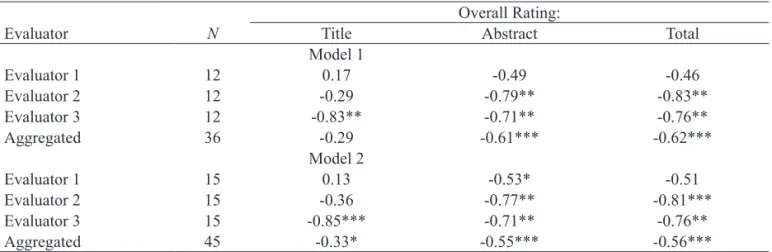
Model 1. Table 6 reports the association between mean overall rating and the three mean error counts: individually for each evaluator and aggregated, for the panel, as a
whole. Considered as a whole, indings indicated a strongly
negatively correlated relationship between mean overall rating and mean abstract errors, r(34) = -0.61, p < .001; and
mean overall rating and mean total errors, r(34) = -0.62, p < .001. There was no statistically signiicant relationship
between mean overall rating and mean title errors, r(34) =
-0.29, p = .090. For evaluator 1, there were no statistically signiicant relationships between mean overall rating and
any of the mean error counts: title errors, r(10) = 0.17, p = .588; abstract errors, r(10) = -0.49, p = .109; and total
errors, r(10) = -0.46, p = .135. For evaluator 2, indings
indicated a strongly negatively correlated relationship between mean overall rating and mean abstract errors,
r(10) = -0.79, p = .002; as well as mean overall rating
and mean total errors, r(10) = -0.83, p = .001; while
the relationship between mean overall rating and mean title errors, r(10) = -0.29, p = .357, was not statistically signiicant. For evaluator 3, indings indicated a strongly
negatively correlated relationship between mean overall rating and all three mean error counts: title errors r(10) =
-0.83, p = .001; abstract errors r(10) = -0.71, p = .009; and
total errors r(10) = -0.76, p = .004.
Model 2. As seen in Table 6, incorporating the
ifth journal (Psychology & Neuroscience) into the analyses of the sample as a whole, elicited a moderately
negatively correlated relationship between mean overall rating and mean title errors, r(43) = -0.33, p = .028; a strongly negatively correlated relationship
between mean overall rating and mean abstract errors,
r(43) = -0.55, p < 0.001; and a strongly negatively
correlated relationship between mean overall rating and mean total errors, r(43) = -0.56, p < .001. For evaluator 1, indings now indicated a strongly negatively
correlated relationship between mean overall rating and mean abstract errors, r(13) = -0.53, p = .042; while
relationships between mean overall rating and mean title errors, r(13) = 0.14, p = .635; and mean overall
rating and mean total errors, r(13) = -0.51, p = .054, remained not statistically signiicant. For evaluator 2, the associations were not substantially changed; as they were not, also, for Evaluator 3.
Overall Impression (Hypotheses 1 & 2)
Table 7 presents an overall impression ranking of the
Brazilian journals in the sample, based on a tri-category
(negative, neutral, positive) scale (see Table 2 for conversion). For Model 1, which includes the journals with
dual-language summary materials, Paidéia and Psicologia:
Relexão e Crítica ranked highest, both with positive overall impression ratings based on two positive (++) and
one neutral (±) article rating. Psicologia: Teoria e Pesquisa
ranked second lowest with a negative overall impression rating based on one positive (+) and two negative (--)
article ratings. And Psicologia e Sociedade ranked lowest of the journals, with a negative overall impression rating
based on three negative (---) article ratings. For Model 2, the ifth journal (Psychology & Neuroscience) ranked the highest, with its positive overall impression rating based
on three positive (+++) article ratings. This, consequently, moved the other journals down a spot.
Overall Rating:
Evaluator N Title Abstract Total
Model 1
Evaluator 1 12 0.17 -0.49 -0.46
Evaluator 2 12 -0.29 -0.79** -0.83**
Evaluator 3 12 -0.83** -0.71** -0.76**
Aggregated 36 -0.29 -0.61*** -0.62***
Model 2
Evaluator 1 15 0.13 -0.53* -0.51
Evaluator 2 15 -0.36 -0.77** -0.81***
Evaluator 3 15 -0.85*** -0.71** -0.76**
Aggregated 45 -0.33* -0.55*** -0.56***
Table 6
Pearson Correlation Coeficients Between Overall Rating and Error Variables
Note. Title, title error count; Abstract, abstract error count; Total, total error count.
Model 1, four-journal model with summary materials in Portuguese and English: Psicologia: Teoria e Pesquisa (Brasilia), Psicologia e Sociedade, Paidéia (Ribeirão Preto), Psicologia: Relexão e Crítica. Model 2, ive-journal model: the above journals plus Psychology & Neuroscience, which publishes exclusively in English.
Discussion
This study is the irst that we are aware of that establishes
a relationship between the translational integrity of EDN translated summary materials and the impression they
leave with native English-language scholars. Consistent with Hypothesis 1, as well as recent research (e.g., Hanes, 2014), is the inding of mixed levels of translational integrity among the journals in our sample. Consistent with Hypothesis 2 is the inding that the summary materials left a mixed overall impression with our native English-language scholars. And consistent with Hypothesis 3 is the inding of a positive correlation between translational
integrity and the overall impression the summary materials
left with our native English-language scholars. This inal inding provides answers to questions that we posed, as to the eficacy of dual-language summary materials. As to the
potential that this hybrid format has in narrowing the gap between the lingua franca and non-lingua franca worlds?
Our prognosis is conditionally positive. It is conditionally positive because—as our indings indicate—the overall
impression of the translated summary materials is related
to its translational integrity. This inding forecasts both
a narrowing of the gap and a widening of the gap that
separates the lingua franca and non-lingua franca worlds.
We forecast a narrowing of the gap, for those scientists and authors who rate high in their translational integrity—
through access to resources or afinity for language; or a hunger to share their science with the world—; and a
widening of the gap, for scientists who rate substantially
lower, regardless of their circumstance or reason.
Therefore, connection can be built or distance be made wider, depending on the resource of translation (see Curry
& Lillis, 2014).
Regarding the speciics of our indings, there were signiicant differences in translational integrity and overall
impression ratings between two of the journals that we
surveyed: Psychology & Neuroscience and Psicologia e Sociedade. A partial explanation may be resources.
As previously mentioned, of the five journals in the sample, Psychology & Neuroscience is the only journal in the group that is partnered with an English-language
entity; it is published by the APA. It is important to
remember, however, that while other Brazilian journals
have attempted to publish exclusively in English, Psychology & Neuroscience was the first Brazilian
psychology journal that did so and succeeded. This
continued success, as well as partnership with the APA, is at least partially attributable to the journal having native English-language resources that predated the move to
APA. And also, due to its partnership with the APA—the
world’s largest association of psychologists—the quality of submissions to Psychology & Neuroscience, in terms of content and coherence, may be at a slightly higher
level than submissions offered to the other journals. As
to the consistently low ratings of Psicologia e Sociedade,
several observations bear discussion. The irst concerns its presentation style. Of the ive journals that we surveyed, Psicologia e Sociedade was the only one of all the ive that styled its titles in an “all caps” format. While title styling
is at the discretion of the journal, most native English-language scholars—psychologists especially—are used to titles in an APA format: “uppercase and lowercase”
(APA, 2010, p. 23). Conceivably, therefore, an all caps presentation may have negatively inluenced the ratings. The second observation concerns evaluator comments. Of the materials evaluated, the materials from Psicologia e Sociedade were the only ones that garnered comments such as “generally poor” or “really didn’t understand this
at all.” Although these comments were not included in
the analyses, they are consistent with our ratings of the
journal. An explanation for this phenomenon may be that Psicologia e Sociedade represents a segment of psychology
very “Brazilian” in its thought; so Brazilian, in fact, that it has dificulty moving its native scientiic concepts into sister terminology in English.
There were particular challenges we encountered in
this study. The irst was our evaluation of translational integrity. In contrast to the Hanes study (2014), in which translated text was evaluated by a linguistic specialist for speciic grammar errors, the evaluation in our study was more nuanced. In our study, the native English-language
scholars were not only evaluating grammar, they were
dealing with a larger whole. They were dealing with the all-elusive abstract. The abstract that sums the essence of
the study: its point and purpose, its participants, its method, what it showed us, where it leads us, what it tells us of the
future. In one paragraph: the essence of our work. By its very nature, the scientiic abstract is a complex beast to quantify. For grading, there were no speciic rubrics we adhered to. The evaluators focused on disruptions in the low; and when encountering them: underlined or circled. And because disruptions in the low may vary
person-to-Ratings
Journal Articles Overall
†Psychology & Neuroscience + + + +
Paidéia (Ribeirão Preto) + + ± +
Psicologia: Relexão e Crítica + + ± +
Psicologia: Teoria e Pesquisa
(Brasilia) + - -
-Psicologia e Sociedade - - -
-Table 7
Overall Impression of the Top-Five Brazilian Psychology Journals by Native English-Language Scholars
Note. +, positive: mean overall rating > 2; -, negative: mean
overall rating < 2; ±, neutral: mean overall rating = 2. See Table 2 for coniguration of categories.
person, the grading of an abstract is elusive. Nonetheless,
within our study, as reported earlier, there was consistency
across evaluators.
A second challenge was in our overall rating
assessment. The instructional wording for this rating was:
“Based on your review of the abstract and title of this article, rate the likelihood of your revisiting this journal
in the future.” We were reminded, however, that browsing
on-line scholars pay less attention to the journal than the
article itself. When encountering this issue, the facilitator backed up and clariied our intent and answered questions the evaluator had. And again, as mentioned earlier, the IRR found consistency across evaluators.
This study aimed to empirically examine the
translational integrity and overall impression that translated EDN summary materials leave with native
English-language scholars. Previous studies by Theresa Lillis and Mary Jane Curry have examined writing for
publication practices among non-native English-speaking
scholars (Curry & Lillis, 2014; Lillis & Curry, 2010; Lillis, Hewings, Vladimirou, & Curry, 2010); as the previously-mentioned Hanes (2014) study has examined EDN grammatical integrity from a linguistic perspective. However, ours is the irst study we are aware of that empirically examined the association between translational
integrity and overall impression, from the perspective of a
panel of well-published native English-language scholars.
An obvious limitation in this research is that it focuses on summary materials from one country in one discipline:
Brazil and psychology, respectively. Accordingly, it would
be helpful if we had data on summary materials from other
EDNs, across a spectrum of varied disciplines. Should this
opportunity create itself, it would be especially helpful if the same instruments were used, which would facilitate
the merging and comparison of data. Comparisons across disciplines would be interesting to have; as would comparisons across culture and several other variables. Expanded research of this nature would obviate another
limitation: in this study, we looked at
Portuguese-to-English translation only. Would indings be consistent
across Chinese-to-English or Russian-to-English? Accordingly, future research would address these and other
questions, as we struggle with the issues of lost science.
The present study established a direct relationship between the translational integrity of EDN summary materials and their overall impression with native
English-language scholars. In the case of our highest-rated journal
(Psychology & Neuroscience), we see the likely inluence
that language resources has on translational integrity and, consequently, on the overall impression that the journal
leaves with the native English-speaking scholar. In the case
of our lowest-rated journal (Psicologia e Sociedade), we
see the converse inluence that language resources has on
translational integrity and, consequently, on the overall impression the journal leaves with the native English-speaking scholar, through summary materials that, to this
author’s eyes, were not proofread by a native
English-language speaker.
The mention of proofreading brings up our inal issue:
Are the EDN journal editors aware of the importance of proofreading? Especially translated summary materials?
Through my experience at several EDN journals, in the role
of English-language editor, reviewer, and guest editor, the answer is emphatically no. Through my experience, albeit
anecdotal, the English-language translation of titles and
abstracts is mostly viewed a nuisance or a necessary task. It
is rarely viewed an opportunity to spread the gospel of one’s
science to the global universe. Hopefully, upon reading this, a few converts will be made. There is also the distinction
between a “rote translation” and a translation transparent
to the native English-language eye. Using the example of
Portuguese-to-English translation, a rote translation would translate all the words, with a minimal regard for sentence-structure stylings or the myriad of subtleties between the
languages. See Marlow (2014) for a top ten list of worst offenders. A transparent translation, of the same material, would read as if a native English-speaker were the writer. And, in accordance with our indings (Model 1 and Model 2), a transparent translation of coherent subject matter
would engender a positive impression on the native
English-language reader. And a positive impression on the journal.
And, in doing so, recover a scrap of the lost science—in
whatever modicum or tiny bit.
References
American Psychological Association. (2010). Publication manual of the American Psychological Association (6th ed.).
Washington, DC: American Psychological Association. American Psychological Association. (2015). Retrieved from
http://www.apa.org/
Cicchetti, D. V. (1994). Guidelines, criteria, and rules of
thumb for evaluating normed and standardized assessment
instruments in psychology. Psychological Assessment, 6(4),
284-290.
Collazo-Reyes, F., Luna-Morales, M., Russell, J., & Pérez-Angón, M. A. (2008). Publication and citation patterns of
Latin American & Caribbean journals in the SCI and SSCI
from 1995 to 2004. Scientometrics, 75(1), 145-161.
Curry, M. J., & Lillis, T. M. (2014). Strategies and tactics in academic knowledge production by multilingual scholars.
Education Policy Analysis Archives, 22(32).
de Swaan, A. (2001). Words of the world: The global language system. Cambridge: Polity Press.
Gamba, E. C., Packer, A. L., & Meneghini, R. (2015). Pathways to internationalize Brazilian journals of psychology.
Psicologia: Relexão e Crítica, 28(suppl. 1), 66-71. Gibbs, W. W. (1995). Lost science in the third world. Scientiic
American, 273, 92-99.
Gomes, W. B., & Fradkin, C. (2015). Editorial. Psicologia:
Relexão e Crítica,28(suppl. 1), 1.
Hanes, W. F. (2014). Nominal groups as an indicator of
non-native English communication problems in top-ranked
Brazil: The road behind and the road ahead. In M. J. Stevens & D.Wedding (Eds.), Handbook of International Psychology
(pp. 151-168). New York: Brunner-Routledge.
Lillis, T. M., & Curry, M. J. (2010). Academic writing in global context. London: Routledge.
Lillis, T., Hewings, A., Vladimirou, D., & Curry, M. J. (2010).
The geolinguistics of English as an academic lingua franca: Citation practices across English-medium national and
English-medium international journals. International Journal of Applied Linguistics, 20(1), 111-135.
Marlow, M. A. (2014). Writing scientiic articles like a native English speaker: Top ten tips for Portuguese speakers. Clinics, 69, 153-157.
McGraw, K. O., & Wong, S. P. (1996). Forming inferences about some intraclass correlation coeficients. Psychological Methods, 1(1), 30-46.
Meneghini, R., & Packer, A. L. (2007). Is there science beyond
English? EMBO reports, 8, 112-116.
Montgomery, S. L. (2013). Does science need a global language?: English and the future of research. Chicago:
University of Chicago Press.
Packer, A. L. (2014). The emergence of journals of Brazil and scenarios for their future. Educação e Pesquisa, 40(2),
301-323.
Packer, A. L., & Meneghini, R. (2007). Learning to communicate science in developing countries. INTERCIENCIA, 32, 643.
SCImago. (2015). SJR — SCImago Journal & Country Rank. Retrieved from http://www.scimagojr.com
Thussu, D. K., & Nordenstreng, K. (2015). Contextualizing the BRICS media. In K. Nordenstreng, & D. K. Thussu (Eds.),
Mapping BRICS Media (p. 2). New York: Routledge.
Wilson, D., & Purushothaman, R. (2003). Dreaming with BRICs: The path to 2050 (Vol. 99). Goldman, Sachs & Company.
Received: July 08, 2015
Appendix A
Title:
Phasellus nec nisi interdum aliquam nulla vitae: luctus tellus
Abstract:
Lorem ipsum dolor sit amet, consectetur adipiscing elit. Fusce pellentesque diam ac leo ultricies lobortis. Nunc hendrerit in ipsum nec eleifend. Vestibulum sit amet magna vitae ipsum eleifend pulvinar. Donec semper tincidunt metus, non euismod tortor. Proin aliquet condimentum augue, eu pharetra lacus porta nec. Donec
risus lorem, pellentesque quis tellus in, ornare ultrices
diam. Etiam nec magna nec augue feugiat scelerisque. Curabitur faucibus laoreet neque sit amet imperdiet. Donec molestie ligula non tincidunt porta. Vestibulum sed tellus eu ex dictum sollicitudin. Maecenas in elit dapibus, convallis massa vitae, cursus tortor. Aliquam consectetur vel dui quis varius. Praesent dapibus vestibulum ipsum, non sollicitudin urna convallis a. Donec odio erat, porta ac laoreet quis, maximus id tortor.
Keywords: dignissim semper, nisl, odio bibendum
ipsum, et quis
INSTRUCTIONS:
1) READ TITLE AND ABSTRACT AS IF YOU WERE BROWSING FOR ARTICLES RELEVANT TO YOUR RESEARCH.
2) WHILE READING, CIRCLE OR UNDERLINE
PHRASES OR WORDS OR SENTENCES THAT ‘BUMP’ OR INHIBIT THE FLOW OF INFORMATION INTAKE (e.g., grammar errors, sentence structure errors, structural anomalies).
3) WHEN DONE WITH 1 & 2, RATE THE LIKELIHOOD OF YOUR REVISITING THE JOURNAL THESE SPECIFIC MATERIALS CAME FROM BASED ON THE READ-THROUGH YOU JUST DID (0 = non-existent through 4 = very likely).
PLEASE:
FOCUS ON ERRORS OR STRUCTURAL ANOMALIES THAT DISTRACT FROM THE READING/SCANNING EXPERIENCE: NO NEED TO NITPICK
AND REMEMBER:
ONE PHRASE COULD QUALIFY FOR MORE THAN ONE ERROR
OVERALL IMPRESSION RATING:
Based on your review of the abstract and title of this article, rate the likelihood of your revisiting this journal
in the future.