Psychological Research Collaboration and Visibility in
Iberoamerica
A Visibilidade e Cooperação da Pesquisa em Psicología na Ibero-América
Wilson López-López
a,*, Félix de Moya Anegón
b, César Acevedo-Triana
c, Agnaldo Garcia
d, &
Luis Manuel Silva
aaPontiicia Universidad Javeriana, Bogotá, Colombia, bSCImago Research Group, Madrid, Spain, cPontiicia Universidad Javeriana, Bogotá, Colombia & dUniversidade Federal do Espírito Santo, Vitória, ES, Brazil
Abstract
The phenomenon of collaboration is an increasing trend in many ields of science, including that of psychology. In Iberoamerican psychology, collaboration occurs on a local and international level. The aim of the study was to evaluate the levels of collaboration in Iberoamerica, using as a baseline the level of worldwide collaboration in psychology in 2012. We collected data from the Scopus database and analyzed it by cluster distribution. Analysis of the sample found within-country collaboration prominent among Iberoamerican psychologists. Findings indicated that in Iberoamerica there is signiicantly less global collaboration than in other regions, although Iberoamerican scientists are receptive to the idea and acknowledge its potential.
Keywords: Scientiic production, psychology, collaboration, Iberoamerica
Resumo
O fenômeno da colaboração é uma tendência em crescimento em muitos campos da ciência, incluin-do a psicologia. Na psicologia ibero-americana a colaboração vem ocorrenincluin-do em nível regional e internacional. O objetivo deste estudo foi avaliar níveis de colaboração em Ibero-América, usando como linha de base o nível de colaboração mundial em psicologia nos anos de 2012. Os dados foram coletados da base Scopus e analisado pela distribuição de dados segundo seu grau de agrupamento (cluster). A análise mostrou que a colaboração entre ibero-americanos é maior dentro dos respecti-vos países e menor em nível global. Mesmo assim, destaque-se que cientistas ibero-americanos são receptivos a ideia de internacionalização e reconheçam seu potencial.
Palavras-chave: produção cientíica, psicologia, colaboração, Ibero-América
* Correspondence concerning this article should be addressed to Wilson
López-López, Facultad de Psicología, Pontiicia Universidad Javeriana, Ediicio 95 - Manuel Briceño S.J. Carrera 5 No. 39-00 Bogotá, D.C. Colombia. E-mail: [email protected].
Science is a social practice. In many cases, it depends on interaction and partnership, and collaborative
relationships (Bozeman & Corley, 2004). Once these
collaborative relationships are established, they are
sustained through scientiic output—published articles produced by the collaborators—and the attention that that
output draws. Collaboration, however, occurs on different levels: locally, nationally or internationally (Chinchilla-Rodríguez, Vargas-Quesada, Hassan-Montero,
González-Molina, & Moya-Anegón, 2009; Guerrero Bote, Olmeda-Gómez, & de Moya-Anegón, 2013). Studies indicate that
internationalization is a factor related to the mechanism of
collaboration (Chinchilla-Rodríguez et al., 2009; Guerrero Bote et al., 2013).
Some authors attribute the recent increase in scientiic
collaboration to the accessibility of internet and technology,
the internationalization of training programs, and students exchange and training of doctoral and postdoctoral researchers. They additionally cite the increase of economic incentive for collaborative work
(García-Martínez, Guerrero-Bote, & Moya-Anegón, 2012; Kliegl & Bates, 2010; Romero-Torres, Acosta-Moreno, & Tejada-Gómez, 2013). It is thus clear that increasing opportunities
for collaboration may increase incentives for collaboration,
and thus increase scientiic output (Easterbrook, 1993; Johnson, 2009; Porac et al., 2004).
One way to measure international collaboration is through the analysis of output from researchers, joint projects, academic events, and research training
(Chinchilla-Rodríguez et al., 2009; Garcia et al., 2014). Following Chinchilla-Rodríguez et al. (2009),
we understand that collaboration is the reflection of an individual and institutional process that promotes
generation of output, irst and foremost which are scientiic
73 López-López, W., Anegón, F. M., Acevedo-Triana, C., & Garcia, A. (2015). Psychological Research Collaboration and Visibility in Iberoamerica.
dificult to evaluate in terms of long-term scientiic merit;
but they do serve as a means to quantify collaboration. For
the purpose of this paper, collaboration will be deined as
output derived from co-authorship between researchers at
different institutions (Chinchilla-Rodríguez et al., 2009; Garcia et al., 2014; Katz & Martin, 1997).
This collaboration generates levels of analysis beyond the number of published articles. We must consider variables such as authorship criteria, design, implementation and development, considering the
contribution of each author to the inal output (Allen, Brand, Scott, Altman, & Hlava, 2014; Shen & Barabasi, 2014). On the other hand, contexts such as participating
institutions, area of expertise, and countries of the principal
authors inluence the impact of products as well (Guerrero Bote et al., 2013). In general, international cooperation
is associated with higher visibility and higher impact. Various studies have tried to characterize the collaboration
parameters by regions (Guerrero Bote et al., 2013). Thus,
one collaboration analysis between China and other countries demonstrated that while the growth of the number of publications increases among the countries of high economic level, the impact of these publications does not
increase in the same way (He, 2009). More comprehensive
reports suggest there is a system that favors countries with wider science resources (Leydesdorff & Wagner, 2008). On the other hand, contexts such as participating institutions, area of expertise, and countries of the principal
authors also inluence the impact of products (Arencibia Jorge & de Moya Anegón, 2008; Cervi, Galante, & Oliveira, 2013; García-Martínez, Guerrero-Bote, Hassan-Montero, & Moya-Anegón, 2009; Lovón Canchumani, Leta, & Figueiredo, 2013). In the case of psychology,
there have been attempts to use these kinds of measures to improve program quality and the prestige of researchers
(Alzate-Medina, 2008; García-Cepero, 2010; López, Silva, García-Cepero, Bustamante, & López, 2011).
The incidence of collaboration is closely associated with
subject ield. In the humanities, for example, the sense of
authorship is strong and collaboration among authors is
low (Bordons, Gomez, Fernandez, Zulueta, & Mendez, 1996; Garcia et al., 2014; Salazar-Acosta, Lucio-Arias, López-López, & Aguado-López, 2013). This feature is
probably related to the way products relate to the contexts
in which they are produced. In the ield of psychology,
recent studies show that high productivity is concentrated
in some countries; therefore the way these researchers
collaborate could be used as a model for other countries to
increase research (García-Martínez et al., 2012; Guerrero Bote et al., 2013). Geographical proximity and language
could be seen as factors that could enhance communication. Studies indicate that when English is used as a lingua franca of science, visibility can increase for productions from countries where English is not the native language, even
for works related to local issues. (Morales, Jaraba-Barrios,
Guerrero-Castro, & López-López, 2012). The cooperation
phenomenon is so complex that even publications favor those products that do not present a sectorial emphasis in the focus of the magazine, but on the contrary, that allows to maintain publications as a real channel dissemination of relevant knowledge and international use (Vera-Villarroel, López-López, Lillo, & Silva, 2011).
Psychology in Latin America
In Latin America the dynamic of production and consumption of knowledge are different from the dynamic
at the international level (Alonso & Sánchez, 2005; Delgado, 2011). Although psychology in Latin America
has experienced a sustained growth in production (López et al., 2011), the visibility of the knowledge generated nowadays has had a wide participation due to the inclusion of Latin American psychology journals in international indexes (Navarrete-Cortés, Fernández-López,
López-Baena, Blasco, & Buela-Casal, 2010; Quevedo-Blasco & López-López, 2011). The internationalization
of this knowledge has shown that scientific journals have turned out to be a privileged channel for production
visibility (Rivera-Garzón, 2008; Zych & Buela-Casal, 2010). In this regard, the measurement of 2013 indicates
that Iberoamerica has had several publications in Scopus,
from which 34 are from Latin America and 22 are from
Spain. In terms of production, countries like Chile,
Colombia, Argentina, Brazil and Spain account for over a thousand documents from 1996 to 2013, and Spain and Brazil are among the countries with the highest production.
In terms of psychology production worldwide, Spain
ranks 9th and Brazil 15th. These preliminary results show
a particular and important tendency in the contribution of psychological documents worldwide. Regarding the trend
in cooperation between researchers, approximately 25% of
the works are credited to single authors. This trend did not diminish but remained stable, or even increased, suggesting
a particular proile of some researchers (Scimago Group, 2014). Considering the above, the aim of this work is to
describe the trend of global cooperation, with an emphasis on the cooperation in Latin America and Iberoamerica.
Method
Using the Scopus database, we examined psychology
production with a focus on authors and institutional
afiliation between at least two different countries to deine the collaboration (Garcia et al., 2014). We developed
two bibliometric maps according to the methodology
described by Hassan-Montero et al. (2014). In short
terms, we used as a unit of analysis the international
scientiic journals in which we evaluated the data on three
previously standardized measures: citation, co-citation and bibliographic coupling.
We used the data from the Scopus database (2003-2013) with the general qualiication of “Psychology”
which the size of the area indicates the weight within the chosen indicator and the color represents the node
to which it belongs (Hassan-Montero, Guerrero-Bote, & Moya-Anegón, 2014). For the descriptive results, data
from international and Latin American bases in Scimago were consulted (http://www.scimagojr.com/).
Results
Descriptives
Within the countries of the region (Iberoamerica) that contribute the largest amount to the worldwide psychological production, there are six countries: Spain
(9th place, 14,927 documents); Brazil (15th place, 7,379
documents); Mexico (25th place, 3,071 documents);
Portugal (31st place, 2,469 documents); Colombia (40th
place, 1,109 documents) and Chile (41st place, 1,095
documents) (Table 1). As for the production in Latin
America, we found in irst place Brazil (7,379 documents), followed by Mexico (3,071 documents) and Argentina (1,276 documents), then Colombia (1,109 documents) and Chile (1,095 documents).
We also found that the distance between the irst and second place (Brazil and Mexico respectively) is more than double the production of the second place (48.1% of Brazil and 20% of Mexico) and the distance of the irst ive
places is far from the rest of the countries (Table 2). When analyzing the relationship between the documents and the quotations, we found a high correlation (r = 0.989, p <
0.0001; r2 = 97%), indicating that the growth in production
is associated with growth in quotation. This relationship is not the case in Puerto Rico, however, where production
is low (336 documents) in comparison with the number of citations reported (7,281 citations). The same asymmetrical relationship also appears in Panama with 24 documents and more than 1,500 citations, which indicates that there are more than 147 citations per document produced. If we
consider the mean of citations among the 20 countries,
without considering Panama, we find around 13.15 citations per document (DE = 6.78); therefore it is dificult to understand the behavior of 147 citations per document in the case of Panama (0.2% in the region population) which places it in irst place if we organize the data by this item.
Another relevant relationship to analyze is the one between co-authorship and citations, in which we found that the greater the number of the authors per work, the greater the number of citations of the study, as a function of the increase in possible sources of citations. In this analysis,
we examined this parameter by country (Table 3). In the
case of Puerto Rico and Panama, we found that the high amount of citations was due to an article that generated
around 15,000 citations. The article was in the area of health, in which more than 15 countries collaborated. Since
the production in these countries is high, it does not allow
us to relect about the phenomenon of inlation that we
can see in countries with low production. Thus, in cases
in which productive proiles are low, the measurement of
citation counts per document is not a good indicator of
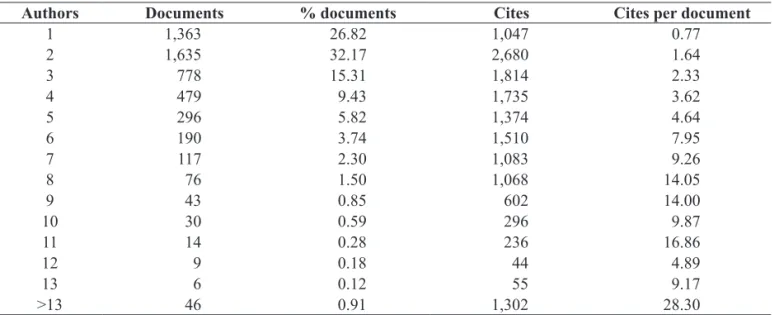
this relationship. A good example can be seen in Table 4,
where it is evident that as the number of authors in an article increases, the number of citations increase, reaching a maximum of eight authors per article. This feature suggests a positive relationship between the number of authors per article and the number of citations that article receives.
Cooperation Networks
To analyze the results of collaboration, we performed
irst a graphic grouping of global cooperation, following the method of Hassan-Montero et al. (2014). In Figure 1,
we can observe that the extent of participation of countries is given by the size of the circles, i.e., the greater the
area, the greater the participation; and the proximity of
the countries in the graph indicates the strength of this collaboration. Additionally, the intersection of the circles shows the cooperation between the countries, according to
the country of the authors’ afiliation. Thus, the proximity
between the countries and the intersection expresses the strength of cooperation.
As can be observed in Figure 1, there is a group of countries that have higher levels of cooperation. To facilitate the understanding, information was grouped by
variables into several clusters. Cluster 1 (cluster EEUU) is characterized by collaborations around United States and England, some close countries as Canada, Australia, Korea
and Israel are represented in a spatial proximity and this
would be given by the intensity in scientiic and academic relationships generated by these countries and the EEUU. In
second place, another cluster would consist of Iberoamerican
countries, such as Spain, Brazil, Portugal and Colombia,
and close to this one is seen other Iberoamerican countries such as Mexico, Philippines, Chile, Argentina, Venezuela, Peru, and Costa Rica. In this second cluster, despite having a common language, there is a geographical distance between Portugal and Spain and the other European countries with high productivity such as Germany, France and the triplet of Switzerland, Finland and Norway. In Iberoamerica, there is a particular interaction between Argentina, Chile, Venezuela and Peru. It does not make any difference that the language similarity largely corresponds to a geographical proximity. In this analysis, in addition to the intersection, the proximity
deines inclusion in the cluster. In the European cluster, there
are several groups indicating differences in the preference for cooperation, thus the Central European countries (Germany,
Holland, Belgium, Switzerland, Luxembourg, Bulgaria and
Austria) would form a type of individual interaction. In a second place, the Western European countries would form another particular interaction (Hungary, Romania, Poland, Czech Republic, Lithuania, Estonia, Malta, Slovenia and
Bosnia). In the case of a smaller group of Northern Europe,
there are the countries of Finland, Sweden and Norway.
75 López-López, W., Anegón, F. M., Acevedo-Triana, C., & Garcia, A. (2015). Psychological Research Collaboration and Visibility in Iberoamerica.
Country Documents Citable
documents Citations Self-Citations
Citations per
Document H index
1 United States 283,925 271,992 5,533,083 2,279,002 22.18 456
2 United Kingdom 68,288 63,963 1,182,659 227,988 20.97 262
3 Canada 39,470 38,027 722,252 102,778 22.02 221
4 Germany 37,062 35,426 499,069 112,049 16.73 191
5 Australia 26,378 25,328 384,081 52,358 18.76 163
6 France 26,041 25,103 191,672 32,003 9.88 135
7 Netherlands 23,182 22,377 441,378 68,504 24.98 185
8 Italy 15,250 14,456 176,042 26,393 15.93 128
9 Spain 14,927 14,621 129,072 34,207 12.27 103
10 Japan 11,141 10,906 93,796 14,675 9.56 92
11 Israel 9,129 8,869 138,977 18,149 18.27 124
12 Belgium 8,513 8,201 117,861 16,070 18.98 111
13 Switzerland 8,009 7,691 96,517 9,949 16.19 104
14 Sweden 7,624 7,394 121,811 15,150 19.07 115
15 Brazil 7,379 7,197 39,397 7,551 14.67 71
16 New Zealand 5,449 5,237 86,797 7,229 19.82 107
17 China 5,249 5,095 39,380 6,326 16.28 69
18 Norway 4,946 4,819 68,277 6,643 18.30 87
19 Turkey 4,636 4,562 27,189 3,959 13.66 64
20 Finland 4,558 4,418 74,045 8,294 19.83 93
21 Hong Kong 4,250 4,148 60,132 7,430 17.38 90
22 Taiwan 4,146 4,068 37,882 5,997 15.46 68
23 Austria 3,781 3,589 41,051 3,718 14.58 80
24 South Africa 3,626 3,517 26,516 4,892 9.13 62
25 Mexico 3,071 3,001 16,454 2,186 6.58 48
26 Ireland 2,987 2,759 28,142 2,865 11.64 66
27 South Korea 2,977 2,896 30,490 2,621 17.04 67
28 Denmark 2,793 2,671 36,645 4,162 18.04 72
29 Poland 2,777 2,705 14,596 1,491 9.73 55
30 Greece 2,495 2,437 22,544 1,969 11.70 57
31 Portugal 2,469 2,403 18,325 2,293 16.80 54
32 India 2,427 2,271 17,240 1,815 11.98 50
33 Iran 2,003 1,971 6,844 1,210 15.87 34
34 Singapore 1,868 1,828 19,208 1,503 14.73 58
35 Russian Federation 1,737 1,713 10,734 1,124 10.65 43
36 Hungary 1,602 1,549 18,400 1,612 18.45 61
37 Argentina 1,276 1,228 10,110 1,352 14.20 41
38 Romania 1,228 1,208 3,724 401 11.87 27
39 Czech Republic 1,143 1,126 6,776 1,232 7.15 38
40 Colombia 1,109 1,077 6,929 549 11.01 38
41 Chile 1,095 1,074 5,993 1,151 9.92 33
42 Malaysia 1,085 1,076 3,772 690 12.61 26
43 Croatia 837 828 5,180 433 12.89 30
44 Slovakia 674 670 2,730 624 4.33 22
45 Cyprus 503 493 3,157 378 11.45 27
46 Slovenia 471 462 3,875 312 12.29 31
47 Thailand 450 432 4,977 188 24.50 27
48 Estonia 439 426 5,142 643 15.76 35
49 Nigeria 399 387 2,614 168 8.78 25
50 Iceland 396 383 4,996 458 17.15 36
Table 1
Ranking of Countries in Terms of Production in Psychology for the Period of 1996-2013
sy
ch
ol
og
y
/P
sic
ol
og
ia R
el
ex
ão
e C
rític
a,
28
(S
), 7
2-8
1.
Table 2
Ranking of Latin American Countries In Terms of Production In Psychology for the Period of 1996-2013
Data collected from Scimago (http://www,scimagojr,com/ ).
Country Documents Citable documents Citations Self-Citations Citations per Document
H index Documents Percent
1 Brazil 7,379 7,197 39,397 7,551 14.67 71 48.1
2 Mexico 3,071 3,001 16,454 2,186 6.58 48 20.0
3 Argentina 1,276 1,228 10,110 1,352 14.20 41 8.3
4 Colombia 1,109 1,077 6,929 549 11.01 38 7.2
5 Chile 1,095 1,074 5,993 1,151 9.92 33 7.1
6 Puerto Rico 336 328 7,281 312 28.46 39 2.2
7 Venezuela 234 227 1,683 167 7.72 21 1.5
8 Peru 172 166 1,356 36 11.30 16 1.1
9 Cuba 142 141 1,256 87 14.49 20 0.9
10 Uruguay 107 105 639 38 7.36 13 0.7
11 Costa Rica 105 105 1,373 83 22.41 18 0.7
12 Jamaica 66 66 585 18 15.95 12 0.4
13 Trinidad and Tobago
58 56 718 12 13.21 16 0.4
14 Guatemala 35 35 164 2 8.02 6 0.2
15 Ecuador 30 29 128 3 5.29 8 0.2
16 Bolivia 29 29 617 13 27.89 10 0.2
17 Barbados 27 27 202 17 7.55 7 0.2
18 Dominican
Republic
25 25 218 0 15.86 6 0.2
19 Panama 24 22 1,542 9 147.63 8 0.2
77 López-López, W., Anegón, F. M., Acevedo-Triana, C., & Garcia, A. (2015). Psychological Research Collaboration and Visibility in Iberoamerica.
Country Documents Citable
documents Citations Self-Citations
Citations per Document
H
index Dif
1 Netherlands 23,182 22,377 441,378 68,504 24.98 185 15.5204836
2 United States 283,925 271,992 5,533,083 2,279,002 22.18 456 41.1886465
3 Canada 39,470 38,027 722,252 102,778 22.02 221 14.2302133
4 United Kingdom 68,288 63,963 1,182,659 227,988 20.97 262 19.2775771
5 Finland 4,558 4,418 74,045 8,294 19.83 93 11.2012965
6 New Zealand 5,449 5,237 86,797 7,229 19.82 107 8.32862887
7 Sweden 7,624 7,394 121,811 15,150 19.07 115 12.4373004
8 Belgium 8,513 8,201 117,861 16,070 18.98 111 13.6347053
9 Australia 26,378 25,328 384,081 52,358 18.76 163 13.6320203
10 Hungary 1,602 1,549 18,400 1,612 18.45 61 8.76086957
11 Norway 4,946 4,819 68,277 6,643 18.30 87 9.72948431
12 Israel 9,129 8,869 138,977 18,149 18.27 124 13.0589954
13 Denmark 2,793 2,671 36,645 4,162 18.04 72 11.3576204
14 Hong Kong 4,250 4,148 60,132 7,430 17.38 90 12.3561498
15 South Korea 2,977 2,896 30,490 2,621 17.04 67 8.59626107
16 Portugal 2,469 2,403 18,325 2,293 16.80 54 12.5129604
17 Germany 37,062 35,426 499,069 112,049 16.73 191 22.4516049
18 China 5,249 5,095 39,380 6,326 16.28 69 16.0639919
19 Switzerland 8,009 7,691 96,517 9,949 16.19 104 10.3080286
20 Italy 15,250 14,456 176,042 26,393 15.93 128 14.992445
21 Iran 2,003 1,971 6,844 1,210 15.87 34 17.6797195
22 Taiwan 4,146 4,068 37,882 5,997 15.46 68 15.8307376
23 Singapore 1,868 1,828 19,208 1,503 14.73 58 7.82486464
24 Brazil 7,379 7,197 39,397 7,551 14.67 71 19.166434
25 Austria 3,781 3,589 41,051 3,718 14.58 80 9.05702663
26 Argentina 1,276 1,228 10,110 1,352 14.20 41 13.3728981
27 Turkey 4,636 4,562 27,189 3,959 13.66 64 14.5610357
28 Malaysia 1,085 1,076 3,772 690 12.61 26 18.2926829
29 Spain 14,927 14,621 129,072 34,207 12.27 103 26.5022623
30 India 2,427 2,271 17,240 1,815 11.98 50 10.5278422
31 Romania 1,228 1,208 3,724 401 11.87 27 10.7679914
32 Greece 2,495 2,437 22,544 1,969 11.70 57 8.73403123
33 Ireland 2,987 2,759 28,142 2,865 11.64 66 10.1805131
34 Colombia 1,109 1,077 6,929 549 11.01 38 7.92322124
35 Russian
Federation 1,737 1,713 10,734 1,124 10.65 43 10.4713993
36 Chile 1,095 1,074 5,993 1,151 9.92 33 19.20574
37 France 26,041 25,103 191,672 32,003 9.88 135 16.6967528
Table 3
Worldwide Psychology Production Ranked by Country 1996-2013
Figure 1. Collaboration network in psychology represented by countries in 2012.
Note. USA, United States; GBR, Great Britain; DEU, Germany; CAN, Canada; AUS, Australia; FRA, France; NLD, Holland; ESP,
Spain; ITA, Italy; BRA, Brazil; BEL, Belgium; JPN, Japan; ISR, Israel; CHE, Switzerland; CHN, China; SWE, Sweden; TWN, Taiwan; NOR, Norway; PRT, Portugal; IND, India; NZL, New Zealand; FIN, Finland; KOR, Korea; HKG, Hong Kong; ROU, Romania; AUT, Austria; TUR, Turkey; ZAF, South Africa; IRN, Iran; DNK, Denmark; IRL, Ireland; POL, Poland; SGP, Singapore; MEX, Mexico; GRC, Greece; CHL, Chile; RUS, Russian Federation; HUN, Hungary; COL, Colombia; CZE, Czech Republic; MYS, Malaysia; HRV, Croatia; EST, Estonia; SRB, Serbia and Montenegro; CYP, Cyprus; SVN, Slovenia; THA, Thailand; SAU, Saudi Arabia; MAC, Macao; LTU, Lithuania; PHL, Philippines; LUX, Luxemburg; ISL, Island; PER, Peru; NGA, Nigeria; ARE, United Arab Emirates; LBN, Lebanon; PRI, Puerto Rico; VEN, Venezuela; JOR, Jordan; KEN, Kenya; PAK, Pakistan; MLT, Malta; BGR, Bulgaria; LKA, Sri Lanka; IDN, Indonesia; JAM, Jamaica; MAR, Morocco; CRI, Costa Rica; DZA, Algeria; BGD, Bangladesh; BIH, Bosnia Herzegovina; TZA, Tanzania; DMA, Dominica; TUN, Tunisia; GEO, Georgia; NAM, Namibia; PSE, Palestine.
Authors Documents % documents Cites Cites per document
1 1,363 26.82 1,047 0.77
2 1,635 32.17 2,680 1.64
3 778 15.31 1,814 2.33
4 479 9.43 1,735 3.62
5 296 5.82 1,374 4.64
6 190 3.74 1,510 7.95
7 117 2.30 1,083 9.26
8 76 1.50 1,068 14.05
9 43 0.85 602 14.00
10 30 0.59 296 9.87
11 14 0.28 236 16.86
12 9 0.18 44 4.89
13 6 0.12 55 9.17
>13 46 0.91 1,302 28.30
Note. Data collected from Scimago (http://www,scimagojr,com/); Authors, number of authors per work; Documents, number of articles. Table 4
Brazilian Psychology Articles: 2012
79 López-López, W., Anegón, F. M., Acevedo-Triana, C., & Garcia, A. (2015). Psychological Research Collaboration and Visibility in Iberoamerica.
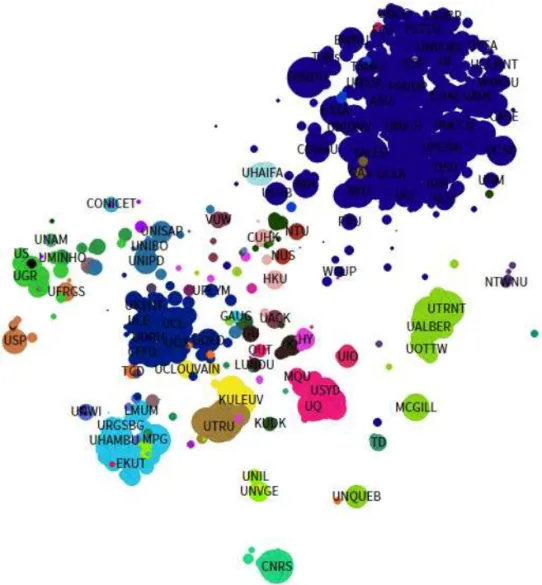
Figure 2. Collaboration network in psychology represented by institutions in 2012, colors correspond to countries.
Note. The colors represent the countries of origin of institutions.
In Figure 2 we confirmed that the distribution of institutional collaboration is found around the countries, which indicates a tendency for a local cooperation at a
country-speciic level. Unlike Figure 1, where it is shown that the proximity to United States could be due to an
interest of the countries to cooperate by virtue of what
such interaction represents for the collaborators; in the second igure, England assumes a more central role due to
its size and geographical proximity with other countries.
There is not a speciic country that represents the center of the collaboration map, but instead, we ind that the countries generate speciic interactions by their sizes and
production. In the case of Iberoamerican institutions, this is not represented in the map due to two main factors. First, the amount of collaborations is of less than 100 documents which is the cutoff point for the interaction to be represented in the graph, and second because
speciic collaborations are also not shown in the spatial
representation.
Discussion
As for the global dynamic, a speciicity and local
behavior of each one of these is shown. It stands out the production and collaboration in psychology in North America, and highlights the high levels of participation within (inbred) versus an interest in some countries (Asia) to cooperate, for different reasons, with the
United States of America, due to the prestige derived from this collaboration (Porac et al., 2004). Additionally
and related to the cooperation interest with economic powers of North America, would be related explanations
that favor scientiic collaboration and associates it with
economic power between countries. Collaboration among these countries could have increased over time in more traditional areas of science (biology, chemistry, engineering, clinical and neuroscience) but not necessarily have the same levels of interaction, despite regularizing
the case of China this collaboration does not necessarily foster the impact of these publications, which would show other factors such as currents of thinking (main stream)
or the interest in social scientiic topics as possible
mechanisms that stimulate collaboration. However,
Bordons et al. (1996) showed how in the area of biology
different patterns of collaboration can exist. In this regard, it is noted that the most productive authors do not always
have the same patterns of collaboration (Bordons et al., 1996). But, as is clear in the Brazilian case, the increase
in the amount of products increases the likelihood of citation. Even though these variables might be important, the cluster result reported by different variables indicates the importance of different aspects of interest in the international collaboration with developing countries
(He, 2009).
The cooperation dynamic seems to obey factors such as relationship stability, agreements, training and
other variables of speciic disciplinary interest. Part of this evidence and beneit has been found in regional
publications, with collaboration alliances between researchers increasing among these publications
(García-Martínez et al., 2009; Navarrete-Cortés et al., 2010).
Several studies have demonstrated that productivity in psychology in Iberoamerica represents a growing number worldwide, beside the steady increase in the last years allows to predict that this growth would be higher
(García-Martínez et al., 2012; Morales et al., 2012). Even
further, considering the collaboration maps between the countries, there appears to be regional interest to increase this collaboration path (Figure 1). It is important to note that this cooperation brings together Latin America as a region, not through geographical proximity, but through the closeness of language. This phenomenon fosters what is called linguistic community (Figure 1).
On the other hand, when we observe the dynamic in the production of institutional collaboration, these interactions become clearer for us and we can differentiate the
collaboration processes between Brazilian and Portuguese
psychology on one side, and Latin American and Spanish psychology on the other (Figure 2).
In addition, citation practices of these communities affect perspectives. Thus, for example, the citation
dynamic of countries such as Portugal, Brazil and Spain (Table 3) is enhanced by the number of works
produced, but also by the number of authors included in
a publication (Table 4).
Another characteristic of this study is that the sample of the cooperation networks is not a static network. That is, although there may be several factors that explain the cluster gathering (language, geopolitics, philosophical school), the absence of homogeneity of a single criteria suggests that these dynamics, in greater or lesser extent, affect the collaboration processes, and are changing over time. These dynamics have inspired the concept of
“evolution networks” in contrast to the concept of networks
of small discrete worlds, in attempts to offer insights to
these projects (Jeong, Ravasz, Schubert, & Vicsek, 2002). In this regard, within studies of cooperation and scientiic
impact measurement, we must consider the dynamic between researchers, institutions and the impact these have
on cooperation (Deville et al., 2014).
An important limitation of the study is that, although it is possible to see the cooperation levels in different world regions, the case of Iberoamerica for example, has large
production not relected in the Scopus indicator. This is
because many of the Iberoamerican publications indexed on international databases like Scopus represent only a part of the regional publications. Consequently, we recommend that future assessments of cooperation include local publications along with those indexed in the international databases. This dual-level approach would allow us to see a more representative picture of cooperation, through its inclusion of a wider range of journals.
Conclusion
Finally, we can conclude that in the ield of psychology
there is a tendency for international cooperation and, in the case of Iberoamerican psychology, there is variability by local dynamics. There is also variability through regional and
institutional collaboration; however, there are several factors
promoting and accelerating the process. Thus, factors such as the current of thought and economic status are important to consider in the process of establishing partnerships.
References
Allen, L., Brand, A., Scott, J., Altman, M., & Hlava, M. (2014). Credit where credit is due. Nature, 508, 312–313.
Alonso, J. O., & Sánchez, L. A. (2005). Revistas electrónicas en América Latina: Un panorama general. Revista Digital Universitaria, 6(1), 1–11.
Alzate-Medina, G. (2008). Efectos de la acreditación en el mejoramiento de la calidad de los programas de psicología de Colombia. Universitas Psychologica, 7(2), 425–439.
Arencibia Jorge, R., & de Moya Anegón, F. (2008). La evaluación de la investigación cientíica: Una aproximación teórica desde la cienciometría. ACIMED, 17(4).
Barabási, A. L., Jeong, H., Néda, Z., Ravasz, E., Schubert, A., & Vicsek, T. (2002). Evolution of the social network of scientiic collaborations. Physica A, 311, 590–614.
Bordons, M., Gomez, I. I., Fernandez, M. T., Zulueta, A., & Mendez, A. (1996). Local, domestic and international scientiic collaboration in biomedical research. Scientometrics,
37(2), 279–295.
Bozeman, B., & Corley, E. (2004). Scientists’ collaboration strategies: Implications for scientiic and technical human capital. Research Policy, 33(4), 599–616. doi:10.1016/j.
respol.2004.01.008
81 López-López, W., Anegón, F. M., Acevedo-Triana, C., & Garcia, A. (2015). Psychological Research Collaboration and Visibility in Iberoamerica.
Chinchilla-Rodríguez, Z., Vargas-Quesada, B., Hassan-Montero, Y., González-Molina, A., & Moya-Anegón, F. (2009). New approach to the visualization of international scientific collaboration. Information Visualization, 9(4), 277–287.
doi:10.1057/ivs.2009.31
Delgado, J. E. (2011). Papel del acceso abierto en el surgimiento y consolidación de las revistas arbitradas en América Latina y el Caribe. Educación Superior Y Sociedad, 16(2).
Deville, P., Wang, D., Sinatra, R., Song, C., Blondel, V. D., & Barabási, A.-L. (2014). Career on the move: Geography, stratification, and scientific impact. Scientific Reports,
4(4770), 1–7. doi:10.1038/srep04770
Easterbrook, S. (Ed.). (1993). CSCW: cooperation or Conlict?
London: Springer. doi:10.1007/978-1-4471-1981-4. Garcia, A., Acevedo-Triana, C. A., & López-López, W.
(2014). Cooperación en las ciencias del comportamiento latinoamericanas: Una investigación documental. Terapia Psicológica, 32(2), 165–174.
García-Cepero, M. C. (2010). El estudio de productividad académica de profesores universitarios a través de análisis factorial conirmatorio: El caso de psicología en Estados Unidos de América. Universitas Psychologica, 9(1), 13–26.
García-Martínez, A. T., Guerrero-Bote, V. P., & Moya-Anegón, F. de. (2012). World scientiic production in Psychology.
Universitas Psychologica, 11(3), 699–717.
García-Martínez, A. T., Guerrero-Bote, V. P., Hassan-Montero, Y., & Moya-Anegón, F. de. (2009). La psicología en el dominio cientíico español a través del análisis de cocitación de revistas. Universitas Psychologica, 8(1), 13–26.
Group, S. (2014). SCImago Journal & Country Rank. Journal Ranking in Psychology. Retrieved August 15, 2015, from
http://www.scimagojr.com/
Guerrero Bote, V. P., Olmeda-Gómez, C., & de Moya-Anegón, F. (2013). Quantifying the beneits of international scientiic collaboration. Journal of the American Society for Information
Science and Technology, 64(2), 392–404. doi:10.1002/asi.22754
Hassan-Montero, Y., Guerrero-Bote, V. P., & Moya-Anegón, F. de. (2014). Graphical interface of the SCImagoJournal and Country Rank: An interactive approach to accessing bibliometric information. El Profesional de La Información,
23(3), 272–278.
He, T. (2009). International scientiic collaboration of China with the G7 countries. Scientometrics, 80(3), 571–582.
doi:10.1007/s11192-007-2043-y
Jeong, S., Choi, J. Y., & Kim, J.-Y. (2013). On the drivers of international collaboration: The impact of informal communication, motivation, and research resources. Science and Public Policy, 1–12. doi:10.1093/scipol/sct079
Johnson, T. R. (2009). Cooperative research and knowledge low in the marine commons. International Journal of the Commons. Katz, J. S., & Martin, B. R. (1997). What is research
collaboration? Research Policy, 26(1), 1–18. doi:10.1016/
S0048-7333(96)00917-1
Kliegl, R., & Bates, D. (2010). International collaboration in psychology is on the rise. Scientometrics, 87(1), 149–158.
doi:10.1007/s11192-010-0299-0
Leydesdorff, L., & Wagner, C. S. (2008). International collaboration in science and the formation of a core group.
Journal of Informetrics, 2(4), 317–325. doi:10.1016/j.
joi.2008.07.003
López, W. L., Silva, L. M., García-Cepero, M. C., Bustamante, M. C. A., & López, E. A. (2011). Retos para la colaboración nacional e internacional en la psicología latinoamericana:
Un análisis del sistema Redalyc, 2005-2007. Estudos de Psicologia (Natal), 16(1), 17–22.
Lovón Canchumani, L. R. M., Leta, J., & Figueiredo, A. M. de. (2013). Estudos de coautoria e cocitação: A participação brasileira no período 2000-2011. In: XIII Encontro Nacional de Pesquisa em Ciência da Informação - XIII ENANCIB, 2012, Rio de Janeiro. Anais do XIII Encontro Nacional de Pesquisa em Ciência da Informação - XIII ENANCIB. Rio de Janeiro: Fiocruz.
Morales, Y. J. G., Jaraba-Barrios, B., Guerrero-Castro, J., & López-López, W. (2012). Entre internacionalización y consolidación de comunidades académicas locales. sobre la revista latinoamericana de psicología. Revista Colombiana
de Psicologia, 21(1), 97–110.
Navarrete-Cortés, J., Fernández-López, J. A., López-Baena, A., Quevedo-Blasco, R., & Buela-Casal, G. (2010). Global Psychology: A bibliometric analysis of web of science publications. Universitas Psychologica, 9(2), 567–582.
Porac, J. F., Wade, J. B., Fischer, H. M., Brown, J., Kanfer, A., & Bowker, G. (2004). Human capital heterogeneity, collaborative relationships, and publication patterns in a multidisciplinary scientiic alliance: A comparative case study of two scientiic teams. Research Policy, 33(4), 661–678.
doi:10.1016/j.respol.2004.01.007
Quevedo-Blasco, R., & López-López, W. (2011). Situación de las revistas iberoamericanas de Psicología en el Journal Citation Reports de 2010. Universitas Psychologica, 10(3), 937–943.
Rivera-Garzón, D. M. (2008). Caracterización de la comunidad cientíica de Psicología que publica en la revista Universitas Psychologica (2002-2008). Universitas Psychologica, 7(3),
917–932.
Romero-Torres, M., Acosta-Moreno, L. A., & Tejada-Gómez, M.-A. (2013). Ranking de revistas científicas en Latinoamérica mediante el índice h: Estudio de caso Colombia. Revista Española de Documentación Cientíica,
36(1), e003. doi:10.3989/redc.2013.1.876
Salazar-Acosta, M., Lucio-Arias, D., López-López, W., & Aguado-López, E. (2013). Informe sobre la producción cientíica de Colombia en revistas iberoamericanas de acceso abierto en redalyc.org 2005-2011 (pp. 1–160). Ciudad de
México: Universidad Autónoma del Estado de México. Shen, H.-W., & Barabasi, A.-L. (2014). Collective credit allocation
in science. Proceedings of the National Academy of Sciences,
111(34), 12325–12330. doi:10.1073/pnas.1401992111
Vera-Villarroel, P., López-López, W., Lillo, S., & Silva, L. M. (2011). La producción científica en psicología latinoamericana : Un análisis de la investigación por países.
Revista Latinoamericana de Psicologia, 43(1), 95–104.
Zych, I., & Buela-Casal, G. (2010). Internacionalidad de las revistas de psicología multidisciplinar editadas en Iberoamérica e incluidas en la web of science. Universitas
Psychologica, 9(1), 27–34.