RECENT DEVELOPMENTS OF THE SOLAR COOKING SYSTEM WITH OR WITHOUT
HEAT STORAGE FOR FAMILIES AND INSTITUTIONS
ABSTRACT
This article presents the recent development in manufacturing a solar cooker, with indirect heating and with or without temporary heat storage. The two basic system components are the solar collectors with reflectors and a cooking unit. The working fluid, thermal oil, circulates in natural, thermo-siphon flow through copper piping connect the components. The system presents interesting features such as the possibility of indoor cooking, heat flow control in the pots, and modularity. The first prototype of this collector-cooker system was built and installed in Juelich, Germany. Further development and adjustment were performed for the next versions. For this work, a new flat plate collector with one plastic and one glass cover was tested and the experimental measurements show the good performance of the cooker.
Keywords: solar cooker, indirect cooking .
1. INTRODUCTION
Solar cooking is a needed process worldwide and finds its application in areas with good solar radiation intensity. Because of energy supply shortages and also because the fuel price makes it unaffordable to many people in developing countries, a good quality and yet affordable cooker is needed. Solar cookers of various types have been developed and presented in the literature, since the early papers about box cookers, Refs. (1) and (2).
In the line of research presented here, a solar cooker with indirect heating and with some special characteristic,
such as robustness and reliability, is being developed. Because its operation and thermal performance have already been successfully tested and presented in the literature (Refs. (3), (4), and (5)), the objectives are to continuously improve the thermal efficiency and to reduce initial costs through the use of new materials and manufacturing processes.
This article presents the most recent cooker of this model (Schwarzer´s cooker) and its thermal efficiency, determined using experimental data. In this sense, the purpose of the work is to reduce the manufacturing costs and thus, to make the cooker more affordable.
To reduce transportation costs and to also to absorb and to adjust the manufacturing technology, the cooker was made in Brazil, in the Northeast region, where solar cooking is applicable and needed. Because the components were not available in the market, they were developed and manufactured, especially the flat plate solar collector, as presented in the following sections.
2. BACKGROUND
The solar cooker with or without temporary heat storage has two basic units: a set of flat plate collectors and a cooking unit. The solar collector absorbs solar energy and transfers heat to a working fluid, usually a vegetable oil, which transports this heat to pots, where cooking is done. The cooking unit is made of cooking pots, a piping circuit that connect the solar collectors to the pots, control and direction valves, and a storage tank, which is added to the cooker if temporary heat storage is needed. As already mentioned, the operation and thermal results of this solar cooker have been presented in the literature, Ref. (3).
Klemens Schwarzer Solar-Institut Juelich Heinrich Mußmann St.
Juelich, D-52428 Germany
Maria Eugênia Vieira da Silva Lab. de Energia Solar e Gás Natural
Bloco 718-Campus do Pic -UFC Fortaleza, 60.455-760
Brazil [email protected]
Lana Ludimila P. Santana Lab. de Energia Solar e Gás Natural
Bloco 718-Campus do Pici-UFC Fortaleza, 60.455-760
Figure 1 shows a solar cooker with temporary heat storage that was manufactured in Germany and installed and tested in Brazil, where a baking oven was added. This system has two flat plate collectors and a total of 4m2 collector area, three 8-liter cooking pots, one baking oven, and a temporary heat storage tank. The cooking unit, shown to the left of the solar collectors in Fig. 1, can also be installed indoors to make it easier for the cooking operation. In this cooker, each collector has two high quality glass covers and metallic frames to support both, the collector itself and also the top, bottom and side reflectors, which enhance solar radiation on the absorber plate.
Fig. 1 Solar cooker with temporary heat storage tank and a baking oven.
3. THIS PROJECT
For the first time, this solar cooker was manufactured in Brazil at the Solar Energy and Natural Gas Laboratory (Laboratório de Energia Solar e Gás Natural – LESGN) by the authors. Because some components could not be directly found in the market, it became necessary to develop and manufacture them, which represented a higher cost at this time. These components were:
The cooking pots were stamped in a local factory for the approximate size desired. The welding process and final refinements were done at the university The supports for the solar collector; for the top, bottom and side reflectors, and also for the cooking unit were made out of wood, because good quality and yet affordable wood is locally found. This final cooker looked somewhat like some previous cookers used in Africa, which also used wood.
Some parts were directly found in the market, such as valves, which are manually operated, the expansion tank, copper and stainless steel tubes, insulation, reflective aluminum sheets for the reflectors.
Today, the market in Brazil for solar thermal system is for hot water systems. There are manufacturing, installations, and consulting firms, located mostly in the Southeast region. The solar collectors available in the market are not appropriate for use in the solar cooker, which needs high temperature for its proper operation. Thus, the solar collectors were also developed and manufactured, based on the experience of the previous work. As new characteristics in this collector, the following can be noticed:
The use of a transparent, solar radiation resistant plastic sheet (according to the manufacturer) as the first cover in the solar collector. The second cover is a transparent, tempered glass.
The use of a different selective coating, manufactured using vapor-deposition processes. The copper sheets with selective coating were imported from Europe, as they were not directly available in the market. The fins were manufactured in the Lab. De Energia Solar e Gás Natural (LESGN)
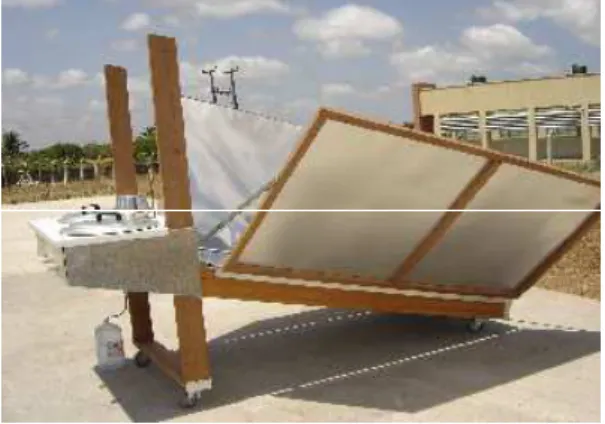
Figure 2 shows a photograph of the new solar cooker, without a temporary heat storage tank. Because the side reflectors are fixed to the collector, it became necessary to set the cooker on wheels so that the cooker could be aligned with the sun rays. These wheels are also needed to move the cooker from the interior to the exterior of a family house. Side reflectors are used to intensify solar radiation on the collector and also to protect the solar collector when the cooker is not in use, avoiding accidental damage on the glass cover.
The characteristics of this cooker are: One 2m2 flat plate collector with selective coating, one 8-liter and one 5-liter pot, fixed reflectors, and no storage tank.
3.1 Experimental Measurements
In order to study the performance of the solar cooker shown in Fig. 2, it was tested at the LESGN (3ºS, and average dry-bulb temperature of 32ºC and wet bulb temperature of 26ºC).
To measure temperature, type-K thermocouples were fixed to the outside walls of the copper tubes at the collector inlet and outlet, and at the pots inlet and outlet. The ambient temperature was measured by a PT-100 sensor. The global solar radiation was measured by a pv-cell sensor that has a 1% error, when compared to a precision pyranometer. This sensor was used because it could easily be installed on a horizontal plane and on the glass cover. On the glass cover, it measured the enhanced radiation on the collector due to the reflectors. Four thermocouples were used to measure the temperature of the water in the pot. All measured data were scanned every 2 seconds and the average values were stored every minute.
The thermal efficiency, Eq. 1, is the ratio of the sensible energy necessary to heat up the mass of water in the pot from the ambient temperature to 95ºC and the solar energy incident on the collector during the same period. This value of 95ºC has been used in the testes to avoid the uncertainty of the start of the boiling process.
t
0 c
95 amb p w 95
G.dt
A
T
.
c
.
m
?
(1)In this equation, m is the mass of water in the pot in m w
[kg], c p is the specific heat at constant pressure in
[J/(kg.K)], T is the temperature difference in [C], t is the time in [s], A is the area of the solar collector in c [m²], and G is the flux of global solar radiation incident in the collector plane in [W/m²].
During a complete heating process (sensible and latent) of a certain mass of water in the cooking pot, from the ambient temperature to the boiling point, there is evaporation of a certain mass of its surface. This evaporated mass is either lost as vapor or condenses on the inside surface of the cooking pot cover and drops back into the mass of water in the pot. Besides this loss, there are losses after boiling starts because there is the need to remove the cover to let the vapor out; otherwise, the water condensed on the cover returns to the liquid mass in the pot, and the measured amount in the end of the process can not be used to calculate the mass evaporated.
The global efficiency, that includes the sensible and the latent processes during heating, is an expression that more closely represent the physical process. It is expressed as,
t
0 c
fg w,2 w,1 p
w,2 g
G.dt
A
h
m
m
T
.
c
.
m
?
(2)Where m w is the mass of liquid water in the pot, the subscripts 1 and 2 refer to initial final stages of the process, and hfgis the latent heat of vaporization in
[J/kg].
3.2 Experimental Results
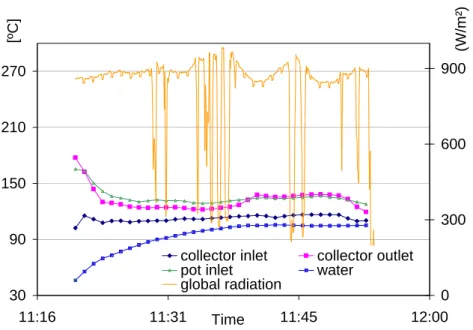
To determine the thermal efficiency, 2.5 liters of water were used and the results are presented in this section. Fig. 3, which shows the experimental data collected: temperature at the inlet and outlet of the solar collector, temperature at the inlet and outlet of the cooking pot, and global solar ration on the same plane of the solar collector.
At the start, the water temperature was the same as the ambient temperature (32ºC) and after approximately 15 minutes, boiling started. During the measurement period, there were some clouds and the average global solar radiation was 815 W/m2.
When the average temperature in the water was about 96ºC, the measured values were used to calculate the sensible efficiency, according to Eq. (1). The value calculated for the sensible efficiency was 0.40. This result is slightly over other previously measured results (Schwarzer and Silva, 2004) of 0.35. This difference can be associated with the use of the plastic film as the first transparent cover in the solar collector. This film has a higher transmissivity value than the tempered glass and it is also very thin. What is not clear at the moment is its resistance and endurance with time. Some collectors that were made more than ten years ago are still working properly.
the heat transfer process in the pot has a higher coefficient.
30 90 150 210 270
11:16 11:31 Time 11:45 12:00
[º
C
]
0 300 600 900
(W
/m
²)
collector inlet collector outlet
pot inlet water
global radiation
Fig. 3 Experimental measurements, temperature and global solar radiation on the tilted plane of solar collector, made in the cooker presented in Fig. 2, for an average global radiation of 815 W/m2.
4. CONCLUSION
It can be concluded from the results presented in this paper that the thermal efficiency of the solar was improved after changing the first glass cover in the solar collector to a plastic sheet . More tests are needed, but this preliminary result showed an increase from 0.35 to approximately 0.40 in the sensible efficiency.
As a consequence of this change, the solar collector became lighter and thus, easier to handle. The question now is whether the plastic sheet can resist solar radiation as claimed by the manufacturer.
As already mentioned, during the measurement period, there were some clouds and the average global solar radiation was 815 W/m2. Other measurements were made in clearer periods, but this day was chosen to better demonstrate the reliability of the solar cooker.
5. REFERENCES
(1) Löf, G. O. G. , Recent investigation in the use of solar energy for cooking. Solar Energy 7, 125-133, 1963.
(2) Telkes, M., Solar cooking ovens. Solar Energy 3, 1-10, 1959.
(3) Schwarzer, K., Silva, M. E. V., Solar cooking system with or without heat storage for families and institutions.
Solar Energy 75, 35-41, 2003.
(4) Schwarzer, K., Krings, T R., Demonstrations- und Feldtest von Solarkochern mit remparärem Speicher in Indien und Mali, Springer Verlag, ISBN 3-8265-1981-7, Germany, 1996.
(5) Silva, M. E. V., Schwarzer, K., Medeiros M. R. Q. Experimental Results of a Solar Cooker with Heat Storage. In Proceedings of Rio 02 World Climate and