Flávio Rodrigues Ferreira Alves(a) Marlei Gomes Silva(b)
Isabela Neves Rôças(a) José Freitas Siqueira Jr(a)
(a)Departamento de Endodontia, Faculdade de Odontologia, Universidade Estácio de Sá, Rio de Janeiro, RJ, Brasil.
(b) Instituto de Microbiologia Prof. Paulo de Góes, Universidade Federal do Rio de Janeiro - UFRJ, Rio de Janeiro, RJ, Brasil.
Corresponding author: Flávio Rodrigues Ferreira Alves E-mail: [email protected]
Biofilm biomass disruption by
natural substances with potential for
endodontic use
Abstract: This study evaluated the in vitro effects of four natural sub-stances on the biomass of bacterial bioilms to assess their potential use as root canal irrigants. The following substances and their combinations were tested: 0.2% farnesol; 5% xylitol; 20% xylitol; 0.2% farnesol and 5% xylitol; 0.2% farnesol, 5% xylitol, and 0.1% lactoferrin; 5% xyli-tol and 0.1% lactoferrin; and 20 mM salicylic acid. The crystal violet assay was used to evaluate the effects of these substances on the bio-mass of bioilms formed by Enterococcus faecalis and Staphylococcus epidermidis. All substances except for 20 mM salicylic acid and 20% xy-litol reduced bioilm mass when compared to controls. The combination of farnesol and xylitol was the most effective agent against E. faecalis
ATCC 29212 (p < 0.05). Farnesol combined with xylitol and lactofer-rin was the most effective against bioilms of the endodontic strain of
E. faecalis MB35 (p < 0.05). Similarly, combinations involving farnesol, xylitol, and lactoferrin reduced the biomass of S. epidermidis bioilms. In general, farnesol, xylitol, and lactoferrin or farnesol and xylitol reduced bioilm biomass most effectively. Therefore, it was concluded that combi-nations of antibioilm substances have potential use in endodontic treat-ment to combat bioilms.
Descriptors: Farnesol; Xylitol; Lactoferrin; Enterococcus faecalis.
Introduction
Current evidence indicates that apical periodontitis is a disease caused by bioilm infection.1 Bacteria organized in bioilm communities are
of-ten observed in the apical root canal system of teeth with primary or post-treatment apical periodontitis.1 Therefore, treatment of apical
peri-odontitis involves targeting the bioilm with speciic substances and de-livery strategies.
In root canal treatment, mechanical debridement is of utmost impor-tance to remove bioilms and organic matter that might hinder the poten-cy of antimicrobials or serve as nutrients for residual bacteria. However, studies have demonstrated that although instrumentation and irrigation are effective in substantially reducing the bacterial bioburden in infected canals, in many cases bacteria remain in the main root canal even when sodium hypochlorite (NaOCl) is used as the irrigant.2 In addition to
ex-hibiting a clinical performance that does not match its in vitro antibacte-rial potential, NaOCl has many disadvantages, including cytotoxicity to
Declaration of Interests: The authors certify that they have no commercial or associative interest that represents a conflict of interest in connection with the manuscript.
Submitted: Aug 19, 2012
vital tissues,3 reduced eficacy in the presence of
or-ganic matter,4 bad smell and taste, and interference
with pulp regeneration procedures and bonding of adhesive materials by altering the dentin surface.5
These undesirable inluences therefore warrant the search for alternative irrigants that are safer and more effective.
Naturally occurring substances with antibioilm effects have been suggested for treatment of bioilm-related diseases, including caries and chronic wound infections.6,7 Examples of these substances include
those that target bacterial attachment (lactoferrin and salicylic acid) and those that block formation or cause degradation of the bioilm matrix (xylitol and farnesol). By partially disrupting the bioilm structure, the remaining bacteria can become more vulnerable to antimicrobial agents. Therefore, sub-stances that affect bioilm biomass may be of great utility for the treatment of bioilm infections.
Given their speciic mechanisms of action, these antibioilm substances have the potential to be used as endodontic irrigants or interappointment medica-tions. Trans-trans farnesol (tt-farnesol) is a sesqui-terpene alcohol commonly found in propolis and in essential oils of citrus fruits and has been reported to have antibioilm effects, either by preventing bioilm formation or by attacking bioilms already estab-lished.8,9 Xylitol is a ive-carbon alcohol sugar found
naturally in small quantities in fruits and vegeta-bles, and it has been shown to inhibit bioilm forma-tion10,11 and disrupt bioilm structure.12 Lactoferrin
is a large, multifunctional iron-binding glycoprotein of the innate immune system that has been shown to exhibit antibioilm effects.12,13 Combinations
involv-ing farnesol/xylitol11,14 and lactoferrin/xylitol12,15 act
synergistically against bioilms. Lastly, salicylic acid is produced by many plants as part of their defense mechanisms against infection and also inhibits bio-ilm formation.16,17 The present study was conducted
to evaluate the potential of these substances and their combinations to reduce the biomass of bioilms formed by two strains of Enterococcus faecalis and one of Staphylococcus epidermidis.
Methodology
The following antibioilm
substances/combina-tions were used in this study:
• 0.2% tt-farnesol (FAR; Sigma-Aldrich, St. Louis, USA);
• 5% xylitol (XYL; Sigma-Aldrich);
• 20% xylitol (XYL; Sigma-Aldrich);
• 0.2% tt-farnesol and 5% xylitol (FAR-XYL);
• 0.2% tt-farnesol, 5% xylitol and 0.1% lactofer-rin (FAR-XYL-LAC; Sigma-Aldrich);
• 5% xylitol and 0.1% lactoferrin (XYL-LAC); and
• 20 mM salicylic acid (Sigma-Aldrich).
Saline was used as a control. Bioilm biomass was visualized and quantiied with a modiied crys-tal violet binding assay.18-21 The following bacterial
strains were used in this experiment:
• E. faecalis ATCC 29212,
• E. faecalis MB35 isolated from a human root ca-nal–treated tooth with post-treatment disease,22
and
• S. epidermidis ATCC 35984.
substances (p < 0.05). FAR-XYL-LAC was the most effective against bioilms of the endodontic strain of
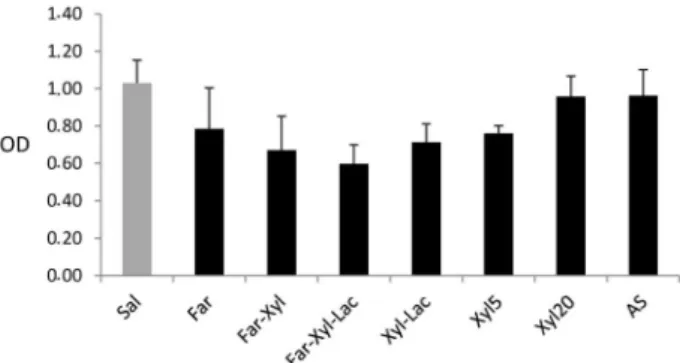
E. faecalis MB35 (p < 0.05) (Figure 2). FAR-XYL was the second most effective, being signiicantly more potent than all the other agents except for FAR. As for the strong bioilm producer S. epider-midis, FAR-XYL, FAR-XYL-LAC, XYL-LAC, and 5% XYL were the most effective, with no signii-cant difference between them (p > 0.05) (Figure 3). All of them were signiicantly more effective than the other agents, except for the comparison between FAR-XYL and FAR. In general, FAR-XYL-LAC and FAR-XYL were the most effective substances for reducing bioilm biomass (Figure 4).
Discussion
The present study evaluated the ability of several potential endodontic irrigants and medicaments to disrupt the biomass of single-species bioilms. Con-centrations of the test substances were based on previous studies.7,11,12,23 Despite some variations of
effectiveness depending on the bacterial source of the bioilm, our overall indings revealed that the combinations of farnesol, xylitol and lactoferrin or farnesol and xylitol had the best outcomes among the substances tested.
Antibioilm substances can inhibit bioilm for-mation (preventive effect) or alternatively act on bio-ilms already formed (therapeutic effect). The mech-anism of action against established bioilms may be through disruption of bioilm biomass and/or direct killing of the bioilm bacteria. It is important for an 680, Bio-Rad Laboratories, Hercules, USA). For the
positive control, saline was used instead of the test substance. For the negative control, sterile culture broth was used. All assays were performed with four repetitions on three separate occasions. The cut-off value for optical density (OD) measurements was deined as three standard deviations above the mean OD of the negative control.18 Therefore, inal
OD values were expressed as average OD value re-duced by the cut-off value.
Data were statistically evaluated via analysis of variance and the Student-Newman-Keuls test for multiple comparisons with the signiicance level es-tablished at 5% (P < 0.05). The statistical analysis was performed using SPSS 17.0 computer software (IBM, New York, USA).
Results
All test strains formed bioilms as assessed with the crystal violet assay. The most substantial bio-ilms were produced by S. epidermidis, followed by E. faecalis strain MB35 and then ATCC 29212. All the test substances signiicantly reduced bioilm biomass compared with controls (p < 0.05); excep-tions were 20% XYL against E. faecalis MB35 bioilms and salicylic acid and 20% XYL against
S. epidermidis bioilms. Analysis of the antibioilm effects against E. faecalis ATCC 29212 bioilms revealed that FAR-XYL was signiicantly more ef-fective than all other substances (p < 0.05) (Figure 1). FAR-XYL-LAC was the next most effective, also being signiicantly more potent than all the other
Figure 1 - Effects of the candidate antibiofilm substances on the biomass of biofilms produced by Enterococcus fae-calis ATCC 29212 as measured by the crystal violet assay (p < 0.05).
endodontic irrigant or medicament to act primarily on established bioilms attached to the root canal walls so as to promote their elimination.
Farnesol has been shown to have both effects on bioilms, i.e., by inhibiting bioilm formation and disrupting already-formed bioilms.8,24,25 Indeed,
topical application of farnesol reduces the bioilm matrix content.24,26 In addition to disrupting bioilm
biomass, farnesol also directly kills bioilm bacteria.9
Xylitol also inhibits bioilm formation and dis-rupts the structure of established bioilms.10,12
How-ever, xylitol only minimally reduces bacterial vi-ability in bioilms.12 Xylitol can act synergistically
with farnesol, and this combination can selectively inhibit the growth of Staphylococcus aureus.11,14
The present indings conirm the potential synergy between farnesol and xylitol.
Lactoferrin also has antibioilm effects,12,13 but
the mechanisms are not well established. Lactofer-rin has great potential to act synergistically with xylitol to disrupt bioilm structure and reduce bacte-rial viability.12,15 Speciically, xylitol disrupts bioilm
integrity whereas lactoferrin permeabilizes bacterial membranes.12 Our present indings demonstrate that
the combination of farnesol, xylitol and lactoferrin reduces bioilm biomass most effectively compared with the other agents tested. Further studies are required to evaluate the effects of these substances and their combinations on bacterial viability in end-odontic bioilms.
Salicylic acid, another substance tested in this study, prevents bacterial attachment to medical de-vices27 and inhibits bioilm formation.16,17
Specii-cally, salicylic acid–based polymers interfere with
Salmonella enterica bioilm formation.28 In a study
using mixed bioilms, salicylic acid speciically in-hibited S. aureus, consequently increasing the ratios of Pseudomonas aeruginosa and E. faecalis within the same bioilm.23 This indicates that salicylic acid
preferentially affects certain species, which may help explain its poor results against the three strains (two species) tested in the present study. Another possible explanation for our observed poor performance of salicylic acid is that, in most other studies, the com-pound was applied prior to bioilm formation where-as we evaluated its effects on established bioilms.
The crystal violet assay used in this study re-mains among the most frequently used assays for investigating bioilm formation or testing the effects of substances on bioilm biomass.18 Crystal violet is
a basic dye that not only stains bacterial cells but also binds to negatively charged surface molecules and polysaccharides in the bioilm extracellular ma-trix.29 The main advantages of the method are its
ro-bust reproducibility and rapid analysis of bioilm re-duction, permitting a screen of potential antibioilm substances prior to performing labor-intensive con-focal microscopic quantiication. One limitation of the method is that there is no relationship between the reduction of bioilm biomass and the potential to kill bioilm bacteria.30 Because crystal violet stains
viable and dead cells and also the bioilm matrix, it cannot be used to speciically evaluate the killing of bioilm bacteria.30 Thus, even though the crystal
violet assay provides useful information on the efi-cacy of substances to remove bioilm remnants,
oth-Figure 4 - Overall antibiofilm results. Sal, saline; Far, farne-sol; Xy, xylitol; Lac, lactoferrin; AS, salicylic acid.
er assays must be used to evaluate the ability to kill viable sessile bacterial cells. Taking this information into consideration, a poor result in the crystal violet assay does not necessarily mean that the substance has not killed the bacteria composing the bioilm.
Antimicrobial effectiveness is one of the most im-portant properties required for endodontic irrigant solutions.2 Other important properties for selecting
an irrigant include tissue compatibility, substantiv-ity to dentin, and soft-tissue dissolving abilsubstantiv-ity, and therefore the substances tested in our study must be further evaluated with respect to these properties.
Conclusion
In conclusion, our indings demonstrate that the
combination of farnesol, xylitol and lactoferrin sig-niicantly reduces the biomass of bioilms produced by two E. faecalis strains and one S. epidermidis
strain. Therefore, a combination of these antibioilm substances has the potential to be used in endodon-tic treatment to combat bioilms.
Acknowledgements
This study was supported by grants from Funda-ção Carlos Chagas Filho de Amparo à Pesquisa do Estado do Rio de Janeiro (FAPERJ) and Conselho Nacional de Desenvolvimento Cientíico e Tec-nológico (CNPq), Brazilian Governmental Institu-tions.
References
1. Ricucci D, Siqueira Jr JF. Biofilms and apical periodontitis: study of prevalence and association with clinical and histo-pathologic findings. J Endod. 2010 Aug;36(8):1277-88. 2. Rôças IN, Siqueira Jr JF. Comparison of the in vivo
antimicro-bial effectiveness of sodium hypochlorite and chlorhexidine used as root canal irrigants: a molecular microbiology study. J Endod. 2011 Feb;37(2):143-50.
3. Pashley EL, Birdsong NL, Bowman K, Pashley DH. Cy-totoxic effects of NaOCl on vital tissue. J Endod. 1985 Dec;11(12):525-8.
4. Pappen FG, Qian W, Aleksejuniene J, Leonardo RT, Leonardo MR, Haapasalo M. Inhibition of sodium hypochlorite anti-microbial activity in the presence of bovine serum albumin. J Endod. 2010 Feb;36(2):268-71.
5. Fouad AF. The microbial challenge to pulp regeneration. Adv Dent Res. 2011 Jul;23(3):285-9.
6. Rhoads DD, Wolcott RD, Percival SL. Biofilms in wounds: management strategies. J Wound Care. 2008 Nov;17(11):502-8. 7. Koo H, Jeon JG. Naturally occurring molecules as alternative
therapeutic agents against cariogenic biofilms. Adv Dent Res. 2009 Aug; 21(1):63-8.
8. Jabra-Rizk MA, Meiller TF, James CE, Shirtliff ME. Effect of farnesol on Staphylococcus aureus biofilm formation and antimicrobial susceptibility. Antimicrob Agents Chemother. 2006 Apr;50(4):1463-9.
9. Gomes F, Teixeira P, Cerca N, Azeredo J, Oliveira R. Effect of farnesol on structure and composition of Staphylococcus epider-midis biofilm matrix. Curr Microbiol. 2011 Oct;63(4):354-9. 10. Badet C, Furiga A, Thebaud N. Effect of xylitol on an in
vitro model of oral biofilm. Oral Health Prev Dent. 2008 Dec;6(4):337-41.
11. Katsuyama M, Ichikawa H, Ogawa S, Ikezawa Z. A novel method to control the balance of skin microflora. Part 1. At-tack on biofilm of Staphylococcus aureus without antibiotics. J Dermatol Sci. 2005 Jun;38(3):197-205.
12. Ammons MC, Ward LS, Fisher ST, Wolcott RD, James GA. In vitro susceptibility of established biofilms composed of a clinical wound isolate of Pseudomonas aeruginosa treated with lactoferrin and xylitol. Int J Antimicrob Agents. 2009 Mar;33(3):230-6.
13. Singh PK, Parsek MR, Greenberg EP, Welsh MJ. A component of innate immunity prevents bacterial biofilm development. Nature. 2002 May 30;417(6888):552-5.
14. Katsuyama M, Kobayashi Y, Ichikawa H, Mizuno A, Miyachi Y, Matsunaga K, et al. A novel method to control the balance of skin microflora Part 2. A study to assess the effect of a cream containing farnesol and xylitol on atopic dry skin. J Dermatol Sci. 2005 Jun;38(3):207-13.
15. Ammons MC, Ward LS, James GA. Anti-biofilm efficacy of a lactoferrin/xylitol wound hydrogel used in combination with silver wound dressings. Int Wound J. 2011 Jun;8(3):268-73. 16. Prithiviraj B, Bais HP, Weir T, Suresh B, Najarro EH, Dayakar
BV, et al. Down regulation of virulence factors of Pseudo-monas aeruginosa by salicylic acid attenuates its virulence on Arabidopsis thaliana and Caenorhabditis elegans. Infect Immun. 2005 Sep;73(9):5319-28.
17. Muller E, Al-Attar J, Wolff AG, Farber BF. Mechanism of salicylate-mediated inhibition of biofilm in Staphylococcus epidermidis. J Infect Dis. 1998 Feb;177(2):501-3.
recommenda-tions for assessment of biofilm production by staphylococci. APMIS. 2007 Aug;115(8):891-9.
19. Stepanovic S, Vukovic D, Dakic I, Savic B, Svabic-Vlahovic M. A modified microtiter-plate test for quantification of staphylococcal biofilm formation. J Microbiol Methods. 2000 Apr;40(2):175-9.
20. Izano EA, Wang H, Ragunath C, Ramasubbu N, Kaplan JB. Detachment and killing of Aggregatibacter actinomy-cetemcomitans biofilms by dispersin B and SDS. J Dent Res. 2007 Jul;86(7):618-22.
21. Kaplan JB, Ragunath C, Velliyagounder K, Fine DH, Ramasubbu N. Enzymatic detachment of Staphylococ-cus epidermidis biofilms. Antimicrob Agents Chemother. 2004 Jul;48(7):2633-6.
22. Zoletti GO, Pereira EM, Schuenck RP, Teixeira LM, Siqueira Jr JF, Santos KR. Characterization of virulence factors and clonal diversity of Enterococcus faecalis isolates from treated dental root canals. Res Microbiol. 2011 Feb-Mar;162(2):151-8. 23. Rosenberg LE, Carbone AL, Romling U, Uhrich KE, Chi-kindas ML. Salicylic acid-based poly(anhydride esters) for control of biofilm formation in Salmonella enterica serovar Typhimurium. Lett Appl Microbiol. 2008 May;46(5):593-9. 24. Jeon JG, Pandit S, Xiao J, Gregoire S, Falsetta ML, Klein MI,
et al. Influences of trans-trans farnesol, a membrane-targeting sesquiterpenoid, on Streptococcus mutans physiology and
survival within mixed-species oral biofilms. Int J Oral Sci. 2011 Apr;3(2):98-106.
25. Koo H, Schobel B, Scott-Anne K, Watson G, Bowen WH, Cury JA, et al. Apigenin and tt-farnesol with fluoride effects on S. mutans biofilms and dental caries. J Dent Res. 2005 Nov;84(11):1016-20.
26. Koo H, Hayacibara MF, Schobel BD, Cury JA, Rosalen PL, Park YK, et al. Inhibition of Streptococcus mutans biofilm accumulation and polysaccharide production by apigenin and tt-farnesol. J Antimicrob Chemother. 2003 Nov;52(5):782-9. 27. Arciola CR, Montanaro L, Caramazza R, Sassoli V, Cavedag-na D. Inhibition of bacterial adherence to a high-water-content polymer by a water-soluble, nonsteroidal, anti-inflammatory drug. J Biomed Mater Res. 1998 Oct;42(1):1-5.
28. Li X, Yan Z, Xu J. Quantitative variation of biofilms among strains in natural populations of Candida albicans. Microbiol-ogy. 2003 Feb;149(Pt 2):353-62.
29. Dowd SE, Sun Y, Smith E, Kennedy JP, Jones CE, Wolcott R. Effects of biofilm treatments on the multi-species Lub-bock chronic wound biofilm model. J Wound Care. 2009 Dec;18(12):508, 10-12.