*Correspondence: Solmaz Ghaffari. Department of Medical Nanotech-nology. Faculty of Advanced Sciences and TechNanotech-nology. Pharmaceutical Sciences Branch. Islamic Azad University - IAUPS. Tehran, Iran. E-mail: [email protected] and [email protected]
http://dx.doi.org/10.1590/S1984-82502015000400005
Freeze-drying of ampicillin solid lipid nanoparticles using mannitol
as cryoprotectant
Faezeh Alihosseini
1,
Solmaz Ghafari
1,2,*, Ali Reza Dabirsiaghi
3, Setareh Haghighat
41Department of Medical Nanotechnology, Faculty of Advanced Sciences and Technology, Pharmaceutical Sciences Branch,
Islamic Azad University, IAUPS, Tehran, Iran, 2Young Researchers and Elite Club, Pharmaceutical Sciences Branch, Islamic
Azad University, IAUPS, Tehran, Iran, 3Department of Pharmaceutics, Faculty of Pharmacy, Pharmaceutical Sciences Branch,
Islamic Azad University, IAUPS, Tehran, Iran, 4Department of Microbiology, Faculty of Advanced Sciences and Technology,
Pharmaceutical Sciences Branch, Islamic Azad University, IAUPS, Tehran, Iran
Solid lipid nanoparticles (SLNs) are interesting colloidal drug-delivery systems, since they have all the advantages of the lipid and polymeric nanoparticles. Freeze-drying is a widely used process for improving the stability of SLNs. Cryoprotectants have been used to decrease SLN aggregations during freeze-drying. In this study Ampicillin was chosen to be loaded in a cholesterol carrier with nano size range. To support the stability of SLNs, freeze-drying was done using mannitol. Particle size, drug
release proile and antibacterial efects were studied after freeze-drying in comparison with primary
SLNs. Preparations with 5% mannitol showed the least particle size enlargement. The average particle
size was 150 and 187 nm before and after freeze-drying, respectively. Freeze-drying did not afect the release proile of drug loaded nanopartilces. Also our study showed that lyophilization did not change the antimicrobial efect of ampicillin SLNs. DSC analysis showed probability of chemical interaction
between ampicillin and cholesterol.
Uniterms: Solid lipid nanoparticles. Stability. Cryoprotectant. Freeze-drying. Antibacterial eicacy. Particle size
Nanoparticulas lipídicas sólidas (NLSs) são sistemas coloidais de liberação interessantes, uma vez
que reúnem todas as vantagens de nanopartículas lipídicas e poliméricas. A lioilização é um processo
amplamente utilizado para melhorar a estabilidade das NLSs e os crioprotetores têm sido usados para diminuir a agregação destas durante esse processo. Neste estudo, a ampicilina foi escolhida para ser encapsulada em um carreador de colesterol de escala nanométrica. Para manter a estabilidade das NLSs,
a lioilização foi realizada utilizando-se manitol. O tamanho de partícula, o peril de liberação do fármaco e os efeitos antibacterianos foram estudados após a lioilização em comparação com a NLSs primária.
De acordo com os resultados, as preparações que contêm 5% de manitol mostraram o menor aumento
do tamanho de partícula. Os resultados de tamanhos médio foram de 150 e 187 nm antes e depois da lioilização, respectivamente. O peril de liberação prolongada, bem como o efeito antimicrobiano da ampicilina NLSs não foram alterados após a lioilização. A análise por DSC evidenciou provável interação
entre a ampicilina e o colesterol.
INTRODUCTION
Solid lipid nanoparticles (SLNs) as colloidal carrier systems have the advantages of traditional systems but avoid some of their major disadvantages (Mehnert, Mader, 2001; Hu et al, 2004). Some advantages of SLNs are possibility of the incorporation of lipophilic and hydrophilic drugs, possibility of controlling drug release and drug targeting, increased drug stability, high drug payload, lack of biotoxicity of the carrier, no problems with respect to large-scale production, sterilization possibility, and good tolerability (Zhang et al., 2006; Varshosazs et al., 2010; Mukherjee et al, 2009). The enhancement of antibacterial efficacy of antibiotics using SLNs as a carrier was reported as one of the advantages of these colloidal systems (Varshosaz et al., 2010; Alihoseyni et al., 2014). Freeze-drying has been considered as a good technique to improve the
long-term stability of colloidal nanoparticles. Other
studies show that poor stability in an aqueous medium is a major barrier against the clinical use of nanoparticles (Abdelwahed et al., 2006). Also freeze-drying may generate many stresses that could destabilize colloidal suspension of nanoparticles before turning them to dried particles (Abdelwahed et al., 2006). Cryoprotectants have been used to decrease SLN aggregations due to the stress during the process of freeze-drying (Subedi, Kang, Choi, 2009). Glucose, sucrose, trehalose, lactose, mannitol, sorbitol, aerosol, maltose, polyvinyl pyrrolidone, fructose, dextran, glycerol, polyvinyl
alcohol, glycine, hydroxypropyl-β-cyclodextrin and
gelatin were used as cryoprotectant in several studies
(Mehnert, Mader, 2001; Ghafari et al., 2011). In this study we studied the effect of mannitol in different percentages as cryoprtecant in freeze-drying process
on particle size, morphology, drug release proile and antibacterial eicacy of ampicillin SLNs. Our goal was
to prepare freeze-dried ampicillin SLNs and optimize lyophilization process to have minimum impact on their physicochemical and antimicrobial properties.
MATERIAL AND METHODS
Material
Cholesterol (Merck, Germany) was used as lipid material of SLNs. Tween 80 (Merck) was used as surfactant. Ampicillin (Kosar Pharmaceutical Co., Tehran, Iran) was used as the active pharmaceutical ingredient. Ethanol and acetone (Merck Chemical Company, Germany) were organic solvents.
Preparation of ampicillin SLNs
At irst 350 mg of cholesterol was added to the mixture of acetone and ethanol in ratio of 1 to 3, then the mixture
was heated in a water bath at 75 °C. Ampicillin was added to deionized water containing 1% (w/w) tween 80 as surfactant (Varshosaz et al., 2010; Alihoseyni et al., 2014).After that, the hot oily phase was added to water at room temperature under homogenizing at 11,000 rpm, using IKA® (Staufen, Germany) T-18 basic, Ultra-Turrax® (Germany) for 20 minutes. The prepared mixture was sonicated at 45-50 °C for 7 minutes, using a bath-sonicator system (Tecna 6; Tecno-Gaz, Sala Baganza, Italy). SLNs were made when the mixture temperature was decreased to room temperature. The particle size of the nanoparticles was measured by
a Zetasizer (ZEN3600; Malvern Instruments, Britain).
Determination of ampicillin
The spectrophotometric scan of ampicillin was done on 200-400 nm wavelength, the maximum absorption was seen on 208 nm, the linearity of the results was studied for
solutions with diferent concentration (25-200 ppm) in bufer and water and R2 of the method were respectively
0.993 and 0.995.
Drug loading efficiency
For determination of drug loading efficiency, the samples were centrifuged at 26,000 rpm for 45 minutes, at
4 °C by using a Sigma Laboratories centrifuge (Osterode am
Harz, Germany). The drug concentration in the supernatant was analyzed using spectrophotometer (Shimadzu, Japan)
at 208 nm and the drug-loading eiciency was calculated
by using the following equation. (Kimberly, Tabrizian 2005;
Ghafari et al. 2012; Alihoseyni et al. 2014) The results reported as mean of three analyses with standard deviation.
Freeze-drying
The particles were freeze-dried using freeze-dryer
(Lyotrap/Plus, UK) at −80 °C under 0.4 bar. Different
amounts of mannitol (5,10 and 15%) was used as cryoprotectant.
Morphology study
by scanning electron microscopy (SEM) before and after freeze-drying. The nanoparticles were mounted on aluminum stubs, sputter-coated with a thin layer of Au/Pd,
and examined by using an SEM (Philips XL30, Almelo,
Netherlands) instrument.
Release studies
Release study was done using the dialysis sack method by DO405 Dialysis tubing 23x15 mm (Sigma,
Germany). Five mL of the formulation before and after freeze-drying was placed in dialysis membrane (10-12
KD) immersed in 50 mL phosphate bufer solution (pH 7.4)
at room temperature (25±2 oC). The freeze dried particles
were diluted in 5 mL of deionized water before placing in dialysis membrane. The free drug which was not loaded on SLNs was removed using centrifuge at 26,000 rpm for 45 minutes, at 4 °C by a Sigma Laboratories centrifuge.
One mL samples were withdrawn in predetermined time
intervals and drug concentration was analyzed using UV spectrophotometry (Shimadzu, Japan) method at 208 nm. (Varshosaz et al., 2010, Alihoseyni et al, 2014).
DSC analysis
DSC thermograms were obtained using: DSC 823e
Mettler, Swiss. A certain amount of dried nanoparticle powder was crimped in a standard aluminum pan and heated from 25–400 °C at a heating rate of 10 °C /min under constant purging of nitrogen.
Antimicrobial activity of SLNs
The antimicrobial activity of nanoparticles before
and after freeze-drying was studied using well difusion test. P. aeruginosa (ATCC 27853) and E. coli (ATCC
25922) were used as gram negative pathogenic strains. The bacterial suspensions with a cell density equivalent to 0.5 McFarland (1.5 × 10⁸ CFU/mL) were transferred
individually onto the surface of Muller–Hinton agar plates using sterile swabs. Wells with 8 mm diameters were prepared by punching and removing the agar to form
a well. Aliquots of 100 μL of each original SLNs after
preparation and SLNs after freeze-drying, were delivered into the wells as the test samples. After incubation time for
48 hours, at 35 °C–37 °C, the zones of inhibition around
the wells were measured in mm using a caliper.
RESULTS AND DISCUSSION
Particle size
The evaluation of particles using Malvern zeta
sizer (ZEN3600) showed a normal distribution of particle
size before and after freeze-drying when the percentage
of cryoprotectant was equal to 5%. Results showed that
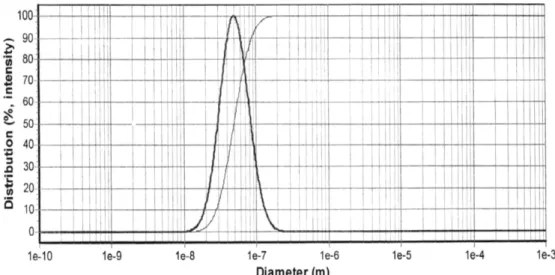
more than 70% of particles were smaller than 95 nm in size also 85% and 96% of prepared particles were smaller than 150 and 285 nm before freeze-drying. More than 77% of particles were smaller than 69.7 nm, more than
92% of particles were smaller than 95.3 nm, more than 98% and 99% were smaller than 130 and 208 nm, after
lyophilization. Figure 1 shows the particle size distribution profile after freeze-drying. This result confirmed that
lyophilization of ampicillin SLNs did not show any efect
on particle size of prepared particles. Comparison of particle size of SLNs after lyophilization, shows that 5% mannitol as cryoprotectant yileds the smallest particles.
The average particle size was 187, 911 and 1930 nm
for formulations with 5, 10 and 15% mannitol. So the lyophilized particles with 5% mannitol were chosen to continue the studies. Varshosaz et al. showed that sucrose as cryoprotectant in concentration of 12% would be suitable choice to avoid particle size increase during freeze-drying process of SLNs.
SEM study
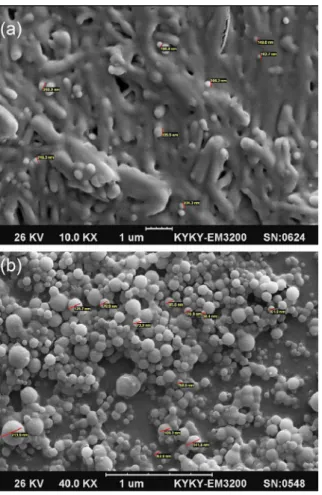
Figures 2a and 2b show the morphologies of the freeze-dried formulations in comparison with
non-lyophilized particles respectively. Results showed that no signiicant enlargement of particle size was happened
after freeze-drying.
Drug loading efficacy
Our results showed 77±4% drug loading eicacy.
The percentage of drug loading was used for calculations
of drug release proile as well.
Drug release studies
Figure 3 compares the release proile of ampicillin
from SLNs before and after lyophilization which lasts for about 24 h and releases about 98% of ampicillin
during this period by a sustained behavior. No signiicant diference was observed between two proiles. No burst efect was established for lyophilized SLNs. Varshosaz
et al. (2012), reported burst efect after freeze-drying of amikacin SLNs.
Antimicrobial activities
The antimicrobial activity of lyophilized SLNs of ampicillin after redispersion in water is shown in Figure 4a and 4b against P. aeruginosa and E. coli. Results showed that ampicillin loaded nanoparticles increase antibacterial efficacy of ampicillin in comparison with free drug. Therefore, lyophilization process did not have impact on antimicrobial activity of SLNs as carrier of ampicillin. Enhanced antibacterial properties of drug loaded SLNs
was reported by Ghafari et al. (2011) before.
DSC analysis
Differential Scanning Calorimetry thermograms (DSC) for pure cholesterol, ampicillin and ampicillin-loaded SLNs were shown in Figure 5. The endotherm
of melting point of cholesterol has shifted from 132 oC
to about 166 oC in the SLNs of ampicillin. The melting
temperature of ampicillin is also seen in 112 oC and 137 oC
in the thermogram of pure ampicillin. However, the melting point of the drug has been covered in the SLNs and only the endotherm of probable shifted melting point of cholesterol is observable. Sustained release of ampicillin from SLNs can be related to probable hydrogen bond formation between cholesterol and ampicillin which can be seen in DSC thermograms.
FIGURE 2 - Scanning electron microscopy pictures of ampicillin
solid lipid nanoparticles after drying (a), before freeze-drying in primary preparation (b).
FIGURE 3 - Release proile of ampicillin solid lipid nanoparticles
FIGURE 4 - Photographs of the zone of inhibition produced by free ampicillin and its SLNs in freeze-dried SLNs against P. aeruginosa(a) and E. coli (b).
FIGURE 5 - DSC thermograms of raw materials and freeze-dried
SLNs of ampicillin.
proper croprotectant to have minimum impact on their physicochemical and antimicrobial properties. Mannitol 5%provided the optimum condition to avoid particle
aggregation. Release profile, DSC analysis, SEM of lyophilized SLNs and antibacterial eicacy were studied and the results showed no burst efect on release proile of ampicillin without signiicant increase in drug release
rate. DSC analysis showed probable interaction between ampicillin and cholesterol. The SEM photographs showed spherical shape of the freeze-dried particles.
As the inal conclusion, freezing of SLNs of ampicillin
dispersion at -80°C and the addition of 5% mannitol before lyophilization inhibited the aggregation of the nanoparticles after reconstitution.
ACKNOWLEDGEMENTS
The authors would like to acknowledge the research vice chancellor of Islamic Azad University, Pharmaceutical sciences branch for technical support, Prof. S. Mahdi
Rezayat Sorkhabadi for scientiic support, Mr. Rezae for SEM pictures, Hedieh Ghafari and Dr. Shirzad Azarmi
for English edit of manuscript and Mrs. Loebenberg for Portuguese translation of abstract.
REFERENCES
ABDELWAHED, W.; DEGOBERT, G.; STAINMESSE, S.; FESSI, H. Freeze-drying of nanoparticles: Formulation, process and storage considerations. Adv. Drug. Del. Rev., v.58, n.15, p.1688-1713, 2006.
ALIHOSEYNI, F.; GHAFFARI, S.; DABIRSIAGHI, A.R.; HAGHIGHAT, S. Preparation and evaluation of ampicillin solid lipid nanoparticles. World J. Pharm. Sci., v.9, n.2, p.914-920, 2014.
CHACON, M.; MOLPECERES, J.; BERGES, L.; GUZMAN, M.; ABERTURAS, M.R. Stability and freeze-drying of cyclosporine loaded poly(D,L lactide-glycolide) carriers.
Eur. J. Pharm. Sci., v.8, p.99-107, 1999.
GHAFFARI, S.; VARSHOSAZ, J.; HARIRIAN, I.; KHOSHAYAND, MR.; AZARMI, SH.; GAZORI, T. Ciprofloxacin loaded alginate/chitosan and solid lipid nanoparticles, preparation, and characterization. J. Dis. Sci. Technol., v.33, n.5, p.685-689, 2012.
GHAFFARI, S.; VARSHOSAZ, J.; SAADAT, A.; ATYABI, F. Stability and antimicrobial efect of amikacin-loaded solid lipid nanoparticles. Int. J. Nanomed., v.6, p.35-43, 2011.
CONCLUSION
Our goal was to prepare freeze-dried ampicillin
HU, F.Q.; HONG, Y.; YANG, H. Preparation and characterization of solid lipid nanoparticles containing peptide. Int. J. Pharm., v.273, n.1-2, p.29-35, 2004.
KONAN, Y.N.; GURNY, R.; ALLEMANN, E. Preparation and characterization of sterile and freeze-dried sub-200 nm nanoparticles. Int. J. Pharm., v.233, p.239-252, 2002.
KIMBERLY, LD.; TABRIZIAN, M. Effect of experimental parameters on the formation of alginate-chitosan nanoparticles and evaluation of their potential application as DNA carrier. J. Biomater. Sci. Polymer Ed., v.16, n.1, p.43-56. 2005.
LEE, M.K.; KIM, M.Y.; KIM, S.; LEE, J. Cryoprotectants for freeze-drying of drug nano suspensions: efect of freezing rate. J. Pharm. Sci., v.98, n.12, p.4808-4817, 2009.
MEHNERT, W.; MADER, K. Solid lipid nanoparticles: production, characterization, and applications. Adv. Drug. Deliv. Rev.,v.47, n.2-3, p.165-196, 2001.
MUKHERJEE, S.; RAY, S.; THAKUR, R.S. Solid lipid nanoparticles: a modern formulation approach in drug delivery system. Ind. J. Pharm. Sci., v.71, n.4, p.349-358,
2009.
OHSHIMA. H.; MIYAGISHIMA, A.; KURITA, T.; MAKINO, Y.; LWAO, Y.; SONOBE, T.; ITAI. S. Freeze-dried nifedipine lipid nanoparticles with longterm nano dispersion stability after reconstitution. Int. J. Pharm., v.377,
p.180-184, 2009.
RODRIGUEZ, A.; SOLINIS, M.A.; GASCON, A.R.; PEDRAZ, J.L. Short and longterm stability study of lyophilized solid lipid nanoparticles for gene therapy. Eur. J. Pharm. Biopharm., v.71, p.181-189, 2009.
SUBEDI, R.K.; KANG, K.W.; CHOI, H.K. Preparation and characterization of solid lipid nanoparticle loaded with doxorubicin. Eur. J. Pharm. Sci., v.37, n.3-4, p.508-513,
2009.
VARSHOSAZ, J.; GHAFFARI, S.; KHOSHAYAND, M.R.; ATYABI, F.; JAFARIAN DEHKORDI, A.; KOBARFARD, F. Optimization of freeze-drying condition of amikacin solid lipid nanoparticles using D-optimal experimental design.
Pharm. Dev. Technol., v.17, n.2, p.187-194, 2012.
VARSHOSAZ, J.; GHAFFARI, S.; KHOSHAYAND, M.R.; ATYABI, F.; AZARMI, S.; KOBARFARD, F. Development and optimization of solid lipid nanoparticles of amikacin by central composite design. J. Liposome Res.,v.20, n.2, p.97-104, 2010.
YANG, S.; ZHU, J. Preparation and characterization of camptothecin solid lipid nanoparticles. Drug. Dev. Ind. Pharm., v.28, n.3, p.265-274, 2002.
ZHANG, N.; PING, Q.; HUANG, G.; XU, W. Lectin-modiied solid lipid nanoparticles as carriers for oral administration of insulin. Int. J. Pharm., v.327, n.1-2, p.153-159, 2006.
ZIMMERMANN, E.; MULLER, R.H.; MADER, K. Inluence of different parameters on reconstitution of lyophilized SLN. Int. J. Pharm., v.196, n.2, p.211-213, 2000.
Received for publication on 29th January 2015