INTRODUCTION
The number of fully or partially edentulous patients is still large in present days. Dentures are used for replacing lost teeth and returning the functional and esthetic conditions to the patients.
The literature shows that the presence of some diseases and the use of certain medications can affect the oral tissues and amount of saliva (1). Knowledge of these factors associated with the constant intraoral changes related to use of the dentures and the aging of the individuals is of paramount importance to the dentist for making an accurate diagnosis and promoting health.
In addition, efficient and regular procedures for cleaning complete dentures are important for maintaining good oral health and greater longevity of the prosthesis (2). To minimize the prevalence of denture stomatitis, the dentist must instruct the patient in removing complete dentures 6 to 8 h per day (3).
Behaviors and Hygiene Habits of
Complete Denture Wearers
Amanda PERACINI Ingrid Machado de ANDRADE Helena de Freitas Oliveira PARANHOS
Cláudia Helena Lovato da SILVA Raphael Freitas de SOUZA
Department of Dental Materials and Prosthodontics, Ribeirão Preto Dental School, University of São Paulo, Ribeirão Preto, SP, Brazil
In this study, a questionnaire was applied to patients from Ribeirão Preto Dental School, University of São Paulo, Brazil, to evaluate the hygiene methods and habits concerning the use of complete dentures, the age of dentures, and whether patients have been instructed on how to clean their dentures. The mean age of patients was 63.35 years, and most of them were females (82.08%). The results showed that 62.26% of the respondents had been using the same maxillary complete denture for more than 5 years, and 49.06% used the same mandible complete denture for more than 5 years. Of the patients interviewed, 58.49% slept with the dentures. Mechanical brushing was the most used cleaning method by the patients (100%), using water, dentifrice and toothbrush (84.91%). Most patients (51.89%) reported never having been instructed by their dentists as to how to clean their dentures. Based on the limitations of this study, it was concluded that the patients interviewed had limited knowledge about prosthetic hygiene and oral care. The method more used by patients was the mechanical method of brushing, most patients used the same complete dentures for more than 5 years and slept with the dentures.
Key Words: denture complete, habits, hygiene, dental care.
The fitting of complete dentures should not be considered the final stage of treatment, but the beginning of a long relationship between patient and dentist in order to maintain the health of oral tissues (4). It is extremely important that patients return regularly to the dentist for oral health maintenance and for the evaluation of their dentures.
However, surveys have reported that complete denture wearers have difficulty in cleaning their dentures (5,6), and so preventive programs are effective in promoting good oral health. Patients do not return to the dentist for control and maintenance of their dentures generally at the appropriate intervals (7). Thus, it is up to the dentist to guide their patients properly about proper denture cleaning and the appropriate products to be used.
Using a specific questionnaire, the purpose of this study was to evaluate the hygiene methods and habits concerning the use of complete dentures, the age of dentures, and whether the patients have been instructed
on how to clean their dentures.
MATERIAL AND METHODS
This research project was approved by the Research Ethics Committee of Ribeirão Preto Dental School, University of São Paulo, Brazil (Process #2008.1.313.58.0).
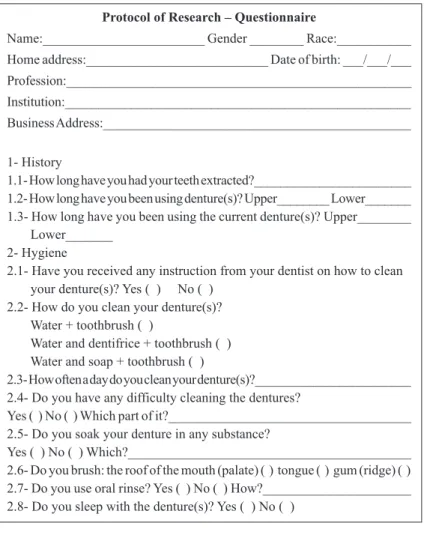
One hundred and six patients of both genders from Ribeirão Preto Dental School, University of São Paulo, Brazil, were invited to participate in this survey. The patients were asked to fill out a questionnaire (Fig. 1) addressing denture wearing and denture cleansing habits.
RESULTS AND DISCUSSION
Nineteen patients were males (age range 45-80 years) but the majority (n=87; 82.08%) were females (age range = 37 to 92 years). The mean age of patients
was 63.35 years. Among the male patients, 12 wore upper and lower complete dentures and 7 wore upper complete denture only. Among females, 72 wore upper and lower complete dentures, and 15 wore upper complete denture only.
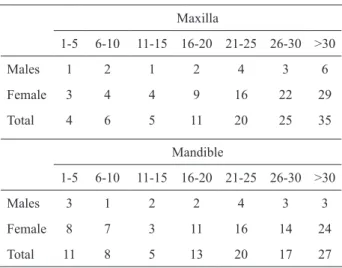
Data referring to patient distribution according to time of edentulousness, time of denture use, age of current denture, previous information on denture cleansing, denture cleansing method used, frequency of cleaning of dentures, cleaned regions of the oral cavity, alleged difficulty on cleaning of dentures, use of some type of oral rinse, and continuous use of complete dentures, are presented in Tables 1-10.
DISCUSSION
Several factors that may be related to the occurrence of denture stomatitis were approached by the questionnaire: denture age, denture hygiene habits, and frequency of denture use and cleaning.
The results showed that 62.26% of the respondents had been using the same upper complete denture for over 5 years; 49.06% had been using the same lower complete denture for over 5 years; and 24.53% and 16.04% had been using the same upper and lower dentures, respectively, for more than 20 years (Table 3). Coelho et al. (8) also found that most patients wore their dentures for 20 years.
Previous studies (2,9) have reported that the majority of denture wearers do not know how to clean their dentures because they have never received instructions from their dentist. In this study, most patients (51.89%) reported never having been advised by their dentists as to how to clean their dentures (Table 4). Similar results were obtained by Dikbas et al. (2), Hoad-Reddick et al. (5) and Marchini et al. (7), who found that 82.9%, 86.3% and 77.5%, respectively, of the respondents did not receive proper denture cleaning instructions from their dentists.
In this study, all patients (100%) used brushing (mechanical method) for denture cleansing. Similar results were obtained in previous studies that found that 97% (4), 86% (10), 80.1% (8), 79.7% Figure 1. Questionnaire.
Protocol of Research – Questionnaire
Name:________________________ Gender ________ Race:___________
Home address:___________________________ Date of birth: ___/___/___
Profession:____________________________________________________
Institution:____________________________________________________
Business Address:______________________________________________
1- History
1.1- How long have you had your teeth extracted?________________________ 1.2- How long have you been using denture(s)? Upper________ Lower_______ 1.3- How long have you been using the current denture(s)? Upper________ Lower_______
2- Hygiene
2.1- Have you received any instruction from your dentist on how to clean your denture(s)? Yes ( ) No ( )
2.2- How do you clean your denture(s)? Water + toothbrush ( )
Water and dentifrice + toothbrush ( ) Water and soap + toothbrush ( )
2.3- How often a day do you clean your denture(s)?________________________ 2.4- Do you have any difficulty cleaning the dentures?
Yes ( ) No ( ) Which part of it?____________________________________ 2.5- Do you soak your denture in any substance?
(7), 57.1% (6) and 40.59% (2) of patients brushed their dentures as the cleaning method of choice. In the study by Veres et al. (11), most patients used dentifrice or tap water (70% and 63%, respectively) to clean their dentures.
Brushing with dentifrice was used by 84.91% of patients in the present study (Table 5), which is in agreement with the findings of a previous study (12). Dentifrice has the advantage of being simple to use and relatively inexpensive. However, if used with an improper brushing technique, dentifrice can damage the prosthesis material (2), due to the potential abrasive wear of the denture material (9).
Only 58.49% of the patients in present study reported the use of chemical solutions for cleaning by immersion. Among the substances used for immersion, of the dentures water was the most frequent (38.71%) followed by sodium hypochlorite (33.87%) (Table 5). In the study by Baran and Nalçaci (13), 42.9% of patients immersed their dentures in water and only 1.6% immersed then in a chemical (hypochlorite) solution. The use of chemical solutions for denture immersion is less frequently than manual brushing methods of cleaning (7).
Hoad-Reddick et al. (5) found that a combination of methods (brushing and soaking) was used more frequently. Veres et al. (11) found that the majority of patients (59%) brushed and immersed their dentures, whereas 36% only brushed their dentures, and only 5% used immersion as the only method of cleaning.
Chemical methods have the advantage of being simple to use (14-16). However, chemical methods have disadvantages such as high cost and metal corrosion as well as the bleaching of acrylic resin resulting in damage to the denture base (9,14).
Table 1. Distribution of patients according to the time of edentulousness (in years) for each gender.
Maxilla
1-5 6-10 11-15 16-20 21-25 26-30 >30
Males 1 2 1 2 4 3 6
Female 3 4 4 9 16 22 29
Total 4 6 5 11 20 25 35
Mandible
1-5 6-10 11-15 16-20 21-25 26-30 >30
Males 3 1 2 2 4 3 3
Female 8 7 3 11 16 14 24
Total 11 8 5 13 20 17 27
Table 2. Distribution of patients according to time of use (years) of complete dentures, for each gender.
Upper complete denture use
<1 1-5 6-10 11-15 16-20 21-25 26-30 >30
Male 0 2 2 1 1 4 3 6
Female 0 5 5 3 11 15 24 24
Total 0 7 7 4 12 19 27 30
Lower complete denture use
<1 1-5 6-10 11-15 16-20 21-25 26-30 >30
Male 0 2 0 3 1 4 2 2
Female 1 7 6 4 12 15 13 18
Total 1 9 6 7 13 19 15 20
Table 4. Distribution of patients according to instructions provided by the dentist on complete denture cleansing, for each gender.
Gender Received instructions
Did not receive
instructions Total
Male 7 12 19
Female 44 43 87
Total 51 55 106
Table 3. Distribution of patients according to the age (in years) of current complete dentures, for each gender.
Upper complete denture
<1 1-5 6-10 11-15 16-20 21-25 26-30 >30
Male 0 4 6 1 2 2 1 3
Female 6 30 15 8 8 7 7 6
Total 6 34 21 9 10 9 8 9
Lower complete denture
<1 1-5 6-10 11-15 16-20 21-25 26-30 >30
Male 0 3 2 3 1 2 0 1
Female 5 24 13 8 8 8 2 4
In relation to inflammation of the oral mucosa of the edentulous, Abelson (14), showed that one of the main etiological factors is the lack of denture hygiene. With regard to the frequency of denture cleaning, 99.06% of the study population said they clean their dentures at least once a day (Table 6). These results agree with those of Nevalainen et al. (17) and De Castellucci Barbosa et al. (12) (96.0% and 98.0%, respectively). Hoad-Reddick et al. (5) and Dikbas et al. (2) showed that only 79.1% of a sample of 233 patients and 70.0% of a sample of 234 patients, respectively, cleaned their dentures at least once a day.
In the present study, 73.58% of patients cleaned their dentures 3 or more times daily (Table 6). This frequency was higher than that of Dikbas et al. (2), where 25% of individuals, from a sample of 234, reported cleaning their dentures 3 times a day. However, according to Pietrokvoski et al. (18), 96% of patients reported cleaning their dentures 2 or more times per day.
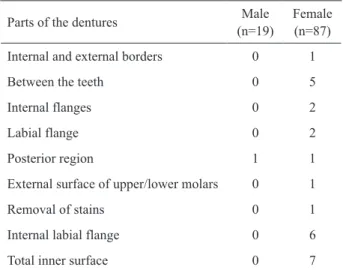
Table 7 shows that the internal labial flange,
inner surface, and the regions between the teeth were the most difficult regions to clean. Paranhos et al. (19) found that the greatest amount of biofilm was present on the internal labial flange.
The dentist should also instruct the patient on how to clean the soft tissues of the oral cavity. Of the
Table 5. Distribution of patients according to the denture cleaning method used, for each gender.
Mechanical brushing Male Female Total
W+ TB 1 3 4
W and D + TB 16 74 90
W and soap + TB 2 7 9
W and D + handbrush 0 1 1
W and D + TB and bicarbonate 0 1 1
Brush + effervescent tablets 0 1 1
Total 19 87 106
Chemical cleaning by immersion Male Female Total
W 2 22 24
W and soap 1 0 1
W + detergent + hypochlorite 0 2 2
Bicarbonate 0 6 6
Detergent 1 1 2
Oral rinse 2 1 3
Sodium hypochlorite 2 19 21
Effervescent Tablets 0 3 3
Total 8 54 62
W = water; D = dentifrice; TB = toothbrush.
Table 7. Distribution of patients according to the difficulty on cleaning of dentures, for each gender.
Parts of the dentures Male
(n=19)
Female (n=87)
Internal and external borders 0 1
Between the teeth 0 5
Internal flanges 0 2
Labial flange 0 2
Posterior region 1 1
External surface of upper/lower molars 0 1
Removal of stains 0 1
Internal labial flange 0 6
Total inner surface 0 7
Table 8. Distribution of patients who cleaned regions of the oral cavity, for each gender.
Gender
Regions of the oral cavity
Palate Tongue Ridge
Male 8 14 9
Female 44 63 50
Total 52 77 59
Table 6. Distribution of patients according to the frequency of cleaning of dentures.
Gender
Denture cleaning
Total Times per day After
eating
Not reported
1 2 3 4 5
Male 2 9 4 3 0 1 0 19
Female 2 14 43 20 2 5 1 87
Nalçaci (13) also showed that 55.2% of patients slept with their dentures. Marcus et al. (20) found that nearly one third of the participants of their study slept with both dentures, and 12% slept with the lower denture only. Veres et al. (11) showed that 49% of the patients wore their dentures continuously.
The use of dentures during the day by the patients might result in the accumulation of biofilm on their surface (5,7). Thus, the continuous use increases the prevalence of denture-induced stomatitis, which has the biofilm as its main etiological factor. According Zissis et al. (3), patients who wore dentures continuously (day and night) had a higher prevalence of denture stomatitis. Similar result was reported by Jeganathan et al. (4), who found that denture-induced stomatitis was more common in patients with continued use of the dentures (61%) when compared to controls with healthy mucosa (18%).
T h i s s u r v e y revealed the hygiene habits of 106 patients. Within the limitations of this study, it may be concluded that the interviewed patients had limited knowledge of denture cleansing and oral hygiene. Brushing was the method of choice for cleaning, most patients had been using the same complete dentures for more than 5 years, and were used to sleep with the dentures.
RESUMO
Foi realizada uma pesquisa na Faculdade de Odontologia de Ribeirão Preto - Universidade de São Paulo, por meio da aplicação de questionário, para avaliar os métodos de higiene e hábitos referentes ao uso de prótese total, idade das próteses, e se os pacientes têm sido instruídos em como limpar suas próteses. A idade média dos pacientes estudados foi 63,35 anos, a maioria (82,08%) do sexo feminino. Os resultados mostraram que 62,26% dos entrevistados usavam a mesma prótese total superior há Table 10. Distribution of patients according to the continuous
use of complete dentures.
Gender
Sleeps with both
CDs
Does not sleep with both CDs
Sleeps with the upper CD
Sometimes sleeps with
the CD
Male 7 5 7 0
Female 33 38 15 1
Total 40 43 22 1
CD = complete denture.
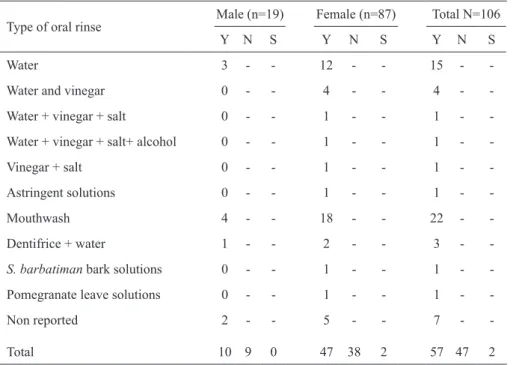
patients interviewed, 72.64% reported to clean the oral tissues daily; the most frequently brushed region was the tongue (Table 8). In the present study, 52 patients (49.06%) reported brushing their palate, 77 (72.64%) reported brushing their tongue and 59 (55.66%) brushed their ridges (Table 8). Of the patients surveyed, 53.77% used some type of oral rinse (Table 9).
Data analysis in this study showed that 58.49% of the patients usually slept with their dentures (Table 10). Similar results were obtained in previous studies in which 41.5% (2) and 64% (12) of patients, respectively, did not remove their dentures at bedtime. Baran and
Table 9. Distribution of patients who used oral rinse.
Type of oral rinse
Male (n=19) Female (n=87) Total N=106
Y N S Y N S Y N S
Water 3 - - 12 - - 15 -
-Water and vinegar 0 - - 4 - - 4 -
-Water + vinegar + salt 0 - - 1 - - 1 -
-Water + vinegar + salt+ alcohol 0 - - 1 - - 1 -
-Vinegar + salt 0 - - 1 - - 1 -
-Astringent solutions 0 - - 1 - - 1 -
-Mouthwash 4 - - 18 - - 22 -
-Dentifrice + water 1 - - 2 - - 3 -
-S. barbatiman bark solutions 0 - - 1 - - 1 -
-Pomegranate leave solutions 0 - - 1 - - 1 -
-Non reported 2 - - 5 - - 7 -
-Total 10 9 0 47 38 2 57 47 2
mais de 5 anos, e 49,06% a mesma prótese total inferior. Dos pacientes entrevistados, 58,49% dormiam com as próteses. O método mais utilizado pelos pacientes foi o método mecânico de escovação (100% dos pacientes), utilizando água, pasta e escova de dente (84,91%). A maioria dos pacientes (51,89%) relatou nunca ter sido orientado pelos dentistas de como higienizar as próteses. Baseado nas limitações deste estudo, concluiu-se que os pacientes entrevistados tinham conhecimento limitado sobre higiene protética e cuidados bucais. O método de higiene mais utilizado foi a escovação da prótese, a maioria dos pacientes usavam a mesma prótese total há mais de cinco anos e dormiam com as próteses.
REFERENCES
1. Guggenheimer J, Moore PA, Rossie K, Myers D, Mongelluzzo MB, Block HM, et al.. Insulin-dependent diabetes mellitus and oral soft tissue pathologies: II. Prevalence and characteristics of Candida and Candidal lesions. Oral Surg Oral Med Oral Pathol Oral Radiol Endod 2000;89:570-576.
2. Dikbas I, Koksal T, Calikkocaoglu S. Investigation of the cleanliness of dentures in a university hospital. Int J Prosthodont 2006;19:294-298.
3. Zissis A, Yannikakis S, Harrison A. Comparison of denture stomatitis prevalence in 2 population groups. Int J Prosthodont 2006;19:621-625.
4. Jeganathan S, Payne JA, Thean HPY. Denture stomatitis in an elderly edentulous Asian population. J Oral Rehabil 1997;24:468-472.
5. Hoad-Reddick G, Grant AA, Griffiths CS. Investigation into the cleanliness of dentures in an elderly population. J Prosthet Dent 1990;64:48-52.
6. Kulak-Ozkan Y, Kazazoglu E, Arikan A. Oral hygiene habits, denture cleanliness, presence of yeasts and stomatitis in elderly people. J Oral Rehabil 2002;29:300-304.
7. Marchini L, Tamashiro E, Nascimento DFF, Cunha VPP. Self- reported denture hygiene of a sample of edentulous attendees at a University dental clinic and the relationship to the condition of the oral tissues. Gerodontology 2004;21:226-228.
8. Coelho CM, Sousa YT, Daré AM. Denture-related oral mucosal lesions in a Brazilian school of dentistry. J Oral Rehabil 2004;31:135-139.
9. Jagger DC, Harrison A. Denture cleansing - the best approach. Br Dent J 1995;178:413-417.
10. Polyzois GL. Denture cleansing habits. A survey. Aust Dent J 1983;28:171-173.
11. Veres EM, Wolfaardt JF, Hnizdo E. Denture cleansers: Part III - A survey of materials and methods employed by denture wearers. J Dent Assoc S Afr 1985;40:591-594.
12. De Castellucci Barbosa L, Ferreira MR, De Carvalho Calabrich CF, Viana AC, De Lemos MC, Lauria RA. Edentulous patients’ knowledge of dental hygiene and care of prostheses. Gerodontology 2008;25:99-106.
13. Baran I, Nalçaci R. Self-reported denture hygiene habits and oral tissue conditions of complete denture wearers. Arch Gerontol Geriatr 2009; 49:237-241.
14. Abelson DC. Denture plaque and denture cleansers: review of the literature. Gerodontics 1985;1:202-206.
15. McNeme SJ, Von Gonten AS, Woolsey GD. Effects of laboratory disinfecting agents on color stability of denture acrylic resins. J Prosthet Dent 1991;66:132-136.
16. Ünlü A, Altay OT, Sahmali S. The role of denture cleansers on the whitening of acrylic resins. Int J Prosthodont 1996;9:266-270. 17. Nevalainen MJ, Närhi TO, Ainamo A. Oral mucosal lesions and
oral hygiene habits in the home living elderly. J Oral Rehabil 1997;24:332-337.
18. Pietrokovski J, Azuelos J, Tau S, Mostavoy R. Oral findings in elderly nursing home residents in selected countries. Oral hygiene conditions and plaque accumulation on denture surfaces. J Prosthet Dent 1995;73:136-141.
19. Paranhos HF, Silva-Lovato CH, Souza RF, Cruz PC, Freitas KM, Peracini A. Effects of mechanical and chemical methods on denture biofilm accumulation. J Oral Rehabil 2007;34:606-612. 20. Marcus PA, Joshi A, Jones JA, Morgano SM. Complete edentulism
and denture use for elders in New England. J Prosthet Dent 1996;76:260-266.